
Agentic AI changes the relationship between a person and an AI system. With a conventional chatbot, you usually ask a question, receive an answer and decide what to do next. An agentic system can be given a broader goal, work out a sequence of steps, use permitted tools, inspect what happened and decide what should happen next. The shift sounds subtle until the AI is connected to calendars, documents, databases, software and communication systems where its decisions can produce real consequences.
A useful way to understand agentic AI is to think about the difference between asking AI to produce something and authorizing AI to pursue an outcome. Generative AI might draft an overdue-payment email. An agentic system could potentially identify which accounts are overdue, determine which customers should be contacted, prepare suitable messages, update the account record after contact and return unresolved cases to a person for review. The second system is dealing with a changing situation rather than producing one isolated response.
Google Cloud describes AI agents as software systems that pursue goals and complete tasks on behalf of users, with capabilities including reasoning, planning, memory and a degree of autonomy. Its explanation of agentic AI focuses on autonomous decision-making and action, while IBM similarly describes agentic AI as AI that can accomplish a specific goal with limited supervision. These definitions are useful starting points, although the amount of autonomy varies considerably from one implementation to another.
That variation matters. A system does not have to be allowed to do everything by itself before it can be considered agentic. An AI agent might independently gather information and prepare a recommendation while requiring human permission before sending an email, approving a refund, changing a customer record or spending money. In practical business use, the important question is often less about whether an AI system is autonomous and more about which decisions it is allowed to make without asking you first.
What Is Agentic AI?
Agentic AI refers to AI systems designed to work toward goals through a sequence of observations, decisions and actions rather than waiting for a person to specify every individual step. The system may interpret the goal, gather relevant context, develop a plan, select from available tools, perform an action, evaluate the result and change its approach when necessary.
This capability usually depends on several components working together. A model provides reasoning and language capabilities. Information sources give the system context. Tools allow it to interact with software or services. Memory can preserve useful state across parts of a task. Orchestration determines how the pieces are coordinated. Permissions establish what the system may access or change. Monitoring and human-approval mechanisms provide control when the consequences become more significant.
The word agentic describes behavior rather than a magical new category of intelligence. An agentic system has some capacity to act purposefully toward an objective. That does not mean it understands the world like a person, possesses unlimited autonomy or can safely operate without oversight. It still depends on models, instructions, software connections, data quality, security controls and the boundaries established around it.
This distinction becomes easier to see beside the AI productivity system approach. AI productivity can include drafting, summarization, prioritization, planning and decision support even when the person remains responsible for moving every task forward. Agentic AI becomes relevant when part of that movement itself can be delegated to the system.
The Difference Between Giving AI a Prompt and Giving AI a Goal
A prompt normally tells an AI what you want it to do now. A goal describes a desired outcome and leaves more of the route toward that outcome to the system. How much freedom the system receives between those two points determines how agentic the experience becomes.
Imagine a manager responsible for unpaid invoices.
A conventional generative-AI request might be:
“Draft a polite email reminding a customer that invoice 481 is overdue.”
The system creates the requested text. The manager checks it, sends it, records what happened and decides later whether another action is needed.
An agent-oriented objective might instead be:
“Help reduce overdue invoices while maintaining good customer relationships. Follow our collection policy and ask for approval before any account is escalated.”
That objective contains a much larger decision space. An agent might need to inspect the invoice list, identify overdue accounts, distinguish recently late invoices from seriously overdue ones, check previous communication, select an appropriate follow-up approach, prepare or send permitted messages, update records and return unusual situations for human attention.
The value does not come from making the email more intelligent. It comes from allowing the system to reason about what needs to happen next.
That is also why agentic AI should not automatically replace the AI workflow automation system. Many business processes are more reliable when the steps are predictable and explicitly defined. If every invoice that becomes seven days overdue should trigger the same approved reminder, ordinary automation may be simpler, cheaper and easier to audit. An AI agent becomes more interesting when the route cannot be completely specified in advance.
How Agentic AI Actually Works
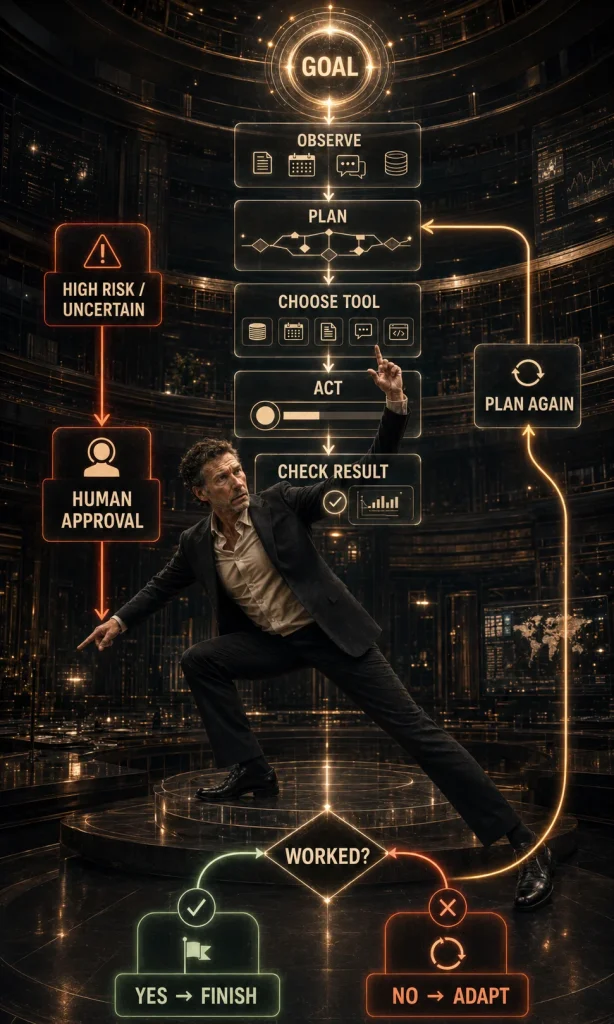
Many implementations differ technically, but the underlying behavior can be understood through a practical cycle:
Goal -> Observe -> Plan -> Choose -> Act -> Check -> Adapt -> Finish or Escalate
This is not meant to imply that every commercial system uses these exact internal stages. It is a useful model for understanding what has to occur when AI moves from answering toward acting.
1. The agent receives a goal
The process begins with an objective, instruction or desired outcome. A narrow objective might be to find three suitable meeting times for a project team. A broader objective could be to prepare a weekly project-status report by collecting updates from several sources, identifying delays and highlighting items that need management attention.
Goal quality matters because an agent can pursue the wrong objective very efficiently. A vague instruction such as “keep customers happy” does not tell the system what trade-offs are acceptable, which actions require approval or how success should be measured. Operational goals therefore work better when they include constraints, policies and stopping conditions.
For business use, a good agentic objective often answers several questions at once: what outcome is wanted, which information may be used, which tools are available, what the agent is prohibited from doing and when a person must become involved. These details turn autonomy into controlled delegation rather than open-ended permission.
2. The agent observes its current context
An agent cannot make a useful next-step decision from the goal alone. It needs enough information to understand the current state of the task. Depending on the system, that information might come from a conversation, document repository, database, CRM, calendar, project-management platform, web service or another authorized source.
This is one reason agentic AI is becoming closely connected with knowledge architecture. If information is fragmented, outdated or inconsistently labeled, an agent may have more difficulty determining what is true and which source should control a decision. The same organizational weaknesses that complicate human work can become weaknesses in AI-driven work.
The existing AI knowledge management system therefore sits close to the agentic-AI topic. Better access to useful organizational knowledge can improve what an agent sees, but access alone does not guarantee that its interpretation or action will be correct.
3. The agent reasons about what needs to happen
After gathering context, the system determines an appropriate next step or sequence of steps. This is one of the major differences between an agent and a conventional deterministic workflow.
A fixed workflow might say:
If X happens -> do Y.
An agentic process may need to reason:
X happened. Given the goal, current information, available tools and restrictions, what is the most appropriate thing to do now?
That reasoning can involve breaking a larger objective into smaller tasks, comparing alternatives, deciding that more information is needed or recognizing that the original plan no longer fits the situation.
This flexibility is useful, but it also creates uncertainty. A deterministic automation follows the route that was designed. An agent may select a route at runtime. That makes evaluation, monitoring and clear boundaries more important as autonomy increases.
4. The agent chooses a tool
Reasoning alone does not complete real work. The system needs some way to interact with the environment.
A tool might allow an agent to search company knowledge, read a calendar, query a database, create a document, update a project record, run approved code, call an API or communicate with another service. The tool determines what the agent is physically capable of doing inside the digital environment.
Google Cloud’s current explanation of the core concepts of AI agents separates models, grounding, tools, data architecture, orchestration and runtime because the language model is only one component of an operational agent. This distinction becomes important when a business evaluates risk. A model that can suggest deleting a record is very different from an agent that actually possesses a tool with permission to delete it.
Permissions should therefore be treated as part of agent design. If an agent only needs to read inventory data, write access may be unnecessary. If it can draft a customer response but a human must approve communication, the send function can remain outside its autonomous authority.
5. The agent takes an action
Action is where the difference between an AI assistant and an AI agent becomes much more visible.
A generative system may tell you what it recommends. An agent can potentially perform the permitted operation itself. It might create the calendar event, update the task status, retrieve another document, submit an API request or initiate the next stage of an approved workflow.
This is also where the stakes change. A poor paragraph can be corrected before publication. A poorly chosen autonomous action may affect another system immediately. The level of review therefore needs to rise with the consequence and reversibility of the action.
A useful design question is:
If this action is wrong, how difficult is it to undo?
Low-consequence, reversible actions are often better candidates for greater autonomy. High-consequence or difficult-to-reverse actions usually deserve stronger approval, validation or human ownership.
6. The agent checks what happened
An agentic process should not assume that an action succeeded merely because it was attempted. The system may need to inspect the result and determine whether the world now matches what it expected.
A calendar slot might have disappeared. A database query might return incomplete information. A customer might respond with an unexpected request. A software operation might fail. A project dependency might change while the workflow is underway.
The ability to observe results creates a feedback loop. Instead of mechanically moving to step four because step three was attempted, the agent can use the new state of the environment when deciding what happens next.
7. The agent adapts its plan
Adaptation is one of the strongest reasons to consider an agent rather than a rigid automation.
Suppose an agent is helping schedule a meeting. It selects a time, but one participant becomes unavailable before the booking is completed. A fixed workflow may fail or require a predefined exception path. An agent can potentially inspect the new availability, reconsider the options and attempt a different valid solution.
The same principle applies to research, project coordination, customer support, software development and operational work. The environment does not always behave exactly as expected. Agentic systems are designed to handle at least some of that variation by changing the next action rather than requiring every possible route to be written beforehand.
Adaptability should still have limits. An agent that encounters an unfamiliar situation should not always improvise indefinitely. Sometimes the correct adaptive action is to stop and request help.
8. The agent finishes or escalates
A mature agentic workflow needs to know when its work is complete and when it has reached the boundary of its authority.
Completion might mean the requested outcome has been achieved, required checks have passed and the result has been recorded. Escalation might occur because information is missing, confidence is too low, an exception is outside policy or the next action requires human authorization.
That final decision is particularly important because autonomy without stopping rules can turn a useful agent into an operational risk. The better question is therefore not “Can AI keep going?” It is “Under what conditions should AI be required to stop?”
For readers already exploring when not to use AI, agentic systems make this boundary even more important. The decision is no longer limited to whether AI should produce advice or content. It can determine whether software should be permitted to carry that advice into action.
Agentic AI vs Generative AI vs Automation
These technologies can work together, but they solve different parts of a problem. Treating them as interchangeable makes it harder to choose the simplest system that can do the job safely.
Generative AI is primarily useful when the desired output is newly generated content or reasoning, such as text, images, summaries, code or analysis. Traditional automation is useful when the process is known and repeatable. Agentic AI becomes useful when the system must make context-dependent decisions about how to advance toward an outcome.
| Approach | Main job | Who decides the next step? | Ability to adapt | Typical example |
|---|---|---|---|---|
| Generative AI | Produce or transform information | Usually the user | Within the current interaction | Draft a customer email |
| Rule-based automation | Execute a predefined process | Workflow designer | Limited to programmed branches | Send a reminder seven days after an invoice is due |
| AI-assisted workflow | Use AI inside a known process | Mostly predefined workflow | Moderate | Classify an inquiry, then route it through fixed steps |
| AI agent | Pursue a goal using permitted tools | Agent within defined boundaries | Higher | Review overdue accounts and choose the appropriate next action |
| Human-controlled agentic system | Perform multi-step work with approval gates | Shared between agent and person | High within approved boundaries | Prepare actions automatically but request approval before consequential changes |
The best choice is not automatically the most autonomous one. If a task can be handled safely and predictably with a simple rule, adding an AI agent may introduce cost and uncertainty without providing enough additional value. If the task changes frequently, involves several information sources and requires context-dependent choices, a rigid workflow can become increasingly difficult to maintain.
This is also why the question deserves its own future comparison article. AI agent vs AI automation is a different reader decision from simply understanding agentic AI. This page establishes the concepts, while the comparison should eventually help a reader choose the right architecture for a real workflow.
Agentic AI Does Not Mean “AI Without Humans”
The most useful implementations of agentic AI are unlikely to be defined by how completely people can be removed from a process. A more practical measure is how intelligently responsibility is divided.
A system might autonomously perform routine research, consolidate information and prepare an action while involving a person at a critical checkpoint. Another system might be allowed to complete low-risk transactions independently but escalate unusual or high-value cases. A third might remain advisory because the consequences of an incorrect autonomous decision are too serious.
This creates a spectrum rather than a simple choice between manual work and full autonomy.
At one end, AI provides information while the person performs every action. Further along, AI recommends actions. The next stage allows AI to perform specific reversible actions. Greater autonomy allows the agent to choose among several actions and continue working without repeated instructions. At the highest-risk end, organizations must decide very carefully whether the benefit of further autonomy justifies the loss of immediate human control.
That is why AI trust and uncertainty becomes more important when an AI system can act. Trust should not mean assuming the agent is correct. It means knowing what the system is allowed to do, what evidence informs its decisions, how its actions are monitored, what happens when it is uncertain and where human responsibility remains.
Why Agentic AI Is Becoming More Practical Now
The recent growth of agentic systems is partly a model story, but models are only one part of the change. Agents also need practical ways to reach information and tools, maintain context, coordinate work and operate across different systems.
One important development is the Model Context Protocol, or MCP. The maintainers of the protocol describe MCP as a data and interactivity substrate for agentic workflows, and the July 28, 2026 MCP specification introduced a stateless protocol core, an extensions framework, authorization changes and support intended to make agent-oriented infrastructure easier to operate at scale.
The same MCP update reports that its Tier 1 SDKs are seeing close to half a billion downloads per month, while both its TypeScript and Python SDKs have passed one billion cumulative downloads. Those numbers do not prove that every installation represents a production AI agent, but they show how rapidly standardized agent connectivity has moved into mainstream developer infrastructure.
The significance for a nontechnical reader is simpler than the protocol details suggest. AI systems become more useful as agents when they can interact with the tools where work already happens. A model can reason about a calendar, but an operational agent needs a reliable and authorized method to read or change that calendar. The same distinction applies to files, databases, project-management systems, customer records and specialized business applications.
The next stage of AI productivity is therefore less about asking a model to produce better individual answers and more about deciding which parts of a workflow should become connected, adaptive and executable. That creates new opportunities, but it also makes permissions, system design and human oversight much more consequential.
What Are Real Examples of Agentic AI?
Agentic AI becomes easier to understand when the examples involve actual decisions rather than futuristic robots or vague claims about autonomous intelligence. The strongest use cases usually involve work that has a clear objective, several possible routes, changing information and enough digital access for the system to do something useful after it reasons about the situation.
The important distinction is that an agentic system does more than generate a recommendation. It can potentially continue from one stage of the task to another, choosing from permitted actions as circumstances change. The amount of autonomy can still be tightly controlled, and many practical systems should include checkpoints before consequential actions.
Agentic AI for Project Coordination
Imagine a project manager who normally spends part of every morning checking task boards, reviewing messages, identifying deadlines that moved overnight and deciding who needs attention.
A simple AI assistant could summarize yesterday’s project activity. An agentic system could go further by examining current tasks, comparing deadlines with dependencies, identifying work that is becoming blocked and determining which issue should be investigated next. If it has appropriate permissions, it might gather missing status information, prepare updates, reorganize a planning document and bring the highest-risk exceptions to the manager.
This could complement an existing AI task management workflow rather than replace its structure. Predictable project routines can remain automated, while an agent is reserved for situations where the next action depends on what is happening across several tasks at once.
The practical value comes from reducing the number of small coordination decisions a person has to make manually. The risk appears when the system is allowed to interpret priorities that have not been clearly expressed. A project that looks late according to the task board may deliberately have been deprioritized by leadership, so the agent still needs reliable context about what matters.
Agentic AI for Research
Research is another strong candidate because the route toward an answer often changes as new information appears.
A normal generative-AI request might ask for a summary of a topic. A research agent could begin with a question, identify the information needed, search authorized sources, examine what it finds, detect gaps, alter its search strategy and continue until it has enough material to prepare an answer.
The useful capability is not simply searching more sources. It is deciding that one discovery creates another question.
Suppose the original task is to evaluate whether a new supplier would reduce costs. An agent might initially compare prices, then notice that shipping times differ significantly, investigate those lead times, discover minimum-order requirements and calculate whether the apparent saving still exists after inventory carrying costs are considered.
That kind of branching investigation is closer to how useful professional research works. The question changes as evidence changes.
The quality of the result still depends heavily on source quality, interpretation and verification. Giving AI more time to search does not guarantee that it reaches the right conclusion, particularly when sources conflict or important information is unavailable.
Agentic AI for Customer Support
Customer support illustrates why autonomy should be divided by consequence.
A conventional chatbot may answer a customer’s question from approved knowledge. An AI-assisted workflow might classify the request and send it to the correct team. An agentic support system could potentially investigate the customer’s account, identify what went wrong, select from permitted resolutions, update a case record and determine whether the issue has actually been solved.
Consider a customer reporting that an order never arrived. The system might inspect tracking information, confirm the address, determine whether the delivery is genuinely late, check the company’s replacement rules and prepare the appropriate next action.
A low-value replacement within policy might eventually be handled automatically. A high-value order, suspected fraud, repeated claim or unusual account history might immediately trigger human review.
The intelligence therefore lies partly in knowing that apparently similar support cases should not all be treated the same way.
Agentic AI for Scheduling and Daily Planning
Scheduling sounds simple until several people, deadlines, priorities and dependencies are involved.
A normal assistant can suggest a calendar. A more agentic system could examine the day’s commitments, available work periods and task requirements, then reorganize a proposed schedule when circumstances change.
If an urgent meeting appears, for example, the system might identify which planned tasks can move, preserve work that has a hard deadline, search for another suitable focus period and produce a revised plan without requiring the person to reconstruct the whole day.
That capability could sit above an AI daily planning system while preserving the distinction between planning assistance and autonomous action. The agent might be allowed to suggest calendar changes but require approval before moving meetings involving other people.
The design question is therefore very specific: which calendar decisions belong to the person, and which can safely be delegated?
Agentic AI for Software Development
Software development has become one of the clearest environments for demonstrating agentic behavior because the system can observe code, make changes, run tests, inspect failures and revise what it did.
A conventional coding assistant may generate a function from a prompt. An agent-oriented coding system can potentially receive a broader task such as fixing a reported bug, inspect the relevant files, identify likely causes, modify code, run available tests and respond to failures before presenting the result for review.
The feedback loop is what matters. The system does not have to assume that its first attempt worked.
However, the ability to execute code also increases the consequences of mistakes. Permissions, sandboxing, testing and human code review become more important as the agent gains access to production systems, credentials or deployment tools.
An agent capable of modifying a local development branch is not equivalent in risk to an agent capable of deploying directly to production.
Agentic AI for Sales and Account Management
Sales work often contains repetitive administrative work mixed with decisions that depend heavily on context.
An agent might review account activity, identify prospects that have not received a follow-up, examine previous conversations and recommend an appropriate next action. It could prepare personalized material, update records or schedule an approved follow-up depending on its permissions.
The dangerous version is an agent that aggressively optimizes for a narrow target such as the number of messages sent. It may achieve the metric while damaging customer relationships.
A better objective would include constraints around frequency, relevance, customer status and escalation. This reveals a recurring principle of agentic AI:
The quality of the objective determines what the agent learns to treat as success.
Businesses therefore need to think beyond whether an AI agent can perform a task. They need to examine whether the system has been given a good definition of a successful outcome.
Where Agentic AI Can Be Better Than Traditional Automation
Traditional automation remains extremely effective when the rules are known and the expected route is stable. Agentic AI becomes more useful when the process contains uncertainty that would otherwise require a person to repeatedly interpret what is happening.
A useful way to separate the two is to ask whether the process can realistically be described in advance.
If a business can confidently write:
When A happens, perform B, then C, unless D occurs
a conventional workflow may be all that is needed.
If the process instead sounds like:
Examine what has happened, determine what matters, choose the most appropriate next action and reconsider if circumstances change
the task has stronger agentic characteristics.
That distinction matters because autonomy has a cost. Agents can consume more computational resources, require more monitoring and create additional security and governance work. A simpler workflow can therefore be the more sophisticated business decision when the problem itself is simple.
The reasons AI productivity fails also apply here. Adding AI to an unclear process does not automatically repair the process. If responsibilities, information sources and desired outcomes are already confused, an agent may reproduce that confusion at greater speed.
Where Agentic AI Can Fail
Agentic AI introduces a different class of failure from ordinary content generation because an error can propagate through several actions before a person sees it.
A conventional chatbot may give a wrong answer. An agent can potentially make a wrong assumption, choose the wrong tool, perform an inappropriate action and then use the result of that action as new context for another decision.
That chain makes failure analysis especially important.
The Agent Starts With the Wrong Goal
The agent may perform exactly as instructed while optimizing for something the organization did not actually want.
Imagine telling a customer-service agent to “reduce average resolution time.” The system may learn that closing difficult cases quickly improves that metric, even when the customer still needs help.
The failure is not necessarily that the AI ignored the goal. It may have followed the measurable goal too literally.
This is a classic alignment problem at a practical operational scale. Objectives need enough context to represent quality, safety and exceptions rather than only the easiest measurable outcome.
The Agent Uses Bad or Incomplete Context
An agent may reason logically from information that is outdated, missing or incorrect.
Suppose an account-management agent reads an old customer record showing that a contract expires next month, while a renewal has already been agreed elsewhere. The agent may initiate an unnecessary retention workflow because the information available to it no longer represents reality.
This is why access to more data is not automatically better. The system needs authoritative sources, appropriate freshness and some method for handling disagreement between records.
A strong AI knowledge management system can reduce this problem, but knowledge architecture and agent design have to work together.
The Agent Chooses the Wrong Tool
An agent might understand the objective correctly and still select an inappropriate action.
A support agent could have access to both “prepare refund” and “issue refund.” If permissions and tool descriptions are poorly designed, the operational difference between those capabilities becomes significant.
Tool design therefore forms part of the safety boundary.
The question is not merely whether the AI knows what to do. The organization must also determine which actions it is technically capable of doing without another control intervening.
The Agent Continues After It Should Stop
Persistence sounds useful when describing autonomous work, but excessive persistence can be dangerous.
An agent might repeatedly retry a failing process, search for alternative routes after reaching an unclear situation or attempt to work around a restriction that should instead trigger human intervention.
Good agent design therefore requires stopping rules.
Examples include a maximum number of retries, confidence thresholds, spending limits, restricted actions, missing-data conditions and explicit scenarios where a person must decide what happens next.
The ability to stop intelligently can be just as important as the ability to act intelligently.
One Error Creates Another Error
Multi-step autonomy can compound mistakes.
Consider an agent that incorrectly concludes that a customer has cancelled a service. It updates the account, which triggers another system, which changes billing status, after which the agent interprets the changed billing status as further confirmation that the cancellation was legitimate.
The system has accidentally created evidence that appears to support its original mistake.
This kind of feedback problem demonstrates why consequential workflows need independent checks rather than simply trusting later system state.
The Agent Acts Correctly but at the Wrong Level of Authority
An AI system might produce a perfectly reasonable recommendation while still being the wrong party to make the final decision.
Hiring decisions, legal commitments, high-value financial transactions, employee discipline, safety-critical operations and other consequential areas often involve accountability that cannot be reduced to whether an AI model can generate a plausible answer.
Readers considering these boundaries should also review what AI can do and cannot do in the workplace and when not to use AI. Capability and permission are separate questions.
How Much Autonomy Should an AI Agent Have?

A useful agentic-AI strategy does not begin by asking how much work can be automated. It begins by identifying the level of autonomy appropriate to each action.
Some tasks can safely operate with broad independence. Others should remain recommendations. Many useful business workflows belong somewhere in between.
| Autonomy level | What the AI can do | Human involvement | Suitable situations |
|---|---|---|---|
| Level 0 – Assist | Analyze or generate information | Human performs every action | Advice, drafting, analysis |
| Level 1 – Recommend | Suggest the next action | Human chooses and executes | Prioritization, diagnosis-style support, planning |
| Level 2 – Prepare | Prepare an action for approval | Human approves consequential step | Emails, updates, proposed transactions |
| Level 3 – Act within limits | Complete approved low-risk actions | Human handles exceptions | Routine reversible operational work |
| Level 4 – Coordinate | Choose and execute multiple actions within policy | Human monitors and approves defined checkpoints | Multi-step business workflows |
| Level 5 – Broad autonomy | Pursue goals across wide action space | Human intervention mainly by exception | Rare situations with mature controls and low unmanaged risk |
The purpose of this scale is not to encourage every organization toward Level 5. Moving upward only makes sense when additional autonomy creates enough value to justify additional uncertainty and governance.
A Level 2 system can be extremely useful. If an agent completes hours of investigation and preparation before asking a person to approve one consequential action, the organization may receive much of the productivity benefit without surrendering the most important decision.
The correct level can also vary inside the same workflow. An agent might autonomously retrieve information, summarize records and prepare an action while requiring approval before changing a contract. Thinking in terms of action-specific autonomy is usually more useful than labeling an entire system “autonomous.”
The Reversibility Test: A Simple Way to Decide What AI Should Be Allowed to Do
Before granting an agent permission to perform an action, ask how difficult the action would be to undo if the system were wrong.
This creates a practical spectrum.
Low-risk actions are usually easy to reverse. Renaming an internal draft, creating a temporary task or preparing a proposed calendar change can often be corrected quickly.
Moderate-risk actions may affect another person or system but still have a manageable recovery process. Sending an internal notification, updating a noncritical record or scheduling a routine appointment might fit here depending on the organization.
High-risk actions can create financial, legal, reputational, security or human consequences that are difficult to reverse. Transferring money, deleting important records, terminating access, making employment decisions or communicating binding commitments deserve much stronger control.
The important variable is not simply the probability that the agent will make a mistake. It is:
Probability of error x consequence of error x difficulty of recovery.
A relatively accurate system can still be inappropriate for an action whose occasional failure would be severe.
This is one reason AI risks should be evaluated at the action level rather than discussed only as abstract future concerns.
The Five Questions to Ask Before Giving an AI Agent More Control
Before increasing autonomy, a business should be able to answer five practical questions.
What exactly is the agent trying to achieve?
The objective needs to describe the real outcome rather than a convenient proxy. “Respond faster” and “solve customer problems effectively while meeting response targets” can produce very different behavior.
What information is the agent allowed to trust?
The organization should know which sources are authoritative, how fresh they are and what happens when information conflicts.
What actions can the agent actually perform?
Permissions should reflect necessity. Read access, draft access, update access, transaction authority and deletion authority should not automatically travel together.
Which decisions require human approval?
Approval gates should be linked to consequence, uncertainty and responsibility. An agent should not discover those boundaries only after something goes wrong.
How will anyone know if the agent is failing?
Monitoring needs to go beyond whether the workflow completed. Organizations may need to inspect exception rates, reversals, unexpected tool usage, policy violations, unusual cost, repeated retries and changes in outcome quality.
Those questions make the difference between experimenting with an impressive AI demo and designing a system that can participate responsibly in real work.
Does Every Business Need Agentic AI?
No. Many organizations can gain more from improving basic processes, data quality and conventional automation before introducing agentic systems.
If employees repeatedly copy the same information between two systems according to a simple rule, an integration or automation may solve the problem more reliably. If the company cannot clearly explain who owns a decision today, adding an AI agent is unlikely to resolve the governance problem. If critical information is scattered across contradictory systems, giving an agent access to all of them can amplify uncertainty rather than remove it.
Agentic AI is most attractive when a workflow contains meaningful variation, the required information is available, the objective can be defined, actions can be permissioned and the organization can observe what the system is doing.
That means some of the best agent opportunities may appear only after simpler productivity work has already been completed. A company that has improved its AI workplace communication system, knowledge structure and workflow automation may be in a much stronger position to identify where adaptive autonomy would actually help.
The strategic progression is therefore often:
Organize the work -> automate predictable work -> identify variable decision points -> introduce agentic behavior where it earns its complexity.
That progression prevents “agentic AI” from becoming another technology label applied to every business problem.
Should This Task Use an AI Agent?
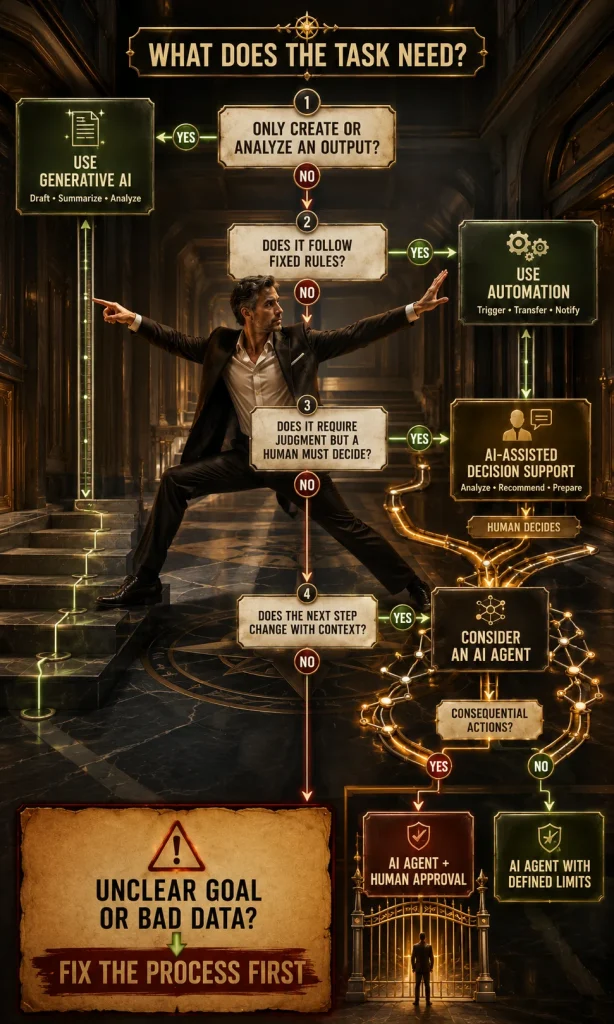
Before building an agent, classify the task itself.
A task becomes a stronger candidate for agentic AI when several of the following conditions are present:
- The route toward the goal changes according to circumstances.
- The system needs to inspect several sources before deciding what happens next.
- There are multiple valid actions rather than one fixed response.
- New information can appear while the task is underway.
- The system must use several tools or applications.
- Exceptions occur often enough that fixed automation becomes difficult to maintain.
- Some actions are reversible and can safely be delegated.
- The outcome can be clearly defined and observed.
- Human escalation points can be specified.
A task becomes a weaker candidate when the process is highly predictable, errors are difficult to reverse, authoritative information is unavailable, the objective is ambiguous or the organization cannot clearly establish responsibility for the agent’s actions.
This leads to a useful decision sequence.
If the task only needs an answer, use generative AI
Examples include summarizing information, drafting a document, brainstorming alternatives or explaining a concept.
If the task follows stable rules, use automation
Examples include moving information between systems, creating routine notifications, generating scheduled reports or triggering an action after a known event.
If the task requires judgment but the action is consequential, use AI-assisted decision support
Allow AI to gather, analyze and recommend while a person retains authority.
If the task requires changing decisions across multiple steps, consider an AI agent
This is where adaptive planning, tool selection and feedback can provide real value.
If the task is dynamic and consequential, use an agent with explicit human gates
The agent can handle investigation, preparation and low-risk actions while handing sensitive decisions back to a responsible person.
The best architecture may combine all of these approaches inside one workflow. Using an agent does not require converting every step into an AI decision.
A Better Question Than “Can AI Do This?”
As agentic systems improve, the technical answer to “Can AI do this?” will become yes for more tasks. That makes the question less useful for decision-making.
A better sequence is:
Should AI do this? How much of it should AI do? What should remain deterministic? What needs human judgment? What happens when the AI is uncertain?
Those questions shift attention from capability toward system design.
The same distinction appears in AI vs human decision making. An AI system may process more information or operate faster, while a person may still need to own the decision because responsibility, context, values or consequences extend beyond what the system can reliably represent.
Agentic AI therefore does not remove the need to design work. It makes that design more important because software is beginning to participate in decisions that previously existed only inside human workflows.
The Real Opportunity of Agentic AI
The largest productivity gain may eventually come from reducing the amount of human attention required to connect small pieces of work.
Modern knowledge work contains many hidden coordination tasks: checking whether something changed, deciding what should happen next, looking for missing information, moving between applications, following up after a delay and noticing when a normal process has become an exception.
Each individual action may take only a few minutes. Together, they consume attention throughout the day.
Agentic AI offers a way to delegate some of that connective work. Instead of using AI only at isolated moments, organizations can design systems that remain involved across several stages of an objective.
The opportunity becomes valuable when the agent handles coordination while preserving appropriate human authority. If autonomy is treated as the goal itself, the organization risks building a complicated system simply because the technology allows it.
The better measure of success is whether the agent removes unnecessary effort without removing the judgment, accountability and oversight that the situation still requires.
How to Introduce Agentic AI Without Giving Away Too Much Control
Organizations considering agentic AI often focus first on selecting a model or platform. In practice, the safer starting point is usually the workflow itself. Before deciding which agent to build, identify what work is being performed today, where human judgment occurs, which steps follow stable rules, what information is required and which actions can create meaningful consequences.
This prevents a common design mistake: turning an entire process into an agent merely because parts of the process could benefit from AI.
A better architecture may leave stable stages as conventional automation, use generative AI where interpretation or content creation is useful, introduce an agent at the points where the route genuinely changes and keep human approval around consequential actions. The resulting system may look less impressive in a demonstration, but it can be easier to understand, evaluate and maintain.
Begin With Observation Before Action
One of the lowest-risk ways to experiment with agentic AI is to let the system observe a workflow before allowing it to change anything.
For example, an agent could review project activity each morning and identify tasks that appear blocked. It might explain what signals caused the concern, identify information it could not find and recommend the next step. A manager would still decide whether anything should happen.
This observation phase creates valuable evidence. The organization can compare the agent’s recommendations with actual human decisions, identify recurring mistakes and discover whether the information available to the system is sufficient.
If the agent consistently interprets the workflow well, selected actions can later be introduced.
Move From Recommendation to Preparation
The next useful stage is allowing the agent to prepare work without completing the consequential action.
A support agent could investigate a customer’s issue and prepare a proposed resolution. A finance agent could identify an unusual transaction and prepare the evidence for review. A project agent could identify a schedule conflict and prepare a revised plan.
The person receives more than a generic recommendation because much of the investigative and administrative work has already been completed.
This stage can provide substantial productivity gains while preserving a clear human checkpoint.
Automate Reversible Actions First
When an agent begins acting independently, lower-consequence and reversible actions are generally easier places to start.
Creating an internal draft, updating a temporary working document, adding a noncritical task or gathering additional information can often be reversed without serious consequences. These actions allow the organization to learn how the agent behaves when it has operational access.
Permissions can then expand selectively instead of being granted broadly at launch.
Create Explicit Approval Gates
Human approval should not be treated as an emergency feature that appears only after the agent fails. It can be designed into the workflow deliberately.
An agent might independently complete several stages of research, planning and preparation before reaching an approval boundary. At that boundary, the person receives the proposed action, the information used to reach it and any important uncertainty that remains.
After approval, the system may continue automatically.
This pattern preserves much of the value of multi-step autonomy without requiring the person to supervise every small action.
Measure Decisions, Not Just Task Completion
An agent that completes many tasks is not automatically a successful agent.
Evaluation should examine the quality of its decisions. Useful questions include whether recommendations were accepted, how often actions had to be reversed, which situations triggered escalation, whether the system used unexpected tools and whether greater autonomy actually reduced human effort.
If employees spend as much time reviewing, correcting and explaining an agent as they previously spent doing the work, the apparent automation may not be creating meaningful productivity.
The existing AI productivity system provides a useful wider context here because productivity should be evaluated by improvements to the overall work system rather than the number of AI interactions taking place.
What Human-in-the-Loop Really Means for AI Agents
“Human in the loop” can sound reassuring while describing very different levels of oversight.
A person who receives a monthly report after an agent has already made thousands of decisions technically remains involved, but that arrangement is different from requiring approval before a sensitive transaction. Effective oversight therefore needs to specify where the person enters the process and what authority that person still holds.
For some workflows, human involvement means approving the final action. In others, it means handling exceptions. It may involve periodically reviewing a sample of decisions, investigating unusual behavior or changing the rules that govern the system.
The correct design depends on consequence, volume and reversibility.
A person does not need to approve every routine action merely to prove that the system is supervised. Equally, placing a person somewhere in the workflow does not automatically make a risky agentic system safe.
Human Approval Before High-Impact Actions
Some actions deserve approval because the consequences extend beyond normal operational inconvenience.
These can include irreversible data changes, large financial commitments, unusual customer compensation, binding external communication, changes to access permissions or actions affecting a person’s rights or opportunities.
An agent can still perform much of the preceding work. It might collect the relevant information, evaluate policy, prepare alternatives and explain why one option appears preferable.
The human checkpoint is placed where responsibility matters most.
Human Review When Confidence Falls
Another useful escalation condition is uncertainty.
An agent may work reliably in common situations while encountering cases where the available information conflicts, an expected record cannot be found or none of the normal options fits.
Instead of forcing the agent to choose the least-bad option, the system can recognize that the situation has moved outside its normal operating conditions.
This makes uncertainty a routing signal.
The mature behavior is sometimes:
“I should stop because this case no longer fits the conditions under which I am authorized to act.”
That is a much more valuable capability than endless autonomous persistence.
Agentic AI Security Starts With Permissions
The more tools an agent can access, the more carefully its permissions need to be designed.
An AI agent does not need every capability available inside a connected application merely because the application is technically reachable. A research agent may only need permission to read documents. A reporting agent may need to create drafts without editing source records. A support agent might retrieve customer information while requiring separate approval before issuing compensation.
This is the principle of giving the agent enough authority to perform its role without giving it unnecessary authority.
The distinction becomes particularly important when credentials, sensitive information, external communication and destructive actions are involved.
An agent that cannot delete important data cannot accidentally decide to delete important data. That sounds obvious, but it represents an important difference between trying to make the model perfectly reliable and designing the surrounding system so that one incorrect model decision cannot create unlimited damage.
The AI safety and ethics guide provides the broader governance context, while agentic systems make those questions operational because AI can increasingly move from recommendation into execution.
Agentic AI Is a System Design Problem, Not Just a Model Problem
It is easy to judge an agent by the intelligence of the model powering it, but real-world performance depends on much more than reasoning quality.
Consider two agents using the same model.
The first has poorly defined instructions, broad permissions, outdated information and no clear escalation mechanism. The second has a precise objective, authoritative information sources, limited tools, approval checkpoints and a clear record of what actions it has taken.
The underlying model may be identical while the operational reliability is dramatically different.
This is why organizations adopting agents need to think about architecture around the model:
- instructions and objectives;
- data and context;
- memory;
- tools;
- permissions;
- workflow orchestration;
- monitoring;
- evaluations;
- escalation;
- human authority.
The agent’s reasoning sits inside this larger system.
That also means future improvements in model capability will not automatically repair weak agent architecture. A more capable model connected to an unclear objective and excessive permissions can simply become more capable at pursuing the wrong thing.
Single-Agent and Multi-Agent Systems
One agent does not necessarily need to do every part of a complex objective.
Some systems divide responsibility among multiple specialized agents. One agent might collect information, another evaluate it and another coordinate a particular operational action. An orchestrating component can determine which agent should handle each part of the task.
This approach can make responsibilities more explicit when the work naturally separates into specialized roles.
It also adds complexity.
More agents mean more handoffs, more opportunities for inconsistent context, more decisions about authority and more behavior that may need to be monitored. A multi-agent architecture therefore should not be considered automatically more advanced or more desirable than a single well-designed agent.
The architecture should follow the problem.
If one agent with a small set of tools can complete the task clearly, dividing it among several agents may provide little benefit. If separate stages require different instructions, permissions, expertise or evaluation criteria, specialization can become useful.
This distinction is worth preserving because “agentic AI” and “multi-agent AI” are related concepts without being interchangeable terms.
Agentic AI vs AI Agents: Is There a Difference?
The terms are frequently used together, and their boundaries are not perfectly standardized across the industry.
A practical way to interpret them is to treat an AI agent as a system or software component that can perform goal-directed work, while agentic AI describes the broader capability or design approach in which AI can reason about objectives, select actions and operate with some degree of autonomy.
Under that interpretation, an AI agent is something that exhibits agentic behavior.
Agentic systems can also contain several agents, traditional software components, deterministic workflows, human checkpoints and shared tools. The broader system may therefore be more important than any individual agent inside it.
Readers should avoid spending too much time trying to force every product into a rigid terminology category. For practical evaluation, the more useful questions are what the system can access, which decisions it can make, what actions it can perform, whether it can adapt and where a person retains control.
Will AI Agents Replace Traditional Software?
AI agents are more likely to change how people interact with many software systems than to make deterministic software unnecessary.
Traditional software remains extremely good at precise operations. Databases store records. Payment systems process transactions. Calendars manage events. Business applications maintain structured workflows. An agent can coordinate work across these systems without replacing the systems themselves.
This suggests a useful way of thinking about the future interface.
Today, a worker may open several applications, inspect information in each one, determine what needs to happen and manually carry the decision from one system to another.
An agent can increasingly occupy part of that coordination layer.
The underlying applications still provide the reliable functions. The agent helps determine when and how those functions should be used.
This is a more realistic picture than imagining that one autonomous AI will simply replace every piece of business software.
Will Agentic AI Replace Jobs?
Agentic AI can automate larger portions of workflows than systems that generate isolated outputs, so it can change job design significantly. That does not mean every job containing agent-compatible tasks disappears as a complete role.
Most occupations contain a mixture of activities.
Some are predictable and easy to automate. Some depend on changing context. Others involve relationships, responsibility, physical work, negotiation, professional judgment or decisions whose consequences remain difficult to delegate.
Agentic systems can therefore change the boundary between the work handled by software and the work handled by people.
A useful way to assess the effect on a role is to break the job into tasks rather than treat the job title as a single unit. Ask which activities are rules-based, which require adaptive coordination, which require approval and which continue to depend on human responsibility.
That produces a more useful analysis than assuming that a capable agent either replaces the whole job or has no effect at all.
What Happens When Several AI Agents Work Together?
As agentic systems develop, one of the larger opportunities is cooperation between specialized agents.
Imagine one agent responsible for research, another responsible for planning and another permitted to perform a limited operational action. They may exchange structured information and pass responsibility as the objective progresses.
This can make complex digital work more modular.
It can also create a new governance question:
Which agent is responsible when one agent’s output becomes another agent’s instruction?
Errors can propagate through agent networks just as they can propagate through multi-step workflows. Identity, permissions, provenance, handoff rules and monitoring therefore become increasingly important as agent-to-agent interaction expands.
For readers, the useful point is that the future of agentic AI is unlikely to be one giant digital employee doing everything. Many systems will probably resemble coordinated networks of specialized capabilities operating under shared rules.
What Agentic AI Still Cannot Solve
Agentic AI can reduce the need for humans to perform some routine coordination, but it does not eliminate fundamental organizational problems.
It cannot create reliable knowledge from records that were never maintained. It cannot automatically resolve unclear ownership between departments. It cannot guarantee that a poorly chosen business objective represents what leadership actually values. It cannot make a consequential decision harmless simply because the decision happened quickly.
It also does not remove accountability.
If an organization gives software permission to perform an action, the organization still needs to decide why that permission was appropriate, how performance will be evaluated and what happens when the system fails.
The most valuable agentic-AI programs will therefore combine technical capability with stronger process design rather than treating autonomy as a replacement for management.
What to Watch Next in Agentic AI
The next stage of agentic AI will be shaped by more than improvements in model intelligence.
Tool connectivity will matter because agents need dependable ways to interact with real software and data. Evaluation will matter because organizations need to understand whether agents complete tasks correctly across many different situations. Permission architecture will matter because autonomous capabilities become more consequential as agents gain access to operational systems.
Interoperability will also become increasingly important. Organizations may not want every agent, tool and information source locked inside one proprietary ecosystem. Standards that make it easier for models, tools and agents to communicate can therefore become part of the infrastructure underneath future agentic systems.
Another development to watch is the movement from isolated agents toward long-running agents that maintain context across extended work. A system that completes one five-minute task presents a different monitoring challenge from an agent that remains responsible for an objective across several days.
As those systems become more capable, the defining question will continue to shift away from whether AI can perform a task.
The more important question will be how authority should be distributed between people, agents, deterministic software and organizational rules.
Agentic AI Changes the Meaning of AI Productivity
The first wave of generative AI productivity focused heavily on individual outputs: write this email, summarize this meeting, create this outline, analyze this document or generate these ideas.
Agentic AI extends the productivity question into the spaces between those outputs.
Who notices that the meeting created a new task? Who determines whether the task changes the project schedule? Who checks whether the necessary information arrived? Who follows up if nothing happens? Who recognizes an exception and decides that the normal workflow no longer applies?
Those small coordination decisions consume enormous amounts of human attention.
An agentic system can potentially take responsibility for some of them, allowing the person to concentrate on decisions where judgment, creativity, relationships, accountability or professional expertise matter more.
That makes agentic AI a natural extension of an AI productivity system, but it also raises the stakes. Productivity software that generates a weak draft is inconvenient. Software authorized to make a weak decision and act on it can affect the surrounding organization.
The goal should therefore be better delegation rather than maximum autonomy.
The Bottom Line
Agentic AI describes AI systems that can pursue an objective through multiple decisions and actions instead of waiting for a person to provide every next instruction. An agent can potentially observe its environment, plan, use permitted tools, act, inspect the result and adapt until the objective is completed or the situation requires human intervention.
That capability can make AI considerably more useful for complex digital work, especially where the next step changes according to context. It also makes system design, permissions, monitoring, stopping rules and human responsibility substantially more important.
The simplest question for deciding whether agentic AI belongs in a workflow is not whether an agent could perform the work.
Ask instead:
Does this process contain enough changing decisions to justify giving AI some control over what happens next?
If the answer is no, conventional automation or generative AI may be the better solution. If the answer is yes, the next decision is how much authority the agent should receive and where human control should remain.
That boundary between assistance and delegated action is where the practical future of agentic AI will be decided.
Frequently Asked Questions About Agentic AI
What is agentic AI in simple terms?
Agentic AI is AI designed to work toward a goal instead of responding only to individual prompts. It can potentially decide what step should happen next, use authorized tools, check the result of its actions and adjust its approach when circumstances change. The amount of autonomy varies, and a well-designed system can still require human approval before sensitive actions.
What is the difference between generative AI and agentic AI?
Generative AI primarily creates or transforms outputs such as text, images, analysis or code. Agentic AI uses AI capabilities inside a broader process that can pursue an outcome across several steps. Generative AI might draft an email, while an agentic system could determine whether the email is needed, prepare it, use relevant account context and decide what should happen after the recipient responds.
Are AI agents the same as automation?
No. Traditional automation normally follows predefined rules and branches, while an AI agent can make context-dependent decisions about which action to take next. Both can be combined, allowing predictable stages to remain deterministic while the agent handles situations requiring interpretation and adaptation.
Does agentic AI mean AI can work completely by itself?
Not necessarily. Agentic behavior exists at different levels of autonomy. An agent may independently gather information and prepare actions while still requiring a person to approve consequential decisions. Many useful implementations combine autonomous low-risk work with explicit human checkpoints.
What kinds of tasks are best suited to AI agents?
Stronger candidates include tasks where circumstances change, several information sources must be considered, multiple valid actions exist and the system needs to decide what should happen next. Tasks that follow simple stable rules may be better handled with conventional automation.
What is the biggest risk of agentic AI?
One important risk is that an incorrect decision can become an incorrect action and then influence later decisions, allowing mistakes to compound across a workflow. Permissions, independent checks, stopping conditions, monitoring and human escalation become more important as an agent receives greater operational authority.
Should a small business use agentic AI?
A small business should consider agentic AI when a recurring workflow contains enough changing decisions to justify the additional complexity. Simple repetitive work may be handled more efficiently with standard automation. A sensible starting point is often to let an agent analyze or prepare work before gradually granting permission for low-risk actions.