
Why AI Feels More Certain Than It Is
When people interact with AI systems, they often report a similar experience:
The system sounds confident.
It answers quickly.
It uses structured language.
It avoids hesitation.
These characteristics create a perception of certainty.
But certainty is not what the system is producing.
It is producing probability-ranked output.
Understanding this gap between perception and mechanism is essential to evaluating AI trust properly.
Confidence Is a Surface Signal
Confidence in AI systems is a byproduct of probability dominance.
When the statistical distribution strongly favors certain token sequences, the output becomes:
- fluent
- assertive
- structurally complete
There is no internal assessment of “I might be wrong.”
The system does not experience doubt.
This creates an asymmetry:
Humans often signal uncertainty when unsure.
AI systems typically do not.
Why humans equate fluency with reliability
Humans use linguistic fluency as a proxy for expertise.
If something is:
- coherent
- structured
- confidently phrased
it is often perceived as authoritative.
AI systems replicate this surface signal effectively because they optimize for coherence.
The signal feels familiar.
That familiarity reduces skepticism.
This gap becomes clearer when examining how AI makes decisions at a probabilistic level.
Certainty Is Not a Language Pattern
Certainty involves alignment between belief and outcome.
AI systems do not possess belief.
They generate outputs that maximize statistical likelihood based on training data.
This means:
- Confidence reflects distribution strength
- Certainty reflects outcome truth
These are not the same.
When distribution familiarity is high, confidence increases.
When distribution familiarity is low, the system may still produce fluent output.
This is where trust begins to detach from accuracy.
Why Trust Forms Faster Than Verification
Trust is efficient.
Verification is costly.
When users interact with AI systems that:
- respond instantly
- provide structured answers
- appear internally consistent
trust forms before verification occurs.
This is not irrational behavior. It is cognitive efficiency.
Humans conserve effort by trusting coherent signals.
AI systems produce coherent signals at scale.
The cognitive shortcut problem
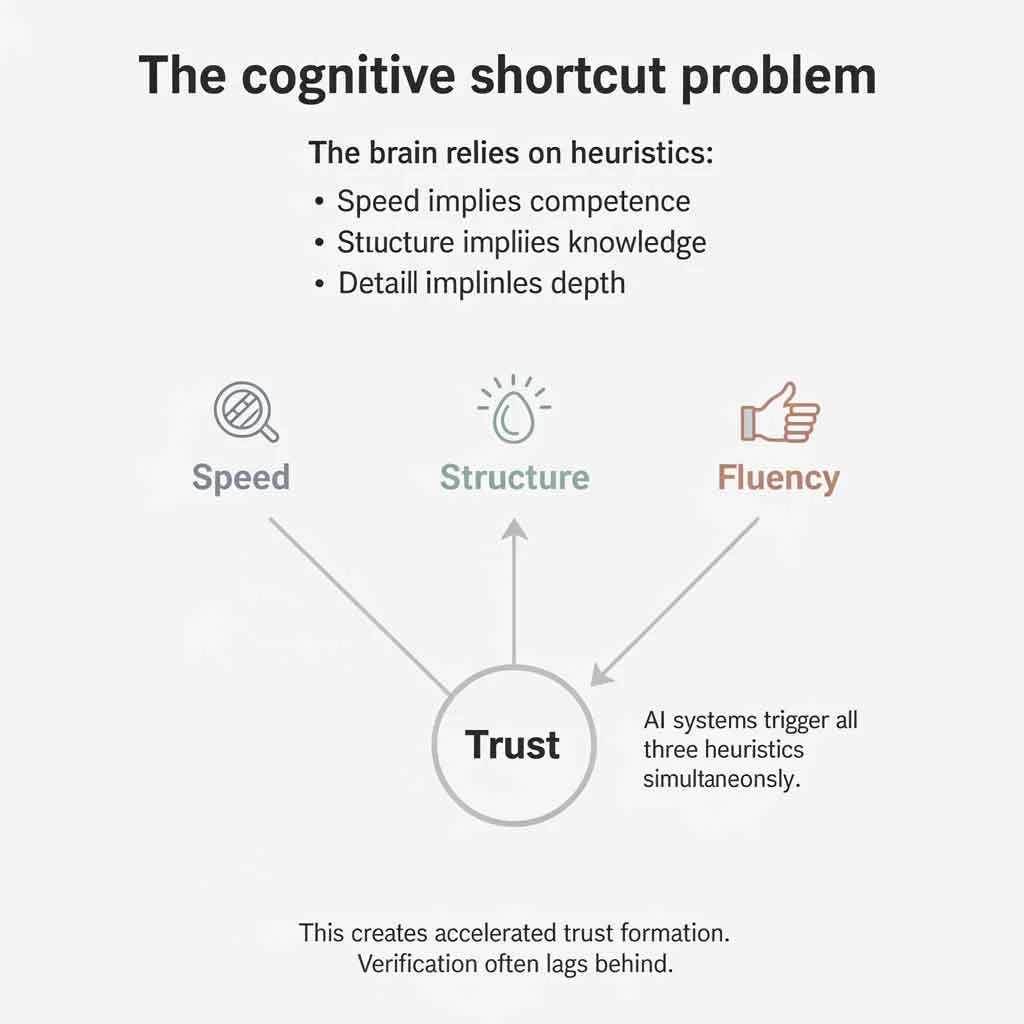
The brain relies on heuristics:
- Speed implies competence
- Structure implies knowledge
- Detail implies depth
AI systems trigger all three heuristics simultaneously.
This creates accelerated trust formation.
Verification often lags behind.
Miscalibration – When Confidence Outruns Accuracy
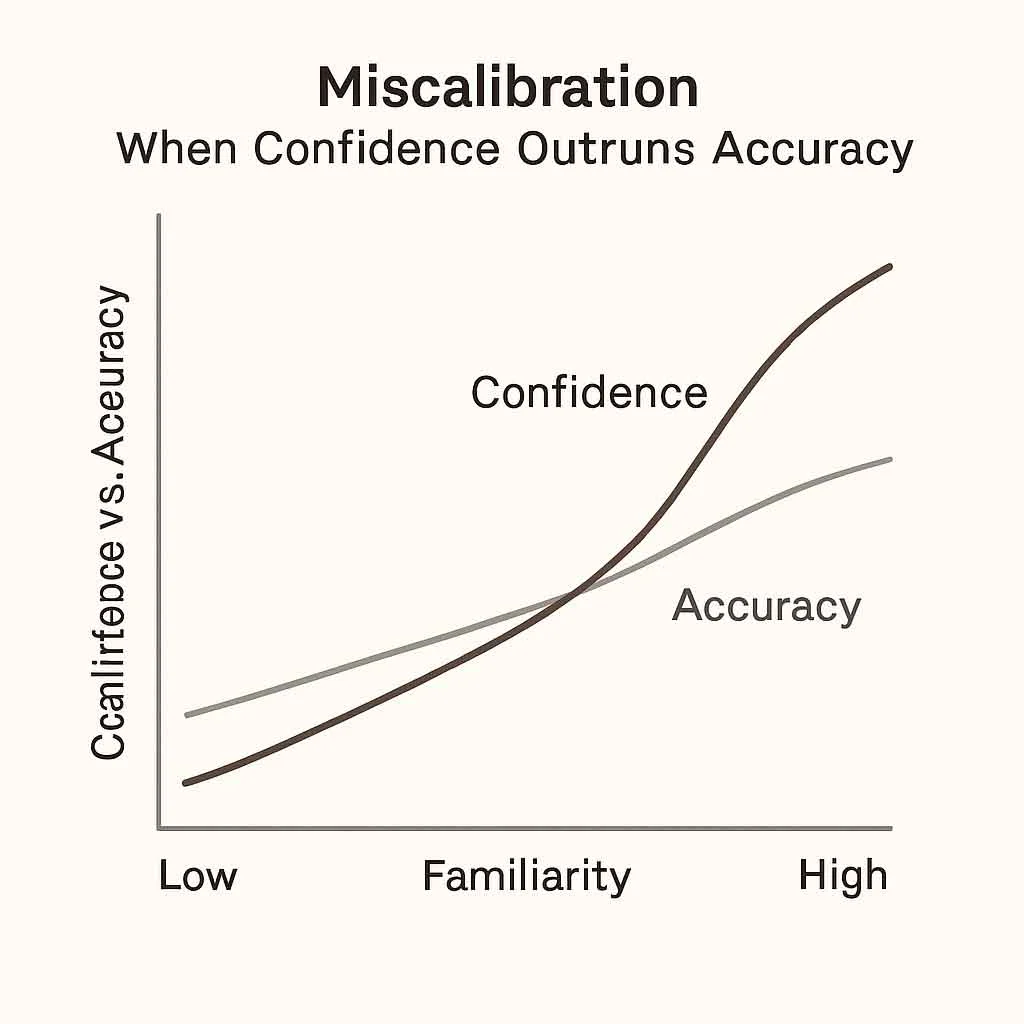
Calibration refers to how closely confidence aligns with correctness.
A well-calibrated system expresses high confidence when accuracy is high and lower confidence when uncertainty rises.
AI systems are not naturally calibrated in this human sense.
They generate outputs based on probability ranking, not on an internal model of correctness.
Why miscalibration emerges
Miscalibration occurs when:
- Distribution familiarity is high but context is incomplete
- The model lacks real-world grounding
- The system cannot detect boundary violations
The output may appear equally confident in both familiar and edge cases.
The confidence signal remains stable even when accuracy probability declines.
This structural property explains many high-profile AI errors.
Human calibration signals
Humans, while imperfect, often express uncertainty through:
- Hesitation
- Conditional language
- Requests for clarification
These signals allow others to adjust trust dynamically.
AI systems must be explicitly engineered to approximate similar signaling.
Without such engineering, the surface confidence remains strong.
Why Overtrust and Overfear Coexist
Public perception of AI often swings between two extremes:
- Overtrust – assuming AI is near-omniscient
- Overfear – assuming AI is uncontrollable
Both reactions stem from misunderstanding mechanism.
Overtrust arises when:
- Fluency is mistaken for reasoning
- Speed is mistaken for mastery
- Consistency is mistaken for correctness
The system’s surface reliability masks underlying probability structure.
Users transfer human-like agency onto a statistical engine.
Overfear dynamics
Overfear emerges when:
- Predictive capability is mistaken for intention
- Automation is mistaken for autonomy
- Optimization is mistaken for strategic awareness
AI does not possess independent goals in the human sense.
It executes objective functions defined by training and deployment constraints.
Recognizing architecture reduces both extremes.
Understanding this dual reaction clarifies why AI vs human decision-making must be evaluated through architecture rather than emotion.
Behavioral Search Signals and Trust
Trust is not only psychological. It is behavioral.
Search systems infer trust through patterns such as:
- Dwell time
- Scroll depth
- Return frequency
- Reduced pogo-sticking
When content acknowledges uncertainty explicitly, users often:
- Stay longer
- Read deeper
- Compare fewer competing pages
Uncertainty, when articulated clearly, reduces friction.
Why certainty claims increase volatility
Pages that present AI as universally reliable often produce:
- Quick consumption
- Fast bounce behavior
- Skeptical comparison browsing
This creates ranking instability.
In contrast, content that defines limits stabilizes engagement.
This is not pessimism. It is alignment with user caution.
Why Uncertainty Signals Expertise
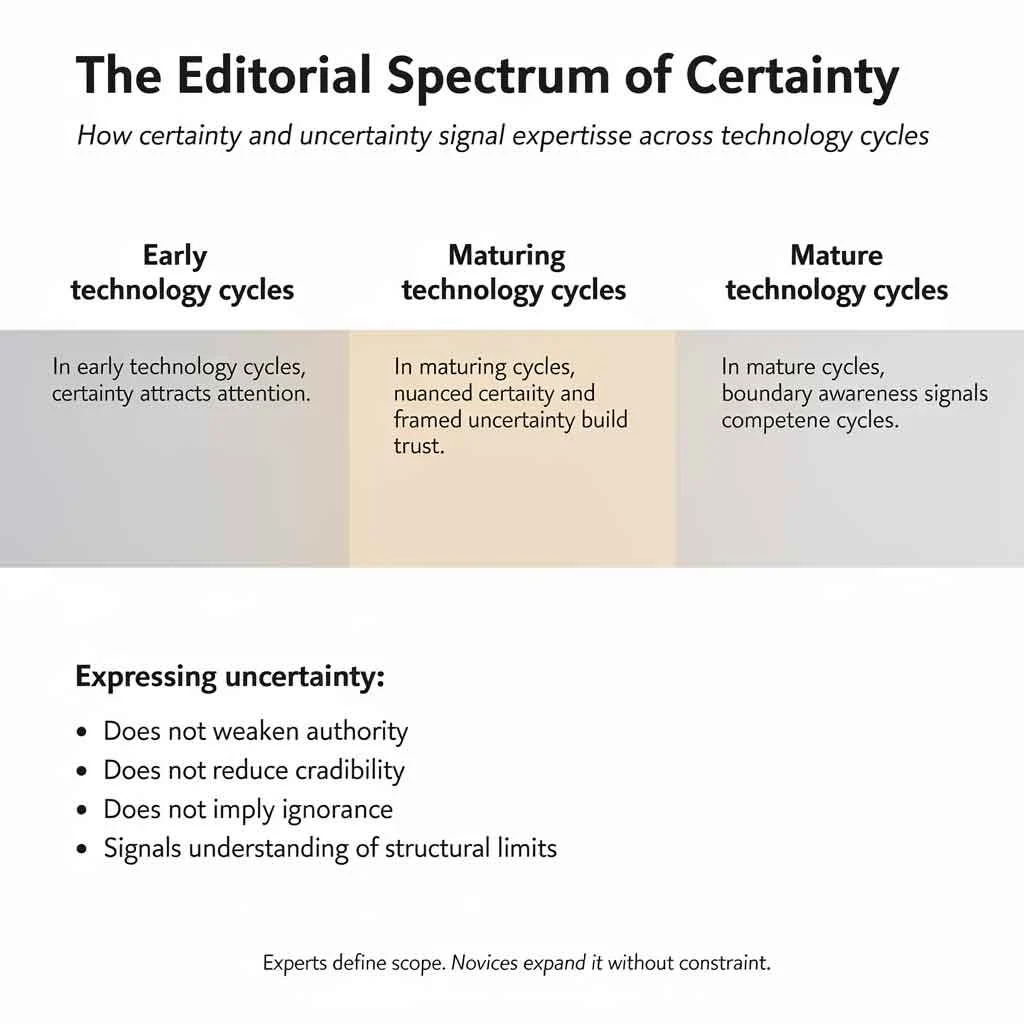
In early technology cycles, certainty attracts attention.
In mature cycles, boundary awareness signals competence.
Expressing uncertainty:
- Does not weaken authority
- Does not reduce credibility
- Does not imply ignorance
It signals understanding of structural limits.
Experts define scope.
Novices expand it without constraint.
The discipline of saying “it depends”
“It depends” is often perceived as weak.
In complex decision environments, it is often accurate.
AI systems do not naturally default to contextual dependency unless explicitly guided.
Human expertise frequently centers on defining conditions under which conclusions change.
This conditional framing strengthens trust rather than eroding it.
Why Confidence Scales Faster Than Certainty
As AI systems improve, confidence tends to increase faster than certainty.
This is structural.
Scaling models improves:
- Pattern coverage
- Fluency stability
- Statistical smoothing
- Output coherence
These improvements make answers sound more complete.
However, scaling does not fundamentally alter:
- Probabilistic architecture
- Distribution dependence
- Optimization trade-offs
- Absence of lived consequence
Certainty depends on alignment between output and reality.
Confidence depends on distribution dominance within the model.
These are related, but not identical.
As coverage expands, fluency improves broadly.
Certainty improves only where distribution familiarity overlaps with real-world context.
This is why confidence appears to accelerate faster than verified correctness.
Long-Term Trust Architecture
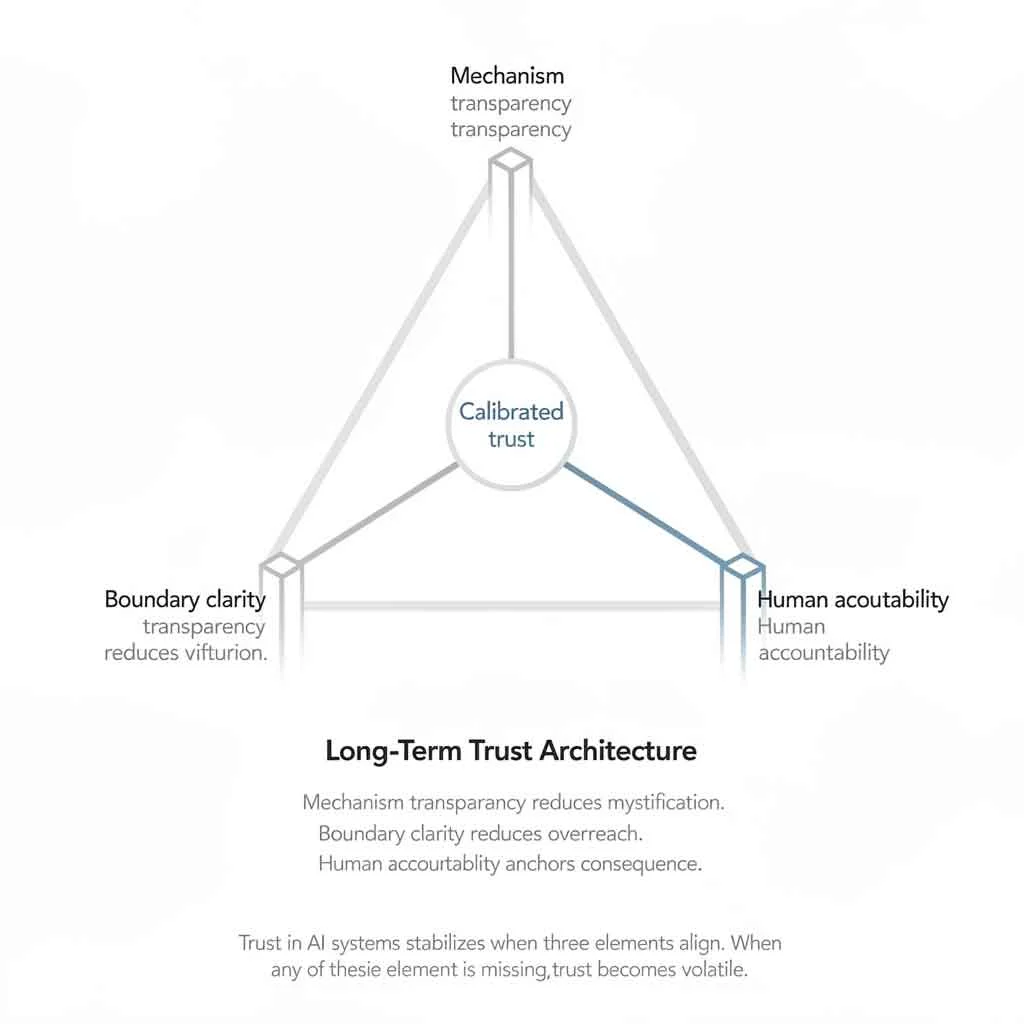
Trust in AI systems stabilizes when three elements align:
- Mechanism transparency
- Boundary clarity
- Human accountability
Mechanism transparency reduces mystification.
Boundary clarity reduces overreach.
Human accountability anchors consequence.
When any of these elements is missing, trust becomes volatile.
Transparency without boundaries
Explaining how AI works without defining where it fails increases surface familiarity without improving calibration.
Users may understand mechanism abstractly while still overextending application.
Boundaries without accountability
Defining limits without assigning responsibility leaves decision authority ambiguous.
AI output may still be treated as default truth.
Accountability ensures calibration is enforced, not merely described.
Hybrid trust systems
Hybrid systems align:
- AI prediction
- Human evaluation
- Explicit responsibility
This structure dampens both overtrust and overfear.
Trust becomes proportional rather than reactive.
The Stability of Calibrated Uncertainty
Calibrated uncertainty is not indecision.
It is proportional trust.
In calibrated systems:
- AI output is treated as probabilistic input
- Humans interpret contextual impact
- Verification scales with consequence
This does not slow every workflow.
It redistributes caution toward high-stakes environments.
Low-risk environments can still benefit from acceleration.
The difference is alignment.
Final Synthesis – Trust Within Constraint
AI systems are designed to produce confident outputs.
They are not designed to experience doubt.
This asymmetry creates the appearance that confidence scales naturally as capability grows.
Certainty does not scale the same way.
Certainty depends on:
- Real-world grounding
- Context stability
- Consequence alignment
These variables exist outside the model.
Understanding this difference reframes trust.
AI trust is not about belief in intelligence.
It is about calibrated deployment within architectural limits.
Confidence can expand rapidly with scaling.
Certainty expands only when application aligns with environment.
Recognizing this gap does not diminish AI.
It positions it accurately.
And accurate positioning is the foundation of stable trust.
Frequently Asked Questions
Why does AI sound so confident even when uncertain?
AI systems optimize for coherent probability ranking rather than expressed doubt. When statistical dominance is strong, output appears fluent and assertive, even if real-world certainty is moderate or context-dependent.
Is AI actually certain about its answers?
AI does not possess certainty in a human sense. It produces probability-weighted outputs based on training distributions. Certainty depends on real-world alignment, not internal model confidence.
What causes overtrust in AI systems?
Overtrust often results from cognitive shortcuts. Humans equate speed, structure, and fluency with expertise. AI systems replicate these surface signals effectively, accelerating trust formation before verification occurs.
Why do some people fear AI while others overestimate it?
Both overtrust and overfear stem from misunderstanding predictive architecture. Overtrust attributes human-like reasoning to AI. Overfear attributes agency or intention where none exists.
Can AI be calibrated to express uncertainty?
AI systems can be engineered to approximate uncertainty signals, but calibration depends on configuration and deployment context. Without explicit design, surface confidence often remains strong.
Does scaling larger models eliminate trust gaps?
Scaling improves pattern coverage and fluency stability, but it does not eliminate distribution dependence or structural limits. Confidence often scales faster than verified certainty.
What is calibrated trust in AI?
Calibrated trust treats AI output as probabilistic input rather than authoritative conclusion. It aligns verification effort with consequence level and maintains human accountability in high-risk contexts.