



The Quiet Shift Most AI Discussions Miss
Most conversations about artificial intelligence focus on what AI can do.
Faster writing.
Broader research.
Cheaper analysis.
Instant output.
This framing feels intuitive, because capability is easy to demonstrate. You can show speed. You can show volume. You can show novelty.
What is much harder to show is judgment.
And yet, across high-stakes environments, the value equation is already changing. The most valuable signal is no longer knowing how to use AI. It is knowing when not to.
This is not a philosophical claim. It is an operational one.
As AI becomes more accessible, more capable, and more embedded into everyday workflows, misuse does not come from ignorance. It comes from overconfidence.
The systems fail not because they are weak, but because they are used in places where they should never have been placed in the first place.
This article is not about fear.
It is not about banning AI.
It is not about moral panic.
It is about fit.
Fit between task and system.
Fit between risk and automation.
Fit between context and output.
Understanding that fit is now one of the most valuable forms of AI literacy.
Why this distinction matters now
Earlier technology waves rewarded early adoption. Speed was the advantage. The faster you implemented, the more leverage you gained.
AI behaves differently.
Because AI systems operate probabilistically, not deterministically, their failure modes are subtle. They often sound correct even when they are wrong. They often feel confident even when uncertainty is high.
This creates a dangerous inversion.
The more fluent a system becomes, the easier it is to trust it beyond its appropriate domain.
In practice, this means that restraint scales in value as capability increases.
The more powerful the tool, the more costly the wrong application becomes.
A pattern emerging across industries
Across writing, research, operations, finance-adjacent analysis, and internal decision workflows, the same pattern appears:
- Low-risk, low-stakes tasks benefit from AI acceleration
- Medium-risk tasks benefit from AI assistance, not authority
- High-risk tasks suffer when AI is placed in the decision role
This pattern is consistent regardless of model brand, prompt sophistication, or tooling layer.
The difference is not the model.
The difference is the task environment.
This article exists to explain that environment in detail.
For readers who want a fast, task-based verdict before diving into the deeper explanation, a free AI decision tool is available here.
Capability Is Not the Same as Appropriateness
One of the most persistent misunderstandings around AI is the assumption that capability implies suitability.
If a system can generate an answer, the reasoning goes, it must be acceptable to use that answer.
This assumption quietly collapses under scrutiny.
AI systems do not understand outcomes. They optimize for likelihood, not consequence. They do not internalize downstream impact. They generate responses based on patterns that historically appeared coherent, not on an understanding of what happens next.
This distinction is invisible in low-risk environments.
If a draft email is slightly off, the cost is negligible.
If a brainstorming list is imperfect, the harm is minimal.
But as consequence increases, this gap becomes critical.
The hidden cost of probabilistic output
Probabilistic systems excel at producing plausible outputs. They do not guarantee correct ones.
This creates a specific type of risk: undetected error.
An incorrect spreadsheet formula often breaks visibly.
An incorrect AI explanation often does not.
It passes initial inspection.
It sounds confident.
It aligns with surface-level expectations.
This is why AI errors in high-risk contexts are often discovered late, not early.
By the time the issue surfaces, the decision has already propagated.
Why human judgment does not scale the same way
Human decision-making is slower. It is inconsistent. It is biased.
But it has one property AI lacks: situational awareness.
Humans implicitly weigh context, consequence, and accountability. Even when imperfectly, they understand when uncertainty should slow action.
AI systems do not self-restrict. They respond when queried.
That means restraint must come from the user, not the system.
This is the central tension of modern AI adoption.
This distinction becomes clearer when comparing AI vs human decision-making in environments where consequence and accountability are non-negotiable.
The misconception of “better prompts fix everything”
As models improve, there is a growing belief that better prompting eliminates misuse.
Prompting improves output quality.
It does not change task suitability.
A well-prompted system can still be inappropriate for the task it is applied to.
The question is not:
- “Can I get a better answer?”
The question is:
- “Should I be asking this system at all?”
Risk Is the Axis Most People Ignore
Most AI discussions categorize tasks by type.
Writing.
Research.
Analysis.
Design.
This is a surface classification. It feels logical, but it misses the more important variable.
The real axis is risk.
Risk determines not only whether AI should be used, but how it should be used, and who should remain responsible for the final outcome.
Low-risk environments
Low-risk tasks share common properties:
- Output is reversible
- Errors are easily detected
- Consequences are limited
In these environments, AI excels.
Drafting content.
Summarizing documents.
Organizing information.
Here, speed matters more than precision. Iteration is cheap. Correction is easy.
AI is not just suitable. It is often optimal.
Medium-risk environments
Medium-risk tasks introduce friction:
- Output influences decisions
- Errors are not immediately visible
- Consequences are contained but real
In these cases, AI performs best as an assistant, not an authority.
It can:
- propose options
- surface patterns
- reduce cognitive load
But it should not finalize outcomes.
The role of the human shifts from creator to evaluator.
High-risk environments
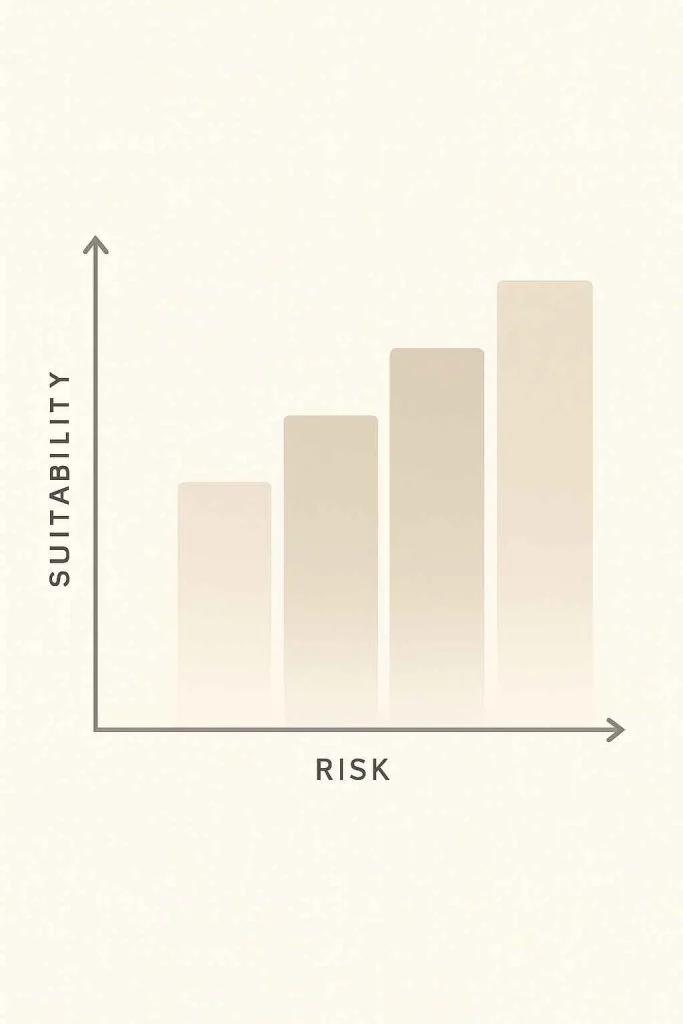
High-risk tasks are defined by three traits:
- Accuracy must be exact
- Context is complex or evolving
- Consequences are asymmetric
This includes legal, financial, medical-adjacent, reputational, and strategic decisions.
In these environments, AI-generated output becomes a liability when treated as a decision-maker.
Not because the system is malicious or incompetent, but because uncertainty is structurally unavoidable.
The cost of being wrong outweighs the benefit of speed.
The more confident an automated system sounds, the more carefully its role should be constrained.
Accuracy Is Not Binary, and That’s the Problem
One of the most dangerous assumptions in AI usage is that accuracy behaves like a switch.
Correct or incorrect.
Right or wrong.
Usable or unusable.
This mental model does not match how AI systems operate.
AI output exists on a spectrum of acceptability, not a binary scale of truth. And this difference is easy to ignore until consequences appear.
Why “mostly right” is often worse than wrong
A clearly wrong answer triggers skepticism.
A mostly right answer triggers trust.
This is the failure mode that matters.
When AI output contains:
- correct structure
- familiar terminology
- confident tone
users tend to accept it without verification, especially under time pressure.
The error is not obvious.
The signal is not noisy.
The problem hides inside plausibility.
This is why AI-related mistakes in real environments are rarely dramatic. They are incremental. They slip through review layers because nothing appears broken.
Acceptability depends on context, not quality
An output can be acceptable in one environment and unacceptable in another, even if the content is identical.
A rough summary may be acceptable for internal brainstorming.
The same summary may be unacceptable in a report that informs strategy.
The difference is not the output.
The difference is what happens next.
This is where many AI discussions fail. They evaluate quality without evaluating downstream use.
Accuracy requirements rise faster than AI reliability
As tasks move closer to decision-making, accuracy requirements escalate sharply.
But AI reliability does not scale at the same rate.
This creates a widening gap:
- marginal gains in model performance
- exponential growth in consequence
The gap is not visible at small scale. It becomes visible only when systems are trusted beyond their natural boundary.
This widening gap is one of the core reasons AI limitations explained cannot be reduced to model benchmarks alone.
Context Is the Variable Models Cannot Fully See
AI systems process inputs.
They do not inhabit environments.
This distinction is subtle, but it explains why context-heavy tasks consistently expose AI weaknesses.
What context actually means
Context is not just background information.
It includes:
- unstated constraints
- social expectations
- timing sensitivity
- reputational asymmetry
- organizational incentives
Humans process these implicitly. AI systems require explicit representation, and even then, interpretation remains probabilistic.
When context shifts mid-process, humans adapt.
AI systems continue optimizing based on the last provided frame.
Why context errors compound silently
Context errors are rarely obvious in isolation.
They compound across steps:
- a small assumption
- followed by a reasonable inference
- followed by a confident conclusion
Each step appears valid. The final outcome feels coherent.
Only later does misalignment surface, often when reversal is costly.
This is why AI is most fragile in environments where:
- rules are implicit
- stakes evolve
- interpretation matters more than calculation
The illusion of “better inputs solve context”

Providing more context improves output quality.
It does not eliminate contextual blind spots.
Some context cannot be encoded:
- political sensitivity
- human relationships
- ethical nuance
- long-term trust impact
These are not data problems. They are judgment problems.
Speed Becomes a Liability When Time Is Not the Constraint
Speed is one of AI’s most celebrated advantages.
But speed only creates value when time is the limiting factor.
In many environments, time is not the constraint. Accuracy, trust, and reversibility are.
When faster output increases risk
Fast output encourages:
- reduced verification
- shortened review cycles
- premature decisions
This is not a tooling problem. It is a behavioral one.
AI accelerates not just production, but confidence. And confidence without proportional validation introduces fragility.
Why slow decisions sometimes outperform fast ones
In high-stakes contexts, decision quality improves when:
- assumptions are questioned
- alternatives are explored
- uncertainty is acknowledged
These behaviors resist automation because they are not efficiency problems. They are judgment calibration problems.
This is why human-in-the-loop systems remain critical whenever speed threatens to outpace verification.
AI optimizes throughput.
Humans calibrate risk.
Replacing one with the other produces imbalance.
Why Long Explanations Outperform Quick Answers
As AI-generated answers become faster and more fluent, something counterintuitive is happening in parallel.
Short answers are losing value.
This does not mean people suddenly prefer long texts. It means quick certainty is no longer trusted in environments where ambiguity is unavoidable.
The collapse of “instant authority”
For a long time, speed implied expertise.
The person who answered first often sounded like the person who knew the most.
AI breaks that signal.
When any system can generate an immediate, confident response, speed no longer differentiates understanding. It only differentiates access.
As a result, authority shifts away from:
- immediacy
- clever phrasing
- surface confidence
and toward:
- explanation depth
- causal reasoning
- acknowledgment of limits
This is why long explanations are resurging in value, even in a world optimized for efficiency.
Explanation vs conclusion
A conclusion tells you what to think.
An explanation shows you why something holds.
AI systems are optimized for conclusions. They compress reasoning into outputs that appear finished.
Humans build trust through explanation, not compression.
When explanations are absent, users borrow trust from the system itself. When explanations are present, users evaluate the reasoning independently.
This distinction matters because borrowed trust collapses quickly. Earned trust compounds.
Understanding how AI makes decisions requires more than an answer – it requires seeing the mechanisms that produce those answers.
Why this favors long-form environments
Long-form content allows space for:
- uncertainty articulation
- trade-off discussion
- mechanism disclosure
- boundary definition
These elements are not decorative. They are trust signals.
In AI-related topics especially, the absence of these signals increases skepticism rather than reducing friction.
This is why shallow AI explainers increasingly underperform despite high initial click-through.
How Search Engines Interpret Uncertainty
Search systems are not neutral observers. They infer trust from behavior.
This matters because AI-related queries often trigger uncertainty-driven searches rather than fact lookups.
Users are not just asking:
- “What is AI good at?”
They are asking:
- “Can I trust this in my situation?”
Uncertainty produces specific behavior patterns
When users encounter oversimplified answers, they tend to:
- scroll quickly
- return to results
- open multiple sources
- hesitate before acting
These behaviors signal unresolved intent.
In contrast, when users encounter explanations that:
- clarify limits
- define scope
- acknowledge uncertainty
they tend to:
- stay longer
- scroll deeper
- click fewer competing results
This behavioral difference is measurable.
Why restraint increases perceived relevance
Pages that aggressively promote AI usage often fail to resolve uncertainty. They increase it.
By contrast, pages that articulate when not to use AI align with the user’s internal risk assessment.
This alignment reduces cognitive friction.
Search systems interpret reduced friction as relevance.
The result is counterintuitive:
Restraint often ranks better than enthusiasm.
This is the core relationship between AI trust and uncertainty in search behavior.
Trust is inferred, not declared
No page becomes authoritative by claiming expertise.
Authority is inferred through:
- depth
- consistency
- behavioral satisfaction
- lack of overreach
This is why articles that clearly define AI limits tend to age better in rankings than those that celebrate capability alone.
Why Restraint Is Becoming a Signal of Expertise
In early technology cycles, optimism signaled insight.
In mature technology cycles, restraint signals understanding.
AI is now firmly entering the latter phase.
Overuse signals shallow understanding
When a system is applied everywhere, it suggests the operator does not fully understand where it fails.
This applies to:
- tools
- frameworks
- methodologies
- AI systems
Experts are defined less by how often they use a tool and more by how precisely they deploy it.
Boundary definition as expertise
Defining boundaries requires:
- understanding failure modes
- recognizing asymmetry in risk
- anticipating second-order effects
These are not beginner behaviors.
They emerge only after repeated exposure to edge cases.
As a result, content that clearly states:
- “AI should not be used here”
- “This is where human judgment must dominate”
signals a deeper model of reality than content that promotes universal application.
The quiet advantage of saying no
Saying no reduces surface appeal.
It increases long-term trust.
This is why experienced operators increasingly position AI as:
- an accelerator
- an assistant
- a lens
but not as a replacement for judgment.
Decision Frameworks Without Advice Language
Most readers do not need instructions.
They need orientation.
Orientation answers questions like:
- “Where am I in the decision landscape?”
- “What type of task is this?”
- “What kind of failure would matter most here?”
This section does not provide prescriptions.
It provides decision lenses.
Lens 1 – Reversibility

Ask one question:
Can this decision be reversed cheaply?
If yes:
- AI usage tends to be safer
- experimentation carries limited downside
If no:
- AI should be constrained to supportive roles
- final authority should remain human
Reversibility matters more than accuracy in early evaluation. It determines how costly learning will be.
Lens 2 – Error detectability
Some errors reveal themselves immediately. Others do not.
AI performs better when:
- mistakes are obvious
- validation is fast
- feedback loops are tight
AI becomes dangerous when:
- errors appear correct
- consequences surface late
- verification is informal
Detectability often matters more than error rate.
Lens 3 – Accountability clarity
In any workflow, ask:
Who owns the outcome if this goes wrong?
If accountability is:
- clear
- personal
- enforceable
AI outputs tend to be scrutinized.
If accountability is:
- diffused
- abstract
- shared
AI outputs tend to be accepted without challenge.
This is not a technology issue. It is an organizational one.
This dynamic is central to decision accountability in AI-enabled workflows.
Where AI Consistently Outperforms Humans
Understanding limits does not require dismissing strengths.
AI consistently outperforms humans in environments defined by:
- volume
- repetition
- pattern density
- low contextual variance
This matters because misuse often comes from ignoring where AI already excels.
High-volume pattern extraction
AI systems excel at detecting:
- correlations
- clusters
- anomalies
- trends across large datasets
Humans struggle with scale. AI does not.
In these environments, AI’s probabilistic nature becomes an advantage rather than a liability.
Drafting and structural generation
When the task is to:
- generate options
- explore structure
- reduce blank-page friction
AI reliably accelerates output.
Here, being “mostly right” is acceptable. Refinement happens downstream.
Consistency over time
AI does not fatigue.
It does not lose focus.
It does not drift in execution.
For tasks where consistency matters more than originality, this stability becomes a strength.
The mistake of overcorrection
Some reactions to AI risk swing too far.
Avoiding AI entirely in domains where it is demonstrably superior introduces inefficiency without increasing safety.
The goal is precision, not abstinence.
Where Humans Remain Irreplaceable

Human judgment persists not because it is perfect, but because it handles dimensions AI cannot fully encode.
Value-based decisions
AI cannot prioritize values.
It can reflect them only when explicitly defined.
When decisions involve:
- ethical trade-offs
- reputational impact
- long-term trust
humans remain essential.
Ambiguity resolution
Humans excel at operating with incomplete information.
They:
- recognize when data is missing
- infer intent
- adjust behavior midstream
AI systems require closure. Humans tolerate ambiguity.
Responsibility acceptance
When outcomes matter, responsibility concentrates.
Humans can accept responsibility.
AI systems cannot.
This is the core reason why human judgment still matters in AI-mediated environments.
This distinction shapes how decisions are reviewed, justified, and defended over time.
Why AI Misuse Repeats Across Organizations
AI misuse is rarely the result of bad intent.
It is the result of structural incentives.
Organizations do not misuse AI because they misunderstand the technology. They misuse it because AI aligns too easily with existing pressure points.
Pressure favors speed over judgment
In most organizations, speed is rewarded visibly.
Deadlines are tracked.
Output volume is measured.
Turnaround time is praised.
Judgment, by contrast, is invisible until failure occurs.
AI naturally amplifies speed, which means it aligns with incentive systems that already favor acceleration. This creates a quiet bias toward overuse.
Diffusion of responsibility accelerates misuse
When responsibility is shared across teams, the cost of error feels abstract.
AI-generated outputs move quickly through:
- drafts
- summaries
- recommendations
Each step adds legitimacy without adding accountability.
By the time a decision is finalized, ownership is blurred.
This is why AI misuse often emerges not at the point of generation, but at the point of acceptance.
Normalization through repetition
Once AI output is accepted a few times without visible failure, trust compounds automatically.
The system becomes normalized.
At that point, questioning AI output feels inefficient, even when stakes increase.
This normalization effect is one of the hardest patterns to reverse.
How Tool-First Pages Support Authority Content
Earlier in this article, the distinction between decision surfaces and explanation surfaces was introduced.
This distinction matters not only for users, but for how systems evaluate trust.
Tools resolve intent before explanation begins
When users arrive at an explanation already oriented, engagement changes.
They are no longer asking:
- “What should I do?”
They are asking:
- “Why does this apply here?”
This shift produces:
- deeper scroll depth
- longer session duration
- lower bounce volatility
Tool-first pages act as intent stabilizers.
This relationship is why an AI decision tool can stabilize engagement before long-form explanation begins.
Explanation content benefits from pre-engagement
Long explanations are fragile when delivered cold.
When users arrive without context, they:
- skim
- jump
- leave early
When users arrive after interacting with a decision tool, they:
- read selectively
- anchor examples to their own task
- tolerate nuance
This is why tool-first architectures consistently outperform article-only structures for complex topics.
Why This Pattern Extends Beyond AI
Although this article focuses on AI, the pattern it describes is broader.
Any system that:
- scales quickly
- produces plausible output
- reduces friction
creates similar misuse risk when applied without judgment.
This includes:
- automation platforms
- analytics dashboards
- recommendation engines
- decision frameworks
The lesson is not about AI alone. It is about tool maturity.
Mature tools demand restraint
Early tools demand exploration.
Mature tools demand boundaries.
AI has crossed that threshold.
The conversation must shift from:
- “What can this do?”
to: - “Where should this stop?”
This shift is uncomfortable, but necessary.
Expertise changes shape over time
In early stages, expertise looks like enthusiasm.
In later stages, expertise looks like selectivity.
The most credible practitioners are no longer those who apply AI everywhere, but those who can articulate where it should not be applied.
Not Using AI Is an Active Skill
Avoiding AI is often framed as resistance.
This framing is inaccurate.
In practice, not using AI well requires more understanding than using it poorly.
It requires:
- recognizing task boundaries
- anticipating downstream effects
- distinguishing assistance from authority
- accepting slower paths when risk demands it
These are not passive behaviors. They are active judgments.
The cost of restraint is visible. The benefit is delayed.
Using AI produces immediate output.
Not using AI produces nothing visible.
This asymmetry explains why restraint feels costly.
But over time, restraint compounds:
- fewer silent errors
- clearer accountability
- higher trust density
- more stable outcomes
The benefit appears later, often in the absence of crisis.
Why restraint scales with experience
As practitioners gain exposure to edge cases, their usage narrows.
This is not because they fear the tool.
It is because they understand its limits more precisely.
Expertise does not look like expansion forever.
It looks like precision over time.
A Stable Way to Think About AI Going Forward
AI will continue to improve.
Models will become faster.
Interfaces will become smoother.
Capabilities will expand.
None of this removes the need for judgment.
The stable mental model is not:
- AI replaces humans
- Humans compete with AI
The stable model is:
- AI accelerates
- Humans decide
This division of labor aligns with how trust, accountability, and consequence actually work in real systems.
Synthesis of the core logic
Across this article, the same principles repeat:
- Capability does not imply appropriateness
- Accuracy is contextual, not absolute
- Context cannot be fully encoded
- Speed amplifies both value and risk
- Restraint signals understanding
These principles do not expire as models improve. They become more important.
Closing without instruction
This article does not ask you to adopt or reject AI.
It asks you to place it deliberately.
In environments where reversibility is high and risk is low, AI accelerates progress.
In environments where consequence is asymmetric and context is dense, judgment must remain human.
Knowing the difference is no longer optional literacy.
It is a defining capability of competent AI use.
Frequently Asked Questions
Is it ever wrong to use AI?
Using AI is not inherently wrong. The issue is task suitability. AI performs well in low-risk, reversible environments. It becomes fragile when applied to high-risk, high-consequence decisions where accuracy must be exact and context is complex.
How do I know when AI should not be used?
AI should be constrained when errors are difficult to detect, consequences are asymmetric, or accountability is concentrated on a specific individual. In such environments, AI may assist, but final authority should remain human.
Does better prompting eliminate AI risk?
Improved prompting can enhance output clarity and relevance, but it does not remove structural uncertainty. Task suitability depends on risk level, context complexity, and downstream impact rather than prompt quality alone.
Is AI reliable enough for strategic decisions?
AI can support strategic analysis by generating options and summarizing data. However, strategic decisions often involve implicit constraints and evolving context, which require human judgment beyond pattern recognition.
Why do AI answers sound so confident even when uncertain?
AI systems generate responses based on probabilistic patterns. Fluency and structure are optimized for coherence, not certainty. This can create the appearance of authority even when uncertainty exists.
Will AI replace human decision-making?
AI is most effective as an accelerator of structured tasks. Human decision-making remains essential in environments involving ambiguity, responsibility, and value-based trade-offs.
Why do long AI explanations rank better than short answers?
Long explanations reduce uncertainty by clarifying limits and mechanisms. When users encounter clear boundaries and contextual depth, engagement stabilizes and trust increases.