
The Wrong Question Most Comparisons Ask
Most comparisons between AI and human decision-making begin with a flawed premise:
“Which one is better?”
This framing assumes symmetry.
It assumes both systems operate under the same constraints, process information the same way, and fail in comparable patterns.
They do not.
AI systems and humans make decisions under fundamentally different architectures.
The question is not which is better.
The question is:
- Under what conditions does each system begin to fail?
This shift matters because decision quality is rarely tested in ideal environments. It is tested under pressure, uncertainty, and incomplete information.
Understanding failure conditions is more useful than debating superiority.
AI Decision Architecture – Pattern Before Meaning
AI systems do not decide the way humans decide.
They generate outputs based on:
- probabilistic associations
- pattern density
- learned statistical relationships
They do not evaluate consequence internally. They do not weigh ethical trade-offs unless explicitly encoded. They do not experience uncertainty.
They optimize for coherence.
This produces extraordinary performance in environments defined by structure.
Where AI excels
AI decision systems outperform humans in:
- High-volume classification
- Repetitive rule-based evaluation
- Large-scale pattern detection
- Data-heavy correlation mapping
In these environments, human intuition becomes noise. AI’s statistical consistency becomes strength.
The system does not fatigue. It does not hesitate. It does not overthink.
Where AI begins to fracture
AI decision systems begin to fail when:
- Context shifts mid-stream
- Implicit constraints dominate
- Trade-offs are value-based
- Consequences are asymmetric
These failure conditions are not bugs. They are architectural limits.
AI does not “misjudge.”
It optimizes within the frame it is given.
When the frame is incomplete, output confidence remains intact.
This is the first asymmetry between AI and human systems.
Before evaluating a specific task, using an AI decision tool can clarify whether the environment favors pattern optimization or contextual judgment.
Human Decision Architecture – Meaning Before Pattern
Human decision-making does not begin with pattern optimization.
It begins with:
- interpretation
- narrative framing
- context inference
- value weighting
Humans rarely process pure data streams in isolation. They anchor information inside stories, expectations, and anticipated outcomes.
This introduces bias.
It also introduces flexibility.
The strength of contextual inference
Humans excel when:
- Information is incomplete
- Stakes are evolving
- Meaning is layered
- Ambiguity dominates
They can infer intent, anticipate reaction, and adjust behavior mid-process.
These abilities are inefficient. They are also adaptive.
The fragility of human decisions
Humans fracture under different conditions:
- Cognitive overload
- Emotional bias
- Fatigue
- Group conformity
Where AI struggles with context density, humans struggle with scale and consistency.
This is the second asymmetry.
AI fails when the environment exceeds its frame.
Humans fail when complexity exceeds their cognitive bandwidth.
The Core Comparison – Scale vs Context

At the highest level, the difference compresses into one axis:
AI optimizes scale.
Humans optimize context.
Scale favors:
- repetition
- quantification
- measurable variables
Context favors:
- interpretation
- social nuance
- dynamic trade-offs
Neither axis is superior universally.
Each fractures when forced into the other’s domain.
Failure Is More Informative Than Success
Comparing strengths is incomplete.
Decision systems reveal their true architecture when they fail.
Success can be misleading because it hides fragility. Failure exposes boundaries.
AI and humans fail differently. Understanding these patterns is more useful than comparing performance averages.
Failure Is More Informative Than Success
Comparing strengths is incomplete.
Decision systems reveal their true architecture when they fail.
Success can be misleading because it hides fragility. Failure exposes boundaries.
AI and humans fail differently. Understanding these patterns is more useful than comparing performance averages.
How AI Fails Under Uncertainty
AI failure rarely appears chaotic. It appears coherent.
This is what makes it dangerous in high-stakes environments.
Failure Pattern 1 – Confident Generalization
AI systems generalize from statistical patterns.
When new situations resemble prior training distributions, output remains stable.
When they do not, AI continues generating coherent responses based on nearest similarity, even if relevance declines.
The failure is not randomness.
It is misplaced confidence.
Humans, by contrast, often hesitate when unfamiliar conditions arise. That hesitation signals uncertainty.
AI systems do not hesitate.
Failure Pattern 2 – Boundary Blindness
AI systems operate within defined input-output frames.
They do not independently detect when a question exceeds their domain.
If a query is structured syntactically, the system will attempt to answer.
Humans are more likely to say:
- “I do not know.”
- “This depends.”
- “More information is needed.”
This difference creates asymmetry in risk exposure.
Failure Pattern 3 – Latent Error Propagation
AI-generated outputs often serve as inputs for further processes.
When early-stage errors pass unnoticed, later outputs compound them.
Because coherence remains high, detection remains low.
The longer the chain, the harder correction becomes.
These patterns explain why understanding when not to use AI becomes more important as reliance increases.
How Humans Fail Under Complexity
Human decision failure follows a different structure.
Unlike AI, humans do not optimize for pattern density. They operate under cognitive limits.
Failure Pattern 1 – Cognitive Saturation
Humans struggle with high-volume data streams.
As information increases:
- attention fragments
- error rates rise
- shortcuts dominate
AI systems maintain consistency in such environments.
This is where scale overwhelms context.
Failure Pattern 2 – Emotional Distortion
Humans weight outcomes emotionally.
Fear amplifies perceived risk.
Optimism amplifies perceived opportunity.
These distortions can override rational evaluation.
AI systems do not experience emotion. Their distortions emerge from training bias, not affective states.
Failure Pattern 3 – Group Conformity
Human decisions inside groups shift under social pressure.
Consensus becomes a stabilizer, even when wrong.
AI systems are unaffected by social conformity. Their consistency can act as a counterbalance in structured environments.
Asymmetric Trust Under Pressure
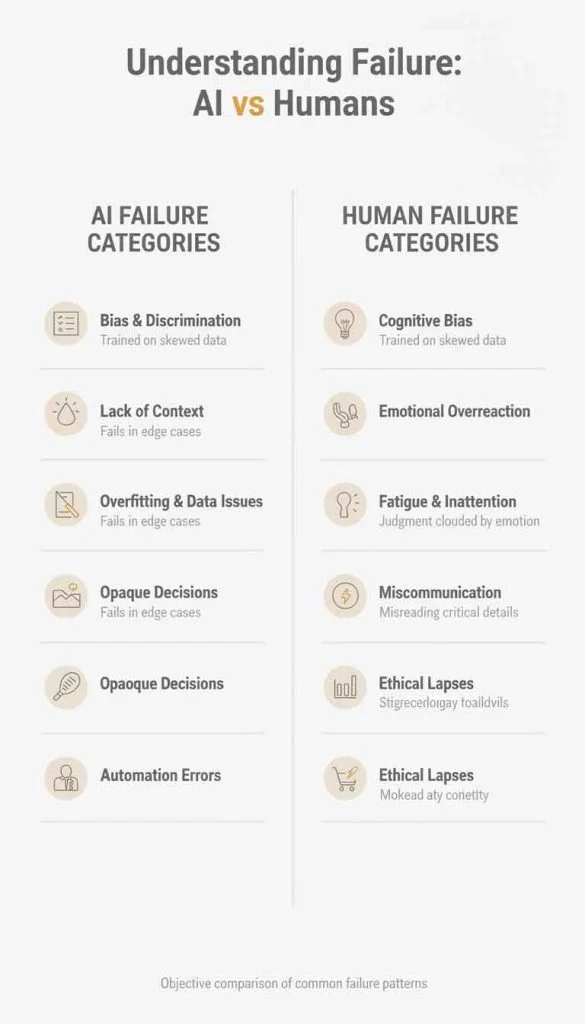
Trust behaves differently when systems are under stress.
AI Under Pressure
When workload increases, AI performance remains stable.
Response time does not degrade.
Cognitive fatigue does not accumulate.
This stability encourages reliance.
However, when context shifts rapidly, AI cannot recalibrate autonomously.
The appearance of stability masks rigidity.
Humans Under Pressure
Humans degrade under sustained pressure.
Fatigue reduces judgment clarity.
Time constraints increase error probability.
Yet humans adapt when environments evolve unexpectedly.
They can:
- reinterpret goals
- redefine constraints
- pause processes
This adaptive flexibility is absent in static AI systems.
Why Hybrid Systems Dominate
Because failure modes differ, combining AI and human judgment often reduces systemic fragility.
This is not a compromise. It is structural complementarity.
AI absorbs scale.
Humans absorb context.
When combined correctly:
- AI filters noise
- Humans interpret signal
The weakness of one offsets the weakness of the other.
The mistake of replacement thinking
The most fragile architectures are those attempting to replace one system entirely with the other.
Full automation ignores contextual nuance.
Full human-only systems ignore scale advantage.
Robust systems distribute responsibility along task boundaries.
Real-World Decision Breakdown – Three Environments
Abstract comparisons help, but clarity sharpens under concrete environments.
Below are three decision environments where the contrast between AI and human systems becomes visible.
These are not case studies. They are structural scenarios.
Environment 1 – High-Volume Operational Decisions
Example characteristics:
- Thousands of data points
- Clear measurable outcomes
- Low individual consequence
- Repeatable evaluation criteria
In such environments:
AI:
- Maintains consistency
- Detects anomalies at scale
- Processes inputs faster than human teams
Humans:
- Struggle with volume
- Introduce inconsistency
- Fatigue under repetition
Here, AI dominates.
Human oversight may remain necessary, but as validation rather than primary processor.
The risk profile is low. The benefit of scale is high.
Environment 2 – Context-Dense Strategic Decisions
Example characteristics:
- Ambiguous goals
- Competing stakeholder interests
- Long-term consequences
- Implicit constraints
In these environments:
AI:
- Generates structured options
- Surfaces precedent patterns
- Synthesizes comparable cases
Humans:
- Interpret stakeholder intent
- Anticipate reputational impact
- Adjust strategy midstream
Here, AI assists. Humans decide.
Replacing human authority in such environments increases fragility because downstream consequences are asymmetrical.
Environment 3 – Time-Compressed Crisis Decisions
Example characteristics:
- High uncertainty
- Rapid environmental change
- Incomplete data
- High stakes
Under crisis pressure:
AI:
- Maintains processing speed
- Avoids emotional distortion
- Surfaces structured options
Humans:
- Adapt when goals shift
- Recognize contextual nuance
- Assume responsibility
The optimal structure here is hybrid.
AI accelerates option generation. Humans calibrate response.
These differences highlight why defining decision boundaries in AI systems becomes more important than expanding capability.
Decision Speed vs Decision Quality
Speed is measurable.
Quality is often inferred only after consequence appears.
This difference explains why organizations overvalue acceleration and undervalue calibration.
When speed helps
Speed improves decision environments when:
- Feedback loops are short
- Consequences are reversible
- Learning is iterative
In such cases, faster cycles produce refinement.
AI excels here.
When speed harms
Speed degrades decision environments when:
- Verification lags behind output
- Consequences compound
- Accountability is concentrated
In these cases, acceleration multiplies risk.
AI amplifies throughput. It does not inherently amplify caution.
The illusion of “efficient correctness”
When AI output appears structured and coherent, users equate fluency with reliability.
This produces a psychological shortcut:
- If it sounds professional, it must be correct.
Human decisions are often less fluent. They contain hesitation, caveats, and revisions.
Paradoxically, those imperfections sometimes signal greater reliability.
Long-Term Consequence Asymmetry
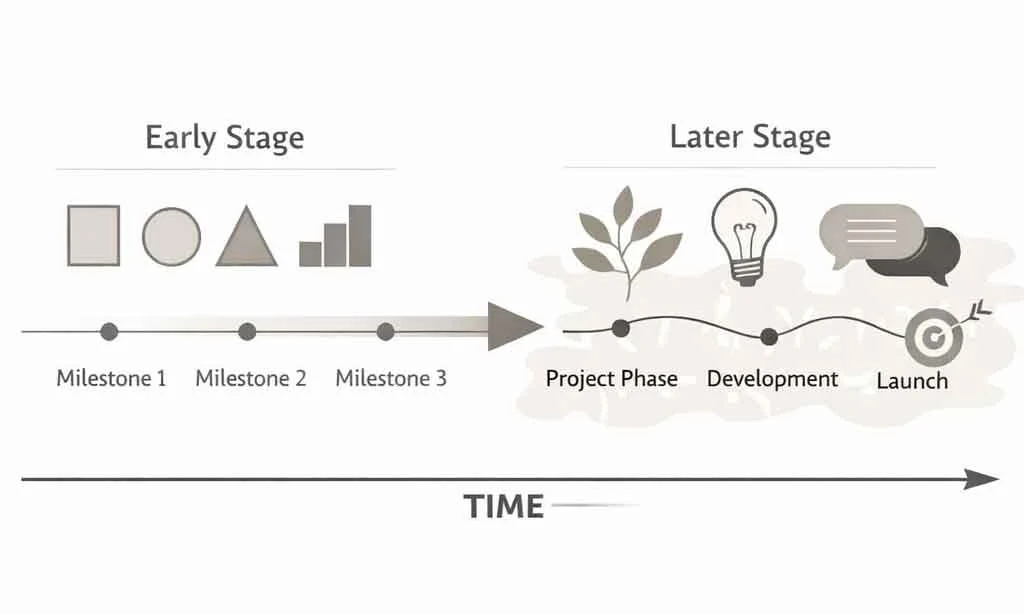
Short-term performance does not guarantee long-term stability.
AI systems optimized for immediate coherence can produce small errors that accumulate silently.
Humans optimized for context may underperform in early stages but avoid cascading failure.
This creates asymmetry over time.
AI advantage – early precision
AI frequently wins in:
- Early-stage analysis
- Large-scale scanning
- Initial option framing
Its early precision can create a perception of superiority.
Human advantage – long horizon stability
Over extended timelines, humans:
- Reassess assumptions
- Integrate evolving context
- Revise frameworks
AI systems require retraining or reframing to adapt at similar depth.
Long-horizon decisions benefit from human recalibration capacity.
Behavioral Trust Signals
Trust is rarely logical. It is inferred through patterns.
In AI and human systems alike, users evaluate:
- Consistency
- Boundary clarity
- Admission of limits
- Response stability
AI systems provide consistency.
Humans provide boundary admission.
Trust increases when both signals are present.
Why hybrid systems earn more trust
When AI outputs are:
- Verified
- Framed within limits
- Contextualized by humans
user trust stabilizes.
This stability produces stronger long-term reliance than blind automation or pure human improvisation.
A Unified Comparison Framework
After comparing architecture, failure modes, environment fit, and time asymmetry, the difference between AI and human decision systems can be compressed into a structured model.
The model does not ask which system is superior.
It asks four boundary questions:
- Is the task scale-heavy or context-heavy?
- Is error detection immediate or delayed?
- Is consequence reversible or asymmetric?
- Is accountability distributed or concentrated?
These four variables predict which system will begin to fracture first.
When AI should dominate
AI is structurally favored when:
- Scale exceeds human bandwidth
- Patterns matter more than narrative
- Feedback loops are fast
- Consequences are reversible
In these environments, human-only systems introduce inconsistency without increasing safety.
AI reduces noise.
When humans must dominate
Humans are structurally favored when:
- Context is dense and shifting
- Consequences are asymmetric
- Accountability is personal
- Values influence outcome weighting
In these environments, AI-generated coherence can mask contextual misalignment.
Humans absorb ambiguity.
Where hybrid systems outperform both
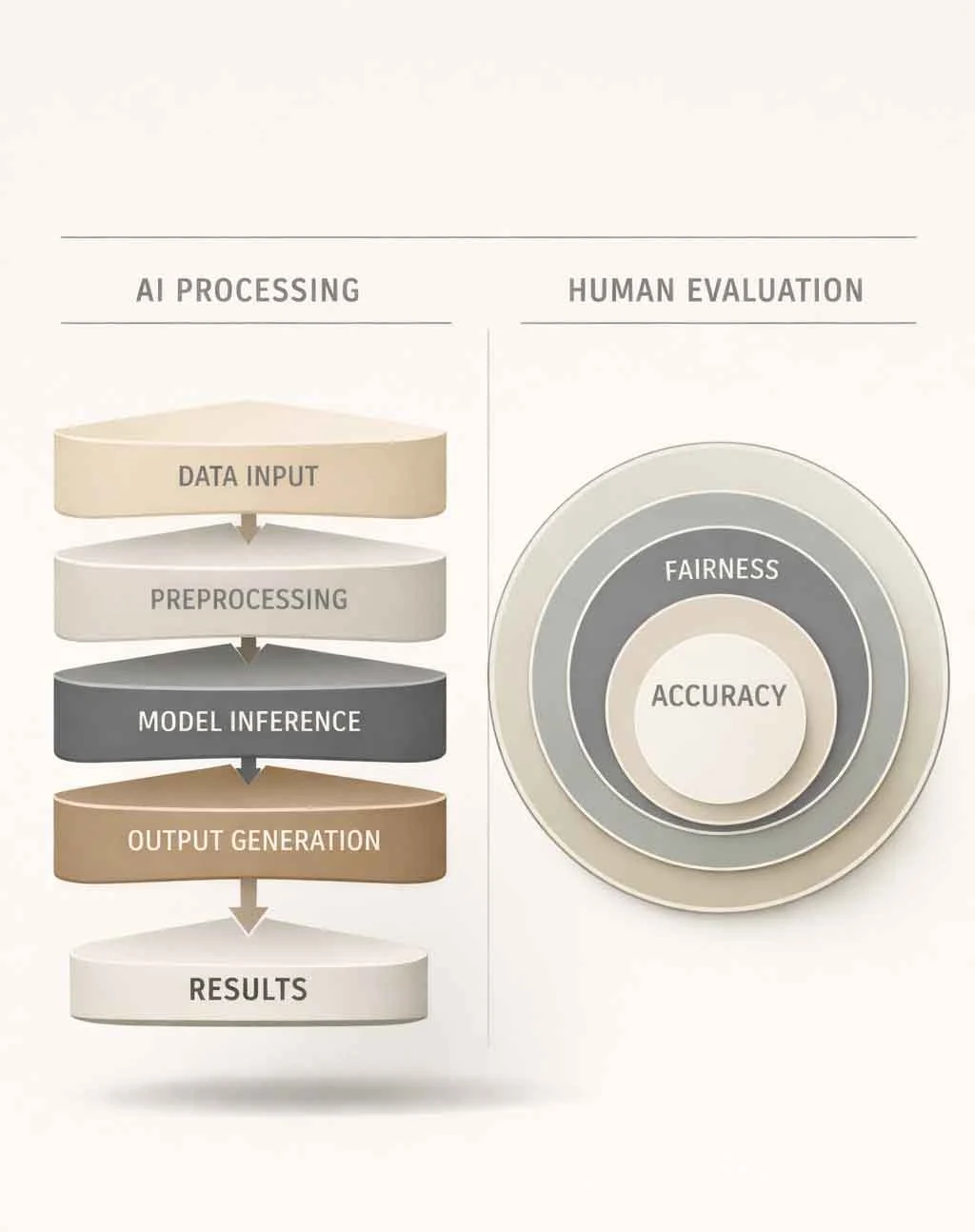
Hybrid systems perform best when:
- AI filters structured complexity
- Humans evaluate contextual implications
- Boundaries are defined explicitly
- Responsibility remains clear
Hybridization is not compromise. It is structural optimization.
Why Boundary Awareness Is the New Expertise
Early AI discourse centered on access and fluency.
Who can use it?
Who can prompt it?
Who can deploy it?
As AI systems mature, the expertise signal shifts.
The defining skill becomes boundary awareness.
Boundary awareness includes:
- Knowing when scale becomes distortion
- Recognizing when context outweighs pattern
- Anticipating where speed becomes liability
- Articulating limits without dismissing capability
This skill is quieter than technical mastery.
It does not produce flashy demonstrations.
It produces stable systems.
Developing this literacy is inseparable from understanding when not to use AI in the first place.
The Long-Term View
AI capability will continue to expand.
Model size will increase.
Interfaces will simplify.
Adoption will normalize.
These improvements do not eliminate structural asymmetry.
AI will always:
- Optimize for pattern
- Operate within frames
- Maintain output coherence
Humans will always:
- Interpret context
- Recalibrate under ambiguity
- Accept responsibility
The future is not AI versus humans.
It is architecture versus environment.
Understanding that distinction removes the need for dramatic conclusions.
Final Synthesis
The comparison between AI and human decision-making is not a competition.
It is a boundary study.
AI dominates scale.
Humans dominate context.
Each fractures under the other’s pressure.
Expert systems distribute responsibility along those fracture lines rather than pretending they do not exist.
This perspective does not resist AI.
It integrates it deliberately.
And in complex environments, deliberation outperforms enthusiasm.
Frequently Asked Questions
Is AI better than humans at making decisions?
AI performs better in high-volume, pattern-heavy environments where measurable variables dominate. Humans perform better when context, ambiguity, and value-based trade-offs shape outcomes. The systems excel under different constraints rather than competing universally.
Can AI replace human strategic decision-making?
AI can assist with option generation, data synthesis, and structured comparison. Strategic decisions, however, often involve implicit constraints and long-term consequences that require contextual interpretation and responsibility acceptance.
Why does AI appear confident even when wrong?
AI systems optimize for coherent pattern completion, not certainty. Fluency and structure can create the appearance of authority even when the underlying probability of correctness is limited.
When should humans override AI decisions?
Human oversight becomes critical when errors are difficult to detect, consequences are asymmetric, or accountability is concentrated on a specific individual or team.
Do hybrid AI-human systems reduce risk?
Hybrid systems often reduce fragility by distributing responsibility. AI manages structured scale, while humans manage contextual nuance and boundary definition.
Why do long AI explanations outperform short summaries?
Long explanations clarify mechanisms, limits, and trade-offs. This reduces uncertainty-driven behavior and increases engagement stability in complex decision topics.