
A student loan refinance denial means the lender has not approved the replacement loan you requested. Before applying again, identify the stated reasons, check the information behind them, and confirm what relevant evidence has changed. There is no universal waiting period or score increase that guarantees a different decision.
Your existing loans remain your responsibility while you sort this out. Keep following their payment instructions; a declined application does not replace the debt or create a payment break. If the next payment is already unaffordable, address that current-loan problem rather than relying on another refinance to arrive in time.
For U.S. borrowers, the useful question is what a new review would see differently. That may be a corrected credit report, accepted income evidence, a resolved access problem, or a lender whose product actually fits the loans. Work from the decision you received instead of assuming every rejection means your credit score is too low.
- Reason: identify each principal reason or requested item.
- Change: address the condition that caused that reason.
- Proof: confirm the correction, accepted document, or changed eligibility before asking about another review.
What did the lender actually decline?
Start with the lender’s notice and the application status. A request for more documents, a closed incomplete application, and a credit denial require different next steps. If the message is unclear, ask whether the existing application can still be completed or whether a decision has already been made; an incomplete application can itself be denied.
An adverse-action notice should give the principal reasons or explain how to request them. The CFPB’s explanation of denial notices describes the right to request reasons within 60 days when they are not supplied. Follow the notice’s instructions promptly rather than waiting for a future application.

If a consumer report contributed to the denial, the notice identifies the reporting company and explains your report rights. You can request a free report from that company within 60 days of receiving the adverse-action notice. This is a separate task from asking the lender for its reasons: the reporting company supplies the file, while the lender made the lending decision.
Read the principal reasons separately from any credit-score factors listed with a score disclosure. A factor that influenced a score is not necessarily the complete reason the lender declined the loan. For example, resolving a credit-report error will not automatically satisfy a separate requirement to verify income.
If the decision came during a preliminary rate check, do not infer your rights solely from the label “prequalification.” Regulation B’s notification guidance distinguishes an inquiry from a request treated as an application based on what the creditor evaluates and communicates. Ask for the actual status and available explanation.
| What the message says | What to establish first | Useful next checkpoint |
|---|---|---|
| More information is needed | Which item, deadline, and submission channel apply? | The required item is accepted for review. |
| Denied because of report information | Which bureau and specific reported information were used? | The relevant file is checked and any supported correction is confirmed. |
| Income could not be verified | Which income source or period could not be established? | The lender receives acceptable proof. |
| Income/debt or credit history did not qualify | Which financial condition was cited? | A relevant, documented change exists. |
| Product eligibility not met | Which rule excludes this borrower or loan? | The rule is met or a genuinely suitable product is identified. |
Which records should you check before changing anything?
Match the credit report to the reason
Obtain the report from the bureau named in the notice, then locate the account or information connected to the stated reason. Check ownership, payment status, balance, and reporting date against your own statements or other records. A recently paid balance and an older report snapshot can differ without proving that either record is fabricated; establish the dates before describing the problem.
A score in a banking app is not a substitute for this comparison. Credit scores can differ by model and reporting source, and the data can change between checks. A favorable app score therefore does not establish that the lender used the wrong score or that its other requirements were met.
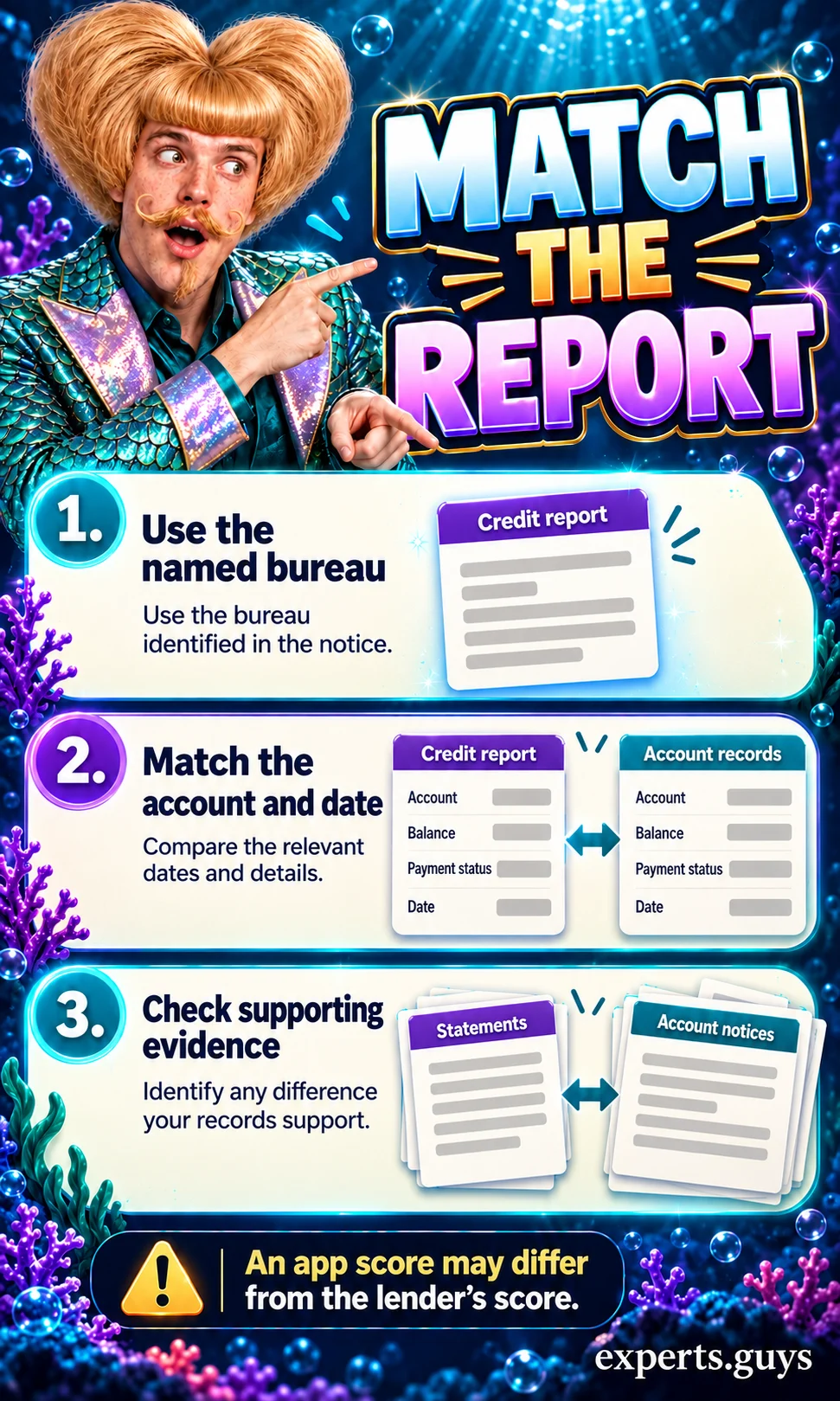
Correct an actual reporting error
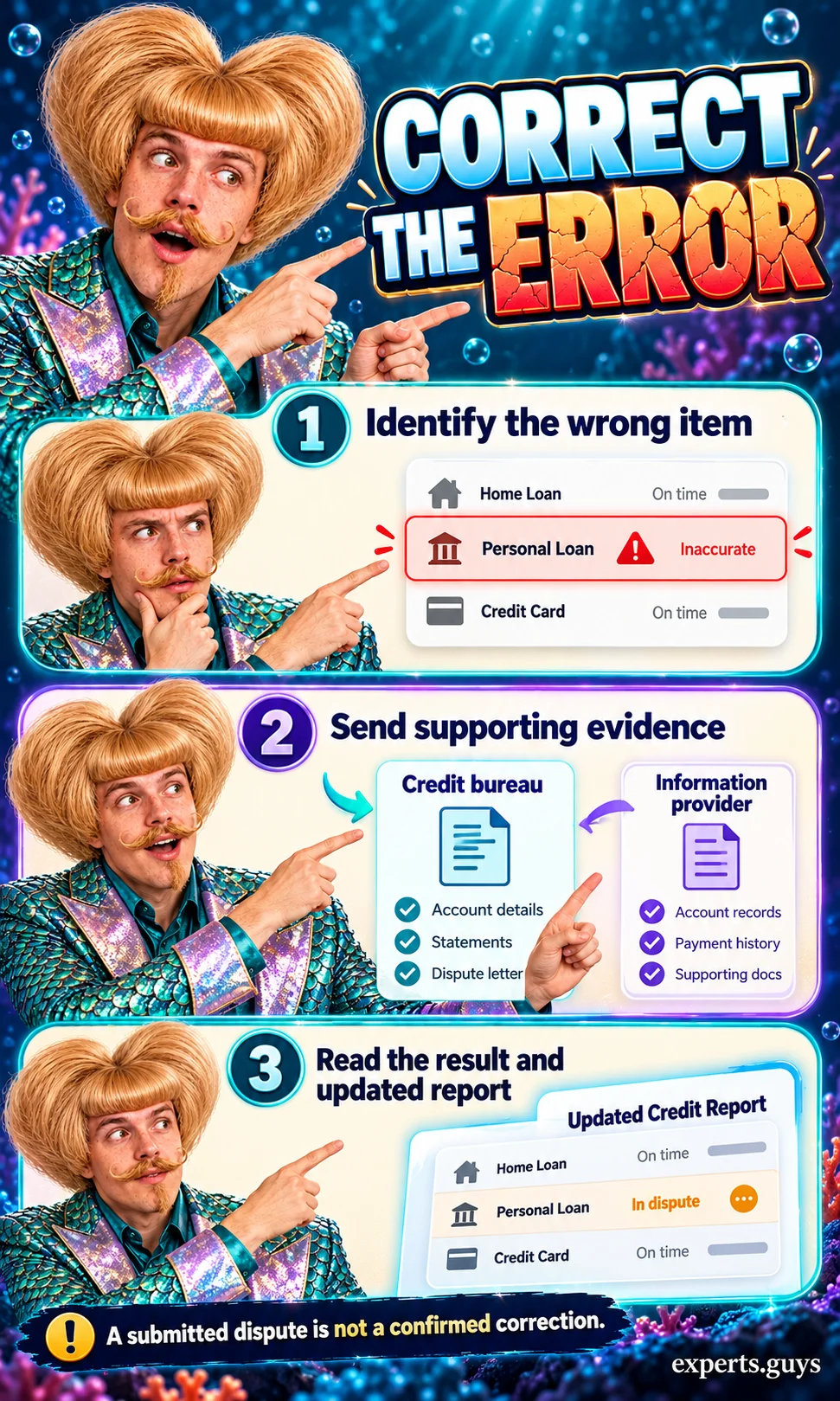
For an item you believe is inaccurate, identify exactly what is wrong and the correction your records support. Dispute the error with the credit reporting company and the information provider, using their designated processes. Supply a clear explanation and copies of relevant evidence; retain the submitted details and confirmation electronically where available. Do not send originals or dispute accurate information merely because it weakens an application.
Read the investigation result and the updated report before treating the issue as resolved. Investigations generally take 30 days, with up to 45 days in specified circumstances; the CFPB’s dispute-timing guidance explains those qualifications. That investigation period is not a universal reapplication waiting rule, and submitting a dispute does not guarantee a deletion or loan approval.
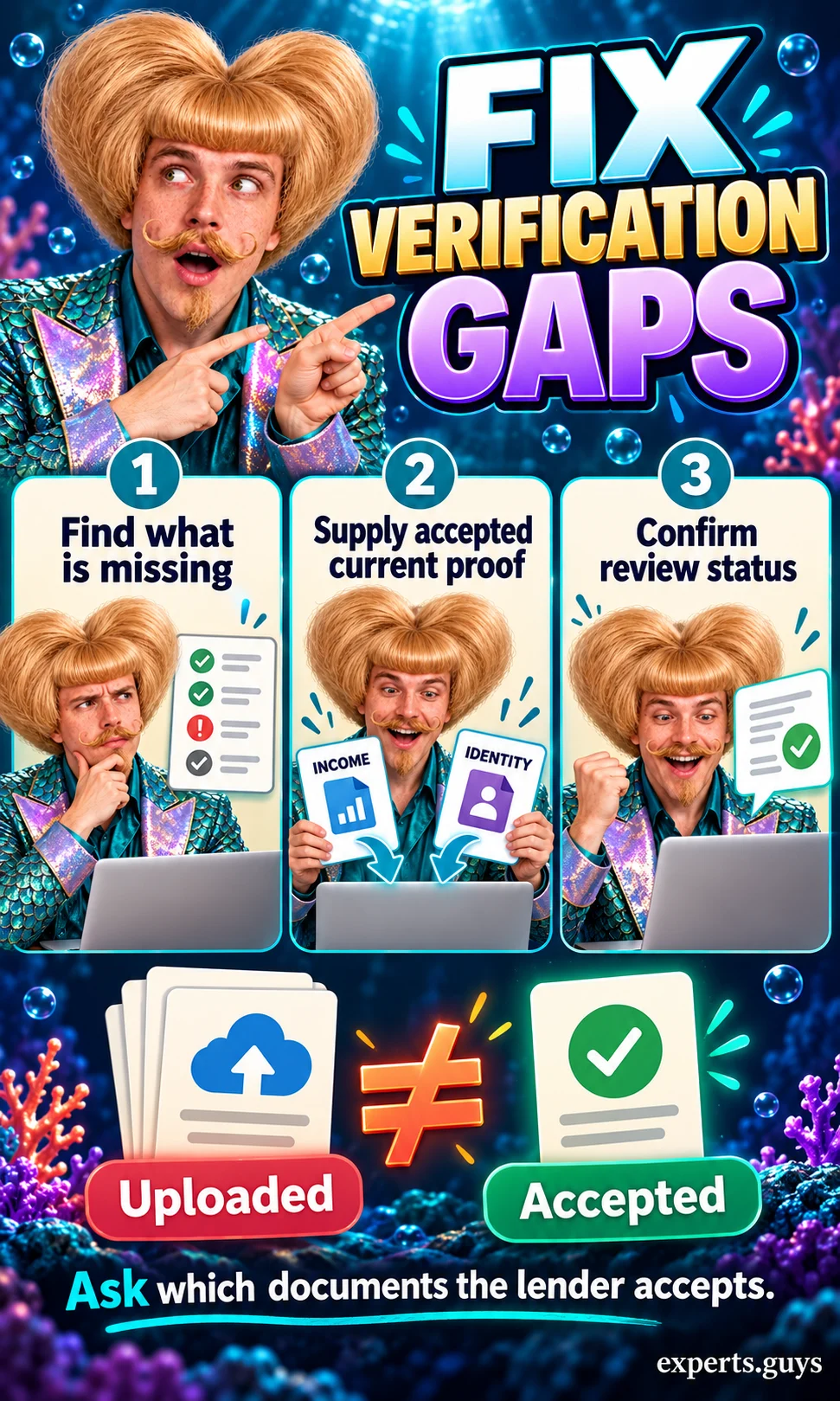
Resolve missing documents and blocked access
“Income could not be verified” calls for a different response from “income is insufficient.” Find the exact missing or unacceptable item, the period it must cover, and the lender’s accepted format. Submit it through the lender’s secure channel, then confirm whether it was accepted and whether anything else remains outstanding. Uploading a file only establishes that you sent something; it does not establish that the lender could use it.
For a recent job change, variable income, or self-employment, ask what evidence the lender accepts for that income type instead of assuming the same document works for everyone. As a product-specific example, ELFI’s application FAQ lists recent paystubs for employed applicants and says additional documents may be needed for other income sources. Do not alter dates or amounts to make a document appear to qualify.
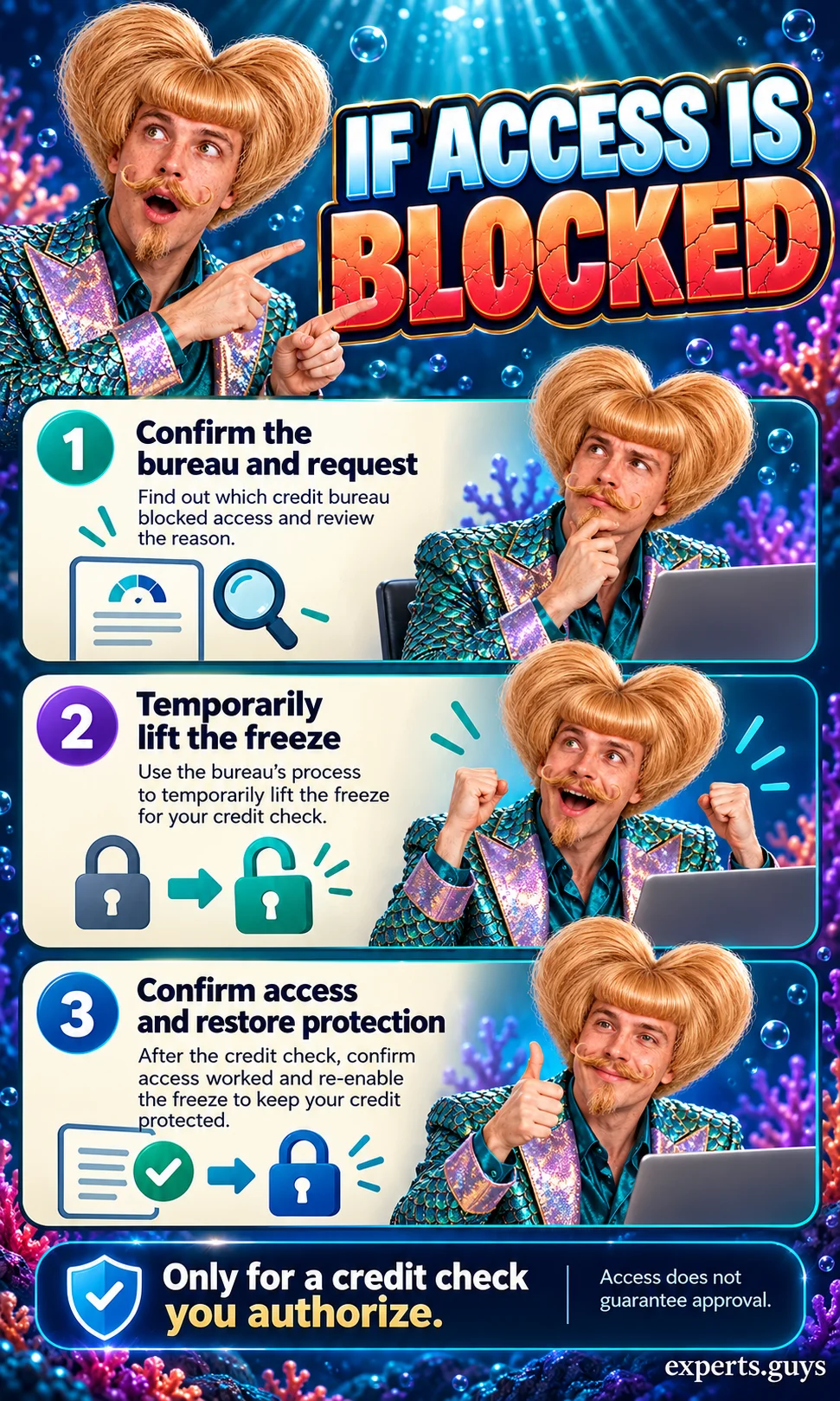
If the lender says it could not access your credit file, establish whether a security freeze is the cause and which bureau it needs. For a check you authorize, use that bureau’s official process to temporarily lift the freeze for the appropriate period, confirm the lender can proceed, and verify that protection is restored afterward. A credit freeze controls access; removing it does not improve the underlying file or guarantee approval. Do not lift a freeze because of an unsolicited message claiming to be a lender.
Is the problem financial eligibility or the wrong product?
Check income and debt using consistent evidence
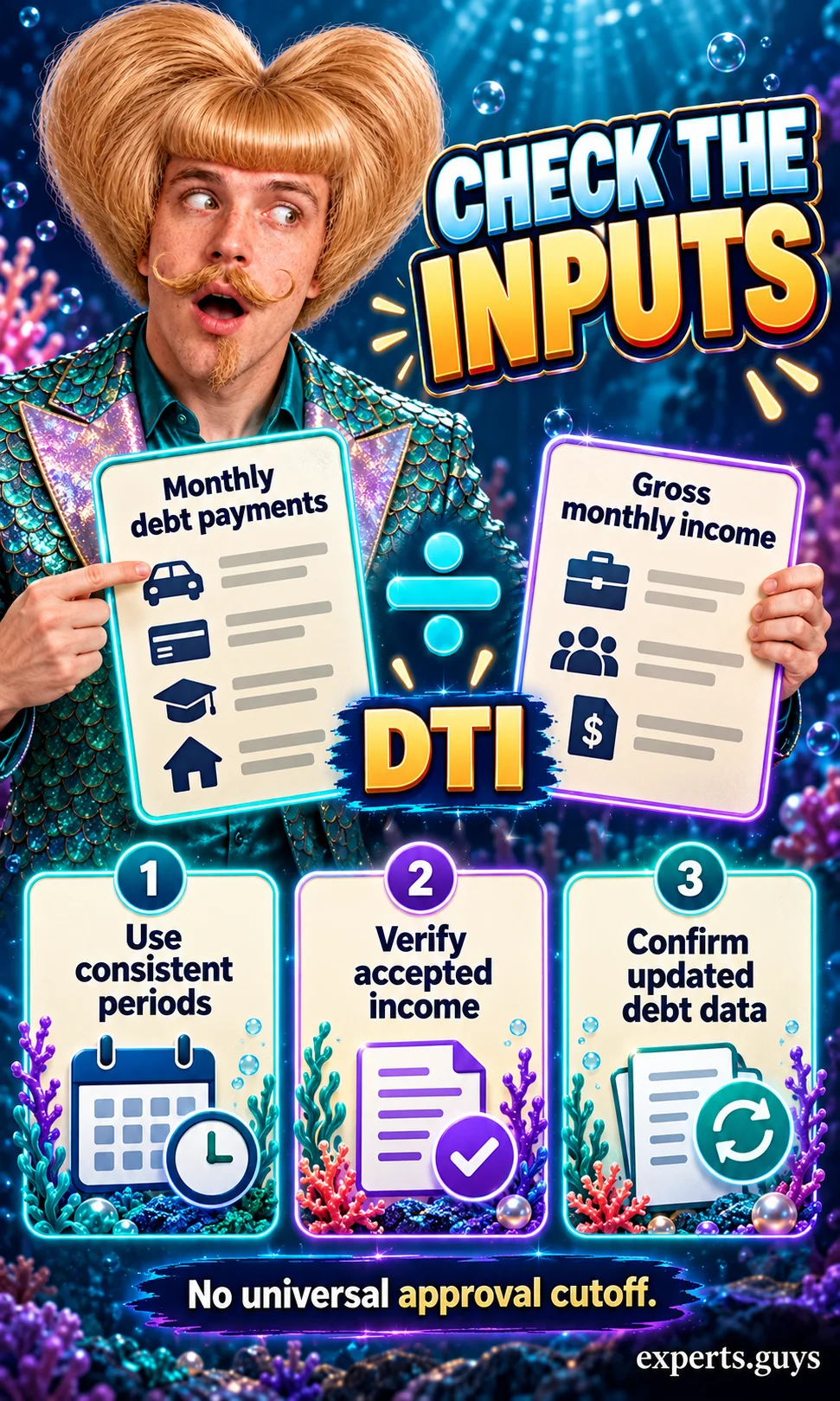
When the reason concerns obligations relative to income, review the inputs before chasing a target percentage. Debt-to-income ratio generally divides monthly debt payments by gross monthly income, before taxes and deductions. Lenders and products have different limits and may apply their own rules for qualifying income and obligations; a calculation made at home cannot reproduce the full underwriting decision.
For an illustrative check, $1,500 in monthly debt payments divided by $5,000 in gross monthly income is 30%. Dividing by a $60,000 annual income instead would mix periods and produce a misleading result. The 30% figure is arithmetic, not an approval cutoff. Ask how the lender treated the student loans being replaced and the proposed payment rather than guessing which obligations belong in its calculation.
A useful change must reach the evidence the lender evaluates. If a required debt payment has fallen, confirm the revised obligation and relevant reporting date; if income has increased, confirm what documentation and history the lender accepts. Avoid treating an expected bonus or someone else’s income as automatically available for underwriting. ELFI, for example, says it uses applicant or cosigner income rather than general household income.
Separate minimum requirements from full approval
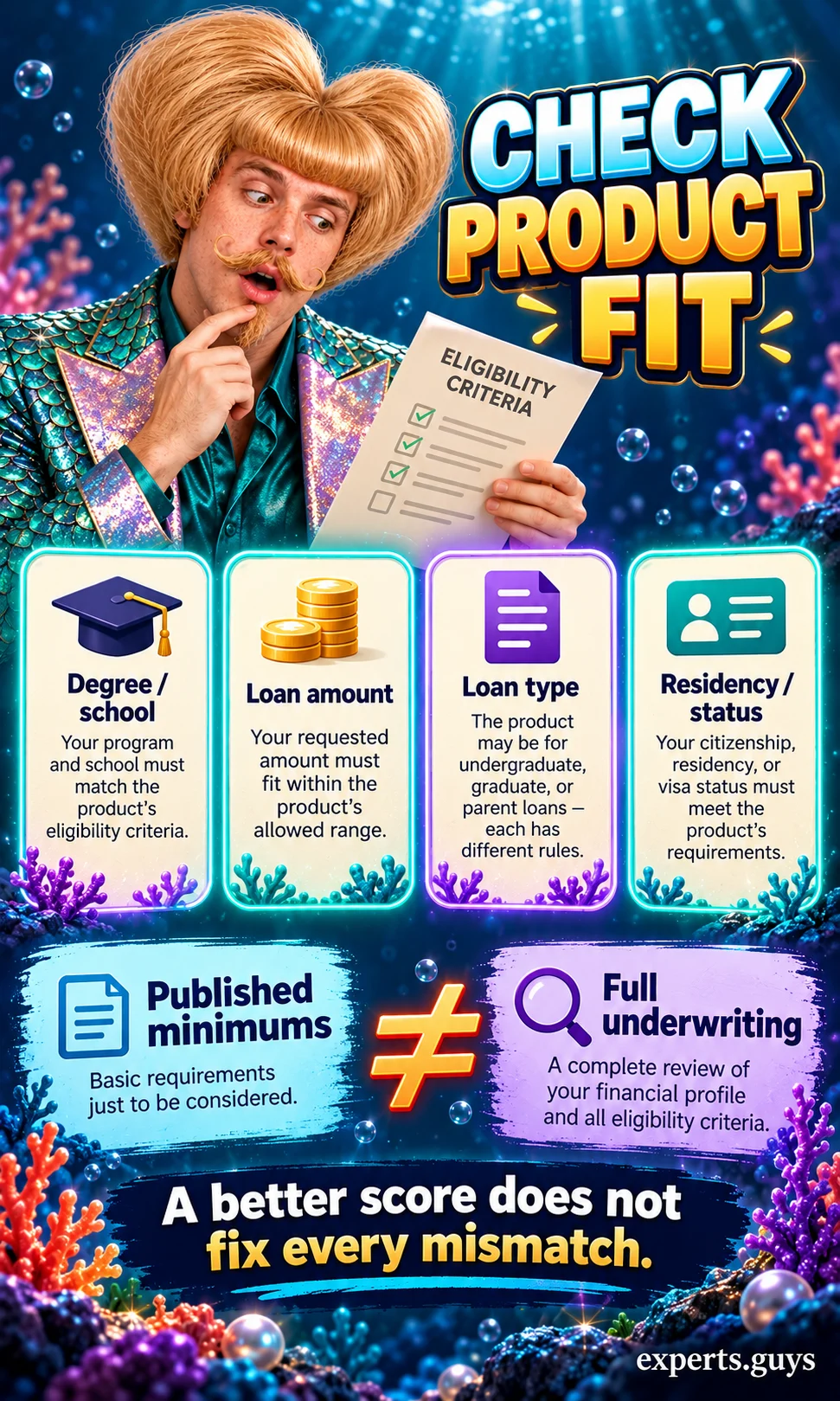
A loan can fail a product rule even when the borrower has strong credit. Check the exact product’s rules for degree or school, eligible debt, loan amount, and residency or other applicant status. A mismatch in one of these categories is not solved by repeatedly submitting the same application with a slightly different requested rate.
On October 29, 2026, ELFI’s published refinancing requirements included a minimum eligible loan amount and degree requirements, alongside financial criteria. Use the ELFI refinancing review for its broader product fit. Passing advertised minimums still leaves credit approval and other underwriting conditions; minimum eligibility is not a promised offer.
If the cited information is accurate but the credit history is thin or contains recent problems, the next meaningful change may take time. A new dispute is not a shortcut for accurate history, and taking on an unnecessary account solely to chase approval adds a separate commitment. Keep the focus on the reason the lender gave and what evidence it would evaluate differently.
A cosigner can change an application’s financial profile where the lender allows one, but this creates repayment obligations for another person and may not overcome a product exclusion. Review those responsibilities before adding a name. Establish which stated reason that change would address before asking someone to accept the debt.
When does another application become worth considering?
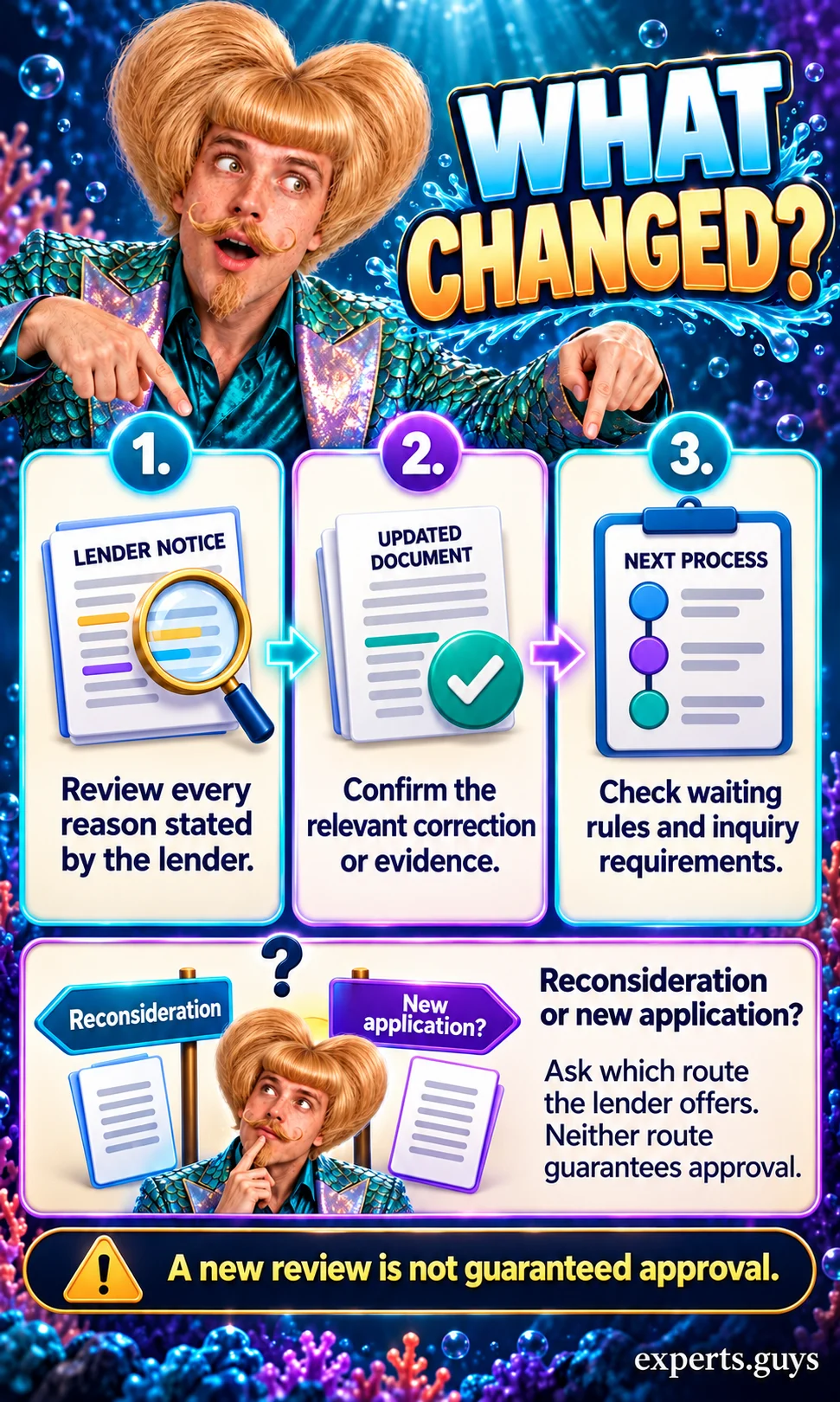
Use a confirmed change as the checkpoint, rather than a generic instruction to wait 30, 60, or 90 days. Ask the lender whether it offers reconsideration of the existing decision, whether new information can be added, or whether a new application is required. Also establish any lender-specific waiting rule and whether another hard credit inquiry would be involved. These options are not guaranteed at every lender.
| Situation now | Better immediate step | What would support a new review |
|---|---|---|
| The reasons are still unclear | Obtain the principal reasons and application status. | A specific issue can be matched to evidence. |
| A dispute or document review is pending | Check the result and remaining requirements. | The relevant correction or document is confirmed. |
| A product exclusion still applies | Compare the actual rule with suitable alternatives. | A product genuinely fits the borrower and debt. |
| A relevant change is confirmed | Ask about reconsideration or the new-application process. | All stated reasons have been considered and the lender’s next process is understood. |
Revisit every stated reason, including those that were less noticeable than the credit-score line. Suppose a report error is corrected but the income document remains unacceptable: the file has improved, yet the verification blocker is still unresolved. Conversely, a document-only problem may be addressable without waiting for a different credit score. Neither example predicts what a lender will approve.
Use the checkpoint tool below to identify the next unresolved item. Select only issues connected to your actual notice or lender explanation, then mark whether the relevant evidence is confirmed. It asks for no account numbers, documents, credit scores, or income amounts and does not estimate your approval odds.
What still needs checking?
Match the lender’s reasons to confirmed evidence.

This check identifies an unresolved step. It does not predict approval or decide whether refinancing is suitable. No personal account details are needed or stored.
Select your situation to identify the next evidence check.
Your selections are self-reported. A confirmed change is not a lender decision. Keep making existing loan payments while an application is unresolved.
Where a lender offers a soft-inquiry rate check, it can help explore preliminary terms without assuming final approval. ELFI’s application FAQ distinguishes its soft prequalification inquiry from the hard inquiry at application and explicitly says prequalification is not a final offer. Check the disclosure for the lender and stage you are using rather than assuming every “check my rate” button works identically.
Once an actual offer is available, evaluate the cost and protections separately from the satisfaction of being approved. The student loan refinancing guide covers the rate, term, and total-cost decision. Refinancing federal loans into private debt gives up federal protections; a prior denial does not make that trade-off less important.
Frequently asked questions
Does a denial itself lower my credit score?
The denial itself does not lower your score; the credit inquiry and the information in your file are separate. A hard inquiry can affect a score; do not assume that the word “denied” creates a separate fixed-point penalty. Check the inquiry type and report rather than estimating damage from the outcome.
Can I ask the lender to reconsider?
Ask whether the lender accepts a reconsideration request or corrected evidence on the existing application. There is no universal reconsideration process or guaranteed reversal. Confirm what to submit and whether a new application or credit inquiry is required.
Should I apply elsewhere immediately?
First distinguish a lender-specific product mismatch from a problem another lender is likely to evaluate too. A genuinely different product may be relevant, but an unresolved report error or unverifiable income does not disappear because the lender’s name changes.
What if I suspect identity theft?
Use IdentityTheft.gov, the federal identity-theft recovery service, and address the unauthorized information through the appropriate reporting processes. Do not treat an unknown account as merely a refinancing obstacle or lift protective freezes for an unverified request.
What if I think the decision was discriminatory?
Keep the notice and relevant communications and review your options under the Equal Credit Opportunity Act. The CFPB accepts complaints about lending and credit reporting. A complaint does not itself approve a loan or suspend existing payments. Review the CFPB’s discrimination guidance.
Will my existing loans stop while I reapply?
No. Continue following the current lenders’ payment instructions until a completed refinance and payoff are confirmed. If you need current payment relief, address it with the existing servicer; another application is not a payment arrangement.
Before you apply again
- Read the decision and identify every principal reason.
- Match each issue with the report, document, or product rule that can explain it.
- Confirm the relevant change; do not substitute “submitted” for “resolved.”
- Check reconsideration, waiting-period, and credit-inquiry rules for that lender.
- Keep current payments separate from the refinancing application.