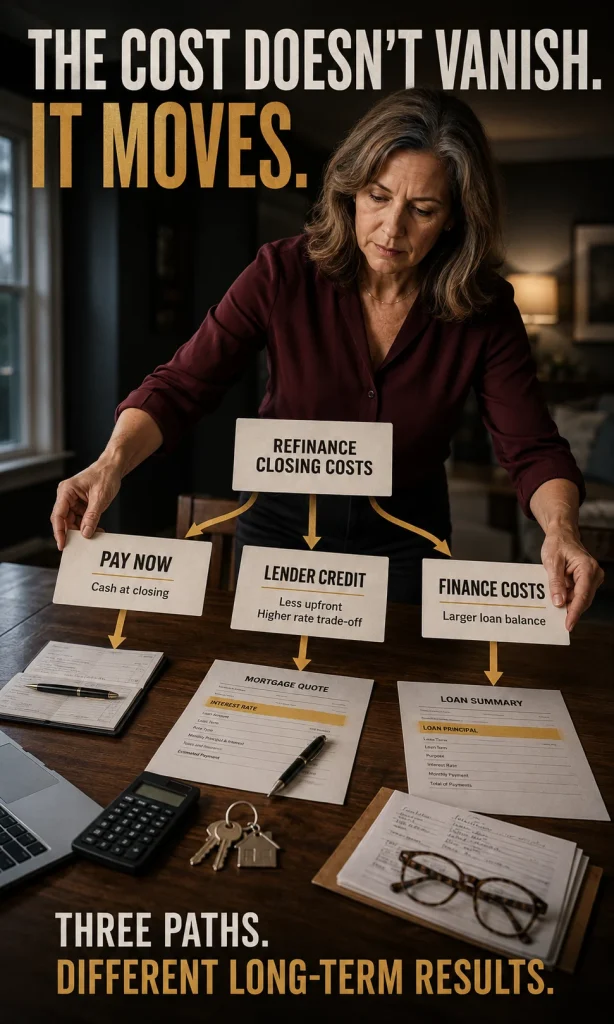
A no-closing-cost refinance is not free. You may avoid paying some or all mortgage closing costs out of pocket, but the economics usually move somewhere else – commonly into a higher interest rate accompanied by lender credits, or into a larger new loan balance when permitted costs are financed. The right choice depends on how much cash you preserve today, how much extra the alternative costs each month, and how long you realistically expect to keep the replacement mortgage.
The practical rule is simple: shorter holding periods can favor lower upfront cost, while longer holding periods can favor paying more upfront for the lower rate. That rule is only useful after the offers have been normalized to the same loan amount, term and borrower scenario. A quote labeled “no closing cost” should therefore be compared with at least one lower-rate alternative from the same lender rather than accepted as a separate category of bargain mortgage.
| Structure | What Happens Today | What You Pay Later | Decision Cue |
|---|---|---|---|
| Pay costs upfront | You bring more cash to closing. | You may obtain a lower rate than an otherwise comparable lender-credit option. | Often worth comparing when you expect to keep the mortgage long enough to recover the upfront cost. |
| Lender-credit option | A lender credit offsets some or all eligible closing costs. | The associated interest rate is generally higher than the comparable option without the credit. | Useful when preserving cash now matters more than achieving the lowest available rate. |
| Finance permitted costs | Less cash may be required because certain costs are added to the new mortgage. | You begin with a larger principal balance and pay interest on that additional financed amount. | Compare the new starting balance and remaining balance at your expected exit date. |
What Does “No Closing Cost” Actually Mean?
The phrase describes how the transaction is funded at closing rather than proving that no costs exist. The Consumer Financial Protection Bureau explains that a lender advertising a no-cost or no-closing-cost refinance can cover the economics through a higher rate and lender credit or by adding closing costs to the loan amount.
Those two approaches should not be treated as identical. A lender-credit structure can leave the original refinance principal largely unchanged while exchanging a higher rate for an upfront credit, whereas financing costs increases principal and reduces starting equity. Both can lower the amount of cash needed today, but they create different future payment and balance behavior.
Marketing language adds another layer of confusion because lenders do not always use “no closing cost,” “no cost,” “zero lender fee” and “no cash out of pocket” to mean exactly the same thing. The Loan Estimate matters more than the advertisement. It shows the loan amount, rate, lender credits, closing costs and cash-to-close calculation needed to determine what actually happened.
Lender Credits Are the Reverse of Paying Points
A lender credit is a pricing trade rather than a gift detached from the mortgage. The CFPB explains that lender credits reduce what the borrower pays upfront in exchange for a higher interest rate than the comparable loan without those credits.
Discount points work in the opposite direction. The borrower pays more at closing to obtain a lower rate, while lender credits allow the borrower to accept a higher rate and receive money toward settlement costs. Mortgage pricing therefore behaves more like a spectrum than a single “rate” offered by the lender.
This leads to one of the most useful questions you can ask before choosing the refinance: “Show me this exact loan with more lender credit, with no lender credit, and with a lower rate that requires me to pay more upfront.” Seeing those versions side by side reveals the actual trade instead of forcing you to compare an advertised rate against an unexplained no-cost offer.
Refi Cost Crossover
Which Refinance Costs You Less?
Compare one refinance route at a time against the mortgage you already have. Enter your real lender quotes to see cash needed now, ongoing payment, cost over your holding period, the crossover point, and the balance still owed when you exit.

No Closing Cost Does Not Always Mean Zero Cash to Close
Closing costs and cash to close are related, but they are not identical. A refinance can involve accrued interest, prepaid items, escrow funding and other adjustments in addition to lender-controlled loan costs, so a lender credit that covers settlement charges does not automatically mean the final cash-to-close line will be zero. The CFPB’s Loan Estimate explainer shows those amounts separately and specifically tells borrowers to review lender credits and the Estimated Cash to Close calculation.
Escrow can cause particular confusion during refinancing. The new loan may require money to establish its escrow account while the old servicer later returns the unused balance from the previous escrow account, creating a temporary cash movement that is different from a permanent lender charge. Treating every dollar brought to closing as a “refinance fee” can therefore overstate the true cost.
Prepaid interest is another timing item. Interest owed for the period between closing and the first scheduled payment is real cash, but it is economically different from an origination fee paid simply to create the mortgage. A useful comparison separates permanent loan costs from timing-related cash movements.
Where to Look on the Loan Estimate
Do not judge a no-cost refinance from the lender’s summary email. Use the formal disclosure and compare the same fields across competing options because the location of the cost tells you how the transaction is being financed.
Check these items first:
- Loan amount: Did the replacement balance increase beyond the payoff for reasons other than an intended cash-out amount?
- Interest rate: How much higher is the lender-credit option than the comparable lower-cost or lower-rate alternative?
- Origination charges: What lender-controlled charges are being assessed?
- Points: Are you paying anything upfront specifically to reduce the rate?
- Lender credits: How much credit appears against closing costs?
- Estimated cash to close: What do you actually need to bring to settlement?
- Prepaids and escrow: Which cash movements are timing-related rather than permanent loan costs?
The Consumer Financial Protection Bureau recommends comparing the origination charges, lender credits, monthly payment and cash to close across Loan Estimates rather than comparing the interest rate alone.
How to Find the Cost Crossover

The central no-cost-refinance calculation is different from the ordinary question of whether refinancing beats your current mortgage. First determine whether refinancing is worthwhile at all, then compare the available pricing versions of the proposed refinance.
For a lender-credit option, a useful simplified crossover calculation is:
Cash costs avoided ÷ extra monthly principal-and-interest from the higher-rate option = approximate crossover months
Suppose the lower-rate version requires meaningful upfront costs while a higher-rate version supplies enough lender credit to cover them. If the extra monthly payment from the higher rate would take longer to accumulate than the period you expect to keep the mortgage, preserving the cash can be rational. If you expect to remain with the loan far beyond that crossover, paying costs today for lower ongoing pricing may become more attractive.
That simple formula is an orientation, not a complete cost model. A rigorous comparison should also consider amortization, different starting principal amounts, mortgage insurance if applicable, expected payoff date and the remaining balance when you sell or refinance again.
Financing the Costs Creates a Different Crossover
When permitted closing costs are added to the mortgage, the interest rate may remain the same as another quote while the starting balance increases. That means comparing monthly payments alone can make the financed-cost option appear inexpensive because the additional payment generated by a few thousand dollars of principal may look small.
The trade appears more clearly in the balance. The financed costs become secured mortgage debt, accrue interest according to the loan structure and reduce the amount of home equity remaining immediately after closing. A borrower expecting to sell or refinance again should therefore compare the mortgage balance at the expected exit date, not simply the first monthly payment.
This distinction is especially useful when someone says, “The lender rolled the costs into the loan, so I did not pay anything.” Economically, the cost was still paid by increasing the debt that must eventually be repaid or satisfied from the home’s sale proceeds.
When a No-Closing-Cost Refinance Can Make Sense
A lender-credit structure can be attractive when the homeowner has a clear reason to preserve liquidity. Paying thousands of dollars at closing may be inefficient if the mortgage will probably be replaced again before a lower-rate option has enough time to recover those costs.
Situations worth comparing include:
- you expect to sell the property within a relatively short period;
- you believe another refinance is reasonably possible later but do not want to speculate heavily on future rates;
- the lower-rate option requires a long recovery period;
- preserving an emergency reserve matters more than maximizing long-term interest savings;
- the lender credit covers substantial settlement costs while the new rate is still meaningfully better than the current mortgage;
- the refinance accomplishes another useful structural goal without requiring a large upfront payment.
None of those conditions makes a no-cost refinance automatically superior. The offer must still improve on the mortgage you already have.
When Paying the Costs Upfront Can Be Better
Paying closing costs can be more attractive when you expect to keep the mortgage for many years and the lower-rate option produces enough monthly and cumulative savings to recover the upfront cash. The longer the loan remains outstanding after that crossover, the more time the lower ongoing rate has to work.
The decision becomes stronger when the lower-rate quote does not require excessive points. Paying a modest amount to obtain materially better pricing can be different from buying an expensive package of discount points that takes many years to recover. Ask for several pricing options instead of assuming the lender’s first lower-rate quote is automatically the sensible “pay costs” benchmark.
Liquidity still matters. Emptying an emergency reserve simply to minimize mortgage interest can create another financial risk, so compare the expected mortgage savings with the value of retaining adequate cash after closing.
The Term Reset Can Distort the Payment Comparison
A new 30-year mortgage can produce a lower required payment partly because the debt has been stretched across a new 30-year amortization schedule. That effect is separate from the benefit produced by the interest-rate reduction, and it becomes increasingly important when the current mortgage has already been outstanding for several years.
A no-cost refinance can therefore look unusually appealing if the comparison focuses only on the payment. The homeowner may be paying less each month while carrying a larger principal balance for longer, especially if costs were financed into the new loan. Compare the remaining mortgage balance at the point you realistically expect to sell, refinance or pay the debt off.
This is also why the broader mortgage refinance decision should be settled before optimizing the closing-cost structure. A clever lender-credit arrangement does not rescue a refinance that is unattractive at the whole-loan level.
Should You Refinance Repeatedly as Rates Fall?
A low-upfront-cost refinance can make repeated refinancing look almost frictionless, which is one reason the strategy is actively discussed by borrowers. The potential benefit is that a homeowner can capture part of a rate decline without paying large nonrecoverable costs each time, then refinance again if future pricing improves enough.
The risk is treating falling rates as guaranteed. Each replacement mortgage can reset amortization, involve administrative work, alter escrow cash flow and expose the borrower to changing property, credit and underwriting conditions. Certain mortgage programs also have seasoning, benefit or recoupment requirements that make frequent refinancing more constrained than an ordinary conventional scenario.
If repeated refinancing is part of your strategy, model each loan as though no future refinance is guaranteed. The guide to how frequently you can refinance a mortgage belongs beside this decision because the technical ability to refinance again is separate from whether doing so will actually save money.
Do Not Confuse “No Lender Fee” With “No Closing Cost”
A lender can waive its own origination or underwriting charge while title, appraisal, recording or other third-party settlement expenses remain. An advertisement saying “no lender fee” can therefore describe a genuinely lower lender charge without promising that the entire mortgage transaction has no closing costs.
The reverse can also happen. A refinance can have many ordinary settlement charges yet require little borrower cash because lender credits offset them. Those are different economic structures even though both marketing messages can sound like “free refinancing.”
The disclosure resolves the ambiguity. If the Loan Estimate still lists costs but shows enough lender credits to offset them, you are looking at cost coverage through mortgage pricing rather than the literal absence of settlement costs.
| Marketing Phrase | What It May Mean | What to Verify |
|---|---|---|
| No closing cost | Costs may be offset by lender credits or incorporated into the financing structure. | Rate, lender credits, loan amount and cash to close. |
| No lender fee | Certain lender-controlled charges may be waived while third-party costs remain. | Origination charges versus title, appraisal and government charges. |
| $0 cash to close | Credits, financing and transaction adjustments may offset the immediate cash requirement. | Whether the loan balance or rate increased to produce the result. |
| Free refinance | Marketing wording that requires clarification. | Compare against the same loan without the promotional pricing structure. |
How to Compare a No-Cost Offer Properly

Ask the lender to produce comparable versions rather than trying to infer the economics from one quote. The loan amount, term, property assumptions and borrower profile should remain as constant as possible so the pricing structure becomes the main variable.
Use this sequence:
- Get the current mortgage baseline. Record the payoff, note rate, remaining term and principal-and-interest payment.
- Get the lender-credit version. Record its rate, lender credit, new principal and cash to close.
- Get a comparable lower-rate version. Ask what the same transaction looks like when you pay more costs yourself.
- Separate permanent costs from prepaids and escrow. Do not treat every temporary cash movement as an origination expense.
- Calculate the payment difference. Find the monthly premium created by the higher-rate no-cost option.
- Find the crossover period. Compare the upfront cash saved with the additional monthly cost.
- Compare principal at your expected exit date. This catches the effect of financed costs and amortization resets.
- Compare with the mortgage you already own. A no-cost refinance still needs to beat the status quo.
That workflow also makes lender shopping much easier. Instead of asking “Who has the lowest refinance rate?” you are asking lenders to price the same economic decision.
Can APR Tell You Which One Is Better?
APR is useful because it incorporates certain finance charges rather than showing only the note rate, but it should not be the only decision number. APR is standardized for disclosure purposes and can help expose a heavily fee-loaded quote, yet your personal holding period may be much shorter than the theoretical life of the mortgage.
A homeowner expecting to sell relatively soon can rationally choose a higher APR mortgage with much lower upfront cost if it performs better during the actual holding period. Someone expecting to keep the loan for a long time can reach the opposite conclusion. The comparison should therefore use both standardized disclosures and your expected timeline.
The “In 5 years” information and other comparison fields on the Loan Estimate can also help you evaluate competing loans under a common timeframe. The CFPB recommends comparing multiple offers rather than assuming the quote with the smallest interest rate is automatically the cheapest.
When I Would Be Skeptical of a No-Cost Offer
The phrase itself is not a red flag, because lender-credit pricing is a legitimate mortgage structure. Skepticism becomes appropriate when the lender cannot explain how the costs were covered or refuses to provide a comparable lower-rate alternative.
Be cautious when:
- the new principal is unexpectedly larger than the current payoff;
- the lender describes a credit but it does not appear clearly on the disclosure;
- “no cost” applies only to one lender charge while substantial third-party fees remain;
- the rate is materially above other matched offers;
- the lender focuses on monthly payment without showing the new term or principal balance;
- the salesperson assumes future refinancing will definitely solve the higher-rate problem;
- the offer only appears attractive because the new mortgage restarts a long amortization schedule.
The remedy is comparison rather than suspicion. A transparent lender should be able to explain each dollar and show how another pricing option changes the rate and upfront cash.
Frequently Asked Questions
Is a no-closing-cost refinance actually free?
No. Mortgage origination and settlement still involve costs, but the borrower may avoid paying them directly at closing through lender credits, a different interest-rate structure or financing permitted costs into the new mortgage. Check the Loan Estimate to see exactly where the cost went before treating the refinance as free.
Why is the no-closing-cost refinance rate higher?
A lender can provide a credit toward closing costs in exchange for a higher interest rate. The credit lowers what you pay upfront while the higher rate increases the ongoing cost of the mortgage. Compare that option with the same lender’s lower-rate quote before deciding which structure fits your expected holding period.
Is rolling closing costs into the loan the same as getting lender credits?
No. Financing costs increases the new mortgage principal, while lender credits generally offset settlement costs through the mortgage’s pricing and interest rate. Both can reduce cash required today, but they affect future cost and equity differently, so compare the loan amount and rate separately.
Can a no-closing-cost refinance still require cash at closing?
Yes. The transaction can still include prepaid interest, escrow funding or other cash adjustments even when lender credits offset eligible closing costs. Review the Estimated Cash to Close section and separate timing-related items from permanent loan charges.
When is paying closing costs upfront better?
Paying costs upfront can be stronger when it produces a meaningfully lower rate and you expect to keep the mortgage beyond the point where the monthly savings recover the upfront cost. The answer depends on the actual quotes, not a universal number of years. Compare your expected holding period with the crossover period before choosing.
Can I keep doing no-cost refinances whenever rates fall?
Repeated refinancing can be possible in some circumstances, but future rate declines and future approval are never guaranteed. Each refinance can reset amortization and may be subject to lender or loan-program seasoning and benefit requirements. Evaluate every refinance on its own economics rather than assuming another one will automatically follow.
Next Steps
Ask the lender for at least two versions of the same refinance before choosing the “no closing cost” option. One should show the lender-credit structure and another should show what happens to the rate, cash to close and monthly payment when you receive less or no lender credit.
Then identify the crossover point and compare it with how long you genuinely expect to keep the mortgage. If you expect to exit before the higher-rate option accumulates more cost than the cash it saved, lower upfront cost can have real value; if you expect to keep the mortgage much longer, paying some costs today for stronger long-term pricing may be the better structure.
Finally, make sure the refinance itself beats the mortgage you already have. Optimizing the closing-cost method is useful only after the replacement mortgage has earned its reason to exist.