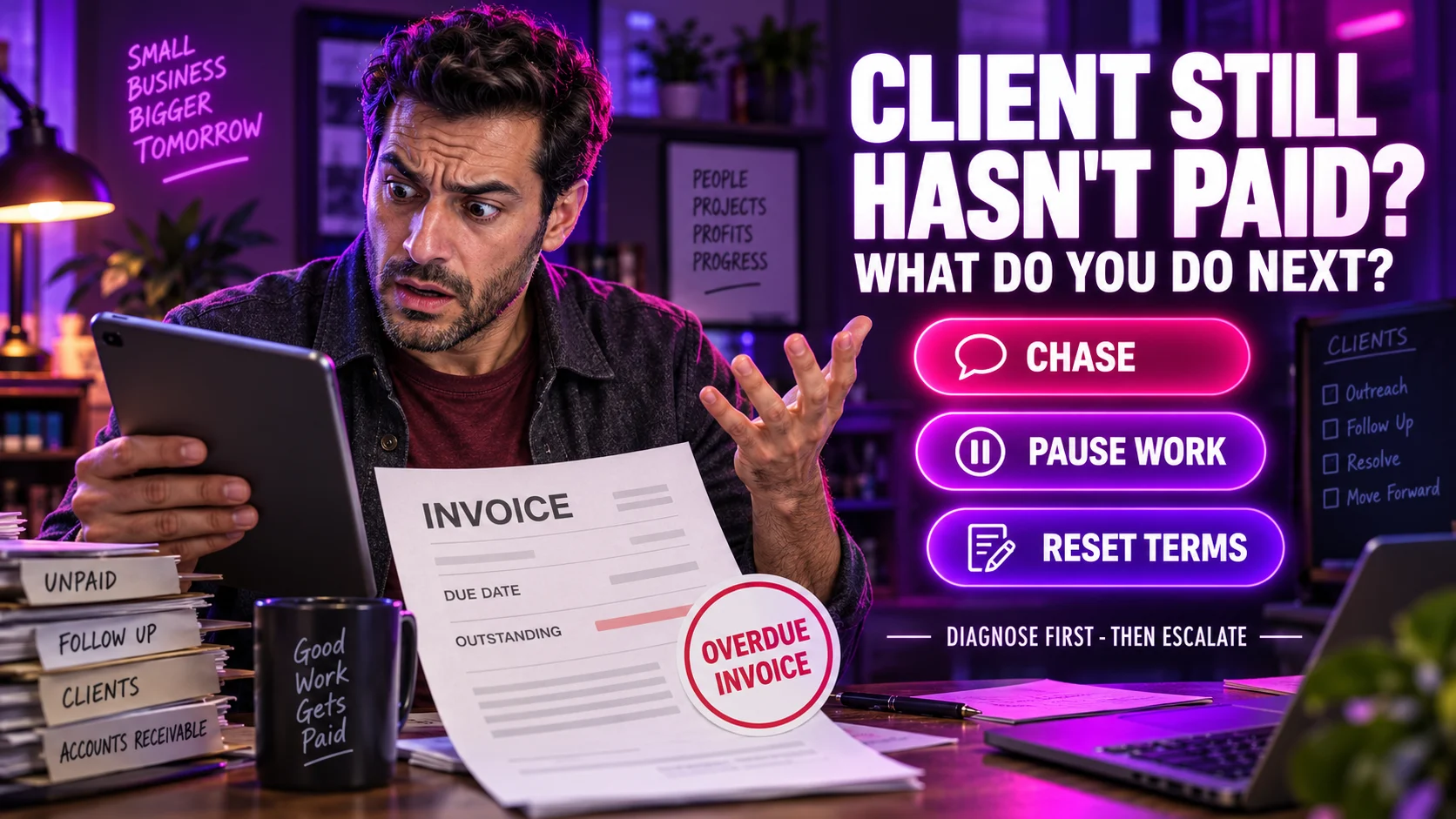
When a client pays late, do not jump immediately from a friendly reminder to threats, late fees or legal action. First confirm that the invoice is correct, received by the right person and not blocked by a purchase-order, approval or genuine service dispute. Once those possibilities are cleared, the response should become progressively firmer when the client misses agreed dates, repeatedly ignores the same terms or continues requesting new work while old work remains unpaid.
The important distinction is between a payment problem and a client problem. One late invoice can result from administrative friction that is easily corrected, while a customer who repeatedly turns Net 30 into Net 60 is effectively asking your business to provide more credit than you agreed to. The second situation deserves a change in future terms even if the overdue invoice is eventually paid.
The Quick Decision: What Should You Do Today?
Use the behavior surrounding the overdue invoice rather than the number of days alone.
| What You Are Seeing | Likely Problem | Best Next Check | What Not to Assume |
|---|---|---|---|
| No acknowledgement of the invoice | Delivery or AP friction | Confirm the invoice reached the correct billing contact and ask whether any PO, vendor setup or document is missing. | Do not assume the customer is deliberately refusing to pay. |
| Client says part of the work or invoice is wrong | Genuine dispute | Identify the exact disputed item and resolve what is actually contested in writing. | Do not treat every dispute as a collection problem. |
| Client gives a payment date and misses it | Cash stress or weak payment discipline | Ask for a new specific commitment and decide whether additional work should continue before payment arrives. | Do not keep accepting vague promises such as “soon.” |
| The same customer repeatedly pays beyond agreed terms | Habitual slow payment | Resolve the current balance, then reconsider the amount of credit and time you extend on future work. | Do not treat every new late invoice as an isolated surprise. |
| Client is silent after multiple direct contacts | Higher collection risk | Move from informal reminders toward a documented escalation appropriate to the contract and jurisdiction. | Do not continue indefinitely with identical reminder emails. |
The table deliberately avoids a universal “Day 7 do this, Day 30 do that” rule. Contract terms, invoice size, customer type, dispute status, industry practice and local law can all change the appropriate escalation. The better operating system uses the due date as the trigger while allowing the response to reflect what the customer is actually doing.
Before You Chase Payment, Verify That the Invoice Is Collectible
The first check is administrative because a surprising amount of payment delay happens before anyone has made an active decision not to pay. An invoice can be sent to the person who bought the service but never reach accounts payable, fail to include a required purchase order, contain the wrong legal entity, omit banking information, or sit in a vendor-registration process that the supplier did not know existed. Repeatedly emailing the same PDF will not solve those blockers.
Confirm the basic payment path before increasing pressure. You should be able to identify who received the invoice, the agreed due date, whether the customer requires additional documentation, whether the invoice has entered their approval system and whether anybody has raised a substantive dispute. If the customer’s internal process was never clarified before work started, record the lesson for the next contract rather than treating the entire delay as bad faith.
Use the Five-Question Invoice Check
Before the second serious follow-up, establish:
- Was the invoice received by the correct billing contact?
- Is the due date consistent with the agreed commercial terms?
- Does the customer require a PO, vendor number, timesheet, acceptance record or other approval evidence?
- Is any part of the invoice genuinely disputed?
- Has the client given a specific payment date rather than a vague assurance?
Those answers determine what happens next. An accounts-payable blockage needs missing information, a dispute needs resolution, and a repeatedly broken payment promise needs firmer credit control.
Diagnose Why the Client Is Late Before Choosing the Response
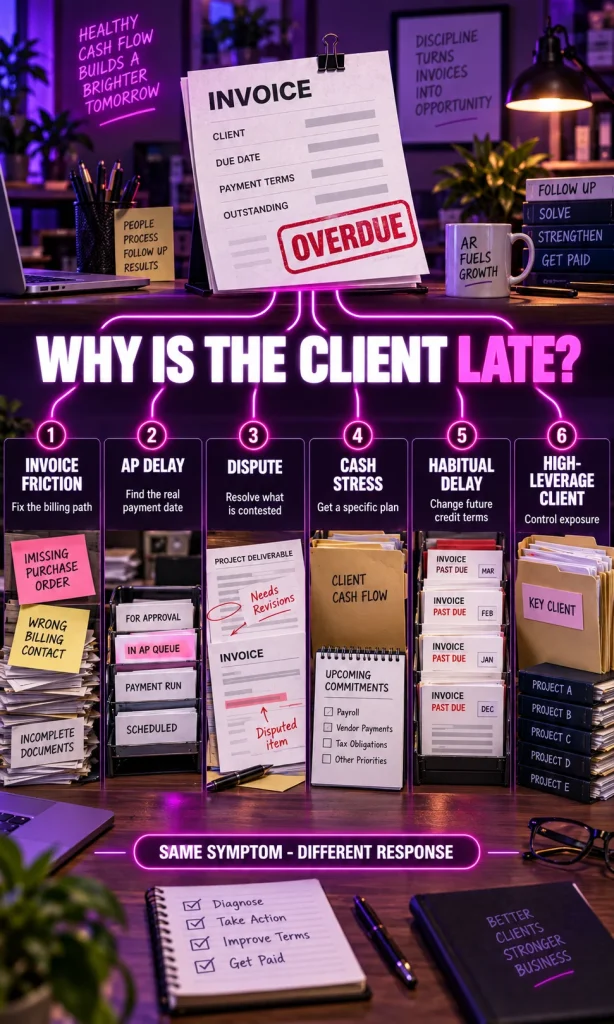
Late payment is an outcome rather than a single cause. Treating every overdue invoice identically can make a simple administrative problem unnecessarily confrontational while giving a chronic slow payer far more patience than the relationship deserves.
A useful diagnosis has six categories.
1. Invoice Friction
The customer intends to pay but something prevents the invoice from moving through their system. Wrong contact details, missing purchase orders, incorrect entity information and inaccessible payment methods belong here.
Fix the blocker first and then confirm the revised payment timing. If the same friction repeats, the client’s billing requirements should become part of your normal business system for recurring work rather than being rediscovered after every invoice.
2. Accounts-Payable Timing
The invoice is valid and approved, but the customer’s payment cycle is slower than the commercial terms suggest. Larger organizations may have scheduled approval runs, internal cutoffs and several levels of sign-off.
The useful response is to identify the real payment event. Ask whether the invoice is approved, which payment run it is scheduled for and what date the funds are expected to be released. “It is with finance” is a status update, not a payment commitment.
3. Genuine Dispute
A client may question scope, quantity, quality, deliverables or the amount billed. Once there is a genuine dispute, repeatedly sending ordinary reminder emails does not address the reason payment stopped.
Separate the disputed portion from everything else conceptually and document the exact issue. The goal is to determine what both sides agree happened, what remains contested and what contract or acceptance evidence is relevant. Serious disputes may require professional legal or commercial advice rather than increasingly aggressive invoice language.
4. Customer Cash Stress
Some customers acknowledge the debt but cannot meet the promised date. Their request for more time may be genuine, but your business is effectively being asked to finance part of their cash-flow problem.
That does not automatically mean ending the relationship. It does mean any revised arrangement should be explicit, documented and evaluated against your own liquidity needs rather than accepted through a sequence of open-ended promises.
5. Habitual Slow Payment
A customer who pays every invoice eventually but consistently ignores the agreed due date presents a different problem from a one-off late payer. The immediate invoice may still be recoverable, but the larger issue is that the customer has effectively rewritten your credit terms without obtaining your agreement.
Track actual payment behavior rather than remembering only the worst incident. If invoices are repeatedly settled well after the agreed date, future work should be priced and structured around the relationship you actually have rather than the payment behavior you originally expected.
The response may include shorter terms, deposits, milestone billing, a lower outstanding-credit limit or requiring an existing balance to be cleared before more work begins. The objective is not punishment. It is preventing the customer’s payment habits from becoming part of your financing model.
6. The High-Leverage Client Problem
Late payment becomes harder to challenge when the customer represents a large share of revenue or future pipeline. The business may hesitate to enforce its own terms because losing the account feels more dangerous than tolerating the delay.
That creates a second risk: commercial dependency can weaken credit discipline.
A large customer can be profitable on paper while still creating financial pressure if it consumes substantial delivery capacity and pays much later than smaller customers. The business should therefore evaluate the account using more than invoice value.
Ask whether the client:
- occupies a large share of delivery capacity
- repeatedly extends payment beyond agreed terms
- requires unusually high administrative effort
- disputes invoices frequently
- expects new work while old balances remain outstanding
- receives more favorable terms than comparable customers
- would create serious cash pressure if payment slipped further
A strategically important customer may justify different commercial treatment, but “important” should not mean “unlimited unsecured credit.”
The Payment Control Ladder

A useful escalation system becomes progressively firmer while preserving a clear record of what happened. Each stage should have a purpose rather than simply repeating the same reminder with stronger wording.
Stage 1: Verify the Invoice
Confirm that the invoice is accurate, addressed correctly and consistent with the agreed scope and payment terms. Check for missing purchase orders, supporting documents, time records, acceptance certificates or other information required by the client.
Do this before escalating. Pressure applied to an invoice that cannot move through the customer’s system wastes time and weakens your position.
Stage 2: Confirm Receipt
Ask the correct billing contact to confirm that the invoice has entered their payment process. If the project contact is not responsible for payment, obtain the accounts-payable contact rather than repeatedly asking someone who cannot release funds.
The objective is simple: establish that the invoice exists inside the customer’s system and identify who controls the next step.
Stage 3: Identify the Blocker
Once receipt is confirmed, ask what specifically prevents payment.
Possible blockers include:
- missing documentation
- internal approval
- incorrect invoice information
- a disputed deliverable
- a missed payment run
- temporary customer cash pressure
- no stated blocker at all
The answer determines whether you need to correct something, resolve a dispute or move toward firmer collection activity.
Stage 4: Send a Structured Reminder
A useful reminder should make the decision easy for the customer. Include the invoice number, original due date, outstanding amount, payment method and a direct request for either payment or an explanation of the blocker.
Avoid long emotional messages. The purpose is to create a clear commercial record and obtain action.
Stage 5: Obtain a Specific Payment Commitment
“Finance is processing it” is not the same as a payment date.
Ask:
When exactly is payment scheduled to be released?
Record the answer. If the customer commits to a date, that date becomes a meaningful checkpoint because a missed commitment tells you more than the original overdue status did.
Stage 6: Decide Whether New Work Continues
This is where invoice management becomes an operating decision.
If the client has a material overdue balance, repeatedly broken payment promises or no credible explanation, continuing to deliver new work increases your exposure. The business should decide deliberately whether to continue, limit or pause additional work rather than allowing projects to continue automatically.
Stage 7: Reset Future Terms
Receiving the overdue payment does not necessarily restore the previous relationship.
If the client has demonstrated that the original terms do not work, adjust future commercial terms before the next engagement begins. A customer who eventually pays after persistent chasing may still be a customer who should receive less credit.
Stage 8: Move Toward Formal Recovery When Appropriate
When normal commercial follow-up has failed, the next step may involve a formal demand, collections professional, lawyer or another recovery method appropriate to the contract, amount and jurisdiction.
Formal recovery has cost, time and relationship consequences. The decision should therefore consider the amount owed, evidence available, client’s financial condition, likelihood of recovery and professional costs rather than escalating automatically because an invoice has reached an arbitrary age.
When Should You Pause New Work for a Late-Paying Client?
Do not use a work pause casually. It can affect contracts, projects, customer relationships and downstream obligations. It can also be one of the most effective ways to stop an unpaid balance from becoming a substantially larger unpaid balance.
A pause deserves serious consideration when financial exposure is increasing while confidence in payment is decreasing.
| Client Situation | Continue Normally? | What to Consider |
|---|---|---|
| First late payment, valid administrative explanation | Often reasonable | Correct the blocker, obtain a payment date and monitor whether the commitment is met. |
| Invoice disputed in good faith | Depends on the dispute | Resolve the commercial issue and check contractual obligations before changing delivery. |
| Promised payment date missed | Review before adding exposure | Ask why the commitment failed and whether additional work would materially increase the unpaid balance. |
| Repeated late payment across several invoices | Not automatically | Consider a credit hold, deposit or revised terms before accepting additional work. |
| No response after repeated documented contact | High caution | Continuing work may increase loss exposure without improving recovery prospects. |
| Large overdue balance plus request for substantial new work | Review urgently | Decide how much additional unsecured credit the business is actually willing to extend. |
Before suspending contracted work, review the agreement and obtain appropriate professional advice where necessary. The operational principle remains useful even when a formal pause is not available: do not allow new exposure to grow invisibly.
A Late-Paying Client May Need Different Terms, Not Immediate Termination
Some late payers are still commercially worthwhile. They may buy regularly, create acceptable margins and eventually pay reliably, but the original payment structure may expose your business to more risk than the relationship warrants.
Instead of making the next engagement identical to the last one, change the financing structure around the work.
1. Use a Deposit When the Business Must Commit Resources Upfront
A deposit can reduce the amount of working capital your business must provide before receiving any payment. It can be especially useful when projects require advance purchasing, reserved capacity or significant early labor.
The deposit should correspond to the commercial structure rather than being chosen arbitrarily. The customer should understand what the payment secures and how it is treated under the agreement.
2. Use Milestone Billing When Value Is Created in Stages
Long projects can become dangerous when nearly all payment is deferred until completion. Milestone billing reduces the amount of completed but unpaid work accumulating at any one time.
Useful milestones should correspond to recognizable stages of progress, acceptance or delivery. Avoid creating so many tiny invoices that administration becomes harder than the risk reduction justifies.
3. Shorten Payment Terms When the Existing Credit Period Is Consistently Abused
If a customer repeatedly pays significantly beyond the agreed term, shortening future terms may reduce the amount of time your business finances the account.
This is not guaranteed to make the customer pay faster. A client who ignores Net 30 may also ignore Net 14. The real improvement comes when shorter terms are combined with active follow-up and limits on how much additional unpaid work can accumulate.
4. Require Payment Before the Next Phase
For customers who have already demonstrated payment problems, a practical condition can be: Existing agreed payment must clear before the next substantial phase begins.
This turns payment from an administrative afterthought into an operating checkpoint. It can be more effective than repeatedly imposing new deadlines while delivery continues unchanged.
5. Set an Internal Credit Limit
Even service businesses that never describe themselves as lenders are extending credit whenever they deliver work before payment.
An internal limit answers: How much unpaid exposure are we willing to carry for this customer at one time?
The limit does not need to appear on the customer’s invoice. It is an internal control that tells the team when additional work requires review.
The appropriate level varies according to cash reserves, customer history, margins, project structure and concentration risk. Avoid inventing a universal percentage.
Should You Charge a Late Fee?
A late fee can encourage timely payment and compensate for some of the cost created by delay, but it should not be improvised after the invoice becomes overdue.
Whether a late fee is enforceable, how it must be disclosed and what limits apply can depend on the contract and jurisdiction. A business should therefore establish the policy in advance and obtain appropriate advice rather than adding an unexpected charge retroactively because a particular customer became frustrating.
A late-fee policy also does not solve every payment problem. Customers can continue paying late and simply dispute the fee, while an administrative blockage remains unaffected by it.
Use late fees as one part of credit policy, not as a substitute for:
- clear terms
- accurate invoices
- active follow-up
- credit limits
- deposits
- milestone billing
- work-pause decisions
When Should a Client Lose Credit Privileges?
The strongest response to chronic late payment is sometimes neither firing the client nor continuing as before.
It is changing the customer from: work now -> pay later
to: pay first -> then work proceeds
That can preserve a commercially valuable relationship while substantially reducing receivables risk.
Consider withdrawing or reducing credit when a client:
- repeatedly pays beyond agreed terms
- misses payment dates they specifically promised
- accumulates several unpaid invoices
- gives vague explanations without verifiable progress
- requires excessive collection effort
- asks for more work while old balances remain unresolved
- creates cash pressure disproportionate to account profitability
- has deteriorating payment behavior over time
Tell the customer what changes before new work begins. Clear commercial terms are usually easier to manage than silently becoming stricter from one invoice to the next.
When Should You Stop Working With a Late-Paying Client?
Do not judge the relationship solely by whether the customer eventually pays. Consider what it costs the business to obtain that payment.
A customer can appear profitable while consuming hidden resources through collection emails, management calls, project interruptions, financing pressure, disputed invoices and uncertainty over whether promised cash will arrive.
The decision becomes stronger when you compare: Revenue and gross profit from the account
Against: delivery cost + collection effort + financing exposure + management disruption + concentration risk
You do not need a sophisticated financial model for every customer. The purpose is to stop treating revenue as if it automatically equals client quality.
A customer may deserve termination or a major terms reset when the payment pattern is chronic, promised dates repeatedly fail, trust has deteriorated and the account no longer provides enough strategic or economic value to justify the risk.
Do Not Confuse Being Firm With Being Aggressive
Professional collection communication should become clearer as risk increases, not more emotional.
A stronger message should specify:
- what remains unpaid
- when payment was originally due
- what commitments have already been missed
- what action is required now
- the date by which a response or payment is expected
- what operational consequence may follow if the issue remains unresolved, where contractually appropriate
Avoid personal accusations, threats you cannot or will not carry out, and unnecessarily hostile language. The purpose of escalation is to create action and protect the business, not win an argument.
The Most Useful Metric Is Payment Behavior, Not the Invoice Due Date Alone
A due date tells you when payment was expected. Payment behavior tells you what kind of client relationship you actually have.
For each material account, track:
- Agreed term – what the contract says.
- Actual payment timing – when funds usually arrive.
- Broken promises – whether specific payment commitments are honored.
- Dispute frequency – how often invoices require intervention.
- Collection effort – how much staff time is required.
- Outstanding exposure – how much unpaid work is currently at risk.
- Future commitment – how much more work is scheduled before the old balance is cleared.
This turns receivables management from memory and frustration into an operating system. It also makes it easier to distinguish a good customer who had one administrative problem from a structurally poor payer who should receive different commercial terms.
Build a Client Payment Risk Profile Before the Next Project
Once a customer has paid late more than once, treat the history as business information rather than an isolated inconvenience. The next quotation, proposal or renewal should reflect what the customer has demonstrated about payment, approval speed and collection effort.
A simple internal profile can classify the account according to four questions:
- Does the client usually pay within the agreed terms?
- If late, do they communicate and honor revised commitments?
- How much unpaid exposure can accumulate before the business feels pressure?
- Does the account remain attractive after collection effort and financing risk are considered?
This does not need to become a formal credit-scoring system. Its purpose is to prevent a team from offering the same terms indefinitely to a customer whose behavior has clearly changed.
Reset the Commercial Terms Before Accepting More Work
When an overdue invoice is eventually paid, there is a temptation to consider the problem finished. That can be a mistake if the underlying relationship has not changed.
The better question is:
What must be different before this client creates another receivable?
Depending on the account, the answer may involve one or more of the following:
- a deposit before work begins
- a larger upfront payment
- shorter payment terms
- milestone billing
- payment before the next project phase
- a lower internal credit limit
- fewer simultaneous open invoices
- a named accounts-payable contact
- purchase-order requirements confirmed before work begins
- automatic invoice reminders
- a requirement that old balances clear before new work starts
The change should correspond to the reason payment was late. A client with recurring administrative confusion needs a cleaner billing process, while a client with chronic cash stress may require less credit exposure.
Prevent Late Payment Before the Invoice Exists
The strongest receivables control happens before work begins. Once a substantial amount of value has already been delivered, the supplier has fewer practical options and more money at risk.
1. Confirm the Commercial Terms in Writing
The agreement should make the payment expectation clear before delivery begins. That includes when invoices will be issued, when payment is due, what triggers milestone billing, what information the customer must provide and what happens if the agreed payment process is not followed.
Avoid relying on assumptions such as “they usually pay in 30 days.” If the commercial relationship matters, the payment structure should be explicit.
2. Identify the Billing Process Before the First Invoice
Ask who receives invoices and whether the customer requires:
- a purchase order
- vendor registration
- specific invoice wording
- project codes
- timesheets
- delivery evidence
- acceptance records
- tax information
- portal submission
- another internal approval document
A customer may consider an invoice incomplete until those requirements are met. Discovering them after the due date creates delay that could have been prevented.
3. Invoice at the Agreed Trigger
An invoice sent late cannot be collected on time. Service businesses sometimes delay billing because the founder is busy delivering work, while larger organizations may lose days waiting for internal project information.
Build invoicing into the operating process rather than treating it as end-of-month housekeeping. Where the business uses milestone billing, the invoice trigger should be connected directly to the corresponding project stage.
4. Make Payment Easy
Payment friction can extend receivables even when the customer is willing to pay. Provide the payment information and methods appropriate to the business, transaction and customer rather than making the payer request basic instructions.
Do not confuse convenience with weak credit control. Making payment easy and maintaining firm payment expectations can operate together.
Create a Receivables Escalation Policy Before You Need One
Owners often become inconsistent because every overdue account is handled according to mood, client importance or current cash pressure. A written escalation policy reduces that improvisation.
The policy should answer:
- Who follows up?
Assign responsibility so overdue invoices do not sit unnoticed because everyone assumes someone else is chasing them. - What happens when an invoice first becomes overdue?
Define the initial verification and reminder process. - When is a promised payment date considered broken?
Record customer commitments rather than starting the process again every time a new excuse appears. - When does management review additional work?
Set a point at which commercial exposure requires deliberate approval. - When are future terms reconsidered?
Do not wait until several late invoices have accumulated before changing the relationship. - When is professional recovery considered?
Define the circumstances that justify moving outside normal client communication.
A consistent policy does not mean treating every customer identically. It means using the same decision logic while allowing the actual facts to change the outcome.
Use an Overdue-Invoice Decision Record for Material Accounts
For a small overdue invoice from a reliable customer, an elaborate process may be unnecessary. For larger balances or strategic accounts, a short written decision record can prevent important details from being lost between finance, sales and delivery teams.
Record:
- invoice amount and original due date
- outstanding balance
- client contact responsible for payment
- whether receipt was confirmed
- whether any amount is disputed
- customer’s explanation
- promised payment date
- whether that commitment was met
- new work currently underway
- additional exposure if work continues
- next agreed action
- future term change under consideration
This becomes especially useful when the person protecting the customer relationship is different from the person managing cash collection. Both sides can evaluate the same facts instead of arguing from incomplete information.
Sales and Delivery Teams Should Know When Credit Risk Has Changed
A common operational failure occurs when finance is chasing an overdue balance while sales accepts another project and delivery begins work immediately. The company increases its exposure because information about payment risk has not reached the people capable of creating more receivables.
The solution does not require every salesperson to become a credit controller. They simply need a clear signal when an account requires review before additional commitments are accepted.
A practical workflow can use states such as:
- Normal – account operating within agreed terms.
- Watch – payment delayed or a commitment needs monitoring.
- Review before new work – repeated delay, broken commitment or material outstanding balance.
- Credit hold / management decision – additional exposure should not be created automatically.
The labels are internal operating cues, not legal classifications. Their purpose is to make sure the business behaves consistently when payment risk changes.
How to Respond When a Client Says, “We Are Waiting to Be Paid”
A customer’s own cash-flow problem can explain a delay, but it does not automatically transfer responsibility for financing that delay to your business. Unless your agreement explicitly links payment to the customer’s receipt of funds, their downstream payment cycle may be commercially relevant without changing what was originally due.
Respond by clarifying:
- whether the invoice is approved
- what amount is undisputed
- when payment is realistically expected
- whether a partial payment is possible
- whether additional work should continue
- what future terms will apply if the delay becomes recurring
Avoid turning the conversation into an argument about whose cash flow matters more. The objective is to obtain a concrete plan while protecting your own exposure.
How to Handle a Request for a Payment Plan
A payment plan can be preferable to indefinite uncertainty when the customer acknowledges the amount but cannot settle it immediately. It should convert a vague delay into specific obligations rather than simply giving the customer more time without structure.
Before agreeing, consider:
- the total outstanding amount
- whether the debt is disputed
- how much can be paid immediately
- the proposed installment dates
- the customer’s history of honoring commitments
- whether new work will continue during the plan
- what happens if an installment is missed
- whether professional advice is appropriate for the amount or circumstances
Document any agreed arrangement clearly. An informal promise that “we’ll send something every few weeks” is not a useful payment plan.
Do Not Let One Overdue Client Control the Entire Business
Late payment becomes strategically dangerous when one customer is large enough to affect payroll, supplier payments, tax obligations or the owner’s ability to accept other work. At that point, receivables risk overlaps with customer concentration.
The problem is not simply that the client is late. It is that the business has allowed one account’s payment behavior to determine too much of its own financial stability.
Reducing that exposure may require:
- changing future payment terms
- lowering the maximum unpaid balance
- invoicing earlier
- using deposits or milestones
- diversifying the customer base
- avoiding additional work until old balances clear
- building stronger cash reserves
- reducing dependence on a single account for future pipeline
A large client can remain valuable while still requiring tighter financial boundaries.
When Formal Recovery Becomes the Next Decision
Normal commercial follow-up has limits. If the client stops communicating, refuses an undisputed payment, repeatedly breaks commitments or appears unable to pay, the business may need to consider a more formal recovery route.
Before escalating outside the normal relationship, organize the evidence. That may include the signed agreement, purchase order, scope, delivery records, acceptance evidence, invoices, correspondence, reminders, payment promises and any documented disputes.
The appropriate recovery route depends on the amount, jurisdiction, contractual terms and circumstances. It may involve a formal demand, collection service, mediation, legal advice or another process, but those options carry their own cost and should not be selected mechanically.
Do a Recovery Economics Check
Before spending significant time or professional fees, compare: Amount potentially recoverable
Against: professional cost + internal time + likelihood of recovery + relationship consequence
A large invoice with clear documentation and a solvent client may justify a different approach from a small balance owed by a customer that appears to have ceased trading. Recovery is a business decision as well as a legal process.
The Best Outcome Is Not Simply Getting Paid
Receiving the money closes the receivable. It does not necessarily solve the client relationship.
After a material late-payment incident, complete a short review:
- Why did payment become late?
- Could our own process have prevented part of the delay?
- Did the customer communicate reliably?
- Were promised dates honored?
- Did we continue adding exposure after warning signs appeared?
- Did the account remain economically worthwhile?
- What terms should change next time?
- Should this customer still receive credit?
This final step prevents the same invoice problem from returning under a new project number.
The Late-Payment Decision Framework
The entire process can be reduced to five decisions.
1. Is the Invoice Administratively Ready to Be Paid?
If not, fix the invoice, supporting documentation or billing path.
2. Is There a Genuine Commercial Dispute?
If yes, resolve the disputed issue rather than treating it as ordinary collections activity.
3. Has the Client Made and Honored a Specific Payment Commitment?
A missed commitment increases concern because it provides stronger evidence about payment behavior than the overdue date alone.
4. Should the Business Keep Increasing Its Exposure?
Decide whether to continue work, limit it, pause it where appropriate or require payment before the next phase.
5. What Must Change Before the Next Invoice Exists?
Reset the payment structure according to what the customer has demonstrated.
A late invoice is therefore not only a collection event. It is information about how much credit the business is extending, whether the client respects the commercial agreement and whether future work should be structured differently.
How Many Payment Reminders Should You Send Before Escalating?
There is no universal number of reminders that makes escalation appropriate. A client who responds promptly, explains a genuine administrative problem and gives a credible payment date may deserve more flexibility than a client who ignores repeated contact or misses a date they personally committed to.
What matters more than the reminder count is whether each contact produces new information or action.
If five emails all say “just following up,” the business has not really completed five escalation stages. It has repeated the same stage five times.
A useful sequence is:
- Confirm receipt and remove administrative blockers.
- Request payment against the agreed due date.
- Ask for a specific payment date if immediate payment is not possible.
- Follow up immediately when that commitment is missed.
- Review whether additional work or credit should continue.
- Move toward formal recovery when ordinary commercial communication is no longer producing credible progress.
The sequence can move faster when the client becomes unresponsive, exposure is substantial or there are indications that recovery risk is increasing.
What to Say to a Late-Paying Client
Good collection messages should become more specific as the situation develops. They do not need to become hostile.
First Overdue Follow-Up
Hi [Name], invoice [number] for [amount] was due on [date]. Could you confirm that it has reached the correct person for payment and let me know whether anything is needed from us to process it? If everything is in order, please confirm the expected payment date.
This message checks for friction before assuming bad intent.
When the Client Says Payment Is Being Processed
Thanks for confirming. Could you let me know the specific date the payment is scheduled to be released? I would like to update our receivables record accurately.
The purpose is to replace a vague status with a measurable commitment.
When a Promised Payment Date Is Missed
We had recorded [date] as the agreed payment date for invoice [number], but payment has not yet arrived. Please confirm what changed and provide the revised payment date today. We are also reviewing whether additional work can continue while the outstanding balance remains unresolved.
This message introduces the operational consequence without unnecessary aggression.
When Future Terms Need to Change
Thank you for settling the outstanding invoice. Because payment has repeatedly extended beyond the agreed terms, future work will need to proceed under revised payment arrangements. We will confirm those terms before the next project begins.
The current invoice and the future credit decision are kept separate.
What Not to Do When a Client Pays Late
Several common reactions make collection harder or increase the amount at risk.
1. Do Not Keep Delivering Automatically
Finishing more work can feel like protecting the relationship, but it also increases exposure. If the client is already failing to meet payment commitments, additional delivery should become a conscious business decision.
2. Do Not Invent New Penalties After the Invoice Is Late
Do not suddenly add fees, interest or consequences that were never agreed or legally established. Payment remedies should be supported by the contract and applicable rules.
3. Do Not Threaten Action You Will Not Take
Repeated claims that an account is receiving a “final warning” lose credibility when business continues normally afterward. Escalation should correspond to a real next step.
4. Do Not Let Sales Promise New Work Without Checking Receivables
A salesperson may see a valuable new opportunity while finance sees a customer whose outstanding balance is already creating risk. Those two views must meet before further credit is extended.
5. Do Not Treat Every Late Client as Dishonest
Administrative errors and genuine disputes do happen. An unnecessarily hostile first response can damage a relationship that could have been resolved quickly.
6. Do Not Treat Every Eventual Payer as a Good Payer
A client who always pays after extensive chasing still creates collection cost and financing exposure. Payment eventually arriving does not erase those costs.
Should You Offer an Early-Payment Discount?
An early-payment discount can improve cash timing in some relationships, but it is not automatically the best response to chronic lateness.
The business is giving up part of its invoice value in exchange for faster cash. That trade can make sense when the value of faster payment exceeds the discount and when the customer actually changes behavior.
Before offering one, consider:
- whether the margin can absorb the discount
- whether the customer is likely to respond
- whether faster cash has meaningful value to the business
- whether the customer already ignores contractual terms
- whether a deposit or milestone structure would solve the problem more directly
Do not use discounts merely to persuade customers to comply with payment terms they already accepted.
Net 30 Does Not Mean the Client Can Pay Whenever It Wants
Net 30, Net 14 or another payment term describes an agreed payment period. It is not a prediction of when the customer happens to prefer releasing funds.
If the business routinely accepts payment well beyond the agreed term without changing anything, the effective commercial term can become much longer than the written one.
That matters for cash planning.
For example, a business may believe it sells on Net 30 while its actual customers consistently pay much later. Staffing, supplier commitments and growth decisions then operate against an assumption that does not match real cash behavior.
Track actual payment timing and design credit policy around reality.
Late Payment Can Make a Profitable Client Less Valuable
Profitability calculations often focus on the cost of delivering the work. Late payment introduces additional costs that are less visible.
These may include:
- employee time spent chasing invoices
- founder attention diverted from sales or delivery
- financing costs created by the cash gap
- postponed supplier payments
- delayed hiring or investment
- additional administrative work
- uncertainty around planned spending
- higher risk of ultimate non-payment
A customer does not become unprofitable automatically because they pay late, but the payment pattern belongs in the commercial evaluation.
The Relationship Should Improve After a Late-Payment Problem
A well-managed payment incident should leave the next transaction safer than the previous one.
If nothing changes after a serious late-payment episode, the business has learned about the risk but has chosen not to use that information.
The improvement may be small:
Before: invoices went to the project manager.
After: invoices go directly to accounts payable with the required PO.
Or structural:
Before: all work was completed before invoicing.
After: the customer pays a deposit and then milestone invoices.
Or commercial:
Before: the client received open-ended credit despite repeated lateness.
After: old balances must clear before additional work begins.
The appropriate response depends on what caused the problem.
A Practical Late-Payment Review After Every Material Incident
When the balance is resolved, answer these questions while the details are still fresh:
| Review Question | What It Reveals | Possible Change |
|---|---|---|
| Why was the invoice late? | Root cause | Fix billing process, dispute prevention or credit structure |
| Was our invoice complete and correctly routed? | Internal process quality | Improve invoice checklist |
| Did the client communicate clearly? | Relationship reliability | Adjust monitoring level |
| Were promised dates honored? | Payment discipline | Reduce credit if commitments repeatedly fail |
| Did we continue adding exposure? | Internal control weakness | Add work-review checkpoint |
| How much effort did recovery require? | Hidden account cost | Reassess profitability |
| Would we offer the same terms again? | Credit decision | Deposit, milestone, shorter terms or prepayment |
| Would we accept more work today? | Relationship quality | Continue, restrict or exit |
The purpose is not to create paperwork. It is to stop the same problem from repeating unnoticed.
Frequently Asked Questions About Late-Paying Clients
How soon should I chase an overdue invoice?
Follow up once the agreed due date has passed unless your contract or normal business process establishes another schedule. The first contact should usually confirm that the invoice was received, is accurate and is not blocked by a purchase order, approval or other administrative requirement. If the customer confirms the invoice is valid, ask for a specific payment date rather than relying on a vague statement that it is being processed.
How many reminders should I send before escalating?
There is no universal reminder count. Escalation should depend on the customer’s response, the amount at risk, whether payment promises are being kept, whether there is a genuine dispute and whether additional unpaid work is accumulating. Repeating the same reminder many times is usually less useful than moving through clear stages such as verification, payment commitment, work review, revised terms and formal recovery where appropriate.
Should I stop working for a client who has not paid?
A work pause may deserve consideration when payment confidence is falling while the business continues increasing its unpaid exposure. The appropriate action depends on the contract, the reason for non-payment, the amount owed and applicable law. Before stopping contracted work, review your obligations and obtain professional advice when necessary. Even when work cannot be paused immediately, the business should still monitor how much additional credit it is extending.
What should I do if a client always pays late but eventually pays?
Repeated late payment should be treated as a credit-policy issue rather than a series of isolated accidents. Once the current balance is resolved, consider changing future terms through deposits, milestone billing, shorter credit periods, lower outstanding limits or requiring old balances to clear before new work begins. Evaluate the customer according to actual payment behavior rather than the fact that payment eventually arrives.
Can I charge a late fee if the invoice is overdue?
Late-fee rights depend on the agreement and applicable law. A business should not assume it can create a new penalty after the customer is already overdue. Establish any late-fee policy in advance, disclose it appropriately and check the requirements that apply in the relevant jurisdiction. A fee is also only one part of credit control and does not replace clear terms, accurate invoicing and active follow-up.
What should I do if the client says they are waiting to be paid by someone else?
Ask whether your invoice has been approved, what amount is undisputed and when payment is realistically expected. The customer’s own cash-flow problem may explain the delay but does not automatically determine your payment rights, which depend on the agreement and applicable law. Consider whether a partial payment, revised payment arrangement or restriction on additional work is appropriate while the balance remains outstanding.
Should I accept a payment plan from a late-paying client?
A structured payment plan can be useful when the customer acknowledges the balance but cannot pay it immediately. The arrangement should specify the amount due, installment dates, what happens to new work and how missed installments will be handled. Consider the customer’s previous payment behavior and obtain professional advice where the amount or circumstances justify it.
Should I change a late-paying client’s payment terms?
Yes, when the customer’s actual payment behavior shows that the existing terms create more exposure than the business is comfortable carrying. Possible changes include deposits, milestone billing, shorter terms, lower credit limits or payment before additional phases begin. The adjustment should respond to the reason for the delay rather than being applied automatically as a punishment.
When should an overdue invoice go to collections or a lawyer?
Formal recovery becomes more relevant when ordinary commercial follow-up is no longer producing credible progress, the customer is unresponsive, an undisputed balance remains unpaid or recovery risk is increasing. The appropriate route depends on the amount, evidence, contract, customer condition and jurisdiction. Compare the potential recovery with professional cost, internal time and likelihood of success before choosing the next step.
How can I prevent clients from paying late?
Prevention starts before the invoice is issued. Confirm payment terms, identify the correct billing contact, understand purchase-order and vendor requirements, invoice promptly, provide appropriate payment information and use deposits or milestone billing when the project structure justifies them. Track actual payment behavior so customers with repeated problems receive different terms before the next project begins.
Next Steps: Treat Late Payment as a Credit Decision
The first overdue invoice requires a payment response. Repeated late payment requires a commercial-policy response.
Start by verifying the invoice and diagnosing the blocker. Obtain a specific payment commitment rather than accepting vague assurances. If commitments are broken or the balance continues growing, decide whether the business should keep extending additional credit through new work.
Once the invoice is resolved, use what happened to change the next transaction. That may mean a better invoicing process, a deposit, milestone billing, shorter terms, an internal credit limit or requiring old balances to clear before additional work begins.
The central decision is: How much more unpaid exposure are you willing to create for this customer based on what their payment behavior has already shown you?
That question moves the business beyond chasing invoices and toward managing receivables deliberately.
Invoice Recovery Studio
Diagnose the delay, choose the next escalation, and decide whether new work or future credit should continue.
Invoice status
Start with what is objectively true about the unpaid invoice.
Client behavior
Payment behavior often matters more than the reminder count.
Exposure and local context
Use these questions to judge how much additional credit the business should keep extending.
Find the right local category without inventing providers
This experience never fabricates business names, ratings, distances, or availability. Use the recommended category and your location to open a real search, then paste the best candidates below.
Compare 3-5 nearby choices from your own search
Enter only information you actually found. The comparison score ranks your entries for fit and completeness; it is not a guarantee of provider quality or recovery success.
Decision support only. Contract rights, late fees, work suspension, worker actions, debt recovery, and legal remedies can vary by agreement and jurisdiction. Use qualified professional advice when the stakes justify it.