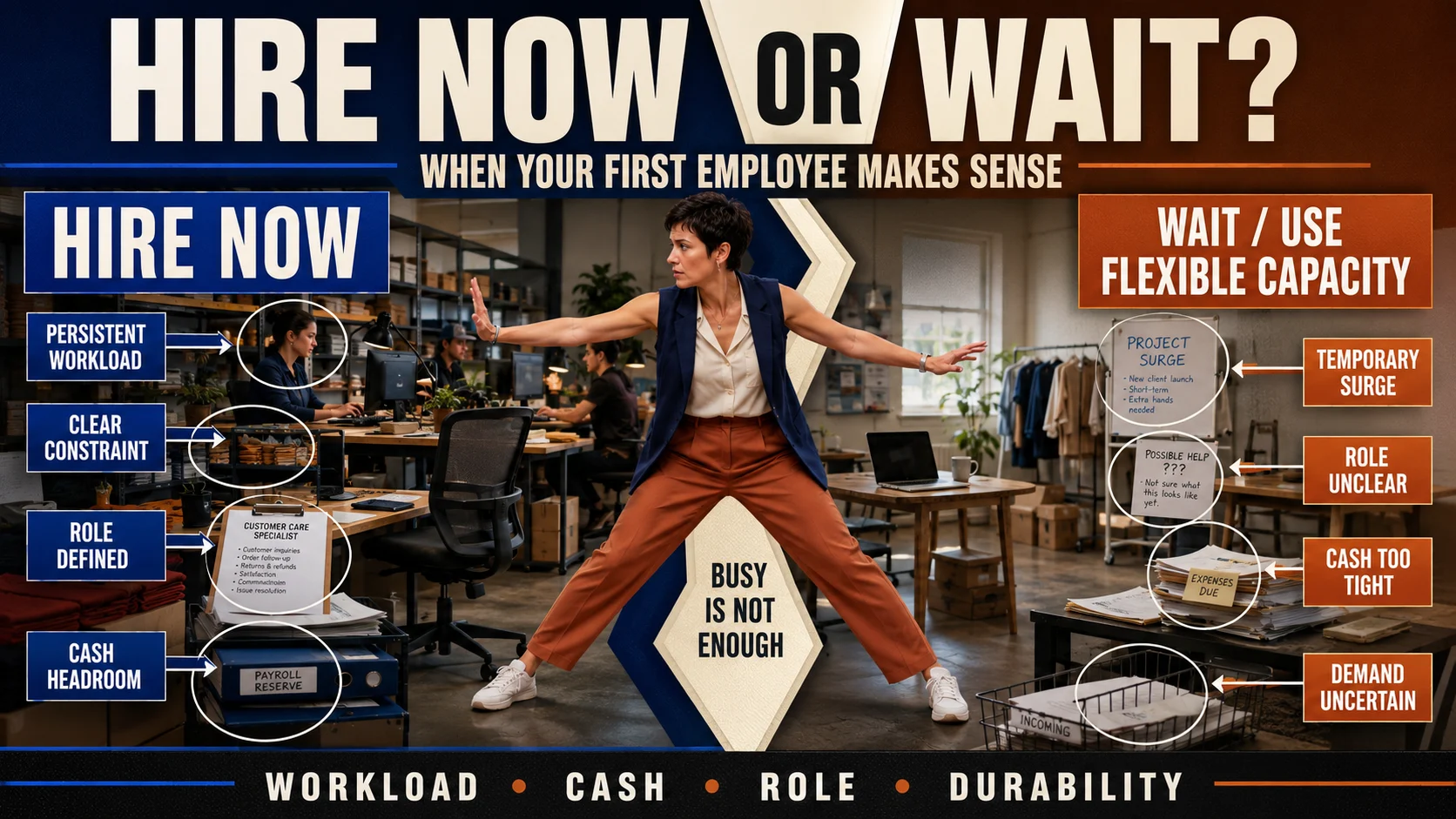

A small business is usually ready for its first employee when the workload problem is persistent rather than temporary, the new role solves a clearly defined capacity constraint, and the business can carry the full ongoing employment cost without depending on one unusually strong month. Being busy is evidence worth investigating, but it is not enough by itself. The stronger signal is that profitable or necessary work repeatedly cannot be completed with the capacity the business already has.
There is no universal revenue level that tells every owner when to hire. A consulting company, restaurant, home-service business and online retailer can produce the same revenue with completely different labor requirements, margins and cash-flow timing. The useful question is therefore not “How much revenue should I make before hiring?” but “What constraint would this employee remove, and would removing it create or protect enough business value to justify the continuing commitment?”
The Quick Decision: Hire, Prepare, or Wait
A first employee makes more sense when several signals appear together. Demand should be reasonably durable, the owner should know which recurring responsibilities the person will take over, and the business should have enough financial headroom to absorb wages plus the additional costs of becoming an employer. If those conditions are still unclear, another sale is not automatically evidence that permanent payroll is the correct next move.
The opposite mistake is waiting until the owner is already overwhelmed. When quotes go unanswered, good customers wait too long, quality slips or profitable work is repeatedly rejected because one person cannot deliver everything, the business may already be paying for insufficient capacity through lost opportunity and operational strain. The cost of a hire should therefore be compared with the cost of remaining understaffed, rather than being viewed in isolation.
A useful first distinction is whether the problem is a temporary spike, an inefficient process or a durable capacity shortage. A seasonal rush may justify temporary help. Repetitive administrative work may be reduced through better systems or automation. Recurring skilled work that the business can consistently sell and deliver may provide a much stronger case for employment.
| What You Are Seeing | Hiring Signal | What to Check First |
|---|---|---|
| Profitable work is repeatedly being turned away | Strong signal | Confirm the work is recurring and the new role can actually increase delivery capacity. |
| One unusually busy month created a backlog | Weak signal | Determine whether demand persists after the temporary peak. |
| The owner spends large amounts of time on recurring low-leverage work | Potential signal | Test whether the work should be removed, standardized, automated, outsourced or employed. |
| Customers are waiting longer and service quality is deteriorating | Strong capacity warning | Identify exactly where the delivery bottleneck occurs before defining the role. |
| The owner wants someone who can “help with everything” | Not ready yet | Define the recurring outcome, responsibilities and success measures before recruiting. |
| Revenue is growing but cash is frequently tight | Financial caution | Test cash timing and the full employment commitment rather than relying on accounting profit alone. |
The Real Decision Is Capacity vs Commitment
Hiring creates capacity, but it also creates a recurring commitment that continues after today’s backlog disappears. That makes the first employee different from buying a piece of equipment for one project or bringing in specialist help for a limited assignment. The owner is adding another person to the operating model and taking responsibility for payroll, management, training and the employment obligations that apply in the relevant jurisdiction.
The decision becomes stronger when the business can describe both sides clearly. On the capacity side, identify what additional work the employee would make possible or what important existing work they would protect. On the commitment side, identify the complete recurring cost, the owner’s management time and how the role would remain useful if sales temporarily softened.
Test 1: Is the Workload Persistent Enough to Hire For?
Look backward before forecasting forward. A business that has been overloaded consistently for several operating cycles has stronger evidence than one reacting to an unusually successful week, one large customer or a seasonal peak.
Review the work that could not be completed with existing capacity. Separate recurring demand from work generated by a promotion, temporary contract, short-term backlog or one exceptional customer. An employee is easier to justify when the underlying need remains visible after those temporary influences are removed.
The strongest evidence is not simply that the owner feels busy. It is that the business can identify recurring work that is being delayed, rejected or performed at an unacceptable level because capacity has become the limiting factor.
Test 2: What Exactly Is Breaking Because You Have No Employee?
Do not begin with the job title. Begin with the constraint.
If potential customers wait days for quotes because the owner is always delivering work, sales responsiveness may be the constraint. If sales are healthy but customer projects start late, delivery capacity may be the problem. If good work is being completed but invoicing, scheduling and customer follow-up are failing, administrative capacity may deserve attention before another technical hire.
The first employee should therefore be hired against a specific recurring failure, not against the general feeling that the owner needs help. That distinction makes the job easier to design and later gives the business something concrete to measure.
I can continue next with the full-cost affordability test, why there is no universal revenue threshold, how to calculate the cost of waiting, how to choose the first role, employee vs part-time vs contractor vs automation, and the First-Hire Readiness Test.
Because demand around first-hire decisions is actively changing, I can also periodically recheck this query family and flag a stronger emerging reader problem before we select future Business articles.
Test 3: Can the Business Carry the Full Cost of the Hire?
The advertised wage or salary is only one part of the commitment. A first employee can also create payroll taxes, insurance obligations, benefits, equipment, software licenses, workspace, recruitment costs, training time and management time, with the exact mix depending on location, employment structure and the role itself. The IRS guidance for businesses with employees explains that employers generally take on withholding, reporting, depositing and employment-tax responsibilities once workers are treated as employees.
That is why a simple rule such as “hire when revenue reaches a certain amount” is unreliable. Two businesses earning the same revenue can have very different gross margins, cash timing, recurring expenses and labor requirements. The better affordability test asks whether the business can support the full recurring commitment under reasonably conservative operating conditions, rather than whether there is enough money in the bank after one strong month.
Build the First-Hire Cost Picture Before Recruiting
Do not invent a universal multiplier for employment cost. Instead, build the cost picture from the categories that actually apply to your business.
| Cost Category | What May Be Included | Cost Pattern | What Owners Commonly Miss |
|---|---|---|---|
| Direct pay | Salary, hourly wages, overtime or commissions where applicable | Recurring | Variable hours or overtime during busy periods |
| Employer obligations | Employment taxes, required insurance and jurisdiction-specific contributions | Recurring | Costs that do not appear in the employee’s quoted wage |
| Benefits | Health coverage, retirement contributions, paid leave or other offered benefits | Recurring | Benefit costs that increase the continuing commitment |
| Work setup | Computer, phone, tools, protective equipment, furniture, vehicle access or uniforms | Mostly one-time with replacement costs | Specialist equipment or duplicate software stacks |
| Software and access | Email, project systems, accounting access, CRM seats or industry software | Recurring | Per-user subscriptions that accumulate across several systems |
| Recruitment and onboarding | Job advertising, screening, background checks where appropriate, onboarding and training | Mostly upfront | The owner’s own time spent recruiting and training |
| Management capacity | Supervision, review, feedback, scheduling and problem resolution | Recurring | A hire can temporarily increase the founder’s workload before reducing it |
The affordability calculation should also reflect timing. A business may be profitable over a month or quarter while still experiencing periods when payroll must be paid before customers pay their invoices. The first-hire decision therefore needs enough cash-flow resilience to handle normal collection delays and weaker-than-expected weeks without making payroll dependent on the next customer payment arriving exactly on time.
There Is No Universal Revenue Threshold for a First Employee
A revenue threshold sounds useful because it produces a simple answer, but it ignores the economic structure underneath the revenue. A company with high gross margins and predictable recurring contracts may support employment at a revenue level that would be uncomfortable for a low-margin company with volatile demand and significant inventory or equipment costs.
Instead of asking whether revenue has crossed a particular number, ask whether the incremental capacity created by the employee has a credible economic purpose. The role may create value by allowing the company to complete additional profitable work, protect existing customer relationships, reduce expensive errors, speed invoicing, improve sales responsiveness or free the owner to perform work with a substantially higher contribution to the business.
Use a Conservative Affordability Scenario
Build at least three internal scenarios before hiring:
- Expected case: demand continues roughly as anticipated and the role performs as planned.
- Soft-demand case: sales or project volume falls below the recent average while the employment cost continues.
- Slow-ramp case: the employee takes longer than expected to reach useful productivity.
The purpose is not to produce a perfect forecast. It is to discover whether the hiring decision only works under an unusually optimistic scenario.
If the business can support the role only when every current customer stays, no payment is delayed and the employee becomes fully productive immediately, the financial margin for error may be too narrow.
Test 4: What Is the Cost of Waiting Too Long?
Hiring too early creates unnecessary fixed cost, but waiting too long also has a price. Owners often calculate the employee’s cost carefully while treating lost capacity as free, even when the business is already rejecting profitable work, delivering late or spending senior time on activities that could be transferred.
The cost of waiting can appear in several forms:
- profitable jobs repeatedly declined because capacity is unavailable
- slower response times that reduce conversion
- customer churn caused by inconsistent service
- overtime or burnout that lowers quality
- delayed invoicing or collection
- founder time consumed by routine delivery instead of higher-value work
- projects starting late because one critical person is overloaded
- opportunities postponed because the business cannot absorb another customer
- mistakes caused by excessive workload
Some of these effects are difficult to measure precisely, but that does not mean they should be ignored. The useful comparison is ongoing hire cost versus ongoing capacity loss, with uncertainty acknowledged on both sides.
Estimate the Opportunity Already Being Lost
Look backward at real operating evidence rather than starting with a large growth forecast. Count how many qualified jobs were rejected, how much work was delayed, how many customers waited beyond the normal service level and how many hours the owner spent performing recurring tasks that another role could reasonably own.
Suppose the owner believes hiring someone will create enough time to double sales. That is a weak assumption unless there is evidence that sales opportunities already exist and that owner capacity is the actual barrier. A stronger case begins with visible demand or operational work that the business is already failing to serve.
Test 5: Can You Define the First Role Clearly?
The phrase “I need someone to help me” is a warning sign because it describes the owner’s frustration rather than the employee’s job. A first hire is easier to recruit, train and evaluate when the business can identify the recurring outcome the person is expected to improve.
Start with the bottleneck identified earlier. If quotations are slow, the role may need to support estimating or sales administration. If work is sold but cannot be delivered, production or service capacity may be the priority. If the owner loses hours each week to scheduling, invoicing and coordination, an administrative or operations role may unlock more useful owner capacity than another revenue-producing specialist.
Choose the Role From the Constraint
Use the failure point to define the hire.
| What Is Breaking? | Role Direction to Examine | Wrong-Hire Warning |
|---|---|---|
| Sold work cannot be delivered fast enough | Delivery, production, technical or service capacity | Hiring administration while the delivery bottleneck remains unchanged |
| Leads wait too long for quotes or follow-up | Sales support, estimating or customer coordination | Hiring more production capacity when unsold opportunities are the real issue |
| Owner spends excessive time on scheduling, invoicing and coordination | Administrative or operations support | Hiring a vague generalist with no defined recurring outcomes |
| Customer problems are increasing after the sale | Customer success, support or quality coordination | Adding sales while post-sale capacity remains overloaded |
| Work repeatedly stops for founder approval | First examine decision rights and systems | Hiring another person who will simply join the approval queue |
This is where small business roles and responsibilities become especially useful. The owner should be able to define what the employee owns, what work remains with the founder and what decisions the employee can make without repeatedly seeking approval.
Do Not Hire Around a Broken Process
A first employee can expose operating weaknesses that a solo owner previously absorbed personally. The founder may know how to prioritize customers, find missing files, correct unusual orders and remember unwritten deadlines without realizing that those decisions are undocumented.
That is why the company should review the recurring workflow before the employee arrives. The business systems needed for repeatable work do not need to be perfect, but the new employee should have enough structure to understand the expected outcome, normal process, decision boundaries and escalation path.
If none of that exists, the founder may spend substantial time answering questions that feel obvious only because the answers have always lived in the founder’s head.
Test 6: Are You Ready to Manage Another Person?
Financial readiness does not automatically create management readiness. A first employee changes the founder’s job because someone now needs direction, feedback, access, training, priorities and decisions that previously occurred privately.
Before hiring, the owner should be able to explain:
- what result the role owns
- which recurring responsibilities belong to the role
- what a good week or month looks like
- which decisions the employee can make
- which matters require escalation
- how priorities will be communicated
- what training is required
- how performance will be reviewed
- where the employee can find the information needed to work
This does not require a corporate HR department. It requires enough clarity that the employee is not expected to infer the entire job from whatever the founder happens to mention each morning.
The First Hire Often Makes the Founder Busier Before It Makes Them Freer
New employees need onboarding, context and feedback. During the first part of the relationship, the owner may temporarily spend more time explaining work than they previously spent doing it personally.
That temporary management load is normal when it leads toward independent capability. The warning sign is a role that remains permanently dependent because the owner never transfers decision authority, operating knowledge or ownership of a result.
Test 7: Would the Role Still Make Sense If Demand Softened?
The first hire should be tested against more than today’s backlog. Ask what the person would own if the current busy period became quieter.
A durable role often contains recurring responsibilities that remain valuable across normal demand fluctuations. A project-specific surge, one unusually large customer or a temporary contract may produce genuine workload without creating a long-term employment need.
This does not mean businesses should wait until demand is guaranteed. Business decisions always involve uncertainty. It means the role should have enough durable operating value that the hiring case does not disappear immediately when the peak passes.
Employee, Part-Time Help, Contractor or Automation?
A permanent full-time employee is only one way to add capacity. The best option depends on how predictable the workload is, how integrated the work must be with the business, whether specialist expertise is needed and whether the working arrangement legally fits the structure being considered.
| Capacity Option | Strongest Fit | Main Limitation |
|---|---|---|
| Full-time employee | Durable recurring workload that needs close integration with normal operations | Largest continuing commitment and management responsibility |
| Part-time employee | Recurring work exists, but the volume does not yet justify a full-time role | Availability may limit coverage and the role still carries employment obligations |
| Independent contractor | Legitimate independent specialist work or clearly defined project capacity | Classification depends on the actual working relationship, not simply what the contract calls it |
| Temporary staffing | Seasonal demand, short-term workload spikes or temporary coverage | May cost more per working hour and provide less continuity |
| Automation | Stable repetitive work with clear inputs, rules and outputs | Cannot replace judgment-heavy work or repair an unclear process |
| Process redesign | Workload is being created by duplication, poor handoffs or unnecessary steps | Does not create additional human capacity when genuine demand exceeds the team’s limit |
Do Not Use “Contractor” as a Cheaper Label for an Employee
An owner should not choose worker classification simply according to which arrangement appears less expensive. The IRS guidance on independent contractors and employees explains that worker status depends on the facts of the relationship and that no single factor or contract label determines the result.
Classification rules can differ by jurisdiction and purpose, so businesses should apply the requirements relevant to where they operate. The practical capacity question and the legal classification question are related, but they are not interchangeable.
The Alternative Capacity Test
Before creating permanent payroll, ask whether the constraint can be removed more effectively another way.
1. Eliminate
Is the work still necessary? Some owner workload exists because old reports, duplicate approvals or low-value tasks have never been removed.
2. Simplify
Can the process be shortened or standardized so the existing business handles more volume without another person?
3. Automate
Is the work predictable enough for software to handle repetitive execution reliably?
4. Buy Specialist Capacity
Would a legitimate independent provider or specialist solve a narrow problem more effectively than creating an internal role?
5. Add Limited Employee Capacity
Would part-time employment cover a durable but smaller workload without prematurely creating a full-time position?
6. Hire for the Persistent Constraint
If demand remains durable and the limiting work genuinely requires another integrated team member, permanent employment becomes much easier to justify.
This sequence should not become an excuse to avoid hiring indefinitely. Its purpose is to make sure the business is buying the type of capacity the constraint actually requires.
The First-Hire Readiness Test
A useful hiring decision can be organized around six gates. A business does not need perfect certainty at every gate, but major uncertainty across several of them suggests that more preparation is needed.
Gate 1 – Workload Persistence
Ready signal: The workload or lost opportunity has appeared repeatedly across normal operating periods.
Caution signal: The pressure mainly comes from one project, seasonal surge or short-lived promotion.
Gate 2 – Capacity Constraint
Ready signal: The business can name the specific work, delay or opportunity that insufficient capacity is causing.
Caution signal: The owner feels busy but cannot identify what the employee would materially change.
Gate 3 – Economic Headroom
Ready signal: The company can support the full employment commitment under reasonably conservative conditions.
Caution signal: The hiring case depends on every recent customer remaining and revenue continuing at an unusually high pace.
Gate 4 – Role Clarity
Ready signal: The role has defined outcomes, recurring responsibilities and measurable signs of useful performance.
Caution signal: The job description is essentially “help me with whatever I need.”
Gate 5 – Management Readiness
Ready signal: The business has enough process, training material, access and decision structure for someone else to operate.
Caution signal: Nearly every non-routine decision still requires the founder to explain what to do.
Gate 6 – Demand Durability
Ready signal: The role remains valuable under a reasonable soft-demand scenario.
Caution signal: The role becomes unnecessary as soon as the present backlog clears.
How to Interpret the Six Gates
Hire Now
This direction is strongest when persistent demand is already creating a clear capacity constraint, the role has a defined purpose, the business has financial headroom and the owner is ready to transfer meaningful responsibility.
The decision still carries risk, but the operating problem and the reason for employment are clear.
Prepare to Hire
This is appropriate when the capacity need appears real but one or two critical pieces are incomplete. The owner may need to document a recurring process, clarify responsibilities, build cash headroom or confirm whether recent demand is durable before recruitment begins.
Preparation should have a specific objective rather than becoming indefinite delay.
Wait and Measure
Wait when the workload surge is recent, the economic case is unclear or the business cannot yet identify what the employee would own. Track demand, lost work, founder hours, backlog and customer impact for another operating cycle so the next decision is based on evidence rather than exhaustion.
Use Flexible Capacity
Temporary, part-time, specialist or automated capacity may make more sense when the need is variable, narrow or project-based. The alternative still needs to fit the actual legal and operating relationship, particularly when considering contractors.
What Happens If You Hire Too Early?
The obvious risk is unnecessary payroll, but the operational consequences can extend further. A poorly defined hire may receive miscellaneous work without developing ownership of anything important, while the founder spends additional time supervising a role that never had a clear reason to exist.
Common early-hire failure patterns include:
- workload disappears after a temporary surge
- the employee is hired before the role is defined
- the founder cannot delegate meaningful decisions
- cash becomes tight because the business modeled only wages
- the employee spends time on low-value work simply to remain busy
- broken processes are transferred rather than fixed
- management time was ignored in the affordability calculation
- the company hires for anticipated sales that never materialize
Hiring is not automatically a mistake when growth turns out slower than expected. The important question is whether the original decision had enough evidence and financial resilience to accommodate normal uncertainty.
What Happens If You Wait Too Long?
Waiting can feel financially conservative while quietly creating another kind of risk. The business can lose good opportunities, exhaust the founder, disappoint customers and train itself to operate permanently in crisis mode.
The strongest signal that waiting has become expensive is repeated evidence that capacity, rather than demand, is now limiting useful business activity. If the same constraint appears every month and the economics of removing it are increasingly clear, continuing to postpone the decision deserves the same scrutiny as hiring too soon.
The First Employee Should Buy Back the Right Capacity
A first employee does not need to generate revenue directly to create substantial value. Administrative, coordination, operations or support work may allow the founder to spend more time selling, designing, serving strategic customers or performing specialist work that cannot yet be transferred.
The important distinction is whether the employee frees or creates valuable capacity. Replacing five hours of owner work with five employee hours is useful only when the owner can redirect those recovered hours toward work that matters more to the company or when the transfer improves reliability, service or resilience.
This connects directly to how business scalability works. A hire supports scalability when it removes a genuine capacity constraint and makes recurring work more transferable, rather than simply adding another person to an operating model that is already overloaded by unclear processes and founder approvals.
Define Success Before the Employee Starts
The first employee should know what progress looks like before performance is reviewed. That does not require dozens of metrics, but the role should have a small number of observable outcomes tied to the reason it was created.
For example, success might mean customer inquiries receive timely follow-up, projects start with complete information, invoicing no longer falls behind or the founder no longer performs routine scheduling. Those measures are more useful than evaluating whether the employee simply appears busy.
The role should also have a review point after onboarding. If the original bottleneck remains unchanged, investigate whether the wrong person was hired, the wrong role was created, the process still blocks the employee or the original diagnosis of the capacity problem was incorrect.
Common First-Hire Mistakes That Look Sensible at the Time
Hiring Because the Owner Is Exhausted
Exhaustion is a warning that something needs to change, but it does not identify the correct solution. The workload may come from durable customer demand, inefficient processes, poor pricing, unnecessary administration or work that could be automated. Hiring becomes stronger when the owner can trace the exhaustion to a recurring capacity constraint that another person can realistically remove.
Before recruiting, separate the owner’s week into work that creates revenue, supports delivery, administers the business and exists because a process is inefficient. That exercise often reveals whether the business needs another person, a better system or both.
Hiring a Generalist Before Defining the Bottleneck
A first employee is sometimes advertised as an all-purpose assistant because the founder needs help in several places. That can work in a genuinely broad operations role, but vague responsibilities often leave both sides unsure which outcomes matter most.
Start with the constraint and build outward. The employee can still perform several related activities, but those activities should contribute to a recognizable operating result such as keeping projects moving, maintaining customer communication or protecting the delivery schedule.
Hiring for Future Demand That Has Not Appeared Yet
Some businesses need to hire slightly ahead of demand because training takes time or specialized workers are difficult to recruit. That is different from creating a permanent role based almost entirely on hoped-for growth.
If the hiring case depends on future sales, document the assumptions behind that expectation. Existing pipeline, signed contracts, repeat purchasing patterns and known capacity shortages provide stronger evidence than an ambitious sales target by itself.
Ignoring the Ramp-Up Period
A new employee rarely produces full useful capacity on the first day. They need access, context, training, feedback and time to understand how the business handles normal work and unusual situations.
Build that ramp-up into the decision. If the company urgently needs immediate output but has no time available for onboarding, the capacity problem may worsen temporarily after the hire.
Keeping Every Important Decision With the Founder
Hiring can add labor without adding much practical capacity when the employee must obtain approval for routine decisions. The founder then becomes the bottleneck between the employee and the outcome the role was created to produce.
The business should establish decision boundaries during onboarding. An employee does not need unlimited authority, but they should know what they can resolve independently, when a threshold has been reached and which situations require escalation.
Measuring Activity Instead of the Constraint
A new employee can be busy all day while the original business problem remains unchanged. Counting emails, completed tasks or hours worked may therefore give management very little information about whether the hire was successful.
Return to the reason the role was created. If the problem was delayed quotes, examine quote turnaround. If the problem was founder overload, measure which responsibilities actually transferred. If the problem was delivery capacity, look at throughput, backlog and quality rather than general activity.
What to Prepare Before You Post the Job
Once the decision has moved from “Should I hire?” to “I am preparing to hire,” the business needs enough operational structure to make recruitment useful.
Prepare these items first:
- A defined role outcome: What recurring result should this employee own or materially improve?
- Core responsibilities: Which work belongs in the role consistently?
- Decision authority: What may the employee decide without approval?
- Escalation conditions: Which situations must move to the owner or another specialist?
- Required skills: Which capabilities are genuinely necessary at entry?
- Trainable skills: Which capabilities can be learned after hiring?
- Work schedule and location: What availability does the business actually need?
- Compensation structure: What form of pay applies and what additional employer costs must be budgeted?
- Systems and access: Which software, devices, records or tools will the employee need?
- Onboarding sequence: What should the employee understand in the first days and weeks?
- Success measures: How will the business know whether the role is solving the intended constraint?
The U.S. Small Business Administration’s employee guidance covers the administrative responsibilities that accompany hiring, including payroll preparation and employer obligations. Those requirements should be treated as part of the hiring decision rather than something discovered after a candidate accepts an offer.
A 30-Day Pre-Hire Readiness Process
If the need appears real but the business is not quite ready to recruit, use a short preparation period to reduce uncertainty instead of postponing the decision indefinitely.
Days 1-7: Measure the Capacity Problem
Record the work being delayed, rejected or performed by the wrong person. Track where the founder’s time goes and identify which activities would genuinely transfer to the first employee.
The objective is to establish whether the problem repeats often enough to justify structural capacity.
Days 8-14: Define the Role From the Work
Group the recurring activities into one coherent role. Define the expected outcome, responsibilities, required skills and decision authority.
If the work cannot be grouped into a sensible role, the business may have several smaller problems rather than one employment-sized constraint.
Days 15-21: Stress-Test the Economics
Build the expected, soft-demand and slow-ramp scenarios. Include direct pay, employer obligations, equipment, software, onboarding and management time.
Also examine the cost of doing nothing. A decision that compares only payroll with zero ignores the value currently being lost because the constraint remains.
Days 22-30: Prepare the Operating Environment
Document the most important recurring processes, establish access requirements, clarify who will train the employee and decide how performance will be reviewed. This is also the time to remove obvious process waste so the new employee is not hired to perform unnecessary work more efficiently.
The business system behind recurring work does not need to be perfect before hiring. It should, however, be clear enough that the employee can learn how normal work is performed and what happens when the normal path no longer applies.
How to Tell Whether the Hire Worked
Evaluate the hire against the original constraint after the employee has had a reasonable opportunity to learn the role. Avoid judging success only by whether the employee appears occupied or whether the founder likes having extra help.
Depending on the reason for hiring, useful evidence may include:
- fewer profitable jobs being rejected
- shorter backlog
- faster customer response
- more consistent delivery
- lower founder involvement in routine work
- fewer missed handoffs
- improved billing or administrative timeliness
- fewer customer complaints
- greater capacity without deterioration in quality
- clearly transferred ownership of recurring responsibilities
The measurement should match the role. A customer-support employee and a production employee should not be judged using identical indicators simply because they joined at the same stage of company growth.
If the Original Bottleneck Did Not Improve
Do not immediately conclude that the employee was the wrong person. Investigate four possibilities separately.
The role was wrong: The business hired into an area that was not actually limiting capacity.
The system was wrong: The employee inherited a process that prevents them from producing the expected result.
Authority was wrong: The employee has responsibility but still waits for founder decisions.
The diagnosis was wrong: What appeared to be a staffing problem may really have been inconsistent demand, poor pricing, weak scheduling or another constraint.
This diagnosis is valuable because adding a second employee to compensate for the first unresolved bottleneck can make the operating model more expensive without making it substantially more capable.
When the First Hire Should Be Delayed
Delay does not mean abandoning the idea. It means the evidence is not yet strong enough for the commitment.
Waiting is usually more defensible when:
- the workload spike is recent or clearly seasonal
- the role would disappear if one customer left
- the business cannot describe what the employee would own
- cash is already unstable before adding payroll
- the underlying process is producing large amounts of avoidable work
- a narrow specialist requirement can be met more appropriately another way
- the founder has no realistic time to recruit, train or supervise
- the employment case depends entirely on hoped-for future revenue
- the business has not checked the employer obligations that apply in its jurisdiction
Use the waiting period to gather evidence. A decision supported by another month of workload, lost-opportunity and cash-flow data is often stronger than one made when the owner is reacting to a particularly difficult week.
When Hiring Is Probably the Better Decision
The case becomes substantially stronger when the signals align rather than appearing one at a time.
A first employee is more defensible when:
- useful work has exceeded current capacity repeatedly
- customers or revenue opportunities are already being affected
- the constraint can be described specifically
- enough work exists to form a coherent role
- the full employment commitment is financially supportable
- the role remains useful in a softer-demand scenario
- the owner can transfer meaningful responsibility
- basic systems and onboarding are ready
- alternatives such as simplification or temporary capacity do not solve the core need adequately
No single signal guarantees that hiring will succeed. Together, they provide a much stronger decision basis than revenue, exhaustion or optimism alone.
Frequently Asked Questions About Hiring Your First Employee
How much revenue should a business make before hiring its first employee?
There is no universal revenue threshold because businesses with similar revenue can have very different margins, cash-flow timing and labor requirements. The better test is whether a persistent capacity constraint exists and whether the business can support the full ongoing employment commitment under reasonably conservative conditions. Review workload, cash flow, role purpose and demand durability together rather than relying on revenue alone.
What are the strongest signs that I need my first employee?
Strong signs include repeatedly rejecting profitable work, growing backlogs, deteriorating customer response, recurring founder overload and a clearly identifiable task or function that is limiting capacity. The evidence becomes stronger when the problem persists across normal operating periods rather than appearing during one temporary spike. You should also be able to explain what recurring outcome the new employee would own or materially improve.
Should I hire an employee just because I am working too many hours?
Long hours indicate that the operating model deserves attention, but they do not automatically prove that employment is the correct solution. The workload may include unnecessary administration, inefficient processes, work that can be automated or activities that should be priced differently. Identify which recurring work another person would take over and what valuable capacity that transfer would create before recruiting.
Should my first employee be full-time or part-time?
Part-time employment may fit when the workload is recurring but not yet large enough to support a full-time role. Full-time employment becomes more reasonable when the work is durable, integrated into normal operations and substantial enough to occupy the role consistently. Employer obligations still apply according to the relevant jurisdiction and employment arrangement, so part-time should not be treated simply as an informal version of employment.
Should I hire an employee or use an independent contractor?
The operating decision depends on the work, but worker classification also has legal and tax implications that cannot be chosen solely for convenience. Independent specialist or project work may suit a legitimate contractor relationship, while closely integrated recurring work may point toward employment depending on the actual facts and applicable rules. The IRS states that classification depends on the real relationship rather than simply the label used in a contract, so check the rules that apply where the business operates.
What should my first employee do?
Your first employee should usually address the recurring constraint that most limits useful business activity. That might be delivery, estimating, customer support, scheduling, administration or another function depending on what is currently breaking. Start with the constraint, then build the role around a coherent outcome instead of creating a vague position whose purpose is simply to help with everything.
Can I hire before the business is consistently busy?
Sometimes a business must hire ahead of demand because training takes time or specialized capacity needs to be secured early. The decision becomes riskier when the role depends almost entirely on anticipated sales that have not yet appeared. Build a conservative scenario showing how the role would be supported if growth arrives more slowly than expected.
What costs should I include before hiring my first employee?
Include direct compensation plus the employer taxes, insurance, required contributions, benefits, equipment, software, recruitment, training and management costs that apply to the role and jurisdiction. Some costs are recurring while others occur mainly during setup and onboarding. Build the estimate from your actual situation rather than applying a universal salary multiplier.
How do I know whether I waited too long to hire?
Waiting may have become expensive when the same capacity constraint repeatedly causes lost work, delayed customer service, quality problems, founder overload or missed opportunities. The strongest evidence is that useful demand exists and the current operating model cannot serve it reliably. At that point, compare the cost and risk of additional capacity with the ongoing cost of remaining constrained.
Decision Summary: Hire for a Persistent Constraint, Not a Busy Week
The first employee makes the most sense when the business has identified a durable capacity problem, can define the role that removes it and can support the full ongoing commitment without relying on an unusually optimistic forecast. Revenue matters, but revenue alone cannot tell you whether the business is ready because margins, cash timing, workload and operating structure vary too much between companies.
If the work is temporary, unclear or heavily inflated by inefficient processes, improve or measure the situation before committing to permanent capacity. If useful work is repeatedly being rejected or delayed, the role remains valuable under conservative conditions, and the business is prepared to transfer real responsibility, waiting can become just as consequential as hiring early.
The final question is therefore practical:
If this employee joined, what recurring constraint would disappear – and would removing that constraint create enough durable value to justify the continuing commitment?
If you can answer both parts with operating evidence rather than hope, you have a much stronger foundation for making your first hire.