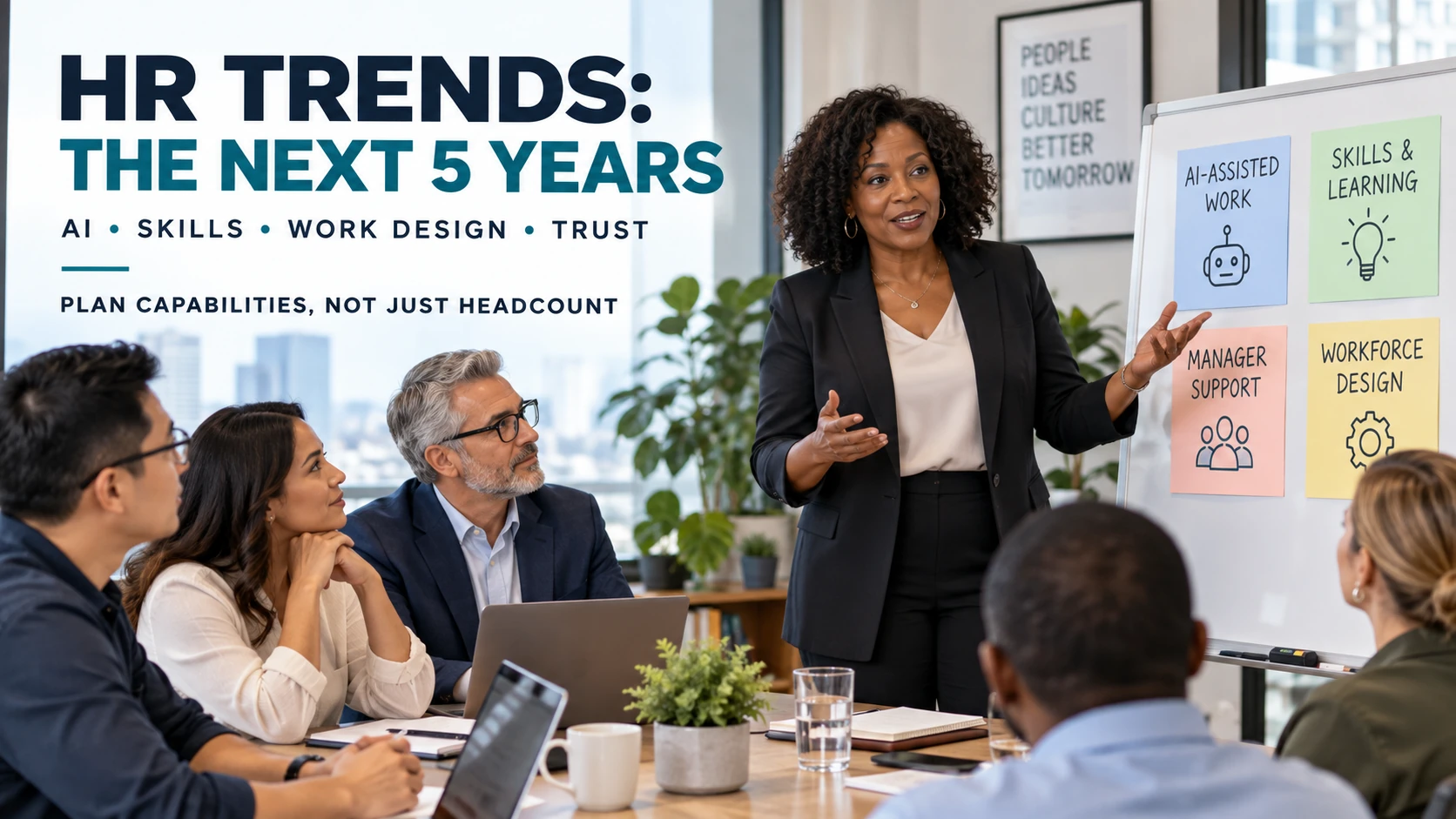

Over the next five years, HR will shift from administering jobs to designing work: deciding which tasks belong to people, which can be supported by AI, and which capabilities the organization must build next. The biggest change is not a single HR technology; it is the move from headcount-based planning toward skills, workflows, manager capacity, trust, and continuous learning.
That shift is already visible. The World Economic Forum’s Future of Jobs Report 2025 found that employers expect substantial skill disruption through 2030, while the International Labour Organization’s 2025 GenAI and jobs update concluded that one in four workers globally is in an occupation with some generative-AI exposure and that transformation is more likely than wholesale job elimination for most exposed work.
| HR theme | What is changing | What HR should build |
|---|---|---|
| Human-AI work design | AI moves from personal assistance into multi-step workflows and agent-supported execution. | Task ownership, human review points, quality standards and clear decision rights. |
| Capability-based workforce planning | Job titles become a weaker proxy for what the business actually needs. | A view of tasks, skills, capacity, succession risk and build/buy/borrow/automate choices. |
| Skills-based hiring and mobility | Employers look more closely at demonstrable capability, not only degrees or prior titles. | Better skills evidence, internal talent marketplaces and clearer career transitions. |
| Manager capability | Managers must translate fast-changing strategy into day-to-day team behavior. | Coaching, workload design, change leadership and AI-use norms. |
| Continuous learning | Training cycles shorten as tasks and tools change faster. | Role-based AI literacy, learning in the flow of work and measurable skill application. |
| AI governance and people-data trust | More recruiting, performance and workforce decisions are influenced by algorithms. | Validation, privacy controls, human accountability, explainability and local legal review. |
| Engagement and wellbeing | Change fatigue and work intensity remain material operating risks. | Manager support, workload clarity, career visibility and friction reduction. |
| Demographics and knowledge continuity | Aging workforces and uneven talent supply increase succession pressure. | Knowledge transfer, flexible career paths, inclusive hiring and succession planning. |
1. AI will redesign tasks before it redesigns the whole workforce
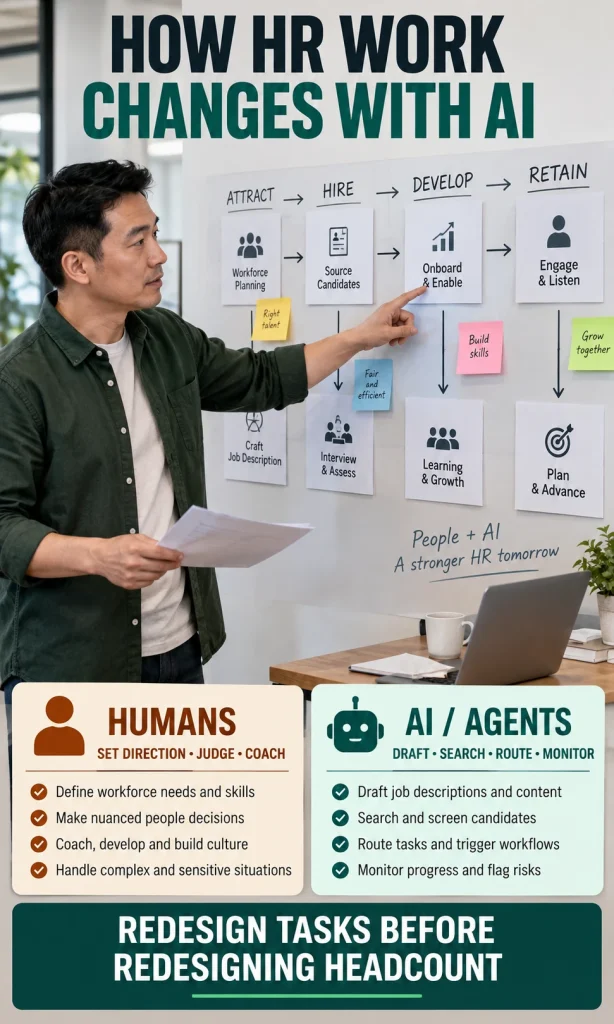
The most useful way to think about AI in HR is at task level. A job can contain work that should be automated, work that can be accelerated with AI, and work that still depends heavily on judgment, empathy, accountability, negotiation or contextual knowledge. Treating the entire job as either “human” or “automated” is too coarse for workforce planning.
The 2026 Microsoft Work Trend Index argues that organizations are moving from simple AI assistance toward workflows in which people direct agents, set quality standards and own outcomes. Its research also found that organizational conditions such as culture, manager support and talent practices explained more of reported AI impact than individual effort alone, which matters because the HR problem is no longer just access to an AI product. It is work design.
For HR, the immediate question becomes: where should human judgment stay non-delegable? Recruitment decisions, employee relations, sensitive performance conversations, accommodation decisions and high-consequence workforce actions need clearer human review than routine drafting, scheduling, searching, routing or summarization. Our guide to human supervision in AI-supported jobs expands that principle beyond HR.
2. Workforce planning will move from headcount to capabilities
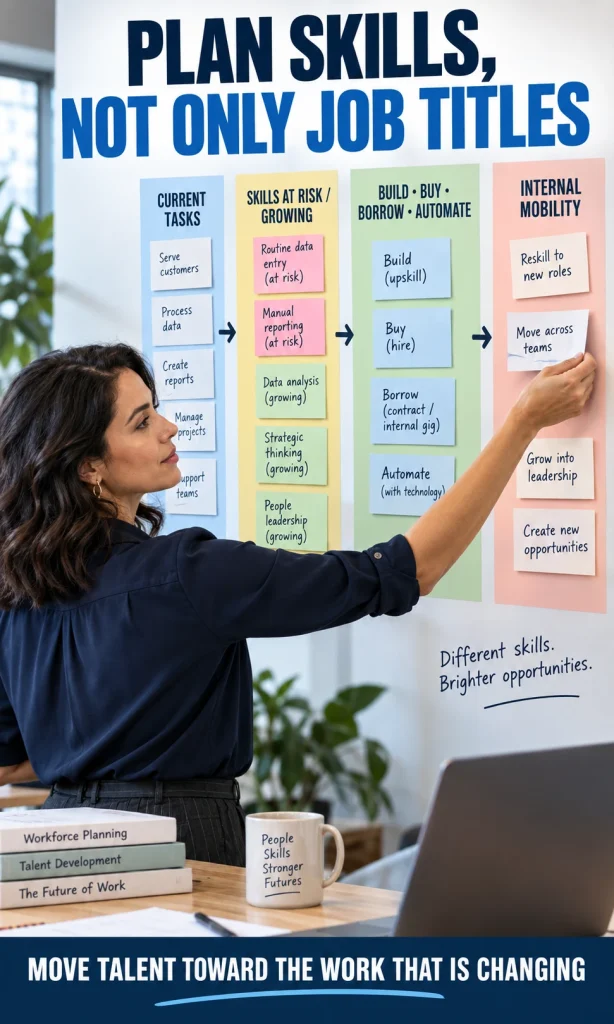
Traditional workforce plans often start with roles, vacancies and approved headcount. Over the next five years, stronger plans will start one level lower: the work that must be done, the capabilities it requires, how much capacity is needed, and which supply option makes sense. Hiring is only one option alongside reskilling, internal movement, process redesign, contractors, automation and stopping low-value work.
That is the direction highlighted in McKinsey’s HR Monitor 2026, which calls for a move from short-term operational planning toward strategic capability planning. The reason is practical: when AI changes the task mix inside a role, a five-year headcount forecast can be precise and still be wrong about the capability the business needs.
A useful workforce plan therefore separates four questions. What work is growing? Which tasks are shrinking or being automated? Which skills are becoming bottlenecks? Where can the organization redeploy people before it competes in the external market? That last question is increasingly important because internal mobility can preserve institutional knowledge while giving employees a credible path through role change.
3. Skills-based hiring will mature into skills-based workforce management
Skills-based hiring is often described as removing degree requirements, but the deeper trend is broader. HR systems are gradually moving toward evidence of capability across hiring, staffing, learning and internal mobility. The LinkedIn Future of Recruiting 2025 report found growing attention to skills assessment and AI-assisted recruiting, reflecting a need to identify what candidates can actually do rather than relying only on title history.
The challenge is that “skills-based” can become another label unless the company has a usable skills architecture. HR needs consistent skill definitions, evidence standards, proficiency language and links between skills and real work. A long library of self-declared skills is not a workforce system if managers cannot use it to staff projects, assess gaps or create credible moves into adjacent roles.
This is also where basic employability skills and a future-ready transferable-skills mindset matter. AI can increase the value of data literacy and technical fluency, but it also raises the premium on judgment, communication, problem solving and the ability to learn unfamiliar work quickly.
4. Most employees will need AI literacy, not advanced AI engineering
One of the easiest planning mistakes is to assume that every worker needs deep technical AI expertise. The OECD’s 2026 AI and skills brief makes a more useful distinction: advanced AI-specific skills are needed by a small share of workers, while a much larger group needs digital fluency, data interpretation, the ability to use AI responsibly and the judgment to evaluate output.
That changes learning design. A finance analyst, recruiter, project manager and customer-service supervisor do not need the same AI curriculum. Each needs training tied to actual tasks, data boundaries, failure modes and review responsibilities. Generic “prompting” classes will have limited value if employees still do not know when an AI answer is unreliable, when confidential data must not be entered, or when a human must take over.
The next five years should therefore move HR from course completion to skill application. Useful evidence includes whether a worker can use the approved system on a real workflow, recognize an error, document a handoff and explain the final decision. Learning becomes part of work design rather than a catalog sitting beside it.
5. Managers become the operating layer for workforce change
Technology changes quickly, but employees experience change through their manager. Managers decide whether experimentation is safe, whether workload is reasonable, whether new skills are actually used, and whether performance expectations have changed to match new tools. If those decisions remain vague, AI adoption can add another layer of work instead of removing friction.
The Gallup State of the Global Workplace 2026 data showed global employee engagement at 20% in 2025, while Gallup’s manager research continues to emphasize the outsized role managers play in team engagement. That makes manager capacity an HR trend in its own right, not merely a leadership-development issue.
Over the next five years, manager development should become more operational. Managers need help setting team AI norms, coaching through role changes, protecting learning time, deciding which work to stop, and giving employees a believable account of how their role is evolving. Those practices also support retention; see our guide to the best ways to reduce employee turnover.
6. HR will have to govern AI as a people system, not only as software
AI in HR can influence who is seen, screened, selected, promoted, monitored or flagged. That makes governance a people issue as much as a technology issue. The EU AI Act, for example, classifies certain AI systems used in recruitment and worker management as high-risk because errors or bias can affect livelihoods and worker rights.
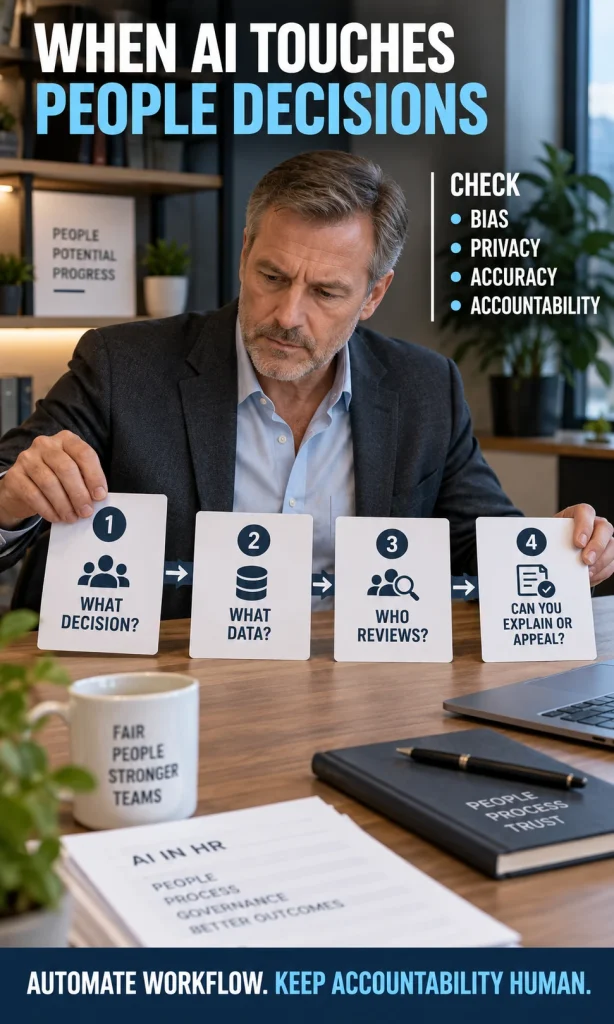
Regulation varies by jurisdiction, so HR should not rely on a single global checklist. A stronger operating model asks four questions every time an AI system touches a consequential people decision: What decision is being influenced? What data is being used? Who reviews the output? Can the result be explained, challenged or corrected?
SHRM’s State of AI in HR 2026 also found that adoption is uneven and that privacy, security, transparency and capability remain practical barriers. The safest direction is to automate workflow where value is clear while keeping accountability traceable to named human owners. This section is general operational guidance, not legal advice; local employment, privacy and AI rules should be reviewed for each country or state where the system is used.
7. Employee experience will shift from perks to friction, trust and career visibility
Employee experience used to be discussed heavily through benefits, office design and engagement programs. Those still matter, but the next five years will place more weight on day-to-day friction: unnecessary approvals, unclear priorities, meeting overload, duplicative systems, weak manager support and uncertainty about career direction. AI can reduce some of that friction, but badly implemented AI can also create monitoring anxiety, lower-quality work and more review burden.
A useful employee-experience strategy therefore asks what makes work harder than it needs to be. Which processes consume effort without improving the outcome? Where does the employee have to re-enter the same information? Which decisions feel opaque? Where do people lack a path to develop into the work the company says it will need?
That last question is especially important during automation. Workers may accept substantial role change when the organization explains what is changing and provides a credible route to learn, move or progress. A discussion of job security versus career advancement becomes more useful when HR can show the actual internal pathways rather than only promising employability in general terms.
8. Flexible work becomes a work-design question, not a location argument
Remote, hybrid and on-site work are unlikely to converge into one universal model because the work itself is different. The more durable HR trend is role-based flexibility: deciding which activities need co-location, which need quiet individual time, which can be asynchronous, and which depend on equipment, customers or physical presence.
That makes policy design more nuanced. A fair workplace does not necessarily give every role identical flexibility; it gives comparable consideration to autonomy, predictability, scheduling, focus time and access to opportunity. HR will need to watch for second-order effects such as proximity bias, uneven mentoring, meeting overload and the risk that flexible workers lose visibility for development.
The strongest organizations will stop treating flexibility as a benefit that sits outside operations. They will design team routines, performance measures and collaboration norms around the actual workflow, then test whether the arrangement helps people produce good work without creating avoidable coordination cost.
9. Aging workforces will make knowledge continuity a core HR system
Population aging is not uniform around the world, but it is significant enough to affect workforce strategy in many mature economies. The OECD Employment Outlook 2025 highlights the decline of working-age populations across much of the OECD and the need to make better use of older workers’ experience while improving lifelong learning and mobility.
For employers, the practical issue is not simply retirement volume. It is where critical knowledge is concentrated in a small number of experienced employees and whether the next layer of talent is getting enough real work to learn it. AI adds an interesting complication: if junior tasks are automated too aggressively, companies may remove some of the practice through which people historically developed expertise.
Succession planning will therefore need to include knowledge transfer, mentoring, staged retirement options, project-based roles and deliberate opportunities for less-experienced employees to handle meaningful work under review. “Who replaces this person?” becomes a weaker question than “How do we keep this capability alive?”
10. HR analytics will be judged by decision quality, not dashboard volume
More data does not automatically create better workforce decisions. Over the next five years, HR analytics should move away from producing more metrics toward improving a smaller number of consequential decisions: where to build capability, which roles are hard to replace, which teams have unsustainable workload, which learning interventions change performance, and where a policy creates unintended inequality.
This matters more as AI generates, summarizes and recommends from people data. Deloitte’s 2026 Global Human Capital Trends emphasizes trust, accountability and intentional human-AI work design as central choices. HR therefore needs data provenance, clear definitions and the ability to explain how a metric or recommendation was produced.
A dashboard that updates in real time is not strategically useful if no one can say what action should follow. The better standard is decision-linked analytics: each metric has an owner, a threshold or interpretation rule, a known limitation and a defined next step.
Which HR themes should your organization act on first?
Not every company should chase every trend at the same time. A small service business with little AI use has a different risk profile from a large employer already using automated screening, and a company with a retirement-heavy technical workforce faces a different problem from a fast-growing digital team. Use the experience below to sort the themes into Act now, Build next and Monitor based on your current workforce conditions.
Workforce strategy
HR Horizon Studio
Turn broad HR trends into a practical Now / Next / Monitor agenda for your organization.
Describe your workforce
Choose the conditions that best match your organization. The studio uses transparent rules, not a predictive score.
What deserves attention first
Next 90 days
Build over 12-24 months
HR Horizon Studio
Five-Year Workforce Priority Report
Priority themes
Next 90 days
Build next
A practical five-year HR agenda
A useful five-year plan should not pretend the future can be forecast precisely. It should create a system that can adapt as technology, regulation and labor markets change. The best starting point is to make the next decisions reversible where possible and to strengthen capabilities that remain useful across several plausible futures.
- In the next 90 days: identify the workflows where AI is already being used, document the human review point, and map the roles with the greatest skills or succession risk.
- Within 12 months: build a practical skills framework for priority roles, train managers on AI-enabled work design, and establish minimum governance for AI-supported people decisions.
- Within 24 months: connect hiring, learning and internal mobility so employees can move toward emerging work rather than waiting for vacancies to appear.
- Across the full five years: review task mix, capability gaps, manager load, engagement and demographic risk regularly. Treat the plan as a learning system, not a fixed headcount forecast.
The core theme is simple: HR is becoming the function that helps the organization decide how work, people and technology fit together. Companies that keep treating HR as a policy-and-process back office will struggle to respond quickly; companies that build capability, trust and adaptive work design will be better positioned to absorb whatever the next five years actually bring.
Frequently Asked Questions
What are the biggest HR trends for the next five years?
The strongest themes are human-AI work design, capability-based workforce planning, skills-based hiring and mobility, continuous learning, manager capability, AI governance, employee experience, flexible work design and demographic knowledge continuity. The priority order will differ by organization, so HR should connect each trend to a real workforce risk or business decision.
Will AI replace HR jobs?
Some HR tasks will be automated or heavily assisted, especially repetitive drafting, searching, routing and scheduling. The more durable change is role redesign: human work shifts toward judgment, coaching, exception handling, governance, workforce strategy and accountability while AI handles more routine execution.
What skills will HR professionals need most?
HR professionals will need AI literacy, data interpretation, workforce planning, job and workflow design, change leadership, governance, communication and business judgment. Most HR roles will not require advanced AI engineering, but they will increasingly require the ability to evaluate AI-supported work and explain its people implications.
Is skills-based hiring the same as removing degree requirements?
No. Removing unnecessary degree requirements can be part of skills-based hiring, but a mature approach also defines the skills a role requires, gathers credible evidence of those skills, and connects hiring to learning and internal mobility. The objective is to make capability more visible, not simply to change the wording of job ads.
Why will managers matter more in the future of HR?
Managers translate policy and strategy into daily work. They determine whether employees have clear priorities, whether AI is used responsibly, whether learning time is protected, and whether role changes feel manageable. HR can design the system, but managers make the system real for employees.
How should a small business prepare for HR changes?
Start with the few workforce risks that could materially affect operations: hard-to-replace skills, manager overload, hiring bottlenecks, uncontrolled AI use and critical knowledge held by one person. Small businesses do not need a large HR technology stack to prepare; they need clear ownership, simple skills records, sensible AI rules and a repeatable process for reviewing workforce needs.