
Employees can leave a well-paid job because fair pay does not repair a difficult manager relationship, stalled growth, or work they cannot control. Before calling the problem “non-pay,” verify that the salary is competitive for the actual role and fair beside comparable colleagues. The useful question is what would need to change for this person to see a credible future here.
Competitive pay is the starting point, not the whole offer
A market-rate salary answers one question: can the employer compete for this kind of work? It does not tell you whether the employee trusts decisions, can complete the workload, or has somewhere to develop. An attractive package can coexist with a job that has become difficult to sustain.
This article concerns voluntary resignation, not an employer firing or laying off an employee. It is for owners and managers trying to understand departures despite apparently competitive pay. Start with four separate lines of inquiry, because each calls for a different response.
- Check pay fairness against the actual scope of work, not the job title alone.
- Ask about the manager relationship without requiring the employee to confront that manager.
- Make the next development step concrete enough to evaluate.
- Compare workload with decision authority, resources and scheduling control.
Take “more money” seriously-and ask what else changes
Salary may be the full explanation, part of it, or the easiest part to describe. Do not assume employees are hiding their true reason just because their answer is inconvenient. Ask what the new position offers besides money, then give them room to decline further discussion.
The evidence supports a multi-cause explanation rather than a universal ranking. In Pew’s survey of U.S. workers who voluntarily quit in 2021, low pay and lack of advancement were each reported by 63%, while disrespect was reported by 57%. Respondents could identify multiple reasons; these historical findings are not a forecast for your team or proof that competitive pay is irrelevant.
The follow-up that separates a pay gap from a job problem
Begin with a neutral question: “What would make the work here more worth staying for?” If pay comes up, ask which comparison matters: a similar employer, a new colleague, increased responsibilities, or household needs. Then ask whether fixing that issue would leave anything else unresolved.
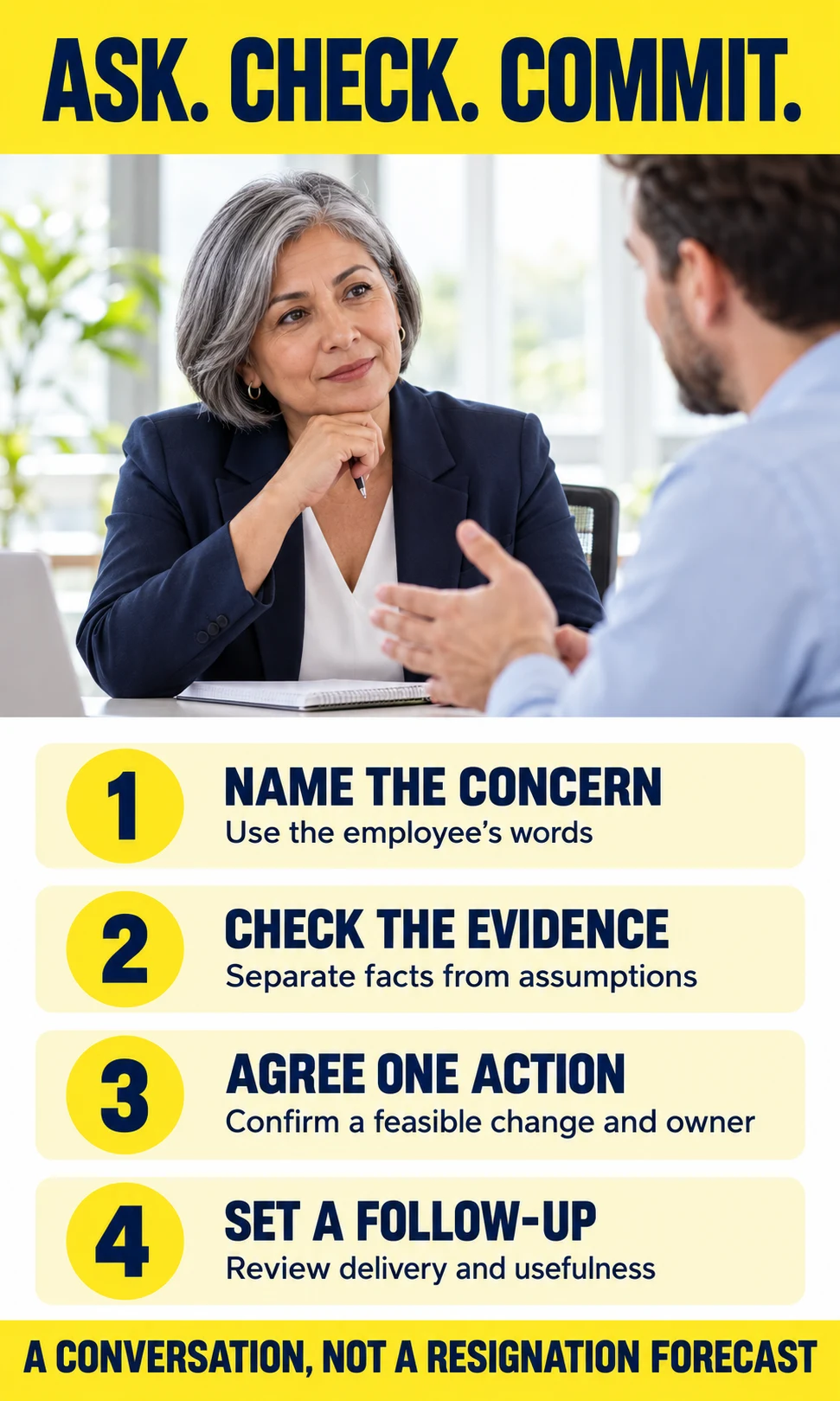
A useful answer names something the organisation can inspect, such as an approval delay or a missing promotion criterion. A vague answer is not permission to press for private circumstances or to guess at disloyalty. Record the concern in the employee’s words and distinguish it from your interpretation.
Consider an illustrative employee who receives a raise but still spends evenings correcting last-minute requests. More money changes the reward, while the recurring deadline problem remains. That example explains a possible mechanism; it is not a report of an interview or a claim about every resignation.
| Possible cause | Evidence to check | Proportionate response |
|---|---|---|
| Pay fairness | Comparable responsibilities, hours, benefits and new-hire pay | Review the role and pay criteria; explain or correct a justified gap. |
| Manager relationship | Specific incidents, inconsistent decisions and unresolved concerns | Offer a safe alternative contact and an accountable management change. |
| Growth | The next skill, assignment or role the employee wants | Agree a credible development step with access, owner and review date. |
| Workload and control | Competing deadlines, approval bottlenecks and schedule constraints | Remove a task or approval; clarify decisions the employee can make. |
Four causes that survive a fair paycheck
Pay compression: the market can look fair while the team does not
Pay compression describes a narrowed difference between pay levels that previously reflected experience or responsibility. A newer employee earning more than a comparable established employee is often described as pay inversion. Neither a small difference nor a reversed difference proves unfairness on its own, because responsibilities, skills, location and contract terms can differ.
Check the comparison on a like-for-like basis before defending the salary band. Include the work actually performed, hours, variable pay and benefits, then ask whether the criteria are understandable and consistently applied. A genuine pay issue needs a compensation review, not a culture initiative offered in its place.
The manager relationship: look for patterns rather than a slogan
“People quit managers” is useful shorthand but too broad to settle a case. A manager may contribute through unpredictable priorities, public criticism, inaccessible support or promises that never turn into decisions. Equally, some constraints come from staffing, policy or senior leadership rather than that manager alone.
Ask for a concrete example and what happened after the concern was raised. If the concern involves the direct manager, provide an appropriate alternative contact rather than making that person the only route for disclosure. Keep the response focused on conduct and conditions; a stay conversation is not a clinical assessment or a misconduct investigation.
No visible next step: development must have an actual route
A promotion promise is weak if nobody can explain the requirements, available work or decision date. Employees may want deeper expertise, a project assignment or a lateral move rather than a larger title. Ask which next step matters before assuming that the only answer is a management position.
Make the offer testable: name the skill to practise, the assignment that develops it, the person providing support and the date for reviewing progress. Be honest when there is no funded vacancy or when promotion is uncertain. A credible smaller commitment is more useful than an attractive promise that the business cannot keep.

Workload and autonomy: control must come with support
An employee can have nominal flexibility and still lack control over the workday. If every decision needs approval while every deadline stays fixed, responsibility has increased without the authority to deliver. The practical check is what the employee can decide, what requires escalation, and what happens when two urgent requests conflict.
Autonomy also fails when it becomes abandonment. Removing supervision without resources, boundaries or feedback transfers uncertainty to the employee instead of improving the job. For unclear ownership, start with clear roles and responsibilities, then decide which approvals can safely be removed.

Run a 30-minute stay conversation before choosing the fix
Treat 30 minutes as a suggested meeting length, not a research-backed threshold. Preparation matters more than the clock: review the role, recent work changes and commitments already made, then invite the employee to discuss what is working and what is becoming harder. Explain who will see the notes and avoid collecting personal information that the work decision does not need.
Use the Stay Conversation Studio below to organise a concern, the available evidence and the next check. It produces questions and an action record rather than a prediction that someone will resign. Keep names, salary figures and sensitive allegations out of the inputs; the experience only needs the category of concern.

Stay Conversation Studio
Turn an unresolved work concern into a useful question and a checkable next step.
Management decision support. This does not predict resignation, benchmark pay or resolve employment disputes. Keep names, salaries and sensitive details out of the form. Inputs stay in this browser tab; there is no submission or saved history.
- Open: “Which part of the job would you most want to improve?”
- Clarify: “Can you describe a recent example and its effect on your work?”
- Separate: “If that changed, what else would still need attention?”
- Commit: agree one feasible next check, an accountable role and a follow-up date.
If the employee names several concerns, record them separately rather than averaging them into a retention score. A pay review, a manager change and a workload adjustment have different owners and may need different timelines. Confirm the priorities with the employee instead of deciding that the easiest intervention is the most important one.
What a more transactional workplace gets wrong
Clear pay, responsibilities and expectations can reduce uncertainty. They do not establish that treating the relationship as a series of transactions will improve retention. When every extra contribution is requested without support or every concern becomes a bargaining exercise, the employee has little reason to trust the next promise.
In Gallup’s study of 717 voluntary leavers, 42% said their manager or organisation could have done something to prevent their departure. That is a retrospective employee assessment, not a measured success rate for any retention intervention. It supports asking earlier and taking specific concerns seriously; it does not justify promising that a script or pay rise will retain everyone.
After a raise or a resignation, match the response to the cause
Someone can accept a raise and still leave because the job remains unsuitable or another opportunity fits better. A counteroffer should be considered against the concern it actually resolves, the business’s capacity to sustain it and fairness to comparable colleagues. Avoid presenting a salary increase as a complete answer when trust, workload or development remains unsettled.
Once an employee has decided to resign, ask whether they want to discuss alternatives and respect the answer. Do not turn a polite exit interview into an interrogation, monitor private job-search activity or infer intent from one quiet week. Review practical leadership behaviours through commitments and consistent decisions, rather than a slogan about loyalty.
What this check cannot tell you
A conversation cannot establish the probability that an individual will leave, validate a market salary or guarantee that an intervention works. Personal circumstances, relocation and career changes can produce departures even when the employer does many things well. Use the record to improve a work condition, and measure whether that condition changed before claiming a retention result.
This is management decision support, not advice on dismissal, severance, final pay or employment disputes. Allegations of harassment, discrimination or retaliation need an appropriate formal route and relevant professional advice. Do not use a conversational worksheet to decide those matters or to discourage an employee from raising them.
Frequently asked questions
What is the top reason employees quit?
There is no universal top reason for every team. Pay, advancement, treatment and work conditions can overlap, and their importance depends on the employee and role. Start with direct evidence from your workplace rather than transferring a survey ranking to an individual.
Do employees quit managers or jobs?
Both can matter, and they are not always separate. A manager shapes priorities, support and trust, while wider policies determine pay, staffing and development options. Ask which condition needs to change and who has the authority to change it.
Why would someone leave after a raise?
A raise may resolve only one part of the problem. The employee might still face unsustainable work, stalled development or a better-fitting opportunity elsewhere. Check what changed in the job as well as what changed in the paycheck.
How is pay compression different from low pay?
Low pay concerns the level of compensation relative to a relevant comparison. Pay compression concerns a narrowing gap between employees or role levels, while pay inversion means the expected order is reversed. Review comparable responsibilities and total compensation before deciding whether the difference is justified.
Does a transactional workplace increase turnover?
Clear terms can help employees understand the deal. A relationship reduced to rewards and demands can leave trust, development and support unresolved. The effect depends on how those arrangements operate; the label alone does not establish a turnover outcome.
What should a manager avoid when a strong employee resigns?
Avoid guilt, surprise pressure and promises you cannot deliver. Ask whether the employee wants to discuss options, respect a refusal and arrange a professional handover. Treat the departure as evidence to examine, not proof of disloyalty.
Your next action
Choose one unresolved condition and arrange a conversation before proposing a retention incentive. Bring evidence about the work, ask what would improve it and agree a commitment that an accountable person can deliver. The next review should establish what changed, what remains uncertain and whether the employee considers that change useful.
- Verify the relevant pay comparison before ruling pay out.
- Separate employee statements from management assumptions.
- Record one feasible change, its owner and the follow-up date.
- Review delivery and usefulness without promising that anyone will stay.