
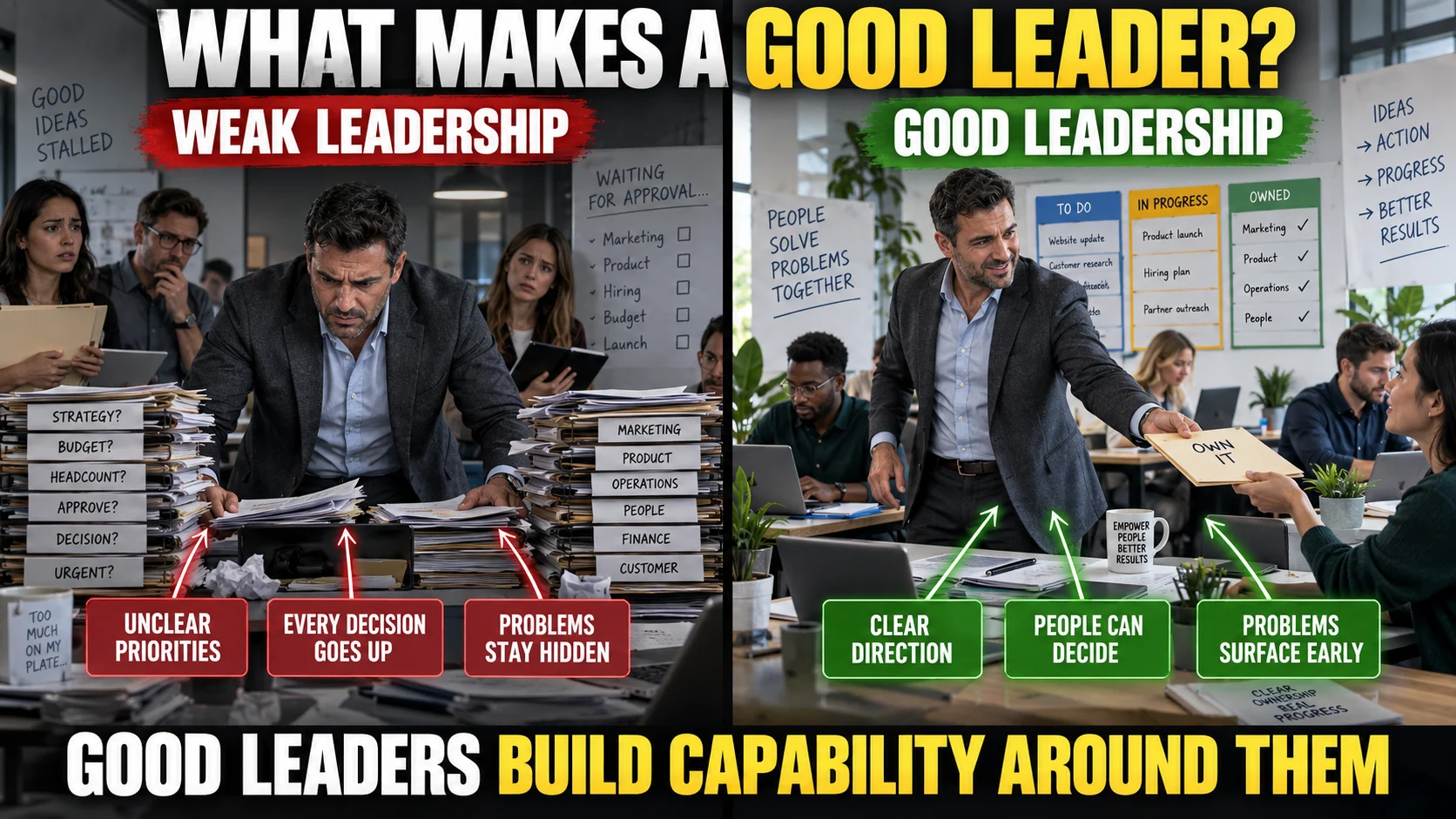

A good leader gives people clear direction, earns their trust, makes responsible decisions, communicates well, develops others and stays effective when circumstances change. The strongest leaders usually combine several qualities rather than depending on charisma, confidence or authority alone.
What matters most is how those qualities appear in everyday behavior. Integrity becomes keeping a difficult promise. Communication becomes making expectations understandable. Accountability becomes owning a poor decision instead of looking for someone else to blame. Leadership becomes easier to judge when you look at what someone repeatedly does when the situation is uncertain, uncomfortable or important.
That distinction matters because a person can appear impressive without leading particularly well. Someone may speak confidently in meetings yet avoid difficult decisions, praise collaboration while controlling every detail, or talk about accountability while becoming defensive when results disappoint.
For practical purposes, eight characteristics are especially useful when evaluating or developing a leader: vision, communication, integrity, sound judgment, empathy and respect, accountability, adaptability, and the ability to develop other people. Self-awareness runs through all eight because leaders need to recognize how their own behavior affects the people around them.
The 8 Characteristics of a Good Leader at a Glance
A leadership quality becomes meaningful when employees can observe it. This table separates the label from the behavior that actually demonstrates it.
| Leadership characteristic | What it looks like in practice | What happens when it is weak |
|---|---|---|
| Vision and direction | Explains what matters, why it matters and what the team should prioritize. | People stay busy but pull in different directions. |
| Communication | Sets clear expectations, listens carefully and checks that important information was understood. | Priorities become ambiguous and avoidable misunderstandings multiply. |
| Integrity | Keeps commitments, applies standards consistently and tells the truth when the news is uncomfortable. | Trust falls and employees begin judging statements against hidden motives. |
| Judgment and decisiveness | Collects enough information, weighs consequences and makes a timely decision. | Decisions stall, problems linger or the team reacts impulsively. |
| Empathy and respect | Understands another person’s circumstances and perspective while keeping expectations clear. | People stop raising concerns or feel that decisions ignore their reality. |
| Accountability | Owns results, follows through and addresses missed standards fairly. | Responsibility becomes unclear and blame replaces correction. |
| Adaptability | Changes the plan when evidence or circumstances change without losing the objective. | The team keeps executing an approach that no longer fits the situation. |
| Developing others | Delegates meaningful responsibility, coaches people and expands their ability to operate independently. | The leader becomes a bottleneck and capable employees stop growing. |
A useful way to read the table is to ignore the labels temporarily and look at the middle column. Good leadership is easier to recognize through consistent observable behavior than through personality descriptions.
Leadership research similarly treats effective leadership as a collection of learnable qualities rather than a single personality type. The Center for Creative Leadership, for example, includes self-awareness, respect, compassion, vision, communication, integrity, courage, learning agility and resilience among its fundamental leadership qualities.
Good Leadership Is More Than Having a Strong Personality
Some people naturally attract attention. They speak confidently, think quickly in front of a group and seem comfortable taking control. Those qualities can help a leader, although none of them proves that the person will lead well.
A quieter manager who clarifies priorities, listens before deciding, protects the team from unnecessary confusion and consistently follows through may be far more effective than the most charismatic person in the room. Likewise, confidence becomes dangerous when it discourages questions, and decisiveness becomes recklessness when evidence is ignored.
This is why leadership should be evaluated over repeated situations. Watch what happens when the leader receives bad news, encounters disagreement, discovers a mistake or has to choose between an easy short-term answer and a harder decision that protects the organization over time.
1. Vision Gives People a Direction They Can Actually Use
Vision in leadership does not require a grand speech about changing the world. At team level, it means helping people understand where they are going, what matters most and how their work contributes to the larger objective.
A useful vision therefore becomes specific enough to guide choices. When two projects compete for time, employees should have some basis for knowing which deserves attention. When conditions change, they should understand which part of the strategy is flexible and which objective remains important.
Weak leaders often confuse announcing a goal with creating direction. Saying that a company wants to “grow faster” gives employees little help with the decisions they make on Tuesday afternoon. A stronger leader translates that ambition into priorities, boundaries and a recognizable definition of progress.
For a small business owner, this becomes especially important as more people join the company. The founder can no longer keep every decision inside their own head. Clear direction must eventually connect with defined small business roles and responsibilities so employees know what they own and where decisions belong.
2. Communication Includes Listening, Clarity and Follow-Through
Good leaders communicate in both directions. They explain priorities and expectations clearly, while also creating enough space to hear information that could change a decision.
That second part is easy to underestimate. Employees closer to customers, production problems or day-to-day workflows often see information earlier than senior leaders do. A manager who talks well but responds badly to disagreement can gradually train a team to remain silent.
Healthy communication therefore includes asking questions, checking understanding, making difficult feedback specific and responding constructively when somebody raises a concern. Psychological safety matters here because people are more likely to discuss mistakes, problems and difficult issues when they believe speaking up will not automatically expose them to punishment or humiliation.
This does not mean that a good leader accepts every suggestion or avoids standards. Listening gives the leader better information. Leadership still requires deciding what to do with that information and explaining the decision clearly.
3. Integrity Makes Leadership Credible
Employees eventually compare what a leader says with what that leader actually does. If the two repeatedly match, credibility strengthens. If they regularly conflict, motivational language becomes less persuasive regardless of how polished it sounds.
Integrity appears in ordinary decisions: keeping commitments, acknowledging information that makes the leader look bad, applying standards consistently and refusing to shift blame simply because doing so would be convenient.
It also matters when no available choice is perfect. A leader may have to disappoint a client, reject an employee’s request or change a plan that people already supported. Integrity does not guarantee that everyone will like the decision. It gives people a reason to believe that the reasoning, standards and explanation are genuine.
Research on leadership trust likewise emphasizes consistency between commitments and behavior, alongside sound judgment and constructive relationships.
4. Sound Judgment and Decisiveness
Good leaders make decisions at an appropriate speed for the consequences involved. They do not demand perfect information before every move, yet they also resist the temptation to make high-impact decisions simply to appear decisive.
Judgment begins with separating what is known from what is assumed. A leader may have financial data, customer complaints, staff observations and several competing explanations for the same problem. The job is to identify which evidence deserves the most weight, what could happen if the decision is wrong and whether waiting will create a larger cost than acting.
A useful leadership habit is to distinguish reversible decisions from difficult-to-reverse decisions. Testing a different meeting format is easy to undo. Hiring a senior employee, signing an expensive lease or committing the business to a major new service can have consequences that last much longer. The second category deserves more investigation because the cost of correction is higher.
Strong leaders also know when analysis has reached diminishing returns. Once the important risks are understood and additional information is unlikely to change the decision materially, continuing to study the problem can become another form of avoidance.
A Practical Decision Check for Leaders
Before making an important decision, ask:
- What problem are we actually solving? Define the issue before comparing solutions.
- Which facts do we know, and which parts are assumptions? Do not allow confidence to turn an estimate into a fact.
- Who has information I may be missing? The person closest to the work may see a constraint senior management cannot.
- What happens if we delay? Waiting has costs too.
- How difficult would this decision be to reverse? Greater commitment usually deserves greater scrutiny.
- What would make us reconsider later? Decide in advance which new evidence would justify changing course.
This is particularly useful in a growing company because business decisions become more frequent as responsibilities expand. A founder who insists on personally resolving every issue eventually slows the organization. Clear small business roles and responsibilities help establish who can decide independently, who should be consulted and which decisions still require the owner’s approval.
5. Empathy and Respect Without Lowering Standards
Empathy helps a leader understand what another person is experiencing before deciding how to respond. That can improve communication, conflict resolution, workload decisions and the way difficult feedback is delivered.
It does not require agreeing with every employee or removing consequences whenever somebody struggles. A manager can understand why a deadline was missed and still conclude that the missed deadline must be addressed. The difference is that the response considers the circumstances rather than jumping immediately to a judgment about the person’s attitude or ability.
Respect is equally practical. It appears in whether the leader allows someone to finish explaining a problem, gives criticism privately when appropriate, credits employees for their work and avoids humiliating people to demonstrate authority.
This becomes especially important when performance is slipping. Poor leaders often move too quickly from an outcome to a character judgment: a late project becomes evidence that somebody is careless, disagreement becomes disloyalty, or a mistake becomes proof that the employee cannot be trusted. Good leaders investigate the cause first.
Sometimes the issue really is performance. At other times the employee may be working with contradictory priorities, unclear ownership, insufficient resources or a process that nobody has properly designed. Leaders who understand those distinctions can correct the real problem instead of merely applying pressure to the person closest to it.
6. Accountability Starts With the Leader
Accountability becomes credible when leaders apply it to themselves before demanding it from everyone else. That means accepting responsibility for decisions, acknowledging mistakes and correcting problems without rewriting the history of how they occurred.
When a team repeatedly misses expectations, for example, the leader should examine more than the employees’ execution. Were priorities clear? Did responsibilities overlap? Was the deadline realistic? Did the team have the authority and resources necessary to deliver? Those questions do not excuse poor performance. They determine whether the failure belongs entirely to an individual or partly to the system surrounding that individual.
A leader also damages accountability by rescuing people from every consequence. If an employee repeatedly misses an agreed standard and the manager quietly absorbs the work each time, the team learns that commitments are negotiable. Accountability requires clarity before the problem occurs and consistency after it occurs.
A useful pattern is:
Expectation → ownership → checkpoint → result → review → correction
That sequence keeps accountability attached to the work rather than turning it into a vague discussion about attitude.
For small businesses, this is closely connected to delegation. Owners sometimes assign tasks while retaining all meaningful authority, then become frustrated when employees constantly return for approval. If responsibility is delegated, the decision boundaries surrounding that responsibility must be clear enough for the person to act.
7. Adaptability and Learning Agility
A good leader can change direction without making the organization feel directionless. The objective may remain stable even when the method used to reach it has to change.
Consider a company that expected a new sales channel to perform well. After several months, acquisition costs are higher than expected and customers are responding better through another channel. A rigid leader may keep investing because changing course feels like admitting failure. An adaptable leader asks whether the original assumptions still hold and redirects resources when the evidence changes.
That ability becomes particularly important for entrepreneurs because early business decisions are often made with incomplete information. A business idea may look convincing on paper and behave differently when customers encounter it. Testing assumptions early is one reason it is useful to test business ideas before making expensive commitments.
Adaptability should still have boundaries. Constantly changing priorities can create as much damage as refusing to change them. Employees cannot execute confidently when yesterday’s urgent initiative disappears every time a new idea appears.
Strong adaptation therefore has a reason that people can understand. The leader explains what changed, what evidence caused the change, what remains the same and what employees should now do differently.
8. Good Leaders Develop People Instead of Becoming the Bottleneck
One of the clearest signs of leadership maturity is whether people become more capable under the leader.
An insecure manager may prefer being the person with every answer. Employees keep returning for approval, difficult tasks flow upward and the leader gradually becomes indispensable to routine operations. That can look like commitment because the manager is always busy, yet it limits the team’s ability to grow.
A stronger leader develops judgment around them. They give employees problems to solve, explain the boundaries of authority, provide feedback after decisions and increase responsibility as competence grows.
This does require accepting that another capable person may occasionally approach a task differently. If the result satisfies the important standard, forcing every employee to reproduce the leader’s personal method creates unnecessary dependence.
For business owners preparing to expand, this transition often becomes important around the same time they consider when to hire their first employee. Hiring adds capacity only when meaningful work and decision authority can move away from the founder.
How to Tell Whether Someone Is Actually a Good Leader
Leadership becomes easier to evaluate when you observe what happens around the person over time. A title tells you who has authority. Repeated outcomes tell you much more about how that authority is being used.
Look for these signals:
- People know what they are responsible for. They do not spend large amounts of time guessing which priority matters most.
- Bad news can travel upward. Employees can raise problems before those problems become crises.
- Decisions eventually get made. Discussion leads somewhere.
- Mistakes produce learning. The same preventable failures do not continue because nobody wants to examine them.
- Standards are predictable. Similar situations receive reasonably consistent treatment.
- Capable employees gain autonomy. Responsibility expands as judgment improves.
- The leader can explain changes in direction. Employees understand why priorities shifted.
- Success does not require constant intervention from the leader. The team can continue operating when that person is temporarily unavailable.
- Disagreement remains possible. Employees can challenge an idea without automatically becoming an enemy of the person who proposed it.
- Credit moves outward while responsibility moves upward. Effective leaders recognize other people’s contribution and accept their own share of failure.
One useful test is to imagine the leader being absent for two weeks. If nobody knows what to do, every decision stops and employees are afraid to act, the organization may have strong individual control but weak leadership infrastructure.
Good Leader vs Nice Leader vs Charismatic Leader
These descriptions can overlap, but they are not interchangeable. A leader can be pleasant without setting useful standards, charismatic without exercising sound judgment, or highly effective without being especially theatrical.
The important question is therefore not whether a leader is impressive, agreeable or confident. Ask whether their behavior improves the quality of decisions, strengthens the people around them and makes the organization more capable over time.
Leadership Failure Patterns That Can Hide Behind Good Intentions
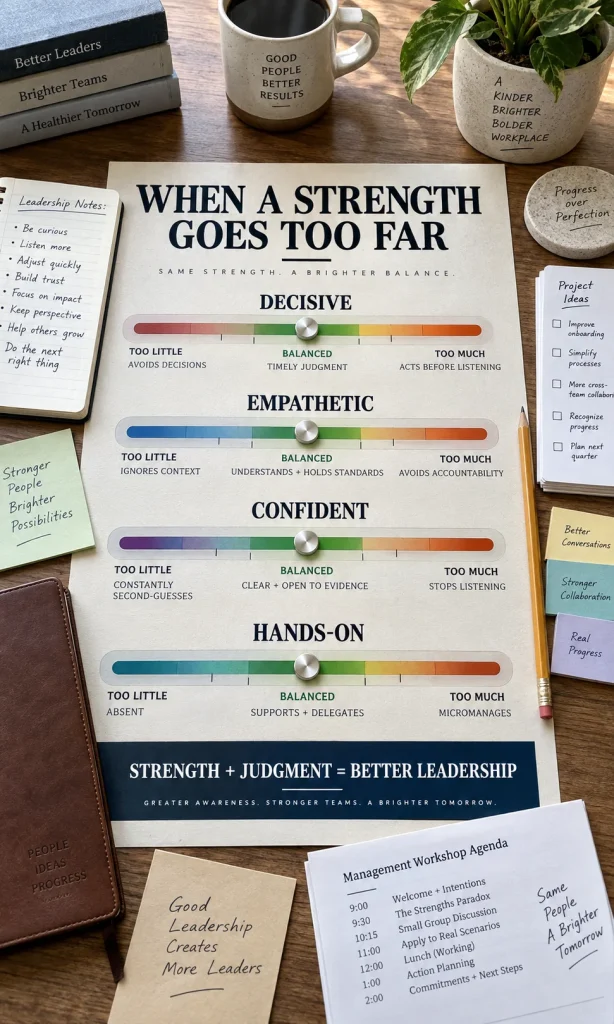
Many leadership problems begin with behavior that initially appears reasonable. A founder wants quality, so they approve everything personally. A manager wants harmony, so they postpone an uncomfortable conversation. Another leader wants speed, so they start deciding before employees have finished explaining the problem.
Over time, those habits can produce recognizable failure patterns.
The Helpful Leader Who Never Delegates
The leader solves problems quickly and therefore becomes the default destination for every difficult issue. Eventually the team’s capability stops developing because employees learn that the safest choice is to ask.
The Supportive Leader Who Avoids Accountability
The manager wants employees to feel respected and gives repeated second chances without clearly addressing the performance problem. High performers eventually notice that commitments have little meaning.
The Visionary Leader Who Keeps Changing Direction
New opportunities are exciting, so priorities shift repeatedly. Employees become reluctant to invest deeply in any initiative because they expect another change soon.
The Decisive Leader Who Stops Listening
Speed becomes part of the leader’s identity. Questions start feeling like resistance, and useful information gets filtered out before decisions are made.
The Experienced Leader Who Stops Learning
Past success becomes evidence that the leader’s judgment should rarely be questioned. This is particularly dangerous when the market, technology, workforce or business model changes faster than the leader’s assumptions.
The pattern underneath these examples is important: a leadership strength can create a weakness when it is used without judgment. Confidence needs curiosity. Empathy needs standards. Decisiveness needs evidence. Delegation needs clear boundaries. Vision needs enough stability for people to execute it.
How to Develop the Characteristics of a Good Leader
Leadership improves faster when development is tied to specific behavior rather than a vague goal such as “become a better leader.” Choose one recurring situation, change what you do in that situation and observe whether the result improves.
For example, a manager who struggles with delegation does not necessarily need another general leadership course. They may need to define decision boundaries more clearly, stop answering questions employees can reasonably solve themselves and review decisions afterward without taking the work back.
The same principle applies to the other characteristics in this article.
1. Replace General Goals With Observable Behaviors
“Communicate better” is difficult to measure. A behavior such as “finish every project briefing with the owner, deadline, decision authority and success criteria” is much easier to practice and evaluate.
Useful behavior-level goals include:
- Vision: explain the top priority and what should be deprioritized whenever priorities change.
- Communication: ask an employee to explain the agreed next step in their own words when an assignment is complex.
- Integrity: record important commitments and follow up when promised.
- Decision-making: separate confirmed facts, assumptions and unanswered questions before major decisions.
- Empathy: ask what is creating the difficulty before deciding whether the issue is effort, skill, workload or process.
- Accountability: define ownership and the review point before work begins.
- Adaptability: specify what evidence would justify changing the current plan.
- Developing others: delegate a decision along with boundaries instead of delegating only the task.
This approach turns leadership development into repeated practice rather than occasional inspiration.
2. Ask for Feedback That Produces Useful Information
Generic questions such as “How am I doing as a leader?” often produce generic answers. Employees may also hesitate to criticize someone who controls their workload, promotion opportunities or performance reviews.
More specific questions reduce that problem.
Ask:
- “Where do I create unnecessary delays?”
- “Which decisions are you unclear about owning?”
- “When priorities change, what information do you wish you received sooner?”
- “Is there anything you avoid telling me because of how I may respond?”
- “Which part of my feedback is useful, and which part makes it harder to act?”
- “What do I still approve personally that you think the team could own?”
The response matters, although the leader’s reaction matters just as much. If someone gives difficult feedback and the immediate response is argument, explanation or retaliation, employees learn that future requests for honesty are largely ceremonial.
A better first response is to clarify the example, understand the impact and decide later whether the criticism is accurate enough to require a change.
3. Review Decisions, Not Just Results
A good outcome does not always mean the decision process was good. A poor outcome does not automatically mean the original decision was unreasonable.
Suppose a manager chooses Supplier A after comparing quality, lead time, capacity and price. An unexpected disruption later causes a delay. The project failed to arrive on time, yet the original decision may still have been sensible based on the information available.
The reverse also happens. A leader may make a careless decision and get lucky.
This distinction is valuable because judging leadership entirely by outcomes encourages hindsight bias. Strong leaders review both:
Was the reasoning sound at the time?
and
What did the result teach us that should change the next decision?
That keeps learning focused on the quality of judgment rather than simply rewarding luck and punishing uncertainty.
4. Practice Delegation as a Transfer of Judgment

Delegation becomes much more useful when the employee receives enough context to make decisions without constantly returning to the manager.
For a meaningful delegated responsibility, clarify:
- the result that is required;
- the deadline or review date;
- which constraints cannot be changed;
- what the employee can decide independently;
- which decisions require consultation;
- what level of cost or risk requires escalation;
- how success will be judged.
The leader then needs to resist unnecessary intervention. Correcting every stylistic difference teaches employees to reproduce the manager’s preferences rather than develop judgment.
This is also where clearer business systems become useful. As companies grow, a founder who wants every process to depend on personal memory or approval eventually creates operational friction. The same issue appears when entrepreneurs begin building business systems: responsibility scales more effectively when recurring decisions, boundaries and handoffs are visible.
5. Learn to Separate Urgent From Important
Leadership quality is often tested by competing demands rather than a lack of work. A customer problem may feel urgent, a long-term hiring decision may be more consequential, and a strategic project may keep being postponed because nobody is demanding it today.
Effective leaders therefore protect attention for decisions whose consequences extend beyond the current week.
A practical filter is to ask:
| Question | If the answer is yes | Leadership implication |
|---|---|---|
| Will delaying this create a larger cost later? | Protect time for it now. | Important work may deserve priority even without immediate pressure. |
| Can someone else resolve this within clear boundaries? | Delegate it. | Do not make senior attention the default resource. |
| Is this problem recurring? | Investigate the system behind it. | Repeated firefighting may signal a process problem. |
| Does the decision create a long commitment? | Slow down enough to examine assumptions. | Irreversible choices deserve more scrutiny. |
| Is the issue reversible at low cost? | Consider testing rather than debating. | Small experiments can produce better evidence than prolonged discussion. |
A leader who handles every urgent issue personally may appear productive while leaving the organization exposed to the problems that require slower, more deliberate attention.
When a Leadership Problem Is Really a System Problem
Not every disappointing team result should be explained as a leadership-character issue. Sometimes a competent leader is operating inside an unclear or badly designed system.
Consider an employee who keeps missing deadlines. The immediate conclusion might be poor accountability. Before reaching it, examine whether the employee receives contradictory priorities from two managers, depends on another department that routinely responds late or has been assigned more work than the available time can reasonably accommodate.
Similarly, a manager may appear indecisive because decision authority was never clearly assigned above them. A team may look unmotivated when their goals change every few days. Communication can deteriorate when information is scattered across several tools without an agreed source of truth.
This is an important leadership distinction because personal coaching cannot repair every structural problem.
Check the System Before Blaming the Person
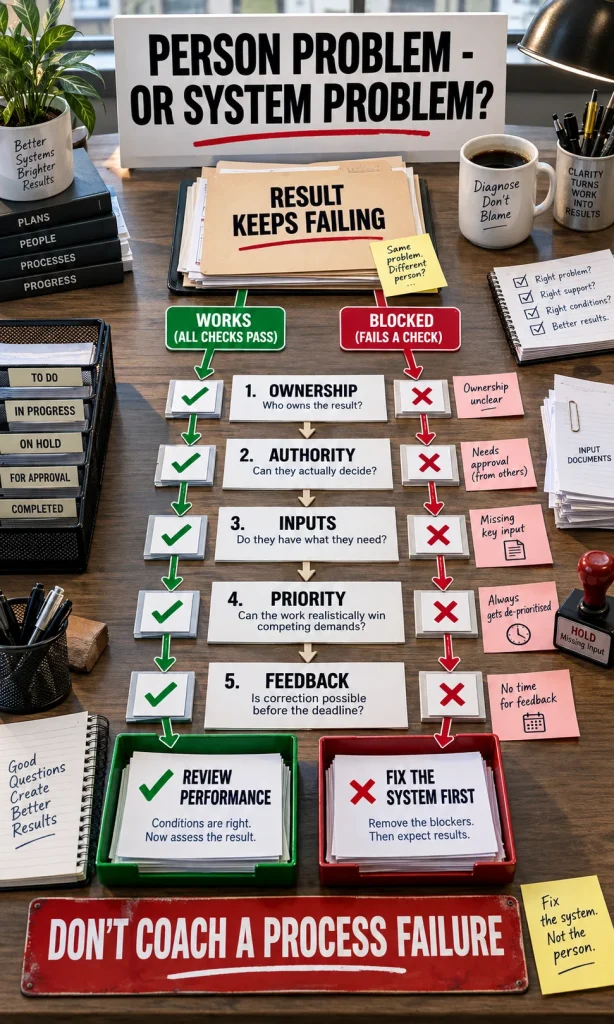
When performance repeatedly breaks down, inspect five areas:
- Ownership: Is one person clearly responsible for the result?
- Authority: Can that person make the decisions required to deliver it?
- Inputs: Do they receive the information, materials or approvals they need?
- Priority: Is the work genuinely important, or does it lose every conflict with something “more urgent”?
- Feedback: Is there a checkpoint early enough to correct problems before the final deadline?
If one of these conditions is missing, a stronger process may produce more improvement than another motivational conversation.
The 30-Day Leadership Self-Check
Leadership development becomes more useful when you can identify whether behavior is actually changing. A short review period is long enough to reveal repeated patterns without turning improvement into an abstract annual goal.
Week 1 – Observe Before Changing Everything
For one week, record situations where:
- employees ask you for decisions they might reasonably make themselves;
- priorities have to be explained more than once;
- you become defensive when challenged;
- work is delayed because people are waiting for your approval;
- someone raises a problem later than you would have preferred;
- a commitment you made is forgotten or delayed;
- you intervene and take ownership back from another person.
Do not try to solve every pattern at once. The purpose is to see which behavior creates the greatest friction.
Week 2 – Choose One Leadership Behavior
Select one pattern with a meaningful operational consequence.
For example:
Problem: Employees repeatedly ask whether routine customer refunds can be approved.
Leadership behavior to change: Define the circumstances in which the employee can approve the refund independently, the monetary boundary and the situations that require escalation.
This is more likely to improve the business than choosing an abstract goal such as becoming “more empowering.”
Week 3 – Give the Team a Clearer Operating Rule
Explain the new expectation and give people a chance to use it. Watch what happens without immediately correcting every imperfect decision.
Ask whether:
- the number of unnecessary questions decreases;
- decisions happen faster;
- quality remains acceptable;
- employees understand the boundary;
- new failure modes appear.
The purpose is to create evidence about whether the leadership change improved the work.
Week 4 – Review the Effect
At the end of the month, compare the new pattern with the old one.
Ask:
- What changed?
- What stayed difficult?
- Did employees behave differently?
- Did my own behavior return to the previous pattern under pressure?
- Does the operating rule need adjustment?
- What should I practice next?
Then choose another behavior rather than attempting a complete personality renovation.
A Leadership Self-Assessment Scorecard
Use the following questions as a diagnostic rather than as a personality test. Rate each from 1 to 5, where 1 means “rarely true” and 5 means “consistently true.”
| Leadership check | 1-5 score | What a low score may indicate |
|---|---|---|
| My team can explain its most important priorities. | ___ | Direction or communication may be unclear. |
| People bring me problems before they become crises. | ___ | Employees may fear the response or lack a reporting route. |
| I keep commitments or communicate early when I cannot. | ___ | Reliability and trust may be weakening. |
| Decisions are made at the lowest sensible level. | ___ | The leader may have become an approval bottleneck. |
| I can explain why an important decision was made. | ___ | Judgment may rely too heavily on instinct or unclear assumptions. |
| People can disagree with me without damaging the relationship. | ___ | The team may be filtering information upward. |
| Capable employees gain more responsibility over time. | ___ | Delegation or development may be too limited. |
| I change direction when meaningful evidence changes. | ___ | Past decisions or ego may be receiving too much protection. |
The total score is less important than the pattern. A very low score in one area can explain significant friction even when the other leadership qualities are strong.
Professional Perspective: The Best Leaders Reduce Dependence on Themselves
A common misconception is that an excellent leader should be needed everywhere. In practice, mature leadership often produces the opposite result.
The leader remains important, but fewer routine decisions require their direct involvement. Employees understand priorities, know their decision boundaries, raise problems earlier and can continue operating when the leader is unavailable.
That is one reason excessive busyness can be misleading. A manager who spends every day approving ordinary decisions, correcting avoidable misunderstandings and rescuing work at the last minute may be working extremely hard while leading an unnecessarily dependent system.
A stronger long-term question is:
Is the team becoming more capable because of the way I lead it?
If the answer is yes, leadership is producing something more durable than short-term compliance.
Frequently Asked Questions About Good Leadership
What are the most important characteristics of a good leader?
The most useful characteristics to look for are clear direction, effective communication, integrity, sound judgment, empathy, accountability, adaptability and the ability to develop other people. Self-awareness supports all of them because leaders need to recognize how their own behavior affects decisions, trust and team performance.
Can anyone learn to become a better leader?
Most leadership behaviors can be improved through practice, feedback and experience. Someone may naturally be more confident or sociable, but leadership depends heavily on learnable behaviors such as setting expectations, listening, making decisions, delegating responsibility, handling disagreement and reviewing mistakes constructively.
What is the difference between a good leader and a good manager?
Management usually focuses on organizing work, resources, processes and performance, while leadership places more emphasis on direction, judgment, trust and helping people operate effectively toward a shared objective. In practice, strong managers often need leadership skills and strong leaders still need enough management discipline to turn direction into reliable execution.
Does a good leader need to be charismatic?
No. Charisma can help someone attract attention or communicate enthusiasm, but it does not guarantee good judgment, integrity, accountability or the ability to develop a capable team. Quiet, deliberate leaders can be highly effective when they communicate clearly, make dependable decisions and create an environment where people know what they are expected to do.
Is empathy always a sign of good leadership?
Empathy is valuable when it helps a leader understand another person’s situation and make a better-informed response. It becomes less useful when empathy is confused with avoiding difficult feedback or removing reasonable standards. Effective leaders can understand someone’s circumstances while still addressing performance, responsibility and consequences.
How can you tell whether a leader is effective?
Look at repeated behavior and what happens around the leader. Employees should understand priorities, important problems should surface early, decisions should be made at sensible levels, standards should be predictable and capable people should gain greater responsibility over time. A team that can operate competently without constant intervention is often a stronger indicator than the leader’s personality or presentation style.
What leadership characteristic should a new manager develop first?
Start with the behavior creating the greatest practical problem. If employees do not understand priorities, work on clarity and communication. If every decision returns to you, improve delegation. If people hide problems, examine how you respond to bad news or disagreement. Leadership development is more effective when it solves a real operating problem than when every quality is treated as equally urgent.
Key Takeaways
Good leadership is easier to understand when personality labels are translated into behavior.
- Vision creates usable direction. People should know what matters and how to make choices when priorities compete.
- Communication goes both ways. A leader needs to explain clearly and remain capable of hearing information they did not expect.
- Integrity creates credibility. Employees notice whether commitments, standards and behavior remain consistent.
- Judgment balances speed with consequence. Reversible decisions can often move quickly; expensive or difficult-to-reverse decisions deserve more scrutiny.
- Empathy improves understanding without eliminating standards.
- Accountability begins with clear expectations and ownership.
- Adaptability means changing the method when evidence changes while preserving enough stability for people to execute.
- Development multiplies leadership capacity. Employees should gradually become more capable of making sound decisions without constant approval.
One weak area can matter disproportionately. A leader may communicate extremely well and still create serious problems if they avoid accountability. Another may have excellent strategic instincts while frustrating everyone because they refuse to delegate.
That is why leadership development should begin with the recurring behavior causing the greatest consequence, rather than trying to improve every trait simultaneously.
Decision Summary: What Actually Makes Someone a Good Leader?
A good leader makes the people and system around them clearer, more capable and more trustworthy over time.
When evaluating yourself or somebody else, avoid relying too heavily on confidence, seniority, popularity or an impressive speaking style. Watch what repeatedly happens when the work becomes difficult.
A strong leader tends to:
- clarify what matters;
- make decisions without pretending uncertainty does not exist;
- listen when new information challenges the original view;
- keep commitments and acknowledge mistakes;
- hold people accountable without making every problem personal;
- change direction when the evidence deserves it;
- give capable people room to exercise judgment;
- build a team that can function without needing the leader in every conversation.
The final test is therefore larger than whether people like or admire the person in charge.
Are decisions improving? Are people learning? Is responsibility becoming clearer? Can problems be discussed earlier? Is the organization less dependent on one person’s constant intervention?
When those answers consistently move in the right direction, the characteristics described throughout this article are becoming real leadership rather than attractive words attached to a job title.