

The Shift Most People Miss When Talking About AI and Selling

Artificial intelligence did not enter product selling through storefronts, ads, or checkout pages.
It entered earlier.
Before a product is recommended.
Before a price is shown.
Before a buyer feels persuaded.
AI reshaped the decision layer that sits underneath modern selling systems.
This distinction matters because many discussions about AI and sales focus on visible tools – chatbots, recommendation widgets, automated emails. Those are surface expressions. What actually changed is how selling decisions are formed, filtered, and executed long before a human sees an offer.
Traditional product selling followed a linear logic:
- Product is created
- Marketing message is broadcast
- Buyer evaluates options
- Sale happens or fails
AI disrupts this sequence by inserting prediction, inference, and probability modeling before intent fully forms.
Instead of asking, “How do we sell this product?”, AI systems increasingly answer:
- Who is most likely to need this product next
- When attention is most fragile or receptive
- Which framing reduces friction for this specific user
- What price maximizes conversion without reducing lifetime value
Selling becomes less about persuasion and more about alignment timing.
This is why AI-driven selling often feels invisible. Nothing looks aggressive. Nothing feels forced. Yet outcomes shift.
Products appear at the right moment.
Prices feel strangely reasonable.
Choices feel limited but comfortable.
These effects are not accidental.
Why This Is Not Just an Ecommerce Story
It is tempting to treat AI-driven product selling as an ecommerce phenomenon. That assumption underestimates how deeply selling logic has changed across industries.
The same mechanisms appear in:
- SaaS onboarding flows
- Subscription renewals
- Financial product offers
- Digital services bundling
- Platform-based marketplaces
In each case, AI does not replace human sales strategy. It compresses uncertainty.
Instead of relying on averages, historical segments, or static funnels, AI systems operate on continuously updated probability models. These models do not ask what worked last quarter. They ask what is most likely to work right now, given current signals.
This introduces a new selling dynamic:
Selling becomes adaptive rather than planned.
Once this shift occurs, familiar sales concepts begin to blur:
- Funnels become fluid
- Buyer journeys stop being sequential
- Intent becomes inferred, not declared
Understanding this shift is critical, because without it, AI appears magical or threatening. In reality, it is mechanical, statistical, and constrained.
The Core Mechanism Behind AI-Driven Product Selling
At its foundation, AI-driven selling relies on three tightly connected mechanisms:
1. Signal aggregation
Every interaction produces signals: browsing behavior, hesitation, scroll depth, comparison patterns, repeat exposure, abandonment timing.
Individually, these signals mean little.
Aggregated, they form probability maps.
2. Pattern inference
Machine learning models identify correlations humans cannot reliably track at scale. These are not causal truths. They are statistical tendencies that improve decision accuracy over time.
3. Decision automation
Once confidence crosses a threshold, actions are triggered:
- Which product to surface
- Which variation to show
- Which price or bundle to present
Importantly, automation does not remove human oversight. It reduces manual decision latency.
This is why AI reshapes selling without rewriting marketing language. The words may stay the same. The timing, context, and selection logic change.
What AI Does Not Actually Do in Product Selling
Clarity matters for trust.
AI does not:
- Understand human desire
- Predict individual behavior with certainty
- Eliminate randomness
- Guarantee higher revenue
What it does is shift probabilities at scale.
Small percentage improvements compounded across millions of interactions produce visible revenue changes. This is why AI appears disproportionately powerful relative to its mechanical nature.
Recognizing these limits is essential. Overestimating AI leads to fragile strategies. Underestimating it leads to irrelevance.
How AI Changes Product Discovery Before Buyers Know What They Want

Most discussions about product selling assume discovery begins when a buyer searches, scrolls, or clicks.
AI breaks that assumption.
These mechanisms are part of broader AI use cases that show how artificial intelligence is applied across real-world decision systems beyond simple automation.
In AI-driven selling systems, discovery often begins before explicit intent exists. This does not mean AI reads minds. It means it operates on pre-intent signals that precede conscious decision-making.
These signals are subtle:
- Repeated exposure to adjacent product categories
- Comparison behavior without purchase
- Time spent hesitating on certain features
- Patterns of return visits without conversion
Individually, these actions appear inconclusive. In aggregate, they form predictive surfaces.
AI systems do not wait for buyers to ask. They anticipate likelihood.
This is the first major shift in product selling logic:
Discovery becomes probability-driven, not query-driven.
From Search-Based Discovery to Probability-Based Surfacing
Traditional discovery systems relied on explicit triggers:
- A search query
- A category click
- A filter selection
These systems assumed intent was already formed.
AI-driven discovery systems reverse this flow.
They ask:
- What product category is most likely to become relevant next
- Which variation minimizes hesitation for this user profile
- When is cognitive load lowest for introducing an option
As a result, products are surfaced earlier, but more selectively.
This explains why modern product feeds often feel:
- Narrow but relevant
- Repetitive but timely
- Limited yet satisfying
The system is not hiding options arbitrarily. It is reducing exposure to choices that statistically increase friction.
This is not personalization in the marketing sense.
It is decision simplification at scale.
Why This Changes the Meaning of “Product Fit”
Product-market fit used to describe alignment between a product and a market segment.
AI complicates this definition.
When discovery is adaptive, product fit becomes contextual, not static. A product may be unsuitable in one moment and highly effective in another, depending on timing, framing, and cognitive state.
AI systems exploit this by adjusting:
- Which products appear first
- Which features are emphasized
- Which comparisons are suppressed
This does not mean inferior products win. It means presentation order and decision context gain measurable influence.
Selling shifts from:
“Is this the right product for this audience?”
to:
“Is this the right product for this moment?”
That distinction matters.
The Quiet Role of AI in Pricing Decisions
Pricing is one of the most misunderstood areas of AI-driven selling.
AI does not simply lower or raise prices dynamically.
That narrative is incomplete.
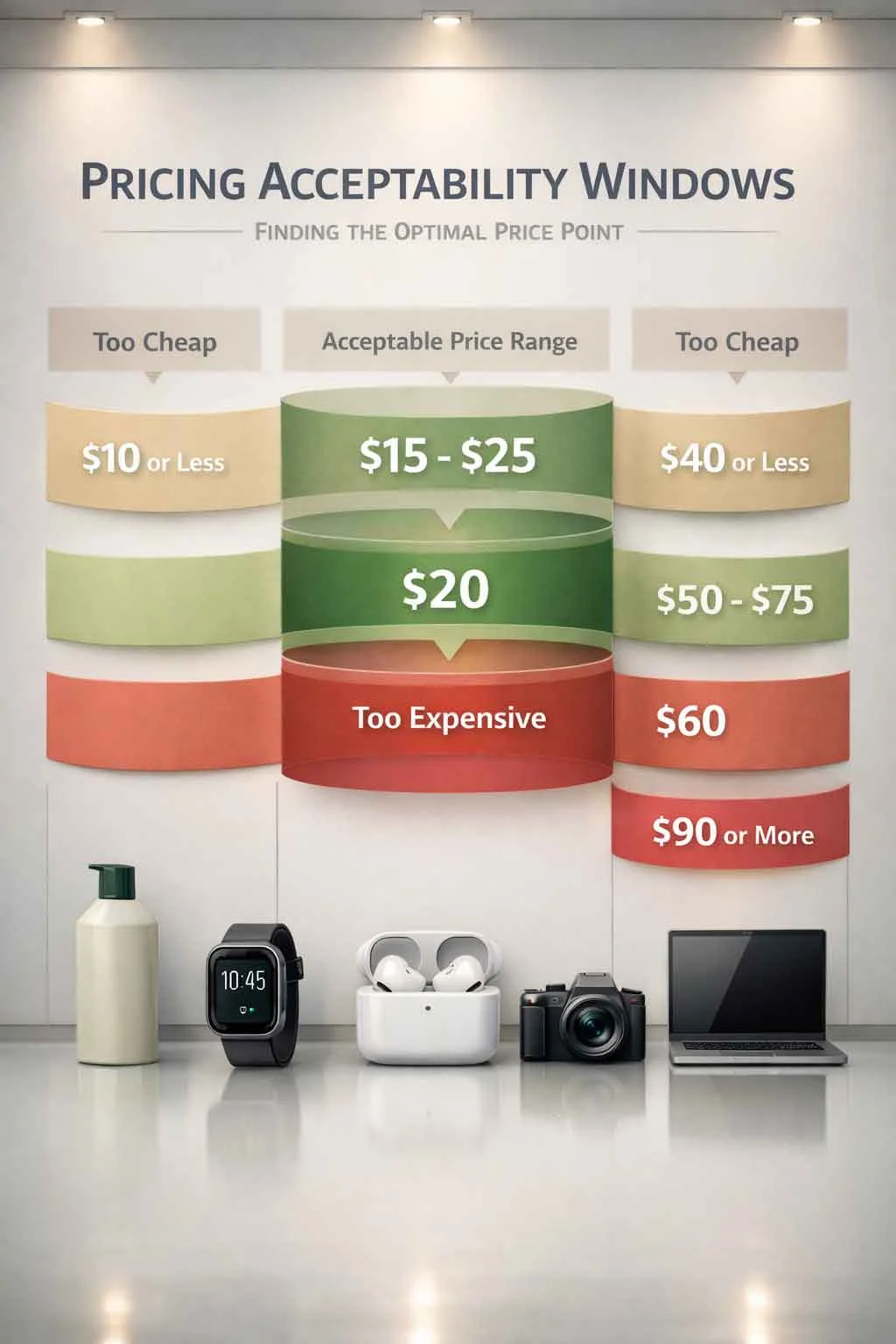
In practice, AI-driven pricing systems focus on price acceptability windows, not absolute price points.
These systems model:
- Historical sensitivity to price changes
- Tolerance thresholds before abandonment
- Perceived fairness relative to alternatives
Instead of asking, “What is the optimal price?”, AI asks:
- At what price does friction increase
- At what price does trust erode
- At what price does urgency disappear
This leads to pricing behavior that feels stable on the surface but adaptive underneath.
Buyers may never see dramatic price swings. What changes is which price they see, when, and alongside what alternatives.
Choice Architecture as a Selling Mechanism

One of the most powerful effects of AI in product selling is its influence on choice architecture.
Choice architecture refers to how options are structured, ordered, and constrained during decision-making.
AI systems optimize this by:
- Limiting visible options
- Reordering products based on predicted relevance
- Emphasizing defaults that reduce decision fatigue
Importantly, this is not manipulation in the malicious sense. It is an optimization of decision efficiency.
Too many options increase abandonment.
Too few options reduce perceived control.
AI continuously adjusts this balance.
This is why many AI-driven product environments converge on:
- 3-option comparisons
- Tiered plans
- Highlighted “most suitable” choices
These patterns are not aesthetic trends. They are statistical outcomes.
Where Discovery and Pricing Intersect
The real power of AI-driven selling emerges when discovery and pricing systems interact.
A product surfaced earlier in the decision process can tolerate different pricing dynamics than one introduced later. AI systems account for this by coordinating:
- Discovery timing
- Price framing
- Feature emphasis
This coordination is largely invisible, yet it determines whether a buyer feels:
- Curious
- Confident
- Overwhelmed
- Pressured
The goal is not persuasion.
The goal is friction minimization.
Limits and Constraints (Google Trust Signal)
It is important to acknowledge what these systems cannot do.
AI-driven discovery and pricing:
- Cannot eliminate buyer regret
- Cannot predict individual decisions with certainty
- Cannot remove external influences (budget, emotion, timing)
They operate within probabilistic bounds. Their effectiveness depends on data quality, model assumptions, and ethical constraints.
Recognizing these limits strengthens credibility and prevents overstatement.
How AI Quietly Rewrites Selling Workflows Inside Organizations

The most visible impact of AI on product selling appears at the customer interface.
The most consequential impact happens inside organizations, where selling decisions are planned, reviewed, and adjusted.
AI does not replace sales teams, product teams, or marketers. It rearranges their decision responsibilities.
This distinction matters because many failures attributed to AI are actually organizational mismatches, not model limitations.
From Human-Led Decisions to Model-Assisted Judgement
Traditional selling workflows relied on:
- Forecasts built from historical averages
- Campaign calendars planned weeks or months ahead
- Manual segmentation based on broad assumptions
AI introduces a parallel decision layer.
Instead of replacing human judgement, it offers:
- Continuous probability updates
- Scenario comparisons at scale
- Early warnings when assumptions drift
This creates a new workflow dynamic:
- Humans define objectives and constraints
- AI evaluates likelihood and trade-offs
- Humans validate, override, or refine
When this balance works, selling becomes adaptive without becoming chaotic.
When it fails, organizations either:
- Over-delegate to automation
- Or ignore model insights entirely
Both outcomes reduce effectiveness.
How Product Teams Experience AI-Driven Selling
For product teams, AI changes how success is evaluated.
Previously, product success was measured through:
- Feature adoption
- Conversion rates
- Retention metrics
AI introduces contextual performance evaluation.
A feature may perform poorly overall but exceptionally well under specific conditions. AI surfaces these micro-patterns, forcing product teams to think beyond averages.
This leads to:
- More modular product design
- Greater emphasis on configurable features
- Reduced reliance on one-size-fits-all releases
Product selling becomes less about launching “the best version” and more about enabling situational relevance.
Sales Strategy Without Fixed Funnels
AI also disrupts the idea of a fixed sales funnel.
Funnels assume a predictable sequence:
Awareness → Consideration → Conversion
AI-driven selling systems do not follow linear paths. They react to signals in real time, adjusting exposure, messaging, and sequencing dynamically.
As a result:
- Some buyers skip stages entirely
- Others loop repeatedly before converting
- Drop-off points shift unpredictably
This does not make selling harder. It makes static planning less useful.
Organizations that adapt stop asking:
“Where did the funnel break?”
They ask:
“Which signals failed to update our assumptions?”
This shift improves resilience.
Why AI Often Appears to “Fail” in Selling Contexts
Many AI selling initiatives underperform. The reasons are rarely technical.
These breakdowns highlight broader AI risks related to over-automation, data bias, and misplaced confidence in model outputs.
Common failure patterns include:
Misaligned objectives
If AI is optimized for short-term conversion, it may undermine trust or long-term value.
Poor signal quality
Models trained on noisy or biased data amplify existing distortions.
Overconfidence in automation
Delegating judgement without oversight leads to brittle outcomes.
Human resistance
Teams ignore model outputs that contradict intuition, nullifying benefits.
These failures create the illusion that AI “does not work for selling.” In reality, the system is functioning as designed within flawed constraints.
Where AI Helps Most – And Least – in Product Selling
AI excels where:
- Decisions are repetitive
- Patterns are subtle
- Scale overwhelms human attention
It struggles where:
- Context shifts abruptly
- Data is sparse or delayed
- Emotional nuance dominates
This is why AI performs well in:
- Product recommendations
- Pricing optimization
- Inventory alignment
And less reliably in:
- High-touch relationship selling
- Novel product categories
- One-off negotiation scenarios
Understanding these boundaries prevents unrealistic expectations and strengthens strategic deployment.
How AI Changes Buyer Perception Without Feeling Like Selling

One of the most misunderstood outcomes of AI-driven product selling is how it alters buyer perception without changing the visible act of selling.
From the buyer’s perspective, nothing dramatic happens.
- No aggressive persuasion
- No sudden pressure
- No obvious manipulation
Yet decisions feel easier.
This is not because buyers are being convinced more effectively. It is because friction is being removed earlier than buyers can consciously register.
Selling Without Triggering Resistance
These perception dynamics also explain why interfaces such as AI chatbots perform best when they assist decision-making rather than actively push outcomes.
Human resistance to selling rarely comes from the product itself. It comes from:
- Cognitive overload
- Poor timing
- Irrelevant framing
- Perceived pressure
AI-driven selling systems reduce these triggers by operating before resistance forms.
Instead of pushing harder at the point of decision, AI works upstream:
- It narrows options before evaluation begins
- It aligns framing with inferred priorities
- It avoids introducing choices during moments of cognitive fatigue
The result is not persuasion. It is non-interruption.
Buyers feel uninterrupted, not convinced.
Why Subtlety Outperforms Persuasion at Scale
Traditional sales optimization focused on improving messaging:
- Stronger calls to action
- Better copy
- Emotional hooks
These techniques still matter, but AI shifts the performance ceiling.
At scale, persuasion saturates quickly. Subtlety does not.
AI-driven systems gain leverage by:
- Choosing when not to sell
- Delaying exposure rather than increasing frequency
- Allowing intent to mature naturally
This explains why some AI-powered selling environments feel slower but convert better over time.
Speed is no longer the primary optimization target.
Readiness is.
Trust as an Emergent Property, Not a Feature
Trust is often treated as something that can be designed directly.
In AI-driven selling, trust emerges indirectly.
When buyers repeatedly experience:
- Relevant recommendations
- Stable pricing logic
- Predictable outcomes
Trust accumulates without explicit signaling.
This is why AI systems that aggressively optimize short-term conversion often undermine long-term performance. They break the consistency patterns that trust depends on.
Effective AI-driven selling prioritizes:
- Predictability over novelty
- Consistency over experimentation
- Familiarity over surprise
These traits rarely feel exciting. They feel reliable.
Perceived Fairness and Why It Matters More Than Price
Buyers do not evaluate price in isolation. They evaluate fairness.
AI-driven pricing systems succeed when buyers feel:
- Prices are consistent
- Changes are explainable
- Alternatives are reasonable
When pricing feels arbitrary, trust erodes even if the absolute price is lower.
This is why effective AI pricing systems often:
- Avoid extreme dynamic swings
- Anchor prices to familiar reference points
- Maintain visible logic across sessions
Fairness perception is not about transparency in a technical sense. It is about pattern stability.
The Psychological Boundary AI Must Not Cross
There is a subtle boundary between assistance and intrusion.
AI-driven selling becomes counterproductive when buyers feel:
- Watched rather than supported
- Nudged rather than guided
- Anticipated rather than understood
Crossing this boundary triggers skepticism.
This is why successful systems often:
- Limit personalization granularity
- Avoid hyper-specific messaging
- Preserve ambiguity in recommendations
Paradoxically, less precision can increase comfort.
Why Buyer Experience Is Now a Selling Mechanism
In AI-driven environments, experience is no longer a byproduct of selling.
It is the selling mechanism.
Every delay, recommendation, and omission shapes the outcome.
This reframes selling success from:
“Did the message work?”
to:
“Did the system respect the buyer’s cognitive limits?”
Organizations that understand this build durable advantage. Those that do not often chase short-term gains while eroding long-term trust.
Where AI-Driven Product Selling Reaches Its Limits
AI-driven selling systems are powerful precisely because they operate within boundaries.
When those boundaries are ignored, performance degrades, trust erodes, and outcomes become unstable. This is why understanding where AI stops working well is just as important as understanding how it works.
Limits are not weaknesses. They are control surfaces.
The Data Ceiling Problem
AI systems do not improve endlessly. They plateau when:
- New data stops adding meaningful variance
- User behavior stabilizes
- Market conditions normalize
At this point, additional optimization yields diminishing returns.
Organizations often misinterpret this plateau as model failure. In reality, it signals that the system has extracted most of the available signal.
Pushing harder beyond this point leads to:
- Overfitting
- Volatile recommendations
- Erratic pricing behavior
Recognizing the data ceiling prevents unnecessary intervention.
Bias Does Not Enter Where Most People Think
Bias in AI-driven selling rarely comes from intent. It comes from selection effects.
If certain products are shown more often, they generate more data. More data increases confidence. Increased confidence leads to more exposure.
This feedback loop can:
- Marginalize niche products
- Reinforce early assumptions
- Reduce diversity in discovery
Importantly, this is not a moral failure. It is a statistical one.
Breaking this loop requires deliberate constraints:
- Exposure balancing
- Exploration thresholds
- Periodic randomization
Without these, AI systems converge too tightly.
The Illusion of Objectivity in Selling Decisions
AI outputs often appear objective because they are numerical.
This is misleading.
Every AI-driven selling system reflects:
- Chosen objectives
- Defined success metrics
- Embedded assumptions
If revenue is optimized without regard for retention, AI will behave accordingly. If engagement is prioritized over satisfaction, the system will reflect that trade-off.
Objectivity is not inherent.
It is designed.
This is why oversight matters.
Regulatory and Ethical Boundaries Are Structural, Not Optional
As AI-driven selling expands, regulatory scrutiny increases.
This is not because AI is inherently dangerous. It is because:
- Selling decisions affect financial outcomes
- Automated systems scale rapidly
- Accountability becomes diffuse
Regulatory frameworks increasingly focus on:
- Explainability
- Non-discrimination
- Consumer protection
These constraints shape how AI can be used, not whether it can be used.
Organizations that treat regulation as an afterthought often face forced redesigns later.
Strategic Misuse: When AI Is Applied Where It Should Not Be
Similar constraint issues appear in systems like AI trading bots, where over-automation without sufficient data context increases risk rather than reducing it.
AI is sometimes deployed in contexts where:
- Data is insufficient
- Decisions are infrequent
- Human judgement dominates outcomes
In these cases, AI adds complexity without value.
Examples include:
- One-off high-stakes negotiations
- Highly customized enterprise deals
- Emotion-driven purchasing scenarios
Using AI here creates false confidence and distracts from human expertise.
Responsible Use as a Competitive Advantage
Responsible AI use is often framed as a compliance obligation.
In practice, it becomes a strategic differentiator.
Systems that:
- Respect cognitive limits
- Avoid exploitative patterns
- Maintain predictable behavior
Earn long-term trust.
This trust compounds quietly, influencing repeat purchases, brand perception, and tolerance during inevitable system errors.
Why Limits Strengthen AI-Driven Selling
Acknowledging limits does not weaken AI-driven selling strategies. It stabilizes them.
Clear boundaries:
- Improve model reliability
- Preserve buyer trust
- Reduce organizational overreach
AI performs best when it is treated as a decision amplifier, not a decision authority.
How AI-Driven Product Selling Evolves Over Time
AI-driven product selling is not a one-time transformation. It is a continuous calibration process.
Systems that perform well in early deployment often degrade if left unchecked. Not because the models fail, but because environments change:
- Buyer expectations shift
- Market saturation increases
- Competitive dynamics evolve
- Regulatory constraints tighten
Sustainable AI-driven selling depends on adaptation discipline, not model sophistication alone.
Why Stability Matters More Than Optimization
Early AI deployments often prioritize improvement metrics:
- Higher conversion rates
- Faster decision cycles
- Increased average order value
Over time, these metrics lose explanatory power.
What begins to matter more is stability:
- Are outcomes predictable across conditions
- Do results degrade gracefully under stress
- Can anomalies be identified quickly
Stability allows organizations to trust systems during uncertainty. Without it, even strong short-term gains become fragile.
This is why mature AI-driven selling strategies intentionally:
- Slow optimization cycles
- Reduce experiment volatility
- Preserve baseline behavior
Optimization becomes incremental rather than aggressive.
The Role of Human Oversight in Long-Term Performance
AI-driven selling systems do not become autonomous in a meaningful sense.
They require:
- Objective review
- Constraint refinement
- Assumption reassessment
Human oversight does not compete with AI. It anchors it.
Over time, the most effective organizations shift from asking:
“What should we automate next?”
to:
“What assumptions should we revisit?”
This shift prevents blind spots from becoming systemic failures.
Why Selling Outcomes Lag Behind System Changes
One challenge with AI-driven selling is delayed feedback.
Changes made today may influence outcomes weeks or months later. This lag complicates evaluation and encourages premature conclusions.
Organizations that misinterpret early signals often:
- Roll back effective systems too soon
- Overcorrect based on noise
- Attribute success or failure incorrectly
Recognizing lag is critical. AI-driven selling rewards patience and penalizes reactive management.
Long-Term Buyer Relationships in AI-Driven Environments
As AI increasingly mediates selling interactions, buyer relationships change subtly.
These long-term dynamics reflect broader real-world AI use cases where systems influence decisions gradually rather than through immediate persuasion.
Trust becomes:
- Pattern-based rather than message-based
- Experience-driven rather than promise-driven
Buyers rarely articulate why they trust or distrust AI-mediated systems. They feel it through consistency, predictability, and respect for limits.
Systems that maintain these traits remain effective even as novelty fades.
Final Synthesis: What AI Actually Changes in Product Selling
AI does not change the goal of selling.
It changes how uncertainty is managed.
Instead of persuading harder, AI reduces friction earlier.
Instead of predicting perfectly, it shifts probabilities consistently.
Instead of replacing judgement, it compresses decision latency.
Product selling becomes:
- Less visible
- More adaptive
- More dependent on system design
Organizations that understand this do not chase novelty. They build resilient decision systems that evolve quietly.
AI-driven product selling is neither a shortcut nor a guarantee.
It is a structural change in how selling decisions are formed, evaluated, and executed at scale. Its effectiveness depends on constraints, oversight, and respect for buyer cognition.
Recognizing these factors separates durable strategies from fragile experiments.
FAQs
How does AI change product selling compared to traditional methods?
AI changes product selling by shifting decisions earlier in the process. It uses probability models to influence discovery, pricing, and choice structure before buyers consciously evaluate options.
Does AI replace human sales and product teams?
No. AI assists by reducing uncertainty and decision latency, but humans retain responsibility for defining objectives, setting constraints, and maintaining oversight.
Is AI-driven product selling only used in ecommerce?
No. AI-driven selling mechanisms also appear in SaaS platforms, digital services, subscriptions, marketplaces, and other platform-based ecosystems.
How does AI affect pricing fairness?
AI systems often manage pricing within acceptable stability ranges rather than constantly changing prices. This helps preserve trust and perceived fairness while optimizing revenue.
What are the main risks of AI-driven selling?
Key risks include over-automation, biased data feedback loops, misaligned optimization objectives, and reduced trust if system behavior becomes unpredictable or opaque.
Why do some AI selling systems fail?
Failures typically stem from organizational misuse, weak data quality, unrealistic ROI expectations, or ignoring system constraints rather than purely technical limitations.
Can AI predict what buyers will purchase?
AI does not predict individual purchases with certainty. Instead, it adjusts probabilities across populations to reduce friction and increase alignment between offerings and likely preferences.
Is AI-driven selling ethical?
Ethical outcomes depend on transparency, governance, objective alignment, and respect for buyer autonomy. Automation alone does not determine ethical quality.