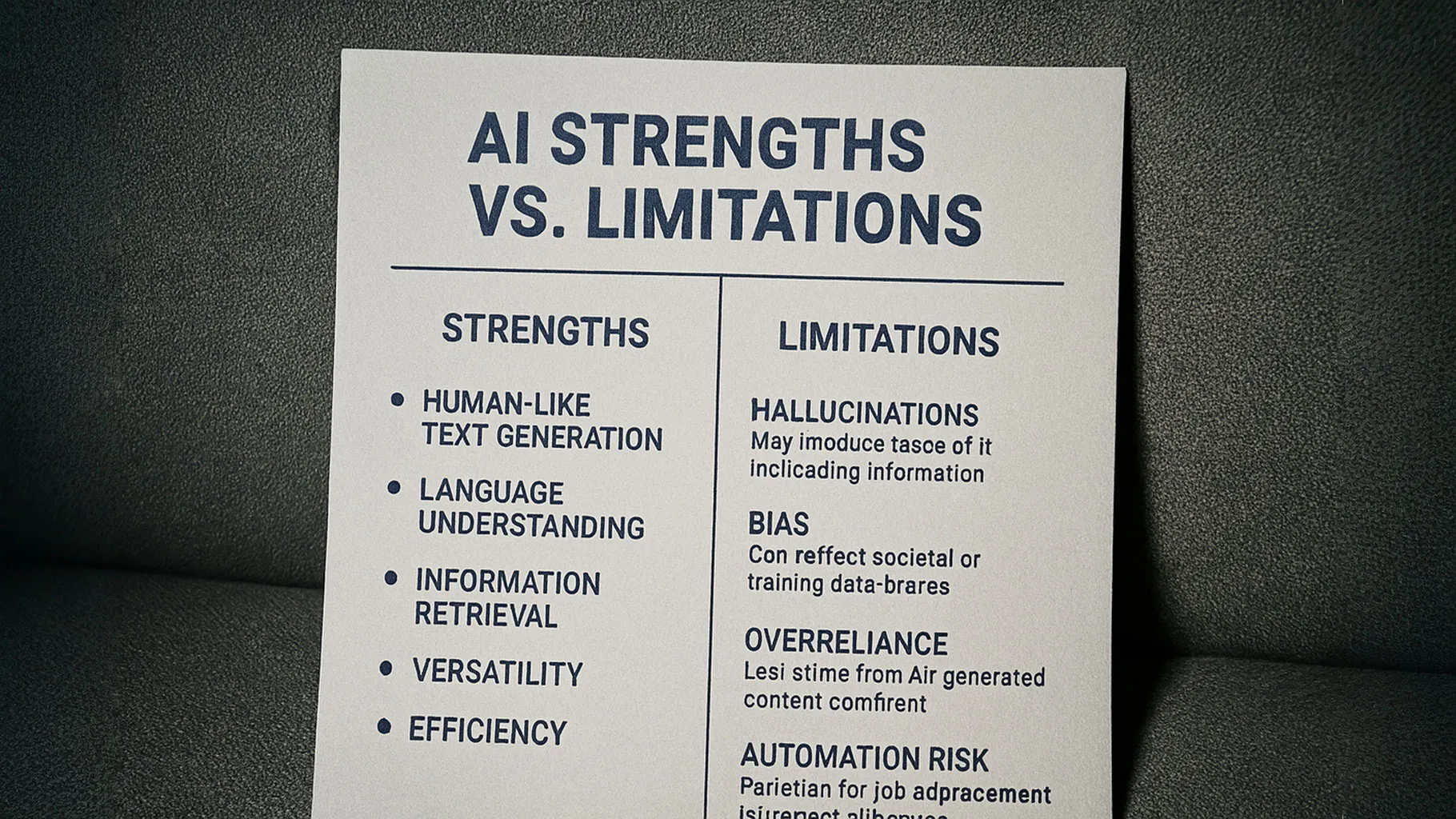

Artificial Intelligence is often presented as smarter, faster, and more reliable than humans. Headlines promise automation, prediction, and efficiency at scale. Yet many people misunderstand what AI can realistically do – and more importantly, what it cannot do.
This gap between expectation and reality creates risk.
This article explains AI risks in practical terms, not fear-based narratives or technical jargon. You’ll learn where AI performs well, where it fails, and why understanding these limits is essential before using AI in decision-making, business operations, or financial contexts.
This guide builds on foundational knowledge from AI Basics and focuses on real-world limitations, not speculation.
Before evaluating the risks and limitations, it helps to understand the real-world AI use cases shaping how artificial intelligence is applied today.
What People Commonly Misunderstand About AI
Many AI risks originate from misunderstanding AI itself.
AI does not “think.”
AI does not “understand.”
AI does not possess intent, awareness, or judgment.
Instead, AI systems identify patterns in data and generate outputs based on probabilities.
When users assume AI behaves like a human, errors become dangerous rather than harmless.
Core Risk Category 1 – AI Does Not Understand Context
AI processes inputs mathematically. It does not understand the meaning in the human sense.
Why this matters:
- AI may generate confident but incorrect answers
- Nuance, sarcasm, and cultural context are often missed
- Outputs can appear logical while being factually wrong
This limitation explains why AI-generated content sometimes feels “almost right” but subtly incorrect.
For a foundational explanation of how AI systems process information without true understanding, see this AI basics guide.
Core Risk Category 2 – AI Hallucinations and Fabricated Outputs
One of the most well-documented AI risks is hallucination – when AI generates information that appears factual but is entirely fabricated.
Common hallucination examples:
- Fake statistics
- Non-existent sources
- Incorrect historical facts
- Imaginary legal or medical claims
This happens because AI models predict plausible language, not verified truth.
Why hallucinations are dangerous:
- They sound confident
- Users may not fact-check
- Errors propagate quickly
This risk increases when AI is used in:
- Research
- Content publishing
- Financial analysis
- Decision support
Core Risk Category 3 – Data Dependency and Bias
AI systems learn from data. If the data is flawed, biased, or incomplete, the output will reflect those flaws.
Bias can originate from:
- Historical inequalities in datasets
- Overrepresentation of certain groups
- Missing or outdated information
AI does not “correct” bias automatically. It amplifies patterns it sees.
Bias, fairness, and responsible AI use are explored in depth in this AI safety and ethics guide.
Core Risk Category 4 – Overreliance on AI Decisions
AI becomes risky when humans stop questioning its outputs.
Overreliance occurs when:
- AI recommendations are accepted without review
- Human judgment is removed entirely
- AI outputs are treated as “objective truth”
This is especially dangerous in:
- Finance
- Hiring decisions
- Medical screening
- Legal analysis
AI should support decisions, not replace accountability.
This risk is particularly relevant when AI is applied in financial decision-making.
Core Risk Category 5 – Automation Without Understanding Consequences
Automation scales both efficiency and mistakes.
When AI systems automate actions without human oversight:
- Errors multiply rapidly
- Edge cases are ignored
- Accountability becomes unclear
This is why fully autonomous AI systems remain limited in real-world deployment.
Where AI Performs Well (And Where It Doesn’t)
Understanding AI risks also means understanding its strengths.
AI performs well when:
- Tasks are repetitive
- Patterns are stable
- Data quality is high
- Human oversight exists
AI performs poorly when:
- Context changes rapidly
- Ethical judgment is required
- Data is incomplete
- Outcomes carry high human impact
This distinction explains why AI excels in narrow domains but struggles with general reasoning.
Transition to Practical Risk Awareness
Understanding these risks does not mean avoiding AI. It means using it responsibly.
In the next section, we’ll examine:
Where human judgment must remain central
Why AI predictions are not guarantees
How risk differs between tools, investing, and automation
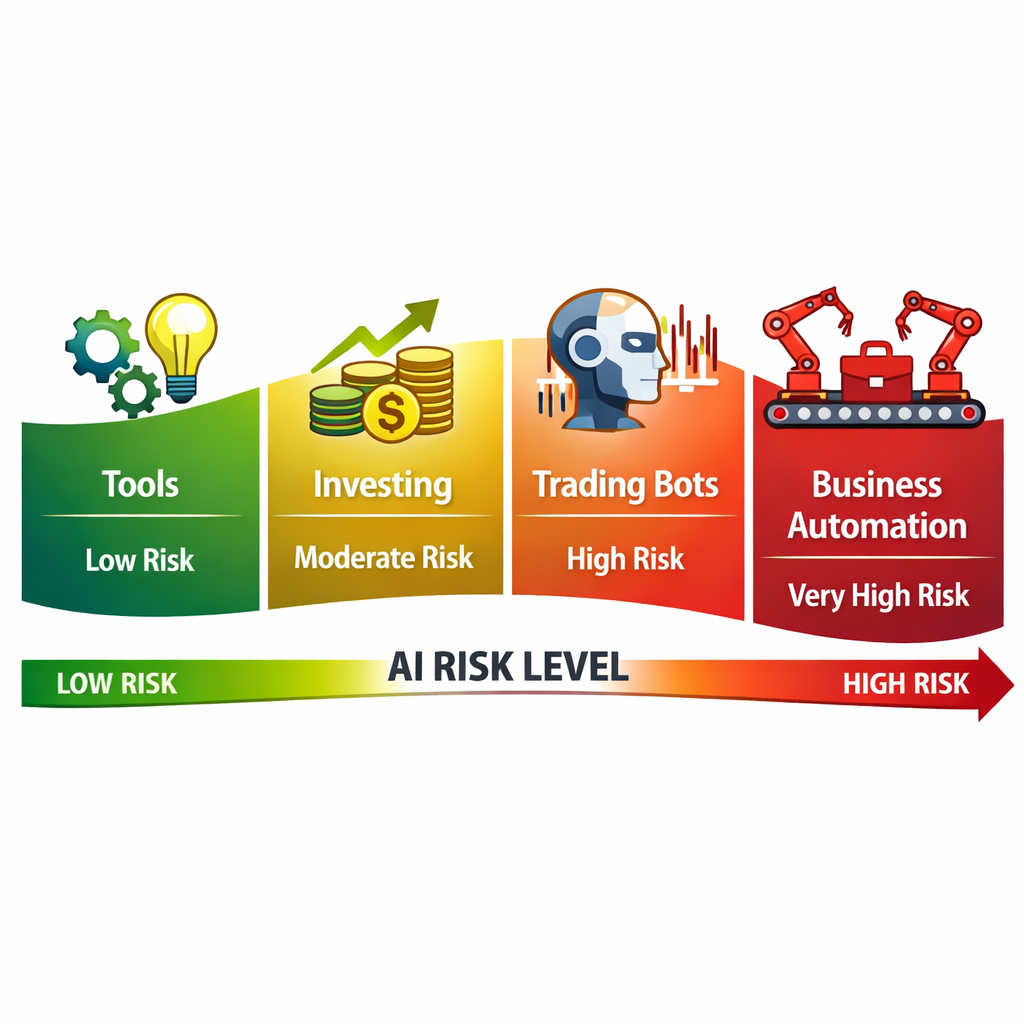
How AI Risk Differs by Use Case
AI risk is not universal. The same AI system can be low-risk in one context and high-risk in another. Understanding where AI is applied is just as important as understanding how AI works.
This section explains how AI risks change across tools, investing, business operations, and automation.
AI Risks in Everyday Tools
AI tools are widely used for:
- Writing assistance
- Image generation
- Data summarization
- Workflow automation
In these cases, AI risks are usually low-impact but still present.
Common tool-related risks:
- Inaccurate summaries
- Overconfident suggestions
- Outdated information
- Subtle misinformation
The key issue is trust calibration. AI tools should speed up work, not replace verification.
A practical overview of common AI tools and their limitations is covered in this AI tools guide.
AI Risks in Investing and Financial Decisions
AI becomes significantly riskier when used in financial contexts.
Unlike content or productivity tasks, financial decisions involve:
- Real capital
- Volatility
- Uncertainty
- Irreversible outcomes
Key financial AI risks:
- Overfitting to historical data
- False confidence in predictions
- Ignoring rare market events
- Automation bias
AI models do not understand markets – they only model past patterns.
These risks are explained further in this detailed guide on AI investing.
AI Risks for Beginners
Beginners face a unique risk: misinterpreting AI capability.
Many first-time users assume:
- AI predictions equal accuracy
- AI recommendations equal advice
- AI automation equals safety
In reality, beginners are most vulnerable to:
- Overtrust
- Lack of domain knowledge
- Inability to detect errors
If you are new to this topic, this step-by-step beginner guide explains how to approach AI investing safely.
AI Risks in Trading Bots and Automation
Trading bots represent one of the highest-risk AI applications for individuals.
Why?
- Markets change faster than models
- Bots execute without hesitation
- Losses scale quickly
Common trading bot risks:
- Poor handling of edge cases
- Latency and execution errors
- Hidden assumptions in models
- False backtesting confidence
Automation removes emotional bias – but it also removes human intuition.
The mechanics and risks of automated systems are discussed in this AI trading bots guide.
AI Risks in Business Operations
Businesses increasingly use AI for:
- Forecasting
- Customer segmentation
- Process automation
- Decision support
At scale, small AI errors can create large systemic issues.
Business-related risks include:
- Biased decision pipelines
- Automation without accountability
- Misaligned optimization goals
- Regulatory exposure
AI does not understand company values or ethics – it optimizes metrics.
Examples of how companies balance AI efficiency with responsibility are covered in this business transformation guide.
Why AI Predictions Are Not Guarantees
AI predictions are probabilistic, not deterministic.
This means:
- Outputs are estimates
- Confidence does not equal correctness
- Rare events are underrepresented
AI excels in stable environments but fails when:
- Conditions shift suddenly
- New variables appear
- Human behavior changes
This limitation explains why AI cannot replace judgment in complex, uncertain domains.
Human Judgment Still Matters
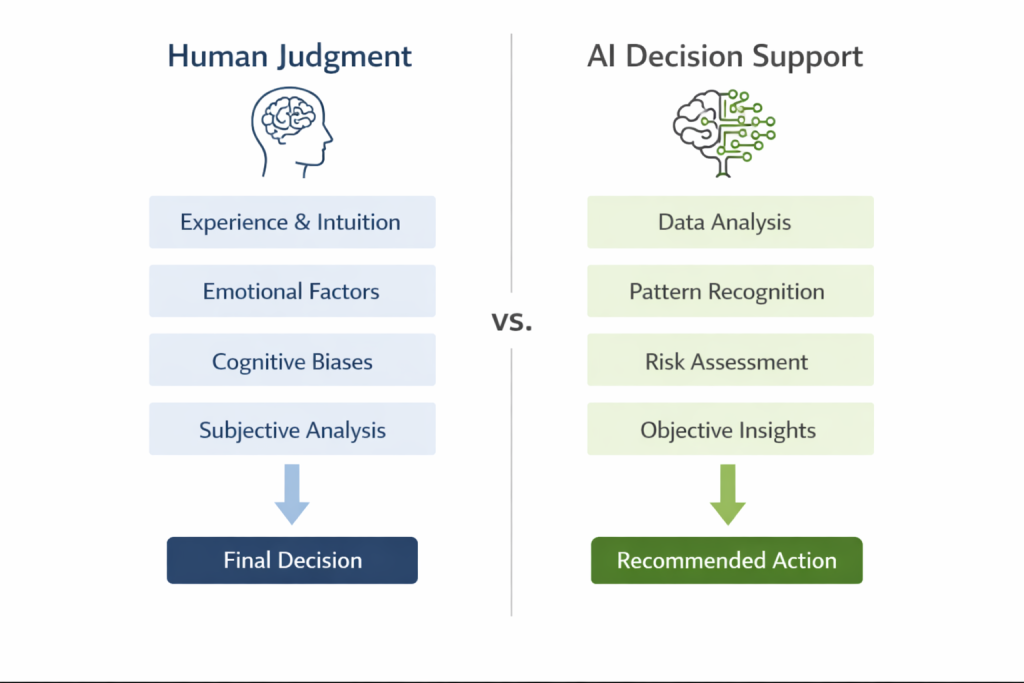
AI should function as a decision-support system, not a decision-maker.
Humans remain responsible for:
- Ethical evaluation
- Context awareness
- Accountability
- Final decisions
Automation improves speed, but trust is built on clarity, accountability, and human judgment.
The safest AI systems are those designed to augment, not replace, human thinking.
How to Evaluate AI Responsibly (Practical Guardrails)
Understanding AI risks is only useful if it leads to better decisions. The goal is not to avoid AI, but to use it with appropriate safeguards.
1. Treat AI Outputs as Drafts, Not Truth
AI outputs should be reviewed, verified, and contextualized. Confidence in wording does not equal correctness.
2. Keep Humans in the Decision Loop
AI should support human judgment, not replace accountability. This is especially important in finance, hiring, and business decisions.
3. Understand the Data Source
Always ask:
- What data trained this system?
- How recent is the data?
- What perspectives may be missing?
4. Avoid Full Automation in High-Stakes Scenarios
Automation should scale efficiency, not risk. Fully automated decisions increase the cost of errors.
5. Match AI Use to Its Strengths
AI performs best in narrow, repetitive tasks with stable data. It performs poorly in ethical, emotional, or highly uncertain environments.
Where AI Should Be Used Carefully
AI requires extra caution when applied to:
- Financial decision-making
- Automated trading systems
- Legal or compliance analysis
- Medical or health-related screening
These areas demand higher standards of verification and human oversight.
High-risk financial use cases are explored in detail in this comparison of AI stocks and ETFs.
FAQ
What are the main risks of AI?
Key AI risks include hallucinated outputs, embedded bias, overreliance by users, automation errors at scale, and the absence of true contextual understanding.
Can AI make accurate decisions?
AI can support decision-making by identifying patterns in large datasets, but it cannot guarantee correctness or replace human judgment, especially in complex or high-risk situations.
Is AI dangerous?
AI technology itself is not inherently dangerous. However, misuse, poor governance, or blind trust in automated outputs can create significant operational, financial, or ethical risks.
Why does AI sometimes give wrong answers confidently?
AI systems generate responses by predicting likely language patterns based on training data. They do not independently verify facts, which can result in confident but incorrect outputs.
Should AI be trusted in financial decisions?
AI can assist with financial analysis and pattern detection, but it should be used cautiously and always combined with human oversight, risk controls, and accountability mechanisms.