

Modern productivity problems are increasingly becoming retrieval problems, especially when teams already use an AI productivity system but lack reliable knowledge retrieval.
Many organizations can generate information faster than ever before.
Artificial intelligence can create:
- meeting summaries
- research reports
- project plans
- operational recommendations
- workflow documentation
within seconds.
At first glance, this appears to improve productivity.
However, a new challenge quickly emerges.
Information becomes easier to create than to retrieve.
Workers often know that useful information exists somewhere.
The difficulty is finding it when it is needed.
A decision may have been documented months earlier.
Research may already exist.
A customer requirement may have been discussed previously.
Yet teams frequently spend time recreating information that has already been produced.
This is one reason knowledge management is becoming increasingly important.
A strong AI knowledge management system helps transform information into reusable organizational knowledge.
Rather than treating documents, conversations, and research as isolated outputs, the system creates continuity between information creation and future retrieval.
Why Information Can Exist Yet Remain Unusable
Information does not become useful simply because it has been stored.
A document may exist inside a shared drive, chat history, meeting summary, or AI workspace, but still remain difficult to use when someone needs it later.
This usually happens because the information has lost its surrounding context.
Workers may not know where it came from, why it was created, whether it is still accurate, or how it connects to current work.
When this happens, stored information becomes passive. It exists inside the system, but it no longer supports decisions, planning, or execution.
What an AI Knowledge Management System Actually Means
Many people assume knowledge management simply means storing information.
In reality, storage and retrieval are not the same thing.
Information may be stored successfully while remaining effectively inaccessible.
A useful knowledge management system helps people answer questions such as:
- What do we already know?
- Where can supporting information be found?
- Why was this decision made?
- What research already exists?
- What lessons were learned previously?
These questions influence daily operations more than many organizations realize.
Knowledge management therefore focuses on preserving context, relationships, and accessibility rather than simply increasing document volume.
The objective is not creating larger information repositories.
The objective is making knowledge reusable.
This retrieval layer supports the broader AI productivity system by helping teams preserve organizational memory and reuse knowledge instead of recreating it.
Why Most Knowledge Management Systems Fail
Many knowledge management initiatives fail because they prioritize collection over retrieval.
Organizations often accumulate:
- documents
- notes
- reports
- recordings
- meeting summaries
without establishing clear retrieval structures.
As information volume grows, workers experience:
- search fatigue
- duplicated work
- repeated research
- decision reconstruction
- information fragmentation
The system technically contains knowledge.
The knowledge becomes difficult to access.
This creates a paradox.
The organization possesses more information while becoming less capable of using it effectively.
A sustainable knowledge management system focuses on retrieval quality rather than storage quantity.
These retrieval problems often create the same fragmentation patterns discussed in why AI productivity fails.
Why Retrieval Is Becoming More Valuable Than Information Creation
Historically, information was expensive to create.
Today, AI has dramatically reduced creation costs.
As creation becomes easier, retrieval becomes more valuable.
Organizations increasingly compete on their ability to:
- locate information quickly
- reuse existing knowledge
- preserve decision context
- maintain continuity across projects
rather than simply generating more information.
The competitive advantage shifts from information production toward information accessibility.
This trend is likely to continue as AI further accelerates content generation.
The Core Components of an AI Knowledge Management System

Most effective knowledge management systems contain several connected components.
Information Capture
Knowledge must first enter the system.
Sources may include:
- meetings
- projects
- customer interactions
- research activities
- operational decisions
- AI-generated outputs
The objective is reducing information loss.
Organization
Information requires structure.
Without organization, retrieval becomes increasingly difficult as volume grows.
Common organizational approaches include:
- topics
- projects
- workflows
- decision histories
- operational functions
The exact structure matters less than consistency.
Retrieval
Retrieval determines whether stored knowledge remains useful.
Workers should be able to locate relevant information without excessive searching.
A knowledge system that cannot support retrieval provides limited operational value.
Context Preservation
Information often loses value when context disappears.
Knowledge systems should preserve:
- reasoning
- assumptions
- constraints
- decision history
- supporting evidence
Context allows future users to understand not only what happened, but why it happened.
Continuous Updating
Knowledge systems should evolve alongside organizational learning.
Outdated information can create confusion.
Regular review helps maintain trust in the system.
What Is Retrieval Debt?
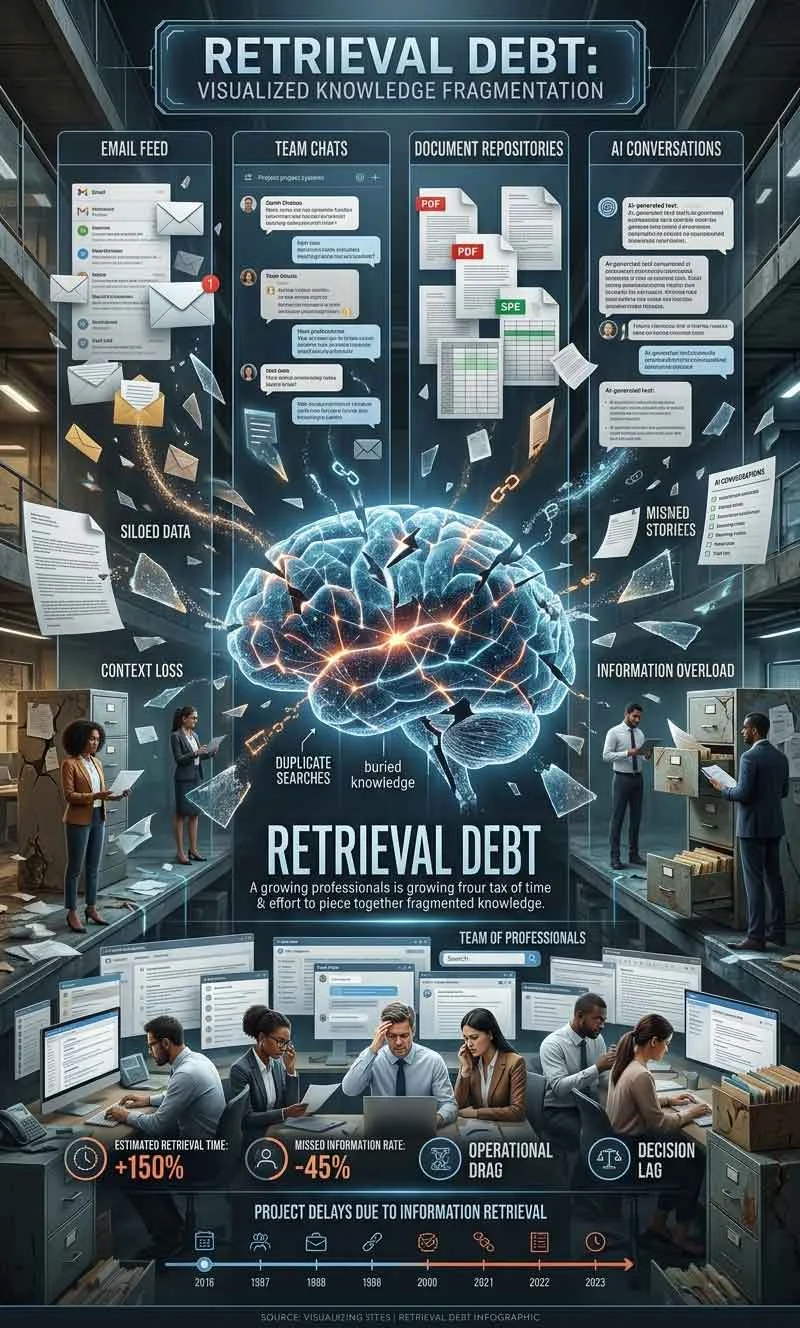
One of the most important concepts in modern productivity is retrieval debt.
Retrieval debt occurs when information is created faster than it can be organized, connected, and reused.
The problem develops gradually.
Teams create:
- documents
- meeting notes
- project plans
- research summaries
- AI-generated content
without establishing strong retrieval pathways.
Initially, the impact may be difficult to notice.
Over time, workers begin spending increasing amounts of effort locating information that already exists.
Knowledge becomes fragmented across:
- chats
- email threads
- cloud drives
- project systems
- AI conversations
- documentation platforms
The information remains available.
The ability to find it deteriorates.
Retrieval debt behaves similarly to technical debt.
Small inefficiencies accumulate until operational friction becomes visible throughout the organization.
Why AI Can Increase Knowledge Fragmentation
AI significantly reduces the effort required to generate information.
This creates substantial productivity opportunities.
However, it also introduces new risks.
Workers may generate:
- multiple versions of the same research
- overlapping project plans
- duplicate documentation
- competing recommendations
- disconnected knowledge sources
without realizing the volume of information being created.
The result is fragmentation.
Knowledge becomes distributed across numerous locations with limited visibility into how those pieces relate to one another.
Information exists.
Continuity weakens.
A sustainable knowledge management system focuses on preserving relationships between information rather than simply increasing the amount of information available.
Knowledge Storage vs Knowledge Retrieval
Storage and retrieval are different parts of a knowledge system. Storage keeps information available. Retrieval makes that information usable when decisions need to be made.
| System | Stores Information | Retrieves Information Efficiently |
|---|---|---|
| Shared Drive | Yes | Sometimes |
| Email Archive | Yes | Often poor |
| Chat History | Yes | Poor without structure |
| Basic AI Knowledge System | Yes | Better, but inconsistent |
| Mature Knowledge Architecture | Yes | Strong |
A strong knowledge system does not only preserve information. It makes information findable, understandable, and usable during future work.
Many organizations invest heavily in storage.
They implement:
- cloud platforms
- documentation systems
- shared drives
- project repositories
These systems successfully preserve information.
However, preservation does not automatically create accessibility.
A useful distinction exists between storage and retrieval.
Storage answers:
- Where is the information?
Retrieval answers:
- Can the information be found when needed?
A system may perform exceptionally well at storage while performing poorly at retrieval.
Workers often discover this difference when they know information exists but cannot locate it efficiently.
Knowledge management therefore depends less on storage capacity and more on retrieval quality.
Why Search Alone Does Not Solve Retrieval Problems
Many organizations assume search functionality solves knowledge management challenges.
Search certainly improves accessibility.
However, retrieval involves more than locating documents.
Workers often need:
- relevant context
- supporting decisions
- historical assumptions
- project relationships
- operational constraints
A search result may locate a document.
It may not explain why the information matters.
This is one reason strong knowledge systems preserve relationships between information rather than treating documents as isolated files.
Retrieval quality improves when information remains connected to its surrounding context.
AI Knowledge Overload and Information Saturation
Modern AI tools can generate information continuously.
Reports, summaries, recommendations, and documentation accumulate rapidly.
Eventually, workers face a new problem.
Information saturation.
The challenge is no longer obtaining knowledge.
The challenge is determining:
- what deserves attention
- what remains relevant
- what should be ignored
- what should be preserved
Without filtering mechanisms, information abundance can reduce clarity rather than improve it.
A useful knowledge system does not attempt to preserve everything equally.
It helps identify which information creates long-term value.
Individual Knowledge Management vs Team Knowledge Management
Knowledge management requirements vary depending on the environment.
Individual systems often focus on:
- personal retrieval
- note organization
- project continuity
- learning preservation
Team systems introduce additional requirements.
These include:
- shared standards
- organizational visibility
- collaborative retrieval
- cross-functional continuity
- decision transparency
A workflow that works well for one person may become ineffective when multiple teams rely on the same information.
Knowledge management systems should therefore be designed around actual usage patterns rather than personal preferences alone.
Why Knowledge Continuity Improves Productivity
Many productivity discussions focus on creating new information.
Far fewer focus on preserving useful information.
Knowledge continuity refers to the ability to build upon previous work rather than repeatedly recreating it.
Examples include:
- reusing research
- referencing previous decisions
- applying earlier lessons
- preserving operational knowledge
- maintaining project context
Without continuity, organizations often repeat the same activities.
The same questions are asked.
The same research is performed.
The same decisions are reconsidered.
Strong knowledge continuity reduces unnecessary repetition and allows effort to compound over time.
The Relationship Between Knowledge Management and Productivity
Knowledge management is not a separate operational function.
It directly influences productivity.
When workers can quickly retrieve relevant information, they spend less time:
- searching
- recreating work
- validating decisions
- rebuilding context
This allows more attention to remain focused on execution.
A useful knowledge management system therefore supports:
- planning
- task management
- decision-making
- collaboration
- execution continuity
Knowledge retrieval increasingly functions as an operational multiplier across the entire productivity environment.
Knowledge retrieval also supports execution quality because teams can continue projects without rebuilding context, which connects directly to the AI task management workflow.
Signs Your Knowledge Management System Is Failing
Knowledge management systems rarely fail suddenly.
Most begin showing warning signs long before larger operational problems become visible.
Common indicators include:
- repeated questions about previously documented information
- duplicated research efforts
- multiple versions of the same document
- difficulty locating project history
- increasing search time
- decision reconstruction
- declining trust in documentation
These symptoms often indicate that retrieval quality is weakening.
Workers may begin creating new information because locating existing information feels more difficult.
As this behavior spreads, fragmentation accelerates.
Recognizing these warning signs early helps organizations improve retrieval before operational inefficiencies become deeply embedded.
How to Evaluate an AI Knowledge Management System
Many organizations evaluate knowledge systems by measuring storage volume.
Examples include:
- number of documents
- knowledge base size
- uploaded files
- archived records
These metrics reveal information quantity.
They do not necessarily reveal information usefulness.
A stronger evaluation framework examines retrieval quality.
Accessibility Indicators
Examples include:
- retrieval speed
- search success rates
- information visibility
- reduced search effort
Workers should locate relevant information quickly.
Continuity Indicators
Examples include:
- preserved project history
- accessible decision records
- reusable research
- operational memory
Knowledge should remain connected across time.
Trust Indicators
Examples include:
- information accuracy
- documentation reliability
- update consistency
- confidence in retrieved content
Workers must trust what they retrieve.
Behavioral Indicators
Examples include:
- reduced duplicated work
- fewer repeated questions
- faster onboarding
- improved decision-making
The strongest systems improve operational behavior rather than merely storing information.
AI Knowledge Management Evaluation Checklist
The checklist below helps determine whether a knowledge management system is improving retrieval quality or creating hidden operational friction.
| Healthy Signal | Warning Signal |
|---|---|
| Information is easy to find. | Workers spend excessive time searching. |
| Knowledge remains connected to context. | Context becomes fragmented. |
| Research is reused effectively. | Research is repeatedly recreated. |
| Decision history remains accessible. | Past decisions are difficult to trace. |
| Documentation remains trusted. | Workers stop relying on documentation. |
| Knowledge supports execution. | Knowledge exists but remains unused. |
| Retrieval is fast and reliable. | Search effort increases over time. |
| Workers trust stored knowledge. | Workers recreate information instead of retrieving it. |
A useful knowledge management system should improve retrieval, continuity, and operational memory simultaneously. If workers consistently choose to recreate information instead of retrieving it, the system may require structural improvements.
Healthy vs Failing AI Knowledge Management Systems
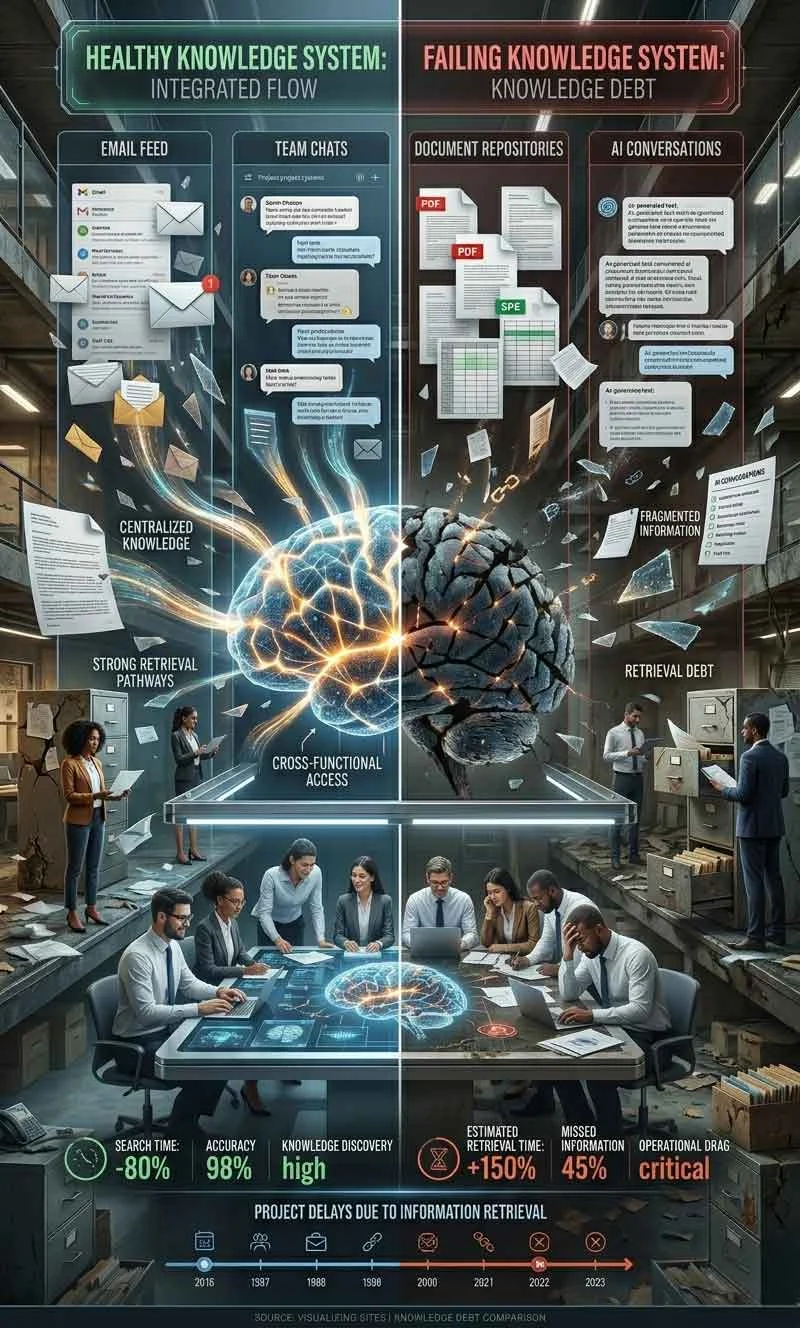
The differences between healthy and failing knowledge management systems often appear long before organizations recognize retrieval problems. A healthy system improves continuity, accessibility, and operational memory. A failing system gradually accumulates fragmentation, duplication, and retrieval debt.
Most knowledge management failures do not occur because information is lost. They occur because useful information becomes difficult to find, understand, or trust.
The comparison below highlights common characteristics that separate sustainable knowledge systems from environments where retrieval quality gradually deteriorates.
| Healthy Knowledge System | Failing Knowledge System |
|---|---|
| Information remains easy to retrieve. | Information exists but is difficult to locate. |
| Decision history remains accessible. | Decision rationale disappears over time. |
| Research is reused efficiently. | Research is repeatedly duplicated. |
| Knowledge remains connected across projects. | Knowledge becomes fragmented across systems. |
| Workers trust documentation. | Workers rely on memory rather than documentation. |
| AI improves retrieval quality. | AI increases information volume without improving accessibility. |
Most retrieval problems develop gradually as information volume grows faster than retrieval capabilities. Identifying these patterns early often prevents larger continuity failures later.
Recovering from Knowledge Management Failure
Many organizations attempt to solve retrieval problems by adding more storage.
This often increases complexity.
Recovery usually begins with simplification.
Questions worth examining include:
- Which information is actually used?
- Which knowledge sources remain trusted?
- Where does duplication occur?
- What information is most difficult to retrieve?
- Which decisions should remain permanently accessible?
Common recovery actions include:
- reducing duplicate repositories
- improving organizational consistency
- preserving decision history
- strengthening retrieval pathways
- simplifying documentation standards
- removing outdated information
Most retrieval failures are not storage failures.
They are accessibility failures.
The objective is improving knowledge reuse rather than accumulating additional information.
The Environmental Effects of Poor Knowledge Management
Knowledge quality influences the broader operational environment.
When retrieval becomes difficult, organizations often experience:
- duplicated work
- repeated research
- slower onboarding
- decision delays
- communication overload
- declining operational confidence
These effects compound over time.
Workers become less confident that useful information can be located.
As trust declines, more information is recreated.
This further increases fragmentation.
Strong knowledge systems improve organizational stability by preserving operational memory and reducing unnecessary repetition.
AI Search Does Not Fix Poor Knowledge Architecture
AI search can improve retrieval, but it cannot fully repair a weak knowledge structure.
If information is duplicated, outdated, poorly labeled, or scattered across disconnected systems, AI may retrieve incomplete or confusing results.
This problem becomes more visible when teams depend on AI assistants, internal search tools, or retrieval-augmented generation systems.
The AI system can only work with the information environment it is given.
Strong knowledge architecture still matters because retrieval depends on clean structure, useful context, consistent documentation, and clear relationships between information sources.
Knowledge Continuity and Long-Term Productivity
Knowledge becomes increasingly valuable when it remains useful over time.
Many organizations focus heavily on creating new information while paying less attention to preserving existing knowledge.
This creates a cycle of repeated effort.
Workers often:
- repeat research
- revisit previous decisions
- recreate documentation
- ask previously answered questions
- rediscover existing solutions
The issue is rarely a lack of information.
The issue is a lack of continuity.
Knowledge continuity allows future work to build upon previous work.
Instead of starting from the beginning, workers can leverage:
- historical context
- operational memory
- documented lessons
- established reasoning
- previous outcomes
This reduces unnecessary effort and improves productivity across the organization.
Over time, strong knowledge continuity allows learning to compound rather than disappear.
Why Knowledge Retrieval Is Becoming a Competitive Advantage
Historically, organizations competed by acquiring information.
Today, information is increasingly abundant.
AI tools can generate reports, research summaries, documentation, and recommendations within seconds.
As information creation becomes easier, competitive advantages begin shifting elsewhere.
Retrieval quality becomes increasingly important.
Organizations that can quickly locate:
- relevant knowledge
- project history
- customer context
- operational lessons
- decision rationale
often move faster than organizations that simply possess more information.
The difference is not knowledge ownership.
The difference is knowledge accessibility.
Retrieval quality increasingly influences:
- decision speed
- execution efficiency
- onboarding effectiveness
- operational continuity
- organizational learning
This trend is likely to become more significant as AI continues accelerating information generation.
The Relationship Between Knowledge, Planning, and Execution
Knowledge management should not be viewed as an isolated system.
It directly supports both planning and execution.
Planning often depends on:
- historical decisions
- project history
- previous priorities
- operational constraints
Execution often depends on:
- documented procedures
- supporting research
- project context
- organizational knowledge
Without retrieval continuity, both planning and execution become less efficient.
Workers spend time rebuilding context rather than applying knowledge.
This is why modern productivity systems increasingly connect:
- planning
- task management
- knowledge management
- retrieval systems
into one operational environment.
The strongest productivity systems preserve continuity across all four areas.
Planning quality also depends on historical context, which makes knowledge retrieval an important companion to an AI daily planning system.
Next-Step Questions Users Often Explore
Once organizations improve knowledge management, they often continue into deeper operational questions.
Retrieval Questions
- How should knowledge be organized?
- What information deserves permanent retention?
- How can retrieval speed be improved?
Workflow Questions
- How should knowledge connect to task systems?
- How should project history be preserved?
- How should teams share operational knowledge?
AI Questions
- How should AI-generated information be stored?
- Which knowledge should be automated?
- How can AI improve retrieval quality?
Productivity Questions
- How can retrieval reduce context switching?
- How can knowledge improve execution speed?
- How can operational continuity be preserved?
These questions help transform knowledge management from a documentation activity into a long-term productivity advantage.
Conclusion
An AI knowledge management system is not simply a storage solution.
It is a retrieval system designed to preserve organizational memory, support decision-making, and improve operational continuity.
As AI continues increasing the volume of available information, retrieval becomes increasingly important.
The challenge is no longer creating knowledge.
The challenge is ensuring that knowledge remains accessible when it is needed.
Strong knowledge management systems improve:
- retrieval quality
- continuity
- operational memory
- decision-making
- execution efficiency
while reducing:
- duplicated work
- repeated research
- information fragmentation
- decision reconstruction
- retrieval debt
The organizations that benefit most from AI may not be those that generate the most information.
They may be those that retrieve and reuse information most effectively.
Knowledge creates potential value.
Retrieval unlocks that value.
Transition to the Next Topic
Knowledge helps preserve information.
However, modern productivity environments also depend heavily on communication.
Projects, decisions, priorities, and operational knowledge frequently move through meetings, discussions, and collaboration systems.
This creates the next important question:
How should communication workflows be structured so information remains clear, actionable, and connected to execution?
The next stage of the AI productivity system focuses on AI workplace communication system design, collaboration, and information flow.
FAQ
What is an AI knowledge management system?
An AI knowledge management system is a structured framework that helps organizations capture, organize, retrieve, preserve, and reuse information while maintaining continuity across projects, teams, and workflows.
Why do AI knowledge management systems fail?
Many AI knowledge management systems fail because they prioritize storing information instead of retrieving information. As information volume grows, workers often struggle to locate useful knowledge when it is needed.
What is retrieval debt?
Retrieval debt occurs when information is created faster than it can be organized, connected, maintained, and reused. Over time, workers spend increasing effort locating information that already exists.
What is the difference between knowledge storage and knowledge retrieval?
Knowledge storage focuses on preserving information, while knowledge retrieval focuses on making information accessible and useful when needed. A system may store information successfully while still performing poorly at retrieval.
Can AI search solve poor knowledge management?
AI search can improve retrieval, but it cannot fully solve poor knowledge architecture. Fragmented, duplicated, outdated, or poorly organized information often reduces retrieval quality regardless of the search technology used.
What are signs that a knowledge management system is failing?
Common warning signs include repeated research, duplicated work, conflicting documents, decision reconstruction, increasing search time, fragmented knowledge sources, and declining trust in documentation.
How does knowledge management improve productivity?
Knowledge management improves productivity by reducing duplicated effort, preserving organizational memory, accelerating decision-making, supporting planning, improving execution continuity, and making information easier to reuse.
Why is knowledge retrieval becoming more important in the AI era?
AI has dramatically reduced the cost of creating information. As information becomes easier to generate, the ability to retrieve, validate, and reuse existing knowledge becomes increasingly valuable for productivity and decision-making.