
Many productivity problems begin long before task execution.
A worker may have an organized task management system.
Tasks may have clear ownership.
Deadlines may be visible.
Projects may be properly documented.
Yet progress still feels inconsistent.
This often occurs because planning and execution are not the same activity.
Task management determines how work gets completed.
Planning determines what work should be completed in the first place.
This distinction becomes increasingly important in modern AI productivity environments.
Artificial intelligence can generate:
- recommendations
- action items
- project plans
- workflow suggestions
- operational insights
at a scale that was previously impossible.
Without a structured planning system, this increased flow of information can create confusion rather than clarity.
Workers become busy.
Progress becomes difficult to measure.
Priorities begin competing with one another.
A strong AI daily planning system creates direction before execution begins.
Rather than reacting continuously to incoming information, the workflow establishes a structured decision framework that guides daily activity.
What an AI Daily Planning System Actually Means
Many people assume AI planning simply involves asking an AI assistant to generate a schedule.
In reality, planning is a broader operational process.
A planning system helps determine:
- what deserves attention
- what can be postponed
- what should be delegated
- what should be ignored
- what creates the highest impact
These decisions shape the entire workflow.
AI can assist by organizing information, identifying patterns, and highlighting opportunities.
However, planning remains heavily influenced by:
- business goals
- operational priorities
- environmental conditions
- strategic direction
- human judgment
The objective is not creating a perfect schedule.
The objective is creating clarity.
A useful planning system helps workers begin each day with a clear understanding of where attention should be focused.
This planning layer supports the broader AI productivity system by helping workers decide what deserves attention before execution begins.
Why Most Daily Planning Systems Fail
Many planning systems fail because they become disconnected from reality.
Workers often create detailed schedules that assume:
- uninterrupted focus
- predictable workloads
- stable priorities
- perfect execution
Real work environments rarely behave this way.
Unexpected meetings appear.
New requests arrive.
Projects change direction.
Urgent issues emerge.
As the gap between the plan and reality grows, workers stop trusting the planning system.
The schedule becomes a document rather than a decision-making tool.
A sustainable planning system accepts uncertainty.
Rather than attempting to control every minute of the day, it provides a framework for adapting to changing conditions while maintaining strategic direction.
When planning becomes disconnected from execution, the same fragmentation patterns described in why AI productivity fails often begin appearing across the workflow.
The Core Components of an AI Daily Planning System
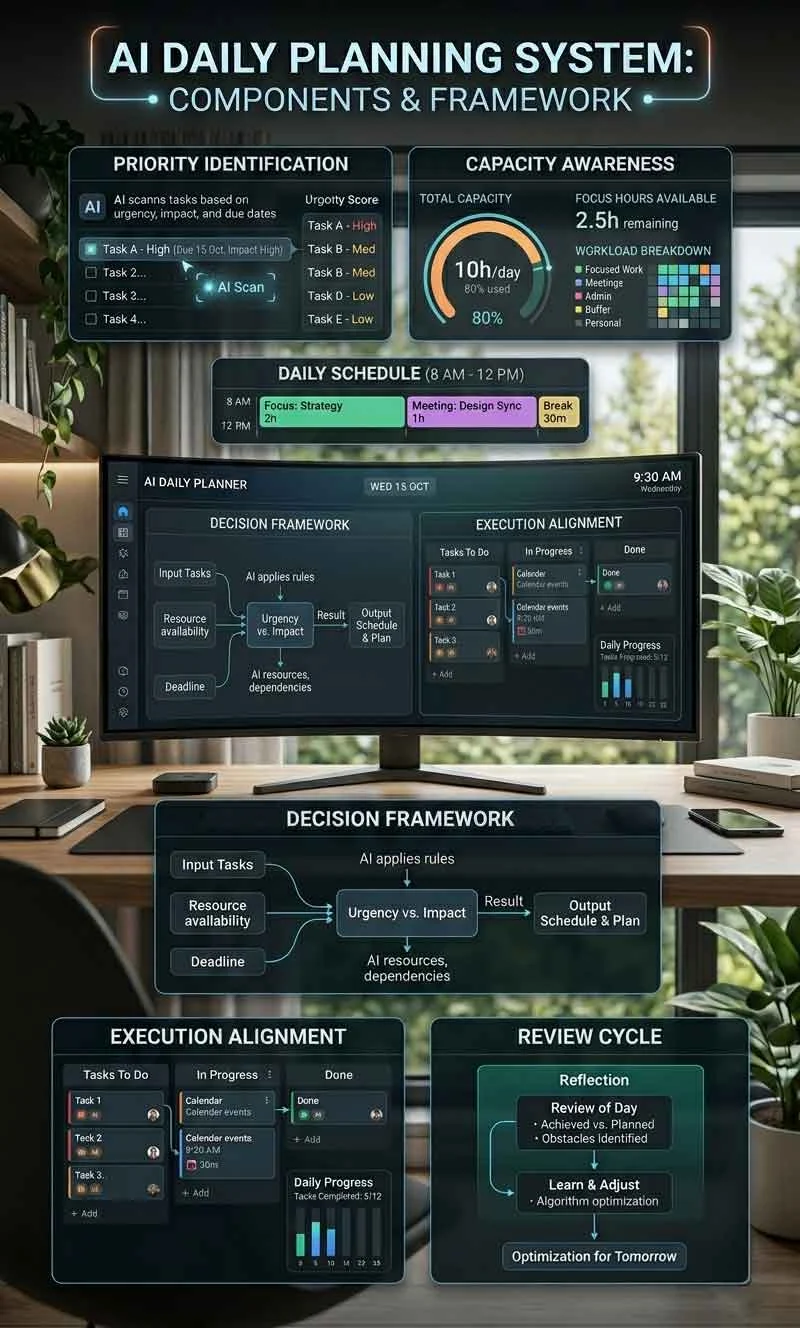
Most effective planning systems contain several connected components.
Priority Identification
Before work begins, priorities must be visible.
A worker should understand:
- critical objectives
- important projects
- urgent commitments
- high-impact opportunities
Without visibility, attention becomes reactive.
Capacity Awareness
Planning should reflect available capacity.
A realistic plan recognizes:
- time limitations
- energy levels
- workload constraints
- existing commitments
Overloaded plans often fail before execution begins.
Decision Frameworks
Strong planning systems reduce repeated decision-making.
Instead of constantly asking what to do next, workers operate within predefined priorities and rules.
This preserves attention for meaningful work.
Execution Alignment
Plans must remain connected to task systems.
This relationship is explored further in the AI task management workflow because planning without execution creates little value.
Review and Adjustment
Conditions change throughout the day.
A planning system should support adjustment without abandoning overall direction.
Review mechanisms help maintain alignment between plans and reality.
Planning and Task Management Are Not the Same Thing
Many productivity systems treat planning and task management as if they are identical.
They are closely related, but they solve different problems.
Planning answers:
- What deserves attention?
- What creates the highest value?
- What should happen today?
- What should wait?
- What should be ignored?
Task management answers:
- Who owns the work?
- What is the status?
- What comes next?
- What is blocked?
- What has been completed?
A planning system creates direction.
A task system supports execution.
When planning is weak, task systems often become overloaded with low-value work.
When task management is weak, good plans fail during execution.
Strong productivity environments require both functions working together.
Planning Problems vs Productivity Problems
Planning problems and productivity problems often look similar, but they do not come from the same place.
Productivity problems usually appear during execution. Work feels slow, tasks remain unfinished, and follow-through becomes inconsistent.
Planning problems appear earlier. The wrong work enters the system, priorities compete with one another, and attention becomes divided before execution begins.
This distinction matters because many workers try to solve planning problems with productivity tools. They add more dashboards, reminders, task lists, and automation systems while the original direction problem remains unchanged.
Planning creates direction. Task management supports coordination. Execution creates results. Retrieval preserves continuity.
When planning is weak, productivity tools often make the workflow look organized without making the work more meaningful.
Why AI Can Create Planning Overload
One of the biggest hidden risks of AI-assisted productivity is planning overload.
AI can generate:
- strategic recommendations
- improvement opportunities
- optimization ideas
- project suggestions
- workflow enhancements
within seconds.
This abundance creates a new challenge.
Workers may suddenly face dozens of possible priorities.
Everything appears useful.
Everything appears important.
Everything competes for attention.
The result is often decision fatigue.
Rather than improving focus, AI can unintentionally create additional complexity.
A strong planning system filters opportunities before they become commitments.
Not every recommendation deserves action.
Not every improvement deserves implementation.
The goal is not maximizing activity.
The goal is maximizing meaningful progress.
Why Prioritization Is More Important Than Scheduling
Many people focus heavily on calendars and schedules.
However, productivity problems often originate before scheduling begins.
If priorities are incorrect, a perfectly organized schedule may still produce poor outcomes.
This is why prioritization often creates greater value than time management alone.
Effective prioritization evaluates:
- business impact
- strategic value
- urgency
- dependencies
- opportunity cost
AI can assist by identifying relationships between tasks and projects.
However, prioritization remains heavily dependent on context.
A task that appears minor may have significant business value.
A task that appears urgent may have little long-term importance.
The strongest planning systems focus on selecting the right work before attempting to schedule the work.
Daily Planning vs Weekly Planning

Daily planning and weekly planning support different layers of productivity. Daily planning focuses on execution, while weekly planning focuses on direction.
When these two layers are disconnected, workers may complete daily tasks without moving closer to larger goals.
| Daily Planning | Weekly Planning |
|---|---|
| Focuses on today’s execution. | Focuses on the next several days of direction. |
| Selects which tasks deserve attention now. | Clarifies which priorities should guide the week. |
| Helps manage workload and interruptions. | Helps prevent daily work from drifting away from larger goals. |
| Supports short-term focus. | Supports strategic continuity. |
| Answers: What should I do today? | Answers: What should this week move forward? |
A strong AI planning system connects both layers. Weekly planning creates direction, while daily planning translates that direction into realistic execution.
Daily Planning vs Reactive Productivity
Many workers spend their day reacting.
They respond to:
- emails
- messages
- meetings
- notifications
- incoming requests
without a structured framework for deciding what deserves attention.
This creates reactive productivity.
Activity remains high.
Progress becomes difficult to measure.
A planning system introduces intentionality.
Instead of allowing external inputs to dictate priorities, the workflow establishes direction before interruptions occur.
This does not eliminate unexpected events.
It creates a decision framework for handling them.
Workers can evaluate new demands against existing priorities rather than continuously shifting attention.
Capacity Planning and Execution Reality
One of the most common planning mistakes is assuming unlimited execution capacity.
Every worker operates within constraints.
Examples include:
- available time
- energy levels
- attention resources
- existing commitments
- operational complexity
Many planning systems fail because they ignore these constraints.
A schedule may look productive on paper while remaining impossible to execute.
AI can help estimate workload requirements.
However, capacity planning still requires realistic expectations.
A sustainable planning system creates enough structure to guide execution while preserving flexibility for unexpected events.
The objective is not creating a perfect day.
The objective is creating a workable day.
The Relationship Between Planning and Behavioral Satisfaction
Planning affects more than operational performance.
It also influences behavioral experience.
Workers often feel more confident when they understand:
- what matters most
- what can wait
- what progress looks like
- how success will be evaluated
Unclear priorities create uncertainty.
Too many competing priorities create stress.
Constant re-prioritization creates mental fatigue.
A strong planning system reduces cognitive load by narrowing attention toward meaningful objectives.
This is one reason effective planning often improves both productivity and well-being.
The system creates clarity before execution begins.
Why AI Cannot Decide What Matters Most
AI can analyze information rapidly.
It can identify patterns.
It can organize projects.
It can summarize options.
However, AI does not inherently understand purpose.
Purpose remains a human decision.
Organizations determine:
- strategic objectives
- customer priorities
- revenue goals
- operational direction
- risk tolerance
AI can support decision-making.
It cannot define success independently.
This distinction is important because many planning failures occur when people expect AI to replace judgment rather than support judgment.
The strongest planning systems combine AI analysis with human direction.
Technology provides information.
Humans provide meaning.
Planning Continuity and Long-Term Productivity
Daily planning should not exist in isolation.
Each day’s decisions influence future execution.
Strong planning systems preserve continuity by connecting:
- daily priorities
- project objectives
- task systems
- historical decisions
- operational goals
Without continuity, planning becomes repetitive.
Workers repeatedly revisit the same decisions without creating sustained progress.
Planning continuity reduces unnecessary decision-making.
The workflow builds upon previous context rather than restarting each day from the beginning.
This creates cumulative productivity gains over time.
Early Warning Signs of Daily Planning Failure
Planning systems rarely fail immediately.
Most begin showing warning signals long before larger productivity problems become visible.
Common indicators include:
- constantly shifting priorities
- overloaded schedules
- repeated task carryovers
- excessive rescheduling
- unclear daily objectives
- decision fatigue
- increasing reactive work
These symptoms often indicate that planning and execution are becoming disconnected.
Many workers respond by creating more detailed plans.
However, additional complexity rarely solves planning problems.
The issue is often a lack of prioritization clarity rather than insufficient scheduling.
Recognizing these warning signs early helps prevent planning systems from becoming administrative exercises instead of decision-support tools.
How to Evaluate an AI Daily Planning System
Many people evaluate planning systems by asking whether a schedule was completed.
A stronger evaluation framework asks whether the planning system improved decision quality.
Several indicators can help assess planning effectiveness.
Clarity Indicators
Examples include:
- visible priorities
- defined objectives
- reduced uncertainty
- easier decision-making
Workers should understand what deserves attention before work begins.
Alignment Indicators
Examples include:
- consistency with goals
- project alignment
- priority stability
- execution relevance
Daily activities should remain connected to larger objectives.
Capacity Indicators
Examples include:
- realistic workload expectations
- manageable schedules
- sustainable execution pace
- reduced overload
A planning system should reflect actual capacity rather than idealized assumptions.
Behavioral Indicators
Examples include:
- reduced decision fatigue
- improved confidence
- lower stress
- increased focus
Strong planning systems improve both productivity and working experience.
AI Daily Planning Evaluation Checklist
The checklist below helps identify whether a planning system is improving operational clarity or creating additional friction.
| Healthy Signal | Warning Signal |
|---|---|
| Clear priorities | Priority confusion |
| Realistic daily workload | Overloaded schedules |
| Stable direction | Constant re-prioritization |
| High execution confidence | Decision fatigue |
| Alignment with goals | Reactive productivity |
| Daily plans are completed consistently | Tasks repeatedly carry over to future days |
| Planning reduces uncertainty | Planning creates additional complexity |
| Workers know what matters most | Everything feels equally important |
A useful planning system should improve clarity, confidence, and execution quality simultaneously. If planning creates more confusion than direction, the workflow may require simplification rather than additional planning tools.
Healthy vs Failing AI Daily Planning Systems

Most planning systems do not fail because people stop planning. They fail because planning gradually becomes disconnected from reality, execution capacity, and operational priorities.
A healthy planning system creates direction without overloading the day. A failing planning system creates the appearance of organization while workers continue reacting, rescheduling, and rebuilding priorities repeatedly.
Recovering from Daily Planning Failure
Recovery often begins by reducing complexity rather than introducing additional planning tools. Many planning systems become stronger when priorities are removed instead of added.
Many planning systems become ineffective because they attempt to control too much.
Recovery often begins by simplifying decision-making.
Questions worth examining include:
- Which priorities actually matter?
- Which activities create the highest value?
- Which commitments should be removed?
- Where does planning complexity originate?
- Which decisions are repeatedly revisited?
Common recovery actions include:
- reducing planning noise
- limiting active priorities
- improving goal visibility
- aligning plans with capacity
- simplifying decision frameworks
- strengthening review processes
Most planning failures are not caused by insufficient information.
They are caused by insufficient clarity.
The objective is creating direction rather than creating larger planning systems.
The Environmental Effects of Poor Planning
Planning quality influences the entire operational environment.
When priorities become unclear, organizations often experience:
- increased stress
- delayed decisions
- project drift
- duplicated effort
- communication overload
- unnecessary meetings
- declining confidence
These effects frequently spread beyond individual workers.
Teams may begin operating reactively.
Projects lose momentum.
Strategic objectives become harder to maintain.
Strong planning systems improve environmental stability by creating shared direction before execution begins.
Why Planning Is Becoming a Retrieval Problem
Modern planning increasingly depends on historical information.
Planning decisions often require access to:
- previous priorities
- project history
- performance data
- earlier decisions
- operational constraints
Without retrieval support, workers repeatedly recreate planning decisions.
This increases cognitive load and slows decision-making.
Strong planning systems preserve context and allow previous decisions to remain accessible.
Planning quality therefore depends not only on future intentions but also on effective retrieval of historical knowledge.
Planning Continuity and Long-Term Productivity
Daily planning should not be treated as an isolated activity.
Every planning decision creates future consequences.
A priority selected today may influence:
- project timelines
- resource allocation
- customer outcomes
- team workloads
- strategic execution
This is why strong planning systems preserve continuity between:
- daily objectives
- weekly goals
- monthly initiatives
- long-term priorities
Without continuity, planning becomes repetitive.
Workers repeatedly revisit decisions that should already be understood.
The workflow restarts from the beginning each day.
Over time, this creates unnecessary cognitive load.
Planning continuity allows previous decisions to remain useful.
Instead of constantly determining what matters, workers can focus on executing previously established priorities.
This creates cumulative productivity gains that become increasingly valuable as operational complexity grows.
The Relationship Between Planning, Execution, and Retrieval
Modern productivity systems increasingly depend on three connected functions.
Planning
Planning determines:
- what deserves attention
- what creates value
- what should happen next
Planning establishes direction.
Execution
Execution transforms plans into outcomes.
This includes:
- task completion
- project progress
- operational delivery
- implementation activities
Execution creates results.
Retrieval
Retrieval preserves continuity.
Workers often need access to:
- historical decisions
- project context
- supporting information
- operational knowledge
Retrieval allows execution to continue without repeatedly reconstructing context.
These three functions increasingly operate together.
Weakness in one area often affects the others.
Strong planning without execution creates inactivity.
Strong execution without planning creates inefficiency.
Strong planning and execution without retrieval creates continuity problems.
Sustainable productivity environments require all three functions working together.
Why AI Daily Planning Systems Often Become Overcomplicated
Many planning systems begin with good intentions.
Over time, additional layers are introduced.
Examples include:
- extra planning templates
- multiple review systems
- additional tracking mechanisms
- complex categorization structures
- excessive optimization processes
Eventually, the planning system itself becomes difficult to maintain.
Workers spend increasing amounts of time managing the planning process rather than benefiting from it.
This creates planning overhead.
The strongest planning systems often remain surprisingly simple.
They provide enough structure to support decision-making without introducing unnecessary complexity.
Planning should reduce cognitive load.
It should not become another source of operational friction.
Next-Step Questions Users Often Explore
Once workers establish stronger planning systems, they frequently continue into deeper workflow questions.
Prioritization Questions
- How should priorities be reviewed weekly?
- What planning decisions should remain manual?
- How many priorities should exist at one time?
Workflow Questions
- How should planning connect to task management?
- How should planning support team coordination?
- How should planning adapt to changing priorities?
Retrieval Questions
- How should planning decisions be documented?
- How can historical planning decisions be reused?
- What planning information should remain searchable?
Productivity Questions
- How can planning reduce context switching?
- How can planning improve focus?
- How can planning support long-term productivity?
These next-step questions help transform planning from a daily activity into a sustainable operational system.
Why Planning Needs Retrieval Continuity
Many planning decisions lose value when the reasoning behind those decisions becomes difficult to retrieve later.
A worker may remember that a priority was selected, but not why it was selected. A team may continue executing tasks without understanding the original tradeoffs, constraints, or assumptions behind the plan.
This creates weak continuity between planning and execution.
Strong planning systems preserve the context behind decisions. They keep important reasoning, constraints, project history, and priority changes accessible for future review.
This is why planning systems increasingly depend on knowledge organization and retrieval continuity rather than scheduling alone.
Conclusion
An AI daily planning system is not simply a scheduling tool.
It is a decision framework that helps determine where attention, time, and effort should be directed.
Many productivity challenges originate before execution begins.
Workers often struggle not because tasks are difficult to complete, but because priorities are unclear.
Strong planning systems improve:
- clarity
- focus
- prioritization
- execution alignment
- decision quality
while reducing:
- reactive productivity
- decision fatigue
- planning noise
- operational confusion
As AI continues increasing the volume of available information, planning becomes increasingly important.
The objective is no longer gathering more options.
The objective is identifying which options deserve action.
Planning creates direction.
Task management supports execution.
Retrieval preserves continuity.
Together, these functions form the foundation of sustainable AI productivity systems.
Transition to the Next Topic
Planning determines what work enters the system.
Execution determines how work gets completed.
However, many productivity challenges still remain because information becomes difficult to find after work has already begun.
This creates the next important question:
How should knowledge, decisions, research, and operational information be stored so they remain accessible in the future?
The next stage of an AI productivity system focuses on retrieval, knowledge organization, and information continuity.
After planning creates direction, the next challenge is preserving knowledge, decisions, and research through an AI knowledge management system so future work can continue without repeated context reconstruction.
FAQ
What is an AI daily planning system?
An AI daily planning system is a structured framework that uses artificial intelligence to support prioritization, decision-making, workload planning, and daily execution alignment.
Why do many daily planning systems fail?
Many daily planning systems fail because they become disconnected from real-world conditions. Unrealistic schedules, overloaded priorities, and excessive complexity often reduce planning effectiveness.
Can AI create a daily plan automatically?
AI can generate schedules, recommendations, and planning suggestions, but human judgment remains necessary to decide priorities, strategic value, and business relevance.
What is the difference between planning and task management?
Planning determines what deserves attention, while task management focuses on organizing and executing work that has already been prioritized.
Why is prioritization more important than scheduling?
Scheduling organizes time, but prioritization determines whether the right work is being scheduled. Strong prioritization often creates larger productivity gains than calendar optimization alone.
How can planning reduce decision fatigue?
Planning reduces decision fatigue by creating predefined priorities and decision frameworks, which lowers the number of choices workers need to make throughout the day.
What are signs that a planning system is becoming ineffective?
Common warning signs include overloaded schedules, constant re-prioritization, repeated task carryovers, unclear objectives, increasing reactive work, and decision fatigue.
What should be improved first in a failing planning system?
Most failing planning systems should first reduce planning noise, simplify priorities, improve goal visibility, and align the plan with realistic execution capacity.