

Communication is one of the most overlooked productivity systems inside modern organizations.
Many teams focus heavily on:
- task management
- planning
- knowledge management
- automation
- reporting
Yet a large percentage of productivity problems originate from communication failures rather than execution failures.
Workers may understand their tasks.
Documentation may exist.
Priorities may appear clear.
However, information often moves between people imperfectly.
Instructions become incomplete.
Decisions become misunderstood.
Context becomes fragmented.
As organizations increasingly adopt AI tools, communication complexity continues growing.
Artificial intelligence can generate:
- summaries
- reports
- meeting notes
- recommendations
- project updates
at unprecedented speed.
This creates a new challenge.
Information can travel faster than understanding.
A strong AI workplace communication system helps teams maintain clarity, context, alignment, and continuity while operating in increasingly information-dense environments.
What an AI Workplace Communication System Actually Means
Many people associate communication with messaging tools.
Examples include:
- chat platforms
- video meetings
- collaboration software
These tools support communication.
They are not communication systems by themselves.
A communication system defines how information moves through an organization.
It determines:
- who receives information
- when information is shared
- how context is preserved
- how decisions are communicated
- how misunderstandings are reduced
The objective is not increasing communication volume.
The objective is improving communication quality.
Organizations often suffer from communication overload rather than communication shortages.
More messages do not automatically create better understanding.
A useful communication system creates clarity without creating unnecessary noise.
This communication layer supports the broader AI productivity system by improving information flow, alignment, and execution quality.
AI workplace communication systems are often one component of a broader AI productivity system because communication quality directly affects planning, execution, and knowledge continuity.
Why Communication Problems Are Increasing
Modern organizations operate across more channels than ever before.
Information may move through:
- emails
- messaging platforms
- meetings
- project systems
- AI assistants
- documentation tools
Every additional communication channel creates opportunities for fragmentation.
Workers may receive:
- conflicting updates
- incomplete instructions
- duplicate requests
- outdated information
without realizing it.
The challenge is no longer access to information.
The challenge is maintaining consistency across communication environments.
As information volume increases, communication quality becomes increasingly important.
Many communication breakdowns eventually create the same fragmentation patterns discussed in why AI productivity fails.
Why More Communication Does Not Always Improve Productivity
Many organizations respond to communication problems by increasing communication.
This often creates the opposite effect.
Workers become exposed to:
- additional meetings
- more status updates
- longer message threads
- increased notification volume
while clarity remains unchanged.
This creates communication overload.
People spend more time processing information and less time acting on information.
The strongest communication systems focus on signal quality rather than message quantity.
Useful communication helps workers understand:
- what matters
- what changed
- what action is required
- why the information is relevant
Communication becomes valuable when it improves decision-making and execution.
Not when it merely increases information flow.
The Core Components of an AI Workplace Communication System

Most effective communication systems contain several connected components.
Information Distribution
Information should reach the people who need it.
Over-distribution creates noise.
Under-distribution creates blind spots.
A communication system balances both risks.
Context Preservation
Messages often lose value when context disappears.
Workers should understand:
- background information
- assumptions
- objectives
- dependencies
Context helps reduce misunderstandings.
Decision Communication
Important decisions should remain visible.
Workers need access to:
- what was decided
- why it was decided
- who approved it
- how it affects current work
Decision transparency improves continuity.
Feedback Loops
Communication should not be purely one-directional.
Feedback mechanisms help organizations identify:
- misunderstandings
- missing information
- process failures
- communication gaps
This improves adaptation over time.
Communication Review
Communication systems should evolve.
Regular review helps identify:
- unnecessary channels
- duplicated information
- communication bottlenecks
- overload risks
Continuous improvement supports long-term effectiveness.
How Information Moves Through an AI Workplace Communication System
An AI workplace communication system works best when information moves through a clear sequence rather than scattered channels.
The process usually begins with information creation. This may come from meetings, project updates, customer requests, internal discussions, AI summaries, or operational reports.
After information is created, it needs proper distribution. The right people should receive the right information without every update being sent to everyone.
Context preservation is the next layer. Workers need to understand why the information matters, what changed, what decision was made, and how it affects current work.
Decision visibility then becomes important. If a meeting produces a decision, that decision should remain easy to find after the conversation ends.
Feedback collection helps the system identify where confusion still exists. Questions, repeated clarifications, and conflicting interpretations often reveal weak communication pathways.
Finally, communication should be refined over time. A strong system removes unnecessary updates, improves channel ownership, and keeps important information connected to planning, knowledge management, and execution.
Understanding Communication Debt
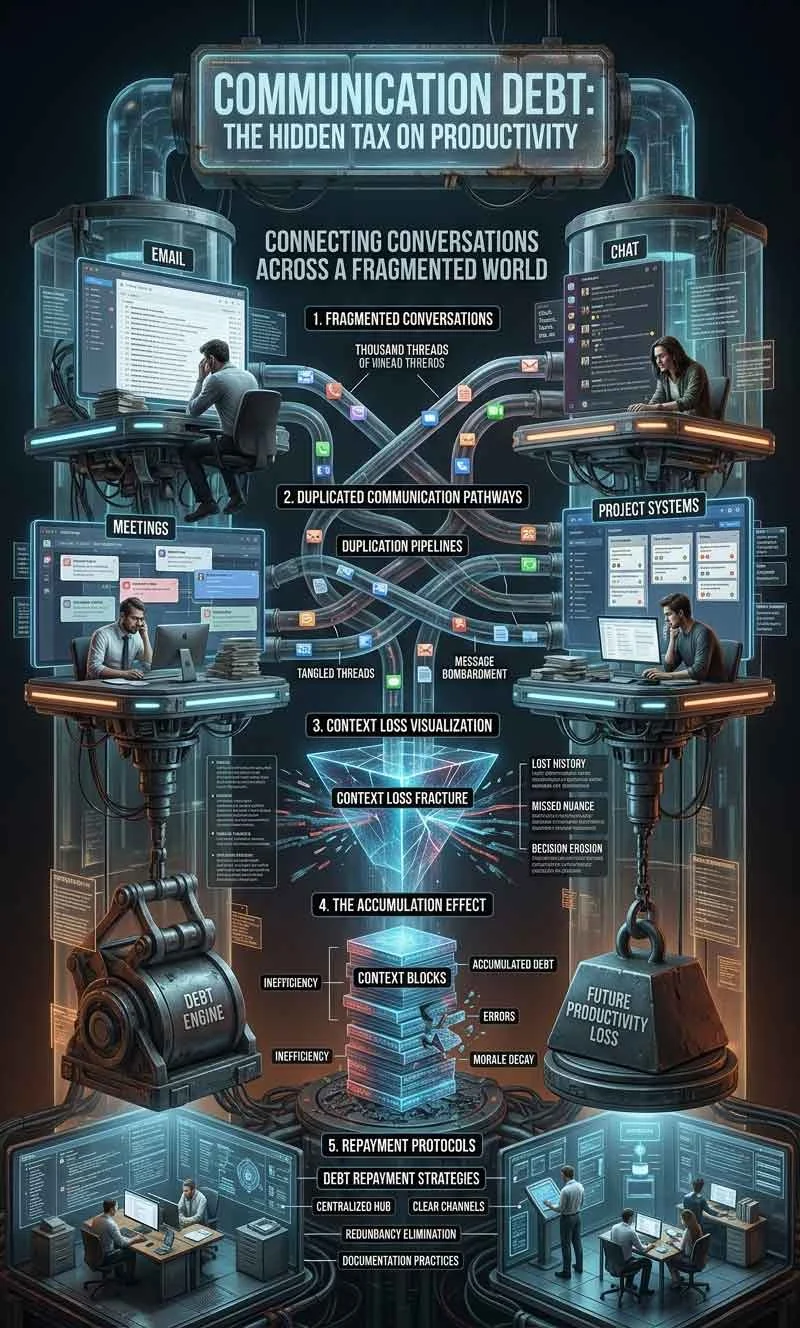
One of the most overlooked productivity problems is communication debt.
Communication debt develops when information is exchanged faster than it can be clarified, validated, and understood.
The problem often begins with small inefficiencies.
Examples include:
- unclear instructions
- missing context
- undocumented decisions
- fragmented conversations
- incomplete updates
Initially, these issues may appear minor.
Over time, however, misunderstandings accumulate.
Workers spend increasing effort:
- seeking clarification
- reconstructing conversations
- verifying assumptions
- resolving conflicting information
Communication debt behaves similarly to retrieval debt.
Small communication failures compound until operational friction becomes visible across teams and projects.
Communication vs Collaboration
Communication and collaboration are closely connected, but they are not the same activity.
Communication focuses on information transfer.
Collaboration focuses on coordinated action.
Communication answers questions such as:
- What happened?
- What changed?
- What needs attention?
- What decisions were made?
Collaboration answers questions such as:
- Who is responsible?
- What actions are required?
- How will work be coordinated?
- What outcomes are expected?
Strong communication improves collaboration.
However, communication alone does not guarantee execution.
Many organizations communicate frequently while collaborating poorly.
The objective is not simply exchanging information.
The objective is ensuring information supports coordinated action.
Why AI Can Increase Communication Overload
AI tools can generate communication at unprecedented scale.
Examples include:
- automated updates
- meeting summaries
- project reports
- status notifications
- workflow recommendations
This can improve visibility.
However, excessive communication often creates new problems.
Workers become exposed to:
- duplicated updates
- repetitive notifications
- unnecessary summaries
- excessive reporting
Information volume increases.
Attention becomes fragmented.
Communication overload occurs when workers spend more time processing messages than acting upon them.
A useful communication system filters information before it reaches users.
Not every update deserves attention.
Not every notification deserves distribution.
The goal is improving signal quality rather than maximizing message volume.
Why Communication Fragmentation Happens
Modern organizations often rely on multiple communication channels simultaneously.
Information may exist inside:
- messaging applications
- project platforms
- AI workspaces
- meeting recordings
- documentation systems
When information becomes distributed across too many locations, communication fragmentation develops.
Workers may struggle to determine:
- which source is authoritative
- which information is current
- where important decisions were documented
- who possesses the latest context
The issue is not a lack of communication.
The issue is a lack of communication continuity.
Strong communication systems establish clear pathways for information movement and decision visibility.
AI-Generated Communication Risks
AI can dramatically improve communication efficiency.
However, AI-generated communication introduces several risks.
Examples include:
- loss of nuance
- missing assumptions
- incorrect summaries
- context compression
- excessive confidence
A summary may appear accurate while omitting information that significantly changes interpretation.
A recommendation may appear complete while lacking important constraints.
As organizations increase their use of AI communication tools, human review remains important.
Communication quality depends not only on speed but also on accuracy, context, and relevance.
AI should support communication rather than replace communication judgment.
Communication support is one of many practical AI use cases, but it becomes more valuable when the surrounding workflow preserves context and decision clarity.
The Relationship Between Communication and Productivity
Communication directly influences productivity.
Workers cannot execute effectively when information remains unclear.
Many productivity problems originate from communication failures rather than operational failures.
Examples include:
- misunderstood priorities
- duplicated work
- delayed decisions
- conflicting assumptions
- coordination breakdowns
Strong communication systems reduce uncertainty.
Workers spend less time seeking clarification and more time executing meaningful work.
This improves both efficiency and operational confidence.
Clear communication supports execution quality by helping workers coordinate tasks effectively, a principle explored further in the AI task management workflow.
Why Communication Quality Matters More Than Communication Volume
Organizations often measure communication through activity.
Examples include:
- message counts
- meeting frequency
- reporting volume
- update frequency
These metrics reveal communication quantity.
They do not necessarily reveal communication effectiveness.
A smaller number of clear, contextual, actionable messages often creates better outcomes than a large volume of fragmented communication.
Communication quality improves when information is:
- relevant
- timely
- understandable
- actionable
- contextualized
The objective is not maximizing communication.
The objective is maximizing understanding.
Communication Continuity and Organizational Memory
Communication often contains important operational knowledge.
Examples include:
- decisions
- approvals
- priorities
- lessons learned
- strategic direction
When communication disappears, organizational memory weakens.
Teams may revisit previous decisions without realizing they were already resolved.
The same discussions occur repeatedly.
Context must be rebuilt.
Communication continuity helps preserve operational memory.
This creates stronger relationships between:
- communication
- planning
- knowledge management
- execution
Over time, communication continuity reduces repetition and supports more efficient decision-making.
Many communication failures originate from poor information organization rather than message volume alone, which is why communication systems closely connect with AI knowledge management systems.
Early Warning Signs of Communication Failure
Communication systems rarely fail overnight.
Most begin showing warning signs long before larger productivity problems become visible.
Common indicators include:
- repeated clarification requests
- duplicated work
- conflicting instructions
- delayed decisions
- frequent misunderstandings
- meeting overload
- communication bottlenecks
These symptoms often indicate that information is moving through the organization inefficiently.
Workers may spend increasing amounts of time interpreting information rather than acting on it.
As communication friction increases, productivity often declines even when technical systems remain unchanged.
Recognizing these signals early helps organizations strengthen communication quality before larger operational issues emerge.
How to Evaluate an AI Workplace Communication System
Many organizations evaluate communication through activity metrics.
Examples include:
- message volume
- meeting counts
- update frequency
- communication channel usage
These metrics measure communication quantity.
They do not necessarily measure communication effectiveness.
A stronger evaluation framework focuses on communication outcomes.
Clarity Indicators
Examples include:
- reduced misunderstandings
- clear instructions
- visible priorities
- actionable information
Communication should improve understanding.
Alignment Indicators
Examples include:
- shared expectations
- consistent messaging
- decision visibility
- operational coordination
Workers should interpret information similarly.
Efficiency Indicators
Examples include:
- fewer unnecessary meetings
- reduced clarification requests
- faster decision-making
- improved response quality
Communication should reduce friction.
Behavioral Indicators
Examples include:
- higher trust
- stronger collaboration
- lower confusion
- improved execution confidence
The strongest communication systems improve behavior, not merely information flow.
AI Workplace Communication Evaluation Checklist
The checklist below helps determine whether a communication system is improving clarity and coordination or creating additional operational friction.
| Healthy Signal | Warning Signal |
|---|---|
| Instructions are understood clearly. | Frequent clarification requests occur. |
| Decisions remain visible. | Decision history becomes difficult to trace. |
| Communication supports action. | Information overload delays action. |
| Meeting outcomes remain clear. | Meetings create confusion or duplication. |
| Workers know where to find updates. | Updates are fragmented across systems. |
| Communication improves execution. | Communication creates operational friction. |
| Teams share a common understanding. | Different teams interpret information differently. |
| Updates contain useful context. | Context is frequently missing. |
| Communication reduces uncertainty. | Communication increases confusion. |
| Workers trust official communication channels. | Workers rely on side conversations and workarounds. |
A useful communication system should reduce uncertainty, improve coordination, and support decision-making. If communication volume increases while clarity decreases, the system may require simplification rather than additional communication channels.
Healthy vs Failing AI Workplace Communication Systems

The differences between healthy and failing communication systems often appear before productivity problems become visible. Healthy communication systems improve alignment, understanding, and execution quality. Failing communication systems gradually accumulate confusion, fragmentation, and communication debt.
Most communication failures do not occur because information is unavailable. They occur because information becomes difficult to interpret, trust, or act upon.
The comparison below highlights common characteristics that separate sustainable communication systems from environments where clarity gradually deteriorates.
| Healthy Communication System | Failing Communication System |
|---|---|
| Important information remains visible. | Information becomes buried or fragmented. |
| Workers understand priorities. | Priorities become inconsistent. |
| Decisions remain accessible. | Decision history disappears. |
| Communication supports execution. | Communication delays execution. |
| AI improves clarity. | AI increases communication noise. |
| Teams trust communication channels. | Teams rely on informal workarounds. |
| Updates are contextualized. | Updates lack context. |
| Communication reduces uncertainty. | Communication creates confusion. |
Communication quality often determines whether information becomes useful knowledge or operational confusion. Small communication problems can compound into larger coordination failures over time if communication debt is allowed to accumulate.
Recovering from Communication Failure
Many organizations respond to communication problems by introducing more communication.
This frequently increases complexity.
Recovery often begins by simplifying information flow.
Questions worth examining include:
- Which channels are actually necessary?
- Where does communication duplication occur?
- Which updates create value?
- Which meetings could be removed?
- How are decisions communicated?
Common recovery actions include:
- reducing communication noise
- simplifying communication channels
- improving decision visibility
- strengthening context preservation
- reducing duplicate updates
- clarifying communication ownership
Most communication failures are not caused by insufficient information.
They are caused by insufficient clarity.
The objective is improving understanding rather than increasing communication volume.
The Environmental Effects of Poor Communication
Communication quality influences the entire operational environment.
When communication weakens, organizations often experience:
- slower decisions
- duplicated work
- increased frustration
- declining trust
- project delays
- coordination failures
- unnecessary meetings
These effects often spread across teams.
Workers spend more time interpreting information and less time executing meaningful work.
Strong communication systems improve operational stability by creating shared understanding before action occurs.
Communication Continuity and Long-Term Productivity
Communication becomes increasingly valuable when it remains accessible over time.
Many organizations focus heavily on sending information while paying less attention to preserving communication context.
This creates continuity problems.
Workers may remember that a decision was made.
However, they may not remember:
- why it was made
- who approved it
- what constraints existed
- what alternatives were considered
As communication history becomes fragmented, teams often revisit conversations that were already resolved.
The same discussions occur repeatedly.
The same questions reappear.
The same misunderstandings return.
Communication continuity helps preserve organizational memory.
Instead of rebuilding context, workers can build upon existing context.
This improves:
- decision quality
- execution speed
- operational consistency
- organizational learning
Over time, communication continuity allows knowledge and experience to compound rather than disappear.
Why Communication Quality Is Becoming a Competitive Advantage
Historically, organizations often competed through access to information.
Today, information is abundant.
AI tools can generate:
- reports
- summaries
- updates
- recommendations
- documentation
at extraordinary speed.
As information creation becomes easier, communication quality becomes more important.
Organizations increasingly benefit from their ability to:
- communicate clearly
- preserve context
- reduce misunderstanding
- maintain alignment
- accelerate decision-making
rather than simply generating more information.
The competitive advantage shifts from information production toward information understanding.
Teams that communicate effectively often move faster than teams with access to larger volumes of information.
The difference is not information ownership.
The difference is communication quality.
The Relationship Between Communication, Knowledge, and Execution
Communication also supports prioritization by helping teams maintain alignment with an AI daily planning system.
Communication does not operate independently.
It connects directly with:
- knowledge management
- planning
- task management
- execution systems
Communication helps distribute information.
Knowledge management helps preserve information.
Planning helps prioritize information.
Execution transforms information into outcomes.
When communication weakens, the entire productivity environment often becomes less effective.
Important knowledge becomes difficult to share.
Planning quality declines.
Execution slows.
Strong productivity systems maintain continuity across all four functions.
This creates a more stable operational environment.
Strong communication depends on accessible context, making communication closely connected to AI knowledge management systems.
Next-Step Questions Users Often Explore
Once organizations improve communication systems, they often continue into deeper operational questions.
Communication Questions
- How many communication channels should a team use?
- Which updates should be automated?
- How can communication overload be reduced?
Collaboration Questions
- How should teams coordinate decisions?
- How can meeting quality be improved?
- How can communication support faster execution?
AI Questions
- Which communication tasks should be automated?
- How should AI-generated summaries be reviewed?
- How can AI reduce communication friction?
Productivity Questions
- How can communication improve planning?
- How can communication support knowledge management?
- How can communication reduce operational delays?
These questions help transform communication from a messaging activity into a strategic productivity advantage.
Conclusion
An AI workplace communication system is not simply a collection of messaging tools.
It is a structured framework that helps information move clearly, accurately, and efficiently throughout an organization.
As information volume continues increasing, communication quality becomes increasingly important.
The challenge is no longer sending information.
The challenge is ensuring information remains understandable, actionable, and connected to context.
Strong communication systems improve:
- clarity
- coordination
- decision-making
- alignment
- operational continuity
while reducing:
- communication debt
- information overload
- misunderstandings
- duplicated effort
- execution delays
Organizations that communicate effectively often execute more effectively.
Communication creates understanding.
Understanding enables action.
Transition to the Next Topic
Communication helps information move across teams.
However, modern productivity systems increasingly depend on automation.
Organizations now use AI to automate:
- repetitive tasks
- reporting workflows
- information processing
- operational decisions
This creates the next important question:
How should AI automation be implemented without creating new risks, dependencies, and productivity failures?
The next stage of the AI productivity system focuses on automation, operational leverage, and sustainable AI-assisted workflows.
FAQ
What is an AI workplace communication system?
An AI workplace communication system is a structured framework that helps organizations distribute information, preserve context, communicate decisions, improve alignment, and reduce misunderstandings using both human and AI-supported communication processes.
Why do workplace communication systems fail?
Many communication systems fail because information becomes fragmented, overloaded, duplicated, or disconnected from context. Workers receive more messages but gain less clarity and understanding.
What is communication debt?
Communication debt occurs when information is exchanged faster than it can be clarified, validated, understood, and preserved. Over time, misunderstandings accumulate and reduce productivity.
Can AI improve workplace communication?
AI can improve communication by generating summaries, updates, reports, recommendations, and meeting notes. However, human review remains important because AI-generated communication may omit context or introduce inaccuracies.
What is communication overload?
Communication overload occurs when workers spend more time processing messages, notifications, meetings, and updates than acting on information. Excessive communication often reduces productivity rather than improving it.
What are signs that a communication system is failing?
Common warning signs include repeated clarification requests, duplicated work, conflicting instructions, delayed decisions, communication bottlenecks, excessive meeting volume, and fragmented information sources.
How does communication affect productivity?
Communication affects productivity by influencing clarity, coordination, decision-making, collaboration, and execution quality. Many productivity problems originate from communication failures rather than technical failures.
Why is communication quality becoming more important in the AI era?
As AI makes information creation easier, organizations increasingly benefit from their ability to communicate information clearly, preserve context, reduce misunderstanding, maintain alignment, and support faster decision-making.