

Artificial intelligence is changing how modern work is organized, but many productivity problems today are no longer caused by a lack of tools. The real problem is workflow fragmentation.
By the middle of a normal workday, information is often already scattered between email threads, AI chats, Slack notifications, task managers, browser tabs, voice notes, unfinished documents, and calendar reminders. AI can accelerate output, but without a structured productivity system, it can also increase retrieval friction, context switching, and operational confusion.
This is why many people feel temporarily faster with AI tools while simultaneously feeling mentally overloaded.
A real AI productivity system is not simply using ChatGPT occasionally or automating isolated tasks. It is the design of a structured operational workflow where planning, research, writing, communication, retrieval, and decision-making remain connected across the entire work environment.
The difference becomes visible quickly in real usage environments.
Some teams generate hundreds of AI-assisted outputs every week yet still struggle to retrieve information efficiently later. Meeting notes become disconnected from execution. AI-generated documents lose contextual continuity. Research becomes duplicated across multiple platforms. Productivity rises temporarily at the output layer while operational clarity slowly declines underneath.
This is one of the biggest misunderstandings surrounding AI productivity today.
The problem is not usually AI capability itself.
The problem is workflow architecture.
This guide supports the broader AI productivity system pillar by explaining how real workflows stay connected instead of fragmented.
What an AI Productivity System Actually Means
An AI productivity system is a structured workflow environment where artificial intelligence supports operational continuity instead of creating additional fragmentation.
Many people currently use AI as an isolated assistant. They open a chatbot, ask a question, copy the answer, then move back into unrelated tools. The interaction ends there. Over time, this creates disconnected productivity islands instead of a unified operational system.
AI Productivity System Builder
Discover your productivity leakage, focus bottlenecks, AI readiness level and practical next learning path.
A real AI productivity workflow behaves differently.
The AI layer becomes integrated into planning systems, research systems, writing workflows, meeting management, retrieval systems, decision evaluation, operational prioritization, and task continuation.
The objective is not merely generating faster outputs. The objective is reducing cognitive friction across the entire workflow lifecycle.
An effective AI productivity system therefore functions less like a chatbot and more like a layered operational environment.
AI Productivity System vs Traditional Productivity System
A traditional productivity system usually organizes tasks, calendars, and documents separately. An AI productivity system connects planning, research, writing, retrieval, and decision support into one operational workflow.
| Factor | Traditional Workflow | AI Productivity Workflow |
|---|---|---|
| Planning | Manual prioritization | AI-assisted prioritization |
| Research | Manual collection | Accelerated synthesis |
| Writing | Fully manual drafting | AI-assisted drafting and editing |
| Retrieval | Folder or memory dependent | Context-aware retrieval support |
| Decision Support | Human only | Human judgment supported by AI |
| Continuity | Often fragmented | Structured across work cycles |
An AI productivity system is a structured workflow environment where artificial intelligence supports operational continuity instead of creating additional fragmentation.
Many people currently use AI as an isolated assistant. They open a chatbot, ask a question, copy the answer, then move back into unrelated tools. The interaction ends there. Over time, this creates disconnected productivity islands instead of a unified operational system.
A real AI productivity workflow behaves differently.
The AI layer becomes integrated into:
- planning systems
- research systems
- writing workflows
- meeting management
- retrieval systems
- decision evaluation
- operational prioritization
- task continuation
Task continuity also depends on a clear AI task management workflow that prevents priorities from becoming scattered.
The objective is not merely generating faster outputs.
The objective is reducing cognitive friction across the entire workflow lifecycle.
For example, a productivity system may begin early in the morning with AI-assisted task prioritization based on deadlines, unresolved conversations, ongoing projects, and behavioral workload patterns. Later, during research sessions, the same system may help summarize industry information while preserving contextual references for future retrieval. During writing phases, AI may assist with structure development, editing, or semantic clarification without replacing human operational judgment.
The system remains connected.
This continuity matters because modern productivity problems are increasingly retrieval problems rather than creation problems.
Many workers no longer struggle to produce information.
They struggle to:
- organize information
- retrieve information
- prioritize information
- maintain contextual continuity
- reduce interruption cycles
An effective AI productivity system therefore functions less like a chatbot and more like a layered operational environment.
The quality of the workflow often depends on whether the system reduces fragmentation or silently increases it.
Why Most AI Productivity Setups Fail
Most AI productivity systems fail because people optimize for output speed before fixing workflow structure.
The initial experience often feels impressive. AI can summarize meetings within seconds, generate drafts rapidly, organize notes, rewrite emails, and produce research summaries faster than manual workflows. Early productivity gains appear obvious.
However, after several weeks, operational friction frequently begins increasing underneath the surface.
AI outputs become scattered across multiple applications. Important decisions remain buried inside temporary chat histories. Duplicate work starts appearing because retrieval systems were never properly organized. Teams continue generating content without creating reliable continuity between research, execution, storage, and future retrieval.
The result is a strange productivity paradox.
Output volume increases while operational clarity declines.
This happens because AI accelerates information generation much faster than most people improve workflow architecture.
In many real-world environments, context switching becomes the hidden productivity killer.
A worker may begin reviewing project notes inside Notion, switch into Slack conversations, open an AI assistant for summarization, return to email threads, move into calendar scheduling, then re-open another AI chat to continue unfinished reasoning. By late afternoon, the workflow itself becomes fragmented enough that mental retrieval costs start consuming more energy than the original tasks.
The person feels busy throughout the day while producing surprisingly little meaningful continuity.
This is why AI productivity should not be measured only through:
- faster output
- shorter writing time
- automation quantity
- task completion speed
This connects directly with AI knowledge management systems, where retrieval quality determines whether information remains useful after it is created.
Those are surface-level metrics.
A stronger productivity system should instead improve:
- retrieval continuity
- decision clarity
- operational organization
- workflow stability
- contextual preservation
- behavioral sustainability
Many current AI workflows fail because they optimize visible acceleration while ignoring invisible fragmentation.
Over time, invisible fragmentation usually becomes the larger operational problem.
How AI Changes Daily Workflow Structure
Artificial intelligence changes productivity systems primarily by altering how humans interact with information throughout the day.
Traditional workflows were often linear.
A person would:
- receive information
- process information
- complete a task
- store the result
- move to the next activity
Modern AI-assisted workflows are far less linear.
Information now moves dynamically between:
- AI assistants
- search engines
- project management tools
- collaborative workspaces
- messaging platforms
- browser environments
- retrieval systems
- automation layers
The operational environment becomes highly interconnected.
This creates both opportunity and risk.
In productive environments, AI reduces repetitive cognitive labor and allows deeper focus on evaluation, prioritization, strategic thinking, and creative decision-making. Repetitive formatting, summarization, categorization, and first-draft generation become partially automated, allowing workers to allocate more mental energy toward higher-level operational reasoning.
At the same time, poorly structured AI workflows can increase behavioral overload.
Continuous notifications, multiple AI conversations, fragmented retrieval systems, and inconsistent organizational structures can quietly erode concentration quality. Instead of reducing cognitive stress, AI may accidentally multiply unfinished mental loops throughout the workday.
This is increasingly visible in remote and hybrid work environments.
Many workers now experience productivity fatigue not because they lack tools, but because their operational systems continuously compete for attention.
A sustainable AI productivity system therefore requires more than AI access alone.
It requires:
- structured workflow architecture
- retrieval continuity
- controlled information flow
- behavioral sustainability
- contextual preservation
- interruption management
Without those layers, AI often accelerates fragmentation faster than productivity.
The Core Layers of an AI Productivity System
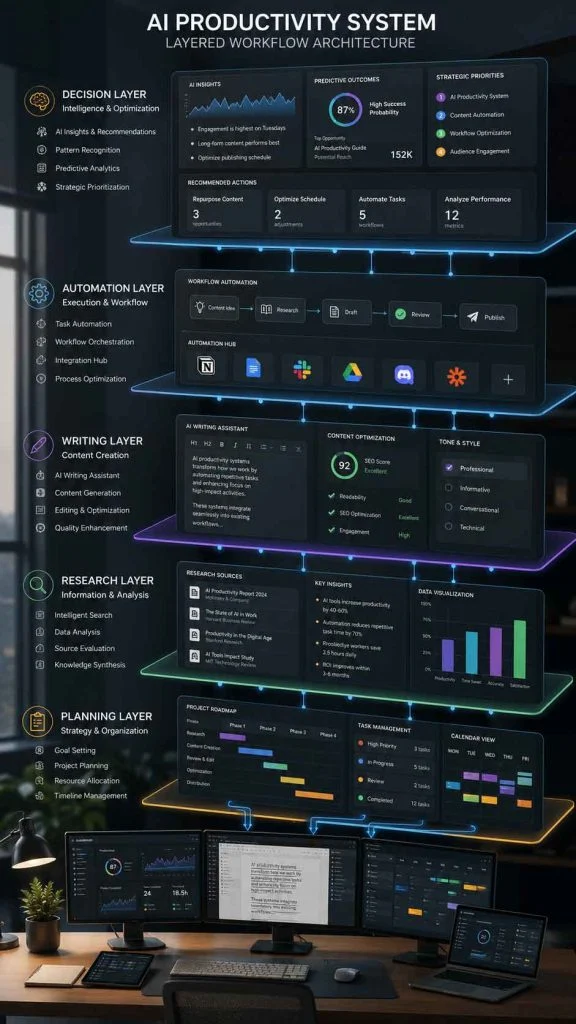
A sustainable AI productivity system is usually built from several interconnected operational layers rather than a single tool or application.
Most failed workflows focus too heavily on the visible AI interface while ignoring the surrounding retrieval and behavioral infrastructure that determines whether productivity remains stable over time.
The strongest systems tend to organize work into connected layers that continuously reinforce each other throughout the day.
Planning Layer
The planning layer controls task prioritization, workload organization, and operational sequencing.
This is where many productivity systems already begin failing before actual work even starts.
In fragmented environments, people often begin the morning by reacting instead of prioritizing. Notifications, unfinished messages, meeting reminders, and incoming requests immediately compete for attention before structured planning occurs. AI tools may accelerate responses, but acceleration alone does not create clarity.
An effective planning layer reduces retrieval friction before workload accumulation begins.
AI can support this process by:
- summarizing pending priorities
- identifying unresolved tasks
- grouping similar work categories
- estimating workload complexity
- generating operational schedules
- organizing follow-up requirements
The objective is not replacing human judgment.
The objective is reducing low-value cognitive sorting work.
For example, many workers lose substantial productivity not during deep work itself, but during repeated micro-decisions throughout the day:
- what to prioritize
- which task to continue
- which conversation remains unresolved
- what deadline is approaching
- which document contains the latest context
AI-assisted planning systems can reduce this constant decision fatigue when integrated properly into a larger workflow environment.
However, poorly designed planning systems can create the opposite effect.
Some people now maintain:
- multiple AI chats
- overlapping task managers
- disconnected calendars
- duplicate reminders
- redundant productivity apps
The result becomes organizational inflation rather than operational clarity.
A productivity system should reduce decision surfaces, not continuously multiply them.
For a deeper planning workflow, see our guide to the AI daily planning system.
Research Layer
The research layer manages information acquisition, contextual understanding, source organization, and retrieval continuity.
This layer has become increasingly important because modern workers interact with much larger volumes of information than traditional workflows were originally designed to handle.
AI dramatically changes research behavior.
Instead of manually searching through dozens of sources, workers can now summarize documents, compare ideas, extract patterns, and accelerate early-stage understanding within minutes. This creates significant productivity advantages, especially during:
- market research
- planning
- brainstorming
- technical investigation
- competitive analysis
- operational evaluation
However, AI-assisted research introduces a new problem.
Information becomes easier to generate than to validate.
Many workflows now produce large amounts of summarized content without preserving:
- source continuity
- contextual accuracy
- retrieval organization
- reasoning transparency
Over time, this weakens decision quality.
A strong research layer therefore requires:
- structured retrieval systems
- contextual labeling
- source preservation
- verification workflows
- searchable organization
The strongest productivity systems do not merely generate information quickly.
They maintain information continuity across future operational decisions.
This distinction becomes critical in long-term projects where earlier reasoning may later influence strategic decisions, budgeting, execution planning, or risk management.
Writing Layer
The writing layer controls communication clarity, operational documentation, and structured output generation.
This is one of the most visible areas where AI productivity systems currently create both major advantages and major misunderstandings.
AI significantly reduces friction during:
- first-draft generation
- summarization
- rewriting
- formatting
- structure creation
- language simplification
- idea expansion
Many workers now complete writing tasks in a fraction of the previous time.
However, accelerated writing does not automatically create stronger communication.
In many environments, AI-generated communication gradually becomes:
- repetitive
- overly polished
- contextually shallow
- operationally vague
- emotionally disconnected
The problem is not grammar quality.
The problem is semantic continuity.
A useful productivity system should preserve:
- operational clarity
- contextual accuracy
- decision traceability
- audience relevance
- behavioral understanding
For example, internal operational documents often fail not because the writing is technically incorrect, but because future readers cannot reconstruct the reasoning context behind earlier decisions.
This is increasingly common in AI-assisted workflows where outputs are generated rapidly without preserving surrounding operational conditions.
Effective writing systems therefore require:
- contextual organization
- retrieval structure
- audience adaptation
- workflow continuity
- revision layers
AI should support communication architecture, not replace operational thinking.
Decision Layer
The decision layer manages evaluation, prioritization, judgment, and operational reasoning.
This layer becomes increasingly important as AI systems generate larger amounts of recommendations, summaries, predictions, and structured outputs throughout the day.
AI can accelerate:
- comparison analysis
- scenario generation
- pattern identification
- summarization
- risk evaluation
- information synthesis
However, AI productivity systems become dangerous when users begin outsourcing judgment instead of supporting it.
One of the largest operational risks today is passive cognitive dependence.
Workers may gradually accept:
- AI-generated conclusions
- summarized reasoning
- suggested priorities
- operational assumptions
without sufficiently evaluating:
- contextual limitations
- environmental variability
- incomplete information
- human consequences
- strategic tradeoffs
This creates a subtle form of productivity fragility.
The workflow appears efficient on the surface while critical reasoning depth slowly weakens underneath.
Strong productivity systems therefore maintain clear separation between:
- information assistance
and - final judgment responsibility
AI should reduce low-value cognitive load while preserving high-value human reasoning capacity.
The strongest systems use AI to expand visibility, not replace accountability.
Automation Layer
The automation layer controls repetitive workflow execution, task continuity, operational triggers, and background process management.
Automation is one of the most attractive aspects of AI productivity because repetitive administrative work consumes large amounts of time across modern organizations.
AI-assisted automation may help manage:
- scheduling
- email categorization
- reminder generation
- document organization
- workflow triggers
- meeting summaries
- repetitive reporting
- information routing
When implemented correctly, automation reduces operational drag.
However, automation introduces a hidden organizational risk.
The more systems become automated, the more important failure visibility becomes.
Many teams automate processes without building:
- verification systems
- interruption monitoring
- escalation logic
- contextual review
- human oversight
The workflow appears efficient until something breaks silently underneath.
This is particularly dangerous in environments involving:
- finance
- compliance
- customer communication
- project execution
- operational dependencies
A sustainable automation layer therefore requires:
- transparency
- controllability
- retrieval visibility
- manual override capability
- behavioral monitoring
The strongest AI productivity systems are not fully automated systems.
They are systems where automation remains operationally observable and strategically controlled.
Why Context Switching Reduces AI Productivity

One of the biggest productivity losses inside modern AI-assisted environments is no longer typing speed or information access.
It is context switching.
Many people now move continuously between:
- AI chats
- messaging platforms
- task boards
- email systems
- browser tabs
- research documents
- collaborative workspaces
- scheduling tools
The switching itself becomes cognitively expensive.
Even short interruptions create retrieval friction because the brain must repeatedly reconstruct operational context after every transition. Over time, this creates mental fragmentation that reduces concentration quality, decision stability, and workflow continuity.
The problem becomes more severe in AI-heavy environments because information generation now happens faster than human contextual consolidation.
Workers may generate:
- summaries
- drafts
- action items
- notes
- research outputs
at high speed while still struggling to maintain a coherent operational sequence throughout the day.
This creates a productivity illusion.
Output volume increases while deep operational progress slows down underneath.
Many workers experience this during the late afternoon.
The day feels busy and cognitively exhausting, yet several important tasks remain only partially completed because attention continuously fragmented across disconnected operational environments.
A strong AI productivity system therefore minimizes unnecessary context switching whenever possible.
This may include:
- centralized retrieval systems
- structured workflow sequencing
- controlled notification environments
- dedicated deep work periods
- grouped operational tasks
- unified information architecture
The objective is not maximizing tool usage.
The objective is preserving operational continuity.
Real Workflow Example Using AI Throughout One Day
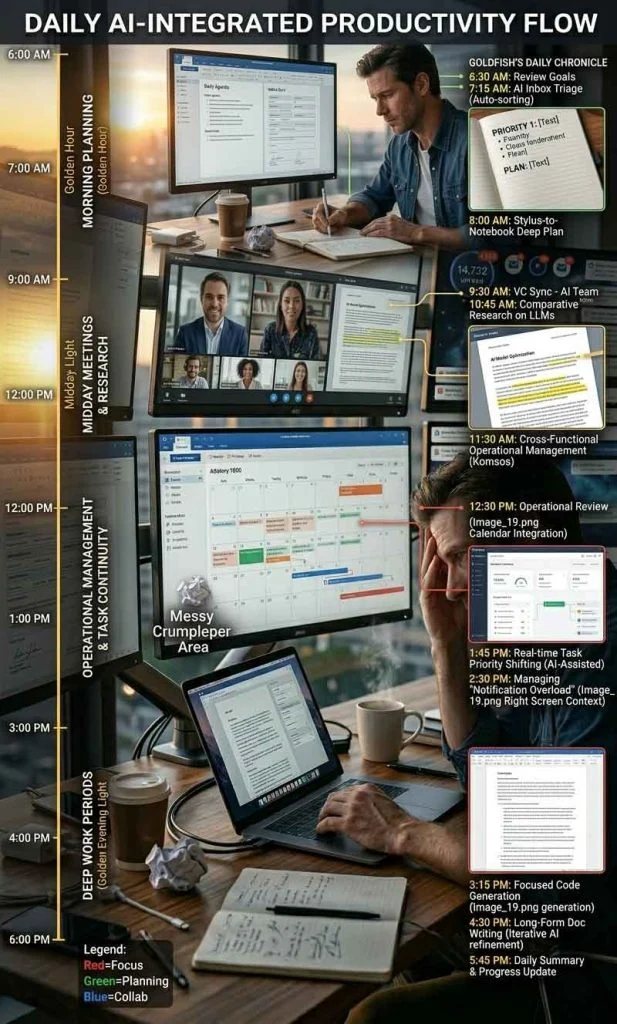
The practical value of an AI productivity system becomes easier to understand when observed across a realistic workday instead of isolated AI demonstrations.
Many AI tutorials online focus on single tasks:
- writing an email
- summarizing a meeting
- generating a document
- creating a task list
Real operational environments behave differently.
Productivity problems usually emerge from continuity breakdowns between tasks rather than the difficulty of one individual task itself.
A normal workday often begins before deep work even starts.
By early morning, many workers already face:
- unread emails
- unresolved conversations
- scheduling conflicts
- unfinished documents
- meeting reminders
- scattered notes
- multiple browser tabs
- fragmented priorities
Without structure, AI simply accelerates the chaos.
A sustainable workflow instead uses AI to reduce operational friction gradually throughout the entire day.
Morning Planning Phase
The day may begin with a centralized operational dashboard where AI assists with:
- summarizing pending priorities
- identifying unresolved tasks
- grouping related work
- highlighting approaching deadlines
- extracting action items from previous conversations
Instead of manually reviewing dozens of disconnected systems individually, AI helps compress retrieval overhead into a more manageable operational view.
This matters because many productivity losses occur during the first hour of the workday when workers repeatedly switch between applications attempting to reconstruct context.
A stronger planning environment reduces this reconstruction burden.
The objective is not automating every decision.
The objective is entering the day with clearer operational continuity.
Research and Information Processing
Later in the morning, research workflows often become fragmented as information expands across:
- browser sessions
- PDFs
- AI chats
- spreadsheets
- meeting notes
- messaging platforms
AI can significantly reduce early-stage information processing time during:
- market analysis
- competitor research
- technical investigation
- brainstorming
- strategic planning
However, strong productivity systems preserve retrieval continuity while using AI.
For example, instead of generating disconnected summaries inside temporary chats, stronger workflows may:
- organize research into searchable repositories
- preserve source attribution
- categorize information contextually
- connect findings to operational tasks
- maintain retrieval visibility for future decisions
This prevents research from disappearing into isolated conversational environments.
The difference becomes important later when earlier reasoning must support:
- strategic evaluation
- budgeting
- client communication
- operational execution
- future retrieval queries
Midday Communication Management
Around midday, operational fragmentation often accelerates.
Meetings interrupt deep work. Messages accumulate. Email volume increases. Scheduling changes appear unexpectedly. AI tools begin generating multiple simultaneous outputs across different environments.
Without control, this period becomes cognitively expensive.
Many workers experience:
- unfinished responses
- duplicated effort
- lost context
- incomplete execution loops
- operational confusion
AI productivity systems work best when communication workflows remain centralized and behaviorally manageable.
AI may assist with:
- meeting summaries
- response drafting
- task extraction
- communication prioritization
- operational clarification
However, the strongest systems avoid turning communication into endless automated output streams.
The goal is preserving clarity, not maximizing generated responses.
For example, some workers now generate large amounts of AI-assisted communication throughout the day while still struggling to identify:
- what remains unresolved
- which decisions were finalized
- which tasks require escalation
- which conversations changed operational direction
The workflow appears active while strategic continuity quietly weakens underneath.
Deep Work and Execution
The afternoon often determines whether productivity systems actually create meaningful operational progress.
This is where context switching becomes most dangerous.
A worker may attempt focused execution while simultaneously responding to:
- notifications
- AI prompts
- email threads
- collaborative edits
- meeting interruptions
- task reminders
Even short interruptions repeatedly reset cognitive momentum.
Strong AI productivity systems therefore protect deep work periods intentionally.
This may include:
- batching communication windows
- grouping operational categories
- limiting notification exposure
- reducing unnecessary application switching
- maintaining centralized retrieval environments
AI becomes most useful during deep work when it supports:
- structured reasoning
- outline generation
- comparison analysis
- operational summarization
- clarification workflows
without constantly pulling attention into fragmented conversational loops.
The objective is not maximizing AI interaction frequency.
The objective is preserving high-quality operational concentration.
End-of-Day Retrieval Continuity
Many productivity systems fail during the final stage of the workday.
Tasks remain partially completed. Research exists across multiple tabs. AI conversations contain unresolved operational decisions. Meeting summaries lack execution follow-through. Important context becomes difficult to retrieve the next morning.
This is where retrieval continuity becomes critical.
A sustainable AI productivity system should help preserve:
- operational summaries
- task progression
- unresolved decisions
- contextual references
- next-step priorities
- retrieval organization
The next workday should begin with continuity rather than reconstruction.
Many modern productivity problems are not caused by insufficient output generation.
They are caused by poor continuity preservation between operational cycles.
This is one reason strong AI productivity systems increasingly resemble retrieval systems as much as traditional task systems.
Common AI Productivity Mistakes
Many AI productivity systems fail not because the technology lacks capability, but because workflow behavior becomes unsustainably fragmented over time.
The most common mistakes are often operational rather than technical.
Using Too Many Tools Simultaneously
One of the largest productivity traps today is tool accumulation.
Workers frequently combine:
- multiple AI assistants
- overlapping task managers
- disconnected note systems
- duplicated calendars
- redundant automation platforms
- fragmented retrieval environments
The operational surface area becomes too large.
Instead of reducing friction, the workflow begins requiring continuous maintenance simply to remain functional.
A stronger productivity system usually reduces complexity instead of expanding it endlessly.
Treating AI as a Replacement for Thinking
AI can accelerate information processing, but it should not replace operational judgment.
Many workflows now depend too heavily on:
- generated conclusions
- summarized reasoning
- automated prioritization
- predictive recommendations
without sufficiently evaluating contextual limitations.
This creates fragile decision environments where reasoning quality slowly weakens underneath increasing automation convenience.
AI should support reasoning visibility, not eliminate human accountability.
Prioritizing Output Volume Over Retrieval Quality
Modern AI systems can generate large amounts of content rapidly.
However, productivity systems frequently fail because generated information becomes:
- difficult to retrieve
- poorly organized
- disconnected from execution
- contextually incomplete
Over time, retrieval friction becomes larger than the original productivity gains.
Strong systems prioritize continuity and retrieval clarity alongside output generation.
Ignoring Behavioral Fatigue
Many AI workflows unintentionally increase cognitive overload.
Constant notifications, continuous AI conversations, fragmented interfaces, and excessive operational switching gradually reduce concentration quality throughout the day.
The result often appears as:
- mental exhaustion
- shallow work depth
- unfinished tasks
- decision fatigue
- operational inconsistency
A sustainable productivity system should preserve behavioral sustainability instead of continuously maximizing stimulation.
Automating Without Visibility
Automation can reduce repetitive labor significantly.
However, many workflows automate processes without preserving:
- transparency
- verification visibility
- operational oversight
- interruption monitoring
The workflow appears efficient until silent failures begin accumulating underneath.
Strong automation systems remain observable and controllable.
Healthy vs Failing AI Productivity Workflows
The difference between a healthy and failing AI productivity workflow usually appears in retrieval, focus, and continuity.
| Healthy Workflow | Failing Workflow |
|---|---|
| Centralized retrieval | Information scattered across tools |
| Structured planning | Reactive task handling |
| Controlled notifications | Constant interruptions |
| Traceable decisions | Hidden decisions inside chats |
| Context preservation | Context loss between work sessions |
| Human judgment preserved | Passive dependence on AI output |
A healthy workflow should reduce mental reconstruction. If every work session begins by searching for lost context, the system is not yet stable.
Common Tools Used Inside AI Productivity Systems
An AI productivity system may use several tools, but the goal is not to collect as many tools as possible. The goal is to assign each tool a clear role inside the workflow.
| Function | Common Tool Types | Main Risk |
|---|---|---|
| AI Assistance | ChatGPT, Claude, Gemini | Disconnected chat history |
| Notes | Notion, Obsidian, Apple Notes | Poor retrieval structure |
| Task Management | Todoist, ClickUp, Asana | Overlapping task systems |
| Communication | Slack, Teams, Email | Notification overload |
| Automation | Zapier, Make, Native Automations | Silent workflow failure |
| Knowledge Storage | Confluence, Notion, Google Drive | Storage without retrieval |
When AI Should Not Be Used
AI productivity systems are powerful, but not every operational environment benefits from increased automation or AI-assisted acceleration.
There are situations where excessive AI dependence may reduce effectiveness instead of improving it.
Tasks involving:
- high emotional nuance
- sensitive negotiation
- ethical judgment
- complex interpersonal dynamics
- strategic ambiguity
- contextual unpredictability
often still require stronger human evaluation layers.
AI-generated communication may appear polished while missing subtle:
- emotional context
- relationship sensitivity
- operational timing
- behavioral implications
This becomes especially important in:
- leadership communication
- conflict resolution
- client management
- hiring decisions
- organizational strategy
- sensitive negotiations
Similarly, some forms of deep reasoning still benefit from slower cognitive processing without constant AI acceleration.
Continuous AI interaction may occasionally reduce:
- reflection depth
- independent reasoning
- strategic patience
- conceptual originality
The objective of a productivity system should not be automating every cognitive process possible.
The objective is improving operational quality sustainably.
In strong workflows, AI supports human capability without fully replacing human contextual judgment.
How to Build a Sustainable AI Workflow
A sustainable AI productivity system is not built by continuously adding more tools, automations, or AI prompts.
It is built by reducing operational friction while preserving contextual continuity over time.
Many productivity systems initially feel effective because AI dramatically accelerates visible outputs. Emails are drafted faster. Summaries appear instantly. Research becomes easier to organize. Repetitive formatting work decreases.
However, long-term productivity depends less on acceleration alone and more on whether the workflow remains behaviorally sustainable after weeks or months of continuous usage.
This is where many systems begin collapsing quietly underneath surface-level efficiency.
A sustainable workflow should reduce:
- cognitive overload
- retrieval friction
- interruption cycles
- operational ambiguity
- decision fatigue
- fragmented information environments
The strongest systems usually prioritize simplicity first.
Centralize Retrieval Whenever Possible
One of the biggest operational mistakes is allowing information to become distributed across too many disconnected environments.
AI chats, browser tabs, collaborative documents, task managers, messaging platforms, voice notes, and temporary summaries often accumulate independently throughout the workday.
Over time, retrieval itself becomes exhausting.
Workers frequently remember that important information exists somewhere, but locating the correct operational context becomes increasingly difficult.
A sustainable workflow therefore centralizes retrieval whenever possible.
This may include:
- unified project repositories
- structured note environments
- searchable documentation systems
- centralized task continuity
- categorized research storage
- operational tagging structures
The objective is reducing reconstruction effort later.
Strong productivity systems preserve future retrieval visibility instead of only optimizing immediate task completion.
Protect Deep Work Intentionally
AI increases the speed of interaction, but faster interaction does not always produce better concentration.
In many operational environments, constant AI usage creates:
- continuous interruptions
- fragmented thought patterns
- shallow reasoning cycles
- behavioral overstimulation
A sustainable workflow intentionally protects uninterrupted concentration periods.
This may involve:
- limiting notification exposure
- batching communication windows
- grouping similar tasks together
- reducing unnecessary AI interactions
- separating execution phases from reactive communication phases
Deep work quality still matters even inside highly automated environments.
AI should support concentration, not continuously compete against it.
Reduce Operational Surface Area
Many modern productivity systems quietly become too large to manage efficiently.
Workers often maintain:
- multiple AI assistants
- overlapping productivity platforms
- duplicate automation systems
- disconnected note environments
- competing organizational structures
The workflow eventually requires operational maintenance simply to remain functional.
This creates hidden productivity drag.
A sustainable AI system usually removes unnecessary layers instead of endlessly expanding them.
Operational clarity often improves when:
- workflows become simpler
- retrieval environments become smaller
- systems become more predictable
- transitions become more stable
Reducing operational surface area frequently improves long-term productivity more than adding new tools.
Preserve Human Judgment
AI can accelerate many forms of operational support, but sustainable productivity systems preserve strong human evaluation layers.
This is especially important during:
- strategic decisions
- financial evaluation
- interpersonal communication
- ethical reasoning
- ambiguous operational conditions
AI-generated outputs may appear highly confident while still lacking:
- environmental context
- emotional understanding
- strategic nuance
- organizational awareness
Strong systems therefore treat AI as an operational support layer rather than a replacement for human accountability.
The objective is sustainable augmentation, not passive dependence.
Build Continuity Between Workdays
Many workflows fail because operational continuity disappears overnight.
The next morning begins with:
- unfinished tasks
- unresolved conversations
- scattered information
- missing retrieval context
- duplicated reasoning effort
This reconstruction process consumes substantial cognitive energy over time.
A stronger AI productivity system preserves continuity between operational cycles.
Before ending the workday, strong systems often preserve:
- unresolved priorities
- next-step actions
- contextual summaries
- operational blockers
- retrieval references
- decision states
The following morning begins with continuity instead of confusion.
This may appear like a small operational improvement, but over weeks and months, continuity preservation significantly affects:
- mental fatigue
- execution stability
- retrieval efficiency
- decision consistency
- strategic momentum
AI Productivity System Evaluation Checklist
Use this checklist to evaluate whether an AI productivity system is improving real workflow continuity or only increasing output volume.
| Evaluation Question | Healthy Signal | Warning Signal |
|---|---|---|
| Can you find yesterday’s work quickly? | Yes, context is easy to retrieve. | No, work must be reconstructed. |
| Do tasks remain connected to research? | Research supports execution. | Research disappears into notes or chats. |
| Are AI outputs traceable later? | Outputs have clear context. | Outputs become disconnected fragments. |
| Are decisions documented? | Decision history is visible. | Decisions are buried in conversations. |
| Does AI reduce context switching? | Workflow feels more stable. | More tools create more switching. |
Future of AI Productivity Systems
AI productivity systems are still in an early transitional phase.
Many current workflows remain heavily fragmented because AI tools evolved faster than operational structures surrounding them.
Over the next several years, productivity systems will likely shift away from isolated AI interactions and toward integrated retrieval environments where:
- context persists longer
- operational continuity improves
- workflows remain interconnected
- retrieval becomes more intelligent
- behavioral personalization increases
The future of productivity is unlikely to be simply “more automation.”
Instead, the larger shift may involve reducing operational fragmentation across increasingly complex information environments.
This matters because modern productivity problems are increasingly retrieval problems rather than creation problems.
Most workers today already possess:
- communication tools
- writing systems
- planning applications
- search capabilities
- automation environments
- AI assistants
The challenge is maintaining continuity across all of them simultaneously.
Future productivity systems will likely compete based on:
- contextual continuity
- retrieval intelligence
- behavioral sustainability
- interruption reduction
- operational clarity
- environmental organization
The strongest systems may eventually behave less like separate applications and more like persistent operational memory environments.
This also aligns closely with how modern search systems increasingly function.
Search engines now evaluate:
- behavioral continuation
- contextual relationships
- passage usefulness
- semantic completeness
- retrieval satisfaction
- multimodal quality
AI productivity systems are evolving in a similar direction.
The operational advantage will increasingly belong to workflows that preserve:
- contextual continuity
- retrieval visibility
- behavioral sustainability
- semantic organization
- decision clarity
rather than workflows that simply maximize raw output speed.
FAQ
What is an AI productivity system?
An AI productivity system is a structured workflow environment where artificial intelligence supports planning, research, communication, organization, retrieval, and operational continuity across daily work activities.
Why do many AI productivity workflows fail?
Many workflows fail because AI accelerates information generation faster than users improve retrieval organization, workflow structure, and contextual continuity.
Does AI always improve productivity?
No. AI can improve speed and reduce repetitive work, but poorly structured workflows may increase cognitive overload, context switching, and operational fragmentation.
What is the biggest hidden problem in AI workflows?
Context switching is one of the biggest hidden problems. Constant movement between AI chats, emails, task boards, documents, and notifications increases cognitive fragmentation.
Should AI replace human decision-making?
AI should support information processing and decision visibility, but strong productivity systems still preserve human judgment for strategic, emotional, ethical, and context-sensitive decisions.
Conclusion
AI productivity is no longer simply about generating faster outputs.
The larger challenge now is maintaining operational continuity inside increasingly fragmented information environments.
Modern workflows already contain:
- excessive notifications
- overlapping systems
- retrieval overload
- fragmented communication
- growing cognitive interruption
AI can either reduce this complexity or silently amplify it depending on how the workflow is structured.
The strongest productivity systems are unlikely to be the ones generating the highest volume of automated outputs.
They will more likely be the systems that preserve:
- contextual continuity
- retrieval clarity
- behavioral sustainability
- operational organization
- strategic visibility
over long periods of real-world usage.
This is why sustainable AI productivity should be viewed less as a collection of isolated tools and more as a structured retrieval ecosystem that continuously supports planning, execution, communication, decision-making, and future operational continuity.
As modern search systems increasingly evolve toward:
- passage retrieval
- contextual evaluation
- behavioral satisfaction
- multimodal understanding
- semantic continuity
AI productivity systems are evolving in a remarkably similar direction.
The future advantage will likely belong to workflows that remain operationally coherent while information environments continue becoming more complex.
Readers who want to understand the first major breakdown point should start with why AI productivity fails, because most workflow problems begin before automation becomes useful.