



AI can generate ideas, summarize information, organize notes, and automate repetitive tasks. However, none of these capabilities automatically create an effective task management system.
This is one reason many people become frustrated after adopting AI productivity tools.
The technology often improves information generation while leaving task execution largely unchanged.
Workers still miss deadlines.
Projects still become delayed.
Important actions still disappear between meetings, emails, AI chats, documents, and project boards.
The problem is not always a lack of productivity.
The problem is often a lack of workflow continuity.
A strong AI task management workflow helps transform information into execution.
Instead of treating AI as a separate tool, successful workflows integrate AI into planning, prioritization, task tracking, retrieval, and operational follow-through.
This article explains how AI task management workflows function, why many systems fail, and how sustainable execution environments can be built around modern AI capabilities.
What an AI Task Management Workflow Actually Means
Many people think AI task management simply means asking AI to create a task list.
In reality, task management involves a much larger operational system.
A complete workflow typically includes:
- task capture
- task organization
- prioritization
- scheduling
- execution
- follow-up
- retrieval
- completion tracking
AI can support each of these stages.
However, if even one stage breaks down, execution quality often declines.
For example, AI may generate excellent action items during a meeting.
If those actions are never assigned ownership or scheduled properly, the value disappears.
Similarly, AI may organize a project plan effectively.
If team members cannot retrieve the plan later, continuity weakens.
Task management therefore depends less on task generation and more on task movement through the workflow lifecycle.
The objective is not creating more tasks.
The objective is ensuring important work continues moving toward completion.
This execution layer forms an important component of a larger AI productivity system, where planning, retrieval, task management, and operational continuity work together.
Why Most AI Task Systems Fail
Many AI task systems fail for the same reason productivity systems fail.
Information moves faster than execution.
Tasks become trapped inside:
- AI conversations
- meeting summaries
- email threads
- note systems
- project documents
without entering a structured execution environment.
This creates operational friction.
A task may technically exist.
However, nobody knows:
- who owns it
- when it is due
- what priority it has
- whether it is completed
The task becomes informational rather than operational.
Many users encounter this problem after experimenting with AI-generated planning systems.
The output appears organized.
The execution layer remains disconnected.
This is closely related to the workflow fragmentation discussed in why AI productivity fails.
The challenge is rarely generating tasks.
The challenge is maintaining continuity after tasks are generated.
The Core Stages of an AI Task Management Workflow

A sustainable AI task management workflow generally moves through several connected stages.
Task Capture
Every workflow begins with task capture.
Tasks may originate from:
- meetings
- emails
- customer conversations
- research sessions
- project discussions
- AI brainstorming sessions
The objective during this stage is reducing information loss.
Important actions should enter a structured system quickly.
Task Organization
Once captured, tasks must be categorized.
Common categories include:
- urgent work
- strategic projects
- administrative tasks
- recurring activities
- delegated responsibilities
AI can assist by grouping related actions together and identifying common themes.
Prioritization
Not all tasks deserve equal attention.
A strong workflow evaluates:
- business impact
- deadlines
- dependencies
- effort requirements
- opportunity cost
AI can support prioritization, but final judgment usually remains human.
Scheduling
Tasks require execution windows.
Without scheduling, even high-priority work may remain incomplete.
Scheduling creates visibility and operational accountability.
Execution
This is where most productivity systems succeed or fail.
Execution depends on:
- focus
- continuity
- retrieval quality
- interruption management
AI should support execution without constantly distracting attention.
Review and Retrieval
Completed work should remain retrievable.
Future projects often depend on earlier decisions, research, and execution history.
Retrieval continuity strengthens future productivity.
Why Task Prioritization Matters More Than Task Volume
One of the biggest misconceptions in productivity is the belief that completing more tasks automatically creates better outcomes.
In reality, productivity often depends on completing the right tasks rather than completing the largest number of tasks.
AI can generate:
- action items
- recommendations
- reminders
- project plans
- follow-up suggestions
at a scale that was previously impossible.
This creates a new challenge.
Workers may suddenly face more potential tasks than they can realistically execute.
Without prioritization, AI can unintentionally increase operational noise.
A sustainable workflow therefore distinguishes between:
- important work
- urgent work
- routine work
- optional work
- delegated work
This allows execution resources to remain focused on activities that create meaningful outcomes.
Many prioritization problems originate earlier in the workflow and are better addressed through an AI daily planning system that establishes direction before tasks enter execution.
AI Cannot Prioritize Business Goals Automatically
AI can evaluate information.
It can identify deadlines.
It can organize projects.
It can highlight dependencies.
However, AI does not inherently understand organizational priorities.
For example, two tasks may appear equally important from a workflow perspective.
Yet one task may support:
- revenue generation
- customer retention
- regulatory compliance
- strategic objectives
while another task may have limited impact.
Human judgment remains essential.
The strongest workflows use AI to support prioritization rather than replace prioritization.
AI can provide structure.
Leaders and operators still provide direction.
Task Continuity Is the Hidden Productivity Multiplier

Many productivity discussions focus on task creation.
Far fewer focus on task continuity.
Task continuity refers to the ability to continue work without repeatedly reconstructing context.
This is one reason fragmented workflows become expensive.
A worker may spend:
- five minutes locating notes
- ten minutes reviewing emails
- fifteen minutes reopening research
- additional time understanding previous decisions
before actual work resumes.
The execution task itself may require less time than rebuilding context.
Strong AI task management systems preserve continuity by ensuring that:
- decisions remain connected to tasks
- supporting documents remain accessible
- ownership remains visible
- historical context remains retrievable
The goal is reducing reconstruction effort.
Every reduction in reconstruction effort improves execution efficiency.
Why Retrieval Matters in Task Management
Many task systems focus exclusively on future actions.
However, task execution often depends heavily on historical information.
Examples include:
- previous decisions
- meeting discussions
- customer requirements
- research findings
- project constraints
- implementation history
Without retrieval support, workers repeatedly recreate information that already exists.
This creates unnecessary operational friction.
Modern task management increasingly resembles retrieval management.
The ability to locate supporting context quickly often determines whether a task progresses efficiently.
This is why successful workflows connect tasks with:
- documentation
- research
- conversations
- project history
- decision records
Task management and retrieval management are becoming increasingly interconnected.
AI Task Management for Individuals
Individual workflows generally focus on personal execution efficiency.
The objective is reducing friction between planning and action.
AI may assist with:
- daily planning
- task organization
- reminder generation
- meeting follow-up
- project tracking
- workload balancing
However, individuals often face a common risk.
Overplanning.
AI makes it easy to create highly detailed systems.
The workflow becomes impressive.
Execution becomes secondary.
Strong personal workflows remain simple enough to support daily action.
The objective is not building the most sophisticated task management environment.
The objective is completing meaningful work consistently.
AI Task Management for Teams
Team environments introduce additional complexity.
Task visibility becomes significantly more important.
A task should clearly communicate:
- ownership
- status
- priority
- dependencies
- completion criteria
AI can assist by:
- summarizing progress
- generating status updates
- identifying blockers
- highlighting dependencies
- organizing project information
However, team productivity still depends on operational clarity.
Without clear ownership, AI-generated task systems can actually increase confusion.
Multiple people may assume responsibility.
No one may take responsibility.
Strong team workflows maintain visibility while reducing administrative burden.
The objective is creating coordination rather than complexity.
The Relationship Between Task Management and Productivity
Task management is not productivity.
Task management supports productivity.
This distinction matters.
Some workflows become heavily focused on:
- dashboards
- reports
- labels
- categories
- organizational structures
while execution quality remains unchanged.
The purpose of task management is improving execution outcomes.
A useful question is:
Does the system make important work easier to complete?
If the answer is yes, the workflow is likely providing value.
If the answer is no, additional complexity may be reducing effectiveness.
The strongest task management systems remain closely connected to real-world execution rather than organizational appearance.
Signs Your AI Task Workflow Is Becoming Inefficient
Many task systems gradually become less effective without attracting attention.
Common warning signs include:
- growing task backlogs
- duplicated actions
- unclear ownership
- missed follow-ups
- excessive planning
- repeated context reconstruction
- increasing administrative effort
- declining execution speed
These signals often appear before larger productivity problems emerge.
Recognizing them early allows workflows to be adjusted before operational friction becomes systemic.
A healthy workflow should gradually reduce friction.
A failing workflow often creates additional layers of work simply to manage itself.
AI Task Management vs Traditional Task Management
Traditional task management systems were designed for environments where information moved relatively slowly.
Tasks were commonly created through:
- meetings
- emails
- manual planning
- project documentation
- direct communication
The volume of incoming information was generally manageable.
Modern AI environments have changed these conditions.
Today, workers can generate:
- project plans
- action items
- research summaries
- implementation ideas
- workflow recommendations
within minutes.
The challenge is no longer generating tasks.
The challenge is managing the increased flow of tasks entering the system.
Traditional task management often focuses on organization.
AI task management increasingly focuses on:
- prioritization
- continuity
- retrieval
- execution support
- operational visibility
The objective shifts from tracking work to managing workflow complexity.
Why AI Task Lists Are Not Task Management Systems
Many people mistakenly believe that AI-generated task lists represent effective task management.
In reality, a task list is only one component of a larger workflow.
A list may identify what needs to be done.
It does not automatically solve:
- prioritization
- ownership
- scheduling
- execution
- accountability
- continuity
For example, AI may generate twenty useful action items after a meeting.
Without structure, those actions may still be forgotten.
A list provides visibility.
A workflow provides execution.
The difference becomes increasingly important as information volume grows.
Successful task systems focus on task movement rather than task accumulation.
How to Evaluate an AI Task Workflow
Many organizations measure task management using completion counts.
Examples include:
- tasks closed
- tickets resolved
- projects completed
- action items generated
While useful, these metrics do not always reveal workflow quality.
A stronger evaluation framework examines whether the workflow improves execution.
Visibility Indicators
Examples include:
- task ownership clarity
- status transparency
- dependency visibility
- deadline awareness
Workers should easily understand what requires attention.
Continuity Indicators
Examples include:
- retrieval speed
- context preservation
- decision accessibility
- project continuity
Tasks should remain connected to supporting information.
Execution Indicators
Examples include:
- completion speed
- reduced delays
- fewer missed actions
- improved follow-through
Execution outcomes matter more than organizational complexity.
Behavioral Indicators
Examples include:
- reduced cognitive load
- improved focus
- lower interruption frequency
- greater confidence
A task system should improve the working experience rather than increase administrative burden.
Healthy vs Failing AI Task Workflows
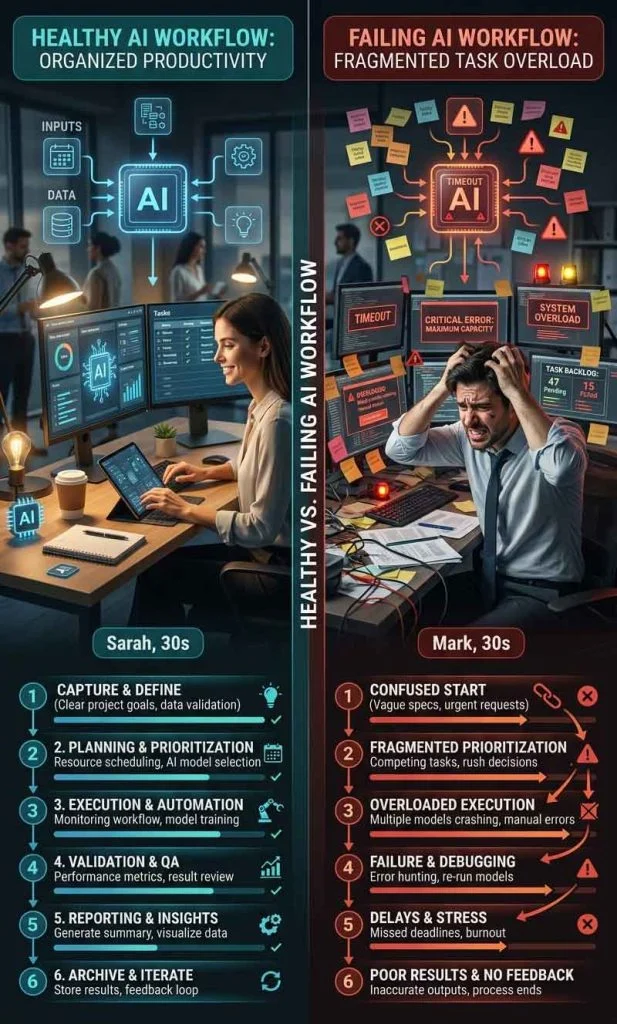
The differences between healthy and failing AI task workflows often become visible long before project performance starts declining. In many cases, organizations continue adding tools, automations, and task systems without realizing that the underlying workflow structure is becoming increasingly difficult to manage.
A healthy workflow improves execution, visibility, continuity, and retrieval quality. A failing workflow often creates the opposite effect. Tasks become harder to prioritize, ownership becomes less clear, context becomes fragmented, and workers spend increasing amounts of time managing the workflow itself rather than completing meaningful work.
The comparison below highlights common characteristics that separate sustainable AI task management systems from workflows that gradually accumulate operational friction.
| Healthy AI Task Workflow | Failing AI Task Workflow |
|---|---|
| Tasks have clear ownership and accountability. | Ownership remains unclear or changes frequently. |
| Tasks remain connected to supporting context and documentation. | Context becomes scattered across chats, emails, documents, and multiple platforms. |
| Priorities remain visible and understandable. | Everything appears equally urgent, creating prioritization confusion. |
| Workers can quickly retrieve task history, decisions, and supporting information. | Workers repeatedly search for information needed to continue work. |
| Task systems support execution and reduce operational friction. | Task systems create additional administrative workload. |
| Task continuity survives across meetings, projects, and work sessions. | Workers repeatedly reconstruct context before continuing tasks. |
| AI helps improve visibility, planning, and execution quality. | AI generates more tasks, recommendations, and complexity than the workflow can manage. |
| Teams spend most of their time executing meaningful work. | Teams spend increasing amounts of time managing the task system itself. |
| Decision-making becomes faster because context remains accessible. | Decision-making slows because supporting information must be rediscovered repeatedly. |
Most task management systems do not become ineffective overnight. Workflow degradation usually occurs gradually as task volume increases, retrieval quality declines, priorities become less visible, and context becomes more difficult to preserve. Recognizing these patterns early often makes recovery significantly easier.
Recovering a Broken AI Task Workflow
Many task systems become inefficient gradually.
The solution is rarely adding more tools.
Recovery often begins with simplification.
Questions worth examining include:
- Which tasks actually matter?
- Which systems store critical information?
- Where does context disappear?
- What creates the most interruptions?
- Which workflows generate the most administrative overhead?
Common recovery actions include:
- reducing unnecessary task categories
- simplifying ownership structures
- improving retrieval visibility
- consolidating information sources
- removing duplicate systems
- strengthening execution focus
Most task management failures are not technology failures.
They are workflow architecture failures.
Improving workflow design often creates larger benefits than introducing additional software.
The Environmental Effects of Poor Task Management
Task management influences more than execution speed.
Over time, workflow quality affects the broader operational environment.
Poor task systems often contribute to:
- delayed decisions
- duplicated work
- project uncertainty
- communication overload
- missed opportunities
- increased stress
These effects frequently appear before organizations recognize the underlying workflow problem.
Workers may feel busy while meaningful progress slows.
This creates an environment where activity increases but outcomes remain inconsistent.
Strong task systems improve environmental clarity.
Workers spend less time searching, coordinating, and reconstructing context.
More attention remains available for meaningful execution.
As task visibility weakens, organizations often experience secondary consequences such as declining trust, ownership ambiguity, delayed approvals, communication inflation, and increasing meeting volume. These effects rarely appear in isolation and often reinforce one another over time.
Why Task Management Is Becoming a Retrieval Problem
As AI accelerates information generation, task management increasingly depends on retrieval quality.
Every task exists within a larger information environment.
Execution may require access to:
- previous decisions
- customer discussions
- research findings
- project history
- operational constraints
If supporting information cannot be retrieved efficiently, task execution slows.
This is one reason modern task management increasingly overlaps with knowledge management.
Future productivity advantages may belong to organizations that connect:
- tasks
- context
- decisions
- documentation
- retrieval systems
into one coherent workflow.
Task management and retrieval management are becoming increasingly interconnected.
Next-Step Questions Users Often Ask
Once people improve task workflows, they frequently continue into deeper operational questions.
Examples include:
Planning Questions
- How should AI be used for daily planning?
- How should priorities be reviewed?
- What planning tasks should remain manual?
Workflow Questions
- How should AI workflows be structured?
- How can workflow continuity be preserved?
- How should teams coordinate AI-generated tasks?
Retrieval Questions
- How should task knowledge be stored?
- How can retrieval debt be reduced?
- What information should remain attached to tasks?
Automation Questions
- Which task workflows should be automated?
- When should human review occur?
- How can automation remain visible?
Understanding task management improves execution.
Building a complete productivity system requires connecting execution, retrieval, planning, and operational continuity together.
Conclusion
AI task management is not about generating more tasks.
It is about creating a workflow environment where important work can move consistently from planning to completion.
Many organizations initially adopt AI to accelerate task creation.
However, long-term productivity depends on much more than task generation.
Successful task systems require:
- prioritization
- ownership
- continuity
- retrieval
- execution visibility
- operational clarity
Without these elements, AI may simply increase the volume of tasks entering the workflow.
The result is often more information but not necessarily more progress.
As information environments continue growing, task management increasingly becomes a retrieval challenge as much as an execution challenge.
Workers must be able to:
- locate context
- understand decisions
- continue projects
- execute effectively
- preserve continuity
without repeatedly reconstructing information.
This is why strong AI task management workflows focus not only on tasks themselves, but also on the information systems surrounding those tasks.
The future advantage will likely belong to workflows that successfully combine:
- task execution
- retrieval systems
- operational visibility
- behavioral sustainability
- workflow continuity
into one connected productivity environment.
Understanding how tasks move through a workflow is an important step.
The next stage involves understanding how planning systems coordinate those workflows across days, projects, and organizational priorities.
Transition to the Next Topic
Task management improves execution.
Planning determines what should be executed.
Many workflow problems originate not because tasks are poorly managed, but because priorities are unclear from the beginning.
This is why the next stage of an AI productivity system focuses on planning, prioritization, and operational direction.
A strong planning system helps ensure that task management efforts remain aligned with meaningful objectives rather than simply increasing activity.
Task management determines how work gets executed. Planning determines which work enters the system. Retrieval determines whether execution can continue efficiently. These three functions increasingly operate together inside modern AI productivity environments.
FAQ
What is an AI task management workflow?
An AI task management workflow is a structured system that uses artificial intelligence to support task capture, organization, prioritization, scheduling, execution, follow-up, and retrieval continuity.
Why do many AI task management systems fail?
Many AI task management systems fail because tasks are generated faster than they are organized, prioritized, assigned, and completed. Information often becomes fragmented across AI chats, documents, emails, and project platforms.
Can AI automatically prioritize tasks?
AI can assist with prioritization by identifying deadlines, dependencies, patterns, and workload signals, but strategic priorities, business impact, and final judgment still require human review.
What is task continuity?
Task continuity is the ability to continue work without repeatedly reconstructing context, searching for supporting information, or reviewing previous decisions before execution can resume.
Why is retrieval important in task management?
Retrieval is important because many tasks depend on previous decisions, research, conversations, project history, and supporting documentation. Strong retrieval systems improve execution speed and workflow continuity.
How can teams improve AI task management?
Teams can improve AI task management by clarifying ownership, improving task visibility, reducing workflow fragmentation, strengthening retrieval systems, and maintaining consistent documentation standards.
What are signs that an AI task workflow is becoming inefficient?
Common warning signs include growing task backlogs, duplicated ownership, unclear priorities, missed follow-ups, excessive planning, repeated context reconstruction, and increasing administrative effort.
What should be improved first in a failing task workflow?
Workflow structure should be reviewed before adding more tools. Simplifying ownership, improving retrieval visibility, reducing unnecessary complexity, and clarifying priorities usually provide the greatest improvement.