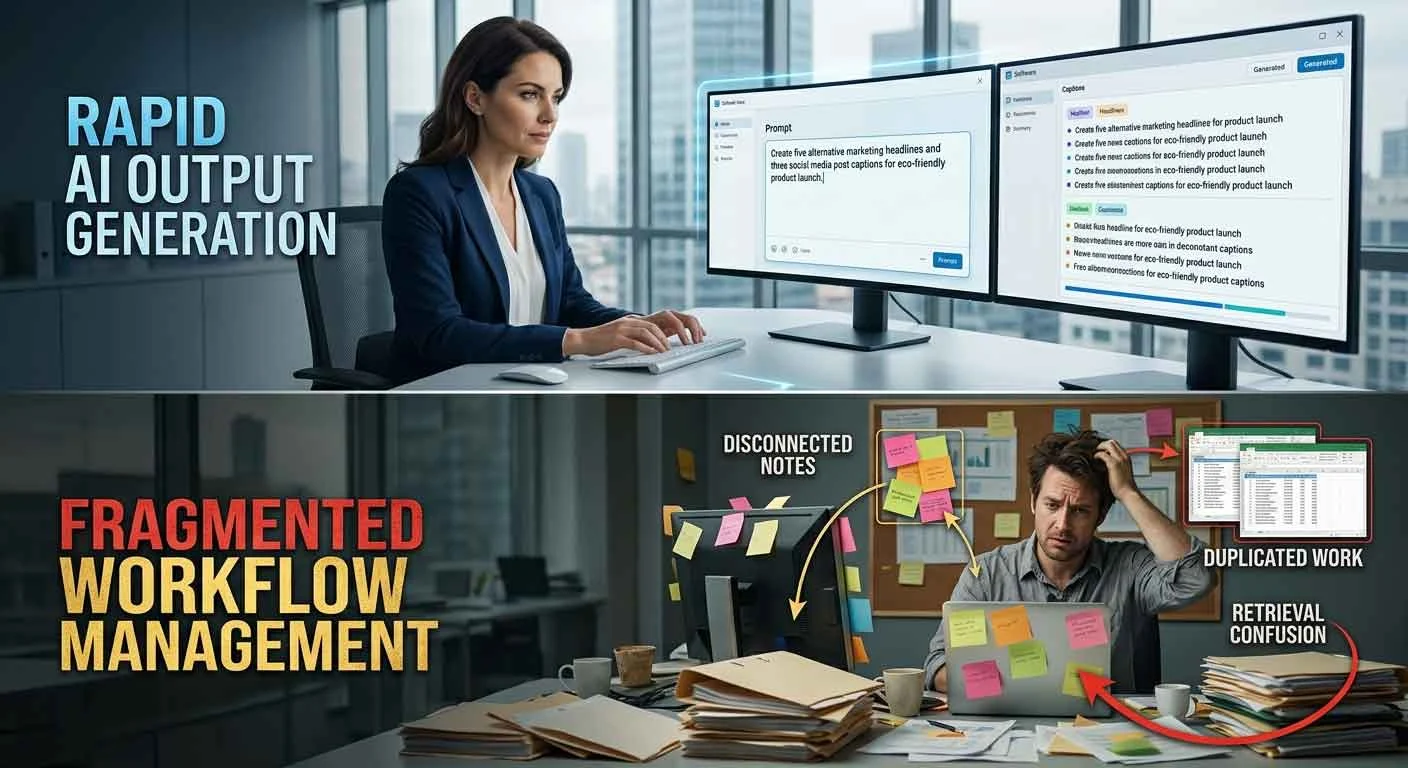

AI productivity often fails because people add artificial intelligence to broken workflows instead of redesigning how work is planned, organized, retrieved, and completed.
At first, the improvement feels obvious. AI can draft emails faster, summarize documents quickly, generate ideas, organize notes, and reduce repetitive writing. The visible output layer becomes faster almost immediately.
But after several weeks, many people notice a different problem.
The workday still feels scattered.
Tasks remain unfinished. AI chats become hard to retrieve. Research gets duplicated. Meeting notes do not always turn into action. Email replies become faster, but decision clarity does not always improve.
This is the hidden weakness of many AI productivity setups.
They improve speed without improving workflow continuity.
A strong AI workflow should not only help someone produce more. It should help them preserve context, reduce switching, organize information, and make better decisions across the full working cycle.
This is why a broader AI productivity system matters more than using disconnected AI tools for isolated tasks.
Why AI Productivity Usually Breaks Down
AI productivity usually breaks down when the surrounding workflow cannot handle the extra speed of information generation.
Most people adopt AI at the tool level.
They ask AI to:
- write faster
- summarize faster
- reply faster
- brainstorm faster
- organize faster
- automate faster
Those tasks are useful.
But productivity does not fail only because work is slow.
It often fails because work is fragmented.
A person may generate a good AI summary, but if the summary stays inside a temporary chat window and never connects to the task system, the workflow still breaks. A team may use AI to extract action items from a meeting, but if no one connects those actions to deadlines, ownership, or follow-up visibility, the summary becomes another passive document.
The problem is not the AI output.
The problem is the missing operational bridge between output and execution, which is why every AI task workflow needs ownership, context, and follow-up structure.
This is where many AI productivity systems become misleading. The user feels faster in the moment, but the larger workflow becomes harder to manage later.
A broken workflow with AI is still a broken workflow.
It just produces more material to clean up.
The Productivity Illusion Created by AI
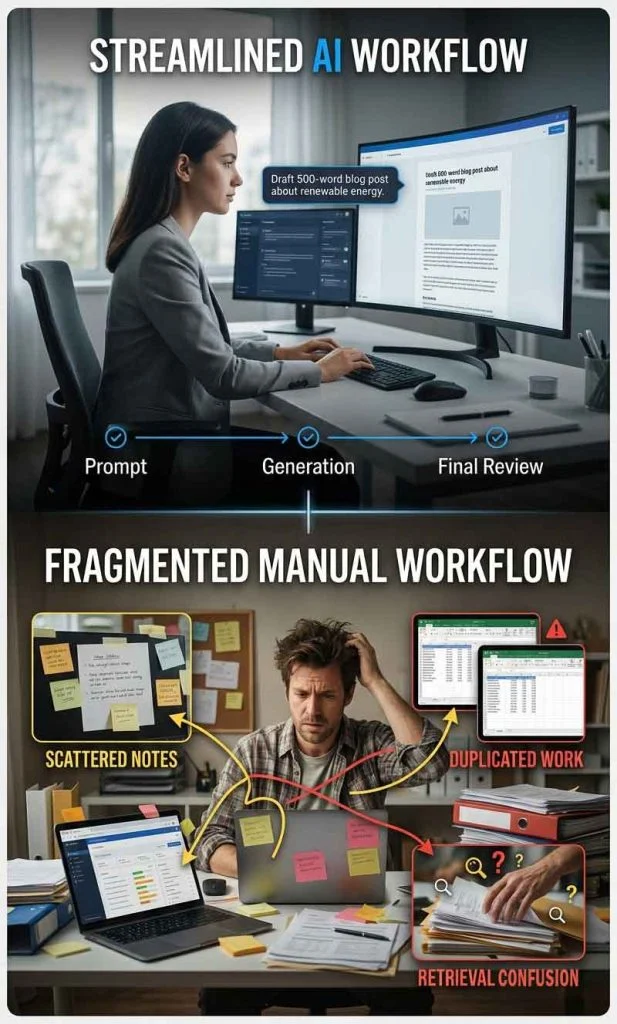
One reason AI productivity can feel successful while producing disappointing long-term results is that humans naturally notice output acceleration more easily than workflow quality.
If an email that previously required twenty minutes now takes five minutes, the improvement is immediately visible.
If a report outline appears within seconds, the improvement is obvious.
If meeting notes are generated automatically, the workflow feels more efficient.
However, many productivity losses remain hidden.
People rarely measure:
- retrieval time
- context reconstruction
- duplicated work
- decision confusion
- unfinished execution loops
- information fragmentation
These costs accumulate gradually.
For example, a worker may interact with AI dozens of times throughout a week. Valuable insights, decisions, summaries, and plans are generated continuously. Yet if those outputs remain scattered across separate conversations, future retrieval becomes increasingly difficult.
Several weeks later, the user may remember that an important insight exists somewhere but struggle to locate it quickly.
The productivity gain achieved during generation is partially lost during retrieval.
This is one reason AI productivity should be evaluated across the entire operational lifecycle rather than individual tasks, especially when comparing it with broader AI use cases that affect real workflows.
A system that creates information quickly but makes information difficult to retrieve later may not actually improve productivity.
It simply shifts friction from one stage of work to another.
Context Switching Is Often the Real Problem

Many people assume AI productivity fails because the technology is inaccurate.
In reality, workflow fragmentation is often the larger issue.
Modern workers regularly switch between:
- messaging platforms
- project boards
- AI assistants
- meetings
- spreadsheets
- collaborative documents
- research tabs
Every transition requires the brain to reconstruct context.
The reconstruction process consumes attention.
A worker may spend only a few seconds switching applications, but several minutes restoring mental continuity.
This hidden cost repeats throughout the day.
AI can unintentionally increase this behavior.
A task begins inside a project management platform.
Research moves into an AI chat.
The output is copied into a document.
Questions are discussed through messaging software.
Action items are transferred into another task manager.
Information exists everywhere, yet continuity exists nowhere.
The workflow becomes operationally expensive despite appearing technologically advanced.
Strong productivity systems therefore reduce unnecessary transitions whenever possible.
The objective is not maximizing AI usage.
The objective is maintaining uninterrupted operational progress.
Information Generation Is Outpacing Information Organization
Another common failure point appears when information creation becomes faster than information management.
Historically, workers spent significant time generating content manually.
Today, AI can generate:
- summaries
- reports
- ideas
- drafts
- action plans
- research notes
at extremely high speed.
This changes the productivity equation.
The challenge is no longer producing information.
The challenge is organizing information effectively.
Many users discover that their folders, notes, chats, and documents grow rapidly while retrieval quality declines.
The organization system remains designed for a slower information environment.
The AI system accelerates creation, but the storage and retrieval system remains unchanged.
Eventually, operational clutter accumulates.
Workers begin:
- searching repeatedly
- recreating previous work
- losing context
- duplicating research
- missing earlier decisions
Productivity decreases even while output volume increases.
This is why retrieval architecture is becoming one of the most important components of modern productivity systems.
The future productivity advantage may belong less to those who generate the most information and more to those who preserve the most usable context.
Why AI Cannot Fix Poor Prioritization
AI can assist with organization, but it cannot automatically determine what matters most inside every operational environment.
Many productivity problems originate from prioritization rather than execution.
Workers frequently know how to complete tasks.
The challenge is deciding:
- which task deserves attention first
- which task creates the largest impact
- which activity should be delegated
- which opportunity should be ignored
- which interruption deserves a response
AI can provide suggestions.
It can analyze deadlines.
It can identify patterns.
It can highlight dependencies.
But prioritization remains heavily influenced by:
- business goals
- organizational context
- strategic direction
- human judgment
- environmental conditions
A workflow that lacks prioritization clarity will often remain inefficient regardless of how much AI support is added.
This explains why some organizations invest heavily in AI tools yet experience only modest productivity improvements.
The technology accelerates execution.
The decision architecture remains unchanged.
The workflow therefore continues producing the same prioritization mistakes at a higher speed.
Automation Without Visibility Creates New Problems
Automation is one of the most attractive benefits of AI productivity systems.
Many repetitive activities can now be delegated to workflows that operate in the background.
Examples include:
- scheduling
- reminders
- email categorization
- reporting
- document routing
- information extraction
When implemented properly, automation reduces operational burden.
However, automation also creates a new risk.
Invisible failure.
A manual process usually exposes problems immediately because humans interact with each step directly.
Automated systems may continue operating incorrectly without attracting attention.
A report may stop updating.
A notification may fail.
A task may never reach the correct owner.
An important message may be categorized incorrectly.
These failures often remain hidden until a larger operational problem appears.
Strong productivity systems therefore maintain visibility.
Automation should reduce workload without removing awareness.
The goal is operational support, not operational blindness.
Why AI Productivity Fails in Teams
Individual productivity challenges become significantly more complex when AI is introduced into team environments.
Many organizations assume that if AI improves personal productivity, the same improvement will automatically scale across departments.
In reality, team productivity depends heavily on coordination quality rather than individual output speed.
A common problem emerges when team members begin using AI independently without shared workflow standards.
One person stores AI-generated research inside documents.
Another stores information in project management software.
Someone else relies on chat history.
Another employee uses personal note systems.
Each person may feel productive individually.
The organization as a whole becomes harder to coordinate.
Over time, teams encounter:
- duplicated research
- inconsistent documentation
- conflicting information
- disconnected decision records
- unclear ownership
- retrieval difficulties
The issue is not AI usage.
The issue is operational inconsistency.
Strong AI productivity systems require shared structures for:
- information storage
- decision documentation
- task ownership
- workflow continuity
- retrieval standards
Without those foundations, AI can increase organizational complexity faster than it increases organizational efficiency.
This is why many companies experience strong short-term productivity gains followed by operational confusion several months later.
The technology scales faster than the workflow architecture.
The Hidden Cost of Cognitive Overload
AI reduces many forms of manual work.
At the same time, it can increase cognitive workload in less obvious ways.
Modern workers are now exposed to:
- more information
- more recommendations
- more summaries
- more automation options
- more notifications
- more operational inputs
The volume of available information grows continuously.
Decision-making becomes more demanding.
A worker may receive:
- AI-generated suggestions
- AI-generated reports
- AI-generated meeting summaries
- AI-generated action items
all before lunch.
The problem is no longer information scarcity.
The problem is information saturation.
Eventually, workers spend increasing amounts of time evaluating information instead of acting on it.
This creates a different type of productivity bottleneck.
The workload shifts from production to filtration.
Strong productivity systems therefore include mechanisms for:
- prioritization
- filtering
- information reduction
- operational simplification
More information does not always create better outcomes.
Sometimes the highest productivity improvement comes from reducing unnecessary inputs rather than generating additional outputs.
Why Retrieval Is Becoming More Important Than Creation
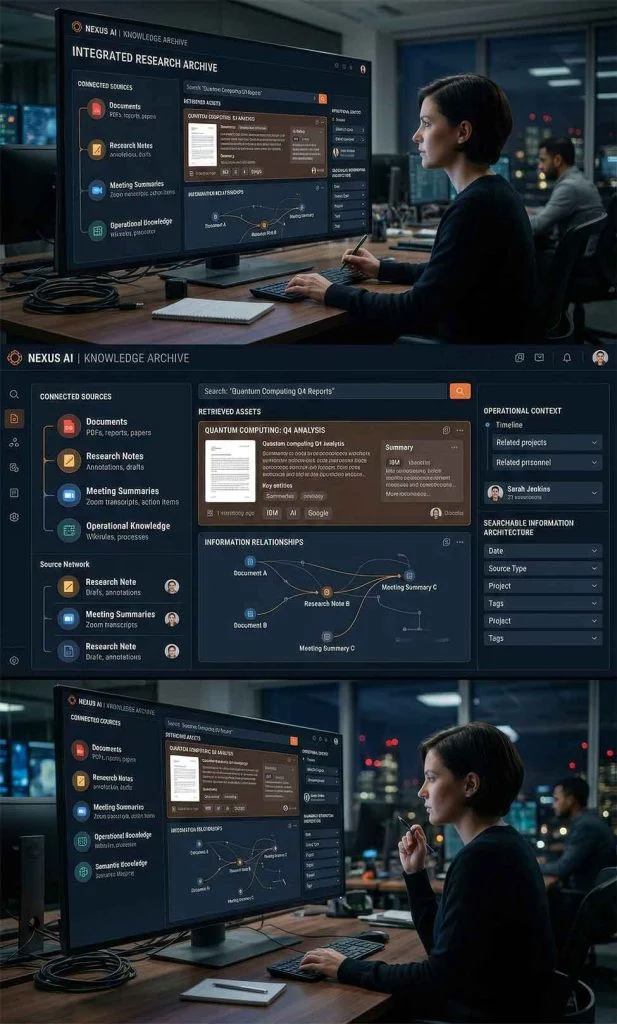
One of the largest shifts occurring in modern productivity environments is the transition from creation scarcity to retrieval scarcity.
Historically, creating information required significant effort.
Writing reports, generating ideas, documenting processes, and organizing knowledge all consumed considerable time.
AI has changed that relationship.
Information can now be generated rapidly.
The new challenge is finding the correct information when it is needed.
Many workers already possess:
- meeting notes
- project plans
- research documents
- action items
- summaries
- operational knowledge
The difficulty lies in retrieving the right context at the right moment.
This explains why many productivity systems feel increasingly cluttered.
The amount of stored information expands faster than the retrieval system evolves.
Workers repeatedly ask questions they have already answered.
Research gets recreated.
Earlier conclusions become difficult to locate.
Operational continuity weakens.
A strong AI productivity environment therefore treats retrieval as a primary function rather than a secondary convenience.
The ability to locate, reconnect, and reuse existing knowledge often produces more value than generating entirely new content.
This principle closely mirrors modern search systems, where retrieval quality increasingly determines usefulness.
What Successful AI Productivity Systems Do Differently
Successful AI productivity systems rarely focus on speed alone.
Instead, they create stability.
They reduce:
- fragmentation
- duplication
- confusion
- unnecessary switching
- retrieval friction
while improving:
- continuity
- organization
- visibility
- prioritization
- decision quality
The strongest systems often share several characteristics.
They Centralize Important Information
Critical decisions, project updates, research findings, and operational knowledge remain accessible through predictable retrieval environments.
Information does not become trapped inside isolated chats or disconnected tools.
They Prioritize Continuity
Work completed today remains usable tomorrow.
Context survives beyond individual conversations.
Teams can reconstruct earlier decisions without excessive effort.
They Minimize Cognitive Noise
Not every notification deserves attention.
Not every AI recommendation requires action.
Not every workflow should be automated.
Successful systems intentionally reduce unnecessary complexity.
They Treat AI as Infrastructure
AI becomes part of the operational environment rather than the center of attention.
The objective is not interacting with AI constantly.
The objective is completing meaningful work more effectively.
This distinction separates sustainable productivity systems from temporary productivity experiments.
How to Prevent AI Productivity Failure
Preventing AI productivity failure usually requires workflow improvement rather than additional technology.
A practical starting point includes:
Create One Primary Retrieval Location
Choose a central environment where important operational information is preserved consistently.
This reduces duplication and improves continuity.
Reduce Unnecessary Tools
Every additional platform creates another retrieval surface.
Simpler systems often outperform larger systems.
Define Workflow Standards
For teams, establish clear expectations for:
- documentation
- ownership
- storage
- follow-up actions
- information retrieval
Consistency improves organizational visibility.
Protect Deep Work
Productivity depends on sustained attention.
Reduce unnecessary interruptions whenever possible.
Review Workflows Regularly
AI systems evolve rapidly.
Productivity systems should be evaluated periodically to ensure they continue supporting operational goals instead of creating hidden friction.
The best AI productivity systems are not necessarily the most advanced.
They are often the most sustainable.
AI Productivity Failure vs Traditional Productivity Failure
Traditional productivity problems and AI productivity problems often look similar on the surface, but they originate from different operational conditions.
Historically, productivity challenges were frequently caused by limited information access, slow communication, manual documentation, and administrative workload.
Workers spent considerable time:
- locating information
- creating documents
- gathering data
- organizing reports
- coordinating updates
Modern AI environments have changed these constraints.
Information can now be generated rapidly.
Communication can be accelerated.
Research can be summarized almost instantly.
The bottleneck has shifted.
Today, many productivity failures occur because people generate more information than they can effectively organize, retrieve, evaluate, and apply.
The challenge is no longer scarcity.
The challenge is operational abundance.
This distinction is important because solving modern productivity problems often requires workflow redesign rather than additional productivity tools.
Understanding Retrieval Debt
Many organizations accumulate a hidden operational problem that can be described as retrieval debt.
Retrieval debt occurs when information is created faster than it can be organized, connected, and reused.
Initially, the problem remains invisible.
Teams generate:
- AI summaries
- meeting notes
- reports
- project plans
- operational documentation
without noticing immediate consequences.
Over time, retrieval becomes increasingly expensive.
Workers spend more time:
- searching
- validating
- reconstructing context
- recreating information
- locating previous decisions
The organization appears productive because large amounts of content exist.
However, operational efficiency declines because usable knowledge becomes harder to access.
Retrieval debt behaves similarly to technical debt.
Small inefficiencies accumulate gradually until they begin slowing the entire workflow.
Many AI productivity failures are actually retrieval debt failures.
AI Tool Overload and Productivity Fragmentation
One of the most common mistakes in modern productivity environments is assuming that more tools automatically create better workflows.
The opposite often occurs.
Organizations may simultaneously adopt:
- multiple AI assistants
- note systems
- project platforms
- automation software
- communication tools
- workflow applications
Each system introduces additional retrieval requirements.
Each platform creates another location where information may exist.
Over time, workers become responsible for managing the productivity system itself.
Instead of reducing complexity, the environment becomes increasingly difficult to navigate.
The strongest productivity systems usually achieve clarity through simplification rather than expansion.
Operational coherence often produces larger gains than technological complexity.
Early Warning Signs of AI Productivity Failure
AI productivity failures rarely appear suddenly.
Most systems show warning signals long before larger operational problems emerge.
Common indicators include:
- repeated information searches
- duplicated research efforts
- difficulty locating earlier decisions
- increasing meeting volume
- unfinished execution loops
- excessive notification dependency
- declining documentation quality
- growing task backlogs
Many organizations misinterpret these symptoms as staffing issues or workload problems.
In reality, they may indicate retrieval and workflow failures.
Recognizing these signals early can prevent productivity degradation from becoming systemic.
Why Managers Often Mismeasure AI Productivity
Many productivity measurements focus on visible outputs.
Examples include:
- documents produced
- emails sent
- reports completed
- tickets resolved
- tasks closed
These metrics are easy to observe.
However, they may not accurately represent operational effectiveness.
A team can generate more content while simultaneously:
- increasing confusion
- reducing continuity
- weakening decision quality
- creating retrieval debt
This creates a measurement problem.
Organizations may believe productivity is improving because output volume increases.
Meanwhile, operational friction continues growing beneath the surface.
A stronger productivity evaluation framework should also examine:
- retrieval speed
- context preservation
- execution continuity
- decision clarity
- operational visibility
- workflow sustainability
These factors often provide a more accurate picture of long-term productivity health.
How to Evaluate Whether AI Productivity Is Actually Improving
Many organizations struggle to determine whether AI is genuinely improving productivity because they focus primarily on output metrics.
Examples include:
- reports generated
- emails sent
- documents completed
- tickets resolved
- summaries produced
These metrics are easy to measure.
The problem is that they may not accurately represent workflow health.
A team can generate significantly more content while simultaneously creating:
- retrieval debt
- operational confusion
- duplicated work
- decision delays
- fragmented knowledge
This is why productivity evaluation should include both output measurements and workflow measurements.
Output Indicators
Output indicators help measure visible activity.
Examples include:
- project completion rates
- report production
- response speed
- documentation volume
- task completion counts
These metrics show whether work is being produced.
However, they do not explain whether the workflow remains sustainable.
Workflow Indicators
Workflow indicators often reveal long-term productivity health more accurately.
Examples include:
- retrieval speed
- decision visibility
- information continuity
- interruption frequency
- context reconstruction effort
- duplication levels
When these indicators improve, operational efficiency usually improves as well.
Behavioral Indicators
Human behavior also provides valuable productivity signals.
Examples include:
- reduced cognitive overload
- improved focus duration
- fewer unnecessary meetings
- lower interruption frequency
- improved task completion confidence
A productivity system should improve both operational performance and working experience.
If output increases while stress, confusion, and fragmentation continue rising, the workflow may not be improving as much as it initially appears.
The Most Important Evaluation Question
A useful productivity evaluation framework often comes down to a simple question:
Can workers find, understand, continue, and complete work more easily than before?
If the answer is consistently yes, productivity is likely improving.
If retrieval becomes harder, continuity weakens, and operational visibility declines, then productivity gains may be more superficial than they appear.
AI Productivity Evaluation Checklist
| Healthy Signal | Warning Signal |
|---|---|
| Information easy to retrieve | Repeated searching for information |
| Clear ownership | Unclear responsibilities |
| Strong workflow continuity | Frequent context reconstruction |
| Focused execution | Constant interruption cycles |
| Low retrieval friction | Growing retrieval debt |