A diversified ETF portfolio can still fall all at once because diversification reduces some risks, not every risk. Different funds may own the same companies, react to the same economic driver, or simply be exposed to the same market-wide shock, so synchronized losses do not automatically mean your diversification has failed. The useful question is which of those three explanations is causing the move.
Why Different ETFs Can Fall Together
| What you see | Likely explanation | What to check | What it means |
|---|---|---|---|
| Several ETFs hold many of the same large companies | Holdings overlap | Top holdings and combined company weights | You may have more concentration than the fund count suggests |
| Different companies and funds still react almost identically | Shared risk driver | Sector, style, rates, credit, currency and economic sensitivity | Different holdings can still represent the same economic bet |
| Broad stock markets across several regions decline | Systematic market risk | Whether the shock affects equities generally | Diversification was never designed to eliminate every market decline |
| Stocks and bonds both fall | Common inflation/rate or liquidity shock | Bond duration, credit quality and the actual market catalyst | Asset classes do not maintain fixed correlations in every environment |
This distinction matters because the appropriate response is different in each case. Accidental ETF overlap is a portfolio-construction issue, shared-factor exposure is a risk-allocation issue, and a broad market decline may simply be the normal price of owning risk assets.
1. Your ETFs May Own the Same Investments
The easiest diversification problem to understand is holdings overlap. A broad-market ETF, a large-cap growth ETF, a technology ETF and an AI-themed ETF can have different names and objectives while repeatedly allocating money to many of the same large companies. Adding another fund therefore does not necessarily add another independent source of return.
This is why fund count is a poor measure of diversification. Five ETFs can produce less genuine diversification than two complementary funds if the five repeatedly concentrate money in the same securities, sectors and market style.
Investor.gov’s asset-allocation and diversification guidance specifically notes that owning several mutual funds or ETFs does not automatically produce diversification and recommends checking whether their underlying holdings actually differ.
- Check the top holdings. Repeated companies near the top of several funds deserve attention because those positions usually have the greatest effect on portfolio returns.
- Check weight, not just presence. Finding the same company in two funds matters much more when it represents a large allocation in both.
- Include individual stocks. Owning a company directly and again through several ETFs can quietly increase its total portfolio weight.
- Look beyond company names. Sector, country, market-cap and investment-style exposure can overlap even when individual holdings differ.
2. Different Holdings Can Still Be the Same Economic Bet
A more subtle problem appears when two funds do not hold exactly the same companies but still respond to the same underlying force. A software fund, semiconductor fund and growth-stock fund may contain different businesses, yet all can be sensitive to changes in interest rates, valuation expectations, technology spending and investor appetite for long-duration growth.
This is risk-driver concentration rather than literal holdings overlap. The labels look different, the stocks may be different, but the portfolio can still behave as though one large position has been split into several wrappers.
Interest rates are a particularly useful example. Companies whose market values depend heavily on profits expected far into the future can react strongly when discount rates change, which is why understanding duration risk is useful even for equity investors. The deeper mechanics of how rates, liquidity and risk premiums can cause many shares to reprice simultaneously are covered in why shares reprice when market conditions change.
3. Sometimes Diversification Is Working Even While Everything Is Down
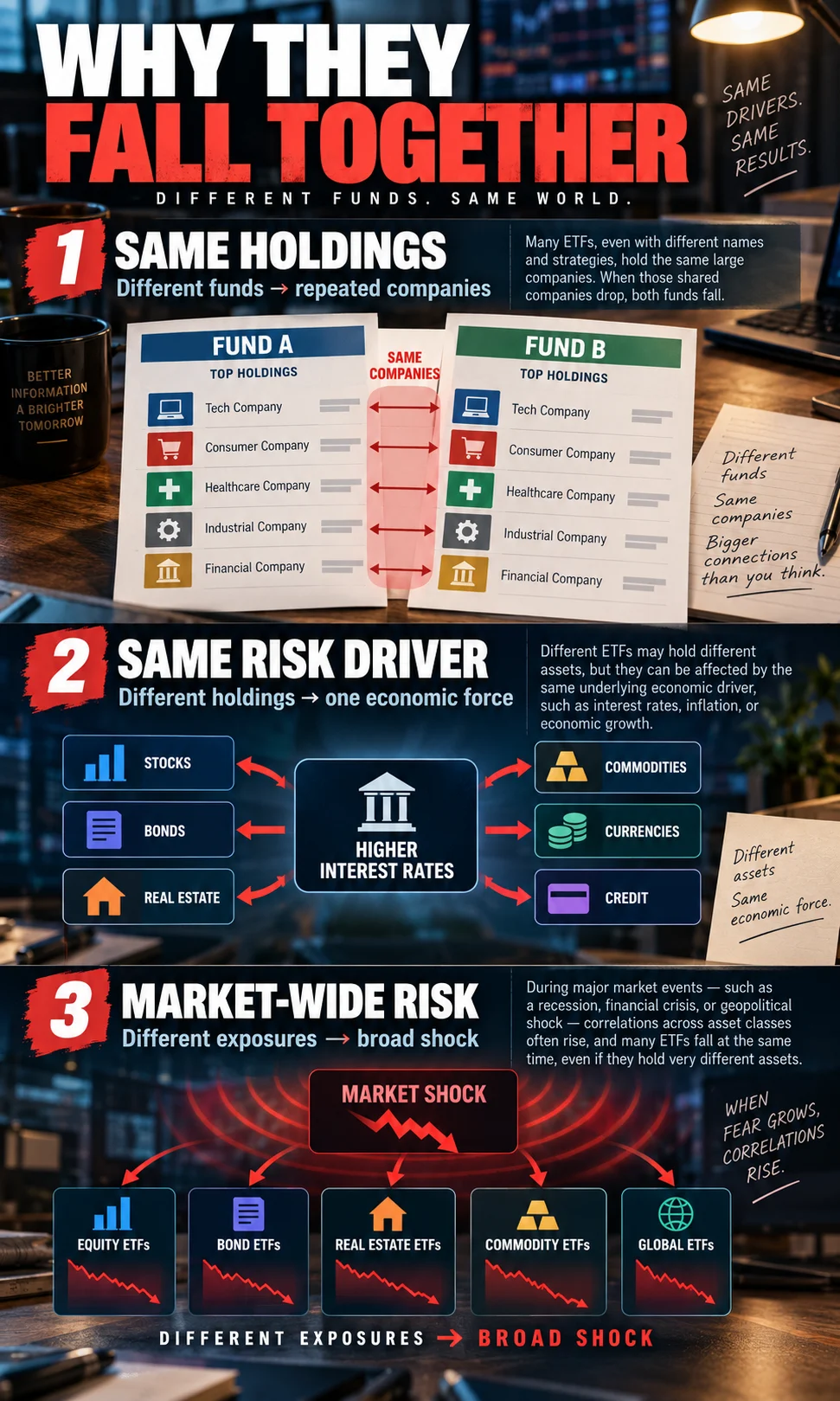
Diversification is primarily designed to reduce the damage caused by being too dependent on one company, sector or other concentrated exposure. It cannot remove systematic risk – the part of investment risk created by forces affecting an entire market or many markets at once.
Imagine that one company loses a major customer while the rest of the economy is healthy. A broad portfolio can absorb that company-specific problem far more easily than a concentrated portfolio. Now replace the company problem with a worldwide shock to interest rates, economic growth, liquidity or investor risk appetite; hundreds of otherwise unrelated companies can be repriced together.
That does not make diversification useless. A diversified portfolio may still fall less than a concentrated one, avoid a catastrophic loss caused by one security, and participate differently when market leadership changes. What diversification cannot promise is a positive return every week, month or market downturn.
Ticker Diversity Is Not the Same as Risk Diversity
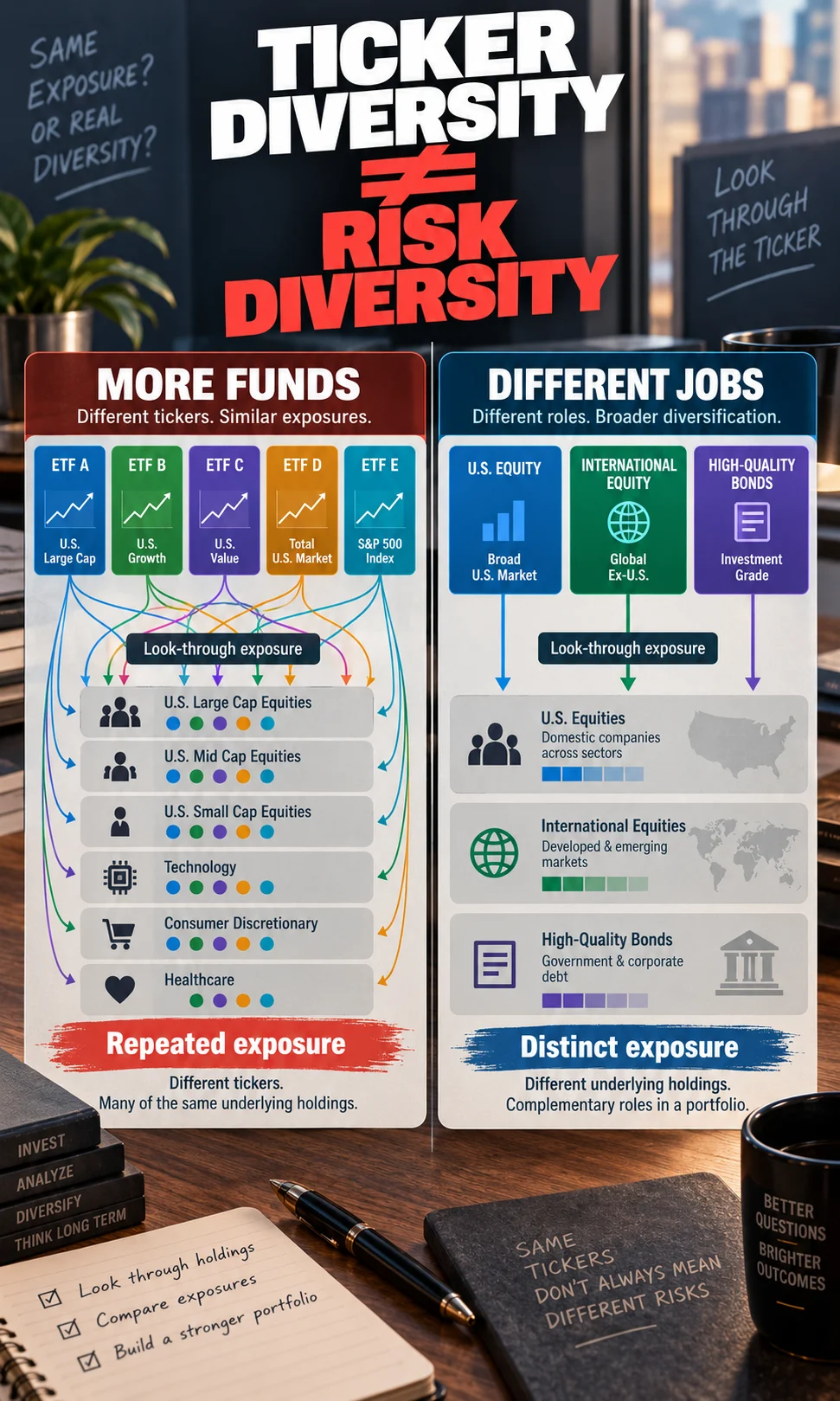
The quickest way to misread a portfolio is to treat every ticker as a separate risk. Investors should instead look through the ticker symbols and ask what economic exposure each position is actually adding.
| Portfolio feature | Looks diversified? | What really matters |
|---|---|---|
| Many ETF tickers | Possibly | Whether their underlying exposures differ |
| Hundreds or thousands of stocks | Within equities, often | How much weight is concentrated in the largest companies, sectors and countries |
| Several equity styles | Potentially | Whether they respond differently to rates, growth and valuation changes |
| Stocks plus bonds | Broader asset diversification | Bond duration, credit quality and the economic shock driving the market |
FINRA’s concentration-risk guidance makes the same practical point from another direction: investors should look under the hood of funds because correlated holdings and repeated positions can create concentration that is not obvious from the fund names alone.
ETF Overlap Is Not Automatically Bad
Overlap becomes a problem mainly when it is accidental or when it creates a level of concentration the investor did not intend. An investor may deliberately own a broad-market ETF and then add a smaller technology allocation because greater technology exposure is part of the intended strategy; in that case, the overlap is functioning as a deliberate tilt.
The problem arises when the investor believes the second fund is reducing risk when it is actually increasing exposure to the same companies or drivers. That distinction is more useful than trying to invent a universal percentage at which ETF overlap suddenly becomes unacceptable.
The same principle applies to thematic investing. Someone comparing individual AI companies with diversified funds should understand the difference between security count and underlying exposure, which is also central to the AI stocks vs AI ETFs decision.
Why Correlations Can Change When Markets Become Stressed
Investment relationships are not permanent. Two assets that usually move differently can begin declining together when one unusually powerful force dominates the market, particularly when investors are repricing inflation, interest rates, liquidity, credit conditions or economic growth.
Bonds provide a useful example. High-quality bonds can sometimes cushion equity weakness, but longer-duration bonds can themselves lose value when yields rise. Corporate bonds can also behave more like risky assets when investors become worried about default risk and demand a larger credit spread.
This is why historical correlation should not be interpreted as a contractual promise. Diversification is strongest when a portfolio contains genuinely different economic exposures, but even good diversifiers can temporarily move in the same direction under a sufficiently broad shock.
How to Check Whether Your Diversification Is Actually Broken
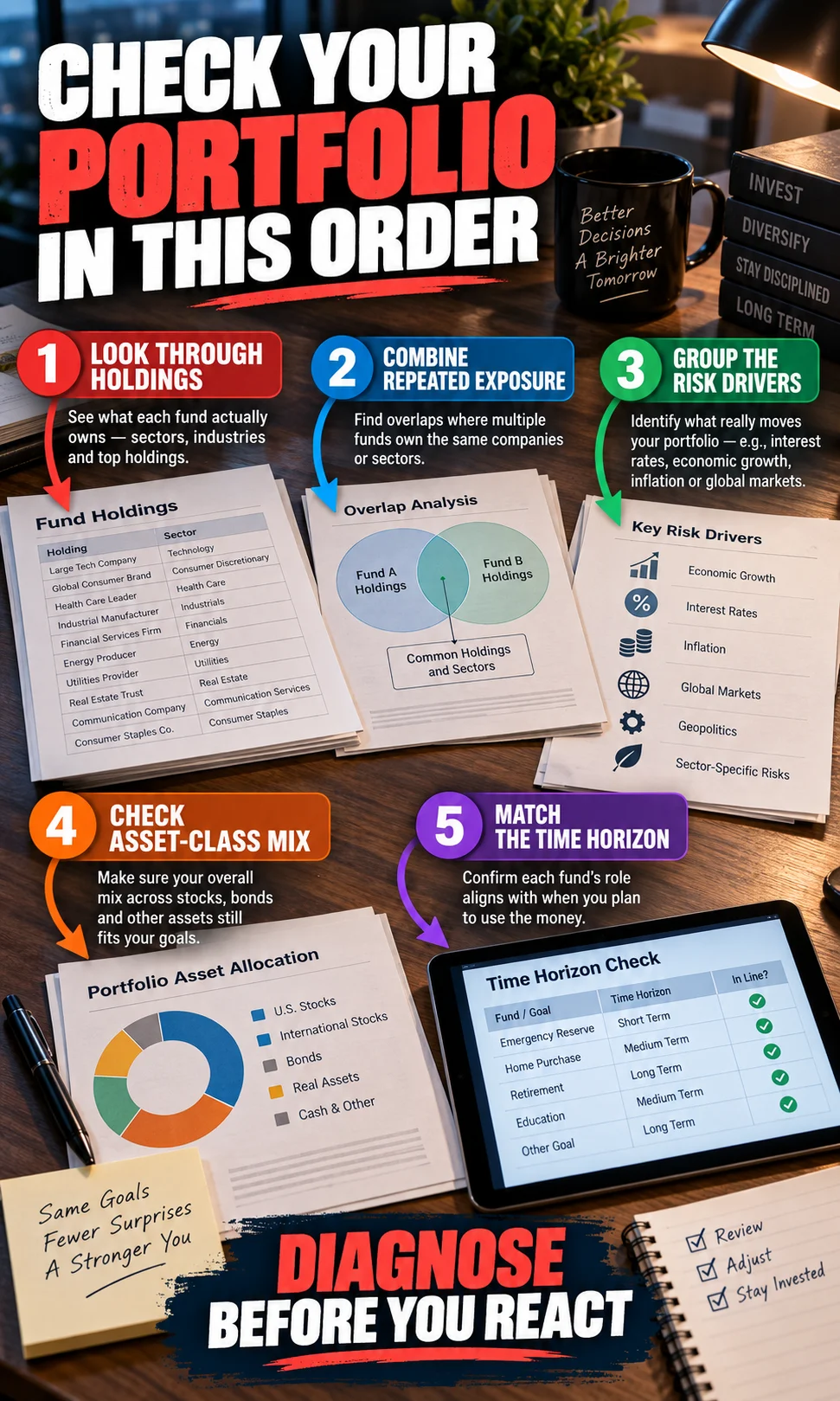
Start with diagnosis rather than reacting to the colour of the performance screen. A synchronized decline tells you that investments are moving together; it does not tell you why.
- Look through every fund. Compare the largest underlying holdings and identify companies that appear repeatedly.
- Add exposures across the whole portfolio. A stock owned directly plus indirectly through several ETFs should be treated as one combined economic exposure.
- Group investments by risk driver. Look at sectors, investment style, geography, interest-rate sensitivity, credit quality and other forces that can cause different securities to move together.
- Separate diversification within equities from diversification across asset classes. Owning global stocks can reduce country and company concentration while still leaving the portfolio predominantly exposed to equity-market risk.
- Compare the portfolio with the time horizon for the money. A portfolio can be well diversified for a long-term goal yet still be inappropriate for money that may be needed soon.
- Check whether the original target allocation has drifted. Strong performance in one sector or asset class can quietly make that exposure much larger than intended.
When Everything Falling Is a Real Warning Sign
Synchronized losses deserve more attention when they reveal something about the portfolio that the investor did not previously understand. Discovering that several apparently different ETFs are dominated by the same companies, that nearly every position depends on the same growth theme, or that money needed soon is invested in volatile assets can expose a genuine construction problem.
Leverage creates another category of concern because it can magnify ordinary market declines and force decisions at an inconvenient time. Narrow sector funds, leveraged products and other specialized investments should therefore not be judged by the same diversification assumptions as a broad-market fund.
The warning sign is not simply that several positions turned red on the same day. The warning sign is finding that the portfolio carries materially more concentration, liquidity risk or short-term loss exposure than its owner intended.
What Should You Do When All Your ETFs Are Down?
A falling market is a poor moment to discover what your portfolio owns, but it is still better to diagnose the problem than to change investments purely because they declined together. First determine whether the decline comes from holdings overlap, a shared risk factor or a broad market event, then compare the resulting exposure with the portfolio’s intended allocation, time horizon and capacity for loss.
If the structure still matches the original long-term plan, synchronized short-term losses alone do not prove that the allocation is defective. If the review exposes unintended concentration or a mismatch between portfolio volatility and when the money will be needed, the useful problem to solve is that underlying mismatch rather than attempting to predict the exact market bottom.
Rebalancing can also matter because market movements gradually alter portfolio weights. An allocation that began at a comfortable level can become concentrated after one group of investments significantly outperforms the rest, leaving the investor with more exposure to that risk than originally intended.
The Better Question: What Risk Does Each ETF Add?
Every ETF in a portfolio should have a clear job. A second fund is most useful when it adds an exposure the portfolio actually needs rather than merely creating another ticker, another account line and another version of an investment already owned.
That makes a simple question surprisingly powerful: If I removed this ETF, what meaningful risk exposure or diversification benefit would disappear? If the answer is difficult to identify because another fund already provides almost the same exposure, the position may be redundant. If the answer is clear – for example, it changes asset class, geography, market segment or another relevant risk driver – the fund may be doing a distinct portfolio job even when it occasionally declines alongside everything else.
Key Takeaway
Different ETFs falling together does not automatically mean diversification has failed. Your funds may be overlapping, they may be different investments exposed to the same economic force, or they may simply be experiencing a market-wide decline that diversification was never capable of eliminating.
The most useful portfolio check therefore goes below the ticker symbols. Examine the actual holdings, combined weights, risk drivers, asset-class mix and time horizon, and judge diversification by what the portfolio is exposed to rather than by how many funds appear on the screen.
Frequently Asked Questions
Why do all my ETFs go down at the same time?
Different ETFs can decline together because they own some of the same investments, respond to the same economic driver, or are all exposed to a broad market decline. The fact that they move together on one day does not prove that the funds are identical, so check their holdings and risk exposures before drawing that conclusion.
Can a diversified portfolio still lose money?
Yes. Diversification can reduce the effect of company-specific and concentration risks, but it cannot eliminate market-wide risk. A genuinely diversified portfolio can therefore lose value during a broad downturn even though diversification may still reduce the damage caused by any single investment.
Does owning more ETFs mean I am more diversified?
No. Additional ETFs improve diversification only when they add meaningfully different exposures. Several funds that repeatedly own the same companies, sectors or investment styles can create more complexity without adding much independent diversification.
Is ETF overlap always bad?
No. Overlap can be intentional when an investor deliberately wants additional exposure to a company, sector or investment style. It becomes more concerning when the investor expects the additional fund to diversify the portfolio but it actually increases an exposure already held elsewhere.
Why can stocks and bonds both fall at the same time?
Stocks and bonds can both decline when the same economic force hurts both markets. Rising interest rates can reduce stock valuations while also pushing down the prices of existing bonds, particularly longer-duration bonds, while worsening credit conditions can pressure both equities and corporate debt.
Should I sell because all my ETFs are falling?
A synchronized decline by itself does not determine whether selling is appropriate. First identify why the funds are moving together and whether the portfolio still matches its intended allocation, time horizon, liquidity needs and capacity for loss; individual investment decisions depend on personal circumstances.