
Definition – What Is Duration Risk
Duration risk refers to the sensitivity of an asset’s valuation to changes in interest rates or discount rates. Assets whose expected cash flows occur further in the future are more exposed to valuation shifts when required return changes.
In equity markets, duration risk explains why growth shares often experience sharper price movements during tightening cycles. Their expected earnings are weighted further into the future, making present value calculations more sensitive to discount rate increases.
Duration in Bonds vs Equities
In bond markets, duration is a mathematical measure of interest rate sensitivity. Longer-duration bonds decline more when yields rise.
In equity markets, duration is conceptual rather than contractual. Companies with long growth runways, reinvestment cycles, and distant profitability expectations exhibit higher duration sensitivity.
This structural link connects directly to:
Why Rising Rates Hit Growth Shares Harder
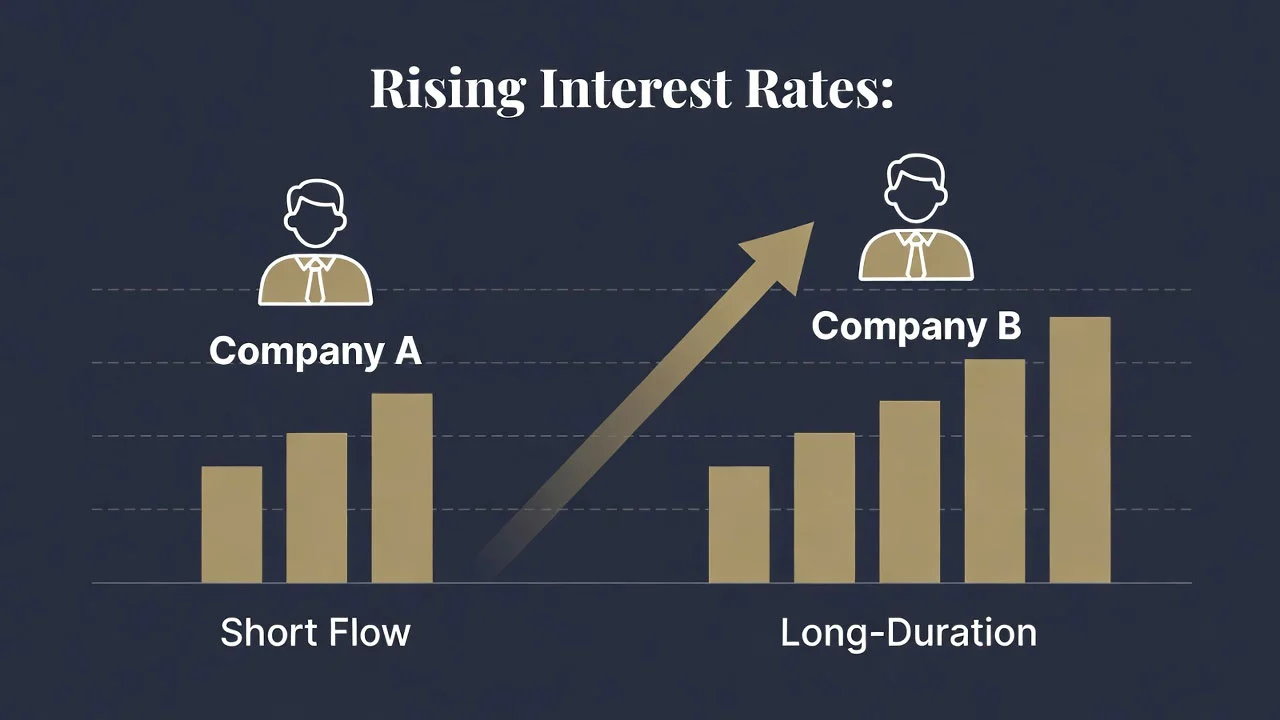
When discount rate increases, distant cash flows are discounted more aggressively than near-term cash flows.
Example dynamic:
Short-duration company:
Most value from near-term earnings.
Long-duration company:
Most value from earnings far in the future.
Higher discount rate compresses the latter more sharply.
This is why tightening cycles often trigger sector rotation away from long-duration growth sectors.
Duration Risk Across Market Cycles
Tightening phase:
Duration risk becomes dominant driver of equity dispersion.
Crisis phase:
Equity risk premium expansion may overshadow duration differences.
Recovery phase:
Declining discount rates often favor longer-duration assets.
Duration risk therefore acts as a volatility amplifier across macro regimes.
Why Duration Risk Matters
Duration risk influences:
- Sector allocation
- Valuation stability
- Rate shock sensitivity
- Growth vs value rotation
- Long-term multiple expansion
Interactive modeling can be explored inside the:
Frequently Asked Questions
What is duration risk in equities?
Duration risk refers to how sensitive an equity’s valuation is to changes in discount rates, especially when earnings are expected far in the future.
Why are growth stocks considered long duration?
Growth stocks derive a larger portion of valuation from distant cash flows, making them more sensitive to changes in required return.