

Definition – What Is the Risk-Free Rate
The risk-free rate represents the theoretical return on an investment assumed to carry no default risk. In practice, it is approximated by yields on sovereign government securities within a stable currency system. These yields serve as the baseline return available without exposure to corporate credit risk.
The risk-free rate forms the foundation of required return in valuation models. It reflects the time value of money before additional compensation for uncertainty is applied. Every asset class, including equities, real estate, and private capital, references this baseline when determining expected return.
Although termed “risk-free,” sovereign bonds still fluctuate in price due to interest rate changes and inflation expectations. The label refers specifically to default risk rather than price volatility.
Where It Fits – Required Return Framework
The structural equation:
Required Return = Risk-Free Rate + Equity Risk Premium
places the risk-free rate as the first component in valuation models. The equity risk premium is layered on top to compensate for uncertainty.
When sovereign yields rise, required return increases even if the equity risk premium remains unchanged. Present value of future cash flows declines. Equity multiples compress.
A deeper explanation of this interaction is provided in:
What Determines the Risk-Free Rate
Sovereign yields incorporate multiple embedded components:
- Expected inflation
- Real interest rate
- Term premium
- Fiscal credibility expectations
When inflation expectations rise, nominal yields typically increase. When central banks tighten monetary policy, short-term rates adjust upward. When fiscal deficits expand, long-term yields may reflect increased supply or credibility concerns.
The risk-free rate therefore evolves with macroeconomic expectations rather than remaining static.
Real vs Nominal Risk-Free Rate
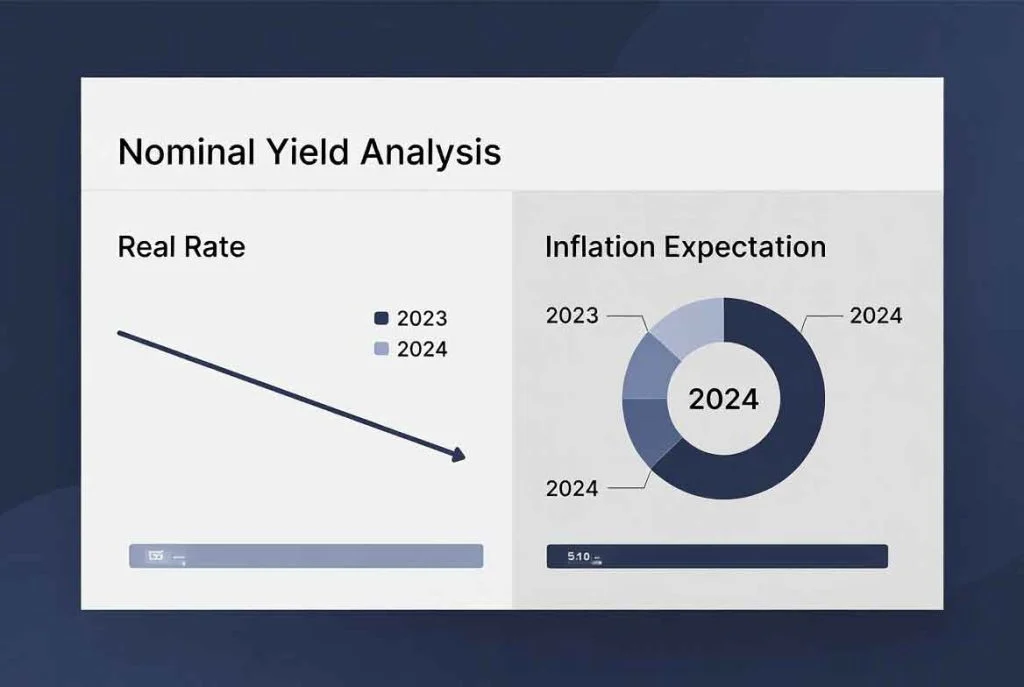
Nominal yields include inflation expectations. Real yields represent inflation-adjusted return. Real yield movements often exert stronger influence on equity valuation because they reflect the true time value of money.
If nominal yields rise solely due to inflation while real yields remain stable, valuation effects may differ from scenarios where real yields increase sharply.
Understanding this distinction helps explain equity market reactions during tightening cycles.
Risk-Free Rate and Market Cycles
The risk-free rate behaves differently across macro phases:
Tightening phase:
Central banks raise policy rates. Sovereign yields rise. Discount rates increase.
Crisis phase:
Flight to safety may lower sovereign yields even as equity risk premium expands.
Recovery phase:
Yields stabilize or gradually rise with growth expectations.
These cycles determine how the risk-free rate interacts with equity valuation.
Why It Matters
The risk-free rate influences:
- Discount rate modeling
- Equity duration sensitivity
- Dividend yield competitiveness
- Credit spread pricing
- Long-term valuation equilibrium
It is the gravitational baseline of asset pricing.
Interactive modeling of rate sensitivity can be explored inside the:
Frequently Asked Questions
Is the risk-free rate truly risk free?
It is considered free from default risk within its currency system, but it still fluctuates in price due to interest rate and inflation changes.
Why do rising sovereign yields affect stock prices?
Rising sovereign yields increase required return in valuation models, which reduces the present value of future corporate cash flows.
What is the difference between real and nominal risk-free rate?
Nominal yields include inflation expectations, while real yields represent inflation-adjusted return.