



Definition – What Is a Discount Rate
A discount rate is the rate used to convert future cash flows into present value. It reflects the required return investors demand for committing capital over time. In equity valuation models, the discount rate incorporates both the risk-free rate and an additional premium for uncertainty.
The higher the discount rate, the lower the present value of future earnings. The lower the discount rate, the higher the present value.
Discount rate functions as the denominator mechanism within discounted cash flow models. It determines how aggressively future income streams are adjusted for time and risk.
Structural Formula – Where It Comes From
In equity markets, the discount rate is typically defined as:
Discount Rate = Risk-Free Rate + Equity Risk Premium
The risk-free rate represents baseline time value. The equity risk premium compensates for uncertainty.
Detailed explanation of these components is provided in:
and
The discount rate integrates both into a single required return assumption used in valuation.
Why the Discount Rate Matters in Valuation
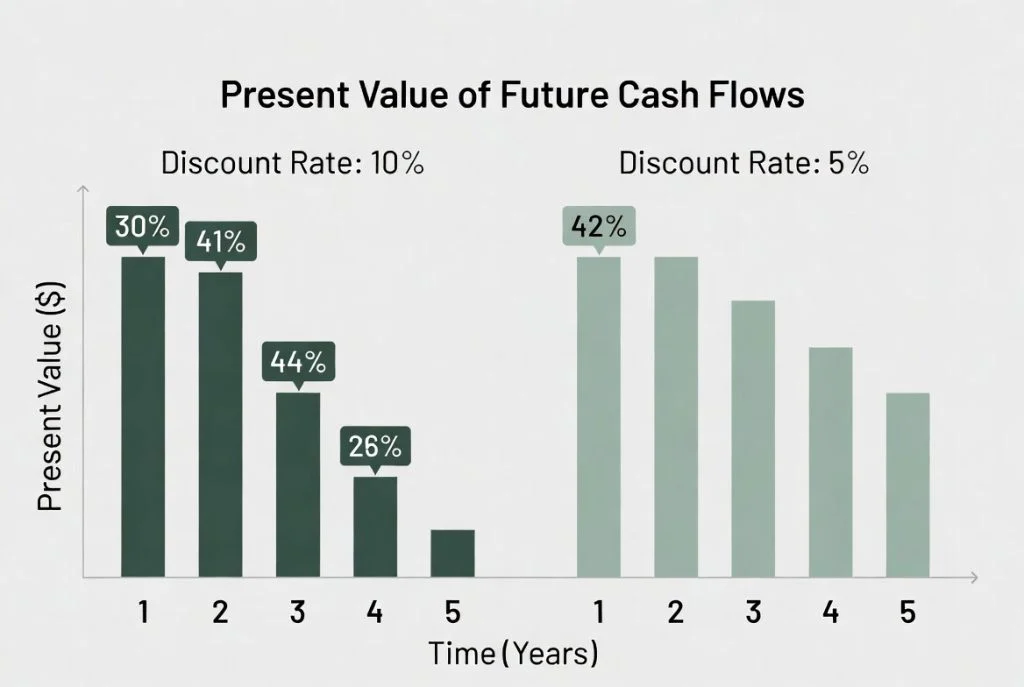
Valuation models estimate the present value of expected future cash flows. Because those cash flows occur in the future, they must be discounted back to today.
If the discount rate increases, the present value decreases even if earnings projections remain unchanged. This mechanical sensitivity explains why equity markets often decline when sovereign yields rise.
Discount rate adjustments influence:
- Price-to-earnings ratios
- Terminal value calculations
- Dividend valuation models
- Duration sensitivity
Even small shifts in discount rate assumptions can materially alter fair value estimates, particularly for long-duration equities.
Real vs Nominal Discount Rate
The discount rate can be evaluated in nominal or real terms. Nominal discount rate includes inflation expectations. Real discount rate reflects inflation-adjusted required return.
In inflationary environments, nominal discount rates may rise. If earnings grow nominally in line with inflation, valuation effects may differ from scenarios where real discount rate increases sharply.
Understanding the real component of discount rate helps clarify structural repricing episodes.
Discount Rate and Duration Sensitivity
Equities with long-dated expected earnings are more sensitive to discount rate changes. When discount rate rises, the present value of distant cash flows declines more sharply than near-term cash flows.
This duration effect explains sector rotation during tightening cycles. Growth sectors often compress more significantly than mature, income-focused sectors when discount rates increase.
Discount rate therefore functions as a transmission mechanism linking sovereign yield movements to sector-specific performance.
Discount Rate and Market Cycles
Across cycles, discount rate behaves differently:
Tightening cycles:
Risk-free rate rises. Discount rate increases. Multiples compress.
Crisis cycles:
Equity risk premium expands. Discount rate increases even if sovereign yields fall.
Recovery cycles:
Premium compresses. Discount rate declines. Valuation expands.
Understanding which component drives discount rate change clarifies market behavior.
Why It Matters for Structural Analysis
Discount rate determines:
- Equity valuation equilibrium
- Capital allocation decisions
- Dividend yield interpretation
- Terminal value modeling
- Long-term return expectations
It is the central mathematical lever in asset pricing.
Interactive modeling of discount rate sensitivity can be explored in the:
Frequently Asked Questions
What is the discount rate in simple terms?
The discount rate is the required return used to convert future cash flows into present value in valuation models.
How is discount rate calculated?
In equity valuation, the discount rate typically equals the risk-free rate plus the equity risk premium.
Why does a higher discount rate reduce stock prices?
A higher discount rate lowers the present value of future earnings, which compresses valuation multiples.