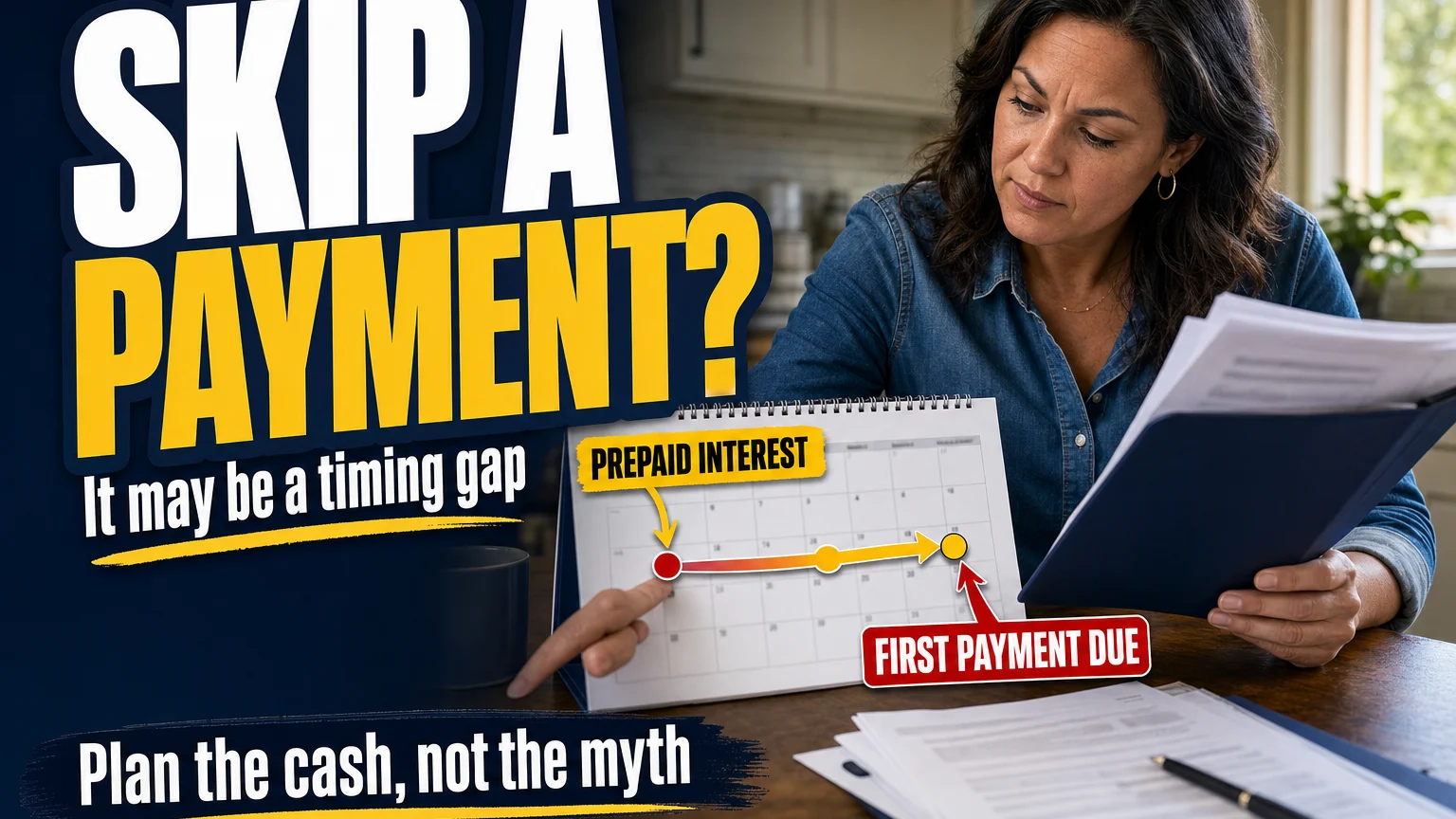

You can sometimes refinance a mortgage and go through a calendar month without making your normal scheduled mortgage payment, but describing that as “skipping a payment” can create the wrong impression. The refinance does not normally erase a month of mortgage interest or give you a free payment. Your old mortgage is paid off during the refinance, the new mortgage begins accruing interest, and the timing of the new loan’s first scheduled payment can create what looks like a temporary gap between monthly payments.
That gap can be useful for cash flow. If your old mortgage payment was due near the beginning of one month, you close the refinance later that month, and the first payment on the new loan is not due until a later date, there may be several weeks in which no regular mortgage payment leaves your checking account. The experience can feel like receiving a month off, particularly when the household is accustomed to making a housing payment on the same date every month.
The money has not simply disappeared from the mortgage, however. Mortgage interest generally accrues according to the loan terms, and part of the interest between closing and the period covered by your first scheduled payment can appear as prepaid interest at closing. The Consumer Financial Protection Bureau’s explanation of prepaid interest charges describes prepaid interest as the daily interest accruing between the mortgage closing date and the period covered by the first monthly payment. That amount appears among the prepaid items on the mortgage disclosures.
Refinancing also replaces the old obligation with a new one rather than temporarily pausing the original mortgage. The CFPB’s current Regulation Z interpretation explains that a refinancing generally involves the old obligation being satisfied and replaced by a new obligation. That means the apparent payment gap comes from the transition between two different loans and their payment schedules, not from the lender deciding that one month’s housing cost no longer exists.
This distinction matters when planning what to do with the temporary cash-flow relief. A borrower who thinks the refinance created a free mortgage payment may spend the money immediately, while someone who understands the timing may decide to reserve some of that cash for closing costs, moving expenses, an emergency fund or the first payment on the new loan. The refinance can still create a useful breathing period, but it should be understood as a payment-timing effect rather than a financial windfall.
Refinance Payment Gap Planner
See what happens when refinancing creates a month without a normal mortgage payment, how much temporary cash you may keep, and what should already be reserved before your first new payment arrives.
Your Refinance Timeline
Your Payment-Gap Plan
What Happens to the Money?
The planner will compare your available reserve with the amount that should remain prepared for closing and the first new payment.
Your Refinance Timeline
What Should You Prepare Before the Gap?
Do You Really Skip a Mortgage Payment When Refinancing?
In practical terms, you may go through a period in which no normal monthly mortgage payment is due. In economic terms, you usually are not receiving one month of completely free financing.
The confusion comes from the way mortgage payments and mortgage interest are timed. Mortgage interest is commonly paid in arrears, meaning a scheduled payment generally covers interest that accumulated during the preceding period. The CFPB explains this timing directly in its mortgage disclosure guidance, noting that mortgage interest is typically paid one month in arrears.
When you refinance, the old loan receives a payoff amount and is closed. The new mortgage then begins under its own interest and payment schedule. Depending on the closing date, you may pay some interest on the new mortgage at closing before the first regular payment becomes due.
This creates the visual appearance of a skipped payment even though the costs have simply been distributed differently across the old payoff, the new loan’s prepaid interest and its first scheduled payment.
Why Does Refinancing Create a Payment Gap?

The easiest way to understand the gap is to separate the old mortgage from the new mortgage.
Your existing mortgage has a payment schedule. When the refinance closes, the new lender generally provides funds that satisfy the old mortgage payoff as part of the transaction. Once the old loan has been paid off, you no longer continue making ordinary scheduled payments on that mortgage.
The new loan has a different starting date. Its first scheduled monthly payment may not be due immediately after closing because of how mortgage interest periods are structured.
The space between those schedules is what borrowers commonly call the skipped-payment month.
Nothing unusual needs to happen for that gap to exist. It is a normal consequence of closing one mortgage and beginning another at a particular point in the monthly payment cycle.
A Simple Refinance Payment Timeline
Imagine your normal mortgage payment is due on the first of every month.
You make your existing mortgage payment on September 1. Your refinance then closes on September 18.
The old mortgage is paid off through the refinance transaction. The new mortgage begins accruing interest after closing according to its loan terms, and your lender tells you that your first scheduled payment on the new mortgage is due November 1.
You therefore do not write a normal mortgage payment on October 1.
At first glance, that appears to be an entire free month.
The more complete timeline looks like this:
| Stage | What Happens | What the Borrower Sees |
|---|---|---|
| September 1 | Normal scheduled payment is made on the existing mortgage. | Regular mortgage payment leaves the account. |
| September 18 | Refinance closes and the old mortgage is paid off as part of the transaction. | Closing funds and disclosures replace the old loan relationship. |
| Remainder of September | Interest on the new mortgage is handled according to the new loan’s closing and payment structure, including applicable prepaid interest. | Part of the cost may appear on the Closing Disclosure rather than as a normal monthly payment. |
| October 1 | No normal scheduled payment is due under this illustrative new-loan timeline. | This feels like the “skipped” mortgage payment. |
| November 1 | First scheduled payment on the new mortgage becomes due. | Normal monthly mortgage payments resume under the new loan. |
This example is illustrative rather than a promise that every September 18 closing creates a November 1 payment date. Your actual first-payment date is determined by the new mortgage documents, so the Closing Disclosure and lender instructions should control your planning.
Where Does the “Skipped” Interest Go?

Interest is the part borrowers often overlook when they focus on the missing monthly payment.
The new mortgage begins creating interest obligations according to its terms. If interest accrues between closing and the period that will be covered by your first regular payment, some of that amount may be collected at closing as prepaid interest.
The CFPB’s prepaid interest guidance explains that these charges cover daily interest between mortgage closing and the period covered by the first scheduled monthly payment. The amount can be found within the prepaid section of the Loan Estimate and Closing Disclosure for covered transactions.
That means the absence of a check on October 1 does not mean the lender provided the home financing during the transition period without interest.
You simply need to look beyond the monthly checking-account transaction to see where the cost is being handled.
Why Closing Date Changes the Amount of Prepaid Interest
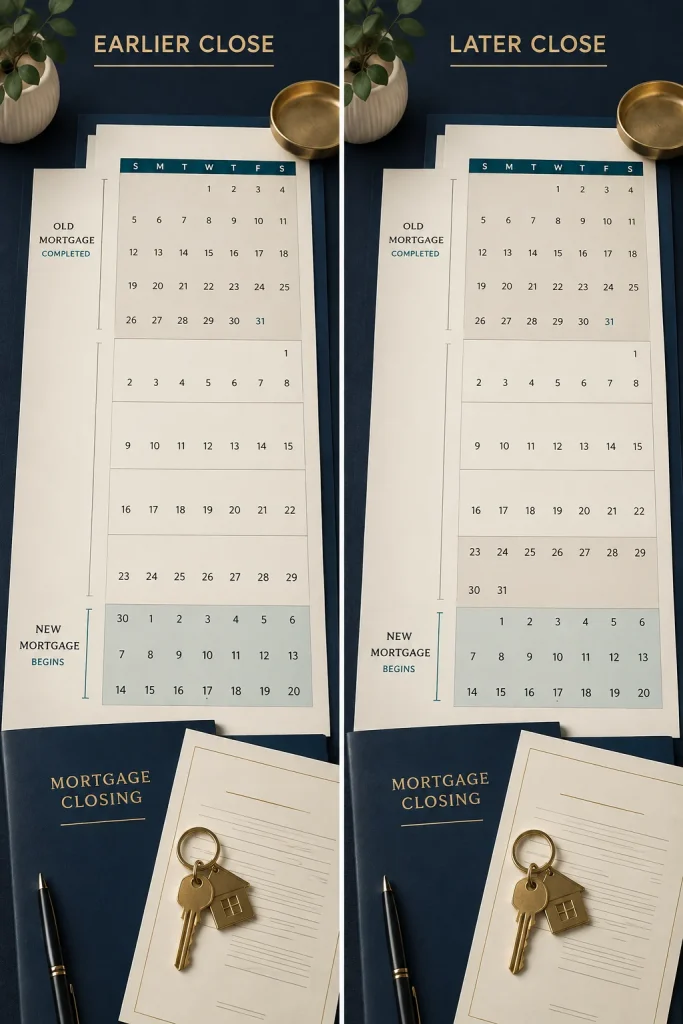
The day of the month on which the refinance closes can affect the amount of interest that must be handled before the first scheduled payment.
A closing early in the month can leave more days between closing and the end of that month. Depending on the loan’s structure, that can create more daily prepaid interest than a closing occurring much later in the month.
A late-month closing may involve fewer days of prepaid interest, although choosing a closing date solely to reduce one line item can be misleading because other parts of the transaction also matter.
The right question is not simply “Which closing date makes my prepaid interest lowest?”
The better question is “Which closing date works with the payoff, rate lock, transaction costs, cash flow and first-payment date of the complete refinance?”
Can You Skip Two Mortgage Payments When Refinancing?
This is where refinance marketing can become particularly confusing.
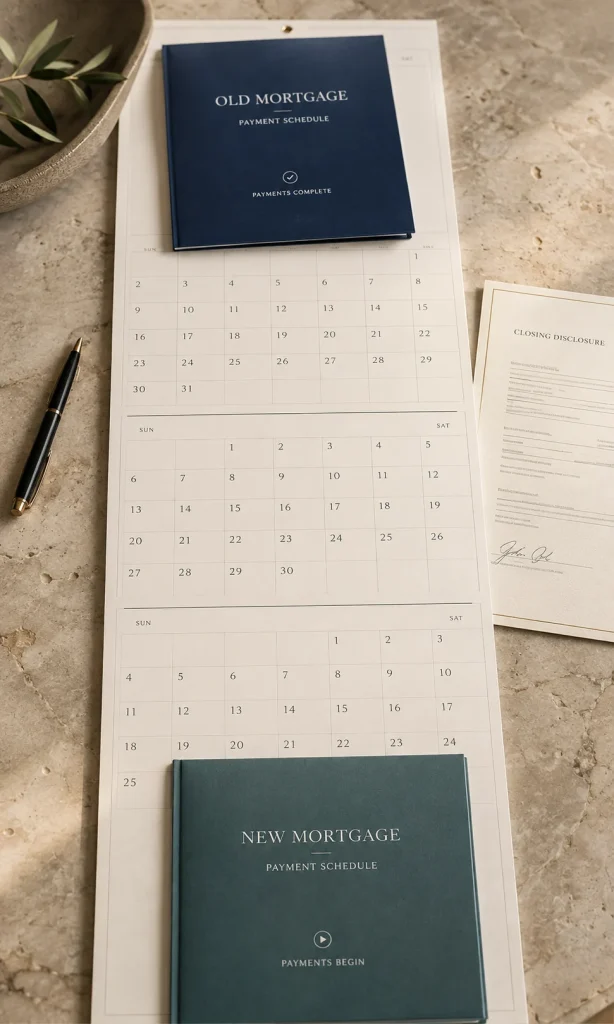
Borrowers sometimes hear claims about “skipping two payments” because of how the last old-loan payment, closing date and first new-loan payment appear on a calendar. Under certain timing arrangements, the period between the last regular payment sent to the old servicer and the first scheduled payment sent to the new servicer can look surprisingly long.
That does not mean two months of mortgage cost vanished.
The old lender still receives the amount needed to satisfy the mortgage through the refinance payoff. The new mortgage still accrues interest according to its terms, and applicable interest can be reflected through the closing and new payment schedule.
A lender may accurately describe the fact that you will not write two normal monthly checks during a particular calendar window, yet the phrase becomes misleading if it suggests that two months of principal and interest were simply forgiven.
For this reason, I would avoid making a refinance decision because a lender advertises “skip two mortgage payments.” Evaluate the refinance based on rate, APR, fees, closing costs, new loan term, break-even period and total expected cost instead.
Your Old Mortgage Payoff Is Not the Same as Your Last Statement Balance
Another source of confusion is the mortgage payoff amount.
The amount needed to completely satisfy an existing mortgage can differ from the principal balance shown on a recent statement because payoff calculations may account for interest through the payoff date and other transaction-specific amounts.
That payoff is normally coordinated during the refinance process.
The practical lesson is that borrowers should not try to estimate the entire transaction simply by taking the old principal balance and subtracting it from the new loan amount.
Review the actual refinance disclosures and payoff information instead.
This becomes especially important when you are calculating how much cash you need at closing or how much equity remains after a cash-out refinance.
What Happens If Your Mortgage Payment Is Due While the Refinance Is Closing?
Continue following the payment obligations on your existing mortgage unless your lender or servicer gives you clear transaction-specific instructions that say otherwise.
A refinance that is expected to close is not the same thing as a completed refinance.
Closings can be delayed because of underwriting, documentation, appraisal, title, funding or other issues. Missing a required mortgage payment because you assumed the refinance would finish first can create a problem that was entirely avoidable.
The safe approach is to confirm directly with the current servicer or refinance lender how a payment due near closing should be handled.
Do not simply stop paying because a loan officer told you casually that the old mortgage is “about to be paid off.”
What If You Accidentally Make the Old Mortgage Payment Anyway?
This can happen when a refinance closes near the same time that an automatic mortgage payment is scheduled.
The old servicer may receive funds while the payoff is also being processed, creating an overpayment or credit that eventually needs to be reconciled.
That does not mean the money disappears, but the timing of the refund or account adjustment can create short-term cash-flow inconvenience.
If your existing mortgage is paid automatically, review the payment timing before closing and ask the servicer how the upcoming draft should be handled.
Do not cancel an automatic payment blindly, because the refinance may be delayed.
The objective is coordination rather than trying to engineer the biggest possible gap between payments.
When Is the First Mortgage Payment Due After a Refinance?
Your first-payment date should appear in the mortgage documentation you receive as part of the new transaction.
The exact date depends on the closing and the new loan’s payment schedule, so borrowers should not assume that every refinance creates the same number of weeks before the first payment.
The CFPB advises borrowers to understand when their first mortgage payments are due after closing and how those payments will be made.
This sounds basic, but it is worth confirming before the refinance closes because the new servicer may also have different online-payment procedures, account numbers or automatic-payment setup.
A refinance changes more than the interest rate. It can change the company receiving the payment and the process used to send it.
Does Refinancing Reset Your Mortgage Payment Schedule?
Yes, in the sense that refinancing creates a new mortgage obligation with a new contractual payment schedule.
This is one reason a refinance can produce a lower monthly payment even when the rate reduction is modest. If a borrower has already spent several years paying an existing mortgage and then refinances the remaining balance into another long term, the principal can once again be distributed over many scheduled payments.
That can lower the payment without necessarily reducing the long-term borrowing cost.
A borrower should therefore separate payment timing, monthly payment size and total mortgage cost.
They answer different questions.
The temporary skipped-payment effect concerns timing.
A lower required monthly payment concerns cash flow.
Whether the refinance saves money concerns the complete economics of the new loan.
A Payment Gap Is Not a Refinance Benefit by Itself
Suppose two refinance offers are available.
Offer A gives you a closing date that creates an appealing month without a regular mortgage payment, but it carries higher fees and a weaker long-term rate.
Offer B requires a less exciting transition from the old payment to the new payment, but it has lower costs and saves substantially more over the period you expect to own the home.
Offer B can still be the better refinance even though Offer A creates more immediate cash in your checking account.
This is why payment-gap marketing should never outrank the core refinance comparison.
Use the ExpertsGuys refinance home loan comparison calculator to compare the broader financial consequences instead of judging the transaction by the month in which the first payment happens.
Should You Spend the Money From the “Skipped” Payment?
You can decide how to use the temporary cash-flow gap, but treating the entire amount as disposable income is rarely the strongest default.
Refinancing can involve closing costs, escrow changes, prepaid items and differences between expected and final cash-to-close amounts. Keeping additional liquidity until the refinance has completely settled can make the transition easier.
One practical use is rebuilding or strengthening the emergency fund.
Another is keeping the money reserved until the first new payment has been successfully processed and the old servicer confirms that its account has been closed correctly.
Borrowers carrying high-interest consumer debt may also be tempted to apply the cash there. That can be sensible in some circumstances, although it should be part of a larger repayment plan rather than based on the mistaken belief that the mortgage company gifted the household one month’s payment.
What Happens to Your Escrow Account When You Refinance?
Your existing mortgage may include an escrow account used to pay expenses such as property taxes and homeowners insurance.
When that mortgage is paid off, the old escrow account must be reconciled according to the servicing and transaction rules that apply. The new mortgage may also establish its own escrow account, requiring funds to be collected at closing.
This can create another confusing cash-flow effect.
A borrower may see money being collected for a new escrow account and later receive funds associated with the old escrow account. Looking at either transaction in isolation can make the refinance appear more expensive or more profitable than it really is.
Keep escrow movements separate from the question of whether the interest rate and loan terms improve your financial position.
Does Skipping a Payment Hurt Your Credit?
A genuine gap created by the normal transition from the paid-off mortgage to the scheduled first payment on the new mortgage is very different from simply refusing to make a mortgage payment that remains contractually due.
If no payment is due under the new loan’s schedule, there is nothing to “miss” merely because the calendar month contains no normal mortgage payment.
Problems arise when a borrower assumes the refinance is complete and stops paying the old mortgage before the obligation has actually been satisfied.
This is another reason to rely on closing documents and direct lender or servicer instructions rather than informal assumptions about the calendar.
Do You Need to Make the Final Payment on the Old Mortgage?
Whether another scheduled payment is required depends on the timing of your refinance and the existing mortgage’s payoff.
If the refinance closes before a particular scheduled payment becomes due and the old mortgage has been properly paid off, that payment may no longer be required in the ordinary way.
If the refinance has not completed, your existing obligation remains in place.
The difference can sometimes come down to a closing delay of only a few days, which is why it is unsafe to plan around an anticipated closing date as though it were guaranteed.
Confirm the status before changing normal payment behavior.
Could Your First New Payment Be Larger Than Expected?
The regular principal-and-interest payment should be disclosed as part of the new mortgage terms, but the household’s actual housing outflow may include other components such as property taxes, homeowners insurance and mortgage insurance where applicable.
Escrow adjustments can also affect the payment that eventually leaves the account.
This is another reason the temporary no-payment month should not dominate budgeting decisions.
Look at the projected payments in the Loan Estimate and final Closing Disclosure, then establish your post-refinance budget using the actual new obligation rather than the amount you were paying before.
Check Prepaid Interest on the Closing Disclosure
The Closing Disclosure gives you a much better explanation of the refinance economics than marketing phrases about skipped payments.
The CFPB’s explanation of mortgage prepaid interest says the applicable prepaid-interest charge appears on Page 2, Section F of the Closing Disclosure for transactions using that form.
Review that amount alongside the loan costs, initial escrow funding and cash required at closing.
If you do not understand why prepaid interest is being collected or how the first-payment date was determined, ask the lender before signing.
A good explanation should connect the dates and dollar amounts clearly enough that you can see how the transition works.
Could There Be a Prepayment Penalty on the Old Mortgage?
Most borrowers focus on the new loan and forget that the old mortgage can also contain terms relevant to refinancing.
Some mortgages can include a prepayment penalty under specified conditions. The CFPB’s guidance on mortgage prepayment penalties explains that whether a penalty can be charged depends on the mortgage type and the terms agreed to when the loan was originated.
If your current mortgage contains such a provision and the refinance occurs during the applicable period, the cost can affect whether refinancing makes financial sense.
This is much more important than whether the calendar creates one month without a normal mortgage draft.
What Should You Check Before Closing the Refinance?
Confirm the date of the last required payment on the existing mortgage with the appropriate lender or servicer.
Confirm the expected closing date, while understanding that expected and completed are not the same thing.
Check the old mortgage payoff, the prepaid interest on the new loan, the first-payment date and the amount of the first regular payment.
Review whether an old automatic mortgage draft needs to remain active until payoff is confirmed.
Then look at the entire transaction rather than the timing alone: interest rate, APR, closing costs, points, loan term, cash to close and the estimated break-even period.
If you are still deciding whether the refinance itself makes sense, the ExpertsGuys guide to when you should refinance your mortgage gives the payment-timing question the larger financial context it needs.
The Real Cost of “Skipping Two Payments”
A borrower might say, “My mortgage payment is $2,500, and the lender says I can skip two payments, so refinancing gives me $5,000.”
That interpretation is too simple.
The old mortgage payoff incorporates what is required to satisfy the existing loan. The new mortgage creates interest obligations according to its own terms, and applicable prepaid interest can be collected at closing.
The payment schedule can leave $5,000 temporarily sitting in the checking account because two ordinary drafts did not occur on their usual dates.
That is a cash-flow effect.
It is not automatically a $5,000 reduction in the lifetime cost of owning the home.
Keeping those two ideas separate is one of the easiest ways to avoid being overly influenced by refinance marketing.
Frequently Asked Questions About Skipping a Mortgage Payment When Refinancing
Do you skip a mortgage payment when you refinance?
You may have a calendar month in which no regular mortgage payment is due because the old mortgage has been paid off and the first scheduled payment on the new mortgage has not arrived yet. This does not normally mean that a month of mortgage interest disappeared. Interest and other amounts are handled through the old payoff, new loan terms, prepaid interest and first-payment schedule.
Can you skip two mortgage payments when refinancing?
The timing of a refinance can sometimes create a long enough gap that two normal monthly mortgage drafts do not occur when a borrower would usually expect them. That should not be interpreted as two months of free mortgage financing. Review the old payoff, prepaid interest and new payment schedule to understand where the costs are actually being handled.
When is the first mortgage payment due after refinancing?
The exact first-payment date depends on the refinance closing and the payment schedule of the new mortgage. Your loan documents and lender instructions should state the date directly. Do not assume every refinance gives the same amount of time before the first payment.
What is prepaid interest on a refinance?
Prepaid interest generally covers daily interest that accrues between the mortgage closing date and the period covered by the first scheduled mortgage payment. For covered mortgage transactions, the charge appears among the prepaid items on the Loan Estimate and Closing Disclosure.
Should I stop paying my old mortgage once I apply to refinance?
No. Applying for or expecting a refinance to close does not itself eliminate your existing payment obligations. Continue following the current mortgage requirements unless the responsible lender or servicer gives clear transaction-specific instructions. Closing delays can occur, so assuming the old mortgage is already paid off can create an avoidable late-payment problem.
Is the skipped refinance payment free money?
No. A month without a regular mortgage draft can improve short-term cash flow, but it should not be treated as a lender gift. The refinance replaces one loan with another, and interest continues to be accounted for through the applicable payoff, closing and payment structure.
Does a refinance payment gap hurt your credit?
A normal period in which no scheduled payment is contractually due is different from missing a required payment. Credit problems can arise if a borrower stops paying the existing mortgage before it has actually been satisfied or fails to make the first payment on the new mortgage when it becomes due.
Final Verdict
Yes, refinancing can create a period that looks like a skipped mortgage payment, and in some transaction timelines the space between the last ordinary payment on the old mortgage and the first scheduled payment on the new mortgage can be surprisingly long.
The mistake is treating that calendar gap as proof that the lender eliminated a month or two of mortgage cost. The old mortgage must be satisfied, the new mortgage begins accruing interest according to its terms, and applicable prepaid interest can be collected through the closing process. The payment has changed position in the transaction more than it has disappeared.
This does not make the cash-flow benefit meaningless. A month without the normal mortgage draft can leave a household with valuable temporary liquidity during a period when closing costs, moving expenses, home repairs or other financial obligations may also be present. The safest approach is simply to understand what created that liquidity before spending it.
Do not choose a refinance because somebody promises you can “skip a payment.” Choose it because the interest rate, APR, loan costs, term, payment, break-even period and expected total cost improve your financial position. Then treat any temporary gap between payments as a secondary cash-flow benefit rather than the reason for the transaction.
Before closing, confirm four dates: the last required payment on your old mortgage, the refinance closing date, the date through which prepaid interest is being handled, and the first scheduled payment on the new mortgage. Once those dates are clear, the mystery around the supposedly skipped mortgage payment largely disappears.