



Searching for the best employment agency near you can be overwhelming. A quick online search often produces dozens of staffing firms, recruitment agencies, temporary employment services, and executive search companies, all claiming to provide the best hiring solutions. However, choosing the right recruitment partner involves much more than selecting the first business with a high review score.
The most effective employment agencies understand your industry, local labour market, hiring challenges, and long-term career or workforce goals. A specialist recruiter can shorten hiring timelines, improve candidate quality, provide salary benchmarking, and connect employers with professionals who may never apply through traditional job advertisements. Likewise, job seekers benefit from recruiters who understand their experience, career ambitions, and the types of employers actively hiring in their region.
Whether you are an employer building a stronger workforce or a job seeker searching for your next opportunity, this guide explains how to evaluate local employment agencies, compare recruitment services, identify warning signs, and choose a recruitment partner that genuinely adds long-term value rather than simply filling vacancies.
Why Local Employment Agencies Still Matter
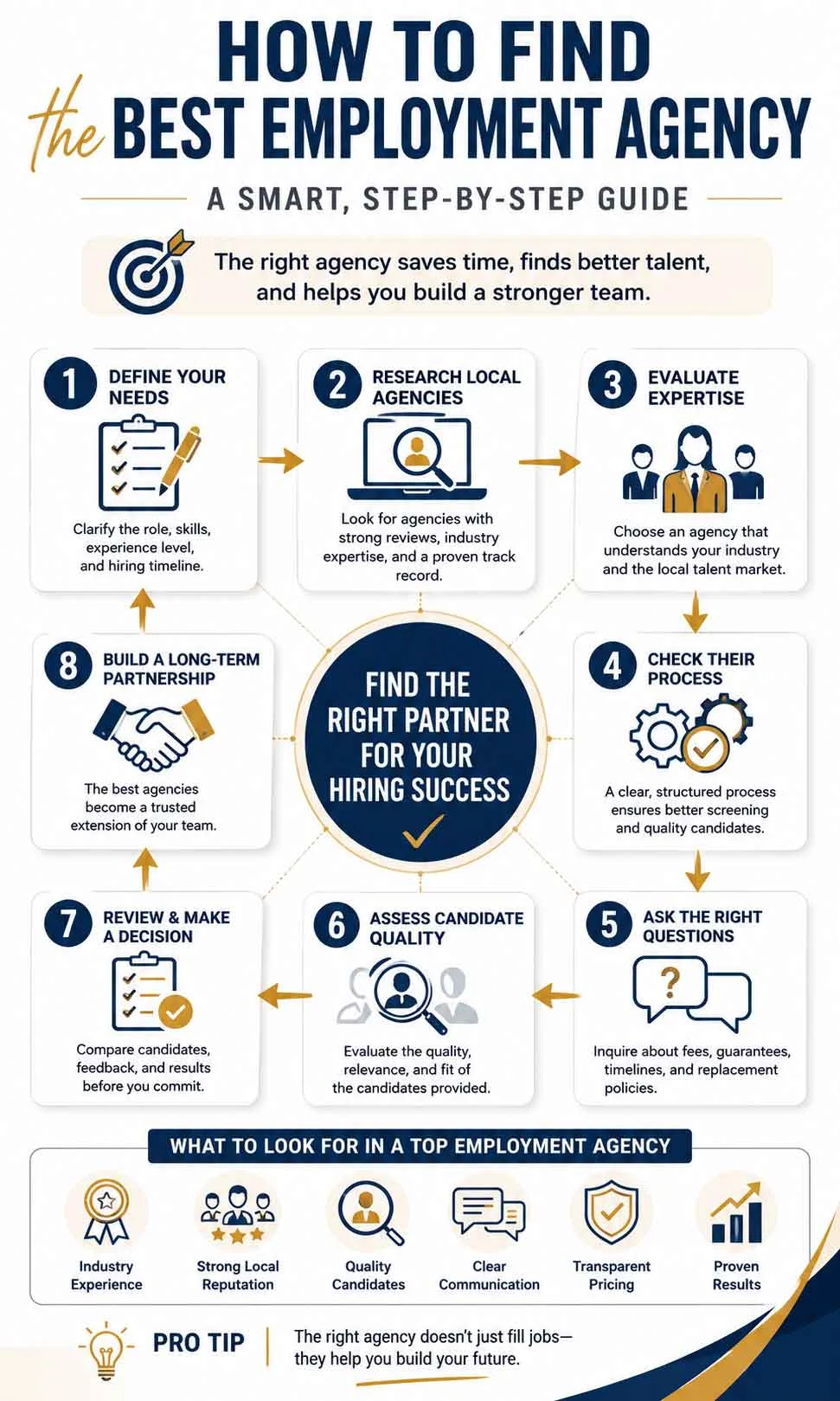
Many employers assume online recruitment platforms have replaced local employment agencies. While digital job boards and AI-powered hiring systems have transformed recruitment, local agencies continue to play a critical role because they combine technology with regional market knowledge and personal relationships.
A recruiter working in your local area understands which industries are expanding, which employers are actively hiring, salary expectations, seasonal workforce trends, commuting considerations, and the availability of qualified candidates. This local insight helps employers hire more efficiently while giving job seekers access to opportunities that may never be advertised publicly.
Before choosing a local recruiter, it helps to compare employment agencies by industry so you understand whether you need a general agency, specialist recruiter, temporary staffing firm, or executive search partner.
Local employment agencies also provide face-to-face support, interview preparation, salary guidance, and employer introductions that online platforms alone cannot easily replicate.
For businesses filling specialist positions or candidates seeking long-term career growth, local expertise often delivers better outcomes than relying solely on national job boards.
How Employment Agencies Work
Employment agencies act as intermediaries between employers seeking qualified staff and candidates searching for suitable employment. Although every recruitment firm has its own process, most agencies follow a structured workflow that improves hiring efficiency and reduces recruitment risk.
If you are still learning the difference between temp agencies, recruiters, and staffing firms, our guide to staffing agencies explains how these services work for employers and job seekers.
For employers, the process typically begins with a consultation to understand the role, required skills, salary range, and hiring timeline. Recruiters then source candidates through internal databases, referrals, professional networks, and public job advertisements before screening applicants, conducting interviews, verifying qualifications, and presenting a shortlist of suitable candidates.
ExpertsGuys Local Employment Agency Intelligence Engine
Find the Right Employment Agency Near You
Compare local recruiters, staffing agencies, agency types, hiring readiness, career readiness, nearby searches, and your personalised recruitment action plan.
For job seekers, the process usually starts with resume registration, career discussions, skills assessment, and matching opportunities based on qualifications, experience, and career objectives. Recruiters may also provide interview coaching, resume advice, salary guidance, and ongoing support throughout the hiring process.
Unlike automated recruitment platforms, employment agencies continue working after an interview is arranged. They coordinate communication, negotiate offers, assist with onboarding, and often maintain long-term relationships with both employers and candidates.
Why Choosing the Right Local Recruiter Makes a Difference

The quality of your recruitment partner influences far more than whether a vacancy is filled. A knowledgeable recruiter can reduce hiring costs, improve employee retention, shorten recruitment timelines, and strengthen employer reputation within the local labour market.
For job seekers, working with a recruiter who understands your profession can lead to more relevant opportunities, better interview preparation, realistic salary advice, and access to employers who recruit exclusively through trusted agencies.
Choosing the right agency is therefore an investment in long-term success rather than simply a short-term hiring decision.
Types of Local Employment Agencies

Not every employment agency operates in the same way. Some specialise in filling temporary vacancies within a few days, while others spend months identifying executive leaders or highly specialised professionals. Understanding these differences helps employers choose the right recruitment partner and allows job seekers to register with agencies that genuinely match their career goals.
Rather than asking which employment agency is “the best,” a better question is which type of agency best suits your hiring requirements or professional background.
Temporary Staffing Agencies
Temporary staffing agencies focus on short-term workforce solutions. Employers often use these agencies when facing seasonal demand, employee leave, special projects, or unexpected staffing shortages.
These agencies usually maintain an active database of workers who can begin assignments quickly, making them particularly valuable in hospitality, retail, logistics, manufacturing, healthcare support, and administrative roles.
Advantages include:
- Fast candidate availability
- Reduced recruitment administration
- Flexible workforce planning
- Lower disruption during peak periods
- Scalable hiring solutions
However, temporary staffing may not always be suitable for highly specialised or long-term leadership positions where cultural fit and long-term retention are equally important.
Permanent Recruitment Agencies
Permanent recruitment agencies specialise in helping organisations fill long-term positions where employee retention and organisational fit are priorities.
Unlike temporary staffing firms, permanent recruiters spend more time understanding company culture, technical requirements, leadership expectations, career progression opportunities, and long-term business objectives before recommending candidates.
These agencies often provide:
- Comprehensive candidate screening
- Behavioural interviews
- Reference verification
- Salary benchmarking
- Offer negotiation
- Replacement guarantees
Businesses recruiting managers, specialists, professionals, and technical employees frequently achieve better hiring outcomes by partnering with permanent recruitment agencies.
Executive Search Firms
Executive search firms, often called headhunters, focus on recruiting senior leadership positions such as Chief Executive Officers, Chief Financial Officers, Chief Technology Officers, Managing Directors, Vice Presidents, and other executive-level professionals.
Unlike traditional recruiters, executive search consultants actively approach passive candidates who are not necessarily seeking new employment opportunities.
Executive recruitment normally includes:
- Confidential market mapping
- Leadership assessment
- Executive networking
- Competitor research
- Succession planning
- Cultural leadership evaluation
Because these searches involve greater complexity and confidentiality, executive recruitment projects generally require longer timelines than standard hiring assignments.
Industry-Specialist Recruitment Agencies
Industry-specialist recruitment agencies concentrate on a single professional sector, allowing recruiters to develop deep market knowledge and highly targeted candidate networks.
Examples include:
- Healthcare recruitment
- Engineering recruitment
- Information technology recruitment
- Finance and accounting recruitment
- Construction recruitment
- Manufacturing recruitment
- Hospitality recruitment
- Logistics recruitment
- Legal recruitment
- Education recruitment
These agencies understand industry certifications, licensing requirements, salary expectations, compliance obligations, and technical skills, enabling them to recommend candidates more accurately than general recruiters.
For employers filling specialised positions, industry expertise often delivers significantly better hiring results than broad recruitment approaches.
Government Employment Services
Many countries provide government-supported employment services that connect employers with job seekers while offering career guidance, training opportunities, apprenticeships, and workforce development programmes.
Although these services may not provide the same level of specialist recruitment consulting as private agencies, they can be valuable for:
- Entry-level recruitment
- Graduate employment
- Workforce development
- Skills training
- Career transition
- Public employment programmes
Employers may also benefit from government hiring incentives and workforce support initiatives depending on local regulations.
Boutique Recruitment Agencies
Boutique recruitment agencies are smaller firms that intentionally limit the industries or professions they serve.
Instead of recruiting across every sector, they often specialise in areas such as:
- Cybersecurity
- Artificial Intelligence
- Renewable Energy
- Biotechnology
- Luxury Hospitality
- Digital Marketing
- Architecture
- Interior Design
Because consultants work within a narrow market, they frequently build stronger relationships with both employers and candidates, allowing them to identify highly qualified professionals who may never appear on public job boards.
Boutique agencies can be an excellent choice when hiring for niche or difficult-to-fill positions where specialist knowledge is more valuable than recruitment volume.
National Recruitment Networks
Large recruitment companies operate through multiple offices across different cities or countries while maintaining centralised recruitment systems, candidate databases, and employer relationships.
These organisations typically offer:
- Nationwide recruitment
- Multi-location hiring
- Workforce planning
- Temporary staffing
- Permanent recruitment
- Executive search
- Recruitment Process Outsourcing (RPO)
National agencies are particularly useful for organisations expanding into multiple regions or hiring at scale because they can coordinate recruitment across several locations using consistent processes and reporting standards.
Hybrid Recruitment Agencies
Hybrid recruitment agencies combine traditional recruiter expertise with modern hiring technology, allowing employers and job seekers to benefit from both personal consulting and digital recruitment tools.
Services often include:
- AI-assisted candidate matching
- Applicant Tracking Systems (ATS)
- Video interviewing
- Skills assessments
- Digital onboarding
- Recruitment analytics
- Workforce reporting
- Talent pipeline management
Rather than replacing recruiters, these technologies allow consultants to spend more time building relationships, advising employers, and supporting candidates throughout the recruitment process.
As recruitment technology continues to evolve, hybrid agencies are becoming increasingly common because they combine operational efficiency with personalised service, giving employers faster hiring decisions while maintaining the human expertise needed for successful long-term placements.
How to Choose the Best Employment Agency Near You

Choosing an employment agency should involve more than comparing online ratings or selecting the first recruiter that appears in search results. While positive reviews are useful, they rarely reveal how well an agency understands your industry, communicates throughout the recruitment process, or supports employers and candidates after a placement has been made.
The best recruitment agencies combine local market knowledge, professional networks, structured hiring processes, and long-term relationship building. Whether you are recruiting employees or searching for your next career opportunity, evaluating these factors will help you make a more informed decision.
Look for Industry Experience
An agency with experience in your industry is more likely to understand the qualifications, certifications, salary expectations, and technical skills required for successful placements.
For example, healthcare recruiters understand licensing requirements, engineering recruiters recognise technical competencies, while finance recruiters know the importance of professional certifications and regulatory compliance. Industry knowledge allows recruiters to screen candidates more accurately and provide employers with stronger recommendations. Healthcare employers and candidates can also review our detailed guide to choosing a healthcare staffing agency for credential checks, clinical hiring, and workforce planning. Technical employers can compare recruitment methods in our guide to choosing an engineering staffing agency for specialist roles and project-based hiring.
Ask agencies about recent placements, the industries they specialise in, and how long they have been recruiting within your sector before deciding to work together.
Evaluate Their Recruitment Process
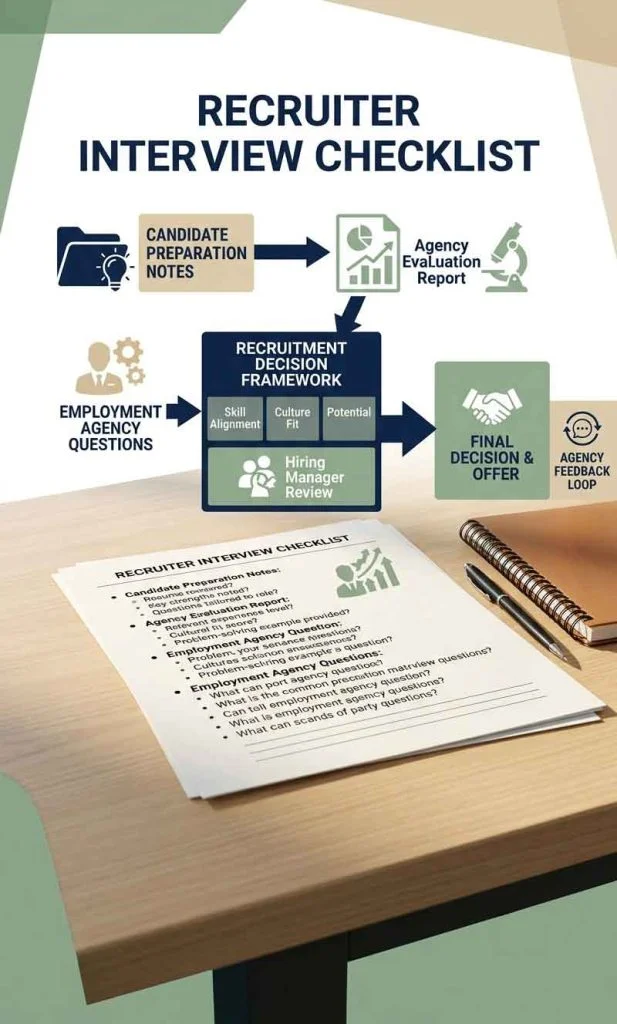
A professional employment agency should be able to explain exactly how candidates are sourced, screened, interviewed, and recommended.
Key questions include:
- How are candidates identified?
- What screening methods are used?
- Are technical assessments performed?
- How are references verified?
- What replacement guarantees are offered?
- How frequently will progress updates be provided?
Transparent recruitment processes usually indicate higher-quality service and better hiring outcomes.
Check Local Market Knowledge
Local recruiters often understand hiring conditions better than agencies operating remotely.
They can provide valuable information such as:
- Current hiring demand
- Candidate availability
- Local salary expectations
- Industry growth
- Seasonal recruitment trends
- Skills shortages
- Regional employment competition
This knowledge helps employers make realistic hiring decisions while allowing job seekers to better understand opportunities within their local employment market.
Compare Communication Quality
Communication often determines whether a recruitment project succeeds or fails.
Professional recruiters should:
- Respond promptly.
- Provide regular progress updates.
- Explain recruitment timelines clearly.
- Offer honest feedback.
- Discuss challenges openly.
- Set realistic expectations.
Agencies that communicate consistently usually build stronger relationships and achieve better placement outcomes than recruiters who only make contact when they have news to share.
Review Candidate Screening Standards
Effective recruitment begins long before an interview takes place.
Ask agencies how they evaluate candidates before making recommendations.
Professional screening may include:
- Resume evaluation
- Skills assessment
- Behavioural interviews
- Technical interviews
- Reference checks
- Qualification verification
- Background screening where appropriate
- Employment history validation
Strong screening reduces hiring risk and improves long-term employee retention.
Understand Their Fee Structure
Recruitment fees vary depending on the type of service provided, the seniority of the position, and the complexity of the search.
Before signing any agreement, employers should understand:
- Placement fees
- Temporary staffing rates
- Replacement guarantees
- Refund policies
- Additional service charges
- Payroll administration costs
- Contract staffing arrangements
Transparent pricing reduces misunderstandings and allows businesses to compare agencies fairly.
Consider Their Employer Network
A well-connected recruitment agency typically works with employers across multiple industries and maintains long-term business relationships.
For job seekers, this often means access to vacancies that are not advertised publicly.
For employers, an established network can shorten recruitment timelines because recruiters already understand hiring managers, company cultures, and previous recruitment projects.
An agency with strong employer relationships is usually positioned to provide better opportunities than one relying solely on public job advertisements.
Assess Long-Term Partnership Potential
The best employment agencies think beyond filling a single vacancy.
Many become long-term recruitment partners by supporting workforce planning, salary benchmarking, succession planning, talent mapping, onboarding, and future hiring strategies.
Likewise, recruiters who build ongoing relationships with job seekers can provide career advice, alert candidates to future opportunities, and offer guidance as industries evolve.
Choosing an agency with a long-term partnership mindset often produces greater value than selecting the lowest-cost recruiter.
Expert Tip
The strongest recruitment partnerships are built on transparency, communication, and industry expertise rather than promises of the fastest placement. Employers should focus on finding recruiters who understand their business objectives, while job seekers should choose consultants who genuinely invest in their long-term career development. In many cases, a recruiter who asks detailed questions before making recommendations will achieve better outcomes than one who simply forwards resumes or job listings.
Questions to Ask Before Registering With an Employment Agency

Registering with an employment agency is more than submitting a resume or filling out an online application. The recruiter you choose may influence your career opportunities, salary negotiations, interview preparation, and long-term professional development. Likewise, employers should evaluate recruitment agencies carefully before trusting them with important hiring projects.
Asking thoughtful questions early helps both employers and job seekers determine whether an agency has the expertise, industry knowledge, and communication style needed to build a successful working relationship.
Questions Employers Should Ask
What industries do you specialise in?
Not every recruitment agency understands every profession. An agency with proven experience in your industry is more likely to recognise technical skills, professional certifications, salary expectations, and the qualities that contribute to successful long-term placements.
Ask recruiters about recent placements within your sector and whether they have dedicated consultants who focus exclusively on your industry.
How do you source candidates?
Strong recruitment agencies rarely depend on public job advertisements alone.
Many successful recruiters combine multiple sourcing strategies, including:
- Existing candidate databases
- Professional networking
- Employee referrals
- Passive candidate outreach
- Industry communities
- University partnerships
- Executive networking
- Skills-based talent searches
Understanding where candidates come from provides valuable insight into the agency’s ability to deliver high-quality talent.
What screening process do you follow?
Candidate screening directly affects hiring quality.
Professional agencies should clearly explain how they assess applicants before presenting them to employers.
Ask whether screening includes:
- Resume review
- Technical assessment
- Behavioural interviews
- Qualification verification
- Reference checks
- Background screening where appropriate
- Skills testing
- Salary expectation discussions
The more structured the screening process, the greater the likelihood of successful placements.
What happens if the placement is unsuccessful?
Recruitment occasionally involves unexpected challenges.
Ask whether the agency offers:
- Replacement guarantees
- Refund policies
- Additional candidate searches
- Ongoing placement support
- Post-placement follow-up
Understanding these policies helps employers reduce recruitment risk before signing an agreement.
How will we communicate during the recruitment process?
Regular communication allows employers to make faster decisions while reducing misunderstandings.
Clarify:
- Update frequency
- Main contact person
- Interview scheduling
- Candidate feedback process
- Hiring timeline
- Market updates
- Salary benchmarking reports
Clear communication usually results in smoother recruitment projects and stronger employer-agency relationships.
Questions Job Seekers Should Ask
What types of employers do you work with?
Recruiters often specialise in particular industries, company sizes, or employment types.
Understanding their employer network helps candidates decide whether the agency aligns with their career goals.
Ask whether they recruit for:
- Permanent roles
- Temporary positions
- Contract work
- Graduate programmes
- Executive careers
- International opportunities
The wider and more relevant the employer network, the greater the number of potential career opportunities.
How can I improve my chances of being placed?
Professional recruiters frequently provide valuable career advice beyond introducing job opportunities.
Before registering with recruiters, update your professional CV so employment agencies can quickly understand your skills, achievements, and career direction.
Recruiters can only recommend suitable opportunities when they clearly understand your career background, technical skills, achievements, and long-term career goals.
Ask for guidance regarding:
- Resume improvements
- Portfolio presentation
- Professional certifications
- Interview preparation
- Salary expectations
- Personal branding
- Skills development
Candidates who actively seek feedback often become stronger applicants for future opportunities.
How often should I stay in contact?
Many candidates register once and never communicate with recruiters again.
Instead, ask how frequently you should provide updates regarding:
- New certifications
- Career achievements
- Salary expectations
- Availability
- Location preferences
- Career goals
Keeping recruiters informed allows them to recommend opportunities that better match your changing circumstances.
Will you provide interview feedback?
Candidates can also practise common interview preparation questions before meeting employers introduced by recruitment agencies.
Constructive interview feedback helps candidates improve regardless of whether they receive an offer.
Good recruiters often explain:
- Employer impressions
- Technical strengths
- Areas requiring improvement
- Communication skills
- Cultural fit observations
- Suggested next steps
Even unsuccessful interviews can become valuable learning experiences when recruiters provide meaningful feedback.
What industries are hiring most actively?
Recruitment agencies monitor local labour markets every day.
Their insights can help candidates understand:
- Growing industries
- Skills shortages
- Salary trends
- Emerging job roles
- Hiring forecasts
- Regional employment demand
These insights allow job seekers to make better long-term career decisions rather than focusing only on immediate vacancies.
Professional Recommendation
Whether you are an employer or a job seeker, treat your first meeting with an employment agency as a two-way interview. A reputable recruiter should be willing to answer detailed questions about their experience, recruitment process, communication practices, and industry expertise. Agencies that provide clear, transparent answers are generally better positioned to build long-term relationships and deliver successful hiring outcomes than those relying on vague promises or generic sales presentations.
Red Flags to Watch When Choosing an Employment Agency
Not every employment agency delivers the same level of professionalism, transparency, or recruitment expertise. While many agencies build long-term partnerships based on trust and successful placements, others may focus primarily on filling vacancies as quickly as possible without fully understanding the needs of employers or candidates.
Recognising warning signs before committing to an agency can save employers significant hiring costs and help job seekers avoid frustrating recruitment experiences. Evaluating an agency’s behaviour, communication, and recruitment practices often reveals more than online reviews alone.
Unrealistic Hiring Promises
Be cautious if an agency guarantees immediate placements or claims it can fill every position regardless of market conditions.
Professional recruiters understand that recruitment depends on factors such as candidate availability, salary competitiveness, industry demand, technical requirements, and employer decision-making. Responsible consultants will provide realistic timelines instead of making promises they cannot control.
Agencies that guarantee perfect results without first understanding your hiring requirements or career background should be approached carefully.
Limited Industry Knowledge
An experienced recruiter should demonstrate genuine understanding of your profession rather than relying on generic recruitment terminology.
For employers, recruiters should be able to discuss:
- Technical skills
- Industry certifications
- Current hiring trends
- Salary benchmarks
- Candidate shortages
- Competitor hiring activity
For job seekers, recruiters should understand career progression, required qualifications, and the employers typically hiring within your industry.
If conversations remain superficial or recruiters struggle to explain industry-specific requirements, they may not have sufficient expertise for specialised recruitment.
Poor Communication
Communication problems often become more serious as recruitment progresses.
Common warning signs include:
- Slow responses
- Missed appointments
- Unclear hiring updates
- Inconsistent information
- Lack of interview feedback
- Difficulty reaching consultants
Professional recruiters maintain regular communication even when there is little progress to report. Consistent updates demonstrate respect for both employers and candidates while helping everyone make informed decisions.
No Clear Screening Process
Every reputable recruitment agency should explain how candidates are evaluated before being recommended.
If recruiters cannot describe their screening process or simply forward resumes without meaningful assessment, employers may spend unnecessary time interviewing unsuitable applicants.
A structured recruitment process should normally include:
- Resume review
- Skills assessment
- Qualification verification
- Interview screening
- Reference checks
- Salary discussion
- Availability confirmation
The more transparent the screening process, the greater confidence employers can have in candidate quality.
Hidden Fees or Unclear Pricing
Employers should fully understand recruitment fees before engaging any agency.
Warning signs include:
- Vague pricing
- Undisclosed administration fees
- Unclear replacement policies
- Confusing temporary staffing charges
- Unexpected contract costs
Professional agencies explain their pricing structure clearly and provide written agreements outlining services, guarantees, payment schedules, and responsibilities.
Job seekers should also be cautious if agencies request suspicious upfront payments for finding employment where local regulations prohibit such practices.
High Staff Turnover Within the Agency
Recruitment is a relationship-driven profession.
If consultants frequently leave an agency, employers and candidates may repeatedly need to explain their requirements to new recruiters.
Stable recruitment teams generally provide:
- Better market knowledge
- Stronger employer relationships
- Consistent communication
- Improved candidate experience
- Greater long-term support
Asking how long consultants have worked with the agency can provide useful insight into organisational stability.
Weak Online Reputation
Online reviews should never be the only factor influencing your decision, but they can reveal recurring patterns.
Look for feedback regarding:
- Communication quality
- Professionalism
- Recruitment speed
- Candidate experience
- Employer satisfaction
- Transparency
- Long-term placement success
Instead of focusing on individual ratings, identify consistent themes across multiple review platforms.
Lack of Post-Placement Support
The recruitment process should not end when a candidate accepts an offer.
Many leading employment agencies continue supporting both employers and candidates during onboarding to ensure the placement is successful.
Good post-placement support may include:
- Follow-up meetings
- Candidate check-ins
- Employer feedback
- Performance discussions
- Replacement assistance if required
Agencies that disappear immediately after placement may be prioritising transaction volume rather than long-term client relationships.
Professional Perspective
One of the strongest indicators of a trustworthy employment agency is the quality of the questions they ask. Experienced recruiters invest time understanding company culture, technical requirements, career aspirations, workplace expectations, and long-term goals before recommending any opportunity or candidate. Agencies that begin by learning about your needs rather than immediately selling their services are often the ones most capable of delivering lasting recruitment success.
Local vs National Employment Agencies: Which Is Better?
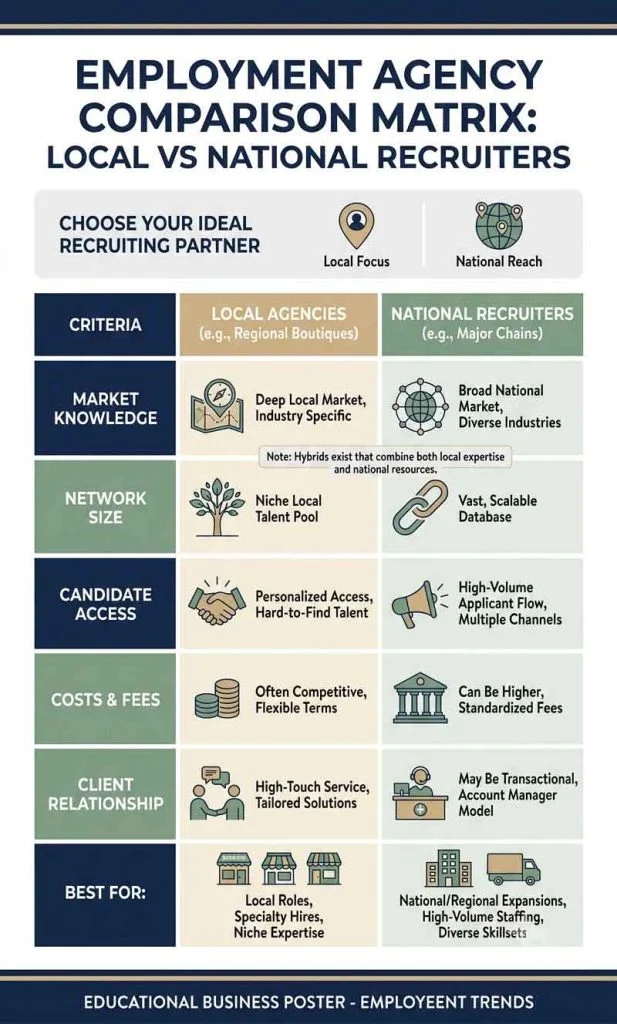
Choosing between a local employment agency and a national recruitment firm depends on your hiring objectives, industry, geographic reach, and the level of personalised support you expect. Neither option is universally better. Instead, each offers distinct advantages that suit different recruitment scenarios.
Local agencies often excel at understanding regional labour markets and building close relationships with employers and candidates. National recruitment firms, on the other hand, typically provide broader talent networks, larger databases, and the ability to coordinate hiring across multiple locations.
Understanding these differences helps employers invest in the right recruitment partner while enabling job seekers to choose agencies that match their career ambitions.
When Local Employment Agencies Are the Better Choice
Local employment agencies develop strong relationships within a specific city, region, or community. Their consultants usually have first-hand knowledge of local employers, salary expectations, commuting patterns, and workforce availability.
For employers, this means recruiters can often recommend candidates who already understand the local business environment and are more likely to remain in the role long term.
For job seekers, local agencies frequently provide personalised career advice, interview coaching, and introductions to businesses that may never advertise publicly.
Local agencies are particularly valuable when recruiting for:
- Small and medium-sized businesses
- Regional offices
- Community organisations
- Family-owned companies
- Local government projects
- Immediate hiring requirements
Because consultants regularly meet employers and candidates in person, communication tends to feel more personalised throughout the recruitment process.
When National Recruitment Agencies Offer Greater Value
National recruitment firms operate across multiple cities, regions, or even countries. Their larger recruiter networks allow them to support organisations hiring across several locations while providing access to wider candidate pools.
Businesses expanding into new markets often benefit from national recruitment partners because they can maintain consistent recruitment standards regardless of office location.
National agencies are commonly used for:
- Multi-site recruitment
- Corporate expansion
- High-volume hiring
- Executive recruitment
- International workforce planning
- Recruitment Process Outsourcing (RPO)
These firms also invest heavily in recruitment technology, candidate databases, and workforce analytics, allowing employers to manage large recruitment campaigns efficiently.
Personalised Service vs Recruitment Scale
One of the biggest differences between local and national agencies is the balance between personalised service and operational scale.
Local recruiters often manage fewer clients, allowing them to spend more time understanding business culture, team dynamics, and long-term hiring objectives.
National firms typically manage larger recruitment portfolios but compensate with broader resources, specialist recruitment teams, advanced Applicant Tracking Systems (ATS), salary intelligence, and market research.
The better option depends on whether personalised consultation or large-scale recruitment capability is your highest priority.
Industry Expertise Matters More Than Agency Size
Many employers assume larger recruitment companies automatically deliver better candidates. In reality, industry expertise usually has a greater influence on recruitment success than organisational size.
A specialist local recruiter with years of experience in healthcare, engineering, finance, or technology may outperform a large general recruitment company that lacks deep industry knowledge.
Instead of focusing only on company size, evaluate recruiters based on:
- Industry specialisation
- Candidate quality
- Recruitment methodology
- Communication standards
- Employer relationships
- Placement success
- Long-term retention rates
These factors often predict recruitment outcomes more accurately than agency size alone.
Which Option Is Better for Job Seekers?
Job seekers should also consider their career objectives before choosing an agency.
A local recruiter may provide:
- Individual career coaching
- Resume feedback
- Local employer introductions
- Faster interview scheduling
- Strong community connections
A national recruiter may provide:
- Larger employer networks
- Relocation opportunities
- International careers
- Executive recruitment
- Specialist industry consultants
- Access to confidential vacancies
When comparing opportunities, candidates should also consider the balance between job security and career advancement instead of focusing only on salary or location.
Many experienced professionals register with both local and national agencies to maximise career opportunities while benefiting from different recruiter strengths.
Professional Recommendation
The strongest recruitment strategy is not choosing between local or national agencies—it is selecting recruiters with proven expertise in your industry and maintaining long-term relationships with them. Employers should evaluate recruitment quality, communication, and industry knowledge rather than company size alone. Likewise, job seekers should work with recruiters who understand their professional goals and continue providing career guidance even after a successful placement.
Online Job Platforms vs Employment Agencies
Online job platforms have transformed the recruitment industry by making vacancies accessible within seconds. Candidates can apply for hundreds of jobs without leaving home, while employers can advertise vacancies to thousands of potential applicants with a single listing.
Despite these advantages, employment agencies continue to play an important role because recruitment is rarely just about advertising a vacancy. Successful hiring often depends on understanding people, evaluating skills, assessing cultural fit, negotiating offers, and building long-term relationships. This is where experienced recruiters provide value beyond what automated job platforms can achieve.
For many employers and job seekers, the best results come from combining both approaches rather than choosing one over the other.
Advantages of Online Job Platforms
Job boards provide fast access to large numbers of vacancies and candidates.
Common advantages include:
- Immediate job searching
- Thousands of available vacancies
- Easy online applications
- Search filters
- Mobile accessibility
- Salary comparisons
- Employer reviews
- Career resources
Employers also benefit from broad candidate exposure and the ability to manage applications digitally.
However, receiving hundreds of applications does not necessarily mean receiving better candidates. Large applicant volumes often increase screening time and make it more difficult to identify professionals who genuinely match the role.
Advantages of Employment Agencies
Employment agencies provide services that extend far beyond publishing job advertisements.
Professional recruiters often:
- Identify passive candidates
- Conduct interviews
- Verify qualifications
- Check references
- Assess technical skills
- Provide salary guidance
- Coordinate interviews
- Negotiate employment offers
- Support onboarding
Because recruiters actively evaluate both employers and candidates, they often produce stronger long-term hiring outcomes than automated matching systems alone.
Many specialist agencies also maintain confidential talent networks that are unavailable through public job boards.
Candidate Quality vs Candidate Quantity
One of the biggest differences between online platforms and employment agencies is the balance between quantity and quality.
Online recruitment platforms often generate a large number of applications, but employers may spend significant time filtering unsuitable candidates.
Recruitment agencies usually present fewer applicants, but those candidates have already been screened against the employer’s requirements.
For technical, regulated, or leadership positions, quality typically delivers greater long-term value than application volume.
Personal Support Throughout the Recruitment Process
Online platforms generally place responsibility on employers and candidates to manage every stage of recruitment independently.
Employment agencies, however, provide ongoing guidance throughout the hiring journey.
Employers receive assistance with:
- Workforce planning
- Candidate shortlisting
- Salary benchmarking
- Recruitment strategy
- Interview coordination
- Offer negotiation
Job seekers often benefit from:
- Resume advice
- Career coaching
- Interview preparation
- Salary guidance
- Employer insights
- Post-interview feedback
This personalised support often improves both hiring confidence and candidate experience.
Recruitment Technology Is Changing Both Models
Modern employment agencies increasingly use technologies that were once available only through digital recruitment platforms.
Many agencies now integrate:
- Applicant Tracking Systems (ATS)
- AI-assisted candidate matching
- Skills assessments
- Video interviewing
- Recruitment analytics
- Talent relationship management
- Workforce reporting
- Automated interview scheduling
Rather than replacing recruiters, these technologies improve efficiency while allowing consultants to focus on relationship building, strategic advice, and complex hiring decisions.
Which Option Should Employers Choose?
For high-volume entry-level recruitment, online platforms may provide sufficient candidate exposure.
However, employers hiring professionals, managers, technical specialists, or executive leaders often achieve stronger results by combining online advertising with specialist recruitment agencies.
A blended recruitment strategy provides:
- Wider candidate reach
- Better screening quality
- Faster hiring decisions
- Improved candidate experience
- Higher long-term retention
This approach reduces recruitment risk while giving employers access to both active and passive talent markets.
Which Option Is Better for Job Seekers?
Candidates searching for employment should avoid relying on a single method.
Successful professionals often combine:
- Online job platforms
- Employment agencies
- Professional networking
- Industry associations
- Referrals
- Career events
Using multiple channels increases visibility while providing access to opportunities that may never be advertised publicly.
Recruiters also help candidates understand current hiring trends, employer expectations, and salary conditions, making them valuable long-term career partners rather than simply job brokers.
Professional Perspective
Technology has changed how recruitment begins, but it has not changed what makes hiring successful. Employers still need trusted advice, careful candidate evaluation, and strong communication, while job seekers continue to benefit from career guidance and professional advocacy. The most effective recruitment strategy combines the efficiency of digital hiring platforms with the expertise, relationships, and judgement that experienced employment agencies provide.
Future of Employment Agencies and Local Recruitment

Employment agencies are evolving rapidly as artificial intelligence, automation, workforce analytics, and changing employee expectations reshape the recruitment industry. While technology continues to improve hiring efficiency, successful recruitment remains fundamentally dependent on human judgement, industry expertise, and trusted professional relationships.
The agencies that will lead the future are not those replacing recruiters with technology, but those using technology to help recruiters make better hiring decisions, communicate more effectively, and deliver greater value to employers and job seekers.
Artificial Intelligence Will Support, Not Replace, Recruiters
Artificial intelligence is already helping recruiters manage repetitive administrative tasks such as resume screening, interview scheduling, skills matching, and candidate communication.
Modern recruitment agencies increasingly use AI to:
- Analyse resumes more efficiently
- Match candidates with suitable vacancies
- Predict hiring timelines
- Identify transferable skills
- Reduce administrative workload
- Improve recruitment reporting
- Build talent pipelines
However, AI cannot accurately evaluate cultural fit, leadership potential, communication style, career ambition, or workplace compatibility without human interpretation.
Experienced recruiters continue to provide the professional judgement needed for successful long-term hiring decisions.
Skills-Based Hiring Is Becoming More Important
Many employers are placing greater emphasis on practical skills and demonstrated ability rather than relying solely on academic qualifications.
Employment agencies are responding by expanding candidate assessments to include:
- Technical evaluations
- Portfolio reviews
- Skills demonstrations
- Industry certifications
- Practical problem-solving exercises
- Behavioural assessments
- Communication capability
- Adaptability and learning potential
This shift allows employers to discover talented professionals who may have been overlooked using traditional recruitment methods.
Workforce Analytics Improve Recruitment Decisions
Leading employment agencies increasingly use workforce data to advise employers beyond simply filling vacancies.
Recruitment analytics can provide insight into:
- Time-to-hire
- Candidate availability
- Salary competitiveness
- Employee retention
- Recruitment channel performance
- Skills shortages
- Workforce planning
- Future hiring demand
Instead of reacting to vacancies as they arise, businesses can use these insights to build stronger long-term workforce strategies.
Remote and Hybrid Recruitment Continue to Expand
The growth of remote and hybrid work has significantly expanded candidate pools for many organisations.
Local employment agencies now regularly recruit professionals for employers located in different cities, regions, or even countries while still providing valuable local market knowledge.
Recruiters increasingly help employers evaluate:
- Remote work readiness
- Digital collaboration skills
- Time zone compatibility
- Home office requirements
- Cross-border employment considerations
- Flexible workforce planning
This combination of local expertise and broader talent access creates new opportunities for both employers and job seekers.
Candidate Experience Is Becoming a Competitive Advantage
Highly skilled professionals often receive multiple employment opportunities simultaneously.
As a result, recruitment agencies are placing greater emphasis on creating positive candidate experiences throughout the hiring journey.
This includes:
- Faster communication
- Transparent recruitment timelines
- Constructive interview feedback
- Career coaching
- Salary guidance
- Professional development advice
- Ongoing relationship management
Employers working with agencies that prioritise candidate experience often improve offer acceptance rates and strengthen their employer brand.
Employment Agencies Are Becoming Workforce Consultants
Recruitment agencies are increasingly expanding beyond traditional hiring services.
Many now advise employers on:
- Workforce planning
- Salary benchmarking
- Talent mapping
- Succession planning
- Employer branding
- Skills forecasting
- Diversity recruitment
- Recruitment technology implementation
Rather than acting solely as recruiters, these agencies become strategic workforce partners that support long-term business growth.
Human Relationships Remain the Greatest Competitive Advantage
Despite advances in automation and AI, recruitment continues to involve trust, communication, and professional judgement.
Candidates want recruiters who understand their career aspirations.
Employers want consultants who understand business objectives, organisational culture, leadership expectations, and long-term workforce planning.
Technology improves efficiency, but meaningful professional relationships continue to determine recruitment success.
Professional Perspective
The future of employment agencies is not a choice between technology and people. It is the integration of both. Agencies that successfully combine artificial intelligence, workforce analytics, local market expertise, and experienced recruitment consultants will deliver the strongest outcomes for employers and job seekers. Businesses should therefore choose recruitment partners based not only on their technology but also on the quality of their advice, industry knowledge, and commitment to building long-term professional relationships.

Summary
Finding the best employment agency near you involves much more than selecting the highest-rated recruiter or the largest recruitment company. Successful hiring depends on choosing consultants who understand your industry, communicate transparently, apply structured screening processes, and invest in long-term relationships.
For employers, the right agency can reduce recruitment costs, improve employee retention, strengthen workforce planning, and provide access to skilled professionals who may never apply through traditional job advertisements.
For job seekers, experienced recruiters offer career guidance, interview preparation, salary advice, and introductions to employers that match long-term career ambitions rather than simply filling immediate vacancies.
As recruitment continues to evolve through artificial intelligence, workforce analytics, and digital hiring technology, agencies that combine innovation with genuine human expertise will continue delivering the greatest value.
Whether you are hiring your next employee or planning your next career move, investing time in selecting the right employment agency is one of the most important decisions you can make for long-term professional success.
Frequently Asked Questions
How do I find the best employment agency near me?
Start by identifying the type of role you need to fill or the type of job you are seeking. Compare agencies based on industry expertise, recruiter experience, communication quality, candidate screening process, employer reviews, replacement policies, and local market knowledge rather than choosing solely based on online ratings.
Should I choose a local employment agency or a national recruitment company?
Local employment agencies often provide stronger regional market knowledge and personalised service, while national recruitment firms usually offer larger candidate databases, broader employer networks, and multi-location hiring capabilities. The better option depends on your hiring objectives and industry.
Do employment agencies charge job seekers?
In many countries, employers pay recruitment fees rather than job seekers. However, regulations differ by location, so candidates should always verify local employment laws and avoid agencies requesting suspicious upfront payments for job placement where such practices are prohibited.
What should employers look for when choosing a recruitment agency?
Employers should evaluate industry experience, recruiter expertise, candidate screening methods, communication standards, placement success, replacement guarantees, pricing transparency, employer references, and long-term workforce planning capabilities before selecting a recruitment partner.
Can employment agencies help with temporary and permanent jobs?
Yes. Many employment agencies recruit for temporary, contract, permanent, seasonal, and executive positions. Some agencies specialise in one employment type, while others provide multiple recruitment services depending on employer requirements.
How can job seekers improve their chances with employment agencies?
Job seekers should maintain an updated resume, prepare references, obtain relevant certifications, communicate career goals clearly, respond promptly to recruiter requests, and stay in regular contact as their skills and availability change.
How long does recruitment usually take through an employment agency?
Recruitment timelines vary depending on the industry, role complexity, candidate availability, salary competitiveness, and employer decision speed. Temporary positions may be filled within days, while specialist or executive recruitment can take several weeks or months.
What are the warning signs of a poor employment agency?
Warning signs include poor communication, unrealistic promises, unclear pricing, weak industry knowledge, limited candidate screening, inconsistent recruiter contact, lack of transparency, and no clear replacement or follow-up process.
Can employment agencies help people changing careers?
Yes. Many recruiters assist career changers by identifying transferable skills, recommending additional certifications, improving resumes, preparing candidates for interviews, and introducing opportunities that match long-term career objectives rather than previous job titles alone.
Will artificial intelligence replace employment agencies?
Artificial intelligence is improving resume screening, candidate matching, scheduling, and recruitment analytics, but experienced recruiters continue to provide professional judgement, relationship building, salary negotiation, cultural assessment, and career guidance that technology alone cannot fully replace.