
Mechanical engineering recruiting firms connect engineers with employers that need particular technical capabilities. Actalent, Kelly Engineering, Randstad USA, PEAK Technical and Hays US are five firms worth investigating, but the useful choice depends on the work you want to do, the employment arrangement and the recruiting team handling that opening. Start with your strongest engineering deliverable, then use the comparison below to decide which conversations to pursue.
Which five mechanical engineering recruiting firms should you investigate?
These five providers have official service pages that explicitly include mechanical engineering or closely identified mechanical work. They are a starting shortlist for U.S. opportunities, rather than a ranking of placement success, service quality or current vacancies. A company’s published coverage establishes that a conversation is relevant; it does not establish that its recruiter has a suitable opening for you today.
The strongest first contact is usually the team advertising a role that matches your actual work. For example, a product engineer who owns drawing release should investigate a product-development opening before a broadly advertised “mechanical” position dominated by facilities maintenance. A familiar agency name cannot resolve that mismatch, and a less familiar recruiter should not be rejected if the opportunity and representation process are clear.
Use this shortlist in three passes:
- Identify the service page that overlaps with your discipline and target location.
- Ask for the specific recruiting team, employment model and role scope before discussing submission.
- Continue when the team can explain the work and your evidence fits it; pause when essential details remain unclear.
| Firm | Coverage and next question |
|---|---|
| Actalent | Mechanical, manufacturing and electrical engineering staffing. Ask: Which local team handles your product, plant or project specialty? |
| Kelly Engineering | Mechanical engineering within advanced manufacturing; contract staffing, direct hire and project delivery. Ask: Are you discussing an individual placement or a managed engineering deliverable? |
| Randstad USA | Mechanical and related design roles across several engineering sectors. Ask: Which sector and client requirement does the specific opening belong to? |
| PEAK Technical | Mechanical engineers, CAD-related designers, contract, contract-to-hire and direct placement. Ask: Does the opening require engineering ownership, design production or technical support? |
| Hays US | Mechanical design, building services, HVAC, commissioning and engineering leadership coverage. Ask: Is the recruiting desk aligned with your mechanical application and seniority? |
Actalent: investigate the mechanical and manufacturing recruiting team
Actalent’s engineering staffing page identifies manufacturing, mechanical and electrical work among its specializations. It also describes locally based specialized recruiting. That makes the relevant market team worth investigating for a mechanical search; it is not evidence that every office handles every mechanical niche equally well.
Ask the team to distinguish the assignment’s engineering output from its software requirement. “Creo experience” might mean producing models under someone else’s direction, releasing a complete assembly or resolving manufacturing changes. Those are different responsibilities. The useful answer names the output and the person who reviews it, so you can compare the opening with work you have actually performed.
Kelly Engineering: clarify whether you are joining a team or buying delivery
Kelly Engineering’s service overview includes mechanical engineering in advanced manufacturing and distinguishes contract staffing, direct hire, project delivery and program delivery. For an employer, that distinction changes the purchasing question: do you need an engineer working within your team, or a provider accountable for an agreed body of work?
For a candidate, clarify who sets priorities and who provides technical supervision. Working on a provider-managed project can differ from being assigned to a client manager, even when the advertised engineering skills look similar. Ask about the actual reporting arrangement and deliverables rather than assuming that the recruiter’s brand identifies your day-to-day employer or project structure.
Randstad USA: use the sector to narrow a broad mechanical title
Randstad USA’s engineering and design page lists mechanical engineering alongside roles in sectors including aerospace, manufacturing, medical devices and energy-related projects. Its breadth makes the sector attached to an opening especially useful. A title shared across those environments does not mean the underlying responsibilities transfer without explanation.
Ask which part of your experience the client considers essential. A recruiter should be able to clarify whether the requirement concerns the product environment, production method, analytical work or release responsibility. If the answer remains only a list of software names, request the deliverable before spending time on a lengthy screening conversation. The missing information may be in the client brief rather than in your resume.
PEAK Technical: distinguish engineering ownership from design support
PEAK Technical’s engineering staffing services identify mechanical engineers, designers and technical support roles, with contract, contract-to-hire and direct-placement options. That combination is useful when the uncertain boundary is the level of technical ownership expected, rather than simply the preferred CAD package.
An engineer responsible for a design decision and a designer producing detailed drawings can contribute to the same project without holding the same responsibility. Ask whether you would define the solution, develop an approved concept or maintain released documentation. Neither role is automatically better. The important issue is whether its authority, learning opportunity and compensation match the position you intend to accept.
Hays US: investigate the application and seniority together
Hays US’s engineering practice includes mechanical design, building services, HVAC, commissioning and engineering leadership roles. Its service page provides a reason to investigate those applications, particularly when a generic mechanical title hides building-system responsibilities or a broader technical-management remit.
Clarify what a senior title means in that opening. A lead engineer might coordinate a discipline, approve technical work or manage people; those responsibilities need separate explanation. A candidate moving from product development should not assume that seniority alone substitutes for building-services experience. Ask which decisions the person owns and which application knowledge must already be present.
If market scale is part of an employer’s procurement decision, the separate guide to large U.S. engineering staffing firms explains that comparison. This page focuses on translating mechanical work into evidence that helps a specific recruiting conversation progress.
How do you match a recruiter to your kind of mechanical engineering?
Match the deliverable first, the engineering environment second and the software third. This order helps distinguish experience that directly supports a role from experience that merely shares its terminology. It also gives recruiters a clearer basis for deciding whether to introduce you to the hiring team or redirect you to a more suitable opening.
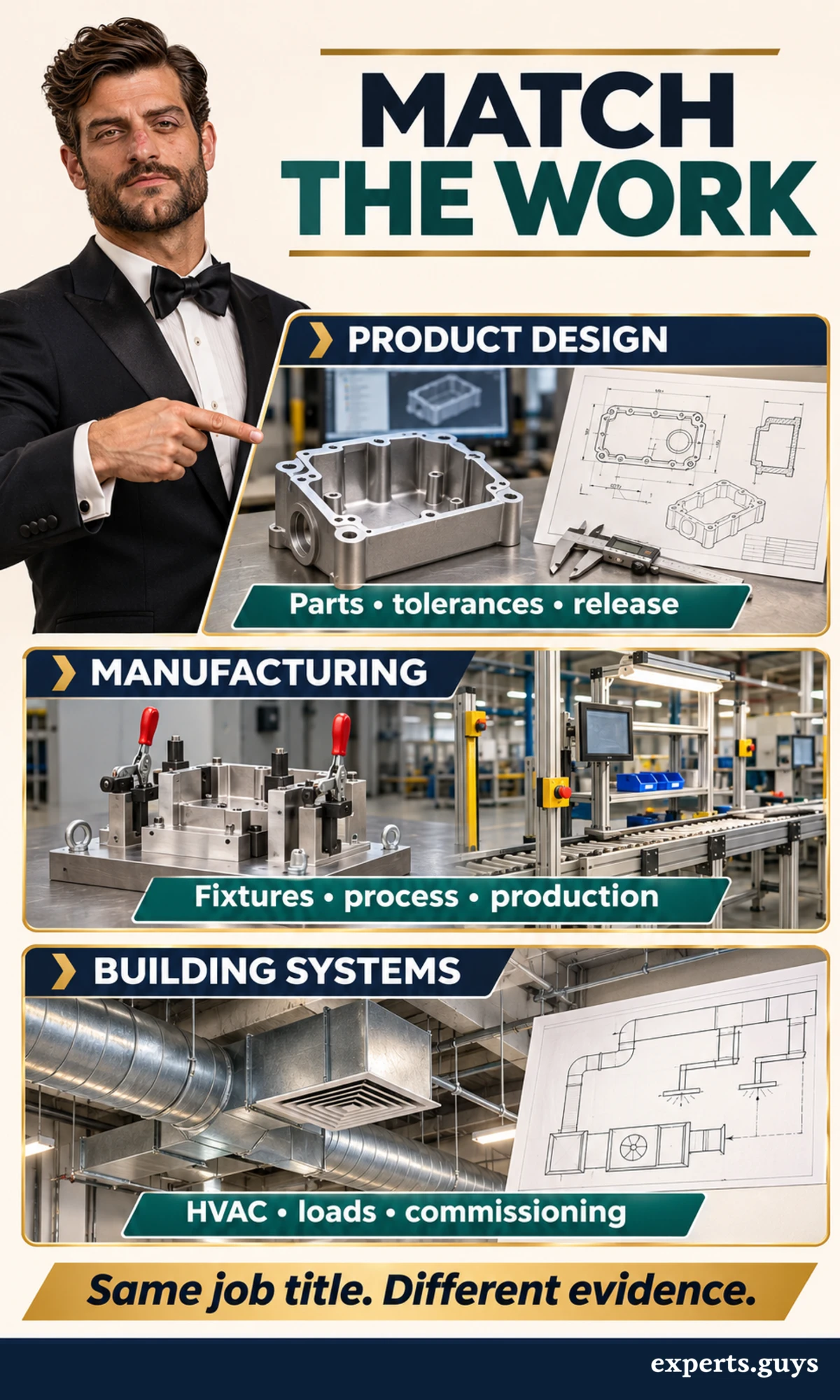
A job title is a compressed description. “Mechanical engineer” can refer to product development, factory support, thermal analysis, rotating equipment or building services. Even within product development, a person who primarily models concepts may need a different opportunity from someone who controls released drawings and production changes. The recruiter needs enough context to distinguish those contributions without turning the first call into a complete technical interview.
Translate one engineering task into an accurate scope statement
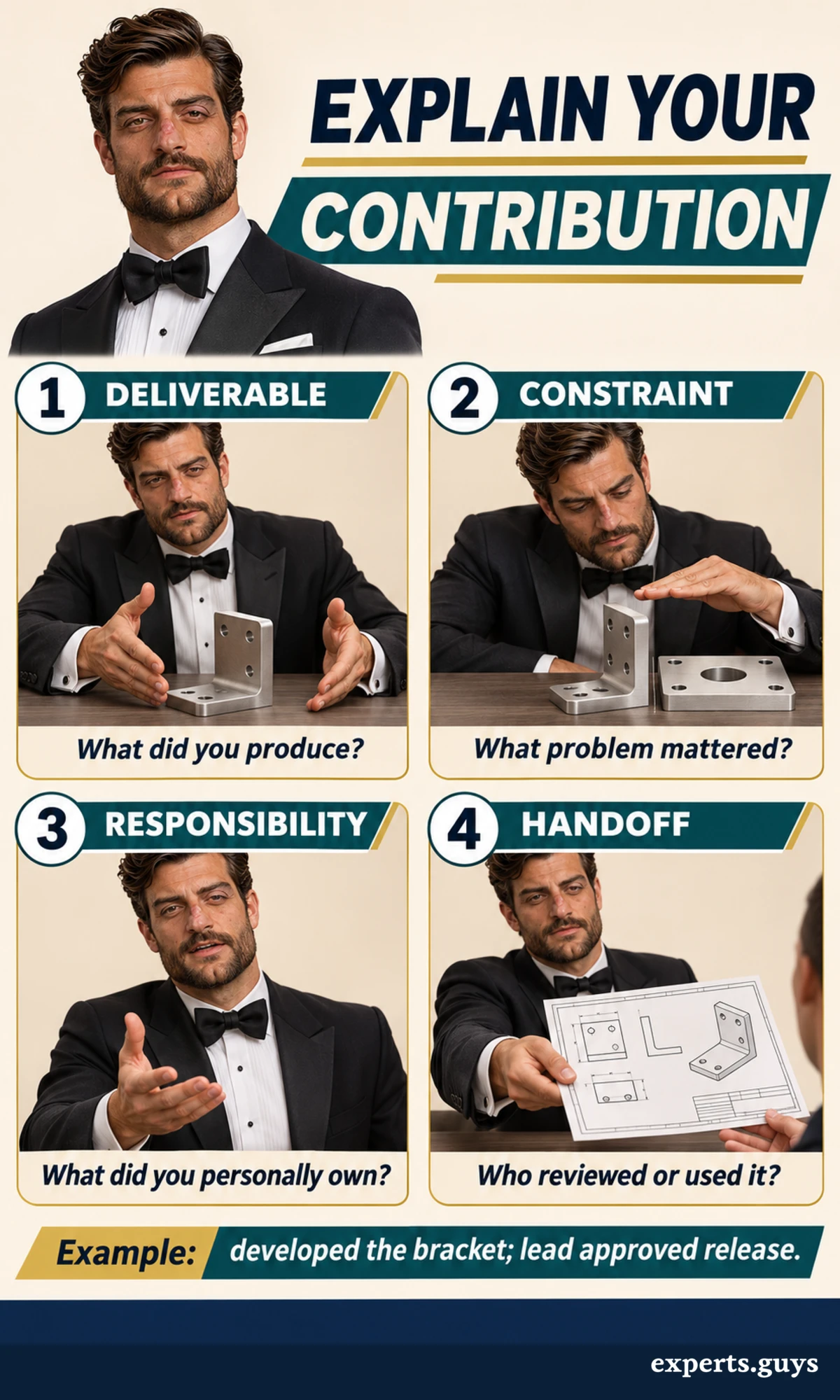
Use a completed task you can discuss without disclosing confidential information. State what you produced, the constraint you addressed and your own responsibility. Then explain the handoff: who used the output, reviewed it or decided whether it could proceed. This is a verbal clarification method; you do not need a worksheet, diary or lengthy personal inventory.
An illustrative product-design statement is: “I developed a machined mounting bracket, assessed assembly access and prepared the drawing package for review; the lead engineer approved release.” That tells the recruiter what you did and what you did not authorize. Compare it with “I know SolidWorks,” which names a software package while leaving the engineering contribution unresolved.
Give the recruiter the task in this order:
- Deliverable: identify the part, assembly, analysis, fixture or system output.
- Constraint: name the relevant fit, load, thermal, production or installation concern.
- Responsibility: explain whether you supported, developed, checked or approved the work.
- Handoff: identify who reviewed or used it, and the target role you want next.
The common mistake is inflating a team result into personal ownership. If you supported a tolerance review but did not decide the final tolerances, say so. Precision is more persuasive than a larger claim that unravels when the hiring manager asks a follow-up question. Equally, do not reduce substantive engineering work to a software task when you can explain the decision you contributed to.
For an early-career engineer, a degree project, supervised placement or personal project can serve the same purpose if its context is stated honestly. Describe the actual deliverable and level of supervision rather than borrowing the language of commercial release authority. Completion means the recruiter can restate your contribution accurately and identify the type of opening it could support; an immediate interview is not required for the method to be useful.
There is also a difference between a task you performed once with close support and a responsibility you can carry independently. Both belong in a truthful conversation, but they support different expectations. A recruiter who understands that distinction can investigate a role with appropriate supervision instead of presenting you for immediate independent ownership. Tell them what you want to develop next as well as what you can already deliver.
Separate a transferable skill from an application-specific requirement
Some experience transfers because the underlying reasoning is similar, while other requirements depend heavily on the engineering environment. A candidate who has investigated assembly interference can explain the method used to identify and resolve a fit problem. That does not automatically demonstrate competence in an unfamiliar safety-critical product, manufacturing process or approval system.
Ask the recruiter to identify what the hiring manager is willing to teach. If the client can train a software transition but requires prior ownership of production drawings, a different CAD background may be manageable. If the client needs someone immediately competent in a particular application, emphasizing general adaptability does not resolve the missing experience. The right response is to establish the actual boundary, not to guess what the client will waive.
| Experience described | Evidence and boundary |
|---|---|
| Product design | Part function, interfaces, drawing contribution and release handoff. Boundary: Concept modeling versus responsibility for production documentation. |
| Manufacturing support | Fixture or process change, production constraint and validation handoff. Boundary: Designing the product versus supporting its manufacture. |
| Analysis | Question studied, assumptions, model boundary and engineering interpretation. Boundary: Operating software versus checking whether the model answers the right question. |
| Building systems | System scope, design or commissioning contribution and project interfaces. Boundary: General mechanical knowledge versus application-specific building work. |
If your resume’s structure hides these contributions, the guide to choosing a suitable CV format covers that separate presentation decision. In the recruiter conversation, concentrate on the engineering output rather than redesigning the entire document before learning what the role requires.
How can you tell whether a recruiter understands your engineering evidence?
Use one representative task and listen to the follow-up. A useful recruiting conversation connects your task to the client’s deliverable, distinguishes your responsibility from the team’s and identifies questions that need a technical interviewer. A recruiter does not need to solve the engineering problem personally, but should not turn an unresolved technical question into a claim that you are qualified.
This is a calibration conversation, not a surprise examination. Tell the recruiter which distinction matters and ask how the client evaluates it. Their response can show whether the role has been scoped clearly, whether another team member needs to join and whether the client’s interview process will actually examine the capability you are offering.
Use a bracket example to test the quality of the follow-up
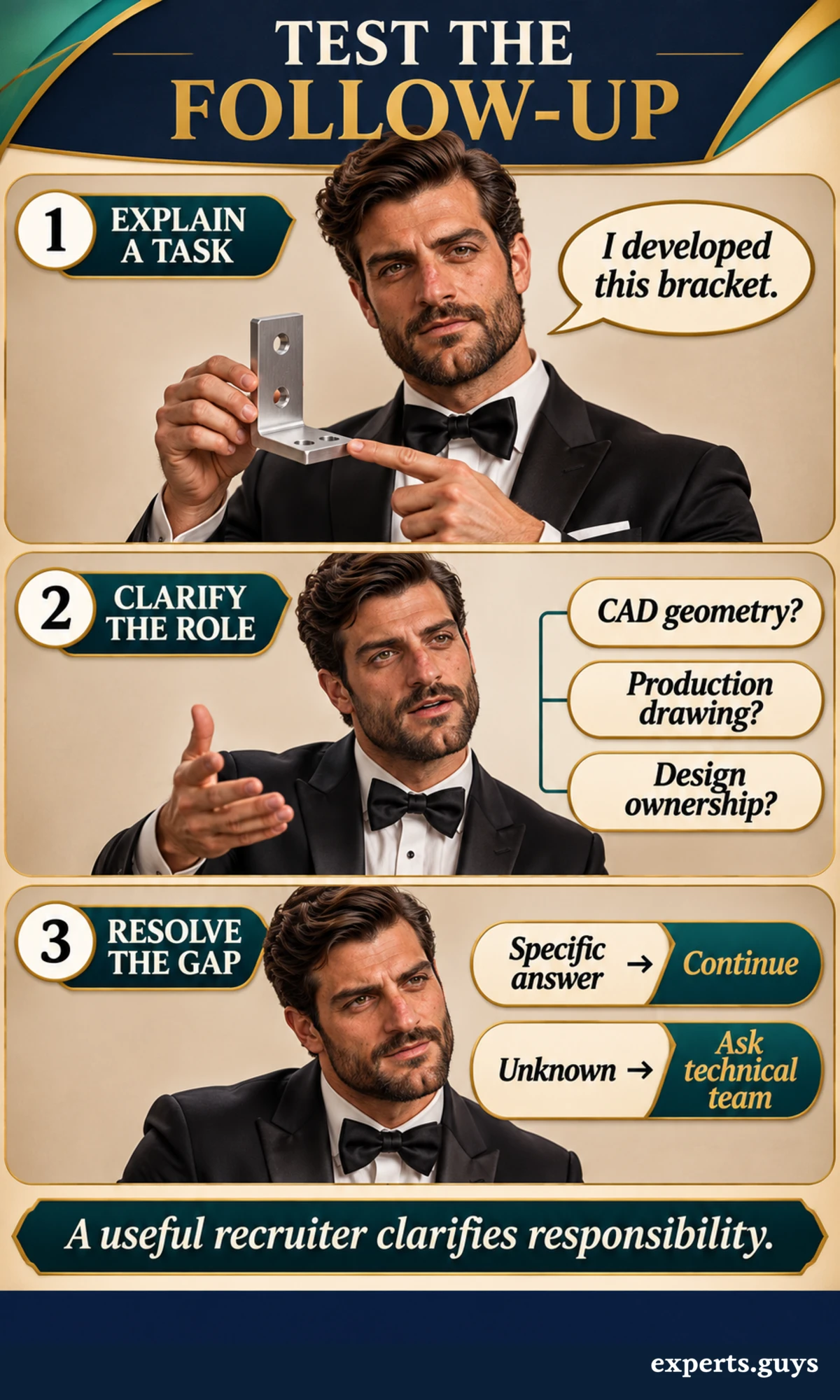
For the illustrative bracket task, explain the function and one constraint without sharing a client drawing. Then ask: “For this opening, does the hiring manager need someone to create the CAD geometry, prepare the production drawing or own the design decision?” That question separates three possible responsibilities without expecting the recruiter to perform a calculation.
A useful follow-up might ask about manufacturing method, mating interfaces or who checked your work. An incomplete response might simply ask how many years you have used the software, even after you have explained that release responsibility is the important distinction. Software experience can still matter; it just cannot answer every question about engineering ownership.
Run the clarification in a short conversation:
- Explain one representative task and identify your own contribution.
- Ask which deliverable and responsibility the client needs from the new hire.
- Listen for a specific follow-up, a clear answer or an honest escalation to the technical team.
- Agree whether to continue, obtain missing scope information or investigate another role.
If you are changing sectors, use an example that exposes the transfer question. “I developed fixtures for repeatable assembly; does this role require fixture development or product design?” gives the recruiter something concrete to resolve. “Can you get me any mechanical job?” invites a much broader search and makes later disappointment harder to diagnose.
When the recruiter does not know, ask who can clarify the requirement. A prompt admission of uncertainty followed by a useful technical conversation is more valuable than confident guessing. If the uncertainty remains unresolved, pause that opening while continuing other relevant applications. The observable result is a clearer understanding of fit, rather than a score assigned to the recruiter.
Demonstrate reasoning without handing over protected work
Choose an example you are permitted to discuss. If an employer’s drawings, dimensions, customer details or test results are confidential, do not send them to demonstrate enthusiasm. Instead, explain the engineering sequence verbally or use a genuinely independent, generic example that does not reproduce protected information. Ask what the hiring team actually needs to evaluate before providing any work sample.
For example, you can describe investigating a component that did not fit its mating assembly: establish the intended interface, compare the relevant geometry, determine where the discrepancy arose and explain how the proposed correction was reviewed. Those steps communicate reasoning. They do not require a proprietary CAD file, and they should not be presented as evidence of a result that you cannot substantiate.
Use a safe demonstration route:
- Check that the example and any material are yours to share; use a verbal explanation when permission is uncertain.
- Show only a generic or authorized representation of the problem.
- Explain the decision sequence and separate your contribution from approval by others.
- Stop before confidential dimensions, customer identities or restricted files enter the conversation.

A common mistake is assuming that removing a customer name makes an entire drawing safe to distribute. The geometry, dimensions or process details may themselves be sensitive. A safer adaptation is to describe the engineering question without sending the document. If the employer needs a formal portfolio assessment, establish an authorized process with the relevant parties rather than improvising disclosure during a recruiter call.
For hiring teams, the same method improves the request. Ask the candidate to explain an engineering decision and its limits, rather than demanding files from previous employment. A hypothetical exercise should be clearly identified as such, with an appropriate scope. The recruiter’s role is to coordinate the process and communicate expectations; the technical team must still judge the engineering substance.
A strong explanation also separates calculation from evidence. If you used an analysis model, describe its assumptions and how the result informed a decision; do not imply that a colorful result plot independently proved the design. If you supported a physical trial, distinguish observing it, analyzing its results and authorizing the next step. These distinctions help a recruiter represent your experience accurately without requiring disclosure of the underlying technical files.
Interpret rejection at the correct level
An unsuccessful introduction can reflect several different mismatches. The work may require another application, the level of ownership may be higher, the location may be impractical or the employment arrangement may not suit you. These explanations lead to different next actions. Rewriting the entire resume is an expensive response when the actual obstacle is a fully on-site role you cannot accept.
Ask which requirement prevented progress, where feedback is available. A specific answer such as “the client needs prior responsibility for production release” gives you a boundary to address in future applications. A vague answer gives little evidence about your underlying engineering ability. Do not invent a reason or treat silence as a technical assessment that never occurred.
The broader engineering staffing agency guide explains recruitment stages and the parties involved. Here, the practical distinction is between a recruiter clarifying fit and a hiring team evaluating competence: one can help you reach the other, but they are different decisions.
What should you clarify before accepting representation or an offer?
Clarify the employment arrangement, the economic assumptions and the exact opening before agreeing to proceed. A mechanical role can be technically attractive while offering an arrangement that does not meet your needs. Resolve these questions while you still have time to compare alternatives, rather than treating them as administrative details after an interview has been arranged.
Identify who employs you and who directs the work
For a direct-hire placement, establish which organization would employ you from the start. For a contract assignment, ask which organization issues the employment agreement and payroll, which client receives the work and who handles technical supervision. For contract-to-hire, ask what conversion would require and what happens if it does not occur. Do not treat a possible future conversion as an accepted permanent offer.
The label alone is insufficient because it compresses several relationships. Your recruiter, employer, project manager and technical reviewer may be different people or organizations. Request the practical arrangement in plain language. If someone says “you will work for the client,” ask whether that describes the work location, daily supervision or employment relationship.

For employers, identify whether the provider is supplying personnel or agreeing to deliver an engineering outcome. A project-delivery proposal needs clarity about scope, acceptance and technical responsibility; an individual staffing arrangement needs clarity about the person’s role in your existing team. Those are purchasing distinctions, and neither should be inferred solely from the job title.
An accessible first question is: “Who signs my employment agreement, and who decides whether my engineering work is acceptable?” If the answer is incomplete, request the appropriate contact before making a commitment. This does not require you to interpret every contractual provision yourself. It establishes which relationship and document you need to understand.
Compare pay using stated hours, rather than a headline rate
An hourly amount and an annual salary are not directly comparable until the paid-time assumptions are explicit. For an illustrative calculation only, an hourly offer of $60 with 1,880 paid hours produces $112,800 in gross pay. Multiplying the same rate by 2,080 hours instead produces $124,800, a $12,000 difference created entirely by the assumed hours.
Neither figure is a market estimate, a guarantee of hours or a complete comparison of compensation. An illustrative annual salary of $120,000 also needs its own terms understood, including the relevant benefits and paid time. Compare like with like: do not add a paid-leave benefit to one side while ignoring that your hourly-hours assumption already includes it on the other.
Compare the offer in a useful order:
- Confirm the rate or salary and which hours or periods are actually paid.
- Calculate gross pay from the stated assumptions; keep uncertain overtime or extensions separate.
- Compare benefits, worker contributions and work-related costs only where the terms are known.
- Check the assignment duration and what changes if the work ends earlier than expected.

The common mistake is multiplying every hourly offer by a full year of paid work without checking leave, gaps between assignments or guaranteed hours. The correction is to ask for the actual arrangement and use a scenario that reflects it. If the hours are unknown, keep several clearly labeled scenarios rather than presenting one annual number as fact. This is arithmetic for comparison, not a conclusion about taxes, employment classification or legal entitlement.
For a simpler first pass, compare two offers over the same stated period and separate known cash pay from unresolved benefits. That is often more useful than trying to force a single “total value” number from incomplete information. Completion means you can identify which assumptions change the comparison and which questions still need answers.
Keep submission permission tied to an identifiable opening
Before authorizing a recruiter to submit your profile, establish enough detail to identify the opportunity and compare it with applications already in progress. The client name where available, requisition identifier, location, title and employment model are useful identifiers. A recruiter may not disclose every detail immediately, but you can pause submission until there is enough information to make an informed choice.
If another recruiter approaches you about a similar role, compare the identifying details in the existing correspondence before agreeing to a second submission. Similar titles do not prove that two openings are identical, and different agency reference numbers do not prove they are different. Ask the recruiters to clarify the uncertainty rather than guessing from a shortened advert.
Use a role-specific permission sequence:
- Identify the opening and compare it with existing applications or recruiter correspondence.
- Clarify the scope of any representation request before agreeing to its wording.
- If it is a duplicate or still unclear, ask the second recruiter to hold submission while the details are resolved.
- Authorize only the intended action once the opportunity and scope are understood.
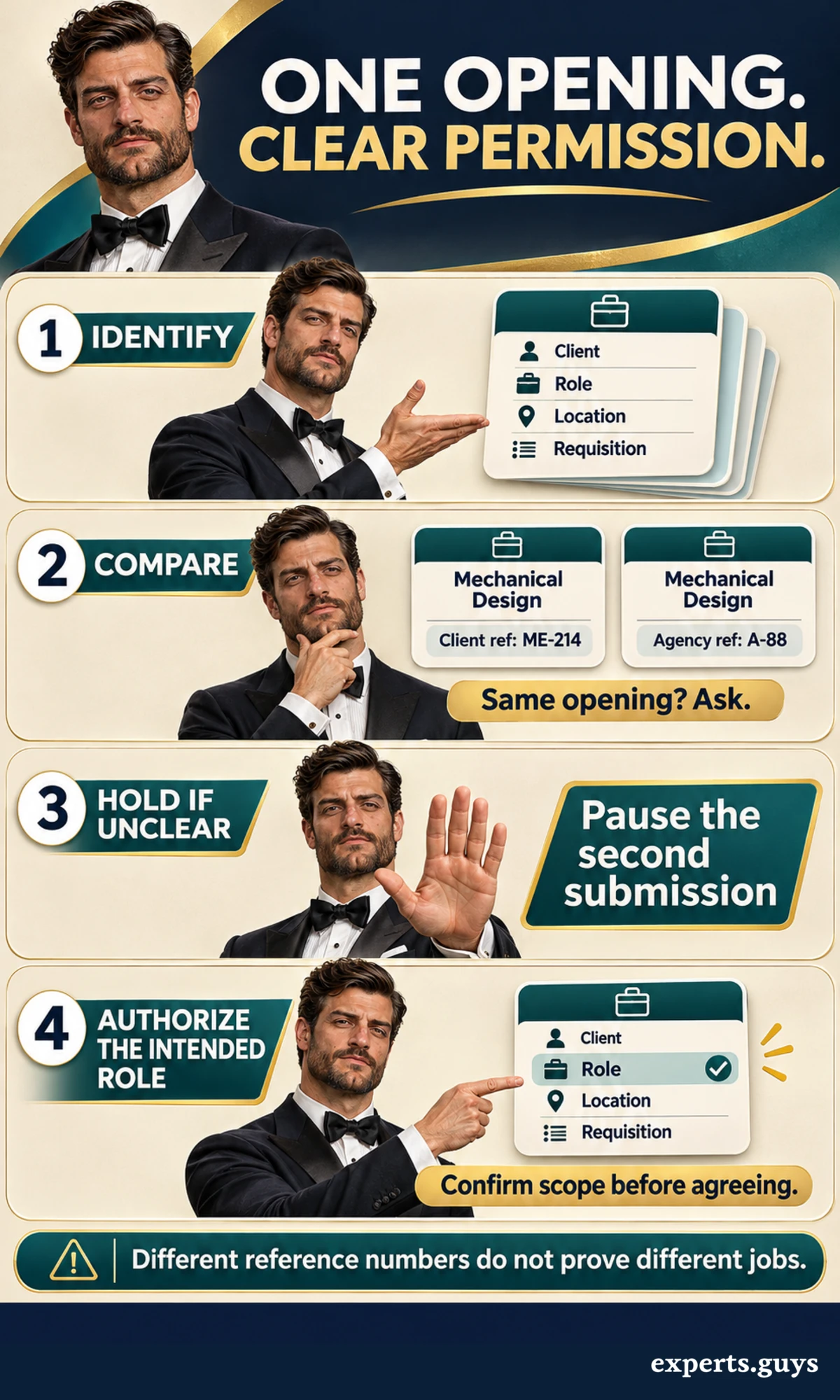
For an illustrative example, two messages describe an on-site mechanical-design contract in the same city. One provides client reference ME-214; the other supplies only an agency reference. You cannot establish duplication from those details alone. Ask whether they refer to the same client opening and hold the second submission until that question is answered. This is a coordination process, not an interpretation of contractual exclusivity or a claim that one recruiter owns your career.
A useful recruiter should also distinguish permission to discuss a vacancy from permission to forward your profile. You can be interested while still needing clarification. Read the actual representation wording, especially if it extends beyond the opening you discussed. If you do not understand a material condition, resolve it with the responsible party before agreeing; do not assume that a casual conversation changes the written terms.
Frequently asked questions
Should a graduate wait for a recruiter before applying directly?
No. Continue direct applications to suitable graduate and entry-level openings while investigating recruiters with relevant vacancies. Explain supervised project work honestly and ask whether the recruiter’s client accepts that experience. A recruiter conversation is one route into a hiring process, not a requirement for starting an engineering career.
Does membership in an engineering society prove professional qualification?
Membership, a degree, a certification and professional licensure are different things. State each credential accurately and identify its issuing organization. If an opening requires a particular registration or certification, verify the exact requirement with the employer and relevant official body rather than treating association membership as a substitute.
Can a recruiter guarantee a remote mechanical engineering job?
Do not infer remote eligibility from CAD-based work. Some roles need access to prototypes, manufacturing equipment, laboratories or project sites. Ask which tasks require attendance, where they occur and how frequently; confirm the actual arrangement for that opening before accepting a remote-work assumption.
Does applying through a recruiting firm mean you will work as a recruiter?
No. A recruiter may introduce you to an engineering position with a client or an assignment delivered through a staffing arrangement. Working as an internal recruiter is a different job. Check the advertised responsibilities so that a recruiting-service page is not mistaken for an engineering employer’s vacancy.
What if none of these five firms has a suitable opening?
Continue with direct employer applications and other recruiters whose actual vacancies match your discipline. The list identifies verified service coverage, not a complete market or a promise of access. An unsuitable opening does not become useful merely because it comes from a familiar provider.
Choose the conversation that clarifies your next engineering role
Start with one real deliverable you can explain accurately. Use it to identify a relevant recruiting team, establish what the client needs and decide whether the opening matches the work you want to own next. Then clarify the employment and submission terms before proceeding; a useful outcome is a better-informed decision, including a clear decision to pass on a mismatch.