
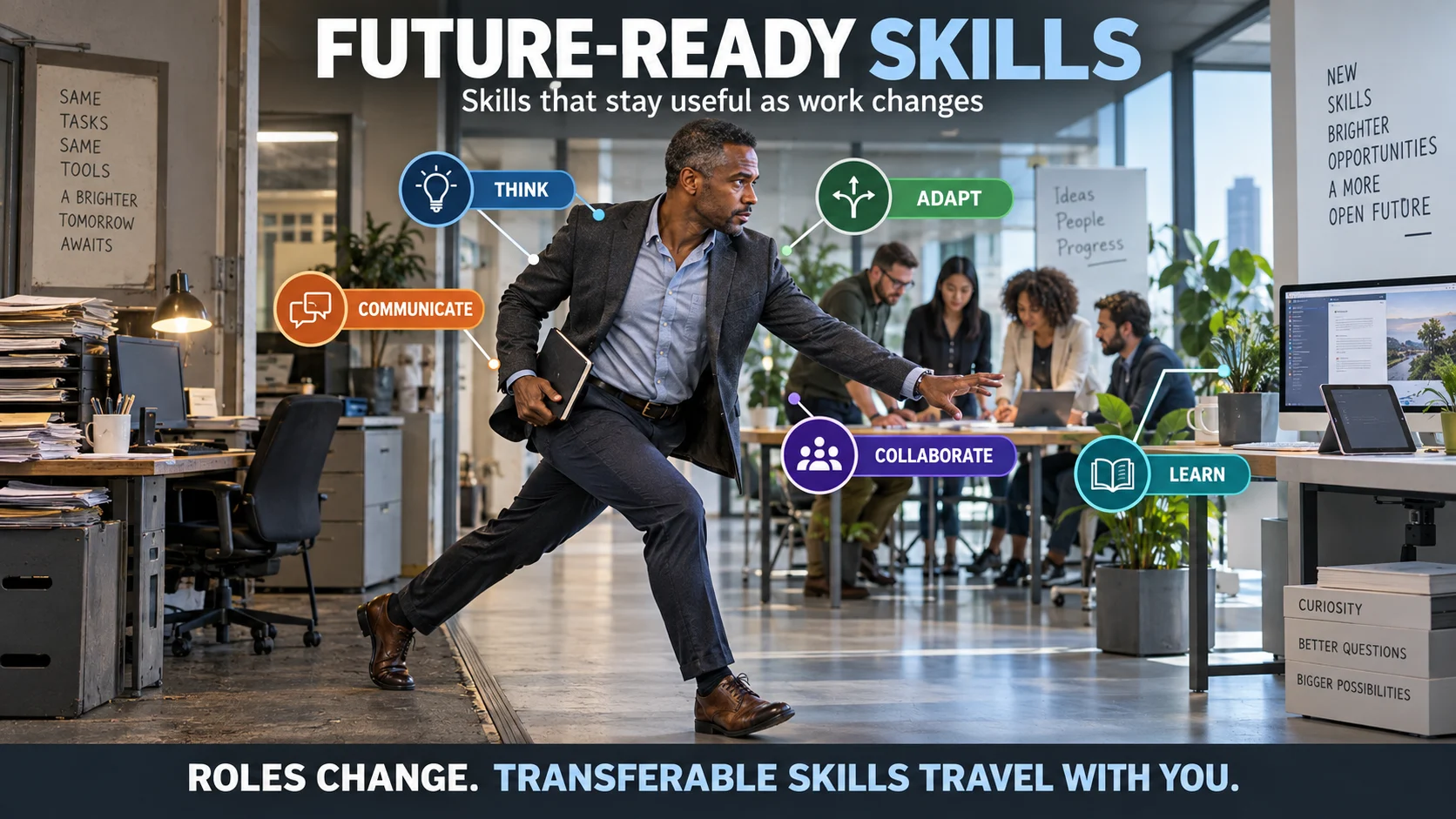

The most useful future-ready skills combine durable human capabilities with practical technology fluency. Analytical thinking, communication, adaptability, creative problem-solving, collaboration, leadership, continuous learning, AI literacy, technology literacy and data literacy travel well across roles because they help people understand new problems, work with others and adjust as tools and job requirements change.
There is no universal list that fits every occupation. A cybersecurity specialist needs deeper technical security skills than a sales manager, while a nurse, designer, accountant and operations lead will apply AI differently. The strongest career strategy is therefore to build a transferable skill stack: a small set of broadly useful capabilities, plus the role-specific skills your target work actually requires.
| Future-ready skill | Why it transfers | How to prove it |
|---|---|---|
| Analytical thinking | Helps you define problems, compare evidence and make decisions under uncertainty. | Show a decision you improved by finding the real cause, testing assumptions or comparing options. |
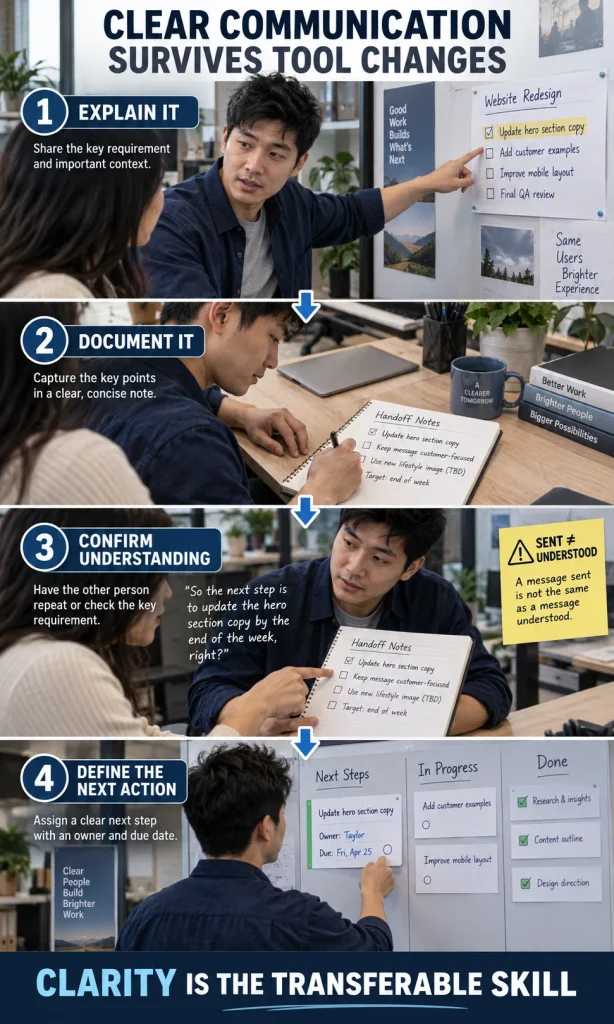
| Communication | Works across teams, customers, managers, suppliers and technical/non-technical audiences. | Use an example where clearer writing, listening or explanation changed an outcome. |
| Adaptability and resilience | Lets you keep performing when systems, priorities, teams or markets change. | Describe a change you absorbed, what you learned and how you restored performance. |
| AI literacy and judgment | Increasingly supports research, drafting, analysis, automation and decision support across functions. | Show where you used AI, checked its output, protected sensitive information and improved the workflow. |
| Technology literacy | Makes it easier to learn new software, systems and digital workflows. | Show how quickly you learned a platform or improved a digital process. |
| Data literacy | Supports evidence-based decisions even when you are not a data specialist. | Explain how you interpreted a metric, spotted a pattern or used data to choose between actions. |
| Creative thinking | Helps when standard procedures do not fully solve a new or ambiguous problem. | Show a useful alternative you designed, tested or improved. |
| Collaboration | Most complex work crosses functions, specialties and locations. | Describe how you aligned people with different goals, knowledge or working styles. |
| Leadership and coordination | Useful even without a management title because work still requires prioritization, influence and ownership. | Show where you created clarity, coordinated people or moved a decision forward. |
| Curiosity and lifelong learning | Keeps the rest of your skill stack current as tools and tasks evolve. | Connect a learning activity to a real change in how you work, rather than listing courses alone. |
What Makes a Skill “Future-Ready”?
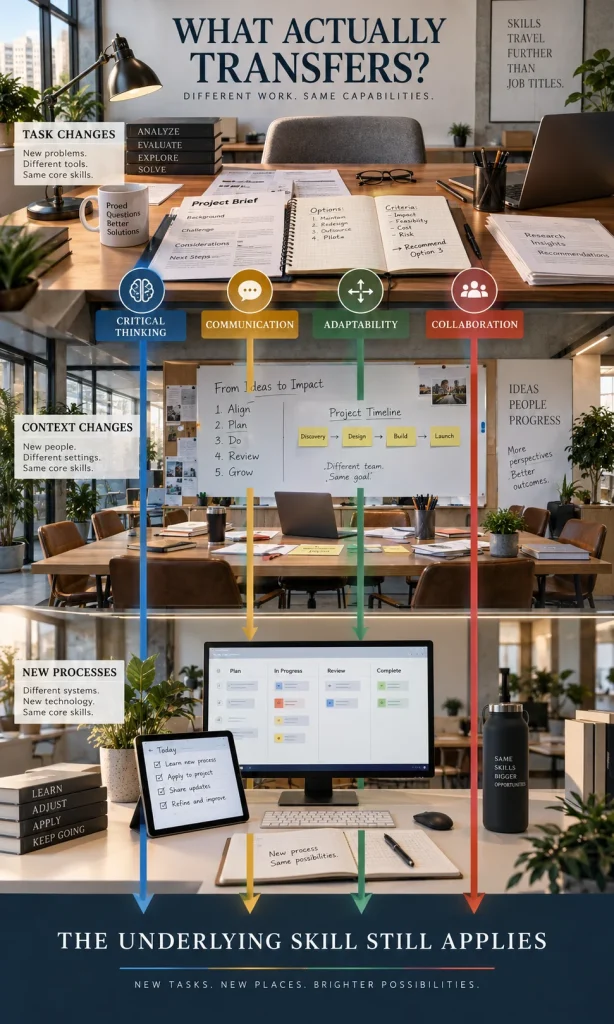
A transferable skill can be used in more than one role or industry. A future-ready skill has an additional quality: it remains useful when the surrounding work changes. The two ideas overlap heavily, but they are not identical. Communication is both transferable and future-ready. A highly specific software command may transfer to several jobs today, yet lose value if the software or workflow disappears.
The World Economic Forum Future of Jobs Report 2025 illustrates why the distinction matters. Employers in the global survey continued to rate analytical thinking as a leading core skill, while AI and big data, networks and cybersecurity, and technology literacy were among the fastest-growing skill areas. The same report also highlights creative thinking, resilience, flexibility and agility, leadership and social influence, and curiosity and lifelong learning as increasingly important.
That mix points toward a practical rule: technical capability matters, but workers also need the judgment and interpersonal ability to apply technology inside changing real-world situations. A person who learns one application very deeply may gain short-term advantage. A person who can learn unfamiliar systems, question outputs, explain decisions and coordinate with others has a wider base for adapting when the application changes.
The 10 Transferable Skills Worth Building
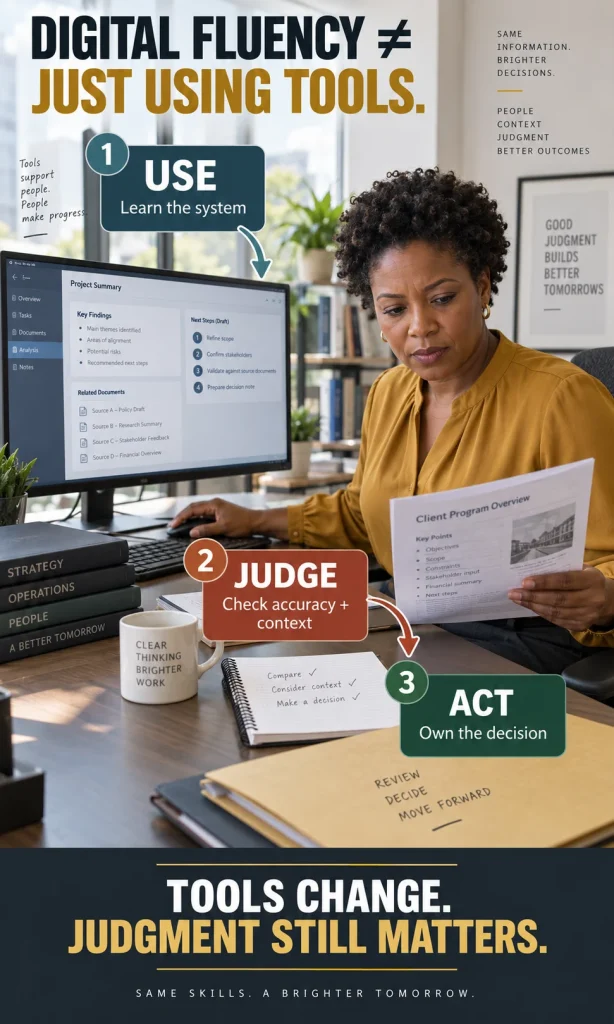
1. Analytical Thinking and Problem-Solving
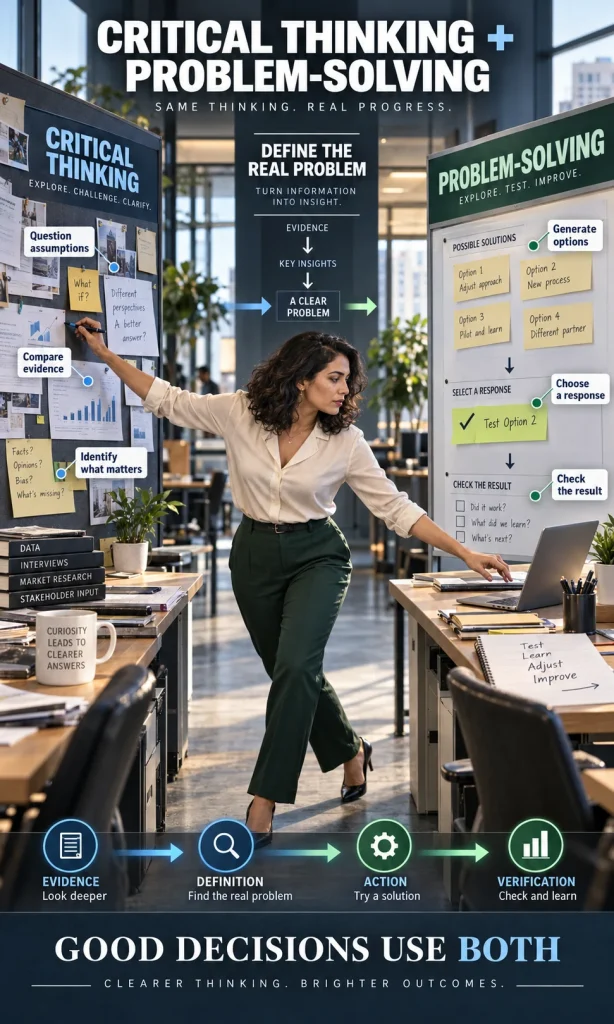
Analytical thinking is the ability to separate a problem into useful parts, identify what is known, test assumptions, compare evidence and decide what matters. Problem-solving turns that analysis into action. These skills transfer because every occupation contains situations where the first explanation is incomplete, the information is messy or several options compete for limited time and resources.
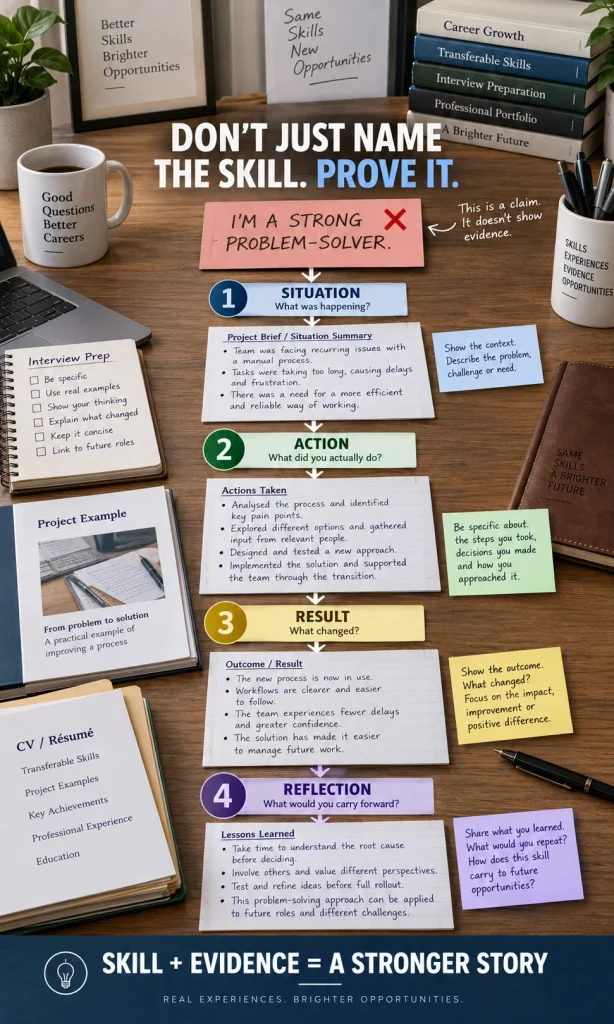
The strongest proof is not saying that you are “a problem solver.” Show the reasoning. Explain what was going wrong, what evidence you checked, what alternatives you considered, why you chose one course of action and what changed after the decision. That structure demonstrates the skill more convincingly than a list of adjectives.
2. Communication and Stakeholder Influence
Modern communication includes writing, speaking, listening, explaining technical information, giving feedback, asking precise questions and adapting a message to the audience. It also includes knowing when a message needs more context and when brevity is more useful. The 2026 LinkedIn Skills on the Rise overview identifies leadership, people management, executive communication and stakeholder communication among major skill trends across the markets it analyzes.
Communication becomes more valuable as work becomes more cross-functional. A technically correct idea can still fail if the people affected by it do not understand the decision, the trade-off or what they need to do next. Strong communicators reduce this translation gap between specialists, managers, customers and other stakeholders.
3. Adaptability, Resilience and Agility
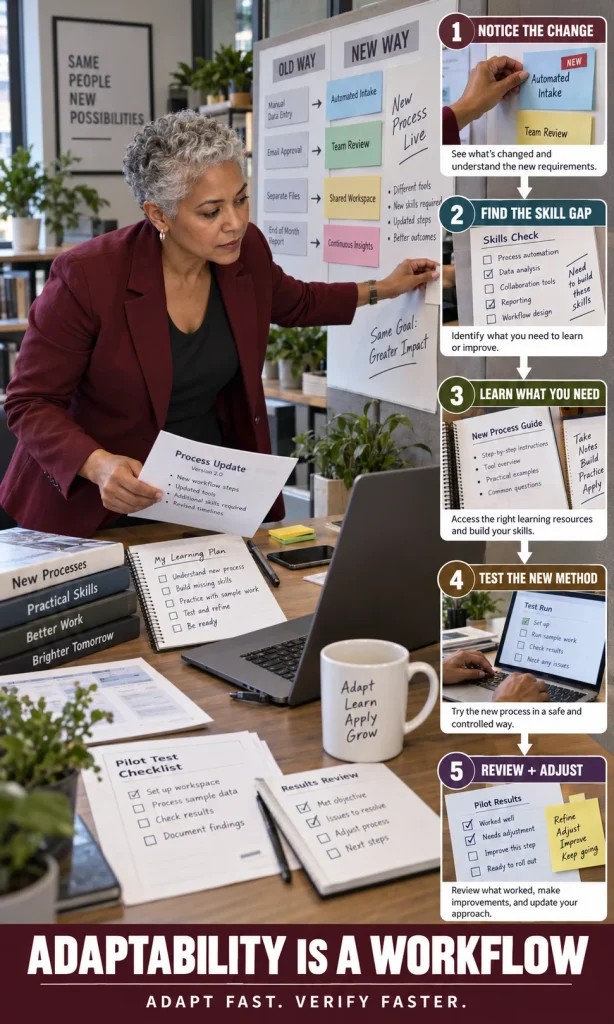
Adaptability means changing your approach when the situation changes. Resilience is the capacity to recover and continue functioning after setbacks or disruption. Agility adds speed: learning what has changed, deciding what matters and adjusting without waiting for perfect certainty.
These qualities are especially transferable because the trigger can vary while the underlying response remains similar. A new manager, software migration, reorganized team, supply problem, policy change or AI-assisted workflow can all require the same sequence: understand the new constraints, identify what still works, learn what is missing, communicate the change and rebuild a workable routine.
4. AI Literacy and Judgment
AI literacy is becoming part of ordinary professional literacy in many roles, yet it does not mean everyone needs to become a machine-learning engineer. For many workers, the practical requirement is knowing where AI can assist, how to give it useful context, how to evaluate its output, where human approval remains necessary and what information should not be exposed to an external system.
The OECD’s Skills in the AI Age describes advanced AI skills as scarce and role-specific while emphasizing complementary capabilities such as critical thinking, creativity and collaboration for effective work with AI. This is an important career distinction. Learning one prompting technique can be useful, but the more durable capability is understanding how to integrate AI into a workflow without surrendering judgment.
A strong AI example therefore includes more than “used AI.” Explain the task, what the AI handled, what you verified yourself, what risks or limitations you managed and why the final process was better than the previous one.
5. Technology Literacy
Technology literacy is the ability to understand and use digital systems well enough to work productively, learn new tools and recognize basic limitations. The exact tools vary by occupation, so a future-ready approach focuses on transferable patterns: permissions, files, data flows, integrations, automation, collaboration features, security practices and how information moves from one system to another.
Someone who understands these patterns usually learns new software faster because the interface is new but the underlying concepts are familiar. That makes technology literacy more durable than memorizing one menu or one vendor’s workflow.
6. Data Literacy
Data literacy does not require every worker to become a statistician. It means being able to read common measures, ask where data came from, recognize when a comparison is weak, distinguish signal from noise and use evidence without claiming more certainty than the data supports.
This matters because AI and analytics can produce more outputs than many teams know how to evaluate. A future-ready employee needs enough quantitative judgment to ask whether a metric is relevant, whether the baseline changed, whether the sample is comparable and what decision the number should actually influence.
7. Creative Thinking
Creative thinking is useful when the existing process no longer fits the problem. It can involve designing a different workflow, combining ideas from separate fields, reframing the question, simplifying a complex task or producing several viable alternatives before choosing one.
AI can generate many options quickly, which changes the value of creativity rather than eliminating it. The harder part often becomes deciding which option is original enough to matter, realistic enough to execute and appropriate for the people or constraints involved. Creative judgment therefore benefits from domain knowledge, critical thinking and the willingness to test ideas rather than simply produce them.
8. Collaboration and Conflict Navigation
Collaboration is more than being agreeable in a team. It involves sharing information, clarifying ownership, handling disagreement, coordinating handoffs and helping people with different specialties move toward the same outcome. Those abilities become more important when projects cross departments or include remote, outsourced or AI-assisted work.
When conflict appears, the transferable skill is identifying what kind of conflict it is. A factual disagreement needs evidence. A priority conflict needs a decision owner. A role conflict needs clearer responsibility. A relationship conflict may require direct conversation and repair. Treating every disagreement as a personality problem weakens collaboration; diagnosing the source makes it easier to resolve.
9. Leadership and Coordination
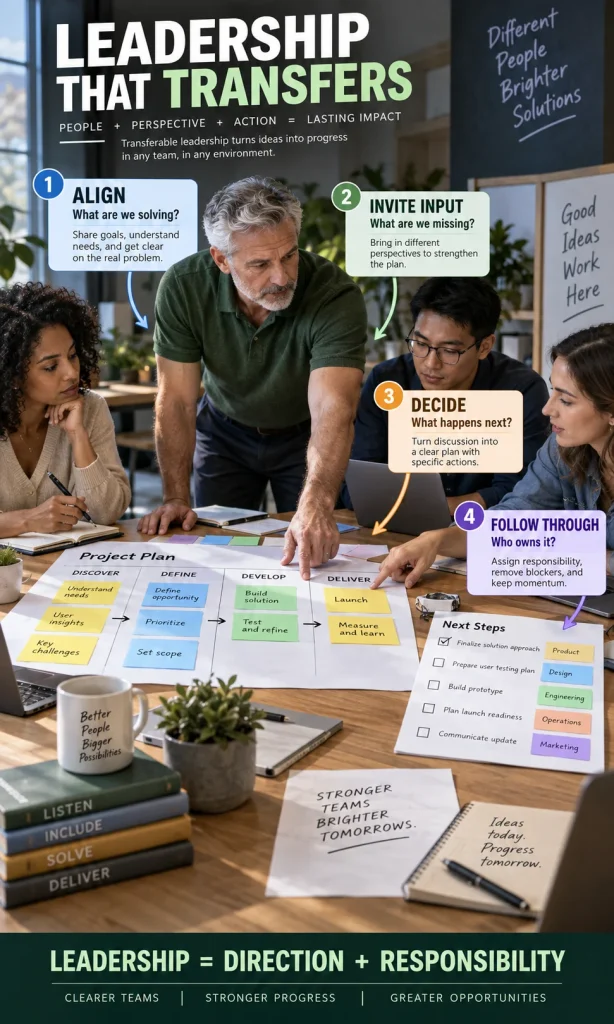
Leadership is not limited to supervising employees. Individual contributors often lead meetings, coordinate projects, mentor newer colleagues, set standards, escalate risks, influence decisions or take ownership when a process has no obvious owner. These are transferable leadership behaviors because they depend on clarity, judgment and responsibility rather than hierarchy alone.
When presenting leadership experience, describe what became clearer or more coordinated because of your involvement. A formal title can support the story, but it does not replace evidence of how you set direction, supported others or moved work forward.
10. Curiosity and Lifelong Learning
Lifelong learning keeps the rest of the skill stack from becoming stale. The goal is not constant course consumption. Useful learning closes a real gap, gets applied to real work and produces feedback that changes what you do next.
The OECD Skills Outlook 2025 emphasizes adaptive problem-solving and lifelong learning in economies where skill requirements can change faster than traditional policy and education cycles. At an individual level, the same logic applies: career durability improves when learning is a repeatable process rather than an emergency response after a role has already changed.
Why a Skill Stack Is More Useful Than a “Top Skills” List
A list is a starting point. Employers hire for combinations. A project manager may need stakeholder communication, risk judgment, data interpretation and AI literacy. A designer may combine creativity, user understanding, communication, AI-assisted ideation and project coordination. A finance professional may combine analytical thinking, data literacy, communication, business judgment and responsible use of AI.
That combination is your skill stack. It gives context to each capability and makes the skills easier to prove. “Communication” alone is broad. “Explaining financial analysis to non-finance stakeholders so a decision can be made” is a transferable application. “AI literacy” alone is broad. “Using AI to accelerate first-pass research, then validating sources and applying professional judgment before recommendations are issued” is a stronger application.
Which Skills Should You Build First?
Do not start with whichever skill is receiving the most attention online. Start with the work you want to do. Review several current job descriptions for the same target role and look for repeated responsibilities, tools, decisions and collaboration requirements. Then compare those patterns with your existing evidence.
- High role relevance + weak current evidence: build this first. It is a direct employability gap.
- High role relevance + strong evidence: keep practicing, but focus on presenting the evidence clearly.
- Low current relevance + strong future importance: build enough familiarity to avoid being caught unprepared, then deepen it when the role requires more.
- Low relevance + low evidence: monitor it rather than spending heavily on training that does not support your target work.
This approach prevents a common mistake: collecting fashionable skills that never become useful in the work you actually want.
How to Identify the Transferable Skills You Already Have
Job titles often hide transferable value because they describe where you worked rather than how you worked. Reconstruct your experience from situations instead. Choose several projects, problems, changes, customer interactions, deadlines or decisions and ask what capability you repeatedly used.
- Describe the situation. What needed to happen, and what made it difficult?
- Name your action. What did you personally analyze, decide, communicate, organize, build or change?
- Identify the constraint. Time, uncertainty, conflicting priorities, limited resources, technical limitations or stakeholder disagreement often reveal the real skill.
- Record the outcome. What became faster, clearer, safer, more accurate, more reliable or easier to execute?
- Translate the capability. Ask where the same reasoning, communication or coordination would matter in another role.
This turns a vague claim such as “good at teamwork” into evidence such as coordinating a handoff between two groups that used different systems and priorities. The specific industry may change, but the underlying collaboration skill remains visible.
How to Build Future-Ready Skills Without Collecting Random Courses
Training is useful when it creates capability. The faster development loop is learn, practice, apply, review and document. A short course can provide the concepts, but a real task exposes the judgment that the course cannot simulate.
For communication, that may mean rewriting a confusing update and asking whether the recipient could act without a follow-up meeting. For analytical thinking, it may mean diagnosing a recurring process problem and documenting how you tested possible causes. For AI literacy, it may mean using an approved AI system on a low-risk workflow, checking the output against reliable sources and recording where human review was still necessary.
The CIPD’s 2026 research on future-proofing skills as AI reshapes work argues for development that evolves alongside how AI is actually used in jobs rather than one-off training disconnected from work design. That principle applies beyond AI: skills become durable when they are practiced inside authentic problems.
How to Prove Transferable Skills on a Resume
Skills-based hiring increases the importance of evidence. In U.S. graduate recruiting, the National Association of Colleges and Employers reported in 2026 that 70% of participating employers used skills-based hiring. NACE also found that employers wanted candidates to provide examples of how they had used skills such as teamwork, problem-solving and communication rather than simply listing them.
Your resume should therefore connect skills to actions and results. A standalone skills section can help with scanning, but the experience section is where the claim becomes credible.
| Weak wording | Stronger evidence | Skill shown |
|---|---|---|
| Excellent communicator | Translated a technical issue into a short decision brief for non-technical stakeholders and clarified the next action. | Communication, judgment |
| Strong problem-solving skills | Compared recurring failure points, identified the highest-impact cause and redesigned the handoff process. | Analytical thinking, process improvement |
| AI proficient | Used an approved AI workflow to accelerate first-pass research, then verified sources and reviewed the final recommendation before use. | AI literacy, verification, judgment |
| Team player | Coordinated priorities across two teams, clarified ownership and resolved a handoff that was delaying work. | Collaboration, leadership |
If you are changing careers, a clear CV structure can still work when your recent experience is relevant, but you may need to rewrite bullet points so the transferable capability is visible rather than buried under industry-specific terminology. You can also use your interview preparation to build short evidence stories for the skills most important to the target role.
How Career Changers Can Translate Experience Instead of Starting Over
A career change often feels like losing accumulated experience because job titles and industry language change. The transferable layer usually survives. Customer service can build conflict resolution, listening and prioritization. Teaching can build facilitation, communication and planning. Operations can build process improvement and coordination. Caregiving can involve scheduling, advocacy and complex communication, although personal experiences should be presented only when relevant and comfortable to disclose.
The goal is to translate without exaggerating. Do not rename an experience as a professional qualification you do not have. Show the underlying capability, then identify the technical or regulatory gap that still needs to be closed. This makes the transition more credible because it separates what you can already do from what you still need to learn.
When exploring a different direction, a broader job-search process can help you compare roles before investing heavily in retraining. Look for overlap between your current evidence and the repeated requirements in target jobs, then focus development on the gaps that appear most consistently.
Skills That Matter but Are Not Universal
Some of the fastest-growing skills are highly valuable without being universal transferable skills. Cybersecurity, machine learning, cloud architecture, environmental stewardship, advanced financial analysis and specialized regulation can be critical in the right field. They should not be presented as mandatory for every worker simply because they appear in a future-of-work report.
The better distinction is between broad enabling skills and role-specific depth. Broad skills help you learn, reason, communicate and adapt. Specialist skills allow you to perform the technical work of a particular occupation. Career resilience usually requires both, in proportions that depend on your role.
Common Mistakes When Trying to “Future-Proof” a Career
- Chasing every new technology. Familiarity can be useful, but depth should follow role relevance.
- Listing skills without evidence. Employers cannot see how well you apply a skill from the label alone.
- Treating AI literacy as prompt memorization. Useful AI work also requires context, verification, risk awareness and judgment.
- Ignoring foundational skills. Reading, writing, numeracy and clear reasoning remain the base on which advanced tools are used.
- Collecting certificates without application. A credential can show study; a work sample or evidence story shows capability.
- Building skills in isolation. Real work usually rewards combinations such as analysis plus communication or AI literacy plus domain judgment.
- Assuming one global ranking applies to every occupation. Demand varies by industry, function, country, regulation and technology exposure.
A Practical 90-Day Future-Ready Skill Plan
A 90-day cycle is long enough to create evidence while still short enough to review and change direction. Treat it as a working cadence rather than a guarantee that a complex skill can be mastered in three months.
Days 1-30: Choose the Skill Gap
- Review several current job descriptions for one target role.
- Mark repeated responsibilities, tools, decisions and collaboration demands.
- Choose one transferable skill and one role-specific skill with the clearest evidence gap.
- Define a real task where you can practice each skill.
Days 31-60: Practice in Real Work
- Apply the skill to a project, volunteer task, course project or realistic simulation.
- Ask for feedback from someone who can judge the work.
- Record mistakes, changes and what you would do differently next time.
- Save evidence that can later become a portfolio item, resume bullet or interview story.
Days 61-90: Prove and Reassess
- Rewrite your resume or profile so the new capability appears in context.
- Prepare a short interview example that explains the situation, action and outcome.
- Check new job postings to see whether the skill still appears consistently.
- Decide whether to deepen the skill, maintain it or move to the next gap.
What the Future of Work Evidence Actually Says
The strongest current evidence does not point to a simple contest between “human skills” and “technical skills.” It points to convergence. The World Economic Forum identifies rapid growth in AI, big data and technology-related capabilities while continuing to place analytical thinking, resilience, creative thinking and leadership among important skills. LinkedIn’s 2026 analysis similarly combines AI development and strategy with communication, leadership and coordination. OECD work emphasizes foundational, technical and complementary skills together.
For workers, the practical conclusion is straightforward: build enough technical fluency to work effectively with changing systems, then strengthen the reasoning, communication and learning capabilities that let you apply those systems responsibly. A career becomes more resilient when the person can transfer useful patterns of thinking and action from one environment to another.
Frequently Asked Questions
What are the most important future-ready skills?
For most workers, the strongest transferable base includes analytical thinking, communication, adaptability, collaboration, creative thinking, leadership, continuous learning, AI literacy, technology literacy and data literacy. The priority changes by occupation, so these broad capabilities should be combined with role-specific technical skills rather than treated as a universal ranking.
Are transferable skills the same as soft skills?
No. Many soft skills are transferable, but transferable skills can also include technical capabilities such as data literacy, project management or technology literacy when those capabilities remain useful across roles. “Transferable” describes portability; “soft” usually describes interpersonal or behavioral capability.
Is AI literacy a transferable skill?
AI literacy can be highly transferable when it includes understanding suitable use cases, giving systems useful context, checking outputs, recognizing limitations, protecting sensitive information and knowing when human review is required. Expertise in a specific model or interface may be less durable than these underlying practices.
Which skills are hardest for AI to replace?
It is safer to think in terms of tasks rather than declaring whole skills “AI-proof.” Work that depends on contextual judgment, accountability, complex interpersonal interaction, negotiation, physical execution, creative direction or decisions under ambiguity may remain difficult to automate fully, but AI can still change how parts of that work are performed.
How do I prove transferable skills if I am changing careers?
Use examples from previous jobs, education, volunteering or other relevant experience. Describe the problem, your action, the constraint and the outcome, then connect the underlying capability to the target role. Be clear about any technical, regulatory or professional qualification you still need to build.
Should I learn technical skills or soft skills first?
Start with the skills most relevant to your target work and weakest in your current evidence. Many roles require both. Technical skills let you perform specific tasks, while communication, analytical thinking, adaptability and collaboration help you apply those technical skills in changing situations.
The Main Point
Future-ready careers are built on skills that continue to work when the job around them changes. Learn the technology your field is adopting, but connect it to analytical thinking, communication, adaptability, collaboration and judgment. Then prove those capabilities through real examples. The goal is not to predict every future job. It is to become better at learning, deciding and contributing when the work changes.