
CNA travel jobs are temporary assignments for certified nursing assistants, usually arranged through a staffing agency rather than an RN travel-nursing contract. The strongest offer is one you are eligible to start and can afford after assignment costs, even if the schedule produces less income than the advertisement suggests. Start with the actual CNA vacancy, then examine the hours and housing commitment together.
This guide concerns United States assignments. CNA titles, registry processes and permitted duties vary by state; an overseas nursing or care qualification does not automatically establish U.S. eligibility or work authorization. A job-search phrase such as “CNA travel nurse jobs” is useful for finding advertisements, but the contract needs to identify the nursing-assistant role accurately.
For a first assignment, favor a familiar care setting with clear support and an affordable exit over the highest advertised weekly package. That is an editorial recommendation about reducing avoidable uncertainty, not a claim that one agency or destination produces better outcomes. A higher offer becomes attractive when its extra compensation survives realistic costs and its working conditions match your competence.
Which CNA travel jobs are you actually qualified to accept?
A workable assignment must fit three separate things: your destination-state eligibility, your recent experience and the facility’s actual CNA duties. Passing one check does not settle the others. An experienced nursing-home CNA may still need destination approval, while an active certificate does not establish familiarity with a hospital unit’s workflow.
Read the duties before the travel label
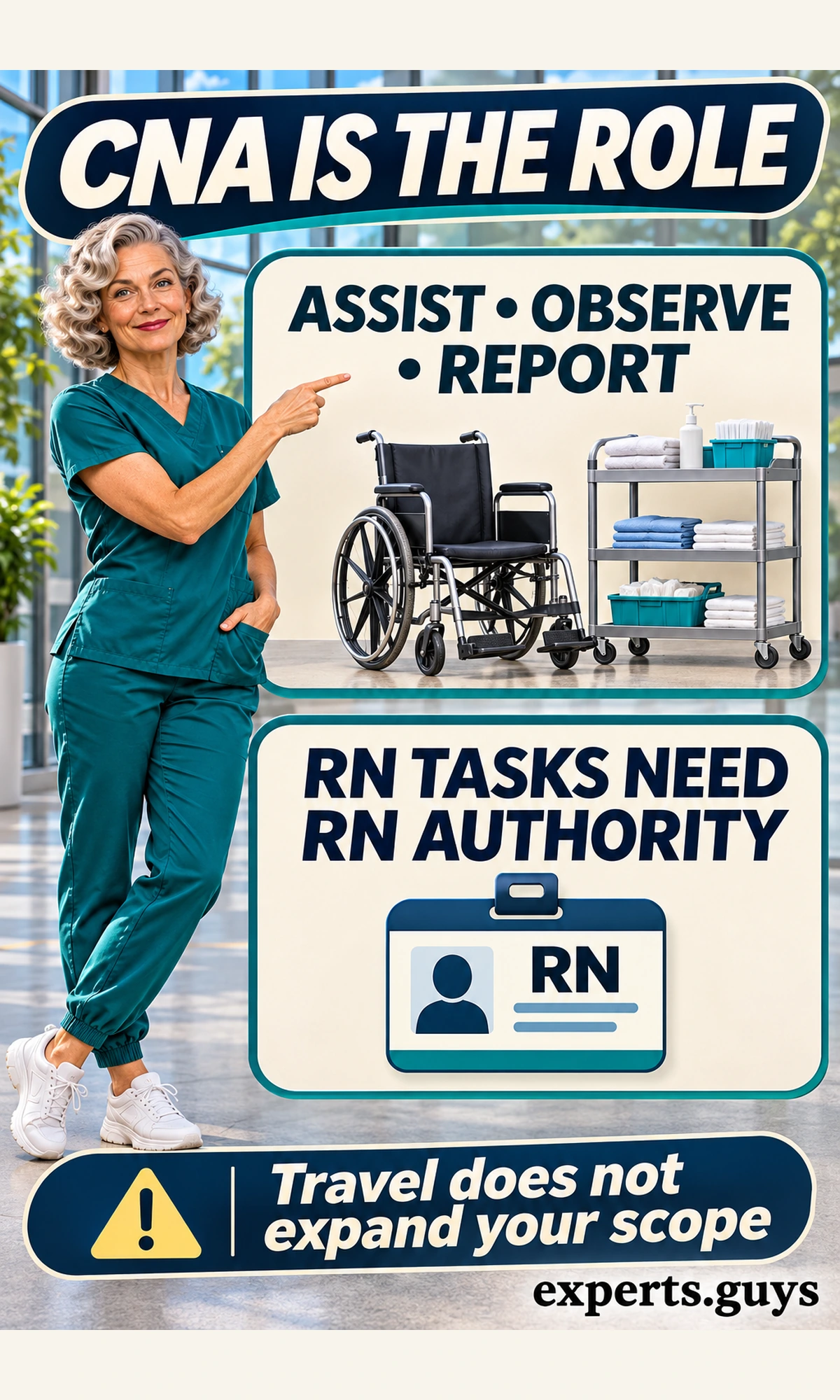
Nursing assistants support daily care and report observations within their training, delegation arrangements and applicable rules. The BLS occupational overview distinguishes nursing assistants from other healthcare occupations and describes state training, examination and registry requirements. Use that distinction to reject advertisements that mix RN compensation or responsibilities into an aide vacancy.
A travel contract changes the employment arrangement and location; it does not expand clinical authority. Ask the facility to clarify ambiguous responsibilities, especially when a posting mentions medication duties, specialized equipment or tasks outside your experience. Additional credentials can matter, but a recruiter cannot establish your authority simply by changing the job title or saying that everyone helps out.
| Check | Check and decision meaning |
|---|---|
| Destination eligibility | What it establishes: The applicable state route and approved status for the role. What it cannot establish: Whether the particular unit is a good experience match. |
| Relevant recent experience | What it establishes: Your familiarity with the care setting and expected work. What it cannot establish: Permission to perform tasks outside authorized CNA duties. |
| Facility clearance | What it establishes: The facility has accepted the required onboarding evidence. What it cannot establish: A guaranteed income or affordable housing arrangement. |
“LTC experience required” deserves more attention than an attractive destination photo. A long-term-care employer may expect familiarity with a sustained resident routine, while a hospital position may involve a different pace, reporting system and distribution of tasks. Describe the work you have actually performed, including the setting and recency, rather than presenting every CNA position as equivalent experience.
Separate state approval from facility clearance
For an out-of-state assignment, begin with the destination’s official nurse-aide authority and its current out-of-state application instructions. Check the requirements applicable to your status, submit through the authorized route and confirm the outcome before relying on a start date. An uploaded application receipt can establish that you applied; it does not establish that the state has approved you.
- State route: which application or recognition process applies to your current credential?
- Evidence: what status, work history and checks does that destination require?
- Outcome: how is approved status confirmed, and what must be complete before work begins?
The Idaho CNA registry guidance, for example, ties reciprocity to an employment offer or Idaho residence and directs applicants to its own process. This is an example of why destination rules matter, not a national application template. Other states can require different evidence, fees or checks, so do not reuse another traveler’s timeline as your promised turnaround.

The Nurse Licensure Compact is relevant to eligible nursing licenses; it does not turn a CNA certificate into a nationwide aide credential. Keep any RN or LPN/VN qualification separate from your CNA application. If you are comparing those career routes, the broader travel healthcare role guide explains the occupation-level distinctions without treating national agency coverage as individual practice permission.
Facility clearance is another decision. The employer may need verified references, role-specific training, health documentation or background screening before it permits the start. Ask the credentialing team which items remain unresolved and who issues final clearance. Do not send identity documents through an unverified text link just because the message names a real hospital.
Experience requirements are offer-specific
There is no useful universal promise that every CNA can travel after a particular number of months. Some facilities accept first-time travelers; others ask for recent experience in their setting or previous assignments. A new CNA should search for an opening explicitly compatible with their experience rather than assuming a short orientation will provide the equivalent of supported entry-level development.
If an advertisement says “one year required,” ask what counts: total CNA experience, recent experience in that setting or prior travel work. A clear answer prevents unnecessary submissions and avoids a late rejection after you have already arranged time off. Never agree to inflate dates or check off skills you have not performed to get through an agency’s submission screen.
The practical outcome of this section is a credible application boundary. You should know the exact role you are seeking, the state process that applies and which setting you can describe honestly. If one of those remains uncertain, resolve that point before treating the offer as a relocation decision.
Where can you find a genuine CNA travel opening that fits?
Search for a specific assignment you could accept, rather than an agency with impressive RN marketing. Start with the credential and care setting, narrow to destinations where eligibility is realistic, then compare the schedule and start window. This reduces time spent on vacancies that are attractive only because the results page grouped different professions together.
Use a small number of meaningful filters
An efficient search combines “travel CNA” or “travel nurse aide” with a relevant setting such as long-term care, skilled nursing or a hospital unit. Add the destination state when you have a realistic route there. The purpose is to surface a compatible vacancy, not to collect every advertisement containing the word “travel.”
Aya Healthcare maintains a dedicated CNA and nurse-assistant travel listing page. It is a verifiable starting point, not an endorsement, ranking or assurance that an opening remains available. Job boards and other specialist staffing agencies can also surface opportunities, but each listing still needs confirmation with the organization handling the placement.

A result can be geographically convenient but structurally wrong for you. For example, an offer built around four long shifts, rotating weekends and an immediate start may not fit someone who can only work fixed nights after a registry application is complete. Those constraints affect whether the vacancy is usable; they are not minor preferences to postpone until after acceptance.
Ask whether the listing is an opening or a lead
Before authorizing submission, ask for the current requisition or job reference, worksite, unit, proposed dates, shift and whether the facility is still reviewing candidates. A general recruiting page may exist to gather applications rather than advertise one open position. A displayed weekly estimate does not itself show that the facility has approved that package for you.
Keep the stages distinct: inquiry, permission to submit, facility interview or screening, written offer and cleared start. Ask what authorizing submission commits you to and whether the recruiter needs exclusive representation for that requisition. Do not let two recruiters submit you to the same facility opening without clarifying the process; duplicate representation can create avoidable confusion about who owns the application.
You do not need a long personal presentation to establish fit. A useful introduction is specific: “I have recent skilled-nursing experience, an active home-state CNA credential, and availability for fixed nights from this date. Does this opening accept first-time travelers, and what destination approval is required?” This is an illustrative conversation prompt, not a script that should replace your actual circumstances.
The wider guide to explaining your background to a recruiter covers general positioning. Here, precision about setting, dates and shift constraints matters more than selling a broadly adventurous personality. A recruiter can assess a concrete availability limit; “I am flexible” can conceal a mismatch that appears only when the schedule arrives.
Evaluate responses rather than promotional claims
A useful recruiter can identify what is known, what needs facility confirmation and who will resolve it. “I will confirm that with the unit” is more credible than an immediate promise outside the recruiter’s authority. Awards, follower counts and glowing testimonials do not answer whether your proposed hours, orientation or housing conditions have been agreed.
| Listing detail | Check and decision meaning |
|---|---|
| Job identity | Ask for: Current requisition, worksite, unit and CNA title. Why the answer changes your decision: A broad recruiting page is not one confirmed vacancy. |
| Schedule | Ask for: Shift, paid hours, weekends and permitted changes. Why the answer changes your decision: An incompatible schedule cannot be fixed by a higher headline rate. |
| Experience | Ask for: Required setting, recency and first-traveler policy. Why the answer changes your decision: Total years alone may not meet the facility requirement. |
| Start window | Ask for: Proposed date, unresolved clearance and responsible team. Why the answer changes your decision: Pending approval can affect when you can safely commit to housing. |
| Representation | Ask for: Submission consent and any requisition exclusivity. Why the answer changes your decision: Two submissions can create confusion without improving fit. |
Look for consistency across the discussion and written documents. If the text exchange says fixed nights but the offer says variable shifts, the conflict needs resolution before acceptance. The same applies when an advertised worksite changes to a different facility after submission. The changed detail may be legitimate, but it creates a new fit decision rather than an obligation to continue under your original assumptions.
The general healthcare staffing agency guide explains the recruitment relationship more broadly. This page’s narrower question is whether one CNA requisition can become a practical assignment. You can complete that decision with a small set of clear answers; registering with many agencies is not a substitute for checking an actual vacancy.
Is the weekly package still worthwhile after housing and a missed shift?
Compare the money left after assignment-specific costs, then test what happens if paid hours fall. A large weekly headline can depend on overtime, allowances or conditions you do not satisfy. It can also disguise a housing commitment that stays fixed when income changes. The useful comparison is between equivalent schedules and realistic costs, not between two isolated advertising totals.
Reconstruct the package before comparing it
Separate ordinary wages, overtime assumptions, allowances, reimbursements and bonuses. Ask which components are conditional and whether the quoted package assumes every scheduled hour is worked. An amount reimbursed after an approved expense is different from money available before departure, even if both appear in the same recruitment summary.
For illustration only, consider a 36-hour offer with a $22 ordinary hourly wage and a stated $700 weekly allowance. If all 36 hours are paid and that allowance is payable in full, the combined weekly amount is $1,492 before taxes, deductions and assignment costs. These are invented arithmetic inputs, not current market rates, a take-home estimate or a promise of allowance eligibility.

Now compare housing, transport and other incremental costs using the same time period. Suppose that illustrative traveler expects $450 in weekly lodging, $80 in assignment transport and $40 per week as the allocation of a nonrefundable setup expense. The $1,492 package leaves $922 after those selected costs, before taxes and payroll deductions. That intermediate result is useful for comparison precisely because it does not pretend to be net pay.
Avoid subtracting a cost twice. If the agency provides housing and the written package already excludes a cash housing allowance, do not subtract an imagined allowance again. Conversely, if you receive a housing allowance and arrange your own lodging, the rent remains your expense. “Housing included” needs an actual description of what is included, not an assumption that every arrangement is financially equivalent.
Compare with the job you would otherwise work
A travel package should be compared with your realistic alternative, such as a local CNA position or compatible local agency shifts. Include benefit differences and the time between assignments where those affect your choice. A travel contract may offer a higher weekly figure while requiring a second household, more transport expense and unpaid gaps that a local job would not create.
Use incremental costs to understand the change caused by travel, then use your full household obligations to judge affordability. Your regular rent may be unchanged under both options, so it can cancel out in the comparison, but it still has to be paid. A comparison that excludes common costs is not a complete personal budget and should never be described as spare cash.
The same distinction applies to deposits. A genuinely refundable deposit is a cash requirement rather than automatically a final expense, but you may be unable to use that money for weeks. A nonrefundable booking fee is a cost. Treating both as ordinary weekly rent hides an important question: do you have enough accessible cash to start without depending on a reimbursement that has not arrived?
Stress-test one unpaid 12-hour shift
Using the same illustrative $22 wage, losing 12 paid hours reduces wages by $264. If the full $700 allowance still applies, the selected-cost remainder falls from $922 to $658. If the contract instead reduces the allowance by one-third for that scenario, the remainder falls by another $233.33, to $424.67. The second result illustrates a hypothetical contract rule; actual allowances may behave differently.

This is why a “guaranteed hours” heading is insufficient. Read what triggers payment, how facility call-offs are treated, how many exceptions are allowed, whether hours can be averaged and what worker availability is required. Ask specifically whether a call-off changes only wages or also allowances. You are testing the agreement’s mechanics rather than predicting that the facility will cancel a shift.
The purpose of the downside example is to expose fixed-cost sensitivity. Lodging often remains payable for the week even if fewer hours are worked. A package that looks generous at the full schedule can therefore leave little margin when compensation falls. If the reduced scenario is unaffordable, negotiate clearer protection, find more flexible lodging or compare a less expensive destination before increasing the hours you hope to work.
| Scenario | Calculation and result |
|---|---|
| 36 paid hours; full $700 allowance | Wages plus assumed allowance: $792 + $700 = $1,492 After $570 selected weekly costs: $922 before taxes and deductions. |
| 24 paid hours; full allowance unchanged | Wages plus assumed allowance: $528 + $700 = $1,228 After $570 selected weekly costs: $658 before taxes and deductions. |
| 24 paid hours; allowance reduced by one-third | Wages plus assumed allowance: $528 + $466.67 = $994.67 After $570 selected weekly costs: $424.67 before taxes and deductions. |
Do not build affordability around overtime you have not been promised. Ask payroll which overtime system applies, what rate or regular-rate calculation it uses and whether any special rules affect the facility. The Department of Labor’s nursing-care fact sheet explains why wage-and-hour arrangements need careful treatment; a recruiter labeling every long shift “overtime” is not enough to establish the calculation.
Treat tax labels as unresolved until the facts fit
An allowance is not tax-free solely because a job is described as travel or sits beyond an agency’s distance threshold. IRS Publication 463 explains tax-home and temporary-assignment concepts. Those concepts depend on facts; a mailing address alone does not settle them. If eligibility is uncertain, obtain an explanation from payroll and a tax professional familiar with your actual work pattern before depending on a favorable tax result.
Keep the offer comparison separate from a tax estimate. The examples above deliberately stop before taxes and deductions, and they do not determine your tax home, allowable expenses or withholding. This makes them useful for checking the structure of an offer without claiming a level of personal accuracy that the information cannot support.
The decision from this section is concrete: identify the full-schedule remainder, the reduced-hours remainder and the cash needed before the first payment. If one of those cannot be established because the contract does not explain a component, the next step is a targeted clarification. A larger total on the advertisement cannot resolve that missing term.
What should be settled before accepting and relocating?
The final decision should join written terms, start clearance and affordable housing in one sequence. Avoid treating each as an independent tick box: a delayed start can change accommodation costs, a revised shift can change transport needs, and an early end can expose a lodging obligation that outlasts the income. The best time to understand those connections is before you make irreversible commitments.
Tie commitments to the remaining start conditions
Begin with the written offer and identify which state and facility conditions remain. Obtain confirmation from the responsible teams when those conditions are cleared, then match housing dates and cancellation terms to the agreed start. When clearance is pending, refundable arrangements or a later commitment can reduce exposure, although neither guarantees that every cost will be recovered.

Ask what happens if the facility moves the start after you have booked lodging. Who communicates the change? Is any travel or lodging reimbursement available, and on what conditions? Do not infer that the agency pays because it helped find the property. Your accommodation agreement can be separate from the staffing contract, with its own obligations even when the placement changes.
Agency housing also needs detail: occupancy dates, private or shared space, utilities, parking, deposits, pets if relevant and the move-out rule after cancellation. Choosing agency housing can reduce the work of finding a place but may reduce control over location or the cash package. Choosing your own housing gives more choice while leaving you responsible for the booking and its cancellation risk.
Read the change terms as seriously as the start terms
Identify the provisions covering facility cancellation, worker cancellation, early termination, changes to pay, floating and extensions. Ask what each clause means in a concrete scenario and request clarification in the actual written agreement where necessary. An informal reassurance may explain someone’s intention without changing the document that will govern a later dispute.
For example, suppose your housing runs for a fixed number of weeks but the facility can end the placement earlier under the contract. The question is not simply whether the weekly rate is good. It is whether you can carry the remaining accommodation cost, end the booking or obtain an agreed form of protection. This is an illustrative mismatch to examine, not a statement that every agency uses that arrangement.
Benefits can change the decision too. Confirm when coverage begins, any worker premium, the eligibility conditions and what happens between contracts. A promise of “benefits available” does not establish uninterrupted coverage or a particular retirement contribution. Compare what the current offer actually supplies rather than carrying forward a benefit described in an old agency review.
Confirm the work support that makes the assignment usable
Before accepting, ask who supervises CNA work, what orientation is provided, which unit you will cover and what happens when a requested task exceeds your preparation or authorized role. Ask how staffing support and equipment access work on your actual shift. A facility-wide assurance may not answer whether a night-shift traveler can reach the person needed at that moment.

These questions do not require you to negotiate a clinical plan through a recruiter. They identify whether the facility can explain its work expectations and support. If the recruiter cannot answer, request the appropriate facility contact or written clarification before deciding. Unresolved competence or safety questions should not be converted into a promise that you will “figure it out” after arriving.
Keep the routes for different problems separate. An immediate care or safety concern belongs with the facility’s responsible clinical chain and applicable emergency procedure; a payroll discrepancy belongs with the agency’s payroll process. This article does not teach patient handling or replace workplace training. It teaches how to establish that the assignment’s expectations and support are clear enough to evaluate.
For the first day, the minimum practical outcome is a confirmed reporting location and time, a named contact or responsible team and clear arrival instructions through a verified channel. This is the final part of the start sequence, not evidence that a recruiter can guarantee how every shift will unfold. If the worksite or reporting arrangement changes, reassess the affected housing and transport assumptions.
- Proceed: the CNA role fits, start conditions are cleared, written terms are understood and costs are affordable.
- Pause: a necessary approval, schedule detail, allowance rule or housing obligation remains unresolved.
- Decline or renegotiate: the duties exceed your preparation, the required schedule is incompatible or the reduced-income scenario is unaffordable.
Frequently asked questions
Can two CNAs travel together?
They can look for compatible assignments, but two applications do not guarantee the same facility, dates or shift. Before booking shared housing, confirm both offers and what happens to the accommodation if only one person is cleared to start. Shared travel is an arrangement to verify, not a benefit automatically attached to a CNA contract.
Can I bring a pet to agency housing?
Only if the actual accommodation permits it and the arrangement fits your dates. Ask about deposits, recurring fees, restrictions and the consequences of a last-minute property change. A recruiter saying that pet-friendly housing can be found does not establish that a particular unit is reserved or approved.
Does an extension keep the same pay and benefits?
Do not assume so. Obtain the extension terms and check the dates, compensation, benefit eligibility, housing and any credential renewal that becomes relevant. An extension can also change the facts used in a tax analysis, so the original short-term arrangement should not be carried forward without reconsideration.
Will every application require paying the agency?
Do not assume a requested fee is legitimate because a real agency name appears in a message. Ask what the payment covers and verify the request through the organization’s independently confirmed contact route. State application costs and genuine accommodation charges are separate from a claim that payment guarantees you a job.
Should I resign from my current job after a verbal offer?
A verbal offer may leave material conditions unresolved. Compare your notice obligations with the written offer, state status, facility clearance and financial exposure before making that commitment. No general article can guarantee the start date or remove the consequences if a placement changes.
Can a foreign-trained nurse apply as a travel CNA?
A nursing qualification from another country is not automatically a U.S. CNA credential or permission to work. The destination’s aide requirements and the applicant’s employment authorization need separate resolution. Apply through the correct route for the actual role rather than assuming a nursing background bypasses those requirements.
Next steps: take one offer from attractive to workable
Choose one compatible CNA opening and resolve its biggest uncertainty first. If the state route is clear but the cancellation language is not, ask how one facility call-off changes wages and allowances. If the written terms are clear but housing commits you for longer than you can fund, change the accommodation arrangement or compare another offer before accepting.
A useful decision is not always a yes. You may proceed with an assignment that fits, pause for a missing approval or decline an offer whose costs and support do not suit your circumstances. What matters is that the decision rests on the actual CNA role, the written agreement and a realistic financial scenario, rather than on the travel label alone.