



Refinancing a mortgage can reduce monthly payments, lower the interest rate, or change the structure of a home loan, but not every refinancing option follows the same process. Homeowners with an existing FHA-insured mortgage often come across the term FHA Streamline Refinance, a program designed to simplify refinancing under specific circumstances. When Wells Fargo is one of the lenders being considered, many borrowers naturally want to understand how the program works, who qualifies, what costs may still apply, and whether refinancing genuinely improves their financial position.
One of the most common misconceptions is that the word “streamline” means refinancing is automatically easier, cheaper, or always the right financial decision. In reality, the term refers to a simplified refinancing process available to eligible FHA borrowers. It does not guarantee lower borrowing costs, eliminate every closing expense, or ensure that refinancing will benefit every homeowner.
Another misunderstanding is that the program belongs to a particular bank. An FHA Streamline Refinance is an FHA program, not a Wells Fargo product. Individual lenders, including Wells Fargo and other FHA-approved mortgage lenders, may choose to offer the program while applying their own underwriting standards, loan availability, and operational requirements. Understanding this distinction helps borrowers compare lenders more effectively rather than assuming every FHA Streamline Refinance experience will be identical.
Before beginning an application, homeowners should understand four important questions:
- What exactly is an FHA Streamline Refinance?
- Who qualifies under FHA rules?
- What costs and savings should be evaluated before refinancing?
- How should Wells Fargo be compared with other FHA-approved lenders?
Answering these questions provides a stronger foundation for making a mortgage decision than focusing only on an advertised interest rate or simplified marketing message.
What Is a Wells Fargo FHA Streamline Refinance?
An FHA Streamline Refinance allows eligible homeowners with an existing FHA-insured mortgage to refinance into another FHA-insured loan using a process that may require less documentation than a traditional refinance. The program was developed by the Federal Housing Administration to help qualifying borrowers refinance more efficiently while still meeting FHA program requirements.
Educational Mortgage Decision Planner
FHA Streamline Refinance Decision Planner
Review how FHA Streamline refinancing works, identify qualification questions, estimate your break-even period, compare lenders and create a personalized refinancing action plan.
Although many borrowers refer to it as a Wells Fargo FHA Streamline Refinance, the underlying rules come from the FHA rather than the lender itself. Wells Fargo, like other FHA-approved lenders, may offer this refinancing option if the borrower meets both FHA eligibility requirements and any lender-specific criteria that apply at the time of application.
The simplified process often reduces certain documentation requirements compared with a standard refinance. Depending on the circumstances and lender requirements, some borrowers may not need a new property appraisal. Income documentation may also differ from what is required during a conventional refinance. However, the exact documentation required depends on both FHA program rules and the lender’s underwriting process.
The key purpose of the program is not simply to make refinancing easier. It is intended to provide a net tangible benefit to the borrower, meaning the refinance should create a meaningful financial improvement according to FHA requirements. This safeguard helps ensure that refinancing serves a legitimate financial purpose rather than simply replacing one mortgage with another.
How Does an FHA Streamline Refinance Work?
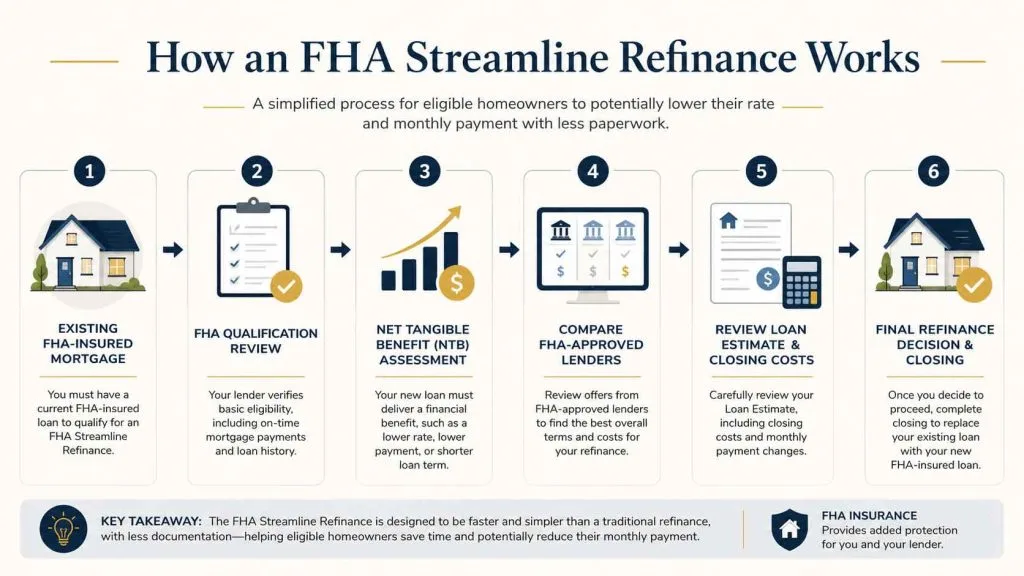
The FHA Streamline Refinance follows a structured process, even though it is generally simpler than many traditional refinance transactions.
A typical process includes:
- Confirm that the existing mortgage is FHA-insured.
- Review whether FHA eligibility requirements are met.
- Determine whether the refinance provides the required net tangible benefit.
- Submit the refinance application with the chosen FHA-approved lender.
- Complete any documentation requested by the lender.
- Review loan disclosures, estimated costs, and refinance terms.
- Close the new mortgage if approved.
The simplified nature of the program does not eliminate careful financial evaluation. Borrowers should still compare interest rates, closing costs, mortgage insurance obligations, loan term changes, and the estimated time required to recover refinancing expenses through monthly savings.
For example, reducing the monthly payment by a modest amount may appear attractive at first. However, if the closing costs require many years to recover, or the refinance significantly extends the repayment period, the long-term financial outcome may be different from the initial impression.
This is why experienced mortgage professionals often encourage borrowers to evaluate the entire refinance rather than focusing on a single number such as the advertised interest rate.
Why the Word “Streamline” Can Be Misleading
The word “streamline” naturally suggests something that is faster, easier, and less complicated. While the program is designed to simplify parts of the refinancing process for eligible borrowers, the decision itself still deserves careful analysis.
A streamlined application does not automatically mean:
- The refinance costs less.
- The lowest available interest rate will be offered.
- Every borrower qualifies.
- Closing costs disappear.
- Mortgage insurance requirements end.
- Refinancing produces long-term savings.
Instead, the simplified process should be viewed as one feature of the program rather than the reason to refinance.
A homeowner planning to remain in the property for many years may evaluate the refinance differently from someone who expects to move within a short period. Likewise, a borrower seeking payment stability may prioritize different outcomes than someone focused on reducing total interest over the life of the loan.
The better question is not:
“Is the process streamlined?”
It is:
“Does this refinance improve my financial situation enough to justify replacing my current mortgage?”
That shift in thinking often leads to a more informed decision.
Who Qualifies for a Wells Fargo FHA Streamline Refinance?
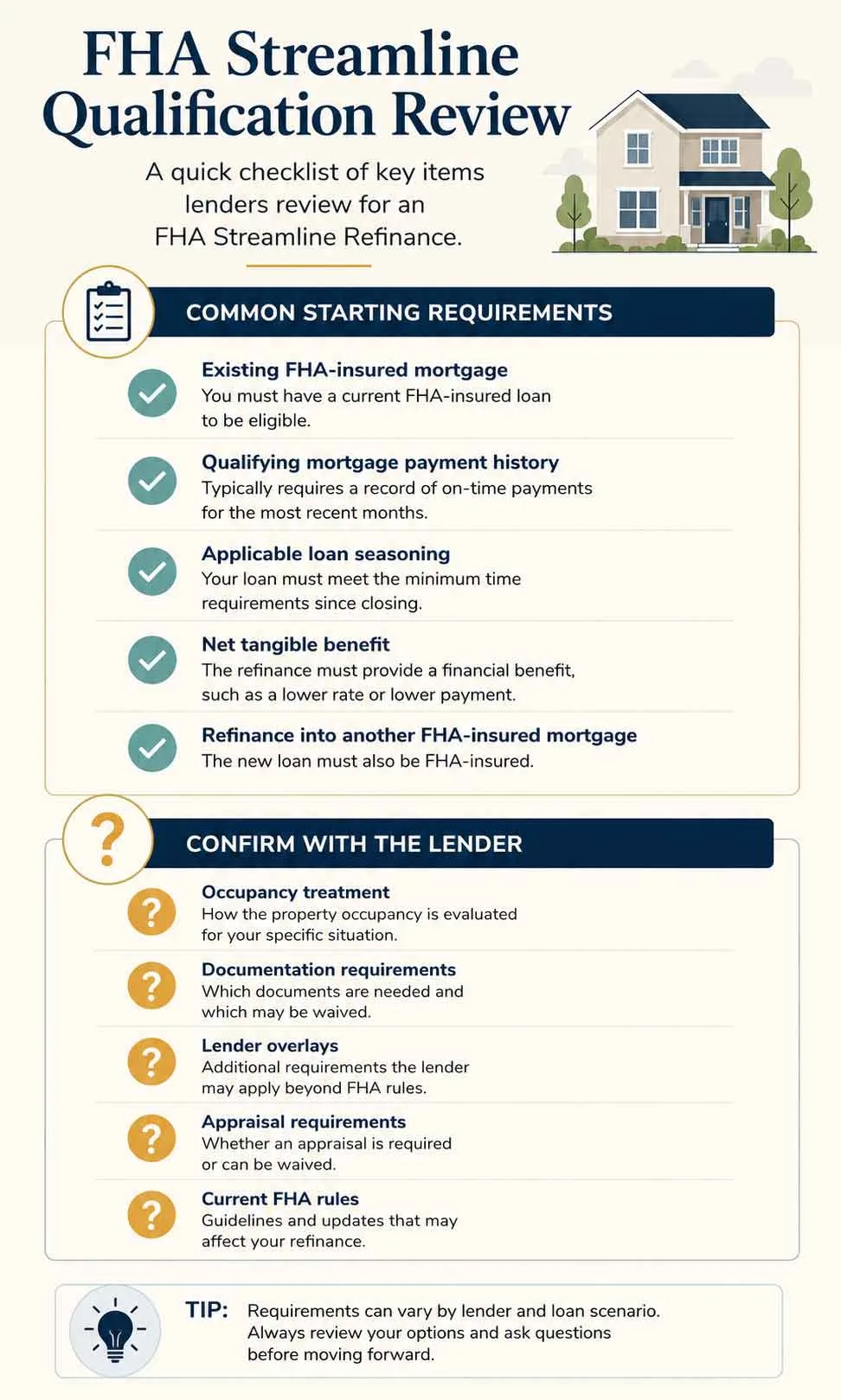
Qualification begins with the FHA program itself. While Wells Fargo and other FHA-approved lenders may have their own lending policies, borrowers must first satisfy the core FHA requirements before lender-specific underwriting is considered.
Although eligibility requirements can change over time, the program generally expects borrowers to meet several important conditions. This overview summarizes the program, while our detailed guide to FHA Streamline Refinance requirements explains each eligibility condition in greater depth.
You Must Already Have an FHA-Insured Mortgage
An FHA Streamline Refinance is only available for an existing FHA-insured home loan.
If your current mortgage is a conventional loan, VA loan, or another type of financing, this program generally does not apply. Homeowners with non-FHA mortgages would normally need to consider other refinancing options instead. Borrowers comparing different loan types may also benefit from understanding FHA vs conventional refinance options before deciding which refinancing path best supports their financial goals.
This is one of the most common misunderstandings among borrowers who first discover the program online.
The Refinance Must Provide a Net Tangible Benefit
Perhaps the most important FHA requirement is demonstrating a net tangible benefit.
This means the refinance should provide a meaningful financial improvement for the borrower rather than simply replacing one mortgage with another.
Depending on FHA program requirements in effect at the time of application, a qualifying benefit might include improvements such as:
- Lower monthly principal and interest payments
- A reduced interest rate
- Moving from an adjustable-rate mortgage to a fixed-rate mortgage
- Another qualifying improvement recognized under FHA guidelines
The exact calculation depends on FHA rules, loan type, and other program requirements, which is why borrowers should ask lenders to explain how the benefit is determined in their particular situation.
Mortgage Payment History Matters
Although the Streamline program simplifies parts of the refinancing process, it is not intended for borrowers with significant recent payment problems.
Lenders generally review mortgage payment history as part of determining eligibility. A consistent payment record demonstrates that the existing mortgage has been managed responsibly and supports the overall purpose of the program.
If payments have been missed or significant delinquencies have occurred, additional review may be required, and eligibility may be affected.
Occupancy Requirements Can Differ
Many borrowers assume every FHA Streamline Refinance follows identical occupancy rules. In reality, requirements may depend on the applicable FHA guidelines and the specific circumstances of the existing loan.
Because FHA policies have changed over the years, borrowers should confirm the occupancy requirements that apply to their particular mortgage rather than relying on outdated information found online.
Individual Lenders May Apply Additional Standards
Meeting FHA eligibility requirements does not automatically guarantee approval by every lender.
Wells Fargo, like other FHA-approved lenders, may apply additional lending standards relating to documentation, credit evaluation, loan availability, operational policies, or other underwriting considerations.
This is one reason borrowers often benefit from comparing more than one FHA-approved lender before making a refinancing decision.
Is a Home Appraisal Required?
One feature frequently associated with an FHA Streamline Refinance is the possibility of completing the refinance without obtaining a new property appraisal.
However, this should not be interpreted as a universal guarantee.
Depending on FHA rules, lender policies, and the details of the transaction, some Streamline refinances may proceed without requiring a new appraisal, while others may involve additional documentation or verification.
The practical advantage of not requiring a new appraisal is that borrowers are generally less affected by changes in local property values during the refinancing process. For homeowners whose property value has changed significantly since purchasing the home, this feature may remove one potential obstacle that could exist under other refinance programs.
Even when an appraisal is not required, borrowers should remember that the refinance remains a new mortgage transaction. Loan disclosures, closing documents, lender reviews, and other requirements still apply.
Does Wells Fargo Require Income Verification?
Many homeowners ask whether income verification is required because they have heard that Streamline refinances involve less paperwork.
The answer depends on several factors, including:
- FHA program requirements
- The specific refinance structure
- Wells Fargo’s lending policies
- Current underwriting standards
- The borrower’s individual circumstances
Some Streamline transactions involve reduced documentation compared with a traditional refinance, but borrowers should not assume that no financial information will ever be requested.
Lenders remain responsible for originating mortgage loans according to applicable regulations, internal lending policies, and FHA requirements.
Rather than assuming the documentation will be minimal, borrowers should prepare for the possibility that the lender may request information needed to complete the underwriting process.
What Costs Should Borrowers Expect?
The word “streamline” sometimes creates the impression that refinancing is inexpensive or nearly free.
That assumption can lead to disappointing expectations.
Even though the process may be simplified, refinancing still involves costs that should be understood before proceeding.
Potential costs may include:
- Closing costs
- Mortgage insurance obligations
- Interest charges
- Escrow adjustments
- Recording or administrative fees
- Other transaction-related expenses, depending on the loan
Some lenders may offer refinancing structures where certain upfront costs are offset through pricing adjustments. While this can reduce immediate out-of-pocket expenses, it does not necessarily eliminate the cost of refinancing. Instead, those costs may be reflected elsewhere in the loan structure.
Understanding where the costs appear is often more important than asking whether they exist.
Why Closing Costs Should Never Be Ignored
Many homeowners naturally focus on the monthly payment because it is the most visible number.
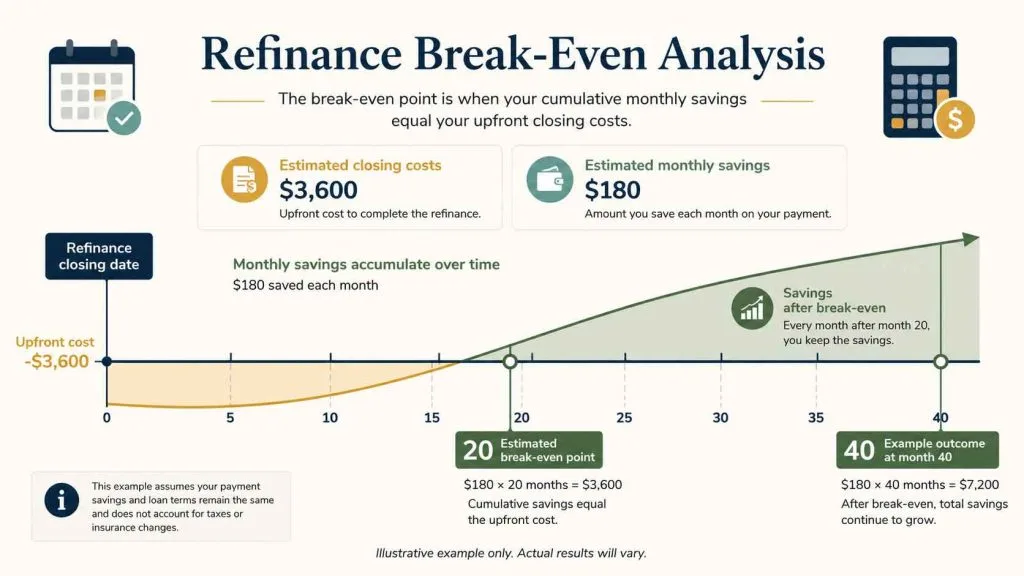
However, mortgage professionals often encourage borrowers to perform a break-even analysis before refinancing.
A break-even calculation estimates how long it will take for the monthly savings generated by the refinance to recover the upfront refinancing costs.
For example:
- If refinancing saves $180 per month…
- …but total refinancing costs equal $3,600…
- …the approximate break-even period would be about 20 months.
This type of calculation does not determine whether refinancing is good or bad. Instead, it provides useful context.
A homeowner expecting to remain in the property for many years may reach a different conclusion than someone planning to sell the home within the next year.
Looking only at the monthly payment without considering the recovery period can produce an incomplete financial picture. A dedicated mortgage refinance break-even calculator can help estimate how long monthly savings may take to recover refinancing costs before deciding whether a refinance is worthwhile.
Mortgage Insurance Still Matters
Another misconception is that refinancing through the FHA Streamline program automatically removes mortgage insurance.
In reality, FHA mortgage insurance rules continue to play an important role in the total cost of homeownership.
Borrowers should evaluate:
- Upfront mortgage insurance requirements
- Ongoing annual mortgage insurance premiums
- Total monthly housing cost
- Overall borrowing cost over the expected life of the loan
A lower interest rate does not always produce the lowest overall borrowing cost if mortgage insurance continues to represent a significant portion of the monthly payment.
That is why experienced borrowers compare the entire housing payment, not simply the mortgage interest rate.
The goal is not merely to obtain a new loan. It is to determine whether the new loan creates a stronger long-term financial outcome than the mortgage already in place.
Should You Choose Wells Fargo or Compare Multiple FHA Lenders?
Many homeowners begin researching refinancing with a specific lender already in mind. Perhaps the original mortgage is serviced by Wells Fargo, or the borrower has an existing banking relationship and assumes staying with the same institution will make refinancing easier.
That can be a reasonable starting point, but it should not be the end of the decision-making process.
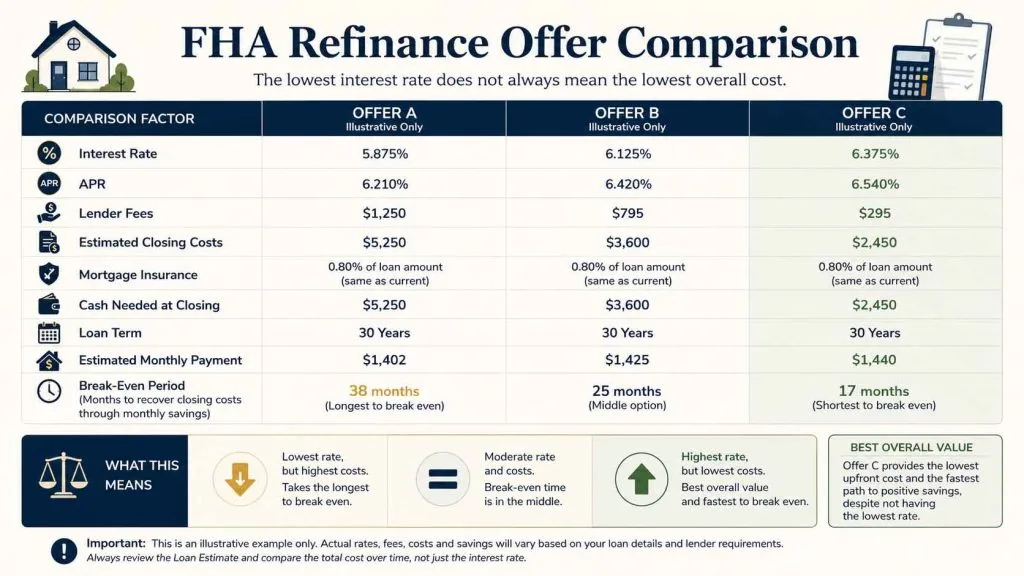
Because an FHA Streamline Refinance is an FHA program rather than a lender-exclusive product, eligible borrowers are generally free to compare offers from different FHA-approved lenders. Each lender may differ in areas such as:
- Interest rates
- Closing costs
- Origination charges
- Customer service
- Processing timelines
- Documentation requirements
- Available loan options
- Communication throughout the refinance process
Even relatively small differences in fees or interest rates can influence the total cost of the mortgage over time.
Comparing lenders does not mean every borrower should automatically leave their existing bank. Instead, it allows homeowners to evaluate whether remaining with the current lender continues to provide the best overall value.
If your next question is whether Wells Fargo is the right lender for your situation, this detailed guide to the Wells Fargo FHA Streamline Refinance plan explains the lender-specific considerations homeowners should evaluate before making a final decision.
Questions to Ask Before Choosing a Lender
Whether you are considering Wells Fargo or another FHA-approved lender, asking informed questions can make the comparison more meaningful.
Consider asking:
- What interest rate is available based on my circumstances?
- What closing costs should I expect?
- Which fees are lender charges and which relate to the loan transaction?
- How is the required net tangible benefit calculated?
- Will a property appraisal be required?
- What documentation will I need to provide?
- Approximately how long does the refinancing process usually take?
- What happens if interest rates change before closing?
- Are there any penalties or restrictions I should understand?
- What will my estimated monthly payment and total borrowing costs look like after refinancing?
A lender that answers these questions clearly allows borrowers to compare more than just an advertised interest rate. Comparing Wells Fargo mortgage refinance rates alongside lender fees, closing costs, and loan terms can provide a more complete picture than focusing on interest rates alone.
When an FHA Streamline Refinance May Make Sense
An FHA Streamline Refinance is not designed to be appropriate for every homeowner. However, there are situations where it may deserve serious consideration.
Examples include:
Your Interest Rate Is Significantly Higher Than Current Market Conditions
Reducing the interest rate may lower monthly payments or reduce borrowing costs over time, depending on the refinance structure and associated expenses.
You Want Greater Payment Stability
Some borrowers refinance from an adjustable-rate mortgage into a fixed-rate mortgage to achieve greater predictability in their monthly housing costs.
While this may not always reduce the payment immediately, it can reduce uncertainty if interest rates increase in the future.
You Expect to Remain in the Home Beyond the Break-Even Period
Borrowers who expect to remain in the property for several years may have more time to recover refinancing costs through monthly savings.
This is why calculating the break-even period remains one of the most useful parts of the decision process.
Your Current FHA Loan Qualifies Under Program Requirements
Borrowers who already meet FHA eligibility requirements and maintain a strong payment history may find the streamlined process more efficient than a traditional refinance.
Efficiency, however, should still be evaluated alongside the overall financial outcome.
When Refinancing May Not Be the Best Choice
Just as important is recognizing situations where refinancing may provide little benefit.
Examples include:
You Plan to Sell the Property Soon
If the home will likely be sold before refinancing costs are recovered, the financial benefit may be limited.
Monthly Savings Are Very Small
Lower monthly payments may appear attractive, but modest savings combined with substantial closing costs can extend the break-even period considerably.
The New Loan Extends Repayment Significantly
Reducing the monthly payment by extending the loan term may increase total interest paid over the life of the mortgage.
Borrowers should compare both the monthly payment and the total borrowing cost.
The Refinance Does Not Clearly Improve Your Financial Position
If the refinance does not create a meaningful improvement after considering costs, loan structure, mortgage insurance, and long-term plans, maintaining the existing mortgage may be the better financial decision.
The objective is not simply to refinance because a program exists.
The objective is to refinance only when the overall financial outcome improves.
Common Misunderstandings About FHA Streamline Refinancing
Mortgage refinancing is surrounded by advice from advertisements, online discussions, and personal experiences. While some information is helpful, several misconceptions appear repeatedly.
“Streamline” Means Free
No.
The process may reduce certain documentation requirements, but refinancing still involves costs that should be evaluated carefully.
You Must Refinance With Your Current Lender
No.
An FHA Streamline Refinance is generally available through FHA-approved lenders. Borrowers are typically able to compare lenders before making a decision.
The Lowest Interest Rate Always Wins
Not necessarily.
A lower rate combined with higher lender fees or a significantly longer repayment period may not produce the lowest overall borrowing cost.
No Paperwork Is Ever Required
Also incorrect.
Although documentation may be reduced compared with some traditional refinance transactions, lenders still need sufficient information to complete the loan according to FHA requirements and their own underwriting standards.
Refinancing Is Always the Smart Financial Move
No financial product is automatically appropriate for everyone.
The value of refinancing depends on:
- Current loan terms
- New loan terms
- Closing costs
- Mortgage insurance
- Time remaining in the home
- Personal financial goals
- Overall borrowing costs
Understanding these factors usually produces a much stronger decision than focusing on a single headline rate.
The Most Important Decision Is Not the Lender
Many homeowners begin by asking:
“Should I refinance with Wells Fargo?”
A more useful question is:
“Should I refinance at all?”
Only after answering that question should borrowers begin comparing FHA-approved lenders.
Choosing a lender is important, but choosing the right financial strategy matters even more.
A borrower who first determines whether refinancing genuinely creates value is in a much stronger position to compare lenders objectively, understand the true cost of the transaction, and select the mortgage that best supports long-term financial goals.
When refinancing is approached in that order—strategy first, lender second—the final decision is usually based on evidence rather than marketing, helping homeowners make one of the largest financial decisions with greater confidence and clarity.
Frequently Asked Questions About Wells Fargo FHA Streamline Refinance
What is a Wells Fargo FHA Streamline Refinance?
A Wells Fargo FHA Streamline Refinance is a mortgage refinancing option that may be offered by Wells Fargo to eligible homeowners with an existing FHA-insured mortgage. Although borrowers often associate the program with a lender, the Streamline Refinance itself is an FHA program administered under Federal Housing Administration guidelines. Individual lenders may apply additional underwriting standards while following applicable FHA requirements.
Who qualifies for an FHA Streamline Refinance?
Eligibility generally begins with having an existing FHA-insured mortgage. Borrowers must also meet applicable FHA program requirements, including demonstrating a qualifying net tangible benefit from refinancing. Individual lenders may request additional documentation or apply their own underwriting standards.
Do I need a new home appraisal for an FHA Streamline Refinance?
Not always. Some eligible FHA Streamline Refinance transactions may not require a new property appraisal, depending on FHA guidelines, lender policies, and the details of the refinance. Borrowers should confirm the appraisal requirements that apply to their specific loan.
Does Wells Fargo verify income for an FHA Streamline Refinance?
Documentation requirements vary according to FHA program rules, the refinance structure, lender policies, and the borrower’s individual circumstances. While some Streamline transactions involve less documentation than a traditional refinance, borrowers should not assume that income verification is never required.
Does an FHA Streamline Refinance remove mortgage insurance?
Not necessarily. Refinancing through the FHA Streamline program does not automatically eliminate FHA mortgage insurance. Borrowers should compare the complete monthly housing payment, including mortgage insurance premiums, rather than evaluating interest rates alone.
What is a net tangible benefit?
A net tangible benefit is an FHA requirement intended to ensure that refinancing provides a meaningful financial improvement for the borrower. Depending on current FHA rules, this may include reducing the interest rate, lowering monthly payments, moving from an adjustable-rate mortgage to a fixed-rate mortgage, or meeting another qualifying improvement defined by the FHA program.
Should I compare Wells Fargo with other FHA-approved lenders?
Yes. Because the FHA Streamline Refinance is an FHA program rather than a lender-exclusive product, borrowers often benefit from comparing multiple FHA-approved lenders. Interest rates, lender fees, processing times, customer service, documentation requirements, and loan options may vary between lenders.
How do closing costs affect an FHA Streamline Refinance?
Closing costs remain an important part of the refinancing decision. Borrowers should calculate the break-even period by comparing refinancing costs with expected monthly savings. This helps determine whether refinancing is likely to produce a meaningful long-term financial benefit.
When might an FHA Streamline Refinance be a good option?
An FHA Streamline Refinance may be worth considering when it provides a meaningful financial improvement, such as reducing the interest rate, improving payment stability, or lowering monthly payments, while allowing enough time to recover refinancing costs through future savings.
When might refinancing not be worthwhile?
Refinancing may provide limited value if the homeowner expects to sell the property before reaching the break-even point, if monthly savings are relatively small compared with refinancing costs, or if extending the loan term substantially increases total interest paid over the life of the mortgage.
Is the lowest interest rate always the best refinancing option?
No. Interest rate is only one part of the overall refinancing decision. Borrowers should also evaluate lender fees, closing costs, mortgage insurance, loan terms, total borrowing costs, and the expected break-even period before selecting a refinance offer.
What is the most important question to ask before refinancing?
Before comparing lenders, homeowners should first ask whether refinancing genuinely improves their long-term financial position. Once that question has been answered, comparing FHA-approved lenders becomes more meaningful because the focus shifts from promotional interest rates to overall financial value.