
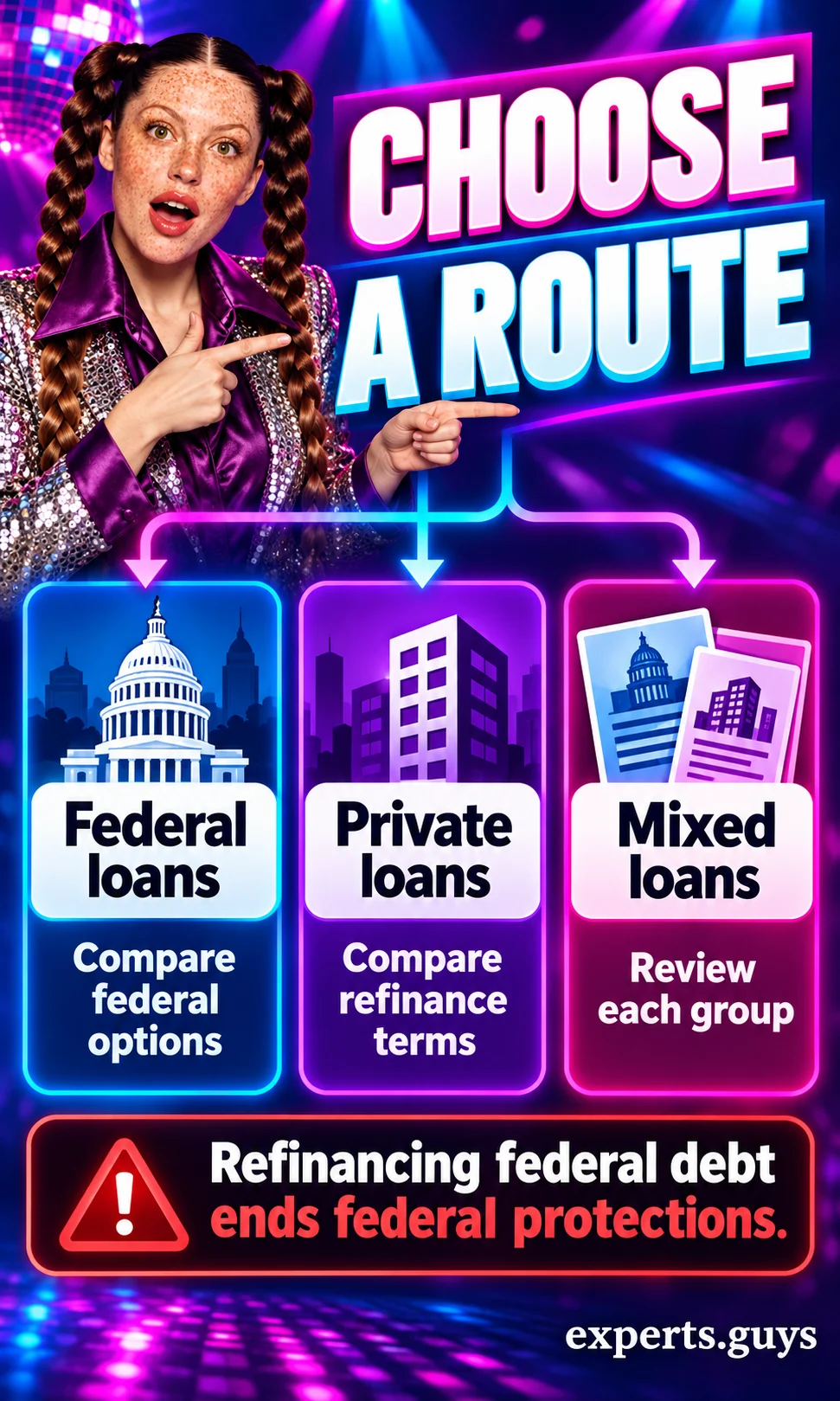
Student loan consolidation combines eligible federal loans into a new federal loan; refinancing replaces selected loans with a private loan on new terms. Start with the type of loans you hold: private loans cannot enter federal Direct Consolidation, and refinancing federal loans gives up their federal protections. If you have both types, you can compare refinancing for the private portion while keeping your federal loans separate.
The useful question is not simply which option produces one payment. It is which loans you should replace, what the replacement changes, and whether that trade improves your situation.
This guide covers U.S. student loans. Federal repayment choices depend on loan type and disbursement date, including the date of a new consolidation loan; the rules discussed here were checked on October 24, 2026.
- Federal loans: compare your current repayment arrangement with Direct Consolidation before considering a private replacement.
- Private loans: compare actual refinance terms against the loans you already have.
- Mixed loans: make a separate decision for each group; one payment is optional.
- Unclear loan type: identify it before requesting a replacement loan.
Which loans do you actually have?
Classify the debt before evaluating a product name. A private company can service a federal loan, and a lender may advertise “consolidation” when it means a private refinance.
The decisive detail is the loan program and agreement, not the company taking your payment. Direct, FFEL, and Perkins are federal loan categories; a private education loan follows its lender’s contract.
Build a digital loan inventory
Open your StudentAid.gov account and your current servicer statements side by side. Use a spreadsheet or a secure notes app to give each loan its own row, without copying account passwords or full account numbers.
- Record loan type, borrower, servicer, principal balance, unpaid interest, interest rate, and first disbursement date.
- Add the current payment, remaining term, repayment plan, and any recorded forgiveness progress. Mark variable rates and temporary discounts separately.
- Match the federal records to your statements. If a loan is missing or the type is unclear, ask the servicer to confirm the program and owner before labelling it private.

Your finished inventory should explain every payment leaving your bank account. If you cannot access a dashboard, start with downloaded statements and leave uncertain fields marked “confirm”; missing information is a reason to pause that loan’s decision, not to guess.
Use the following comparison to narrow the route. Neither column promises approval, a lower bill, or a better outcome for every borrower.
| Decision point | Federal Direct Consolidation | Private refinancing |
|---|---|---|
| Loans involved | Eligible federal loans | Eligible private loans and, with consequential trade-offs, federal loans |
| New loan | Federal Direct Consolidation Loan | Private education refinance loan |
| Rate mechanism | Weighted average of included rates, rounded up to the next one-eighth percentage point | Lender pricing based on its underwriting and selected terms |
| Federal protections | Loan remains federal, but eligibility and loan-specific benefits can change | Federal benefits end for any federal debt paid off |
| Main job | Change the federal loan structure when there is a concrete reason | Replace debt when the offered terms justify the change |
| Keep the current loans? | A valid alternative | A valid alternative |
What changes when you consolidate federal loans?
Direct Consolidation changes the loan structure rather than negotiating a market discount. It can simplify multiple federal payments or make certain loan types eligible for different federal options, but it can also change repayment eligibility, capitalize unpaid interest, and remove particular existing benefits.
Check the rate mechanism first
Multiply each included loan balance by its interest rate, add those products, and divide by the combined balance. Then round the resulting percentage up to the nearest 0.125 percentage point, as described in Federal Student Aid’s consolidation explanation.
For example, $10,000 at 4% plus $20,000 at 6% gives ($10,000 × 4 + $20,000 × 6) ÷ $30,000 = 5.333%. The consolidation rate rounds up to 5.375%; the larger 6% loan has more influence than the smaller 4% loan.

This example assumes no unpaid interest or special discounts. Your actual application can use different inputs, and unpaid interest that becomes principal increases the amount on which future interest is charged; confirm both the new balance and rate in the disclosure.
Check eligibility before submitting
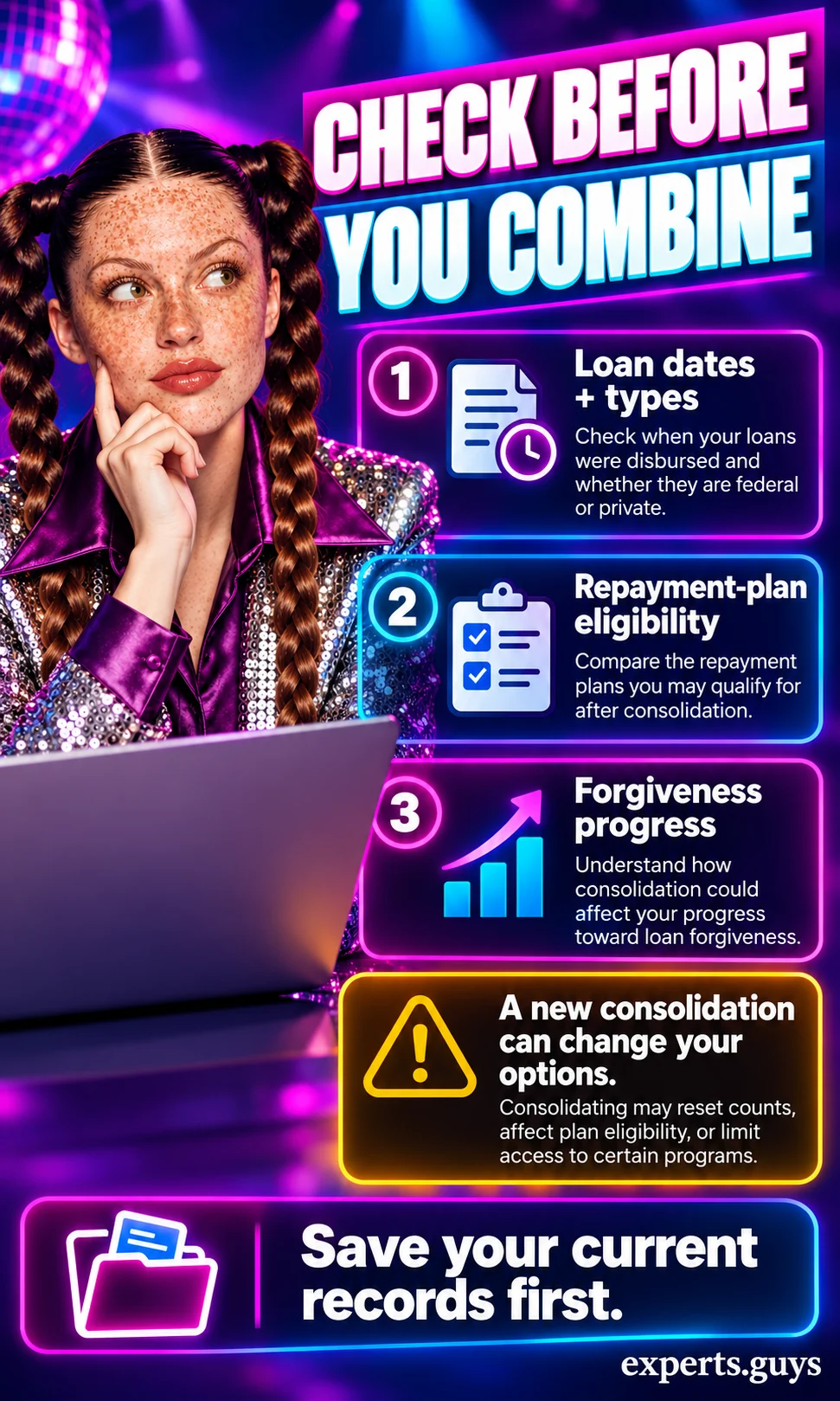
A new consolidation loan can narrow repayment choices. For consolidation loans made on or after July 1, 2026, the relevant new options are generally the Tiered Standard Plan and, when eligible, the Repayment Assistance Plan (RAP); a new consolidation containing Parent PLUS debt does not qualify for RAP. Do not assume that an older loan’s repayment-plan access carries into the new loan.
The effect may extend beyond the loans selected for consolidation, so compare the whole federal portfolio. The federal servicer’s repayment-plan comparison explains the date restrictions, while the official account-based calculator can show the plans available for your particular mix.
- Save the starting position: download current statements and save the displayed repayment plan and payment-count records.
- Compare eligibility: use the Federal Student Aid Repayment Calculator with your actual loans and compare the consolidation setting with the current arrangement. Check the new loan’s disbursement date and Parent PLUS history.
- Resolve benefit changes: check which payment credits, cancellation benefits, or rate reductions would change. Obtain an account-specific explanation for unresolved counts before submitting; do not assume either a universal reset or automatic full transfer.
A useful consolidation reason is specific: “This changes my eligible repayment options in a way I want.” “It sounds simpler” is weaker when the current loans are already manageable and the change would surrender valuable terms.
If your main problem is an unaffordable federal payment, compare available repayment plans before treating a private refinance as the answer. Loan replacement and repayment-plan selection are different decisions, and the latter may address the problem without converting federal debt into private debt.
When does refinancing improve the numbers?
Refinancing deserves a closer look when the offered contract improves the costs or terms you care about and the payment remains affordable. A quoted rate alone is insufficient: compare the same balance, remaining time, rate type, fees, and conditions for discounts. The broader student loan refinancing guide covers the full replacement-loan process; here, use the numbers to decide which loan group deserves further consideration.
For federal loans, there is an additional decision that arithmetic cannot settle. The CFPB explains the irreversible loss of federal protections when a private loan pays them off; the new lender’s hardship or discharge provisions are whatever its agreement provides.
Compare the same term, then test a longer one
Suppose a private loan has a $30,000 balance, a fixed 7% interest rate, and 120 monthly payments remaining. An illustrative fixed 5% refinance over the same 120 months lowers both the payment and scheduled interest, while extending the 5% loan to 180 months lowers the payment further but raises total interest above the original example.
| Illustrative scenario | Monthly payment | Remaining interest | Total remaining payments |
|---|---|---|---|
| Keep: 7%, 10 years | $348.33 | $11,799.05 | $41,799.05 |
| Refinance: 5%, 10 years | $318.20 | $8,183.59 | $38,183.59 |
| Refinance: 5%, 15 years | $237.24 | $12,702.86 | $42,702.86 |
These are calculations, not available offers: no fees, no extra payments, fixed rates, and monthly amortization. Totals use unrounded payments, so multiplying the displayed rounded payment may differ by a few cents; actual servicing can use daily interest and different payment timing.
- Enter the same payoff balance for both options. Use the current remaining term, not the original term from years ago.
- Compare an offered fixed interest rate over that same term; separately read the APR and fee disclosures. If there are fees or extra accrued interest, account for them before using the result.
- Test a longer term only after the equal-term comparison. Decide whether the cash-flow relief is worth the added time and possible extra cost.
- Check whether the required payment fits the money available after essential expenses. For variable-rate offers, examine the contract’s reset rules and cap instead of treating the opening rate as a lifetime rate.

Use this tool for fixed-rate, fixed-payment examples. It does not calculate income-driven payments, forgiveness, variable-rate changes, taxes, lender approval, or the value of federal protections; the term comparison above is also available if you prefer not to enter figures.
Compare the payment.
Check the total.
Test fixed-rate loan terms before deciding which debt to replace.

Start with the loan group. Use only the balance you intend to compare. This tool estimates fixed monthly payments, not federal income-driven plans or lender eligibility.
Your entries stay in this page. No account details, sign-in, or uploads are needed.
Example ready: compare $30,000 at 7% with 5%, both over 120 months. Select “Compare terms” to see the calculation.
A result showing lower total payments is a reason to inspect the offer, not an instruction to accept it. If you have selected the private route, the ELFI refinancing review covers that lender’s separate fit and application questions.
How do you move forward without replacing the wrong loans?
Define the exact loans to replace before beginning the application. A useful decision can be partial: keep federal debt under its existing arrangement, refinance eligible private debt, and leave an unusually low-rate private loan alone if replacing it adds no value.
Keep mixed loans in separate groups
Imagine $24,000 of federal loans and $16,000 of private loans. You can request a refinance comparison for the $16,000 private group without including the federal balance; that leaves the federal loans outside the private transaction, although you still need to manage both groups’ payments.

Match the loans listed in the application to your inventory before agreeing to the replacement. If the lender’s minimum amount or eligibility rules prevent the combination you want, change the comparison or keep the existing loans rather than adding federal debt merely to meet a threshold.
Parent PLUS debt also needs a borrower-identity check. Federal consolidation does not transfer a parent’s debt to the child; lender-specific transfer or refinance questions belong in the Parent PLUS refinancing guide, after the federal-benefit trade-off is clear.
Verify the application and payoff handoff
- Review the final terms: match every included loan, payoff amount, borrower, interest-rate type, repayment term, fee, discount condition, and first-payment instruction to your intended decision. Save the disclosures digitally.
- Keep required payments going: an application does not cancel existing obligations. For federal consolidation, the servicer instructs borrowers to continue until payoff notice; follow the existing and new lenders’ instructions through a private refinance as well.
- Confirm completion: verify that the selected old loans show paid-off status, investigate any remaining balance, and confirm the new servicer, due date, and payment method. Update automatic payments only after checking the handoff, and save both confirmations.

If a balance remains, ask whether it is residual interest, an incomplete payoff, or a posting delay before assuming the old account is finished. Completion means the selected old obligations and the new payment instructions reconcile, not merely that an application says “approved.”
Frequently asked questions
Is private consolidation different from refinancing?
Often the terms describe the same transaction: a private lender pays off selected education loans and issues a new private loan. Confirm who issues the replacement and what contract applies; “consolidation” in a product name does not make it federal Direct Consolidation.
Do I have to include every loan?
No. Federal consolidation can include selected eligible loans, and a private lender may allow selected eligible loans to be refinanced subject to its rules. Excluding a loan from federal consolidation does not necessarily shield it from borrower-level repayment eligibility changes.
Can I turn a private refinance loan back into a federal loan?
No. A private refinance loan cannot be placed into federal Direct Consolidation to recover the federal status of debt it paid off. Treat the decision to privately refinance federal loans as permanent.
Can consolidation help if a federal loan is in default?
It can be one route, subject to the program’s conditions, but default resolution has additional consequences and alternatives such as rehabilitation. Compare those options with the loan holder before using an ordinary refinancing comparison as a decision guide.
Does one payment prove I am saving money?
No. One payment describes billing convenience. Savings require comparing the remaining cost under each arrangement, while also considering the rights and options you give up.
What if my best choice is to do nothing?
Keeping the current loans is a valid outcome when the replacement does not improve the terms you need. Revisit the comparison when your offered rate, financial position, or repayment eligibility materially changes, rather than replacing a loan solely to simplify its label.
Your next-action checklist
- Identify every loan and mark uncertain details for confirmation.
- For federal debt, compare eligibility and benefits before creating a new loan.
- For private debt, compare equal-term costs before testing a smaller payment.
- Select only the loans you intend to replace, then verify the payoff handoff.
Start with the inventory, not an application. Once each loan has a clear type and purpose in your plan, the choice between consolidation, refinancing, and keeping it becomes much easier to defend.