

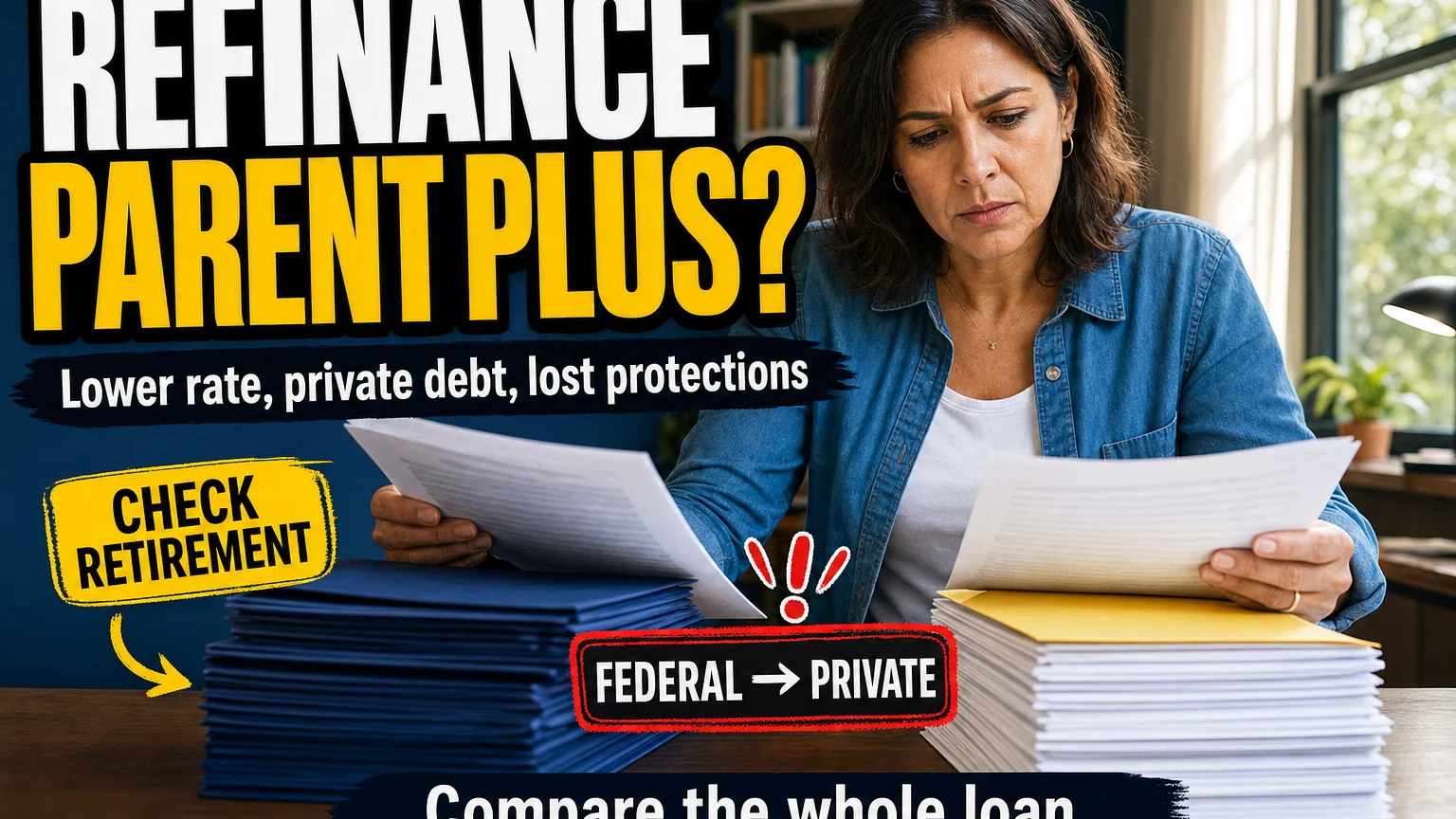

Parent PLUS refinancing can make sense when a parent has expensive education debt, stable income, strong credit and little need for federal repayment protections, but the decision carries more weight than simply finding a lower interest rate. Refinancing replaces the existing Parent PLUS loan with a new private loan, so the interest rate, monthly payment, repayment term and borrower protections can all change at once. The right question is whether the new structure genuinely improves the family’s finances without giving up something valuable.
ELFI allows eligible Parent PLUS loans to be refinanced through its private student loan refinancing program, and its dedicated parent loan refinancing information explains that parents can refinance eligible education debt rather than being limited to the original federal repayment arrangement. That can create a lower rate or a different payment structure for a qualified borrower, although approval and pricing still depend on underwriting rather than the fact that the debt is Parent PLUS debt.
The biggest decision comes before comparing rates. A federal Parent PLUS loan carries federal status, while an ELFI refinance creates private debt, so refinancing can remove access to federal repayment and relief options that may still matter to the parent. Federal Student Aid’s explanation of federal and private student loans is worth reviewing before replacing federal debt, particularly when income, retirement timing, employment or family finances could change during repayment.
Before You Look at an ELFI Rate, Answer These Questions
- Is the Parent PLUS loan still federal? If it is, understand exactly which federal protections would disappear after a private refinance.
- How many years are left on the current loan? A lower payment can become misleading when it is created by restarting repayment over a much longer term.
- Is the parent likely to retire before the new loan is paid off? A payment that feels manageable today can become harder to carry after employment income changes.
- Could the loan realistically be paid faster without refinancing? An aggressive payment strategy on the existing debt may sometimes produce a better result than replacing the loan.
- Is the family trying to move responsibility for the debt to the student? That is a different decision from simply reducing the parent’s rate and needs to be evaluated separately.
- Would the parent need a cosigner on the new refinance? Adding another person changes the legal and financial responsibility for the debt.
What Happens When You Refinance a Parent PLUS Loan With ELFI?
The refinance process pays off the eligible existing loan and creates a new private student refinance loan under the terms approved by ELFI. The old Parent PLUS debt is therefore no longer repaid according to its original federal agreement once the refinance is completed. Your new payment is determined by the refinanced balance, approved APR and repayment term.
That distinction matters because Parent PLUS refinancing is different from federal Direct Consolidation. Federal consolidation keeps qualifying debt inside the federal loan system and generally combines eligible federal loans into a new Direct Consolidation Loan, whereas private refinancing replaces eligible debt with a private loan. Federal Student Aid’s explanation of consolidation and refinancing provides a useful official distinction between those two actions.
A private refinance can still be financially attractive when the current Parent PLUS interest rate is considerably higher than the private rate available to the borrower. Parents with strong credit and stable finances may be able to reduce the cost of carrying the debt, especially when substantial principal and several years of repayment remain. The saving should be measured using the complete repayment path rather than the interest rate by itself.
The monthly payment deserves the same scrutiny. Extending repayment can reduce the required monthly amount even when the new loan does not create the best lifetime cost. For a parent approaching retirement, that can produce an uncomfortable trade-off because today’s lower payment may keep the debt active further into the years when household income could be lower.
Family responsibility adds another layer that is easy to overlook. The parent may view the debt as an education expense they intend to carry personally, while the graduate may plan to contribute informally or assume more responsibility later. Before refinancing, it helps to separate the legal borrower from the person who intends to make the payments because those two roles are not always the same.
| Decision Point | Keep Parent PLUS Federal | Refinance With ELFI | What to Think About |
|---|---|---|---|
| Loan status | Remains federal | Becomes private | Federal benefits can be more valuable than a modest rate reduction. |
| Interest rate | Existing federal rate remains | New rate based on private underwriting | A meaningful rate reduction can matter when a large balance remains. |
| Payment | Depends on the federal repayment arrangement | Determined by new APR and refinance term | A lower payment can come from a longer repayment period. |
| Federal repayment protections | Potentially available subject to federal rules | No longer federal | Consider future income uncertainty before replacing the debt. |
| Retirement exposure | Depends on current federal payment path | Can be reduced or extended depending on term | Compare the payoff date with the parent’s expected retirement timeline. |
ELFI Parent PLUS Refinancing Eligibility
ELFI’s standard refinancing requirements still matter when the debt happens to be Parent PLUS debt. ELFI’s current refinancing eligibility requirements include financial and credit criteria that the applicant must satisfy, and approval is ultimately based on the complete underwriting profile rather than the education-loan type alone. That means the parent should think in terms of both loan eligibility and borrower eligibility.
The refinance amount also matters. ELFI’s standard student loan refinancing program requires at least $10,000 to refinance, so a parent with a relatively small remaining Parent PLUS balance may not fit the standard program even when the rest of the financial profile is strong. This becomes increasingly relevant late in repayment when the balance has already been reduced substantially.
Credit quality can determine whether refinancing produces enough benefit to justify the change. A parent with stronger credit may receive a much more attractive private rate than someone whose credit profile has weakened because of mortgages, credit-card balances, recent borrowing or reduced income. Meeting a minimum standard does not guarantee the lender’s lowest advertised APR.
Income and debt obligations matter for another reason. Parent borrowers are often further along in their financial lives than recent graduates, which means the refinance application may sit alongside a mortgage, retirement contributions, other children’s education costs, car loans and household obligations. The most important question is not simply whether ELFI approves the loan, but whether the resulting payment still fits the parent’s broader financial plan.
Retirement timing deserves special attention because Parent PLUS debt can remain outstanding into a parent’s later working years. Extending a refinance for the sake of lowering the payment can push the payoff date closer to or beyond retirement, which may reduce monthly pressure today while creating a less comfortable future obligation. A shorter term can solve that problem but may require a considerably higher monthly payment.
Finally, the family should decide whether the parent is refinancing for a genuinely better loan or mainly because the current payment feels emotionally burdensome. Refinancing can improve debt terms, but it cannot make a large education balance disappear. Separating rate improvement from payment relief helps prevent a longer term from being mistaken for a major financial saving.
Can ELFI Move Parent PLUS Debt From the Parent to the Student?

This question deserves more care than a normal rate comparison because changing who legally owes the debt is a different decision from simply refinancing the parent’s loan. A Parent PLUS loan begins as the parent’s federal obligation, even when the education benefited the child and the family informally expects the graduate to help with payments. Any private refinance that changes the legal borrower should therefore be confirmed against the lender’s current application rules rather than assumed from the word “refinance.”
The broader family question is still useful even when legal responsibility stays with the parent. Some families want the parent to continue carrying the obligation but reduce the rate, while others want the graduate eventually to assume more responsibility as income grows. Those two goals can produce different loan choices, different underwriting needs and different expectations about payment timing.
If transferring responsibility is important, verify ELFI’s current borrower structure directly before applying. The lender’s parent loan refinancing information should be treated as the current source for who may apply and how eligible parent education debt can be refinanced because this product detail can change over time. Do not base a family debt-transfer plan on an old review or an assumption that every private lender handles Parent PLUS debt the same way.
A Lower Interest Rate Is Valuable Only if the Rest of the Loan Still Works
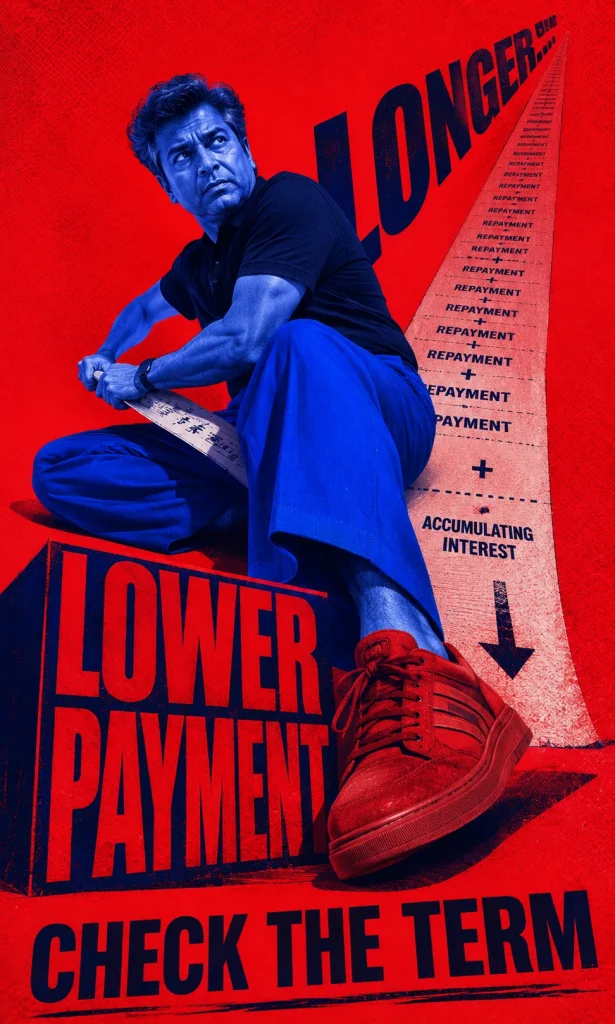
Interest rate savings are most powerful when a large balance remains and the refinance does not dramatically extend repayment. Cutting a high Parent PLUS rate by a meaningful amount can reduce the amount of interest that accumulates over several years. The benefit becomes smaller when little principal remains or when the parent intends to repay the debt aggressively regardless of the required payment.
The repayment term can overwhelm the rate advantage when it changes too much. A refinance from a higher-rate loan with seven years remaining into a lower-rate 10-year loan may reduce the monthly payment while keeping the parent in debt longer than the existing payoff path. That can be a rational cash-flow choice, but it should be described as such rather than presented as automatic savings.
A Parent PLUS Refinance Should Pass These Financial Checks
- The new APR is meaningfully lower, rather than only a few basis points below the current effective rate.
- The new payoff date fits the parent’s working and retirement timeline.
- Estimated lifetime interest improves, unless the family intentionally accepts a higher total cost in exchange for needed monthly cash-flow relief.
- Emergency savings remain intact after choosing the new scheduled payment.
- The parent is comfortable losing federal status on every federal loan included in the refinance.
- The family understands who is legally responsible for the replacement debt.
- The refinance still works if household income falls, rather than depending on an unusually strong current year.
What Federal Options Could You Lose by Refinancing Parent PLUS Loans?

Federal Parent PLUS loans do not have the same repayment menu as every other federal student loan, but federal status still matters. Depending on the borrower’s circumstances and the applicable federal rules, consolidation and federal repayment structures may provide options that cease to exist once the debt becomes private. That is why the federal decision should be made before the lender decision.
The federal student loan repayment options available through Federal Student Aid are the better place to review current federal repayment arrangements than relying on a private refinance page to describe them. Federal repayment rules can change, and eligibility can depend on the type of loan, consolidation status and borrower circumstances. A private lender cannot restore federal status after the debt has been refinanced privately.
This trade-off becomes especially important when the parent’s income could change. Retirement, reduced working hours, caregiving, health events or a spouse leaving the workforce can alter the household’s capacity to make a fixed private payment. A lower rate today may still be worthwhile, but the decision should account for future financial flexibility rather than using current income as though it will remain unchanged indefinitely.
| Situation | Refinancing Looks Stronger When… | Keeping Federal Debt Deserves More Weight When… |
|---|---|---|
| Interest cost | The new APR produces substantial projected savings. | The refinance saves very little once term length is considered. |
| Income stability | Income is predictable and the private payment remains comfortable. | Retirement or reduced income may materially affect future affordability. |
| Repayment timeline | The new term keeps or shortens a reasonable payoff date. | The refinance pushes debt far into retirement. |
| Federal flexibility | Federal protections have little expected value to the borrower. | The borrower may need federal repayment or relief options. |
Should You Refinance Every Parent PLUS Loan at Once?
There is no requirement that the best strategy must involve every eligible loan. A parent with several education loans may find that one or two carry unattractive rates while another already has acceptable terms or benefits worth preserving. Selective refinancing can therefore be more useful than treating the entire education-debt portfolio as one package.
That approach can be particularly valuable when the parent holds both federal and private education debt. Expensive private loans may be candidates for refinancing without touching federal Parent PLUS loans that the family prefers to keep inside the federal system. The decision should be made loan by loan before combining everything into a single replacement obligation.
Refinancing only part of the debt also gives the family more control over repayment timing. A parent may decide to refinance the highest-cost loans aggressively while maintaining a separate payment structure for the remaining debt. The extra administrative complexity can be worthwhile when it preserves a meaningful financial advantage.
How Retirement Changes the Parent PLUS Refinance Decision

Parent PLUS refinancing is unusually sensitive to age and retirement timing because the borrower is often decades further into their working life than the student whose education produced the debt. A younger graduate can reasonably think about a decade-long repayment horizon very differently from a parent who expects to stop working in eight years. The same loan term can therefore carry very different practical risk.
The useful comparison is between the loan payoff date and the parent’s expected income path. If a refinance lowers the payment but moves the final payment several years beyond retirement, estimate whether the payment would still be comfortable on retirement income. A loan that only works while the parent is earning a full salary is not automatically safer because its APR is lower.
The opposite situation can also occur. A strong lower-rate refinance with a shorter term may allow the parent to eliminate the debt before retirement while paying less interest overall. That can be a particularly valuable outcome because it removes a fixed monthly obligation before household income changes.
ELFI Parent PLUS Refinance Check
Parent PLUS refinancing can look attractive when the new rate is lower, but the monthly payment alone does not tell you whether the refinance is actually better. A longer term can reduce the payment while keeping the debt around for more years, and federal Parent PLUS debt also loses its federal status when it is privately refinanced.
Use the check below to compare your current Parent PLUS payment path with an estimated ELFI refinance. It will show how the new offer could affect your monthly payment, estimated interest, time in debt and whether the balance may still be outstanding when you expect to retire.
ELFI Parent PLUS Refinance Check
Compare your current Parent PLUS debt with an estimated ELFI refinance, then see how the payment, total interest, retirement timing and federal-to-private trade-off change together.
Where Are You Starting?
Use the figures from the balance you are seriously considering refinancing.
The payment estimates the real payoff path. The remaining term acts as a reasonableness check, so the result can flag figures that do not line up closely.
Enter the ELFI Offer You Want to Compare
Use your actual prequalified APR when available.
The comparison treats the starting APR as unchanged. Actual payment and interest can differ if the rate changes later.
Will the New Loan Still Fit Your Life?
A lower rate can still be a poor fit if the debt lasts too long or federal flexibility matters to you.
A private refinance changes the refinanced balance into private debt. That trade-off is part of the decision even when the interest math looks favorable.
Your refinance result
Educational estimate only. This is not a loan offer or financial advice. Actual underwriting, repayment rules, variable-rate changes and federal options can produce different results.
Treat the result as a comparison rather than an automatic recommendation. The strongest refinance is one that improves the cost of the debt while still fitting the parent’s future income, retirement timing and need for federal repayment flexibility.
When ELFI Parent PLUS Refinancing Could Make Sense
ELFI can be worth considering when the parent has strong enough credit to receive a meaningfully better rate, a substantial balance remains and federal protections are unlikely to be important. The strongest case usually involves several improvements occurring together: lower estimated interest, a manageable payment and a payoff date that still fits the parent’s financial timeline. That is much more persuasive than a refinance whose only visible benefit is a smaller monthly bill.
Refinancing can also be useful when the parent wants a clearer private repayment structure and is comfortable making the trade from federal to private debt. A stable household with adequate emergency savings and predictable income can evaluate that trade differently from a family expecting major income changes. The same refinance offer can therefore be suitable for one parent and inappropriate for another.
When Keeping Parent PLUS Federal May Be Better
Keeping the existing federal debt deserves serious consideration when federal repayment flexibility has meaningful potential value. Parents approaching retirement, households with uncertain future income, or borrowers evaluating federal repayment options may have more to lose from converting the debt permanently into a private obligation. A modest rate reduction may not compensate for that loss.
Keeping the current loan can also make sense when little time remains before payoff. If the parent is already several years into an aggressive repayment schedule, restarting the debt with a long refinance term can create a more attractive payment while weakening the total-cost outcome. The remaining balance and remaining years matter as much as the headline interest rate.
There is also nothing wrong with waiting when the refinance quote is mediocre. Credit scores, income, debt obligations and market rates can change, so today’s offer does not have to become today’s loan. Refinancing is most useful when the improvement is clear enough to justify replacing the existing debt.
Final Verdict: Is ELFI Parent PLUS Refinancing Worth Considering?
ELFI Parent PLUS refinancing is worth checking when a parent wants to reduce an expensive education-loan burden and has the financial profile to qualify for a materially better private refinance. The strongest offers lower estimated lifetime interest without creating an uncomfortable repayment term or pushing debt further into retirement than the family wants. Those are measurable improvements rather than cosmetic changes.
The federal-to-private transition remains the central limitation. Parent borrowers should review current federal options before replacing Parent PLUS debt because private refinancing removes federal status from the refinanced amount. Once that decision is understood, ELFI’s actual APR, payment and term can be compared against the current loan on equal footing.
For families debating whether the parent should continue carrying the debt or whether responsibility should eventually shift toward the graduate, handle that question separately from the interest-rate comparison. The cheapest loan and the fairest family arrangement are not always the same decision. Clarifying both before signing can prevent a financially attractive refinance from creating a family obligation nobody fully intended.
Frequently Asked Questions About ELFI Parent PLUS Refinancing
Can ELFI refinance Parent PLUS loans?
ELFI currently includes eligible Parent PLUS debt within its parent loan refinancing program. Approval still depends on the applicant satisfying ELFI’s underwriting and eligibility requirements, so having a Parent PLUS loan does not guarantee acceptance or a particular rate. Compare the actual approved terms with the existing federal loan before deciding to refinance.
Does refinancing a Parent PLUS loan with ELFI keep it federal?
No. Private refinancing pays off the eligible federal debt and replaces it with a private refinance loan. That means federal repayment and borrower protections attached to the refinanced debt can be lost, so the federal-to-private change should be evaluated before focusing on the new interest rate.
What is the minimum amount for an ELFI Parent PLUS refinance?
ELFI’s standard student loan refinancing program currently requires at least $10,000 of eligible debt to refinance. A parent whose remaining balance has already fallen below that level may therefore need to keep the existing loan or compare other eligible options. Always confirm the current minimum directly with the lender before applying because product requirements can change.
Should I refinance Parent PLUS loans before retirement?
It can make sense when the refinance lowers the total cost and produces a payoff schedule that fits comfortably before or during retirement. A lower monthly payment deserves extra caution when it is created by extending the debt well beyond your expected working years. Compare the payoff date with your anticipated retirement income rather than evaluating the payment against today’s salary alone.
Can I refinance only some of my Parent PLUS loans?
Selective refinancing may be possible when the lender accepts the specific loans and refinance amount you choose. Refinancing only the highest-cost debt can sometimes preserve useful federal loans while improving the most expensive portion of the family’s education debt. Confirm which individual loans will be included before signing the refinance agreement.
Is a lower ELFI payment always better than my current Parent PLUS payment?
No. A lower payment can result from a lower interest rate, a longer repayment period, or both. Compare estimated lifetime interest and the new payoff date before deciding whether the lower monthly amount represents a genuine improvement or simply spreads the same debt across more years.
Can I refinance an ELFI Parent PLUS refinance again later?
A private refinance loan can generally be refinanced again when the debt remains eligible and the borrower qualifies with the next lender. That may become useful if credit improves or better market rates become available. Another refinance should still be evaluated on APR, repayment term and total cost rather than assuming a second refinance automatically creates savings.
Action Checklist Before Applying
Before applying, collect the current balance, APR, monthly payment and estimated payoff date for every Parent PLUS loan you are considering. Then compare those figures with the ELFI offer using the same refinance balance so that the new payment cannot hide the effect of a longer term. If the parent expects to retire during the proposed repayment period, include that milestone in the comparison.
Review federal repayment options separately before converting any federal Parent PLUS debt into a private loan, and decide whether refinancing all of the balance is actually necessary. Finally, confirm who will legally owe the replacement debt, who will realistically make the payments, and how the family would handle the obligation if income changes. A refinance is strongest when the financial improvement and the family responsibility are both clear.