
The Misunderstanding That Distorts Most AI Discussions
When people ask how AI makes decisions, they often imagine a simplified version of human reasoning.
They assume AI:
- evaluates evidence
- weighs alternatives
- selects the best outcome
This framing is incorrect.
AI systems do not evaluate evidence in the way humans do. They do not deliberate. They do not reason internally with intention.
They generate outputs based on statistical probability.
Understanding this difference removes much of the confusion surrounding AI confidence, AI errors, and AI limitations.
AI Does Not Decide – It Predicts
The word “decision” implies agency.
AI systems do not possess agency. They perform prediction.
At its core, a large language model performs one operation repeatedly:
Given this input, what output is most statistically likely?
Every sentence generated is the result of probability ranking across potential next tokens.
This process happens at massive scale, across layered neural weights trained on enormous datasets.
But the mechanism remains predictive.
There is no internal awareness of consequence.
Why prediction feels like reasoning
When predictions align with structured logic, the output appears reasoned.
If patterns in training data consistently pair certain premises with certain conclusions, the model reproduces that relationship.
From the outside, this resembles inference.
Internally, it remains pattern continuation.
This architectural difference becomes clearer when comparing AI vs human decision-making under uncertainty.
This distinction explains why AI can appear deeply analytical in structured domains yet fail abruptly in edge cases.
The Three Core Layers of AI Decision Generation
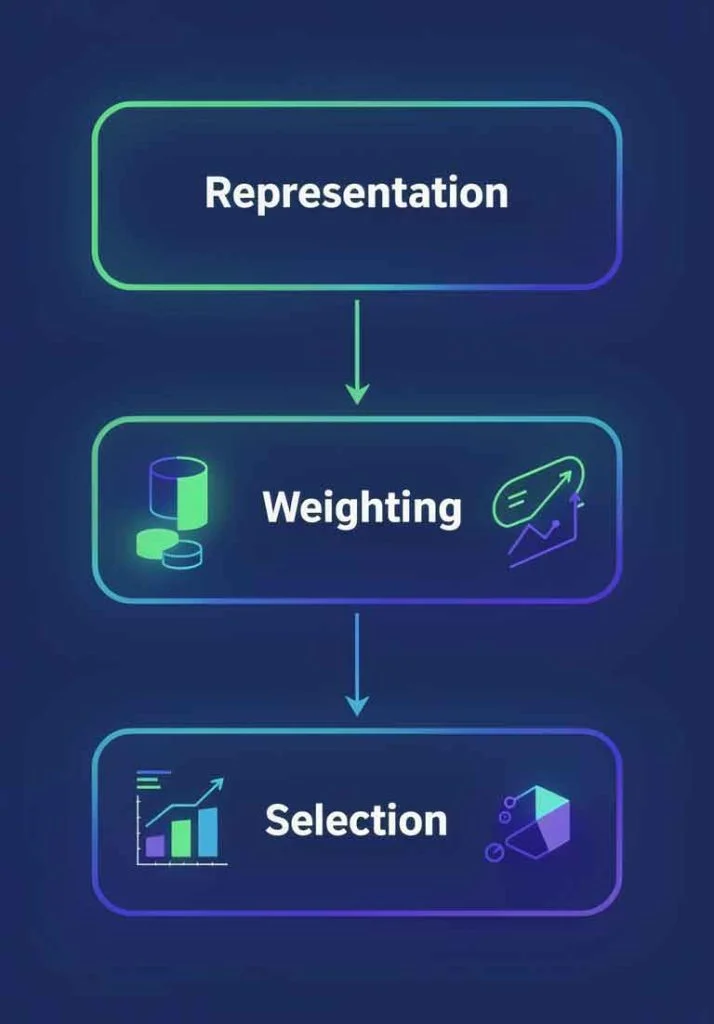
Although AI systems are complex, their output process can be simplified into three conceptual layers.
This simplification does not capture every technical detail, but it clarifies how decisions emerge.
Layer 1 – Representation
Before prediction, inputs must be transformed into numerical representations.
Text becomes tokens.
Tokens become vectors.
Vectors represent relationships in multidimensional space.
Meaning is not stored as definitions. It is stored as relative position among patterns.
Layer 2 – Pattern Weighting
Neural networks apply learned weights across these representations.
These weights encode statistical relationships:
- If X appears, Y often follows
- If context shifts, probability ranking shifts
This weighting process is what people loosely call “learning.”
In reality, it is probability adjustment across training distributions.
Layer 3 – Probabilistic Selection
Finally, the system selects the most probable next element.
Depending on configuration, it may:
- Choose the highest probability token
- Sample among top candidates
- Balance diversity and coherence
This final selection produces output that appears intentional.
But it remains statistical selection.
Why Confidence Emerges Without Certainty
One of the most persistent misunderstandings is equating fluency with accuracy.
AI systems produce fluent output because they optimize for pattern coherence.
Confidence in language emerges when probability distributions strongly favor specific token sequences.
High probability does not equal correctness.
It equals pattern dominance.
This is why AI output can sound authoritative even when the underlying probability of truth is moderate.
Training Data Shapes Decision Boundaries
AI systems do not form beliefs.
They internalize statistical relationships derived from training data.
This distinction matters because decision boundaries are not consciously set. They emerge implicitly from data distribution.
What training actually encodes
During training, models adjust internal weights to reduce prediction error across billions of examples.
The system does not store facts directly.
It stores pattern relationships between representations.
If certain structures, claims, or reasoning styles appear frequently, they receive higher statistical reinforcement.
This creates a learned landscape of likelihood.
Why this creates invisible bias
Bias in AI systems is often misunderstood as intentional distortion.
More accurately, bias emerges from:
- Overrepresentation of certain patterns
- Underrepresentation of others
- Cultural distribution within training data
The model reflects statistical frequency, not normative correctness.
This is not a flaw unique to AI. It is a property of pattern learning.
However, when decisions depend on fairness or context sensitivity, statistical dominance may conflict with contextual appropriateness.
Distribution Shift – Where AI Begins to Hallucinate

One of the clearest structural limits of AI decision systems is distribution shift.
Distribution shift occurs when:
- The input environment differs significantly from training data
- Context moves outside statistical familiarity
- Edge cases dominate the scenario
When distribution shifts, AI systems do not become silent.
They continue generating output based on nearest statistical approximation.
This produces what is commonly called hallucination.
Hallucination is not randomness
Hallucination does not mean the system invents content arbitrarily.
It means:
- The model lacks grounded pattern alignment
- It still must produce a probabilistic output
- Coherence is prioritized over abstention
Humans encountering unfamiliar territory often signal uncertainty.
AI systems typically do not.
This difference amplifies risk under unfamiliar conditions.
Distribution shift is one of the clearest indicators of when not to use AI as a decision authority.
Why AI Cannot Fully Model Consequence
AI systems predict outputs.
They do not simulate downstream reality.
This distinction separates output generation from outcome evaluation.
Output vs outcome
An output is:
- A structured response
- A ranked probability sequence
- A coherent continuation
An outcome is:
- What happens after action
- The real-world impact
- The consequence of implementation
AI does not experience outcome.
It does not update internal state based on lived consequence unless retrained externally.
Humans integrate consequence directly into future decisions.
This feedback loop shapes judgment over time.
The absence of lived calibration
Humans adjust after:
- Failure
- Social reaction
- Reputation impact
- Moral discomfort
AI systems adjust only through retraining processes.
They do not internalize experience.
This explains why AI can repeatedly generate structurally similar mistakes across contexts.
Why Optimization Can Create Blind Spots
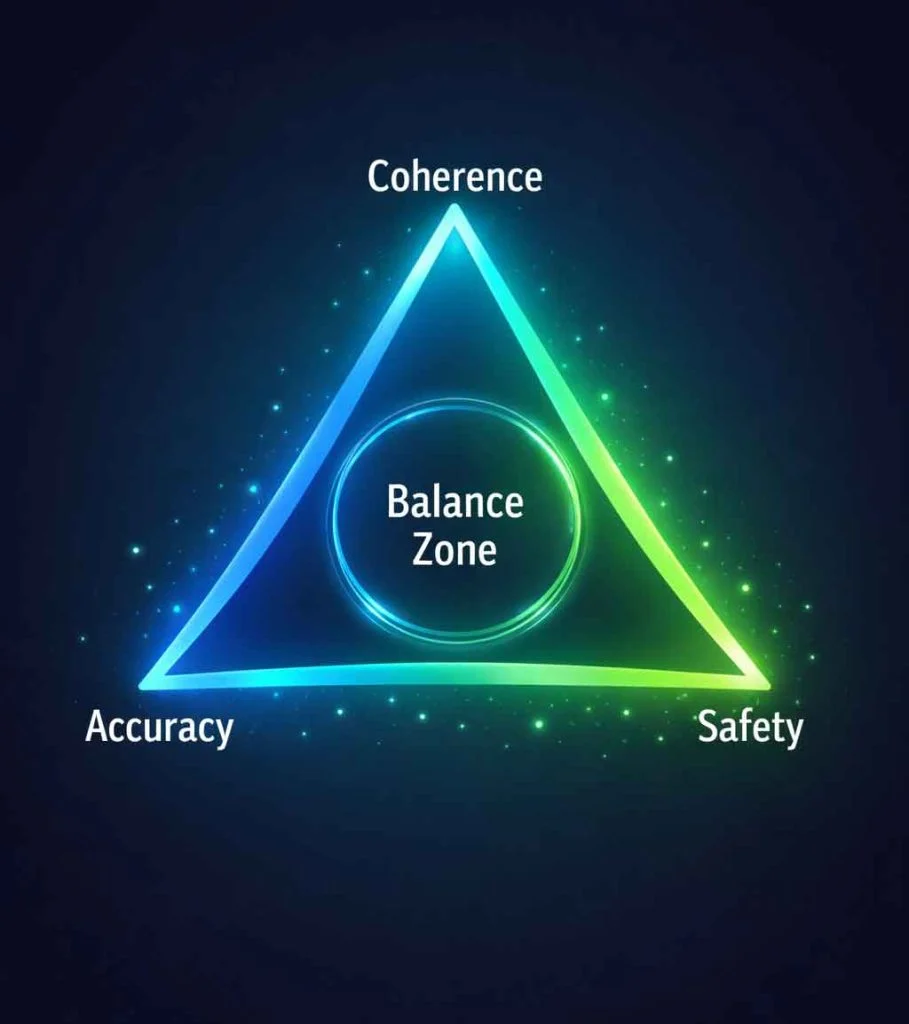
AI systems are trained to optimize specific objectives.
These objectives may include:
- Prediction accuracy
- Coherence
- Reinforcement reward alignment
Optimization narrows focus.
When a system optimizes strongly for one metric, it may neglect adjacent dimensions.
The trade-off problem
For example:
- Optimizing for fluency may reduce transparency
- Optimizing for helpfulness may increase speculation
- Optimizing for safety may reduce completeness
No optimization target captures all dimensions simultaneously.
This is not incompetence. It is mathematical trade-off.
Understanding this prevents over-attribution of capability.
Why Scaling Does Not Eliminate Limits
Larger models often perform better across benchmarks.
However, scaling primarily improves:
- Pattern coverage
- Statistical smoothing
- Fluency stability
Scaling does not fundamentally change:
- The predictive architecture
- The probabilistic nature of output
- The absence of consequence modeling
This means limits shift, but they do not disappear.
Distribution shift remains possible.
Optimization trade-offs remain structural.
Understanding this distinction prevents overgeneralization of capability.
The Interpretability Problem
One of the most persistent misconceptions about AI decisions is the belief that explanations reflect internal reasoning.
In reality, AI explanations are themselves generated outputs.
They do not necessarily reveal the internal weight interactions that produced the original response.
This creates a gap between:
- What the model actually computed
- What it can plausibly describe
The explanation is optimized for coherence, not for transparency.
Why this matters
If a system produces a flawed decision and then generates a convincing explanation, users may overestimate reliability.
Humans often treat explanation as evidence of reasoning.
In AI systems, explanation is often pattern continuation layered over pattern continuation.
The appearance of introspection does not imply internal awareness.
This interpretability gap deepens the contrast between AI vs human decision-making under complex conditions.
Confidence vs Calibration

Human decision systems often reveal uncertainty through hesitation.
AI systems rarely do.
What calibration means
Calibration refers to alignment between confidence and correctness.
A well-calibrated system expresses lower confidence when error probability rises.
Humans, though imperfect, frequently signal uncertainty linguistically:
- “This depends.”
- “I may be wrong.”
- “More context is needed.”
AI systems require explicit configuration to approximate similar behavior.
Why miscalibration is risky
If a system consistently expresses high confidence regardless of distribution familiarity, users may assume reliability even in fragile contexts.
The result is not intentional deception.
It is structural miscalibration.
Understanding this prevents misinterpretation of fluency as certainty.
The Boundary of Mechanism
After examining prediction layers, distribution shift, optimization trade-offs, and interpretability limits, a pattern emerges.
AI decision systems:
- Predict based on statistical representation
- Optimize for defined objectives
- Generate coherent output
- Lack intrinsic consequence modeling
- Do not experience uncertainty
These properties define their architecture.
They do not imply weakness.
They imply boundary.
Mechanism is not intention
AI does not “choose” in the human sense.
It computes.
This computation can outperform humans in structured domains.
It cannot replicate human contextual interpretation without explicit framing.
The limitation is not intelligence. It is architecture.
Why Understanding Mechanism Reduces Overreaction
Misunderstanding mechanism produces two extreme reactions:
- Overtrust
- Overfear
Overtrust assumes AI understands context and consequence.
Overfear assumes AI possesses intention or agency.
Both reactions misinterpret predictive architecture as something else.
When mechanism is clear, both extremes soften.
AI becomes:
- A probabilistic tool
- A scale amplifier
- A pattern engine
Not a replacement for judgment.
inal Synthesis – Capability Within Constraint
The purpose of understanding how AI makes decisions is not to diminish its value.
It is to align capability with constraint.
AI systems:
- Predict effectively within known distributions
- Optimize structured objectives
- Scale beyond human bandwidth
They do not:
- Deliberate with intention
- Internalize consequence
- Self-detect boundary violations
Recognizing these limits is not resistance.
It is calibration.
In environments where pattern dominates, AI excels.
In environments where context, consequence, and responsibility dominate, humans remain essential.
Understanding mechanism transforms AI from a mystified entity into an engineered system.
Engineered systems perform best when deployed within their architectural boundaries.
Frequently Asked Questions
Does AI actually understand what it is deciding?
AI systems do not understand decisions in a human sense. They predict statistically likely outputs based on learned pattern relationships. The appearance of reasoning emerges from structured probability rather than conscious evaluation.
Why does AI sound confident even when it is wrong?
Confidence in AI output reflects strong probability ranking, not certainty. When statistical dominance is high, language becomes fluent and authoritative, even if real-world correctness is moderate or contextually incomplete.
What causes AI hallucinations?
Hallucinations often occur during distribution shift, when input conditions differ from the model’s training patterns. The system continues generating coherent output despite lacking strong statistical grounding for the specific scenario.
Can scaling larger AI models remove structural limits?
Scaling improves pattern coverage and fluency stability, but it does not change the predictive architecture. Limits related to consequence modeling, optimization trade-offs, and contextual interpretation remain structural.
Why can AI explanations be misleading?
AI explanations are themselves generated outputs. They are optimized for coherence rather than transparency into internal weight interactions. This can create the appearance of introspection without revealing true computation pathways.
Is AI capable of learning from real-world consequences?
AI systems adjust through retraining and data updates, not through lived experience. They do not internally experience consequence or moral discomfort in the way human decision-makers do.
What is the most important limit of AI decision systems?
The most important structural limit is the absence of intrinsic consequence modeling. AI predicts outputs but does not internally simulate downstream impact unless explicitly programmed into feedback loops.