
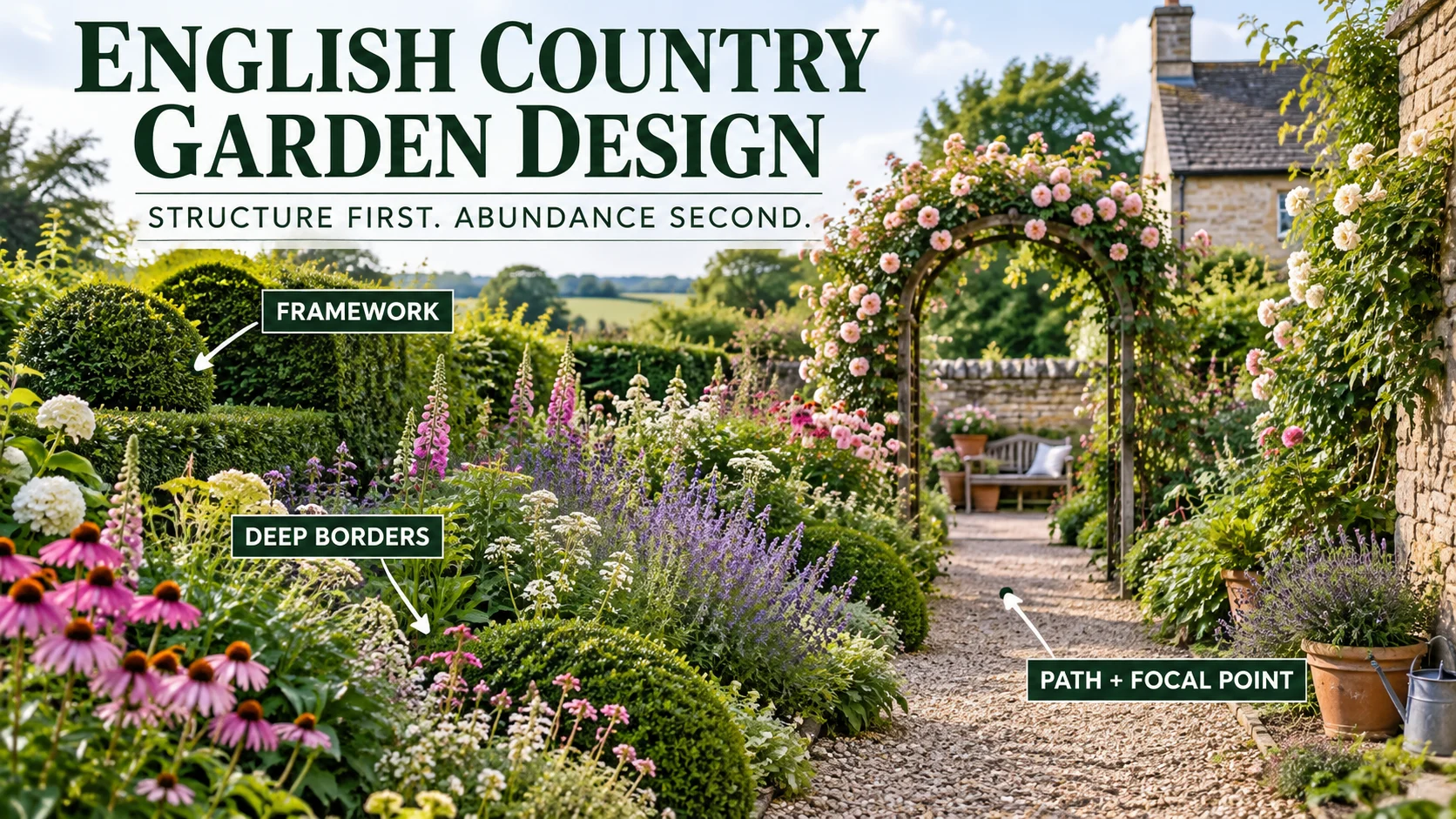

An English country garden works best when the relaxed planting sits inside a clear framework of paths, boundaries, focal points and repeat planting. The loose, flower-filled look should feel generous rather than random, so start with the structure and site conditions before choosing individual plants. Once that framework is sound, you can let roses, perennials, climbers, herbs and self-seeders soften the edges without losing the shape of the garden.
The style overlaps with cottage gardening, but it is not simply a dense collection of traditional flowers. The Royal Horticultural Society’s garden-style guidance describes cottage gardens as abundant planting spilling onto narrow paths while still relying on repeated colour and hedging for discipline. That balance between order and looseness is the design principle to keep throughout the whole garden.
The country garden formula at a glance
If you are collecting inspiration first, compare the framework above with these English garden plans and English garden pictures. The useful question is not which garden looks most romantic in a photograph, but which structural idea can survive your own dimensions, light, soil and maintenance routine. That shift stops the design from becoming a copy of someone else’s planting list.
| Design layer | What it does | Practical move |
|---|---|---|
| Boundary | Creates the visual frame and shelter | Use a hedge, wall, fence with climbers, or a deliberate mix |
| Route | Controls movement and the main sightline | Make one route obvious before adding secondary paths |
| Focal point | Gives the route a destination | Frame a bench, gate, urn, tree, arch or view |
| Borders | Carry the abundant country character | Layer height, repeat key colours and let edges soften naturally |
| Open space | Prevents the design becoming visually crowded | Use lawn, gravel, terrace or another calm surface deliberately |
Build the framework before buying plants
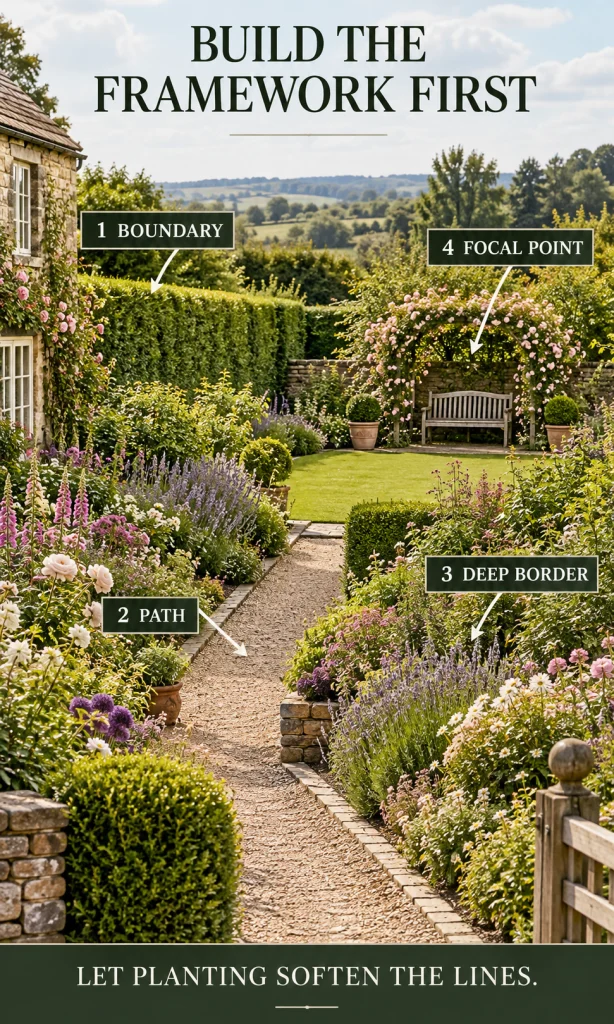
Start by walking the garden and deciding where the eye should travel, where people need to move and where they should stop. A country garden can be informal, but movement should still feel obvious: a main path can lead to a seat, gate, tree or arch, while the boundary gives the composition a stable edge. If the garden already has a strong wall, hedge or mature tree, use it rather than fighting it.
Hedges are especially useful because they can do more than screen a boundary. The RHS notes that hedges can mark boundaries, divide garden areas and provide wildlife habitat, which makes them a natural fit for country-style gardens that need both structure and life. Where privacy is a main concern, the choices in these landscaping ideas for privacy can help you decide whether a living boundary, layered planting or a harder screen suits the site.
A path should also have a reason to exist rather than simply curve for decoration. In a narrow garden, one clear route usually gives you more usable planting depth than several competing routes, while a larger plot can support a secondary garden room or cross-axis. If you need help with the edge itself, these garden borders and edging ideas show ways to keep the path legible even when plants spill over it.
Let the planting soften the structure
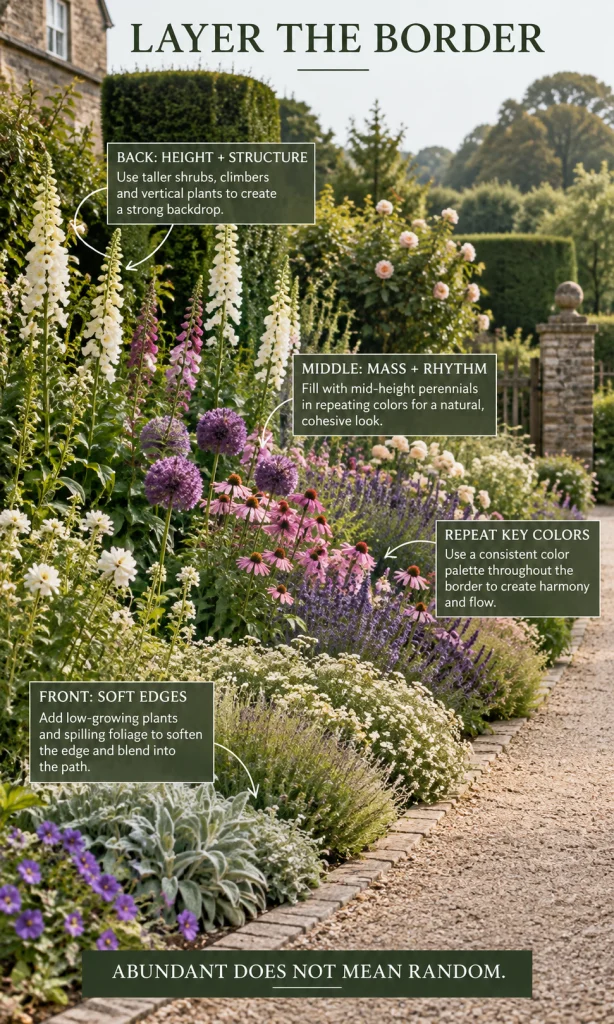
Once the framework is fixed, the planting can become looser. The classic country effect comes from layers: taller shrubs, climbers and vertical flowers at the back; a middle layer of repeated perennials; and lower plants that soften the front edge without swallowing the path. This creates depth and abundance while keeping the composition readable from a distance.
Repetition matters more than sheer variety. If every metre introduces a new colour, leaf shape and plant height, the border can look like a collection rather than a design, so repeat a few key colours and forms through the length of the bed. The approach also makes maintenance easier because you learn the behaviour of recurring plants instead of managing dozens of one-off choices.
The RHS list of cottage garden plants includes familiar choices such as foxgloves, lavender, delphiniums, mock orange and roses, but the important point is that each has different light, soil and maintenance needs. A lavender that wants full sun and free drainage should not be forced into the same damp, shady pocket that suits a different plant simply because both look appropriate in an English border. Use the style as the visual language, then let the site determine the actual species.
Check the site before choosing a planting palette
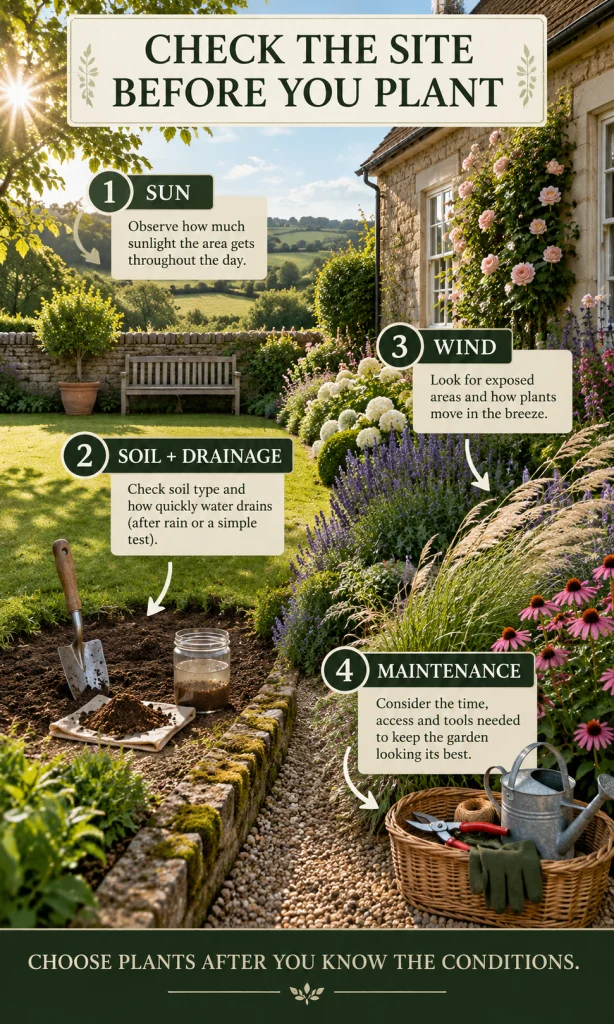
A successful border begins with four observations: light, drainage, exposure and the amount of maintenance you can realistically give. These conditions are more useful than a list of fashionable plants because they decide which plants establish well and which ones keep demanding rescue. The same principle is central to the RHS approach to drought-resistant gardening: choose plants for the conditions, prepare the soil appropriately and focus on good establishment rather than compensating forever with extra watering.
| Site condition | What to observe | Design response |
|---|---|---|
| Sun | Where direct light reaches through the day | Place sun-loving flowers only where the light is dependable |
| Drainage | How long the soil stays wet after rain | Match plants to moisture behaviour instead of watering against the soil |
| Wind | Exposed corners, funnels and movement in tall plants | Create shelter and reserve delicate height for protected positions |
| Maintenance | Time available for staking, clipping, deadheading and division | Use more shrubs and repeat dependable perennials when time is limited |
Build your country garden brief
Use the experience below before you start shopping for plants. It turns your dimensions, light, soil, exposure, maintenance level and design emphasis into a practical framework and implementation sequence, without inventing a decorative score. Treat the result as a design brief, then confirm individual plant suitability for your climate and site.
Build a practical design brief from your real conditions
Country Garden Composition Studio
Set the space, light, soil, exposure and maintenance level. The studio turns those inputs into a compact framework, planting direction and implementation sequence.
Describe the garden you actually have
This produces editorial design guidance, not a horticultural guarantee. Confirm local hardiness, plant toxicity, invasive-species rules, drainage and mature plant size before buying.
Your garden brief
Country garden direction
Framework
Planting direction
Condition response
Maintenance edit
Build in this order
Choose classic plants by job, not by nostalgia
Think of country-garden plants as roles inside the composition. Roses and climbers can soften walls and arches, vertical flowers can lift the back of a border, mounded perennials can create repeated rhythm, and low aromatic or spreading plants can soften the path edge. The plant list becomes much easier to manage when every choice has a job and a location.
- For vertical rhythm: consider site-suitable foxgloves, delphiniums, hollyhocks or other upright plants that can rise through lower layers.
- For fragrance and path edges: lavender can work beautifully in sunny, free-draining positions, while other edging plants may be better in heavier or shadier soil.
- For arches and walls: climbing roses, clematis and other climbers can frame movement, but match their vigour to the support and available space.
- For middle-layer continuity: repeat adaptable perennials rather than filling every gap with a different specimen.
- For winter structure: use shrubs, hedging, evergreen or persistent forms so the garden does not disappear when flowers finish.
For a deeper plant-selection process, use this guide to garden planting design and choosing the right plants for your garden. The goal is not to recreate a historic planting list exactly, because climate, soil and maintenance vary too much from one garden to another. Keep the country character through composition, materials and repetition, then select plants that are capable of succeeding where you actually garden.
Keep the garden readable in winter
Flowering peaks can make a country garden look effortless in late spring or summer, but winter reveals whether the structure is doing enough work. Keep some evergreen or persistent mass, allow selected seedheads to remain, and make sure the path and focal point still read when herbaceous growth drops back. A clipped hedge, shrub framework, wall, tree trunk, arch or simple bench can carry the composition through the quiet season.
Do not respond by filling every gap with evergreen foliage. A good winter garden can include bare stems, seedheads and open ground as long as the underlying geometry is clear and the garden still has a visual destination. This is another reason to establish the framework before you build the flowering layer.
Support wildlife without making the garden look untended
Wildlife value and a designed garden are not opposites. The RHS recommends thinking of a garden as a series of micro-habitats and notes that living boundaries, layered vegetation, climbers and a long flowering season can all support wildlife, as explained in its guide to wildlife in gardens. You can therefore keep a clear path and intentional border while still providing shelter, nectar, seed, water and cover.
A mixed hedge can be especially useful because it creates both structure and habitat, while flowering plants with overlapping seasons reduce the dependence on one short burst of nectar. Leave some seedheads, tolerate a small amount of imperfect foliage and avoid turning every corner into bare hard landscaping. For more ways to integrate habitat into a designed space, see these wildlife garden ideas and wildlife landscaping ideas.
How to get the look in a small garden
A small garden does not need miniature versions of every country-garden feature. One strong path, one generous border, one climber-covered vertical surface and one focal point can create the same visual language with less clutter. The mistake is trying to fit lawn, pond, arch, shed, island bed, herb garden and several paths into a space that only has room for a few of them.
Use the widest planting area where it will have the most visual impact, then repeat the same colours or plant forms elsewhere in smaller quantities. A boundary wall or fence can also become useful planting space with climbers, while the floor stays simple enough to move through comfortably. These small garden designs can help you decide what deserves space and what should be left out.
Common country garden design mistakes
- Buying flowers before setting the framework. The border may look full but still lack direction, usable paths or a clear focal point.
- Using too many one-off plants. Variety without repetition makes the planting harder to read and harder to maintain.
- Copying a plant list without checking the site. Sun, soil, moisture, exposure and climate can turn an attractive reference garden into an expensive failure.
- Making every line curvy. Informality can come from planting that softens a simple route; curves are not automatically more natural.
- Leaving no winter structure. If the design works only at peak bloom, the framework is doing too little.
- Over-manicuring the planting. Country character benefits from some spill, self-seeding and seasonal texture, provided the route and structure remain legible.
A practical five-step sequence
First, observe the garden for light, drainage, exposure, views and movement. Second, set the boundary, main route, focal point and any calm open area; third, reserve enough planting depth to create real layers instead of a thin strip of flowers. Fourth, choose plants that fit the site and repeat the strongest forms or colours; fifth, review the design for winter structure, wildlife value and the maintenance you can actually sustain.
If you are working from a blank site, this broader guide on how to create a beautiful garden at home can help with the overall sequence. If your main challenge is the boundary itself, these beautiful garden fencing ideas for gardens can help you decide how much of the enclosure should be hard structure and how much should be softened with planting. The most convincing result comes from making those decisions before the border becomes crowded.
Frequently asked questions
What makes a garden look English country rather than simply overgrown?
The difference is visible structure. A country garden may use abundant, overlapping planting, but the boundary, route, focal point and repeated plant forms still give the eye a clear order. If those elements disappear, the garden can read as unmanaged rather than intentionally relaxed.
Do I need a lawn for an English country garden?
No. Lawn is one way to create calm open space, but gravel, terrace, meadow-like grass or another simple surface can perform the same visual job. The important point is to leave enough breathing room for the borders and structural features to read clearly.
Which flowers are essential in an English country garden?
No single flower is essential. Roses, foxgloves, delphiniums, lavender and other traditional choices can help create the look, but only where their light, soil, moisture and maintenance needs fit the site. Repeated colour, layered height and seasonal continuity matter more than owning a fixed checklist of species.
Can an English country garden be low maintenance?
It can be lower maintenance if you reduce staking-heavy plants, repeat dependable perennials, use more shrubs and groundcover, and keep the path and edges simple. You will still need seasonal pruning, weeding, mulching and editing, but the design does not have to depend on constant deadheading and replacement planting.
How do I make a small garden feel like a country garden?
Use fewer, stronger moves: one main route, one focal point, one generous border and one vertical planting opportunity. Repeat a limited palette instead of adding many unrelated plants, and allow selected foliage or flowers to soften the path edge. The style comes from the relationship between structure and planting, not from garden size.
Should an English country garden use only native plants?
No. Native plants can be valuable for local wildlife and a regionally appropriate hedge or habitat layer, but a country-style garden can also include suitable non-native ornamentals. Choose each plant for site fit, local regulations, wildlife value where relevant, and the job it performs in the composition.
The design rule to remember
Build the bones first, then let the planting become expressive. A clear boundary, purposeful route, focal point and enough planting depth will make the garden feel intentional even when flowers spill, self-seeders move and the seasons change. That is the difference between a country garden that merely looks full and one that feels settled into its place.