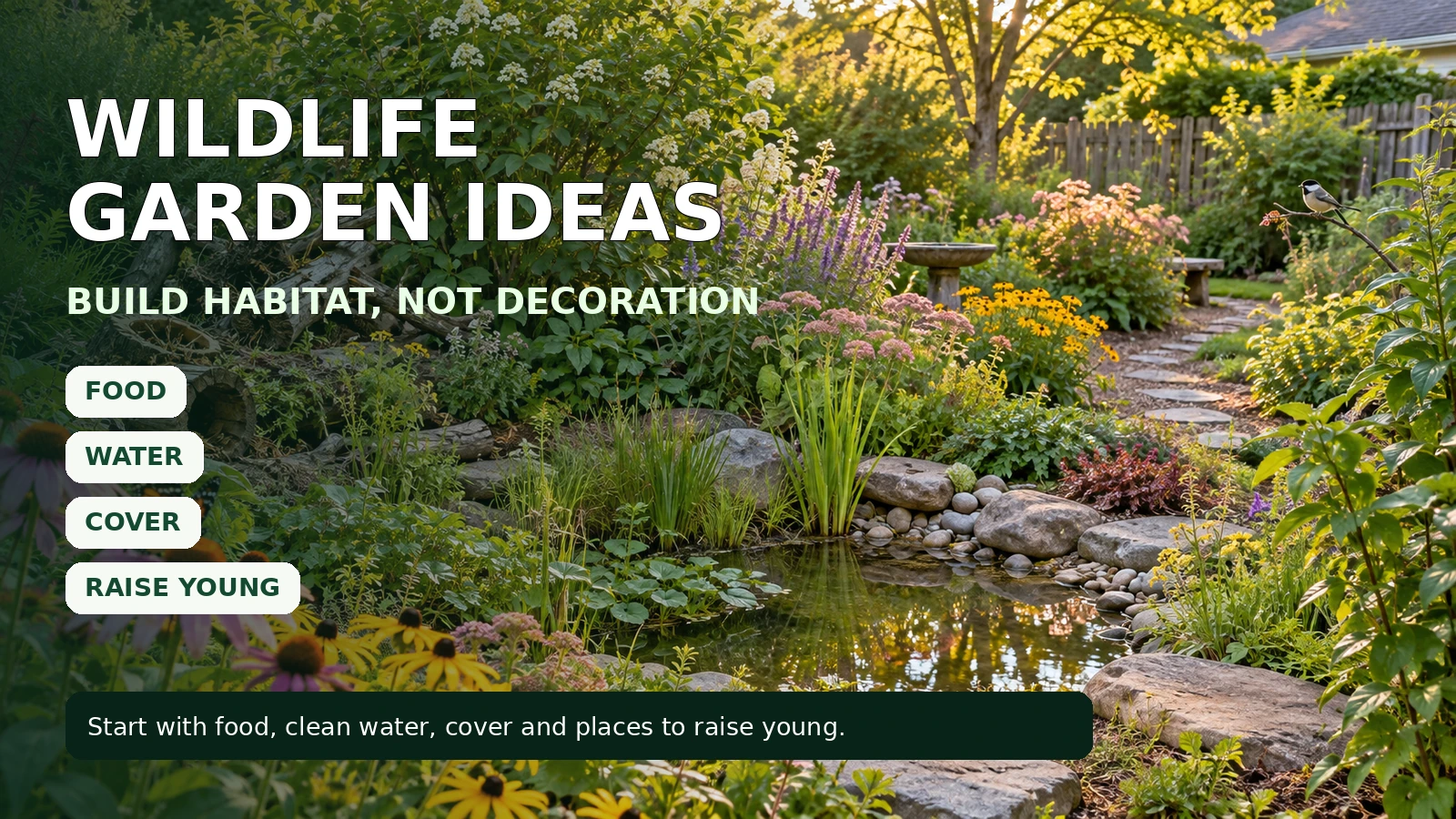

A wildlife garden works best when it is designed as habitat first: provide food, clean water, cover, and places for animals to complete their life cycle, then make those functions fit the way you actually use the garden. The biggest change is usually not buying a birdhouse or adding one pollinator plant; it is replacing isolated decorative features with connected planting, usable water, shelter, and lower-impact maintenance.
You do not need a large or deliberately “wild-looking” yard to do this well. A balcony can combine flowering containers, a shallow water source and sheltered planting, while a larger landscape can use trees, shrubs, meadow-like planting, leaf litter, dead wood and a pond as linked habitat zones.
The practical goal is to make each part of the landscape do more than one job. A shrub can screen a seating area while providing cover and food, a rain garden can manage runoff while creating damp habitat, and fallen leaves can protect soil while giving insects and other small wildlife somewhere to overwinter.
- Food: locally appropriate plants that provide nectar, pollen, seeds, fruits, leaves or support insect prey.
- Water: a clean, accessible source with a safe way in and out.
- Cover: dense planting, ground layers, shrubs, trees, leaf litter, logs or other refuge.
- Places to raise young: host plants, nesting structure, mature vegetation, cavities or suitable wet habitat.
- Low-disturbance management: less broad pesticide use, less unnecessary night lighting, and less total clearing.
Wildlife landscaping is about function, not a particular look
A wildlife-friendly landscape can be formal, contemporary, cottage-style, tropical-looking or naturalistic. The Royal Horticultural Society recommends thinking of a garden as a series of microhabitats, and it notes that both native and non-native plants can contribute to wildlife value. The useful distinction is not “tidy versus messy”; it is whether the landscape provides enough food, shelter, water and safe life-cycle space.
For a stronger ecological base, locally native plants deserve priority because they evolved within the regional food web and can support local insects, birds and other wildlife in ways that ornamental planting may not. The National Wildlife Federation frames wildlife habitat around food, water, cover and places to raise young, with sustainable maintenance practices protecting those resources.
This also explains why a garden full of flowers can still function poorly for wildlife. If the flowers sit in isolated beds surrounded by clipped lawn, bright all-night lighting and regular broad-spectrum spraying, the landscape may provide a short feeding opportunity without enough cover or safe habitat to support the rest of the life cycle.
| Design priority | What it looks like | Why it matters |
|---|---|---|
| Layered planting | Groundcover, flowers, grasses, shrubs and trees where space allows | Creates feeding, hiding, nesting and movement opportunities at different heights |
| Usable water | Shallow dish, birdbath, pond, bog area or rain garden with safe access | Supports drinking, bathing and—in suitable habitats—breeding |
| Quiet cover | Dense shrubs, hedges, long grass, leaf litter, logs or sheltered corners | Reduces exposure to weather, predators and constant disturbance |
| Life-cycle habitat | Host plants, nesting structure, mature trees, hollow stems or wet breeding habitat | Lets wildlife do more than visit briefly for food |
Wildlife-friendly landscape decision support
Wildlife Habitat Activation Studio
See which habitat functions your space already covers, which one is missing, and what to change first.
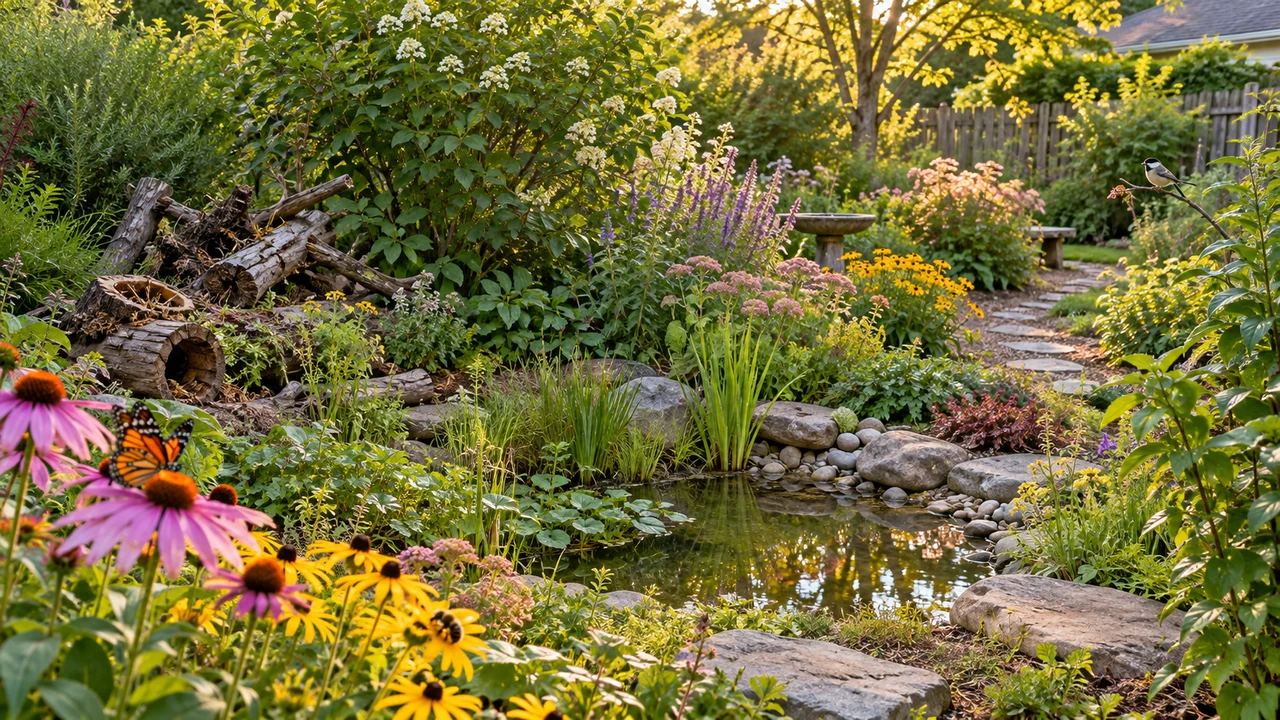
What this checks
A useful wildlife landscape needs habitat functions, not a collection of decorative wildlife products. This check focuses on food and planting, water, cover, places to raise young, and two management risks that can undo those gains.
- Works for balconies, small gardens and larger yards.
- Priorities change with your target wildlife and current conditions.
- No biodiversity score or unsupported species-count estimate.
How to use it
Choose the closest description of your space. The result flags missing functions, then gives three practical priorities rather than asking you to rebuild the whole garden at once.
Plant choices still need local verification because “native” and invasive status depend on region.
Describe the space
Your selections stay in this browser session. The experience does not submit them to a database.
Your habitat direction
Your next three actions
Find the right local source or specialist
Use your location to search for real nearby providers. No company names, ratings, review counts, distances or availability are invented here.
Compare 3-5 candidates using:
- Experience with locally native plants and wildlife habitat, not only conventional landscaping.
- How they handle pesticides, invasive plants, water safety, drainage and night lighting.
- Site-specific plant sourcing, maintenance expectations, establishment care and warranty terms.
- Whether proposed features solve an actual habitat gap rather than adding decorative products.
Design from structure outward
When you plan a wildlife garden, begin with the physical structure before choosing individual decorative plants. The National Wildlife Federation’s ecological landscape guidance emphasizes dense, layered planting, groundcover, seasonal flowers, healthy soil and water as parts of a functioning landscape rather than separate accessories.
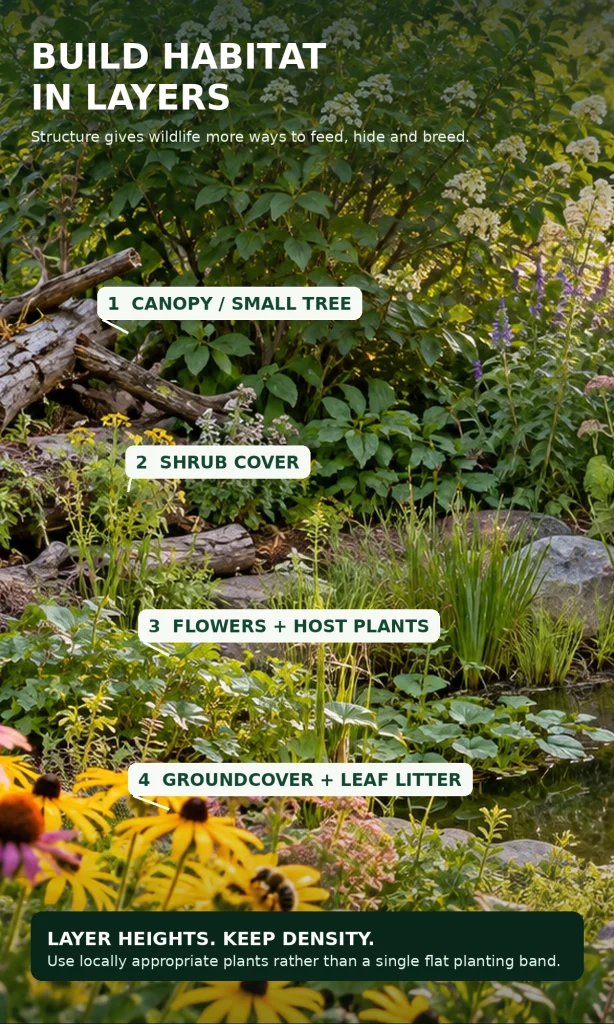
Think vertically as well as horizontally. A flat bed of one flowering height may feed pollinators for part of the year, but combining a ground layer, herbaceous plants, shrubs and—where the site can support them—small or mature trees creates more niches and more ways for wildlife to move through the space.
Density matters because open gaps expose small wildlife and leave more soil vulnerable to drying and weed invasion. You still need paths, sightlines and usable areas for people, but the habitat zones themselves generally work better when their plant layers overlap instead of standing as isolated specimens.
1. Build the plant palette around your region
“Native” is a regional term, so avoid copying a plant list from another country or climate zone. Start with plants that naturally occur in your area or are well documented as valuable to local wildlife, then match them to the site’s sun, moisture, soil and available root space.
A useful plant palette includes more than nectar flowers. Add seed- or fruit-producing plants where appropriate, host plants for caterpillars or other specialist insects, dense evergreen or twiggy cover where your climate supports it, and flowers that overlap through the growing season so the garden does not offer one short burst of resources and then go empty.
If you are working with an established ornamental garden, you do not need to remove everything at once. Keep healthy plants that are useful, non-invasive and compatible with the design, then use the next replacement cycle to add more locally appropriate habitat value; our guide to garden planting design can help you think through the broader layout.
2. Give cover a continuous path
Wildlife often needs to move from feeding areas to shelter without crossing a wide exposed surface. Connect flower beds to shrubs, hedges, climbers, groundcover or quieter corners so the landscape reads as a chain of usable habitat rather than several green islands separated by lawn or paving.
Long grass, dense groundcover and shrubs can be intentional design elements rather than neglected leftovers. If a completely naturalistic look does not suit the house, concentrate these features in shaped beds, clipped outer edges or defined habitat zones while keeping the interior planting structurally rich.
Dead wood and leaf litter add another layer that conventional landscaping often removes. The RHS recommends leaving some long grass and dead wood for wildlife, and a partly hidden log pile or leaf-rich bed can provide that function without making the whole garden look unmanaged.
3. Add usable water, not a decorative trap
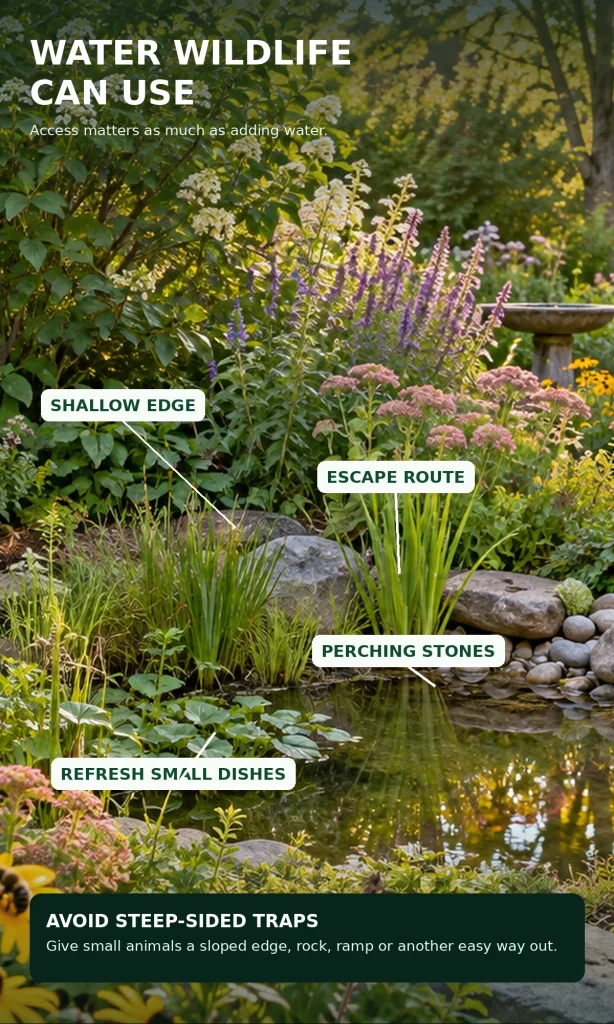
Water can be one of the fastest ways to add a new habitat function, but access is part of the design. The RHS water-habitat guidance recommends wildlife ponds with gently sloping sides or another easy way for animals to leave the water, and it notes that even small containers can create useful watery habitat.
A birdbath or shallow dish can work in a small garden, courtyard or balcony if it is stable, kept clean and shallow enough for the intended use. In a larger garden, a pond or rain garden can add drinking, bathing, wet-edge planting and breeding habitat, but fish may reduce the wildlife value of a pond intended primarily for amphibians and aquatic invertebrates.
Do not hide water behind a steep plastic wall with no exit route. Add a sloped edge, textured stone, ramp or partly submerged log where needed, and design the surrounding planting so animals can approach and retreat into cover instead of crossing a large exposed surface.
4. Plan for nesting, host use and breeding
Attracting an adult animal is only one part of habitat design. Butterflies and moths may need specific host plants for their larvae, cavity-nesting birds need suitable nesting opportunities, and amphibians need appropriate wet and damp habitat if they are going to breed rather than simply pass through.
This is why a wildlife garden should include places to raise young as a separate design question instead of assuming that flowers and feeders cover everything. A mature tree, dense hedge, patch of hollow stems, host-plant cluster, wildlife pond or properly specified nest box can all fill different roles depending on local species and site conditions.
Before installing a generic wildlife house, identify the animals that actually occur in your area and what dimensions, orientation, cleaning or siting requirements apply. Purpose-built habitat is useful when it fits the species; decorative boxes that are too hot, exposed, damp or incorrectly sized can add very little.
5. Reduce disturbance that cancels out the habitat
A wildlife garden can look resource-rich and still be hostile if routine management exposes the same animals you are trying to support. The National Wildlife Federation advises minimizing harmful pesticides, using prevention, physical barriers, hand removal and targeted treatment where necessary rather than broad chemical use across habitat planting.
Night lighting is another design variable, especially around pollinator, bat and bird habitat. DarkSky International recommends using outdoor light only when needed, directing it where it is needed, avoiding excessive brightness, limiting operating time and choosing warmer light where practical.
Maintenance timing matters too. Instead of clearing every stem, leaf and seed head at the same time, use a staged approach: keep high-use areas tidy, leave selected habitat zones intact longer, and remove material only when it becomes unsafe, invasive, diseased or genuinely obstructive.
Wildlife garden ideas by space type
The same habitat principles apply across different sizes, but the form changes. Small spaces need features that perform several jobs at once, while larger gardens can create separate quiet zones, wet zones and layered planting areas without giving up patios, lawns or circulation.
| Space | High-value move | Watch for |
|---|---|---|
| Balcony or patio | Layered containers, flowering/host plants, one sheltered corner and shallow water | Wind exposure, heat, drainage, structural load and unsafe deep containers |
| Small garden | Dense boundary planting plus a compact water feature and one low-disturbance zone | Using too many single-purpose ornaments that consume planting space |
| Lawn-heavy yard | Convert one edge or island at a time into layered planting and connect the beds | Leaving new habitat as isolated islands surrounded by exposed turf |
| Shady garden | Use woodland-edge structure, leaf litter, logs and shade-adapted local plants | Forcing sun-loving pollinator mixes into low-light conditions |
| Wet or runoff-prone area | Consider a rain garden, bog area or pond-edge planting after drainage assessment | Blocking drainage routes or creating unsafe standing-water conditions near structures |
If the garden is very compact, habitat design and space planning should be solved together rather than as separate projects. The ideas in small garden designs are especially useful when you need to preserve movement and seating while increasing planting depth around the edges.
What to change first if the garden is mostly ornamental
Do not start by buying ten wildlife products. Walk the garden once and identify which of the core jobs is missing: no water, no dense cover, no host or nesting opportunity, almost no locally useful planting, or a management problem such as broad spraying or all-night lighting.
Then make one change that fills the largest gap and connects to something already present. A dense planting bed beside an existing tree, a shallow water source next to cover, or a leaf-and-log zone behind established shrubs usually creates more functional habitat than scattering small features around the property.
The visual difference can remain subtle. A garden can still have clean paths, deliberate edges and a strong design while the planting beds themselves become denser, more layered and more useful; that balance is one reason some spaces simply feel alive even when they are carefully designed.
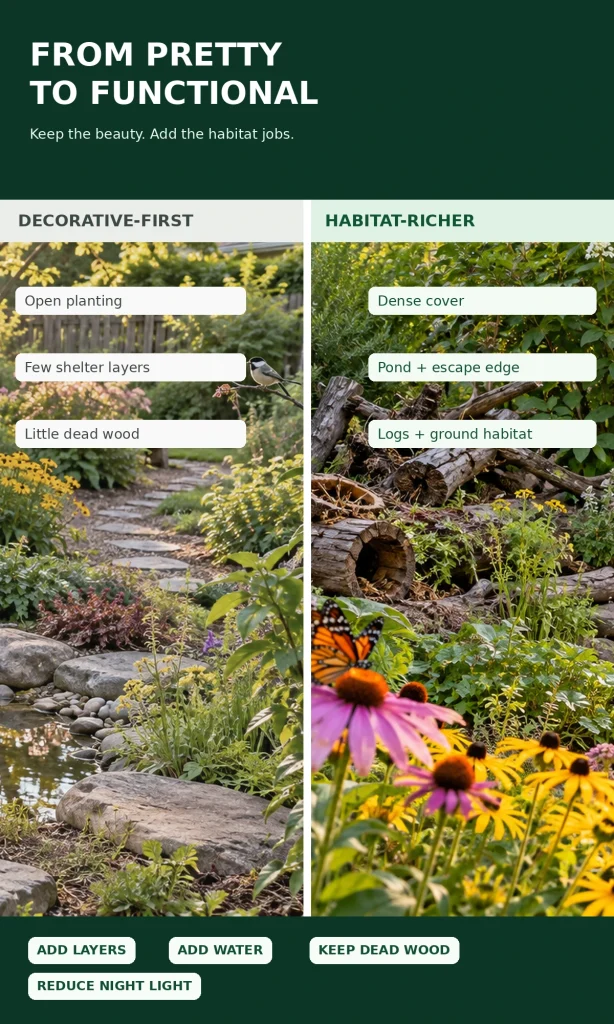
Common wildlife-garden mistakes
Adding feeders before habitat. Feeders can supplement natural food sources, but they do not replace cover, host plants, nesting opportunity or clean water. Build the habitat base first, then add feeders if they suit the species and you can maintain them hygienically.
Using a generic “wildflower” mix without checking the species. A seed mix may contain plants that are poorly suited to your climate, short-lived, non-native or invasive in your region. Verify the species list and site conditions before sowing, especially near natural areas where unwanted plants can escape cultivation.
Making a pond with no exit. A smooth, steep-sided container can trap small animals. Use a shallow margin, ramp, textured stone or another stable escape feature, and keep safety in mind wherever children or pets use the garden.
Tidying every habitat zone at the same time. Removing all leaves, stems, seed heads and dead wood may erase overwintering and shelter opportunities in one weekend. Stagger maintenance and keep at least some protected material where it is safe and appropriate.
Assuming “wildlife-friendly” means low maintenance from day one. New native or naturalistic planting still needs establishment care, weed control and occasional editing. The maintenance pattern changes from repeated mowing, clipping and spraying toward selective watering, thinning, invasive-plant control and seasonal habitat management.
A practical 30-day wildlife-landscaping sequence
- Week 1 – inventory: mark existing food plants, water, cover, nesting/host habitat, pesticide use, bright lighting and exposed gaps.
- Week 1 – protect what already works: identify mature trees, useful shrubs, leaf-rich corners, logs, damp areas and existing wildlife routes before removing anything.
- Week 2 – fill the biggest gap: add water, dense cover, host plants or another missing habitat function rather than adding decorative extras.
- Week 3 – connect: link isolated beds with groundcover, shrubs, climbers or planting bands so wildlife can move between resources with less exposure.
- Week 4 – change maintenance: reduce broad chemical use, unnecessary night lighting and total clearing, then set a realistic seasonal routine.
If you want more attraction-specific tactics after the landscape structure is in place, use our separate guide on how to attract wildlife into your garden. For readers considering a dedicated pond or container water feature, the older water gardening guide can serve as a related starting point while you apply the safety and habitat principles above.
How to tell whether the garden is becoming better habitat
Avoid turning success into a fake biodiversity score. Instead, watch for repeat use over time: animals feeding from several parts of the garden, birds moving through cover rather than only visiting a feeder, insects using host plants as well as flowers, or amphibians using both water and nearby damp refuge where those species naturally occur.
Keep a simple seasonal record of sightings, bloom periods, water use, nesting behavior and management changes. The most useful pattern is not a single exciting visitor; it is whether the landscape offers resources across more of the year and whether wildlife can use them without the same obvious bottleneck recurring.
Expect the answer to be local and gradual. A new water source may be noticed quickly, while a young shrub layer can take several seasons to become meaningful cover, so continue adapting the garden based on real use rather than trying to finish the whole habitat in one project.
Wildlife Garden FAQ
Does a wildlife garden have to look messy?
No. You can use crisp paths, defined bed edges and formal shapes while keeping the planting itself dense, layered and habitat-rich. Wildlife responds to resources and shelter, not to whether the overall design is cottage, modern or formal.
Are native plants always required?
Locally native plants are a strong foundation because they fit the regional ecosystem, but a garden can also contain useful non-native plants where they are non-invasive and appropriate. The practical priority is to increase local food-web value while avoiding plants that threaten nearby habitats.
What is the easiest wildlife feature to add first?
Add the function your garden is missing. If there is no water, a clean shallow source may be the best first move; if the garden is exposed, dense cover can matter more; if broad pesticide use is routine, changing management should come before adding new habitat.
Is a pond necessary for a wildlife garden?
No. A pond can add substantial habitat value, but a small shallow dish or birdbath can provide water in a compact space. Whatever you use, keep access safe, provide an exit route where trapping is possible, and maintain water quality.
Should I stop using pesticides completely?
A wildlife-focused garden should avoid routine broad or systemic pesticide use where possible. Use prevention, physical control and targeted integrated pest management first, and follow local product labels and regulations when treatment is necessary.
Can a small garden really help wildlife?
Yes, especially when the space adds a resource that is scarce nearby or connects to other gardens and green areas. A small garden cannot replace a large natural habitat, but layered planting, safe water and reduced disturbance can still create useful stepping-stone habitat.
Build the missing habitat job first
The strongest wildlife garden ideas are not a shopping list. They are a design sequence: protect what already has habitat value, add the missing function, connect the resources, and manage the space so food, water, cover and life-cycle habitat remain usable.
That approach works whether you are redesigning a balcony, converting part of a lawn or planning a full landscape. Start with one high-value change, watch how the space is used, and let the next improvement respond to what the garden still lacks.