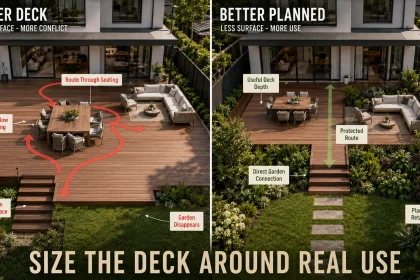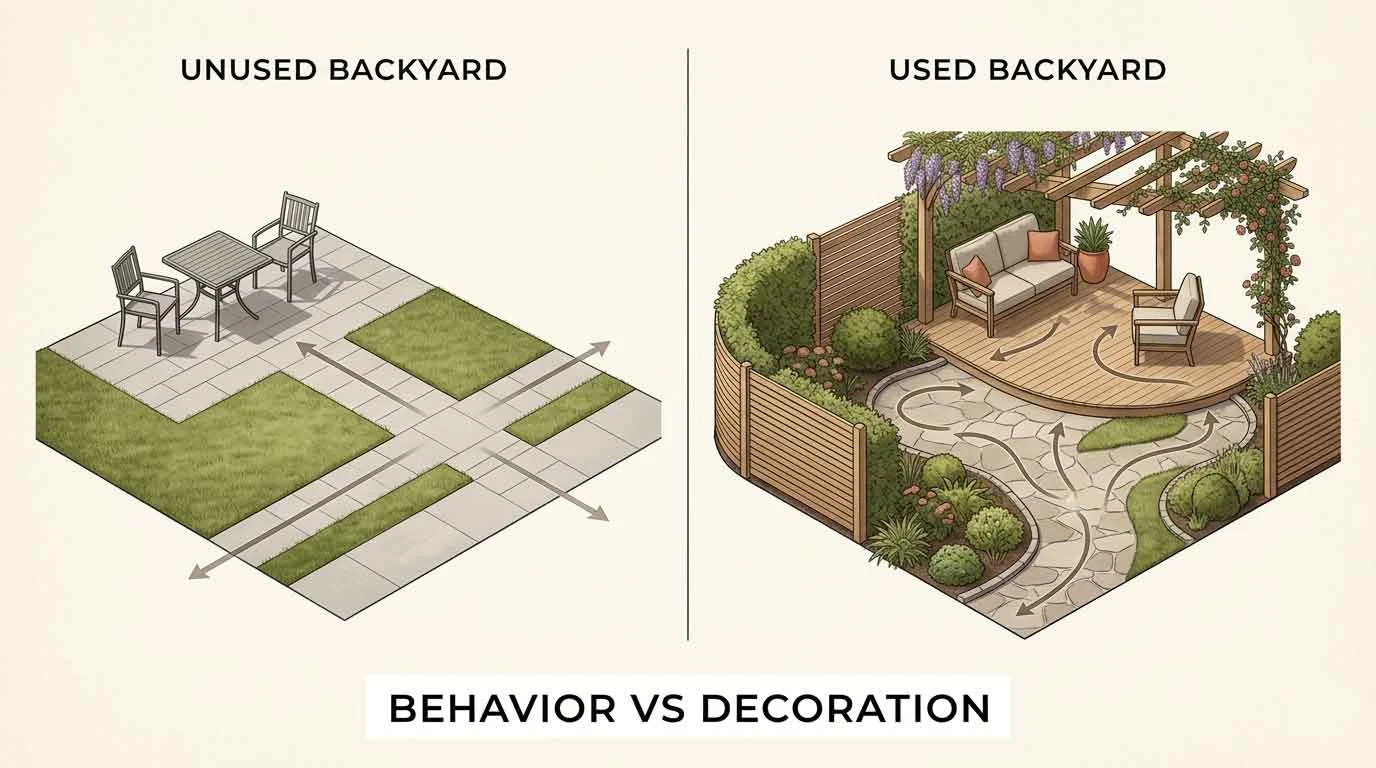

A backyard can look attractive and still go largely unused when getting outside takes too much effort, the place you want to sit feels uncomfortable, movement interrupts the activity, or there is no obvious reason to stay. Before buying more furniture or redesigning the garden, find the first point where ordinary backyard use breaks down.
A useful backyard does not need to impress you every time you look through the window. It needs to make a simple activity – drinking coffee, reading, talking, eating, gardening or letting children play – easy enough to begin and comfortable enough to continue.
That distinction explains why some modest yards are occupied almost every day while considerably more elaborate spaces remain empty. The successful yard removes small barriers between the thought I could go outside and the action of actually going there.
You can usually trace the problem through a short sequence: enter → settle → do something → remain comfortable → repeat. If one part of that sequence consistently fails, improving unrelated parts of the yard rarely changes the habit.
The practical question, then, is not simply What is missing from my backyard? It is What makes us decide against using it? Once that answer becomes clear, the first improvement is often much smaller than a complete landscape redesign.
Find the First Point Where Backyard Use Breaks Down
Use what already happens in your yard as the diagnostic evidence. Think about the last several occasions when somebody considered going outside, then identify the earliest point where the experience became inconvenient or uncomfortable.
| What Usually Happens | Likely Blocker | Test First | Likely Direction |
|---|---|---|---|
| You think about going outside but rarely make it through the door. | Entry friction | Make one seat completely ready for immediate use. | Reduce setup, storage and access steps. |
| You go outside but move back indoors quickly. | Comfort or exposure | Sit in the exact position at the exact time you normally want to use it. | Check sun, heat, privacy, wind, insects and seating comfort. |
| People constantly walk between or around chairs. | Circulation conflict | Observe the natural route between doors, gates, storage and lawn. | Move the activity beside the route rather than placing it inside the route. |
| There is plenty of space, but nobody knows what to do there. | Missing activity anchor | Assign one ordinary activity to one specific location. | Design around a repeatable behavior rather than an abstract “outdoor area.” |
| The yard was exciting after an upgrade but use faded again. | Repeated micro-friction | List everything you must carry, clean, unfold, switch on or reposition. | Remove recurring preparation rather than adding another feature. |
Do not worry if more than one row sounds familiar. Backyards often have several weaknesses, but correcting them all simultaneously makes it difficult to learn which one actually controls behavior. Start with whichever obstacle occurs earliest in the sequence.
For example, better privacy will not materially increase use if nobody wants to carry cushions outside in the first place. Likewise, permanently ready furniture may achieve little if the only seating position becomes unbearably hot at the hour when the household is free.
That is why the diagnostic order matters. Solve the first strong barrier, use the yard normally for a while, and then see whether another barrier becomes important enough to justify the next change.
Going Outside Requires Too Much Setup
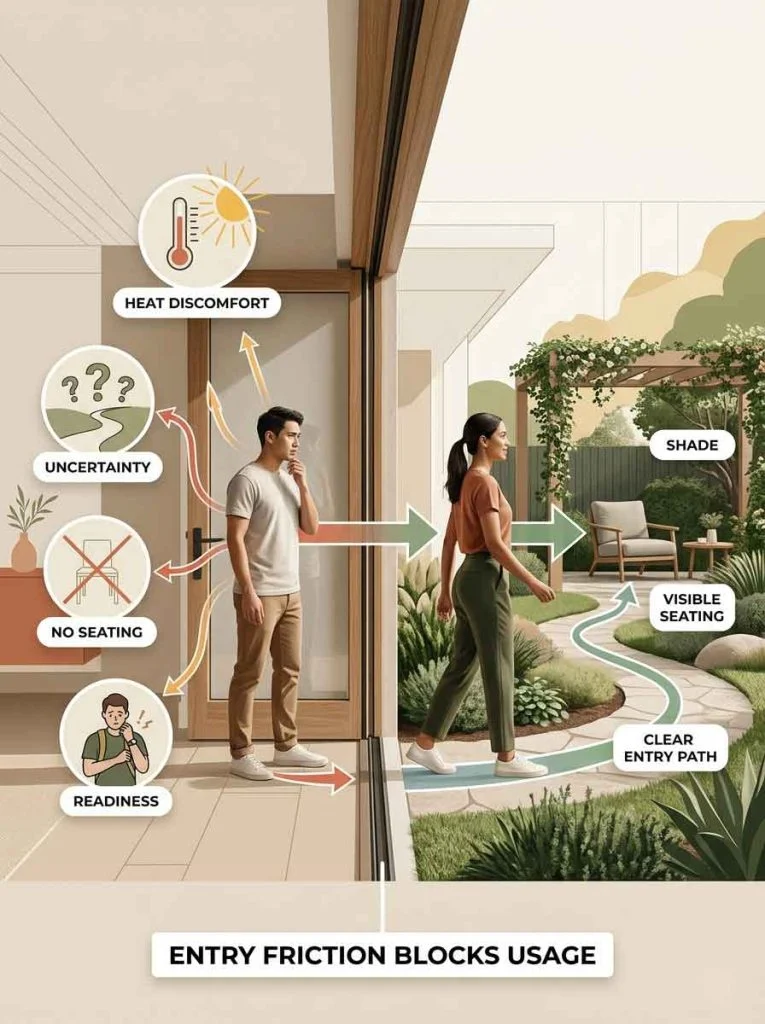
Entry friction is the work that appears between deciding to use the backyard and actually beginning the activity. It can be remarkably small: opening several doors, retrieving cushions, wiping a wet chair, carrying drinks without a nearby surface, moving furniture into shade or searching for outdoor lighting.
None of those jobs sounds serious in isolation. The problem is that indoor spaces usually require almost nothing in comparison, so even a few repeated steps can make the sofa, kitchen table or indoor reading chair the easier choice.
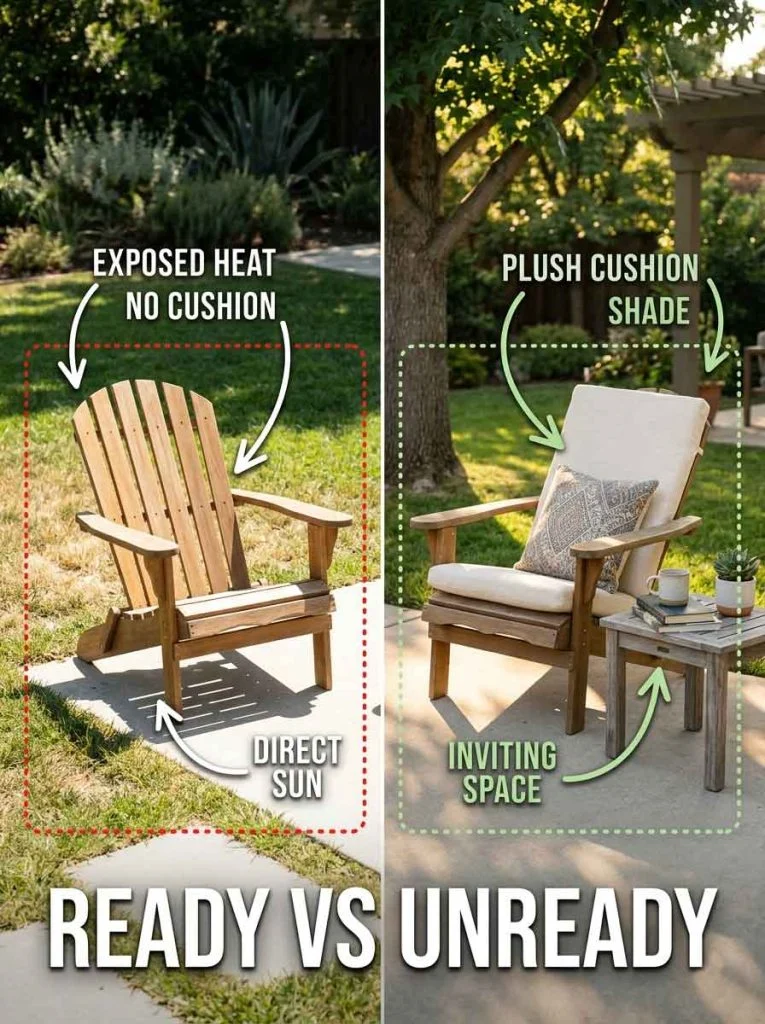
Imagine having fifteen quiet minutes before dinner. There is a chair outside, but its cushion is stored elsewhere, the table needs repositioning and the seat is still receiving direct sun. You could solve each problem within minutes, yet the available break may be half over before the outdoor setting is ready.
That is a usability problem rather than a motivation problem.
A stronger setup makes the invitation obvious: the route is easy, the chair can be used immediately, a useful surface is within reach, and anything needed repeatedly is stored close to the activity. You should be able to step outside and begin without mentally organizing the space first.
Check How Many Actions Come Before Sitting Down
Walk through the process exactly as you would on an ordinary weekday rather than while deliberately “testing the garden.”
Count whether you need to:
- retrieve cushions or covers from another location;
- unlock or move several objects;
- wipe or clean the seating before use;
- carry a table, footstool or umbrella into position;
- find insect repellent, lighting or other equipment;
- cross wet, unstable or inconvenient ground;
- rearrange furniture according to the sun;
- return indoors for items that have no outdoor storage.
One occasional preparation step is rarely decisive. Several steps that occur every single time can be.
The easiest test is therefore simple: prepare one seat so completely that it can remain ready for normal use, then observe whether the frequency of short outdoor visits changes. You are testing whether readiness alters behavior, not trying to finish the whole backyard.
The Place You Want to Sit May Be the Real Problem
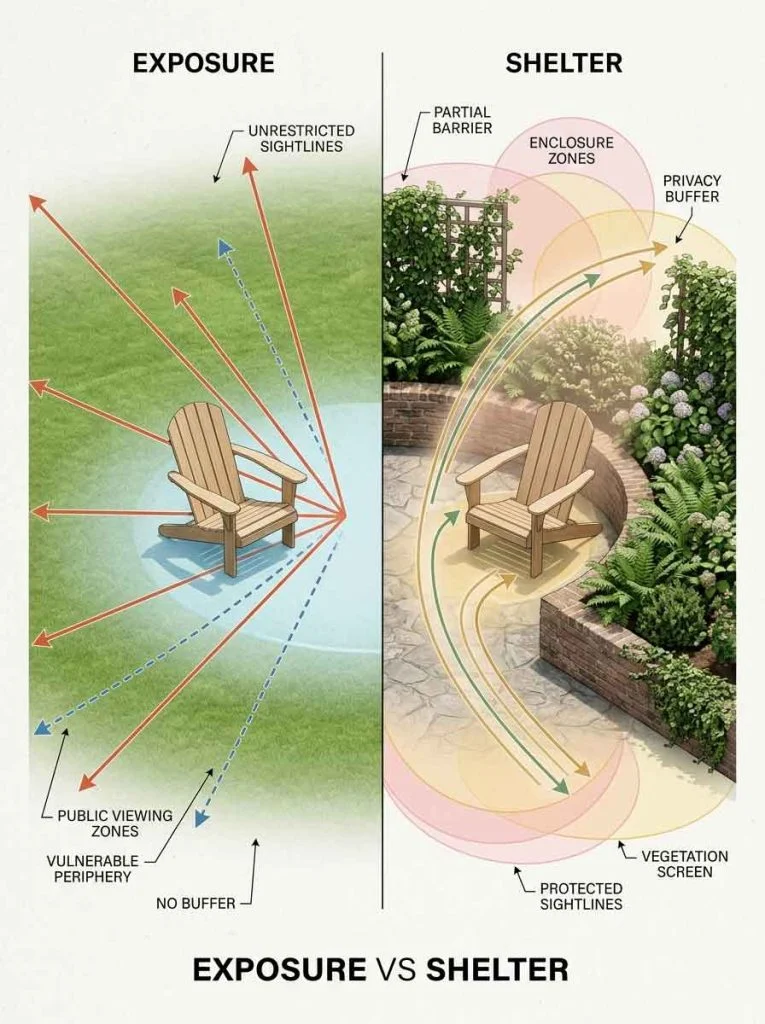
A person can cross the threshold easily and still leave almost immediately if the occupied position feels wrong. This is where a backyard that appears perfectly pleasant from a standing viewpoint can fail once somebody actually sits down.
The useful test is performed at seat height, at the time of day the space is supposed to work. Sit in the chair for long enough to notice where the sun reaches your body, which neighboring windows are visible, where wind funnels through, whether insects gather nearby, how people move around you and what you naturally look toward.
An open lawn does not automatically feel spacious and relaxing from that position. A chair placed in the center of exposed space may have no protected edge behind it, receive several unwanted sightlines and remain disconnected from planting or another useful focal point.
Partial enclosure often works better than indiscriminate enclosure. A hedge, screen, planting mass, wall, pergola edge or other element behind or beside the occupied position can provide enough definition while leaving the preferred direction open.
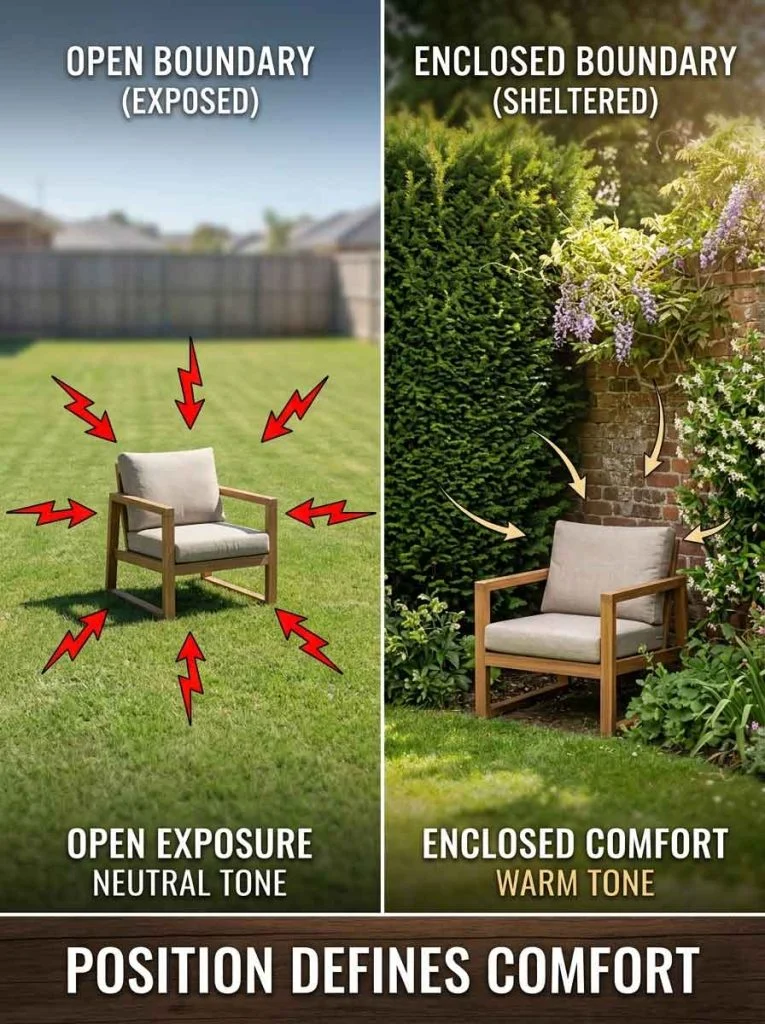
If overlooking is the dominant issue, the deeper question is where the unwanted sightline actually comes from. The existing guide to landscaping ideas for privacy explains how screening can respond to viewing direction rather than simply making every boundary taller.
Comfort also changes through the day. A patio may feel excellent at breakfast and unpleasant at 4 p.m.; another corner may appear too shady in the morning but become the best place in the garden during a hot afternoon. Assessing only the yard’s general orientation misses these occupied conditions.
This is also where usability and relaxation begin to separate. If you willingly go outside but still cannot settle because of glare, noise, exposure, movement or sensory discomfort, the more specific guide to why some gardens never feel relaxing takes that diagnosis further.
Movement Keeps Interrupting the Activity
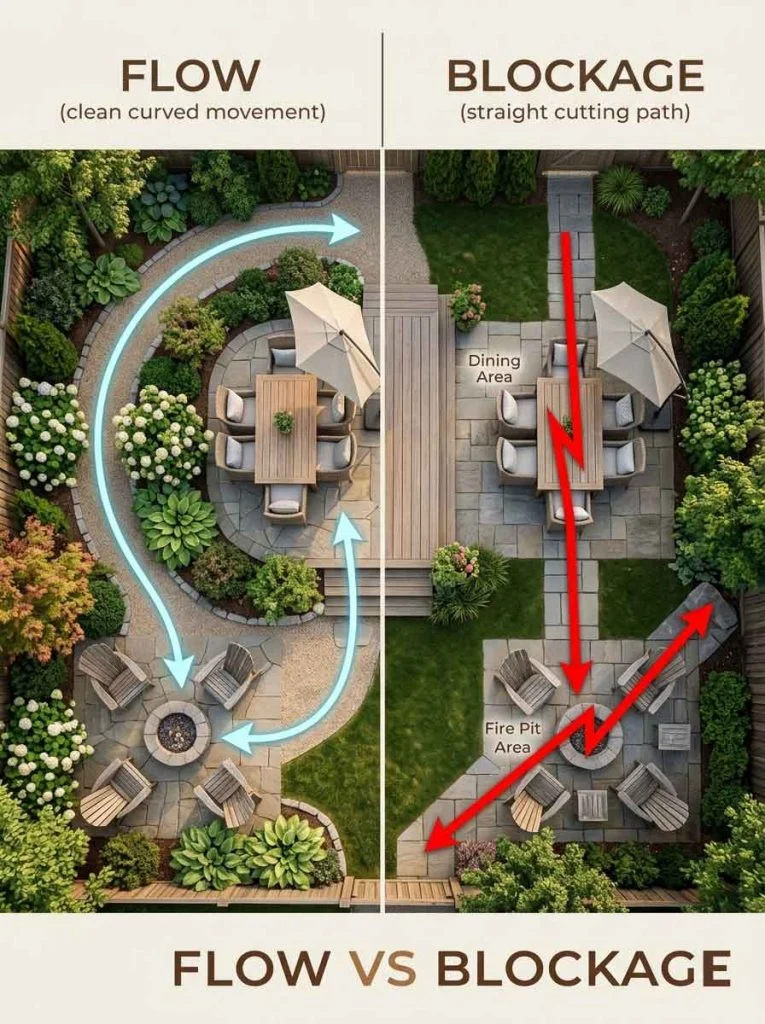
A backyard can contain good furniture, useful shade and attractive planting yet still feel awkward when circulation cuts directly through the place where people are supposed to settle. If somebody must repeatedly squeeze behind chairs, cross between seats or carry bins and garden equipment through the conversation area, the activity never quite separates from movement.
The most revealing way to diagnose this is to ignore the paving pattern for a moment and watch where people actually walk. Trace the everyday routes between the back door, side gate, shed, clothesline, lawn, grill, bins, vegetable beds and any other frequently used destination. Those repeated paths are the yard’s real circulation system, even when the landscape was designed differently.
Problems usually appear when a destination has been placed on one of those routes instead of beside it. A dining table positioned between the house and lawn may look centered in a plan, for example, but every trip to the garden then passes through the dining zone. A pair of lounge chairs beside the same route allows circulation to continue without repeatedly disturbing the people using them.
Watch What People Do Instead of What the Layout Suggests
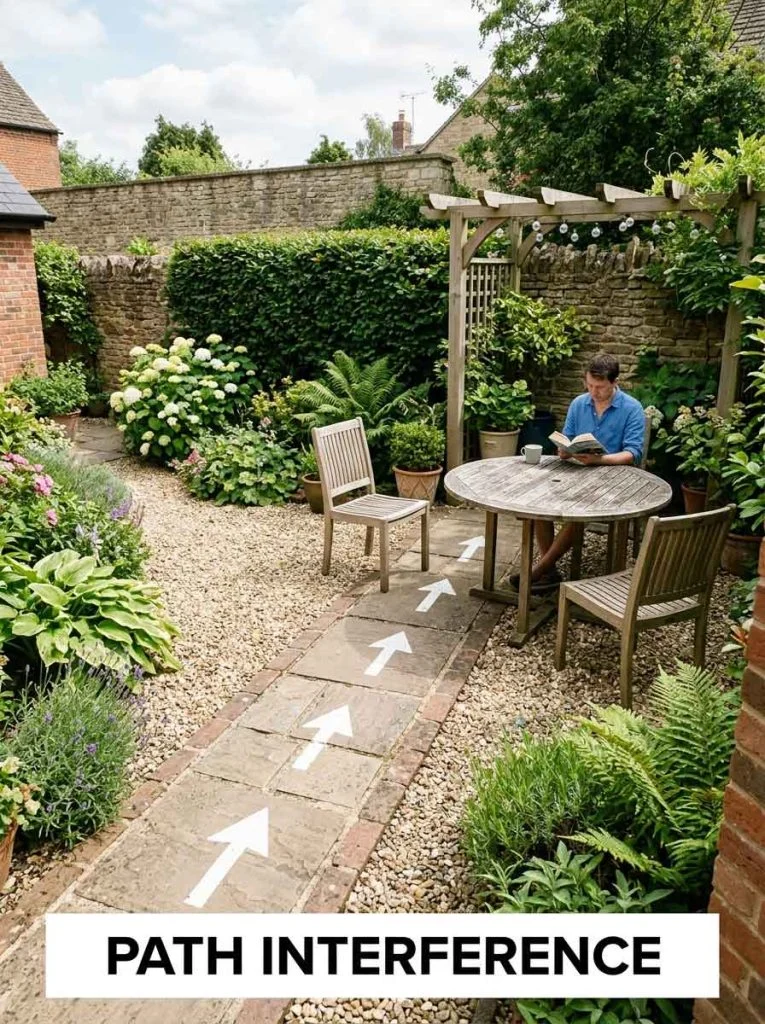
Temporary observation is more useful than immediately rebuilding a path. For several ordinary days, notice where people hesitate, make sharp turns, step off paving, brush against furniture or choose an unexpected shortcut.
Look especially for:
- chairs that have to be moved before someone can pass;
- gates that open into occupied space;
- routes that cut between a sofa and its coffee table;
- narrow passages created after furniture was added;
- grilling or storage routes that cross a quiet seating area;
- children or pets repeatedly running through a dining zone;
- stepping-stone or paving layouts that people routinely ignore.
These are signs that the circulation and activity zones disagree.
The solution is not always a wider path. Sometimes moving a chair group a short distance, rotating the table, shifting the grill or establishing a clearer edge between movement and occupation is enough to make the yard feel calmer.
In a compact backyard, circulation deserves particular attention because furniture can consume most of the usable footprint. The guide to small garden patio planning goes deeper into furniture clearances, patio dimensions and how to preserve useful movement when space is limited.
Give Every Activity an Edge
Seating usually feels more settled when people can occupy it without becoming part of the traffic system. That does not mean hiding every activity in a corner. It means giving the activity a recognizable boundary.
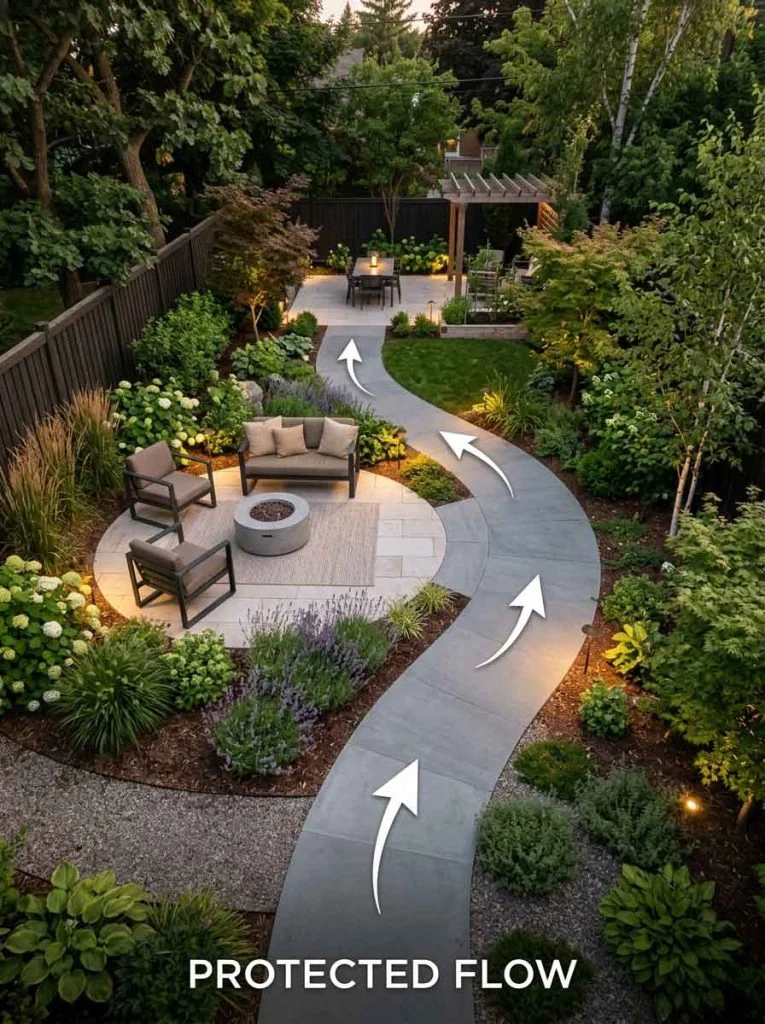
A change in paving, a planting edge, a rug designed for outdoor use, the side of a pergola, a low wall or even the orientation of the furniture can communicate that one area is for staying while the adjacent route is for moving.
This distinction becomes particularly important when the yard contains several functions. A family may need dining, children’s play, gardening, access to storage and a quiet chair within the same relatively small area. Trying to make the entire yard perform every function creates more conflict than assigning each activity a clear territory.
There Is No Obvious Reason to Stay Outside
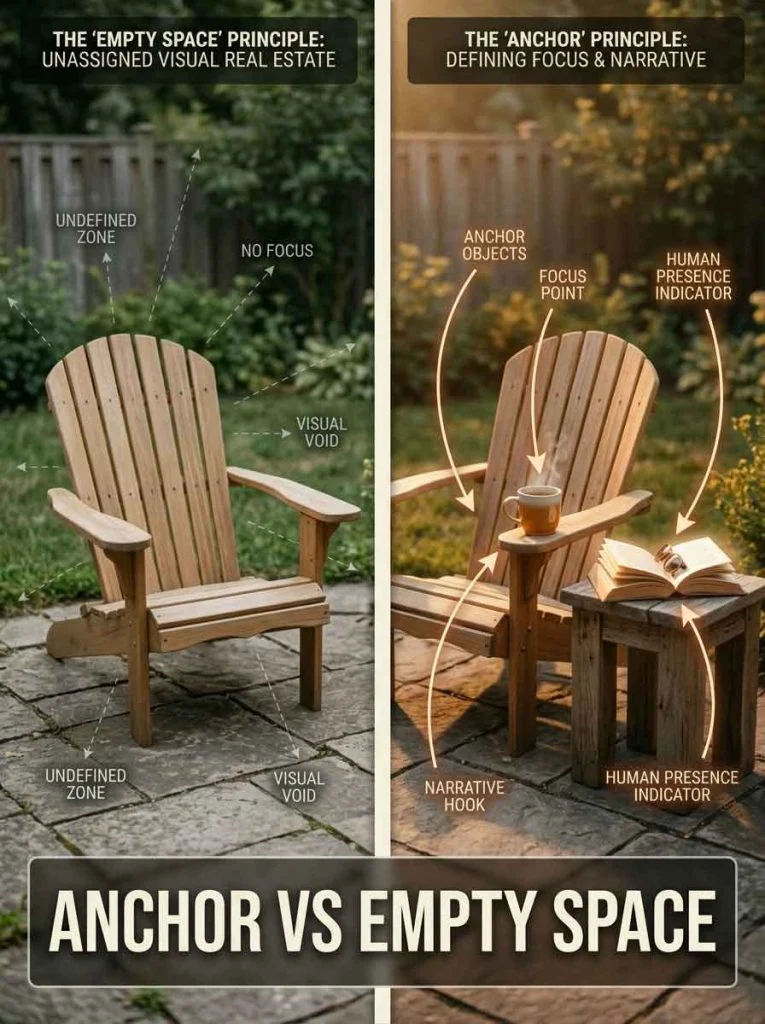
Some backyards are easy to enter and reasonably comfortable but still receive little use because they have no clear behavioral purpose. There may be lawn, paving and furniture, yet nothing strongly suggests what somebody should actually do after stepping outside.
A useful outdoor space usually has at least one behavioral anchor: an element or arrangement that makes a repeatable activity obvious.
That anchor does not need to be expensive or dramatic. It could be:
- one chair positioned for morning coffee;
- a small table used for breakfast or drinks;
- a shaded reading seat;
- an outdoor dining position that remains ready;
- a fire feature that organizes evening conversation where permitted and appropriate;
- an edible garden that encourages regular checking and harvesting;
- a children’s play area that is visible from the house;
- a comfortable spot for watching birds, plants or the changing light.
The important part is the activity, not the object.
A large outdoor sofa does not automatically create a reason to go outside. If nobody in the household naturally spends time lounging outdoors, the furniture can become an expensive display. A modest chair beside a small table may receive far more use because it supports an existing habit.
Design Around Something You Already Do
When choosing a backyard activity, start with behavior that already exists indoors.
If somebody drinks coffee every morning, ask whether one outdoor position could make that routine pleasant. If family members often talk after dinner, consider whether the same conversation could continue outside without rearranging furniture. If someone enjoys reading, create a seat with appropriate light, shade and a place for a drink.
This approach is stronger than inventing an aspirational lifestyle for the garden. Buying a large dining setting does not create a household that suddenly wants formal outdoor dinners every weekend. Building around existing routines gives the yard a much better chance of becoming part of ordinary life.
The most effective anchor is also easy to recognize. Someone walking outside should immediately understand where the activity happens and what is available there.
A Beautiful Backyard Can Still Feel Like a Display
Another common failure occurs when the garden is designed primarily to be viewed from the house. Planting beds, decorative objects and furniture may create an impressive composition through the window while offering little support for somebody actually occupying the space.
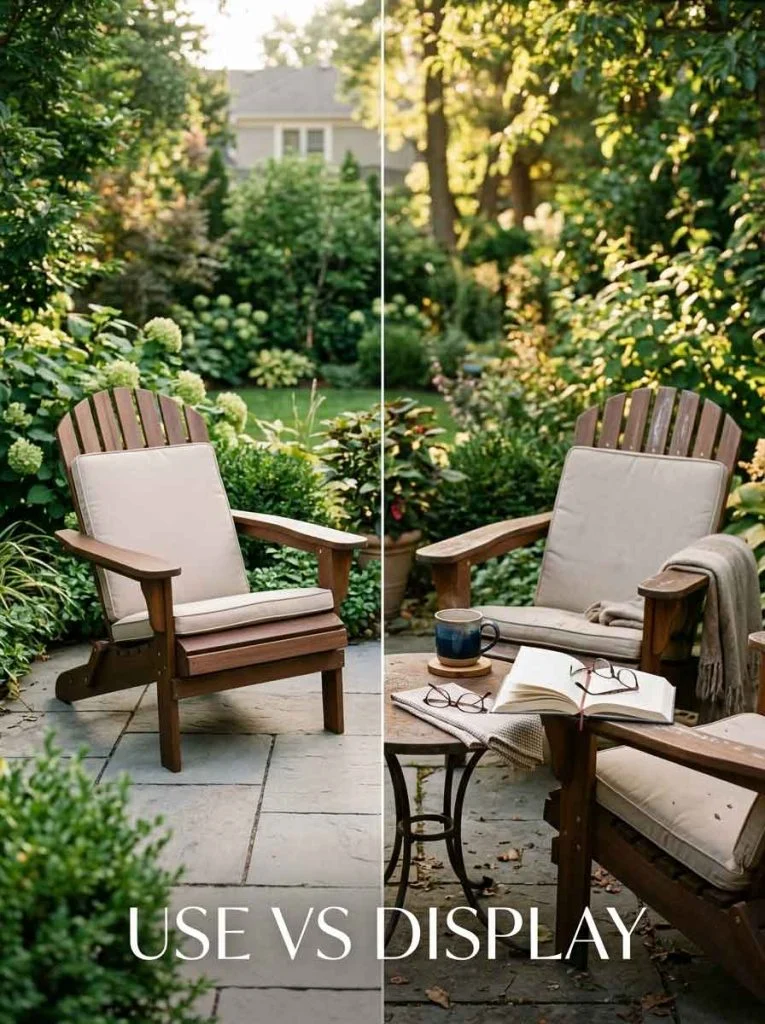
The difference becomes obvious once you sit down.
From inside, a chair may appear perfectly positioned beside a planting bed. From the chair, however, you may discover that it faces a blank wall, receives afternoon glare or sits directly in a circulation route. A decorative table may complete the visual composition while being too small or too far away to hold anything useful.
A backyard intended for real use should therefore be evaluated from occupied positions, not only from standing viewpoints or photographs.
Try sitting in each major location and ask:
- What can I see from here?
- Where does direct sun reach me?
- Is my back or side exposed to circulation?
- Can I put down a drink or book comfortably?
- Can another person join without moving everything?
- Do I feel as though I am sitting in the garden or simply beside it?
- What would make me remain here for another twenty minutes?
Those questions often reveal more than another round of decorating.
Small Maintenance Tasks Can Quietly Kill Spontaneous Use
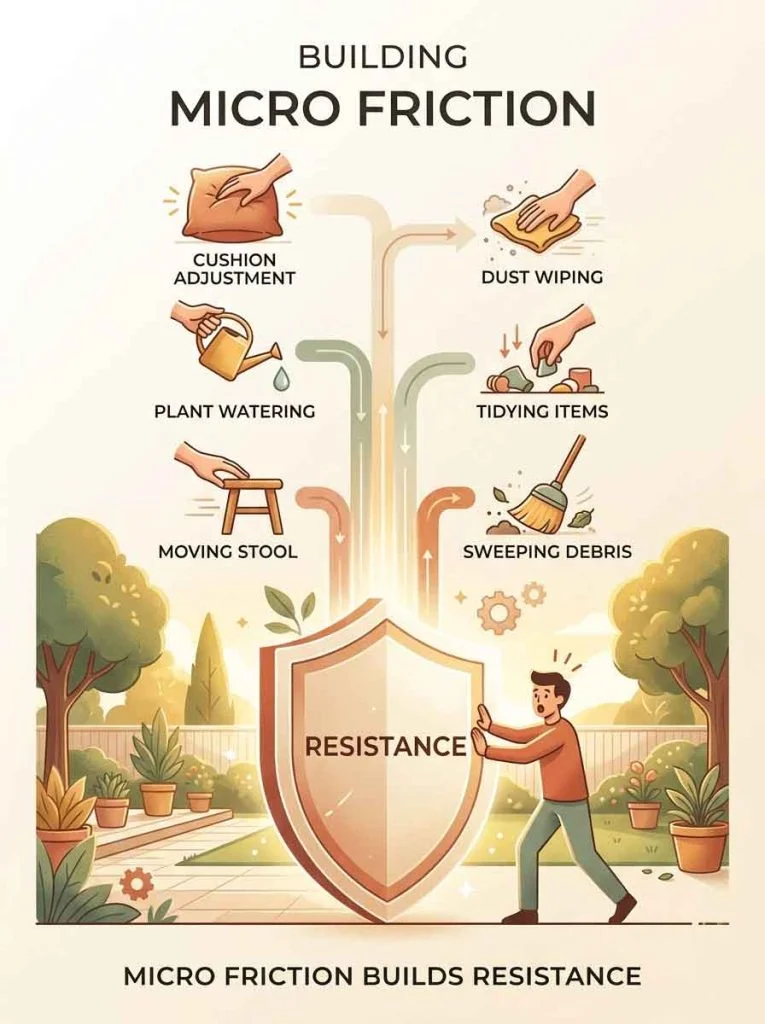
The backyard may work beautifully once everything is prepared yet still remain underused because preparation has become part of every visit. This is especially common after the novelty of a renovation or new furniture wears off.
At first, carrying four cushions outside or wiping the table may seem trivial. Several months later, the same routine can become enough to make a five-minute outdoor break feel inconvenient.
This is why backyard use sometimes declines even though nothing appears to have changed physically. The garden has not necessarily become less attractive. The household has simply stopped tolerating repeated friction that was easy to overlook when the space was new.
Audit the Work Required Before and After Every Visit
Do not evaluate maintenance only by asking how many hours a month the yard requires. Look at the tiny jobs attached to each individual use.
Common examples include:
- carrying cushions between indoor and outdoor storage;
- removing and replacing several furniture covers;
- wiping dew, pollen or dust before sitting;
- relocating furniture whenever the sun moves;
- finding extension leads or portable lights;
- bringing mosquito protection outside;
- retrieving serving trays, glasses or utensils from a distant kitchen;
- returning equipment to storage immediately after use;
- cleaning a surface because nothing can remain ready outdoors.
One task may be harmless. Five tasks surrounding every twenty-minute visit can change behavior.
The goal is to remove the most repetitive steps rather than eliminate maintenance entirely.
A weather-resistant chair that can remain usable may matter more than adding another decorative seat. Storage beside the activity may outperform a larger storage box at the opposite end of the garden. A small permanent side table can remove the repeated need to carry an extra surface outside.
Improve the Friction That Happens Most Often
Prioritize frequency before expense.
If you move an umbrella twice a year, that inconvenience probably does not explain why the garden remains empty. If you retrieve cushions every single time somebody wants to sit down, the cushion routine deserves attention first.
A practical hierarchy is:
- Remove repeated preparation.
- Make one useful activity permanently ready.
- Reduce recurring cleanup around that activity.
- Store frequently used items close to where they are needed.
- Only then consider adding another feature.
This order prevents a common mistake: buying something new for a backyard whose real problem is that existing features are already too inconvenient to use.
Test One Part of the Yard Before Redesigning Everything
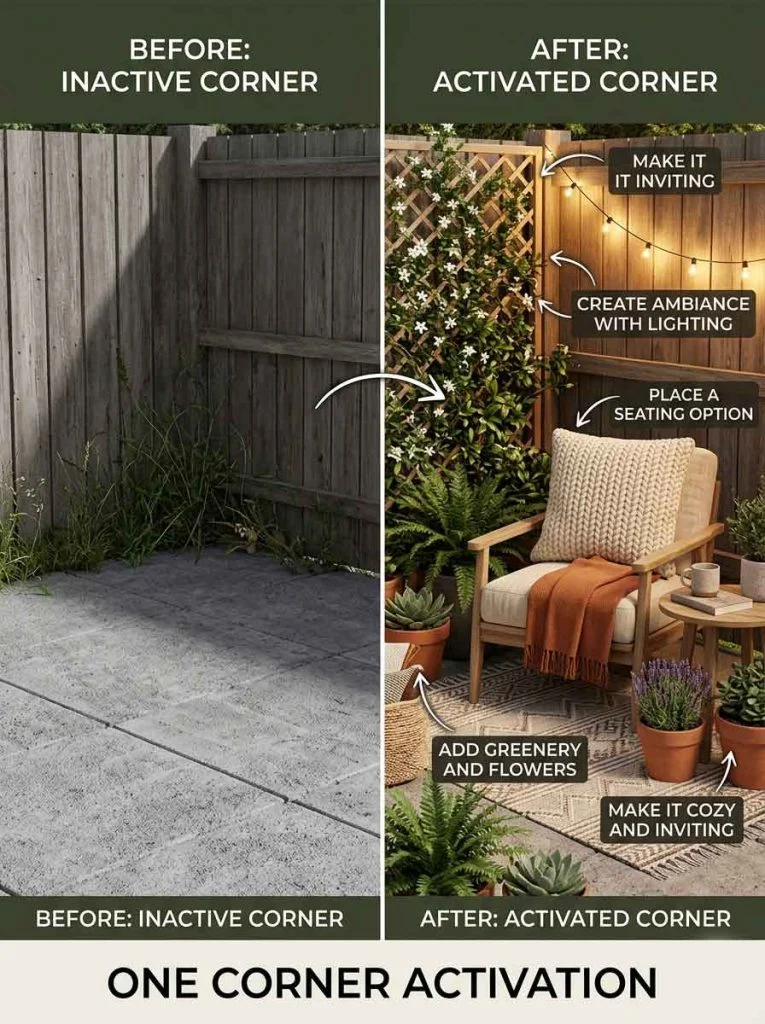
When several problems seem to exist at once, choose one small part of the backyard and make it work exceptionally well before changing the rest.
A single successful corner can answer questions that drawings and inspiration photos cannot. It shows where you naturally want to sit, what direction feels comfortable, when shade is needed, whether privacy actually matters and which activities you repeat without forcing yourself.
Choose a location that is reasonably accessible from the house and has at least one useful existing advantage, such as afternoon shade, a planting backdrop, a pleasant view or some protection from wind and neighboring sightlines.
Then give that corner one job.
Do not begin with a long shopping list. Start with the minimum arrangement needed to test behavior.
The One-Corner Test
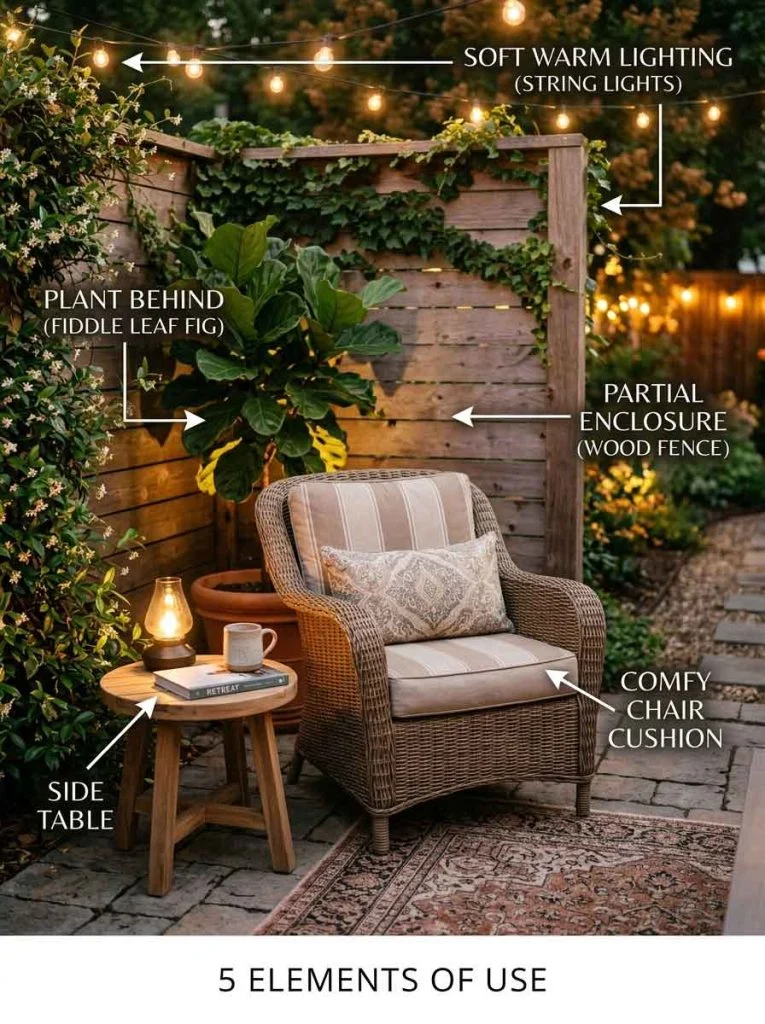
For an ordinary sitting or coffee area, the test may need only:
- one or two comfortable seats;
- one useful surface within reach;
- enough shade for the intended time of use;
- a clear route from the house;
- a reasonable sense of enclosure or privacy;
- nearby storage only if something genuinely has to be carried outside.
Use that setup repeatedly before making it permanent.
If you begin choosing that corner spontaneously, the location and activity are probably working. You can then improve durability, lighting, planting or furniture quality with much more confidence.
If the corner remains unused, resist the urge to decorate it further. Work out why.
Perhaps the sun reaches it later than expected. Maybe the neighboring view becomes uncomfortable once you sit down. Perhaps the route from the kitchen is too long for the activity you chose. The test has still been useful because it has exposed the actual design condition before you committed to construction.
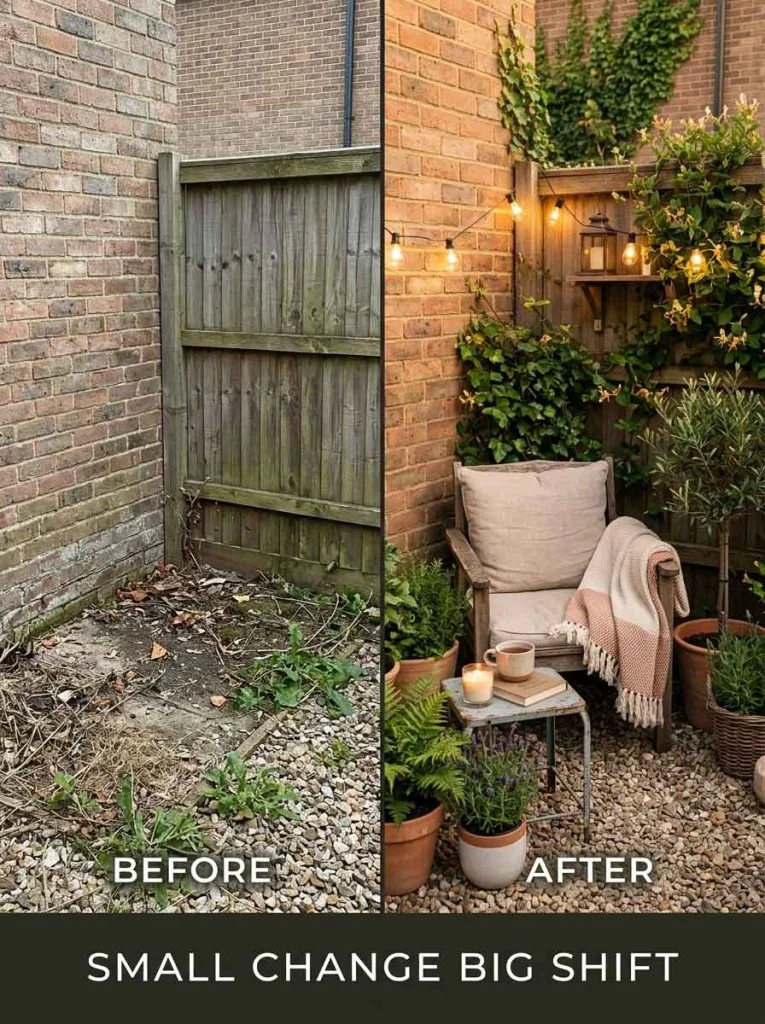
What a Successful Backyard Corner Usually Gets Right
The strongest small outdoor settings tend to combine several practical conditions rather than depending on one impressive feature.
Access is easy. You can reach the area without negotiating storage, muddy ground or furniture.
The activity is clear. The arrangement tells you what the place is for.
Seating is genuinely comfortable. The chair works for more than a photograph.
A useful surface is nearby. Drinks, books, food or gardening items have somewhere to go.
Exposure is controlled enough. Shade, wind and sightlines are acceptable during the intended period of use.
Movement passes beside the activity. People do not continually cut through it.
Preparation is modest. You can begin using the space without a setup routine.
A corner does not need every possible garden feature. It needs the conditions required for its specific purpose.
When the Whole Backyard May Need More Than a Small Fix
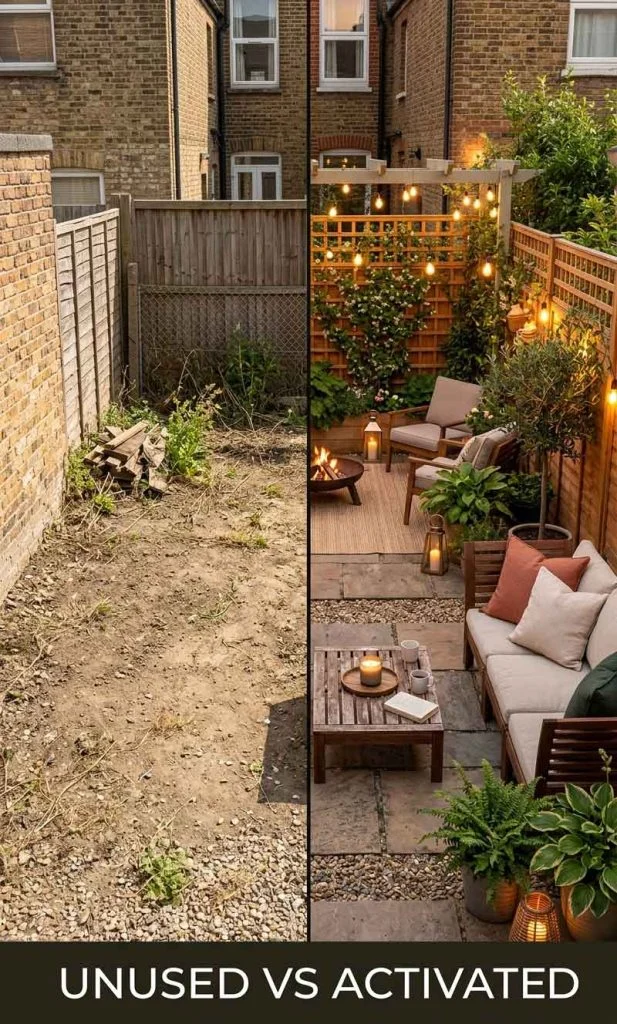
Small reversible experiments are valuable because many underused yards do not need wholesale reconstruction. There are situations, however, where moving furniture and adding shade cannot solve the underlying problem.
A larger redesign becomes more reasonable when permanent conditions prevent safe or practical use.
Examples include:
- persistent drainage or standing-water problems;
- badly deteriorated paving or retaining structures;
- unsafe level changes or steps;
- inadequate access between the house and garden;
- a layout where essential circulation cannot avoid the only usable activity area;
- permanent utilities or structures that make the intended use impractical;
- insufficient usable surface for the activities the household genuinely needs.
In these cases, the one-corner test still has value. It helps define what the redesigned yard needs to accomplish instead of beginning with appearance alone.
A contractor or landscape professional can then work from a clearer brief: we need a shaded two-person sitting area close to the kitchen, outside the main circulation route, for example, rather than the much less useful request to “make the backyard nicer.”
Before You Spend More, Ask What the Next Improvement Will Change
Every proposed backyard improvement should be connected to a specific behavior.
A pergola is valuable if excessive sun is preventing use at the time you want to sit outside. A privacy screen is valuable if a particular sightline makes the occupied position uncomfortable. A larger patio is valuable if the current footprint cannot hold the required furniture while preserving circulation.
The same objects add much less value when they are purchased simply because they are common ingredients in attractive gardens.
Before committing money, finish this sentence:
“If we make this change, we expect to use the backyard more because…”
If the answer identifies a real existing barrier, the improvement has a clear job. If the answer is mainly “it will look better,” decide whether appearance is actually the problem you are trying to solve.
Use the Backyard Assessment Before Making Another Upgrade
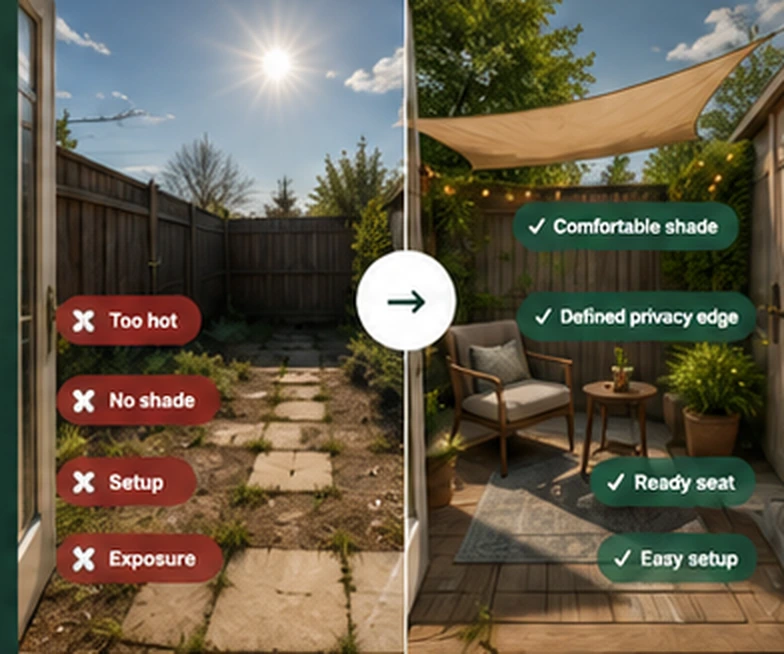
If several causes still seem possible, use the backyard assessment below to separate what looks wrong from what actually prevents use. Answer according to an ordinary week rather than imagining how you would use the yard after a renovation.
The most useful answers are often quite specific. “We need a better backyard” is difficult to act on. “The western sun makes our only seating area uncomfortable between 4 and 7 p.m.” gives you something testable.
Pay particular attention to four questions:
- Do you reach the activity easily? If not, investigate access and setup first.
- Can you remain comfortable once there? If not, investigate sun, heat, exposure, insects, wind or noise.
- Can the activity happen without circulation cutting through it? If not, adjust zoning and furniture position.
- Would you naturally repeat the activity several times a week? If not, reconsider whether the space has the right purpose.
The assessment should point toward the first useful experiment, not produce a shopping list. When the result suggests several improvements, choose the least permanent change capable of testing the diagnosis.
Fix Backyard Problems in the Right Order
The order of improvements matters because one unresolved condition can make later spending almost irrelevant.
For example, suppose a household wants to improve an unused dining patio. They add decorative lighting first, then buy better furniture and eventually install new planting. The patio remains quiet because the afternoon sun still makes the table uncomfortable during the only hours when the family wants to eat outside.
A more useful sequence is to solve the barrier closest to the beginning of the behavior.
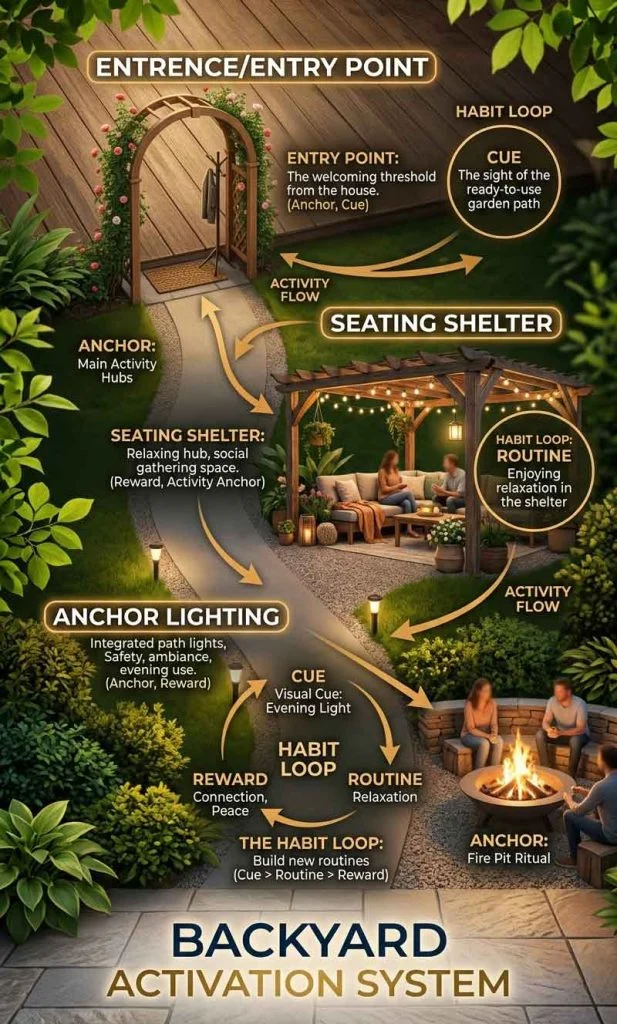
1. Make the Area Reachable
Resolve awkward access, blocked doors, muddy approaches and repeated equipment retrieval before refining the destination. If reaching the space is annoying, improvements within it will be experienced less often.
2. Make One Activity Immediately Possible
Give the area a recognizable purpose and enough furniture or equipment to begin that activity without preparation. Avoid furnishing several imagined zones before learning which one the household genuinely uses.
3. Correct the Main Comfort Failure
Test shade, privacy, wind, insects, heat and seating from the occupied position. Deal with whichever condition repeatedly ends the visit.
4. Separate Staying From Passing Through
Once the activity itself works, make sure everyday circulation does not continually disturb it. This may require little more than rotating furniture or redefining one route.
5. Remove Repeated Maintenance Friction
Reduce the tasks that surround every visit: carrying, covering, cleaning, relocating and retrieving. Improvements that save a small amount of work every day can influence use more than dramatic additions used occasionally.
6. Improve the Experience After the Behavior Works
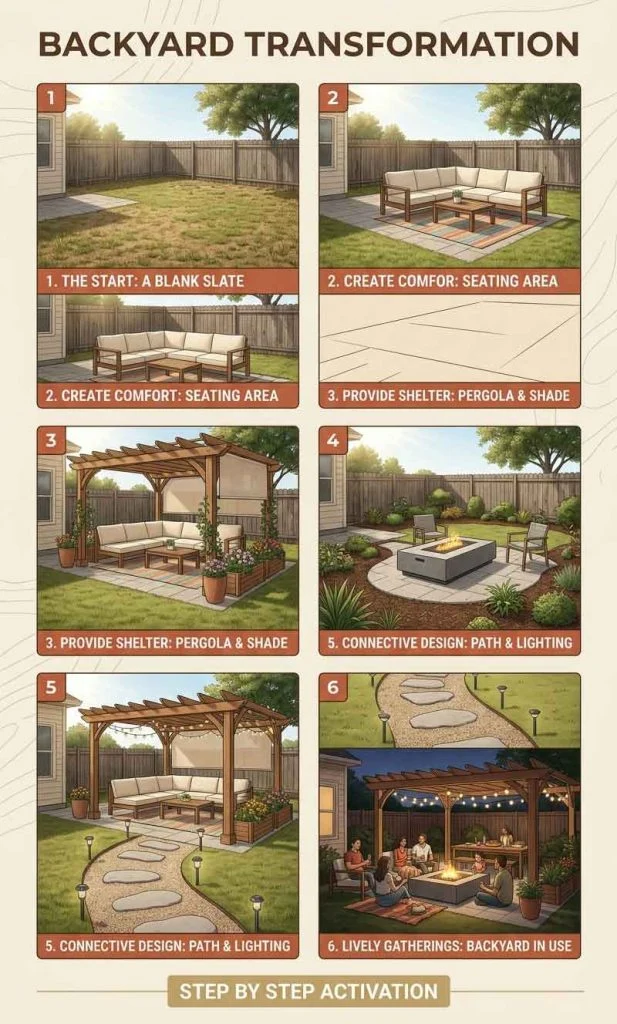
Lighting, planting, finishes, decorative objects and more specialized features can now strengthen a place that people already choose to use.
This sequence is intentionally practical. You are building evidence from actual behavior rather than trying to predict the perfect finished backyard in one step.
Do Not Confuse More Features With More Usability
A common response to an underused garden is to keep adding things.
A second seating area appears because the first one is rarely used. Then comes a fire feature, outdoor kitchen equipment, more lighting, another shade structure or additional planting. Each addition may be attractive, but the yard can become harder to maintain and more fragmented without becoming easier to use.
The useful question is whether a new feature removes a known barrier or supports a demonstrated activity.
A second table makes sense when the household regularly needs another dining or work surface. It makes less sense when the first table already sits unused because the location is too hot.
A pergola may solve a clear shade problem. It will not solve an inconvenient route from the house.
More planting can create enclosure and improve the view from a chair. It can also add maintenance around a seating area whose real problem is that nobody has a reason to sit there.
Treat each proposed feature as a response to evidence.
Why Backyard Use Often Declines After the First Few Weeks
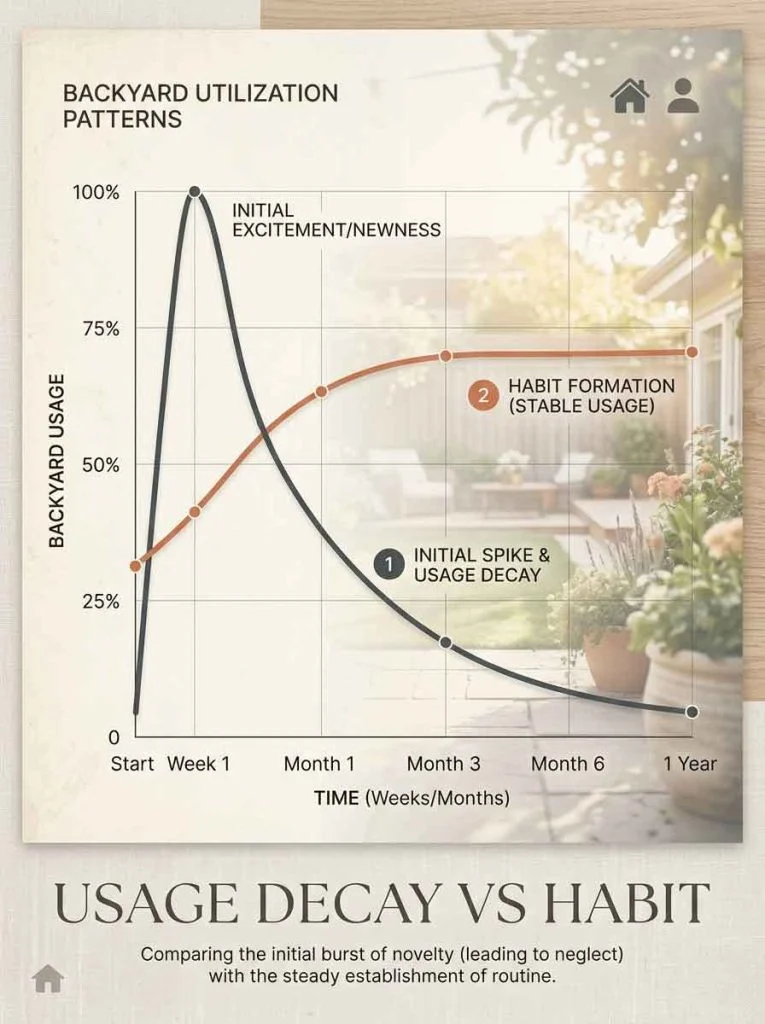
New outdoor furniture or a freshly completed garden can temporarily overcome usability problems because novelty increases motivation. People make a special effort to carry cushions, clean surfaces, move chairs or tolerate imperfect conditions because they are excited to use the new space.
Once the novelty fades, ordinary behavior returns.
This is why declining use does not automatically mean the renovation “failed.” It may mean the initial excitement concealed a handful of practical inconveniences that now matter more.
Watch for this pattern:
New feature → deliberate effort to use it → repeated setup becomes noticeable → spontaneous visits decline → yard gradually returns to display space.
The appropriate response is rarely another novelty purchase.
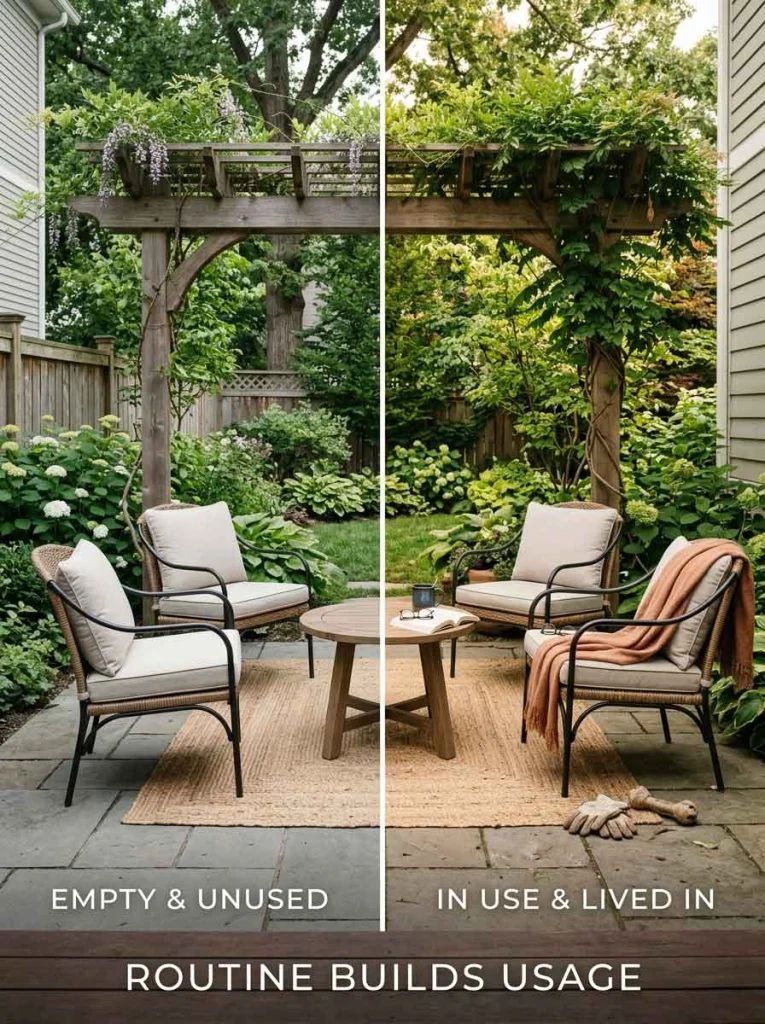
Instead, identify which repeated action appeared between the enthusiastic first weeks and the later decline. If cushions became irritating to move, change their storage or choose a more weather-tolerant setup. If afternoon sun became the limiting factor, solve that exposure. If nobody wants to walk to the far end of the garden for a five-minute break, reconsider the activity location.
The goal is to make ordinary use survive after enthusiasm disappears.
Build for Short Visits, Not Only Special Occasions

Many outdoor spaces are designed around large events: family meals, entertaining, parties or long weekend afternoons. Those activities may matter, but they occur too infrequently to create a strong everyday relationship with the garden.
Short visits are often more important.
A ten-minute coffee, a quick phone call outside, a few minutes checking herbs, an after-work drink or a short conversation can make the backyard part of normal life.
Designing for those moments changes the priorities. The nearest useful seat may matter more than the largest lounge setting. Immediate shade may matter more than a dramatic feature located elsewhere. A small table that remains ready may outperform furniture stored for occasional gatherings.
Once short visits become easy, longer use often follows naturally because people already know which parts of the garden feel comfortable.
The Backyard Should Become Easier to Use Over Time
A well-functioning backyard develops familiarity.
You learn which chair works in the morning, where the afternoon shade falls, how air moves through the yard, where people naturally gather and which routes should remain open. Good design reinforces those patterns rather than forcing the household to relearn the space each time.
That is why observation after each change matters.
After making an improvement, ask:
- Are visits becoming more frequent?
- Are people going outside without suggesting it first?
- Are visits lasting longer?
- Is less preparation required?
- Has furniture stopped being constantly moved?
- Is one part of the garden becoming a natural destination?
- Are new problems appearing only because the original barrier has now been removed?
The final question is particularly useful. Solving one problem can reveal another that was previously hidden.
For example, improved shade may suddenly make you notice an overlooking window because people now remain in the seating area longer. That does not mean the shade improvement was wrong. It means the next genuine constraint has become visible.
When to Stop Improving the Backyard
A backyard does not need to solve every possible design problem.
If the household uses it willingly, the main activities work, preparation is reasonable and the space remains comfortable for the intended periods, additional changes become preferences rather than usability requirements.
This is an important stopping point because outdoor projects can easily drift from problem-solving into perpetual upgrading.
You may still choose to improve planting, lighting, materials or furniture because you enjoy the process. The difference is that you are no longer trying to rescue an unused space.
A useful backyard can be simple.
It can be one shaded chair beside a small table, reached directly from the house and positioned where the garden feels pleasant. If that arrangement is used most days, it is functioning better than a much larger collection of features that rarely draws anyone outside.
Your Backyard Use Decision
Before planning the next project, identify which statement most closely describes your yard:
“We rarely make it outside.”
Reduce entry and preparation friction first.
“We go outside but quickly become uncomfortable.”
Test the occupied position for sun, heat, exposure, wind, insects, noise and seating comfort.
“The space always feels awkward when several people use it.”
Map circulation and separate movement routes from activity zones.
“The yard looks finished, but there is nothing we naturally do there.”
Create one behavioral anchor around an activity that already exists in your daily life.
“We used it at first, then gradually stopped.”
Audit recurring setup, cleaning, moving, covering and storage tasks.
“Small experiments keep failing because of permanent site conditions.”
A more substantial redesign may now be justified.
The best first improvement is the one that removes the earliest dependable reason you decide not to use the backyard. Once that barrier is gone, give the space enough ordinary time to prove whether another change is genuinely necessary.
A Backyard Becomes Useful Through Repetition
The clearest sign of success is not how the garden looks after a project is completed. It is what happens several ordinary weeks later.
A functioning backyard starts attracting small, unplanned visits. Someone carries a drink outside without thinking about it. A chair has a familiar owner at a certain time of day. The garden becomes somewhere to go rather than something to look at.
You do not need to activate every square metre to achieve that.
Start with the point where use currently breaks down, remove the strongest barrier, make one activity easy and observe what happens next. A backyard that works repeatedly is usually built through a series of informed corrections rather than one perfect redesign.
Frequently Asked Questions
Why does my backyard stay unused even though it looks nice?
A good-looking backyard can remain unused when ordinary use involves too much friction. The route outside may be inconvenient, seating may feel exposed or too hot, circulation may interrupt the activity, or every visit may require carrying, cleaning or rearranging things. Judge the yard by how easily somebody can enter, settle, begin an activity and remain comfortable rather than by appearance alone.
What is the fastest way to make an unused backyard more usable?
Make one small part of the backyard immediately usable instead of redesigning everything. Choose an accessible position, give it one clear activity, provide comfortable seating and a useful surface, then remove the main problem affecting that spot, such as poor shade, exposure or repeated setup. Use it for ordinary short visits before deciding whether a larger project is necessary.
Why do we use our backyard less after buying new furniture?
New furniture can temporarily increase backyard use because the novelty makes people more willing to tolerate preparation. Once that excitement fades, repeated jobs such as carrying cushions, removing covers, wiping surfaces or repositioning furniture become more noticeable. If use declines, audit the tasks required before and after each visit before buying another feature.
Why does my backyard feel uncomfortable when it is very open?
Very open seating can expose the occupant to unwanted sightlines, strong sun, wind and passing movement from several directions at once. Partial enclosure behind or beside the seat can create a stronger sense of definition while keeping the preferred view open. Test the location while seated because exposure can feel very different at eye level than it appears when standing or looking from the house.
Where should I put a seating area in my backyard?
Choose the location according to the activity, time of use, shade, privacy and circulation rather than automatically centering the seating on the patio or lawn. A strong position is easy to reach, does not sit inside a major walking route and provides enough comfort at the hour you expect to use it. Temporary furniture is useful for testing several positions before making the arrangement permanent.
Should backyard seating face the house or the garden?
There is no universal direction. Seating often works best when the back or side receives some protection while the open side faces planting, lawn, another person, a fire feature or another worthwhile focal point. Sit in the proposed position and check the actual view, sunlight, neighboring windows and circulation before deciding which direction is most comfortable.
How can I tell if poor backyard circulation is the problem?
Watch the routes people naturally take between the house, gate, lawn, storage, grill and other destinations. Circulation is likely contributing to the problem when people repeatedly squeeze behind chairs, cut between seats, step off the intended path or move furniture to pass. Moving an activity beside the main route is often more effective than simply making the route wider.
What is a behavioral anchor in backyard design?
A behavioral anchor is a feature or arrangement that makes one outdoor activity immediately understandable. A chair and small table can establish a morning coffee spot, a shaded seat can support reading, and a dining setup can organize family meals. The strongest anchor supports something the household already enjoys doing rather than an activity imagined only for the redesigned yard.
Should I redesign the whole backyard if nobody uses it?
Usually not as the first step. Test reversible changes such as moving furniture, creating shade, adjusting privacy or making one activity permanently ready. A larger redesign becomes more reasonable when permanent conditions such as poor drainage, unsafe level changes, inadequate access, failing structures or unavoidable circulation conflicts prevent the household from using the yard effectively.
A backyard gets used when entering it feels easier than ignoring it.
Map the friction between your back door and real daily use. Then turn comfort, shelter, flow, habit and setup problems into a practical one-corner plan before spending money on a full redesign.

What do you want your backyard to help you do?
Choose as many as you like. The plan will look for a clear behavioral anchor rather than a decorative wish list.
What stops you from using it now?
Choose every problem that feels true. Small repeated barriers often matter more than one dramatic design flaw.
What does your backyard already have?
Choose what is already available. The plan will reuse useful assets before recommending more additions.
Which backyard feeling do you want?
Choose the emotional direction that should guide the plan. This keeps the recommendations useful rather than purely decorative.
Choose your backyard size and starter budget
This changes the roadmap from simple one-corner upgrades to a larger transformation plan.
What are you thinking of adding?
Choose multiple options to see whether the additions address your actual friction or simply add more features.