

Why Some Plants Grow Together While Others Fail
Most gardening advice begins with a list.
Plant this. Avoid that. Pair these. Separate those.
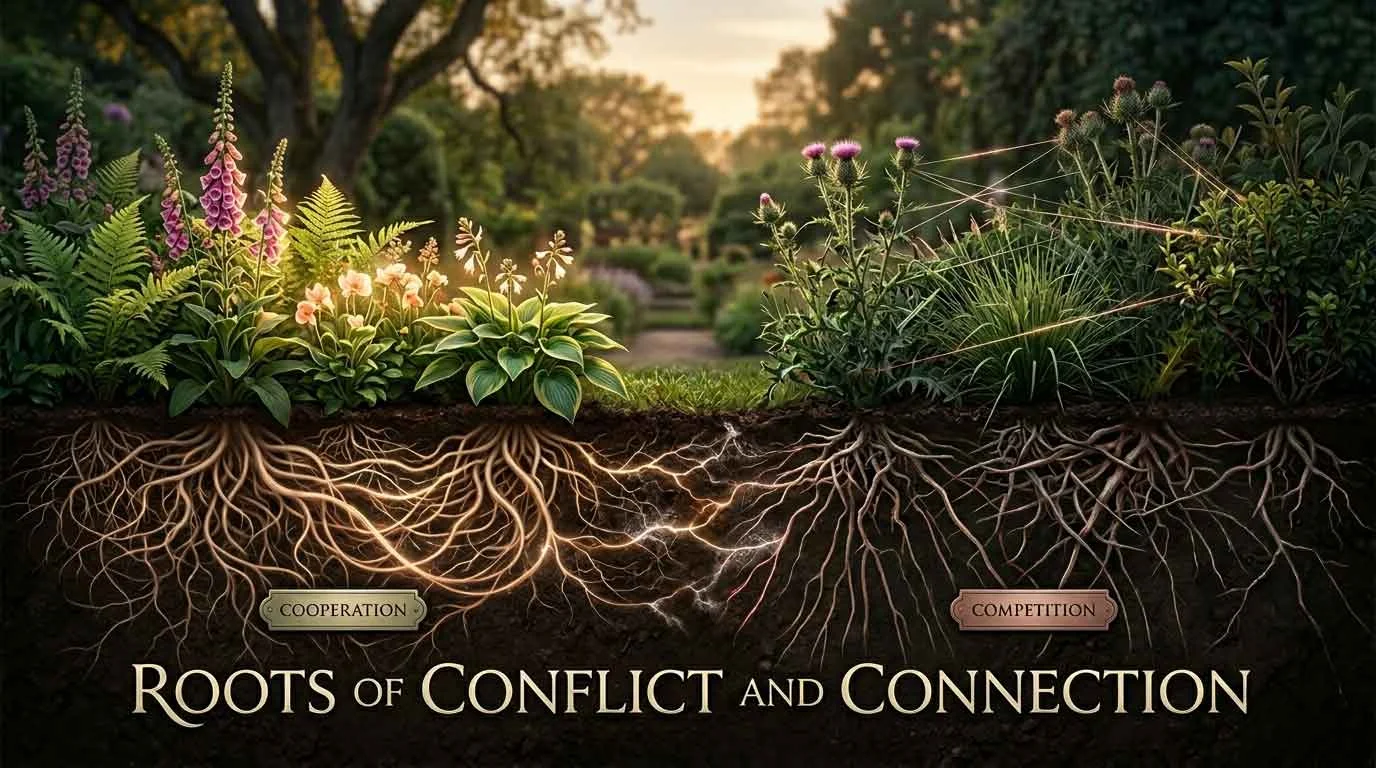
But what most people never see is the system underneath.
A garden is not a collection of plants. It is a network of interactions.
Some plants support each other quietly. Others compete in ways that are not immediately visible. And many simply cancel each other out over time.
This is why two identical gardens, planted with the same species, can produce completely different results.
The difference is not luck.
It is compatibility.
The Hidden Layer Most Gardeners Never Notice
At the surface level, plants look independent. Each has its own space, its own soil, its own sunlight.
But below the surface, three invisible systems are constantly interacting:
- Root competition
- Nutrient sharing or depletion
- Chemical signaling
These processes continue even when nothing appears to be happening above ground.
A plant does not simply grow.
It responds to everything around it.
Why Traditional Companion Planting Feels Incomplete
Most guides present companion planting as a static chart.
Tomatoes grow well with basil.
Carrots work with onions.
Avoid planting beans near garlic.
These are outcomes, not explanations.
Without understanding why these relationships work, gardeners are left to memorize instead of think.
Garden Intelligence Engine
Check plant compatibility, soil needs, fertilizer timing, harvest forecasts, likely problems and nearby garden supply searches.
1. Choose Your Garden Setup
2. Select Plants
Choose at least two plants for compatibility analysis.
And memorization does not adapt.
As soon as conditions change – spacing, soil, or plant combinations – the chart becomes less reliable.
This is where a deeper understanding becomes necessary.
The Core Idea Behind Plant Compatibility
Plant compatibility does not rely on fixed lists.
It is based on how plants behave and interact when they share the same space.
Instead of asking:
“What works together?”
A more useful question is:
“Why do these plants behave the way they do when placed together?”
Once this becomes clear, patterns start to repeat.
And decisions become easier.
The Three Core Compatibility Forces
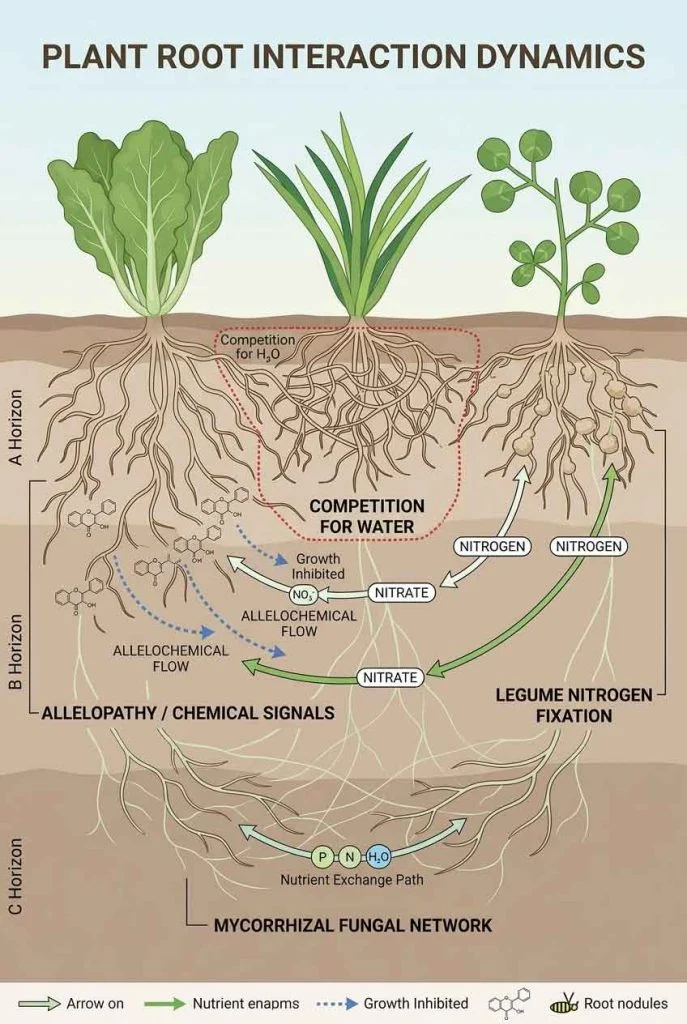
Every plant interaction can be understood through three main forces:
1. Resource Competition
Plants compete for:
- Water
- Nutrients
- Light
- Root space
When two plants demand the same resources at the same depth and intensity, one will gradually dominate.
The other will decline over time.
2. Growth Structure Alignment
Plants grow differently.
Some grow upward.
Others spread outward.
Some have shallow roots.
Others grow deep.
When these patterns align, plants coexist with minimal interference.
When they overlap, growth becomes restricted.
3. Chemical Interaction (Allelopathy)
Some plants release substances into the soil.
These can:
- Slow down nearby growth
- Influence nutrient absorption
- Affect root development
This explains why certain plant pairings fail, even when everything else appears correct.
Why This Matters More Than Most Garden Advice
Many gardening problems are misdiagnosed.
People assume:
- The soil is poor
- The watering is wrong
- The sunlight is insufficient
But in many cases, the issue is interaction, not environment.
A plant can be placed in perfect conditions and still struggle.
Because the problem is not the plant itself.
It is the system it is placed into. This is also why gardeners who understand how to support a balanced garden ecosystem tend to see more stable and resilient growth over time.
What Actually Happens When Plants Are Incompatible
Incompatibility is rarely immediate.
Plants do not “fail overnight.”
Instead, the effects unfold gradually, often misinterpreted as unrelated issues.
Leaves may turn pale. Growth slows. Yield drops. Pests appear. The plant looks alive, but not thriving.
This slow decline is what makes plant incompatibility difficult to detect.
Because nothing looks obviously wrong at the start.
The Illusion of “Healthy but Not Growing”
One of the most common patterns in home gardens is this:
The plant survives.
But it does not perform.
It produces fewer leaves.
It fruits later.
It remains smaller than expected.
This is not a disease.
It is silent competition.
When two plants overlap in resource demand, neither one necessarily dies. But one becomes dominant, and the other is pushed into a reduced state.
This creates the illusion of “good enough,” which prevents correction.
Root-Level Competition – The Invisible Battlefield
Above ground, spacing may look sufficient.
Below ground, roots expand aggressively.
When root zones overlap:
- Nutrients are absorbed faster than they can replenish
- Water distribution becomes uneven
- Microbial balance shifts
The plant with faster root expansion or higher nutrient demand gains the advantage.
The weaker plant adapts by slowing growth.
Over time, this compounds into visible underperformance.
Nutrient Lock vs Nutrient Theft
Not all competition is direct.
Some plants actively alter soil conditions.
This creates two different outcomes:
Nutrient Theft
Both plants consume the same nutrients aggressively.
Example pattern:
- Heavy feeders placed together
- Fast-growing plants paired with nutrient-demanding species
Result:
- Rapid depletion
- Both plants weaken over time
Nutrient Lock
One plant modifies the soil in a way that reduces availability for others.
This is more subtle and often misunderstood.
The plant is not “stealing.”
It is changing the rules.
Growth Structure Conflicts – When Space Is Not Really Space
Garden layouts often assume that spacing equals compatibility.
But spacing is only a surface measurement.
What matters is growth behavior.
Vertical vs Horizontal Conflict
Plants grow in different dimensions:
- Vertical growers compete for light
- Horizontal spreaders compete for territory
When two vertical growers are placed too close:
- One blocks sunlight
- The other adapts by stretching
- Structural weakness develops
When horizontal plants overlap:
- Airflow reduces
- Moisture retention increases
- Disease risk rises
Compatibility depends on how these structures interact, not just distance.
Timing Conflict – The Overlooked Factor
Plants do not grow at the same speed.
Some establish quickly.
Others develop slowly.
When mismatched:
- Fast growers dominate early
- Slow growers never catch up
This creates a permanent imbalance.
Even if both plants are technically compatible, timing mismatch can produce the same negative outcome as incompatibility.
Chemical Interactions – The Most Misunderstood Layer
This is where most traditional advice becomes vague.
Some plants “help.”
Some plants “harm.”
But the mechanism is rarely explained.
What Is Actually Happening in the Soil
Certain plants release compounds through their roots.
These compounds influence:
- Microbial activity
- Nutrient absorption
- Root growth of nearby plants
This is not accidental.
It is part of how plants compete and defend their space.
Why Some Pairings Always Fail
When incompatible plants are placed together:
- One plant introduces inhibitory compounds
- The other plant becomes less efficient at nutrient uptake
- Growth slows without obvious cause
This creates confusion.
Gardeners adjust water, soil, and sunlight.
But the issue persists.
Because the problem is chemical, not environmental.
Real-World Patterns – What Gardeners Experience
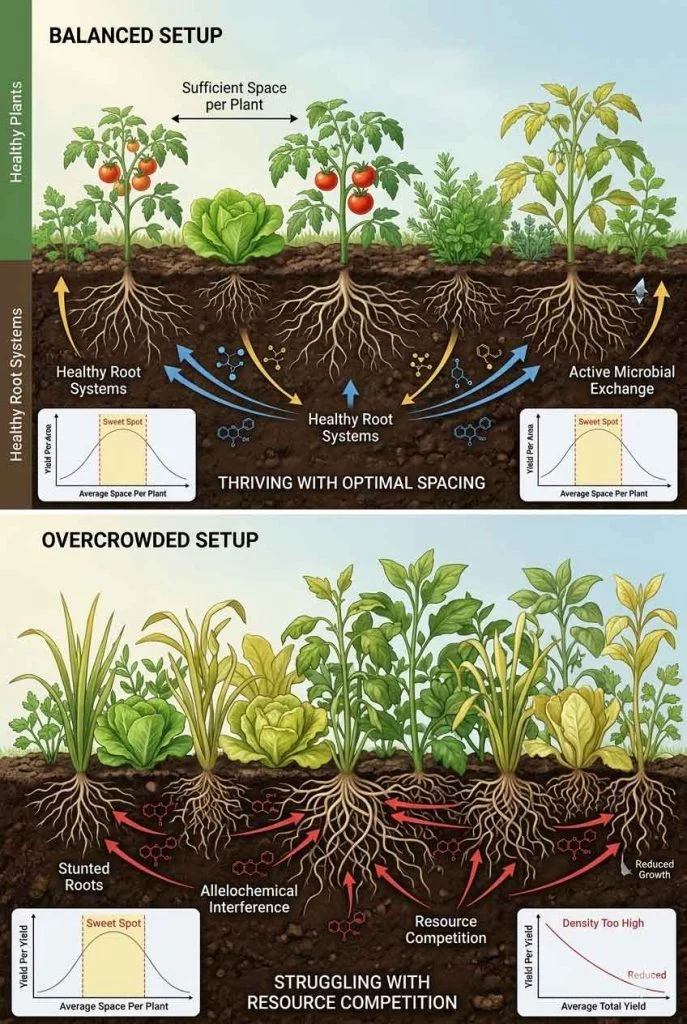
Instead of memorizing plant lists, it is more useful to recognize patterns.
These patterns repeat across different plant types.
Pattern 1 – Strong + Strong = Weak Outcome
Two aggressive growers placed together:
- Both compete heavily
- Neither reaches full potential
This often happens with:
- High-yield crops grouped tightly
- Fast-growing species planted without spacing logic
The expectation is “more plants = more output.”
The result is reduced performance across all plants.
Pattern 2 – Dominant + Passive = Suppressed Growth
One plant thrives.
The other stagnates.
This is not coincidence.
The dominant plant:
- Absorbs more nutrients
- Expands roots faster
- Blocks light or airflow
The passive plant survives but underperforms.
Pattern 3 – Chemical Conflict = Unexplained Failure
This is the most frustrating pattern.
Everything looks correct:
- Proper watering
- Adequate sunlight
- Good soil
Yet the plant declines.
This is often due to unseen chemical interaction.
And without a system to detect it, it feels random.
Why Manual Planning Breaks Down
At this point, a pattern becomes clear.
Plant compatibility is not simple.
It involves:
- Resource demand
- Growth behavior
- Chemical interaction
- Timing differences
Trying to manage all of these manually quickly becomes overwhelming.
This is why most gardeners fall back to static charts.
But charts cannot adapt.
They cannot:
- Adjust for new plant combinations
- Detect conflicts dynamically
- Scale with complexity
The Limitation of Static Knowledge
A chart answers a fixed question.
But gardening is not fixed.
Every change creates a new scenario:
- Adding one plant changes resource demand
- Adjusting spacing alters competition
- Changing soil affects nutrient flow
Static knowledge fails in dynamic systems.
The Shift Toward Understanding Plant Interactions
Instead of memorizing combinations, the better approach is to model interactions.
This is where the idea of a compatibility engine emerges.
A system that evaluates:
- What each plant needs
- How each plant behaves
- How each plant affects others
And then produces a result based on interaction, not assumption.
From Gardening Advice to System Thinking
This is the key shift.
From:
👉 “What should I plant together?”
To:
👉 “How do these plants interact as a system?”
Once this shift happens, gardening becomes more predictable.
And more scalable.
How Plant Compatibility Can Be Understood in Practice
At this stage, the idea becomes more practical.
If plant growth is shaped by interaction, then those interactions can be understood in a structured way.
Not perfectly.
But clearly enough to guide better decisions.
Plant compatibility is not based on fixed lists.
It comes from observing how different plants behave when they share the same space.
Breaking Plant Behavior Into Key Factors
To understand compatibility, each plant needs to be viewed beyond its name.
Every plant follows a pattern.
This pattern includes:
- How much water and nutrients it needs
- How deep and wide its roots grow
- Whether it grows upward or spreads outward
- How quickly it develops
- Whether it influences nearby plants through the soil
When these factors are considered, plants become easier to compare.
Instead of guessing combinations, it becomes possible to see where overlap or balance may occur.
How Plants Influence Each Other When Placed Together
Once multiple plants are grouped together, their behaviors begin to interact.
These interactions are not always visible at first, but they shape long-term results.
Several types of overlap can happen at the same time:
- Plants may compete for the same nutrients
- Their root systems may expand into the same space
- Their growth patterns may block light or airflow
- Some may influence others through subtle chemical changes in the soil
Each interaction adds pressure or balance to the overall combination.
The goal is not to eliminate all interaction.
It is to reduce unnecessary conflict.
What These Interactions Lead To Over Time
As interactions build up, they begin to affect outcomes.
These outcomes are usually seen as:
- Stable growth across all plants
- Uneven growth where one plant dominates
- Gradual decline in one or more plants
- Reduced yield despite healthy appearance
Instead of labeling combinations as simply “good” or “bad,” it is more useful to understand what type of interaction is taking place.
This makes it easier to adjust before problems become visible.
What to Consider When Planning Plant Combinations
When planning a garden, the starting point should remain simple.
Complexity should not come from the process, but from understanding.
Basic Factors to Start With
Even without deep analysis, a few inputs can guide better planning:
- The types of plants you want to grow
- The space available
- The type of setup, such as containers or garden beds
These factors define how much interaction will occur and how intense it may become.
Additional Factors That Refine Results
As more details are considered, planning becomes more precise.
These may include:
- Soil condition
- Watering habits
- Sunlight exposure
- Planting timing
These factors do not change the nature of compatibility.
But they can influence how strongly interactions affect growth.
What Happens When Multiple Plants Are Combined
When plants are placed together, their interactions do not happen in isolation.
Each plant affects several others at the same time.
Interactions Build Across the Entire Combination
If five plants are placed together, each one influences the others in different ways.
Some relationships are supportive.
Others introduce competition.
As these interactions overlap, they form a complete picture of how the garden will perform.
This is why a combination that looks balanced at first may still produce uneven results.
Different Types of Pressure Can Overlap
In many cases, more than one type of interaction is happening at once.
For example:
- Two plants may compete for nutrients
- Another may block light
- Another may affect soil conditions
Even if each interaction seems small on its own, the combined effect can become significant over time.
Small Conflicts Can Become Larger Problems
A minor imbalance at the start may not be noticeable.
But as plants grow, these small conflicts expand.
This can lead to:
- Slower development
- Reduced plant strength
- Increased sensitivity to stress
Recognizing these patterns early allows for adjustments before the impact becomes visible.
What You Will Notice When Compatibility Is Managed Well
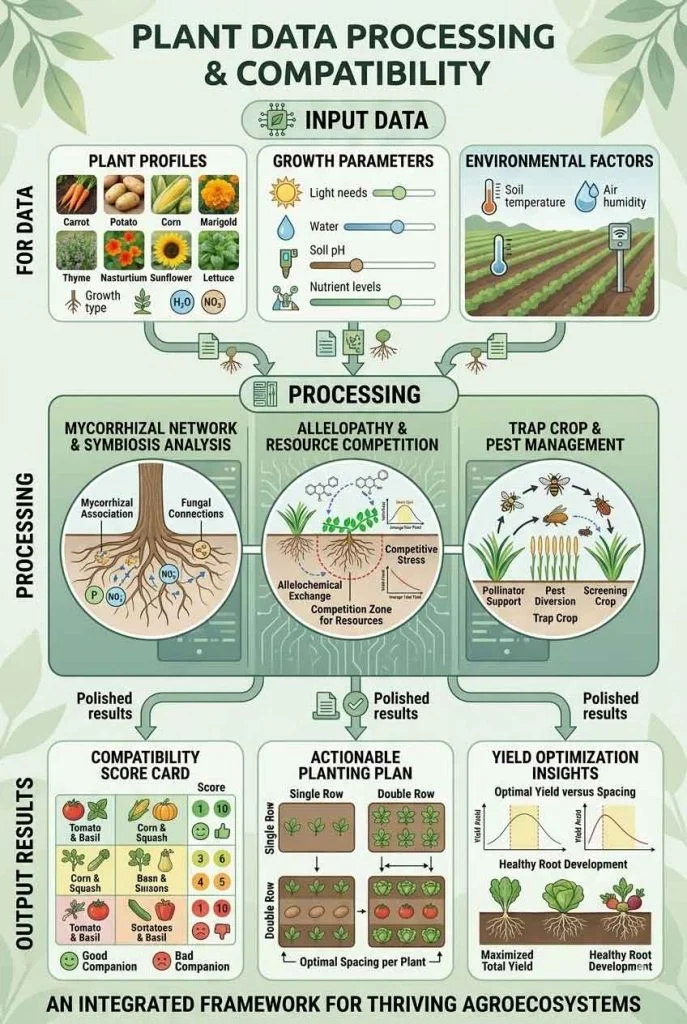
When plant interactions are balanced, the results become clearer over time.
Growth Becomes More Even
Instead of one plant dominating, growth is distributed more evenly across the space.
Each plant has access to what it needs without excessive competition.
Fewer Hidden Conflicts Appear
When compatibility is considered early, many common issues are reduced before they develop.
This includes:
- Nutrient depletion
- Poor airflow
- Uneven spacing pressure
Adjustments Become More Effective
When changes are made, the results are easier to understand.
For example:
- Removing one plant may noticeably improve another
- Increasing space may improve overall balance
- Repositioning plants may reduce competition
These adjustments feel more controlled rather than experimental.
Turning Understanding Into Practical Changes
Understanding plant compatibility is only useful when it leads to action.
Focus on Reducing Overlap
Instead of trying to create perfect combinations, focus on reducing unnecessary overlap.
This includes:
- Avoiding grouping plants with identical needs
- Giving space where root systems may expand
- Balancing vertical and horizontal growth
Adjust Gradually Rather Than All at Once
Small changes are easier to observe.
By adjusting one factor at a time, it becomes clearer what is improving the outcome.
Let Patterns Guide Decisions
Over time, patterns become easier to recognize.
Some combinations consistently work.
Others repeatedly create tension.
These patterns become more valuable than memorized lists.
Over time, these adjustments also help build a more balanced and self-sustaining garden environment, where plant interactions support long-term stability rather than conflict.
Why This Approach Changes How You Plan a Garden
Most gardening advice is designed for one-time use.
You read it, apply it, and move on.
But plant compatibility does not work that way.
Every small change creates a new interaction.
Adding one plant, adjusting spacing, or changing layout can shift the entire system.
Gardening Becomes an Ongoing System
Instead of relying on fixed charts, a compatibility-based approach allows continuous adjustment.
As your garden evolves, your decisions evolve with it.
This makes planning more flexible and less dependent on memorization.
Small Adjustments Create Better Outcomes
When plant interactions are understood, even small changes can improve results.
- Replacing one plant can reduce competition
- Adjusting spacing can improve airflow
- Changing placement can balance growth
These are not major changes.
But they produce noticeable differences over time.
A More Stable and Predictable Garden
When compatibility is managed properly:
- Plants grow more consistently
- Resource competition is reduced
- The overall system becomes more balanced
This leads to a garden that performs more reliably, rather than reacting unpredictably to hidden conflicts.
How to Use This to Plan Better Plant Combinations
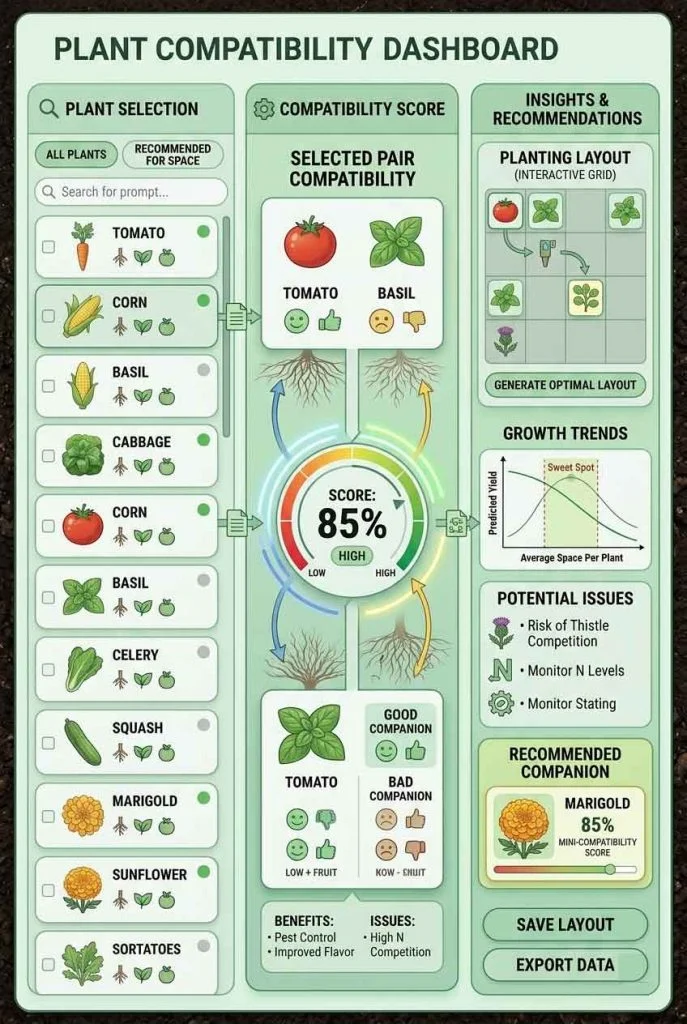
Understanding compatibility is one thing.
Applying it is where the difference appears.
Instead of trying to memorize combinations, the better approach is to test how plants interact before committing to a layout.
Start With a Simple Combination
Begin with a small group of plants you are planning to grow.
For example:
- Tomato
- Basil
- Lettuce
- Cucumber
At this stage, the goal is not perfection.
It is observation.
Look for Interaction Signals
When you evaluate a group of plants together, focus on three key signals:
- Are multiple plants competing for the same nutrients?
- Do their growth patterns overlap?
- Is there any potential for one plant to affect another below the soil?
These signals reveal more than any static chart.
Adjust One Variable at a Time
Instead of changing everything at once, make small adjustments.
Remove one plant.
Replace it.
Reposition it.
Then observe how the interaction changes.
This approach allows you to understand cause and effect.
Build Toward a Balanced Combination
As adjustments are made, patterns begin to appear.
Some plants consistently support each other.
Others introduce tension into the system.
Over time, this process leads to combinations that feel stable rather than forced.
A Simple Example of How Compatibility Changes Outcomes
Consider the same group again:
- Tomato
- Basil
- Cucumber
- Lettuce
At first glance, this looks like a productive mix.
But when interactions are considered:
- Tomato and cucumber both demand high nutrients
- Lettuce grows low and competes for space near the surface
- Basil fits more easily into the system
If one element is adjusted, such as removing cucumber:
- Competition drops
- Growth becomes more balanced
- The system stabilizes
This is not about right or wrong.
It is about reducing friction.
Why This Approach Feels Easier Over Time
At the beginning, compatibility may feel complex.
There are multiple factors to consider.
But as patterns become familiar, decision-making becomes faster.
From Guessing to Understanding
Instead of guessing what might work, you begin to recognize:
- Which plants compete
- Which plants coexist
- Which combinations create imbalance
This reduces uncertainty.
From Trial and Error to Controlled Adjustment
Gardening often involves experimentation.
But without structure, it becomes random.
With a compatibility-based approach:
- Changes are intentional
- Outcomes become easier to interpret
- Adjustments become more precise
A More Consistent Way to Plan a Garden
When plant interactions are considered from the start:
- Growth becomes more predictable
- Competition is reduced before it becomes a problem
- The garden develops as a system rather than isolated parts
This does not eliminate all challenges.
But it removes many avoidable ones.
Where Plant Compatibility Has Limits
Plant compatibility is a useful framework.
But it is not absolute.
Environment Still Matters
Even well-matched plants can struggle if:
- Soil quality is poor
- Watering is inconsistent
- Sunlight is insufficient
Compatibility improves outcomes, but it does not replace basic growing conditions.
Not All Interactions Are Visible
Some plant interactions are subtle.
They may:
- Change over time
- Appear only under stress
- Vary depending on plant maturity
This means results are not always immediate.
Adjustment Is Still Required
A compatibility-based plan reduces risk.
But it does not eliminate the need for observation.
Small adjustments are still necessary as the garden develops.
If you want to see how these interactions change based on your own plant choices, you can test different combinations below and observe how small adjustments affect the overall balance.
Plant Compatibility Checker
Choose the plants you want to grow together and see whether the combination is balanced, risky, or needs spacing adjustments.
1. Choose Your Plants
Tap each plant card. Choose at least 2 plants.
2. Garden Setup
Save Your Garden Plan
Send this result to your email so you can compare combinations later.
FAQs
What is plant compatibility in gardening?
Plant compatibility refers to how different plants interact when grown together, including competition for resources, growth structure alignment, and chemical interactions in the soil.
Why do some plants not grow well together?
Some plants compete for the same nutrients, block each other’s light, or release chemicals that inhibit nearby growth, leading to reduced performance or failure.
Is companion planting always reliable?
Traditional companion planting charts provide general guidance, but they do not adapt to specific conditions such as spacing, soil, or plant combinations, making them less reliable in complex gardens.
How does a plant compatibility engine improve gardening?
A plant compatibility engine evaluates plant interactions dynamically, helping users identify conflicts, optimize layouts, and improve overall garden performance based on system-level analysis.
What is the difference between companion planting and plant compatibility?
Companion planting is based on general pairings that are known to work well together, while plant compatibility focuses on the underlying interactions such as resource competition, growth structure, and chemical influence, making it more adaptable to different garden conditions.
Can plant compatibility change based on environment?
Yes, plant compatibility can change depending on soil quality, spacing, watering conditions, and sunlight. Even compatible plants may compete if resources are limited or if their growth patterns overlap too closely.