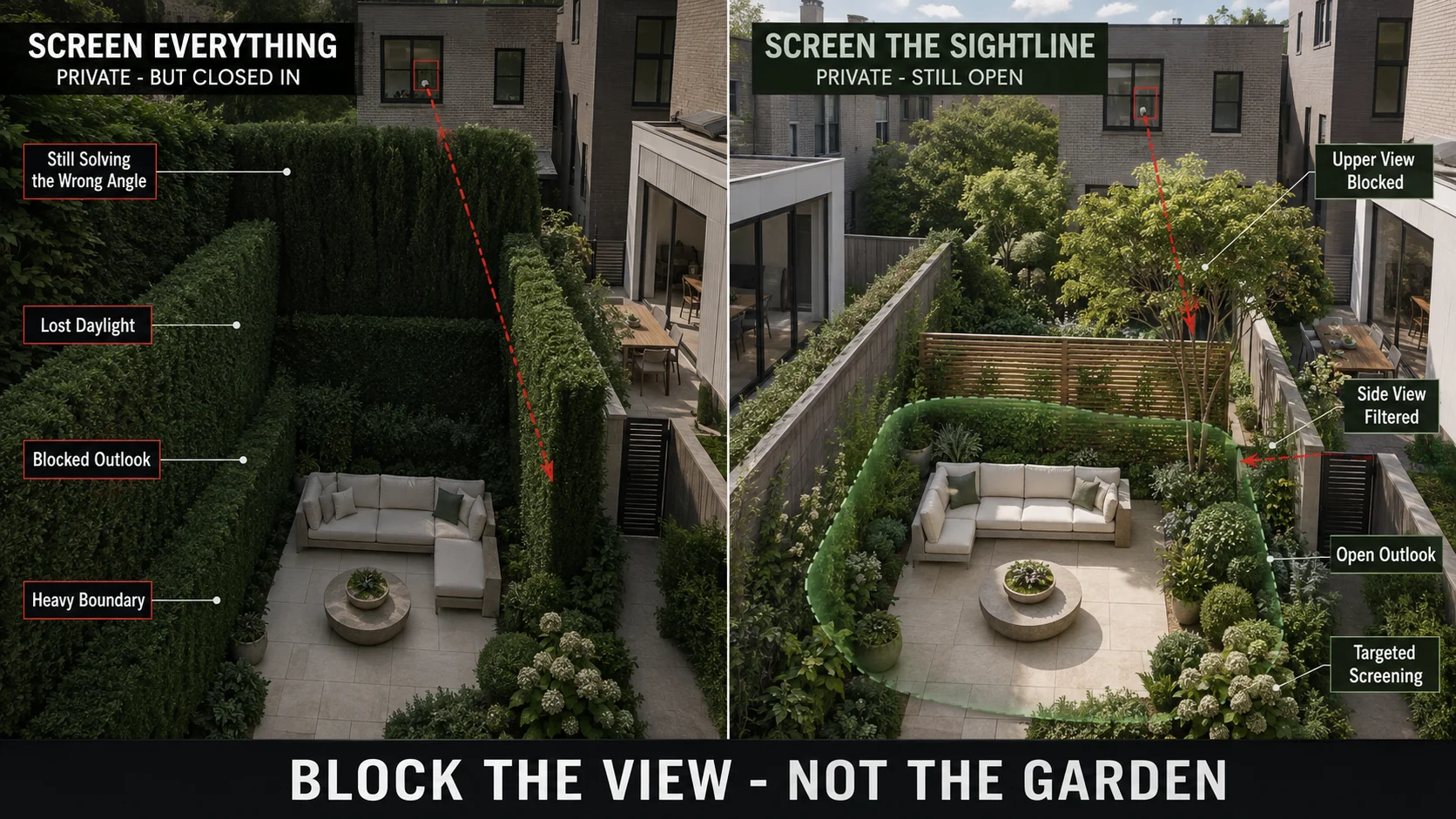

Backyard privacy is often approached from the property boundary outward. Someone notices a neighboring house, decides the garden feels exposed and starts considering a taller fence, a continuous hedge or screening across the entire perimeter. That can work when the exposure genuinely comes from the boundary at roughly eye level, but many difficult privacy problems do not behave that way.
An upper-floor window creates a diagonal view. A neighboring patio may overlook only one end of your seating area. A side gate can expose a chair from a narrow angle while the rest of the garden is already private. In a small urban backyard, the most effective screen may need to sit much closer to the activity than the property line because moving the screen changes the angle at which it interrupts the view.
The useful question is therefore not simply “How high should my privacy screen be?” It is “Where does the unwanted view begin, where does it end, and what is the smallest intervention that interrupts that sightline?”
This shift matters because unnecessary enclosure creates its own problems. A very tall continuous barrier can reduce daylight, obstruct airflow, make a compact garden feel smaller and remove views that were never causing discomfort in the first place. Privacy works best when it responds to the specific relationship between the viewer, the person using the garden and the space between them.
If the wider issue is that a garden feels exposed or difficult to settle in even after obvious views have been screened, why some gardens never feel relaxing examines the additional influence of movement, sound, lighting, posture and sensory comfort. This page focuses more precisely on visual privacy and how to control it without unnecessarily closing the entire garden.
Start With the Sightline, Not the Fence
The easiest way to understand a privacy problem is to forget the boundary for a moment and identify the actual line of view.
Sit in the position where privacy matters most. This may be an outdoor dining chair, lounge seat, hot-tub area, reading corner or the place where the family normally gathers. Look toward the neighboring properties and identify which windows, balconies, paths, gates or elevated areas feel visually connected to your position.
Then reverse the process mentally. Imagine the view from that neighboring location back toward the chair.
That line between the two positions is the sightline your intervention needs to interrupt.
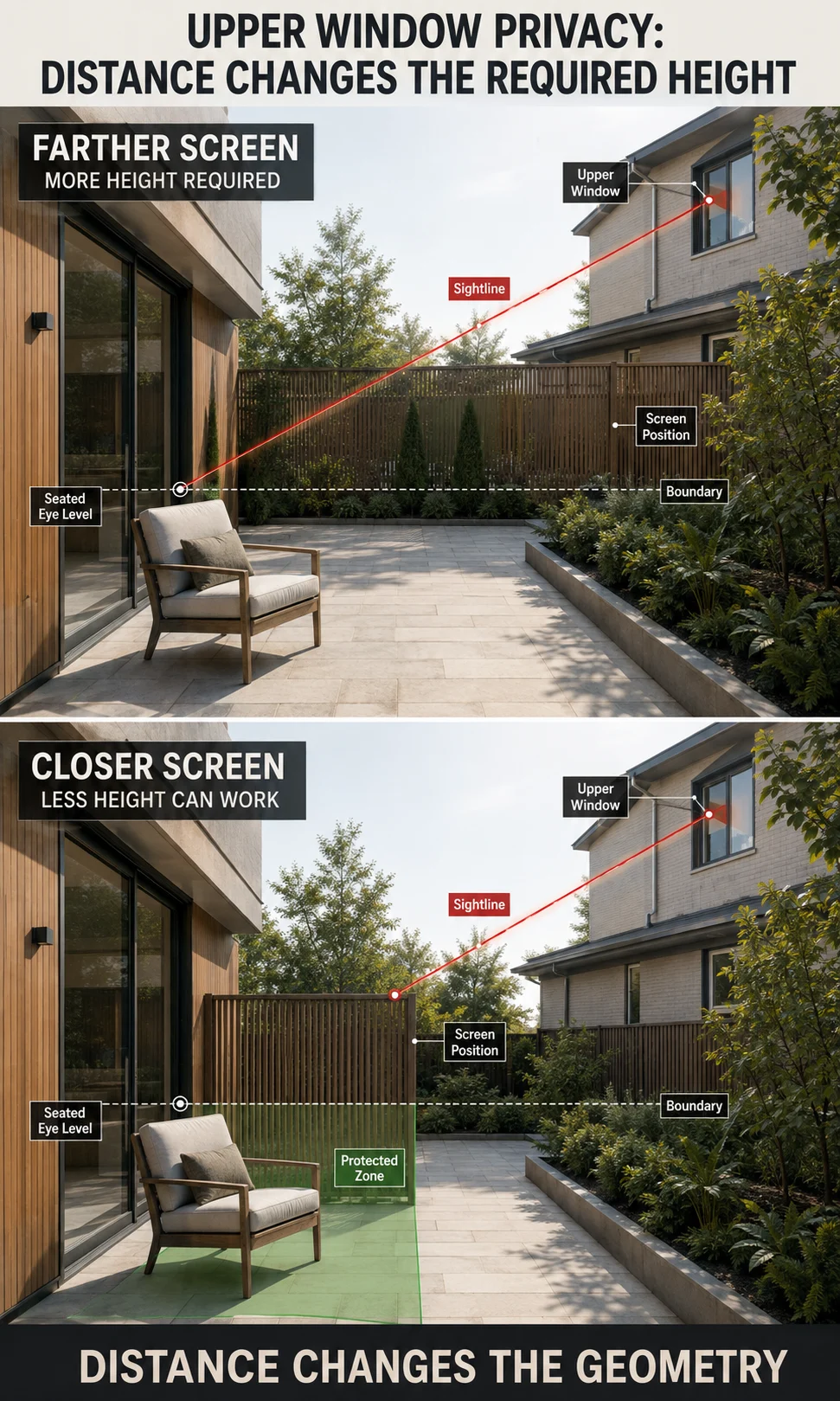
The distinction sounds simple, but it can completely change where a screen belongs. A screen positioned directly on the rear property boundary may appear substantial from inside the garden while sitting too far away to block a high diagonal view. A smaller screen placed several metres closer to the chair can interrupt the same line much more efficiently because the required screening height changes with distance and viewing angle.
This is why the strongest privacy plans should be tested in section as well as plan. A top-down garden drawing shows where boundaries and furniture sit horizontally, but it does not reveal the vertical relationship between an upper window, the top of a screen and someone sitting below.
The Privacy Screen: Wrong Place vs Right Sightline infographic created for the small-patio article illustrates exactly this problem. The same visual principle should become a major part of this privacy article because it demonstrates why spending more on a taller boundary treatment does not guarantee that the relevant view has actually been blocked.
Privacy Changes When You Sit Down
Standing in the middle of a backyard produces a different visual relationship from sitting in the place where the garden is normally used. Screening decisions made only while walking around the property can therefore solve the wrong problem.
A standing person has a higher eye level and may see over planting that completely screens someone sitting in a lounge chair. Conversely, an upper neighboring window may remain visible from a seated position because the view approaches from above rather than horizontally.
This is why privacy should be checked from seated eye level whenever the main activity involves sitting.
Place a temporary chair in the proposed location before planting a hedge or installing permanent screening. Sit naturally rather than deliberately crouching or stretching upward, then look toward every relevant neighboring view. Move the chair slightly and notice how quickly some sightlines disappear while others become stronger.
Small positional changes can be surprisingly powerful.
Moving seating closer to an existing wall, hedge or tree can allow that feature to do more of the screening. Rotating the chair can move the most uncomfortable view behind the body instead of directly ahead. Shifting the entire activity zone by a metre may bring a neighboring window behind an existing structural element that previously had no privacy function.
This is especially useful when planning a small garden patio because compact spaces cannot afford to give unnecessary floor area to oversized privacy structures. The seating position and the screening strategy should be planned together.
Upper-Floor Windows Need a Different Privacy Strategy
Second-storey and higher windows create one of the most misunderstood backyard privacy problems because the sightline travels diagonally downward.
A tall fence at the property line may block views at ground level while doing very little against an elevated window. Increasing the fence height may eventually intercept the view, although that approach can create an unnecessarily dominant boundary and may be restricted by local planning, building or neighborhood requirements.
A more efficient response often involves moving the privacy element closer to the area being protected.
Consider a chair located several metres from the rear boundary. If the screen sits directly beside the chair or behind the seating zone, it does not need to reach the same height as a distant boundary screen because the viewing line is intercepted much earlier.
This is one of the situations where a pergola, partial canopy, slatted overhead structure or strategically positioned tree canopy can become more effective than a vertical fence alone. The problem exists above the horizontal plane, so part of the solution may also need to operate overhead.
The objective is not to cover the entire backyard. It is to create a protected volume around the activity that matters.
Use a Section View for Elevated Overlooking
A simple sectional sketch can prevent expensive mistakes.
Draw the neighboring window at one side, the seating position at the other and a straight line between them. Then test different screening locations along that line.
A distant screen generally needs to be higher to intersect the same angle. Moving the screen toward the person allows a lower element to intercept the view.
The exact geometry depends on site levels, distances and building heights, so this should not be reduced to one universal screen-height formula. The useful principle is positional: the location of the privacy element changes the height required to block the same sightline.
This is more reliable than purchasing a standard privacy panel and hoping the problem disappears after installation.
Ground-Level Privacy Is Usually Easier to Control
When exposure comes from a neighboring patio, sidewalk, side gate or ground-floor window, the viewing angle is generally closer to horizontal. This makes fences, hedges, planting masses, freestanding screens and trellis systems much more straightforward to use.
The first decision is whether the view needs to be blocked completely or simply filtered enough that direct visual connection disappears.
A solid fence provides strong immediate separation but can feel visually heavy, particularly in compact gardens. A hedge creates softer enclosure and can support planting character, although it requires enough width and time to mature. Slatted screening can interrupt direct views while preserving partial airflow and light. Trellis combined with climbing plants can offer a lighter solution where immediate complete opacity is not required.
The correct choice depends partly on distance.
A screen placed immediately beside a seating area becomes a strong visual element in the experience of that space, so its material, texture and proportion matter considerably. The same screen located farther away may read primarily as part of the boundary.
Privacy design therefore affects the appearance of the garden most strongly where the screening sits closest to the person.
Do You Need Full Privacy or Only Visual Separation?
Privacy is often treated as a binary condition: either the neighbor can see you or they cannot. In everyday garden use, there are several useful levels between those extremes.
A dining area near another household’s patio may benefit from substantial screening because the two activities occur at similar heights and may otherwise feel directly connected. A garden path may need only filtered planting because people pass through rather than remain there. A reading chair may feel comfortable once direct eye contact is interrupted even though parts of the neighboring building remain visible above the planting.
This distinction can prevent over-screening.
Full Screening
Full screening is appropriate where direct overlooking is persistent and the activity genuinely benefits from strong separation. Examples may include a closely positioned seating area, pool surround, changing area or another location where visual exposure strongly affects comfort.
A solid screen, dense evergreen hedge or layered combination may be appropriate where site conditions and local requirements allow.
Filtered Screening
Filtered screening interrupts direct visual connection while allowing light, movement and partial views through the boundary.
Slatted timber, perforated panels, trellis, grasses, bamboo-like planting where suitable, multi-stem shrubs and layered foliage can all create degrees of filtered privacy.
This is often enough for casual seating because the feeling of exposure decreases once neighboring movement is no longer visually dominant.
Directional Screening
Directional privacy addresses one particular line of view.
A narrow screen beside the chair, one tall planter, a small tree canopy or a short section of hedge may solve the problem because the unwanted view originates from one limited direction.
Directional screening is particularly valuable in small gardens because it preserves openness everywhere else.
Do Not Screen the View You Actually Want to Keep
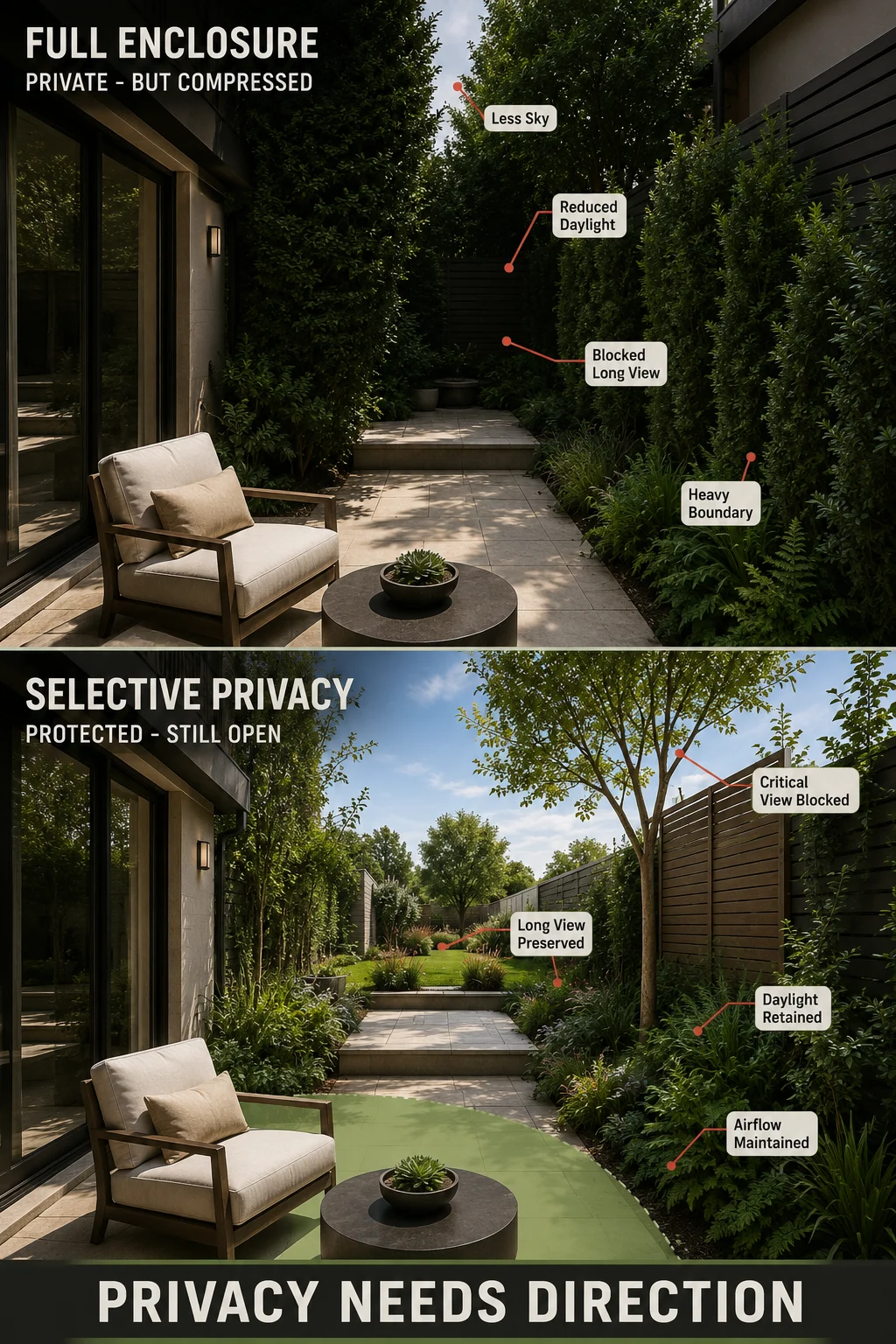
Privacy improvements sometimes make a backyard less enjoyable because the intervention removes the strongest view along with the unwanted one.
A seating area may overlook a pleasant tree canopy beyond the neighboring property, yet a continuous tall screen eliminates that depth. A hedge planted around every edge can create privacy while making the garden feel visually shorter. An overhead canopy can block an upper window but also remove a useful portion of sky.
The better strategy is to distinguish between unwanted sightlines and desirable outlook.
If the problem comes from the left, protect the left. If a neighboring upper window creates exposure from one diagonal angle, intercept that specific line while allowing the central garden view to remain open.
This principle is closely related to the selective shelter discussed in why some gardens never feel relaxing. Comfortable outdoor spaces frequently combine protection around part of the body with an open outlook in another direction.
Privacy should create refuge without removing prospect unnecessarily.
A Privacy Screen Works Better When It Has a Spatial Job
Screens are often added as standalone objects after the rest of the garden has already been planned. This can make them look like defensive additions rather than part of the architecture.
A stronger approach is to let the screen perform several compatible functions.
A screen behind a bench can establish the back of the seating zone. A slatted panel can support climbing planting. A pergola post and side panel can work together to define the corner of a patio. A privacy wall can carry subtle lighting or become the visual background to planting.
This integration matters because a large privacy element is difficult to ignore visually. If it must occupy an important position in the garden, it should strengthen the spatial structure rather than merely hide something beyond it.
The screen does not need to become decorative in a busy way. In many compact gardens, a quiet material background with planting in front is more effective than turning the privacy structure itself into another focal point.
Slatted Screens – Privacy Without a Solid Wall
Slatted screens are popular because they create a degree of separation while appearing lighter than continuous opaque walls.
Their effectiveness depends on orientation, spacing and the viewing angle.
A screen that looks nearly opaque when viewed straight on can become much more transparent when someone approaches from an angle. Conversely, slats positioned according to a known neighboring sightline can limit the direct view while preserving more openness from inside the garden.
This makes slatted systems particularly suitable for directional privacy.
The mistake is assuming that a slatted screen offers the same level of privacy from every direction. Before installation, test the proposed slat spacing and orientation from the viewpoint that actually matters.
Material choice also affects maintenance. Timber can provide warmth but generally requires an appropriate exterior specification and maintenance strategy for the local climate. Metal or composite systems may behave differently in terms of weathering, heat and appearance. The privacy geometry should be resolved before the finish becomes the main decision.
Hedges Create Soft Privacy but Need Real Growing Space
A hedge can provide one of the most natural forms of garden privacy because it creates enclosure while remaining part of the planting system.
The important limitation is width.
Hedges shown in garden inspiration photographs are often treated almost like green walls, but living plants occupy physical volume. A hedge that eventually becomes dense enough to provide screening may consume a significant portion of a narrow backyard unless the selected species and maintenance strategy are appropriate for the available space.
Mature height matters, but mature spread can be equally important.
Planting too close to a path or patio creates a future conflict because the hedge needs repeated pruning simply to preserve circulation. Planting too close to a boundary without understanding access requirements can also make long-term maintenance difficult.
The best hedge is therefore not simply the fastest-growing or tallest option. It is the plant structure that can reach the required screening density while remaining proportionate to the site.
Evergreen or Deciduous Privacy Planting
Evergreen planting provides more consistent year-round screening, which can be useful where neighboring views remain relevant through every season.
Deciduous planting can offer stronger seasonal change and may allow more winter light into climates where that is desirable, although privacy reduces when foliage is absent.
The correct choice depends on when the garden is used and when the overlooking matters.
A summer dining terrace may not require complete winter screening. A year-round urban patio may benefit from a more persistent evergreen layer. Mixed planting can also create a more natural appearance while providing different levels of density across the seasons.
The privacy requirement should therefore be defined by time as well as by location.
Trees Can Block High Views Without Building a Wall
Small trees and larger multi-stem plants can be particularly useful where the unwanted view originates above a conventional fence line.
Their advantage comes from placing foliage higher in the visual field while leaving some usable space beneath the canopy. This can preserve a greater sense of depth than a solid barrier extending from the ground upward.
Tree placement must be considered carefully because mature canopy size, root behavior, shade, leaf drop, maintenance and distance from buildings all matter.
The most useful privacy tree is not automatically the densest tree.
A carefully positioned canopy can interrupt one elevated sightline while allowing light and longer garden views elsewhere. Several smaller trees may also create a filtered layer that feels softer than one continuous wall of vegetation.
In compact patios, this vertical approach can preserve floor area that would otherwise be consumed by a thick hedge.
Trellis and Climbing Plants Are Useful Where Ground Space Is Limited
Vertical planting can create meaningful privacy without requiring the same footprint as a broad shrub border.
A trellis gives the plant a defined plane in which to grow, while the climbing species gradually increases visual density.
This solution works particularly well where the privacy requirement is moderate and there is enough time for the planting to establish. It can also soften an existing fence or screen that already provides the structural privacy.
The key consideration is whether the plant remains appropriate for the support and available maintenance. Vigorous climbers can overwhelm lightweight structures or require substantial pruning, while slower-growing plants may take longer than expected to produce meaningful screening.
The structural support should therefore be selected according to the mature plant rather than only the appearance of the newly installed system.
Layered Privacy Often Looks Better Than One Massive Barrier
Where substantial screening is required, a single tall solid feature can become visually dominant.
Layering allows several smaller elements to share the job.
A conventional boundary fence may provide the lower layer. Shrubs can soften its surface. A small tree canopy can interrupt elevated views. A localized screen near the seating can handle one particularly difficult sightline.
Together, these elements can create stronger privacy than asking one structure to block every possible view.
Layering also creates depth.
Instead of sitting immediately in front of one high wall, the person experiences planting, intermediate screening and a more distant boundary as separate planes. This can make the garden feel richer and less confined even though privacy has increased.
The approach is especially useful where a small backyard needs to feel more spacious because visual depth becomes particularly valuable when physical dimensions are limited.
Privacy Near a Patio Should Protect the Activity, Not the Entire Property
A household may only need meaningful privacy in the ten square metres where people sit, yet the first instinct is often to redesign fifty metres of boundary.
That is rarely the most efficient starting point.
Identify the activity that genuinely requires protection. Dining may need screening from one neighboring patio. Reading may need a quieter corner with one protected side. A fire-pit area may require enclosure around part of the conversation group. A pathway may need almost none.
By concentrating intervention around the main activity, the design can spend material, planting space and budget where privacy produces the greatest change in experience.
This also connects back to why your backyard feels unused. If someone avoids the garden because the primary seat feels overlooked, correcting that single sightline can increase actual use more effectively than decorating several unrelated areas.
The privacy plan should therefore begin where people stay longest.
Privacy Screening Should Not Destroy Daylight
One of the main trade-offs of screening is reduced light.
This is particularly important when the garden is small, enclosed by neighboring buildings or already shaded for part of the day. Adding a dense hedge, tall wall or overhead structure can solve one discomfort while creating another.
Observe where sunlight enters before deciding which edge to screen heavily.
A southern exposure behaves differently from a northern one, and the effect varies substantially by hemisphere, surrounding building height, season and local climate. The important point is to study the site’s actual sun movement rather than relying on a generic assumption about which side should remain open.
Filtered screens can be useful where some privacy is required but complete opacity would remove too much light. Trees with higher canopies may block upper sightlines while allowing more low-level openness. Localized screening can protect the seating without shading an entire planting area.
Privacy should therefore be balanced with the environmental conditions that make the garden usable.
Do Not Ignore Airflow
A continuous solid enclosure can reduce wind exposure, which may be desirable on an uncomfortable site. The same intervention can also reduce useful airflow during warm conditions.
Slatted screens, perforated materials and planting often allow more air movement than solid walls. Their suitability depends on how much visual separation is required and which direction the prevailing wind normally arrives from.
This is particularly relevant around compact patios where enclosing several sides can quickly change the microclimate.
If the garden already struggles with heat, a privacy intervention that blocks airflow and increases shade in the wrong locations may create a space that feels more private but less usable.
The best solution therefore considers privacy, sun and air together.
Before Building Taller, Check the Rules That Apply to Your Property
Fence and screening requirements vary by country, city, municipality, housing type, property location and sometimes by the position of the structure within the site.
A height that is permitted along one boundary may be treated differently near a road, corner, front garden or shared structure. Pergolas, privacy walls and elevated decks can also fall under different local requirements from ordinary fences.
For that reason, a universal statement such as “every privacy fence should be two metres high” is not reliable guidance.
Check the rules that apply to the specific property before making a permanent structure taller, changing a shared boundary or installing substantial screening.
This is another reason directional privacy can be valuable. If a localized screen, furniture adjustment or planting arrangement solves the real sightline, the garden may not need a dramatically taller boundary at all.
Privacy Should Be Tested Before It Becomes Permanent
Temporary testing can reveal whether a proposed screen is in the correct position before money is spent on a finished structure.
Use a temporary fabric, sheet, garden panel, tall cardboard plane or another safe temporary material to represent the approximate screening area. Position it where the permanent intervention is being considered, then sit in the relevant chair and check the view.
Move the temporary screen closer.
Move it farther away.
Raise and lower the top edge.
Change the orientation.
Check the same position from more than one chair and, where appropriate, at different times of day.
This simple experiment often reveals that the privacy problem can be solved with less material than expected. It can also reveal the opposite: a screen that looked adequate on the plan may fail because the actual elevated sightline passes above it.
Privacy is too dependent on geometry to be planned only from product photographs.
Choose the Privacy Method According to the View You Need to Stop
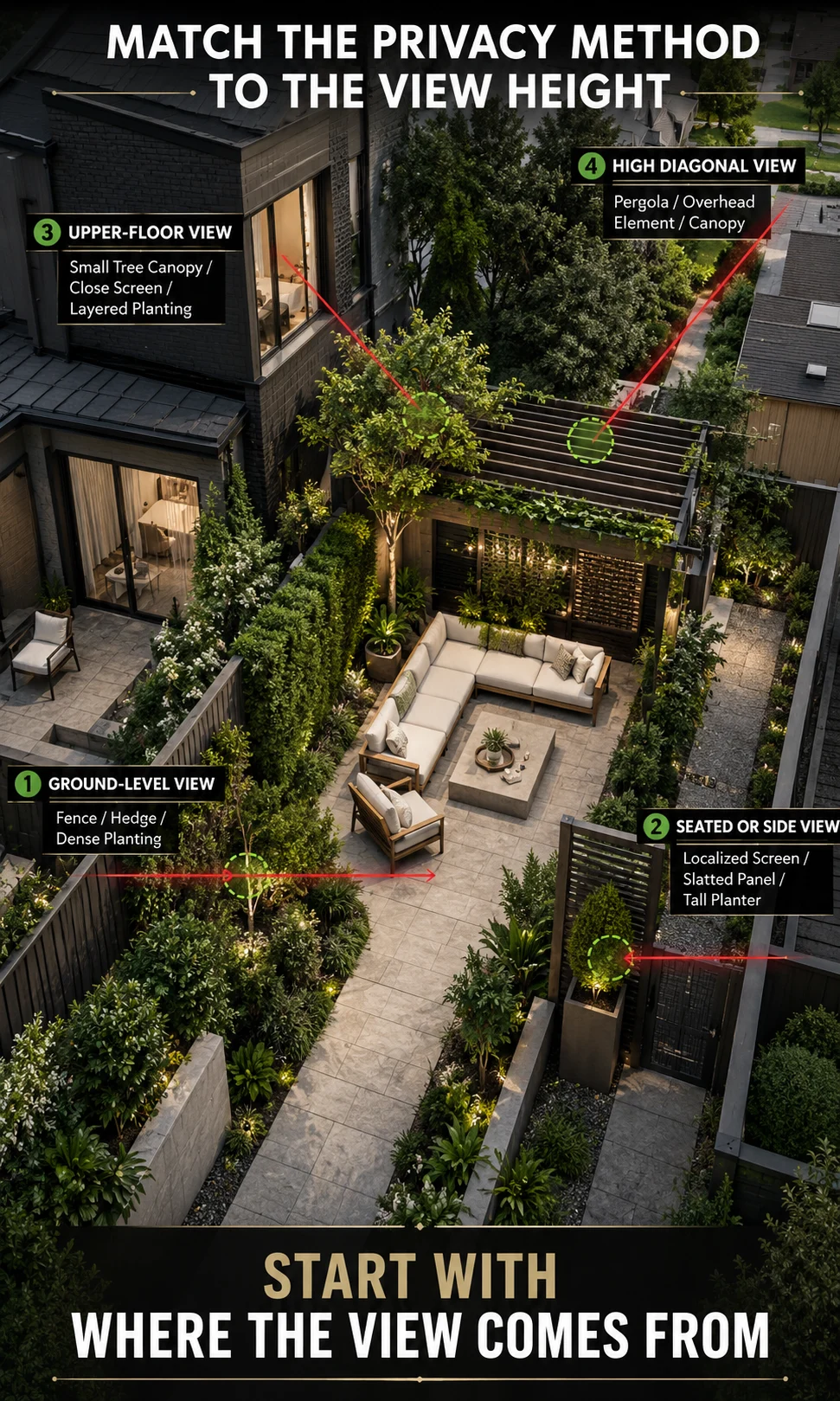
Privacy materials are often compared as if one option is universally superior, but fences, hedges, trees, trellis and freestanding screens solve different geometric problems. The most useful choice depends on where the unwanted view originates, how quickly privacy is needed, how much floor area can be sacrificed, how much maintenance the household accepts and whether the garden should remain visually open in other directions.
A solid fence performs strongly against low horizontal views and provides immediate separation, but it can become visually dominant in a compact garden and may have local height restrictions. A hedge can create softer enclosure and contribute to planting character, although it needs enough width and time to mature. A small tree can interrupt an elevated sightline while preserving useful space beneath the canopy. A localized screen can solve one difficult view with very little material because its position is optimized around the activity rather than the boundary.
The decision should therefore begin with the viewing relationship, not the product category. Once the sightline is understood, the suitable privacy methods become much easier to compare.
Solid Fences Work Best Against Direct Ground-Level Overlooking
A solid fence is one of the clearest ways to interrupt a horizontal view because it creates immediate opacity from the ground upward. This makes it particularly effective when neighboring activity occurs at approximately the same level as the garden, such as another patio, a walkway, a ground-floor window or a side access route.
The limitation is that a fence solves only the portion of the view it physically intersects. An upper-floor window may still look over it, and a raised neighboring deck can create a similar problem when the viewing position is significantly higher than the fence.
Material appearance becomes more important as the fence gets closer to the seating. A large solid surface only a short distance from a chair can dominate the visual experience, especially in a narrow garden. Planting in front, changes in texture or carefully controlled variation can soften the surface without covering every part of it.
A fence therefore works best when it solves the correct viewing angle and contributes to the spatial structure rather than becoming a tall object installed simply because privacy feels insufficient.
Freestanding Screens Give You More Control Over Position
Freestanding privacy screens have an important advantage over boundary treatments because they can be positioned where the geometry works best.
If a neighboring window overlooks one small seating area, moving a screen closer to the chair can reduce the required height and prevent the rest of the garden from being enclosed unnecessarily. A screen can also be rotated to block a diagonal view instead of remaining parallel with the property boundary.
This makes freestanding screens particularly valuable for patios, reading areas and conversation zones where the activity occupies a relatively compact footprint.
The trade-off is that the screen becomes part of the immediate composition. Its structure, base, wind resistance, proportions and material quality matter because people will often experience it from only a short distance away.
A successful freestanding screen should therefore look intentional enough to belong to the garden while remaining visually quiet enough that it does not compete with the activity it is protecting.
Pergolas Can Solve Privacy From Above
When elevated overlooking is the strongest problem, a vertical screen may need to become impractically tall before it interrupts the sightline. A pergola or partial overhead structure can solve the geometry differently by creating protection across the upper viewing angle.
This does not necessarily require a fully covered roof. Slats, climbing planting, retractable elements or a partially screened side can sometimes interrupt the relevant view while preserving daylight and openness.
The effectiveness depends on where the neighboring window sits relative to the seating. A pergola directly above a dining area may block a high diagonal sightline from behind while doing nothing against another window located toward the open front.
This is why pergolas should be planned in section rather than treated as generic privacy structures.
They can also provide shade and stronger spatial definition, which makes them useful when the same seating area suffers from both elevated overlooking and excessive exposure. However, adding a substantial overhead structure where privacy could have been solved with one small screen may unnecessarily darken or dominate the garden.
Privacy Planting Works Best When Height and Density Occur in the Right Layer
A privacy planting scheme should be thought of vertically rather than simply as a row of plants.
Low shrubs can soften the base of a boundary but may do almost nothing against eye-level views. Medium shrubs can interrupt direct ground-level overlooking. Taller shrubs and small trees can deal with elevated sightlines. Climbers can increase density along a narrow vertical plane where ground space is limited.
Combining these layers can create privacy without relying on one extremely dense hedge.
The arrangement also tends to look more natural because the planting has depth. The eye moves through several foliage layers rather than meeting one continuous green wall.
This does not mean that every privacy planting scheme should become complex. In some gardens, one well-selected hedge is the simplest and most successful answer. Layering becomes particularly useful where several viewing heights need to be controlled or where a softer appearance is important.
Do Not Choose Fast Growth Without Considering the Long-Term Size
Fast-growing privacy plants are appealing because they promise quick screening, but rapid growth can become an ongoing maintenance problem when the available space is limited.
A plant that quickly reaches the required height may also quickly exceed the desired width. Repeated cutting can then become necessary simply to keep paths, patios and neighboring boundaries usable. Some plants respond well to regular pruning, while others become sparse, unstable or visually poor when repeatedly forced into a size much smaller than their natural habit.
The most useful plant is therefore one whose mature characteristics are reasonably compatible with the space it is expected to occupy.
Privacy should improve the garden over time rather than creating a permanent pruning emergency.
Containers Can Create Local Privacy Without Giving Up the Whole Boundary
Large containers can provide useful directional screening where permanent planting is difficult or where flexibility is valuable.
A tall planter positioned beside a seating area can interrupt a low or medium sightline without consuming the width required by a full hedge. Several containers can also be moved as the furniture arrangement changes, although their weight, irrigation and stability need to be considered realistically.
The strongest container privacy arrangements use fewer substantial elements rather than many small pots. A large planter with an appropriately scaled plant can create a stronger visual screen while producing less clutter around the patio.
Containers are particularly useful for renters, roof terraces and paved urban gardens where planting directly into the ground may not be possible.
Their limitation is that root volume is restricted, which affects plant selection, watering requirements and long-term size. A plant that performs beautifully in open ground may behave very differently when permanently confined to a container.
A Screen Close to the Seat Can Feel Taller Than the Same Screen at the Boundary
Distance affects perception as well as privacy geometry.
A two-metre screen several metres away may read as part of the garden boundary, while the same height immediately behind a chair can feel highly dominant. This is why moving screening closer to the activity can solve a sightline more efficiently but also requires more careful visual design.
If the screen must sit close, consider whether its top edge feels oppressive from the chair, whether its texture is pleasant at close range and whether planting or partial openness would make the element feel less severe.
A localized screen does not automatically need to become a solid opaque wall. Slats, trellis, planting or an opening above the required privacy line can preserve a greater sense of space while still blocking the critical view.
The aim is to intercept the sightline with the least visually intrusive form that still provides the required privacy.
Privacy From a Side Gate or Path Needs a Different Response
Some gardens feel exposed because a gate, side passage or neighboring path creates a direct view toward the seating whenever someone moves through it.
This type of privacy problem can be highly intermittent. Most of the time the garden appears private, but whenever the gate opens or someone uses the path, the resting area becomes immediately visible.
A short screen positioned perpendicular to the boundary can work particularly well here because it blocks the viewing corridor without changing the entire fence line.
Planting around the arrival point can achieve a softer version of the same effect, although the gap should remain practical for access and maintenance.
Furniture orientation can also help. Turning the primary seating so that the direct path view falls behind or beside the occupant can reduce the feeling of exposure even when the route remains visible.
This is another example where a small directional intervention can outperform a much larger boundary project.
Corner Properties Need Privacy Without Creating Blind Spots
Gardens beside roads, junctions or shared access can require more careful treatment because privacy and visibility may conflict.
A tall dense screen can reduce unwanted views into the property while also reducing the ability of drivers, cyclists or pedestrians to see one another near an entrance. Local rules may regulate these conditions, and the practical safety of the property should take priority over creating complete visual enclosure.
Lower planting, set-back screening or more transparent treatments near access points can preserve safer sightlines while stronger privacy begins farther inside the property.
This is one reason privacy should not be planned as a single continuous height around every boundary. Different sections of the same garden can require different levels of opacity according to what happens immediately outside them.
Privacy Around Dining Areas Should Support Conversation
Dining areas often need more privacy than casual pathways because people remain in one place for longer and naturally become more aware of nearby movement.
However, enclosing a dining patio too heavily can create acoustic and thermal consequences. Solid surfaces close to the table may reflect conversation and mechanical noise, while reduced airflow can make warm evenings less comfortable.
Filtered planting, slatted screening or a combination of lower solid enclosure with softer upper screening can provide enough separation without turning the dining area into an enclosed box.
The arrangement should also consider the view from each chair. A screen that protects one side of the table may place another diner directly in front of a blank wall. Planting, texture or a controlled opening can help preserve a more pleasant outlook while the important sightline remains blocked.
A dining zone therefore needs privacy as part of a broader comfort strategy rather than as an isolated boundary treatment.
Privacy Around a Reading or Resting Chair Can Be More Directional
A single reading chair creates a much smaller privacy target than a large dining area.
This gives the designer more freedom because the body orientation can become part of the solution. A chair placed with its back toward the exposed side may need only a narrow screen or planting mass behind it. The forward view can remain completely open toward the garden.
This is one of the most efficient ways to create a private feeling in a small backyard.
The objective is not to hide the whole person from every possible angle. It is to remove the direct visual relationship that makes the resting position feel exposed.
When the chair feels protected behind and beside the body, the garden can remain surprisingly open ahead without losing the sense of refuge.
A Fire-Pit or Conversation Area Needs Group Privacy
Conversation zones behave differently because several people face different directions. A privacy element that protects one chair may leave another completely exposed.
The screening strategy should therefore be evaluated from multiple seats around the group.
A layered boundary behind one side, a tree canopy above and a smaller screen toward the strongest neighboring view can work together more effectively than trying to surround the entire conversation area with a single continuous wall.
Where fire is involved, any permanent screen, overhead structure or planting must also be appropriate for the installation and required safety clearances. Privacy should never be achieved by placing combustible materials where the fire feature requires open separation.
The spatial goal remains to create enough enclosure that the group feels defined without making the social area visually or physically constrained.
Privacy and Security Are Not the Same Design Problem
A backyard can feel private while still maintaining useful visibility around entrances, paths and access points.
Completely hiding every part of the garden from the house may actually make the space harder to monitor, particularly where children, pets, gates or secondary access are involved.
Privacy should therefore be concentrated around the activities where visual separation improves comfort, while necessary internal sightlines remain intact.
A hedge may block a neighbor’s patio without blocking the view from the kitchen toward the children’s play area. A screen may protect a reading chair while leaving the gate visible from the house. These selective relationships are often more useful than complete enclosure.
The best privacy design controls unwanted views without eliminating every useful one.
Common Backyard Privacy Mistakes
Several recurring mistakes can make privacy projects more expensive, visually heavier or less effective than necessary.
Mistake 1: Making the Entire Fence Taller Without Checking the Sightline
This can add substantial material while failing to block an elevated or diagonal view.
Test the sightline first and determine where interception is actually required.
Mistake 2: Screening Every Boundary Equally
Most gardens have stronger privacy problems in particular directions.
Treating every side identically can reduce daylight and depth without improving the experience proportionately.
Mistake 3: Choosing Plants Only for Fast Growth
Rapid screening can create future width, pruning and maintenance problems.
Mature dimensions and long-term management matter as much as initial speed.
Mistake 4: Ignoring the View From the Chair
A privacy treatment can look appropriate while standing and fail completely from the position where people actually spend time.
Test seated eye level before installation.
Mistake 5: Blocking the Best Garden Outlook
A screen can solve overlooking while simultaneously removing the only long view that makes a compact garden feel spacious.
Preserve desirable outlook wherever the privacy geometry allows.
Mistake 6: Installing Screening Too Close Without Considering Scale
A localized screen may need less height to block the view, but its visual impact becomes stronger as it approaches the seating.
Test the perceived enclosure as well as the privacy performance.
Mistake 7: Forgetting Mature Plant Width
A hedge or screening shrub can gradually consume a walkway or patio edge if its natural growth is incompatible with the available footprint.
Plan the mature volume before planting.
Mistake 8: Treating Privacy as Separate From Shade and Airflow
A new barrier changes more than visibility.
It can alter sun, shade, wind and the overall microclimate around the activity.
Mistake 9: Assuming a Neighboring View Must Be Completely Eliminated
Sometimes interrupting direct eye contact is enough to make the garden feel comfortable.
Filtered or directional privacy can preserve more openness than complete visual isolation.
Mistake 10: Building Before Testing
Temporary testing can reveal sightline failures before they become permanent construction mistakes.
Even a crude temporary screen can provide valuable information about position and required height.
Before and After Example – The Tall Fence That Still Does Not Block the Window
Imagine a small patio near the rear of a townhouse garden. A neighboring second-storey bedroom window overlooks the seating diagonally.
The homeowner replaces the rear fence with a taller, visually heavier boundary treatment. From ground level the new fence appears much more private, but when someone sits at the patio table, the upper window remains clearly visible above it.
The problem was never primarily the fence height. It was the relationship between the distant boundary and the elevated viewing position.
The corrected design keeps the existing boundary and adds a smaller slatted screen much closer to the seating. The screen aligns with the diagonal sightline and blocks the window from seated eye level without enclosing the entire garden.
The improved version uses less material and preserves more sky because the privacy element has been positioned according to geometry.
Before and After Example – Hedge Everywhere vs Privacy Where It Matters
A rectangular garden has neighboring properties on both sides, so the first plan proposes tall evergreen hedges along the entire perimeter.
The result would provide strong privacy but substantially reduce the usable width, particularly around the patio.
A sightline assessment reveals that the right boundary already feels reasonably private because the neighboring house has few relevant windows. The strongest exposure comes from one patio on the left and one upper-floor window toward the rear.
The revised plan uses denser planting only along the left seating edge, one small tree toward the rear and lower planting elsewhere.
The garden remains visually deeper because unnecessary screening has been removed from the directions where it provides little benefit.
Before and After Example – Privacy Screen That Creates a Dark Box
A compact patio beside the house receives useful afternoon light but feels exposed to a neighboring terrace.
The first solution encloses two sides with tall solid screening. Privacy improves immediately, but the patio becomes darker, warmer and visually compressed.
The revised solution retains one solid lower section near the strongest view, replaces the upper portion with slatted screening and adds layered planting beside the seating. The opposite side remains largely open.
The activity still feels protected, but light and airflow can move through the space more naturally.
The lesson is that greater opacity does not automatically produce better overall comfort.
Before and After Example – Small Tree Instead of a Higher Wall
A neighboring upper window overlooks a dining terrace beyond a standard garden boundary.
Increasing the fence height enough to block the view would create a dominant wall across the rear of the property.
Instead, a properly positioned small tree creates foliage at the level where the sightline crosses the garden. The lower trunk remains relatively open, preserving some visual depth beneath the canopy.
The solution introduces seasonal character and vertical structure while solving a high-level view that a low hedge could never address.
The example should not imply that any specific tree is universally suitable. Species selection must still respond to climate, available root space, mature dimensions, maintenance and local conditions.
A Simple Backyard Privacy Planning Sequence
Privacy planning becomes much more reliable when the decisions happen in the correct order.
1. Identify the activity that needs privacy
Decide whether the protected area is dining, lounging, reading, entertaining, bathing or another specific use.
2. Sit in the exact position
Evaluate privacy from the eye level and orientation that will actually be used.
3. Identify the source of the unwanted view
Locate the relevant window, balcony, path, gate, road or neighboring activity.
4. Trace the sightline
Consider both horizontal direction and vertical viewing angle.
5. Test whether furniture movement solves part of the problem
A small shift or rotation can sometimes remove the direct view before screening is added.
6. Test the smallest useful screen location
Move a temporary barrier between the viewer and the activity until the view is interrupted.
7. Decide how opaque the solution really needs to be
Choose between full, filtered or directional privacy rather than defaulting to complete blockage.
8. Check daylight, airflow and outlook
Make sure the privacy improvement has not created a more serious comfort problem.
9. Select the structure or planting
Only now decide whether fence, hedge, screen, tree, trellis, pergola or layered planting best fits the geometry and maintenance requirements.
10. Confirm local requirements before permanent construction
Check relevant rules whenever the project involves substantial height, shared boundaries, structures or other regulated conditions.
This sequence turns privacy from a product-shopping problem into a spatial-design problem, which is why it usually produces a more targeted result.
Backyard Privacy FAQ
What is the best way to make a backyard more private?
Start by identifying the exact unwanted sightline from the area where privacy matters. A fence, hedge, tree, trellis or localized screen can then be positioned to interrupt that view. The best solution is usually the smallest intervention that blocks the relevant sightline while preserving useful daylight, airflow and outlook elsewhere.
How can I block a neighbor’s upstairs window from my backyard?
An upstairs window creates a diagonal viewing angle, so increasing boundary height is not always the most efficient solution. Test a localized screen, pergola element, tree canopy or other screening closer to the seating area because moving the privacy element toward the protected activity can allow a lower structure to interrupt the same sightline.
Is a hedge better than a fence for backyard privacy?
A hedge creates softer living enclosure but requires growing space, establishment time and ongoing maintenance. A solid fence provides immediate separation and occupies less planting width, although it can feel visually heavier. The better choice depends on the viewing angle, available footprint, desired appearance, maintenance tolerance and local requirements.
How do I make a small backyard private without making it feel smaller?
Use directional or layered privacy instead of enclosing every boundary equally. Protect the strongest unwanted view with localized screening or planting while keeping the longest desirable outlook open. Taller foliage can sometimes block elevated views without creating a continuous wall from ground level upward.
Do privacy screens need to be on the property boundary?
No. A privacy element may work more effectively closer to the activity because its position changes how it intersects the sightline. Localized screens can therefore solve some overlooking problems with less height and material than a distant boundary treatment, subject to applicable local rules and site conditions.
What plants are best for privacy?
There is no single best privacy plant because suitability depends on climate, light, available soil volume, mature width, required height and maintenance. Select plants according to the layer of privacy they need to create, then confirm that their mature dimensions are compatible with the available space rather than choosing only by growth speed.
Can slatted screens provide enough backyard privacy?
Slatted screens can provide effective directional privacy when the slat spacing and orientation are aligned with the unwanted view. Their apparent opacity changes with viewing angle, so the proposed design should be tested from the neighboring sightline before installation rather than judged only from straight in front.
Should I completely block my neighbor’s view into my garden?
Complete visual isolation is not always necessary. In many seating areas, interrupting direct eye contact or screening the most exposed direction is enough to create comfort. Partial privacy can preserve more light, airflow and visual depth than fully enclosing every side of the garden.
How do I know how tall my backyard privacy screen should be?
Required height depends on the viewer’s position, the protected activity, differences in ground level and the distance between the screen and the sightline. Test the view from seated eye level and use a temporary screen or sectional sketch before deciding on permanent height, then confirm any applicable local restrictions before construction.
Good Privacy Makes the Garden Feel Protected Without Making It Disappear
The strongest privacy design is rarely the one that creates the tallest continuous barrier around the property. It is the one that understands where exposure actually occurs and intervenes precisely enough that people can use the garden without constantly noticing the unwanted view.
Sometimes that requires a hedge along a boundary. In another garden, a small tree solves the upper sightline. A narrow screen beside one chair may be enough for a reading corner, while a pergola and layered planting may make more sense around an overlooked dining terrace.
The common principle is that privacy begins with people and sightlines rather than property lines and products.
When the important view is blocked, the useful view remains open and the garden retains adequate light, airflow and depth, privacy becomes part of the spatial experience rather than a defensive wall around it. That is when an exposed backyard begins to feel genuinely sheltered while still feeling like a garden.