

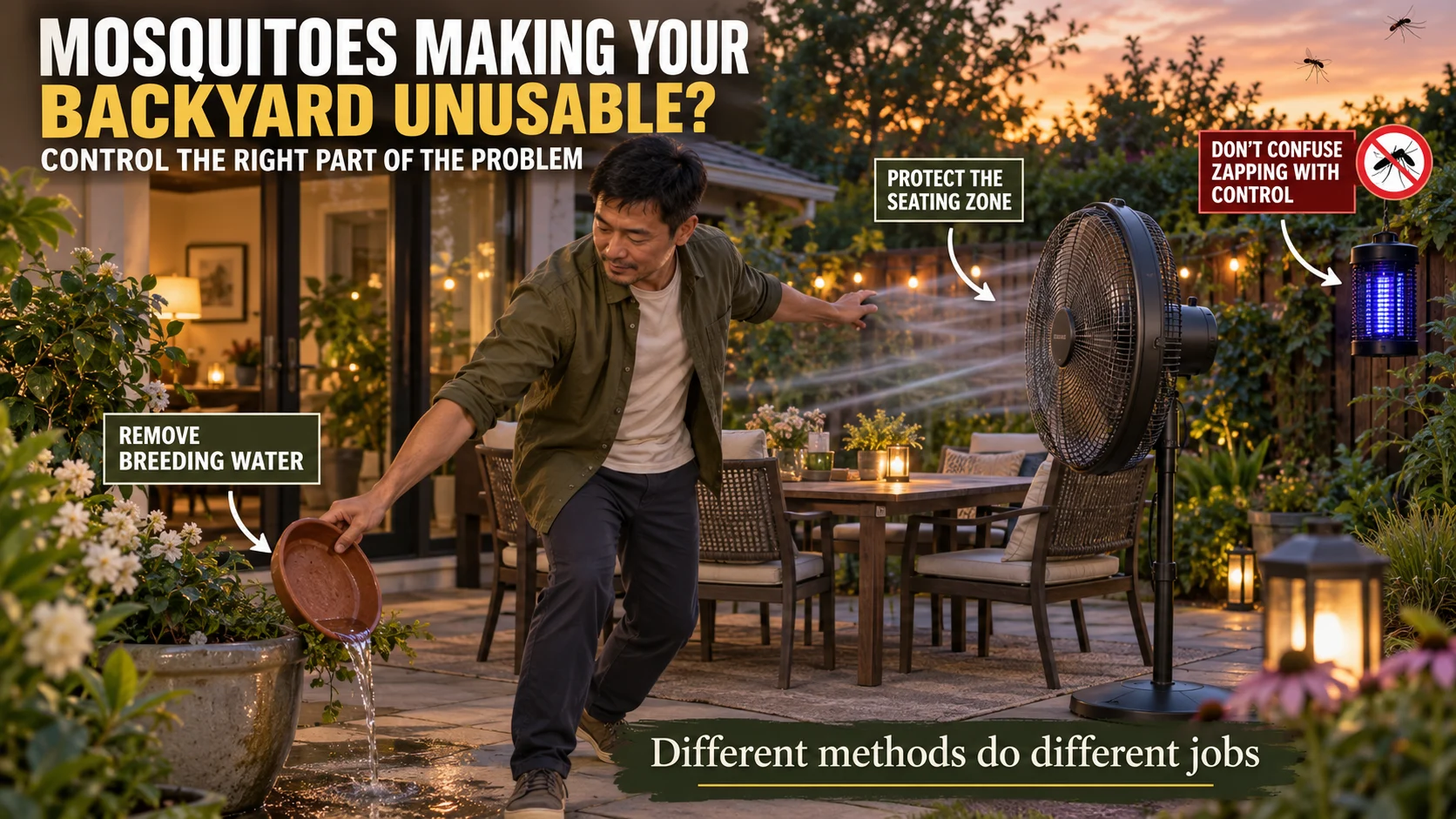

Mosquitoes can make an otherwise useful backyard almost impossible to enjoy, but the best solution depends on whether you need to stop mosquitoes breeding, reduce the adults already around the yard, or simply prevent them from reaching people sitting outside. Start by identifying which of those jobs you actually need, because one mosquito-control method rarely does all three.
The most dependable approach is layered: remove breeding water you control, treat unavoidable standing water appropriately, then protect the part of the backyard people actually occupy. If mosquitoes are arriving from wetlands, neighboring properties or other sources beyond your boundary, expecting one backyard treatment to eliminate them completely is usually unrealistic.
What Actually Helps With Backyard Mosquitoes?
The quickest way to avoid wasting money is to separate population control from bite protection.
| Method | What It Actually Does | Best Use | Main Limitation |
|---|---|---|---|
| Remove standing water | Removes places where mosquito larvae can develop. | First-line property control. | Cannot stop mosquitoes arriving from breeding sites elsewhere. |
| Larvicide for unavoidable water | Targets immature mosquitoes before they become biting adults. | Water that cannot reasonably be emptied or covered. | Does not provide immediate relief from adults already flying. |
| Outdoor fan | Creates moving air that makes the occupied zone harder for mosquitoes to use. | Patios, tables, decks and small seating areas. | Protects a zone; it does not reduce breeding. |
| Skin-applied repellent | Reduces the chance of mosquitoes successfully biting the person using it. | Gardening, play, walking around the yard and situations where you cannot stay inside one protected zone. | Protects the user rather than the property. |
| Spatial repellent | Disperses a repellent through a defined outdoor area. | Relatively stationary seating or dining areas. | Coverage and performance can change with device placement, wind and product instructions. |
| Adult mosquito treatment | Kills adult mosquitoes contacted by an appropriately labeled treatment. | Targeted control when adult pressure remains high. | May be temporary, requires careful label compliance and can affect non-target insects if used indiscriminately. |
| Bug zapper | Kills insects attracted to the device. | Poor choice as the main mosquito-control strategy. | Many insects killed are not biting mosquitoes. |
That table explains why homeowners can have completely different experiences with products that are all advertised around the same problem. Someone using a fan around a dining table may report excellent results because their goal is simply to finish dinner without bites. Another person may call the same approach useless because they expected it to suppress mosquitoes across half an acre.
The target therefore matters as much as the method.
If mosquitoes are only one of several reasons nobody goes outside, start with the broader diagnostic in Why Your Backyard Feels Unused – And How to Fix It. When mosquitoes are clearly the reason people abandon the patio, continue here and treat them as a specific usability problem.
First, Work Out Whether Your Yard Is Producing Mosquitoes
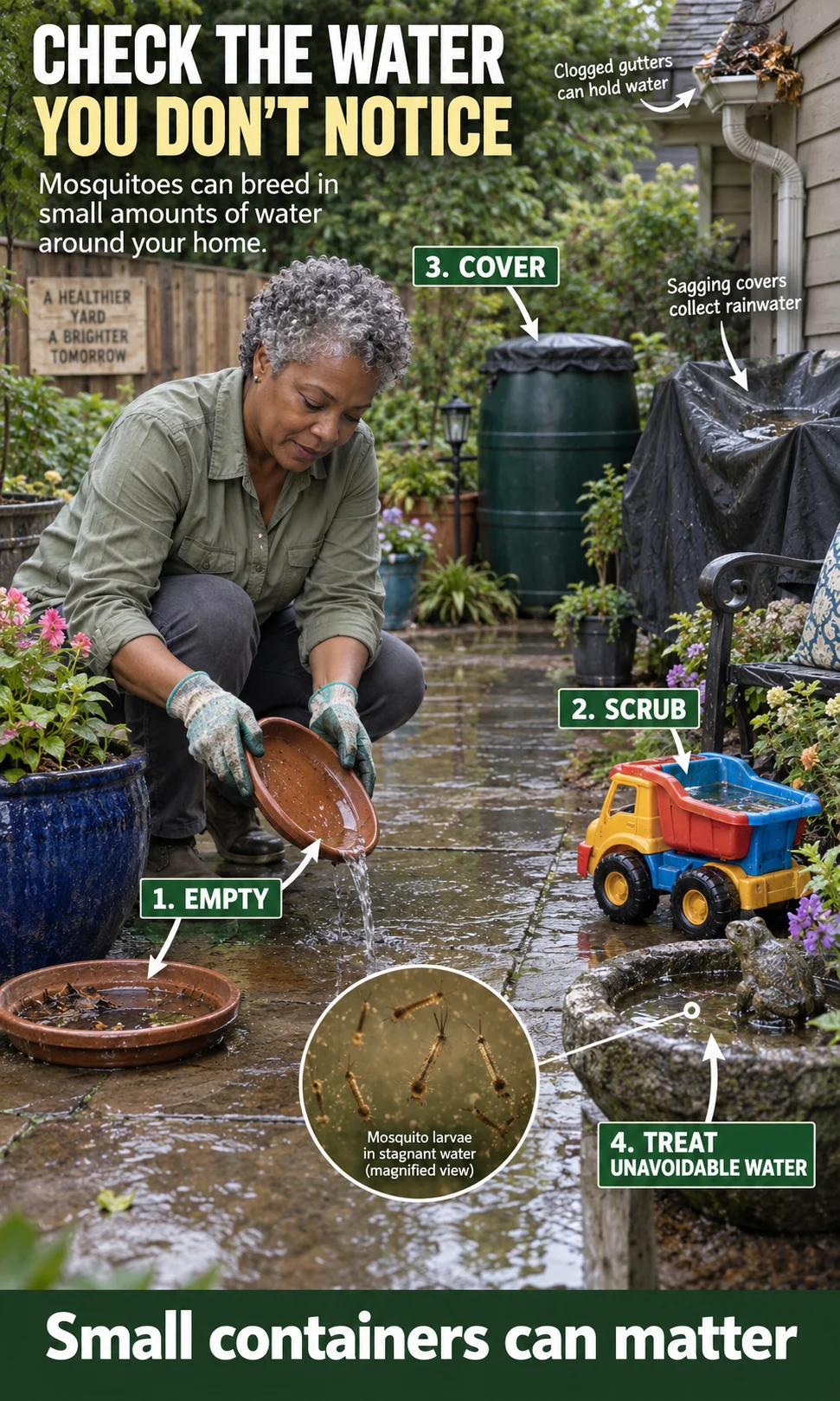
Do not assume the mosquitoes biting you were bred on your property.
Some mosquito problems are strongly local. Others are being replenished from neighboring yards, drainage areas, woodland, wetlands or other habitat beyond the property. Both situations can look identical when you are sitting outside.
Start by inspecting your own yard because that is the part you can control.
Containers deserve more attention than dramatic puddles. A flowerpot saucer, folded tarp, children’s toy, clogged gutter, wheelbarrow, uncovered barrel or hollow object can retain water after everything else appears dry. The CDC’s home mosquito-control guidance recommends routinely emptying, scrubbing, turning over, covering or discarding water-holding items because removing the aquatic stage interrupts the mosquito life cycle before the insects become biting adults.
Look beyond the obvious open bucket. Water can remain where you do not normally look down into it.
Check These Places After Rain or Irrigation
- plant saucers and decorative cachepots;
- buckets and watering equipment;
- children’s toys and paddling pools;
- wheelbarrows and garden carts;
- tarps and furniture covers with depressions;
- clogged gutters and downspout extensions;
- open rain barrels or poorly fitted covers;
- birdbaths and ornamental containers;
- pool covers that develop pockets of water;
- hollow posts, cavities or objects with open tops;
- neglected containers behind sheds or dense planting.
Finding water does not automatically prove it is producing the mosquitoes biting you, but it gives you something actionable. Removing a breeding site attacks the next generation rather than repeatedly dealing with adults after they have emerged.
Why Emptying Water Once May Not Solve the Problem
A one-time garden cleanup is useful, but it is not the same as mosquito management.
Rain falls again. Irrigation refills a saucer. A tarp sags. Leaves block a gutter. A child’s toy is left upright. The useful habit is therefore a repeat inspection rather than one heroic cleanup at the start of summer.
Scrubbing certain containers also matters because simply tipping out visible water may not remove every life stage associated with the container. The practical goal is to leave the object unable to support the next cycle rather than merely looking empty for a few hours.
There is another reason results can disappoint: your yard may not be the dominant source.
If you repeatedly remove standing water and mosquito pressure remains severe, especially when the property is close to wet ground, drainage channels, woodland or uncontrolled neighboring habitat, your next step should shift from “find more breeding water” toward protecting the occupied zone.
That distinction saves a great deal of frustration.
Make the Place Where You Sit Harder for Mosquitoes to Use
You do not always need to make the entire property mosquito-free before you can reclaim a patio.
For a seating or dining area, moving air is one of the simplest interventions worth testing. Mosquitoes do poorly in stronger airflow, so a properly positioned outdoor fan can make the small zone around people substantially less hospitable without spraying the garden.
The aim is not to install a fan somewhere nearby and hope for the best. The airflow needs to pass through the occupied zone – where legs, arms and upper bodies are actually exposed while people are seated.
A fan positioned too high, blocked by furniture or aimed past the table may move plenty of air while providing disappointing bite relief.
Test the Fan Before Building Around It
Use a portable fan first if conditions allow it safely.
Sit where you normally sit and test:
- whether air reaches the lower legs as well as the upper body;
- whether furniture blocks the airflow;
- whether one fan leaves an obvious unprotected side;
- whether the airflow remains comfortable for people at the table;
- whether the location is suitable for outdoor-rated electrical equipment;
- whether a permanent ceiling or wall fan would eventually serve the zone better.
This is a local comfort strategy, not population control. You should not expect fewer mosquito larvae elsewhere in the yard because a fan is running over the patio.
That is precisely why it can still be valuable: if the reader’s actual goal is sit outside for forty minutes without being driven indoors, whole-property eradication may not be necessary.
A Fan and a Spatial Repellent Do Not Work the Same Way
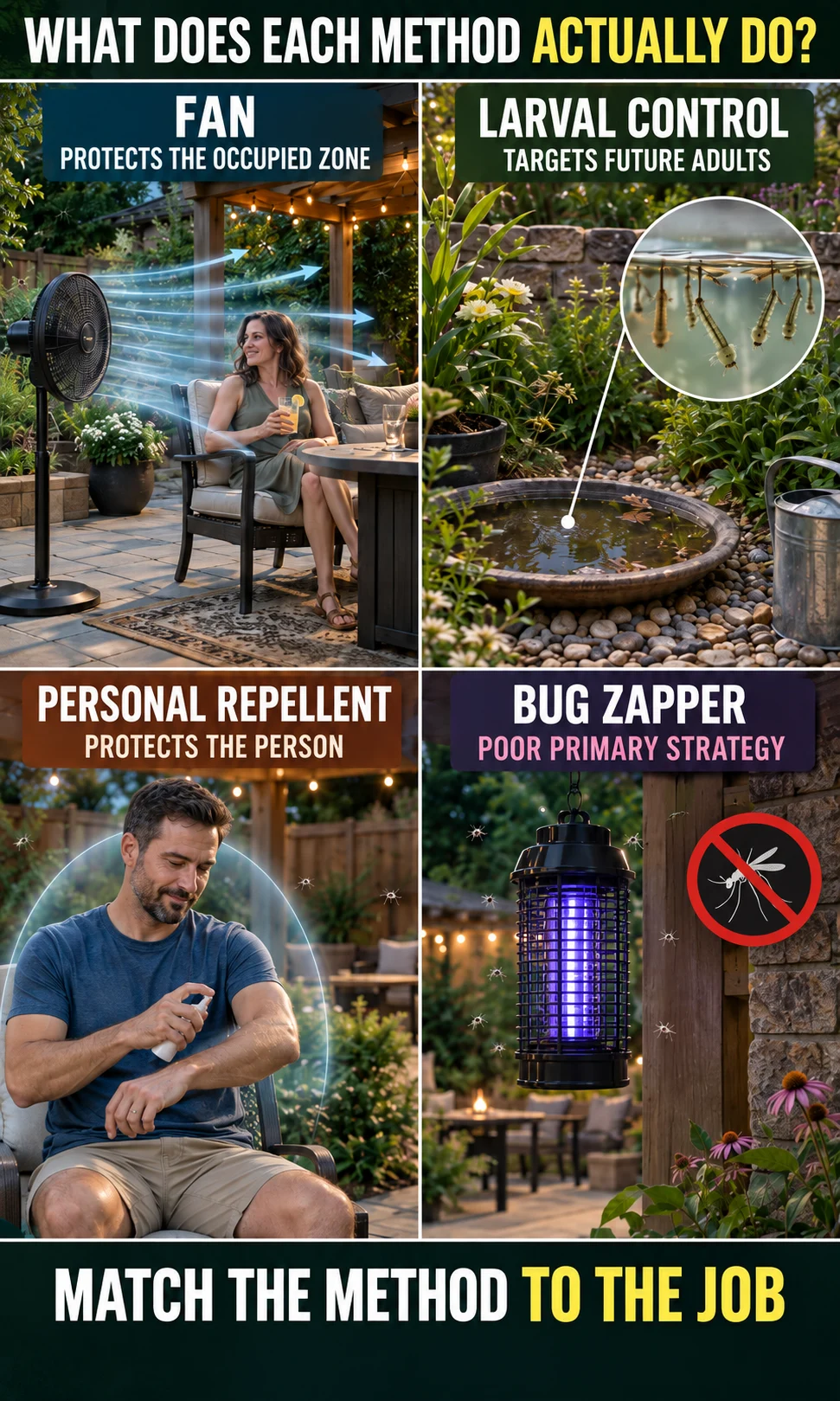
These two methods are sometimes discussed as though they were interchangeable because both can improve comfort around a patio. Their mechanisms are different.
A fan relies on physical airflow through the occupied area. A spatial repellent releases a repellent into the air around a defined outdoor zone.
That difference has a practical consequence: strong airflow may also disperse the chemical plume from some spatial-repellent systems. Product placement and wind conditions therefore matter. The EPA’s explanation of spatial repellents specifically notes that users should check the labeled coverage area, wind limitations and whether the product needs time to establish the protected zone.
Do not assume that combining every mosquito-control device simultaneously produces stronger protection. Sometimes two interventions operate well together; sometimes the conditions that help one can interfere with another.
The next question is therefore where people move.
A spatial repellent makes the most sense when people remain within its intended protected area. Someone gardening across the property, mowing the lawn or playing with children may move in and out of that zone repeatedly. Personal bite protection becomes more relevant in those situations.
Repellent Protects the Person, Not the Backyard
Skin-applied mosquito repellent solves a different problem from larval control or yard treatment. It helps prevent bites when mosquitoes are present and you cannot reasonably control the entire environment.
That makes it particularly useful when:
- you are moving around rather than sitting in one place;
- mosquitoes are arriving from outside the property;
- you need immediate protection while slower control measures take effect;
- the activity occurs away from fans or spatial repellents;
- mosquito-borne disease is a relevant local concern.
Choose products that are legally registered or approved for mosquito repellency in your jurisdiction and follow their labels. In the United States, EPA-registered repellents are evaluated for safety and effectiveness when used as directed; other countries maintain their own registration and public-health guidance.
Repellent therefore deserves a place in the system even though it does nothing to stop larvae developing in a neglected bucket.
That is the broader principle running through this article:
Do not judge a mosquito-control method by whether it eliminates mosquitoes everywhere. Judge it by whether it performs the specific job you chose it for.
Treat Unavoidable Standing Water Differently From Water You Can Remove
Not every water source can simply be tipped out. Some properties have drains, rain barrels, ornamental water features, catch basins or other containers that must hold water for a legitimate reason. In those situations, the objective changes from removing the habitat to preventing that habitat from producing adult mosquitoes.
Larvicides are designed for this stage of the mosquito life cycle. Products containing Bacillus thuringiensis israelensis – commonly shortened to Bti – are widely used to control mosquito larvae in appropriate aquatic habitats. They do not function like an instant adult mosquito spray, so a treated container can be managed correctly while adults already present continue biting for a time.
This timing difference is important because it prevents the reader from abandoning an effective larval-control method simply because mosquitoes are still visible the same evening.
Use a larvicide only where the product label specifically permits its use, and follow the application directions for the particular water body involved. A birdbath, ornamental pond, rain barrel and stormwater feature are not automatically equivalent treatment situations.
Remove Water When You Can – Treat It When You Cannot
The practical hierarchy is straightforward:
- Empty unnecessary standing water.
- Cover water that needs to remain stored.
- Improve circulation or maintenance where appropriate.
- Use an approved larvicide where standing water cannot reasonably be eliminated.
- Continue checking the site after rain and irrigation.
Do not use larvicide as an excuse to preserve unnecessary stagnant water around the property. Source reduction remains the simpler first choice when the container has no useful function.
Do Mosquito Dunks Actually Work?
Mosquito dunks can work when they are used for the job they were designed to perform: controlling mosquito larvae in suitable standing water.
They are frequently misunderstood because homeowners may place one in a container and expect the biting adults around a patio to disappear immediately. That is not the mechanism.
A larval treatment interrupts development before mosquitoes emerge as adults. It therefore works best as part of repeated source management rather than as an emergency response twenty minutes before an outdoor dinner.
A dunk also cannot control breeding sites you do not have access to. If mosquitoes are emerging from unmanaged water beyond your property, treating one rain barrel may still be worthwhile without producing a dramatic reduction in the adults arriving from elsewhere.
Signs Larval Control Deserves More Attention
Give this part of the strategy higher priority when:
- water repeatedly accumulates after rain;
- drainage structures cannot be emptied;
- rainwater storage is part of the property;
- ornamental water must remain;
- mosquito activity increases after predictable wet periods;
- several small containers are repeatedly refilling;
- larvae are visibly present in standing water.
The most successful approach is systematic. One treated barrel does not compensate for six forgotten containers elsewhere in the yard.
Dense Vegetation Can Support Adult Mosquito Resting Areas
Standing water receives most of the attention because mosquitoes require aquatic habitat during their immature stages, but adult mosquitoes also use sheltered environments.
Dense, shaded and humid vegetation can provide resting conditions during parts of the day. That does not mean shrubs, hedges or lush gardens should automatically be removed. It means vegetation immediately around a heavily used sitting area deserves practical inspection when mosquito pressure remains high.
Look for places where:
- foliage is extremely dense around the patio edge;
- air barely moves through the occupied zone;
- wet organic debris accumulates beneath plants;
- irrigation repeatedly leaves a sheltered area damp;
- containers are hidden under foliage;
- vegetation makes it difficult to inspect for standing water.
Pruning for airflow and access can sometimes improve the usability of the occupied area without stripping the landscape bare.
The objective is not a sterile garden. It is a backyard where planting does not conceal water-holding debris or create an unnecessarily stagnant microenvironment immediately around the place people are trying to use.
Adult Mosquito Sprays Can Help – But They Are Usually Temporary
When mosquito pressure remains high despite source reduction, adult mosquito control may be considered. This is where expectations need to become much more precise.
An adulticide can reduce mosquitoes that contact a correctly applied treatment, but it does not permanently stop new mosquitoes from arriving. If the surrounding environment continues supplying adults, the population around the yard can rebound.
That is why repeated blanket spraying can become an expensive cycle when the underlying source remains unresolved.
Adult mosquito treatment should therefore be viewed as one possible layer rather than the foundation of the entire strategy.
Before Using an Adulticide, Ask Four Questions
- Have you already removed the breeding sites you control?
- Are mosquitoes being replenished from outside the property?
- Are you trying to protect one patio or suppress adults across a larger landscape?
- Can the treatment be applied without unnecessary exposure to people, pets and non-target insects?
Product labels matter. Application sites, timing, protective requirements and environmental restrictions vary by formulation and jurisdiction.
Indiscriminate treatment of every flowering plant or garden surface is especially poor practice when the actual reader objective is simply to make one seating zone more comfortable.
Automatic Mosquito Misting Systems Need Careful Consideration
Permanent automated misting systems can sound attractive because they promise repeated mosquito treatment without manual application. The trade-off is that repeated pesticide release may occur whether or not mosquito pressure at that moment justifies it.
That creates practical questions about exposure, drift, non-target insects, maintenance and whether the system is solving the actual source of the problem.
For most ordinary residential situations, I would investigate source control and occupied-zone protection before making an automatic pesticide-dispensing system the default answer.
A system that sprays frequently cannot compensate for a rain-filled toy, clogged gutter or untreated water source that keeps producing mosquitoes.
Do Mosquito Traps Work?
Mosquito traps are another category where the answer depends heavily on what “work” means.
Some traps can capture mosquitoes. That does not automatically mean a single trap will reduce biting enough to reclaim the entire backyard. Performance depends on mosquito species, attractant, device design, placement, surrounding habitat and the number of mosquitoes entering the area.
This distinction matters because trap counts can look impressive without answering the real question:
Are people getting bitten less?
For a homeowner, bite reduction is normally the more useful outcome.
A trap may deserve consideration as one component of a broader program, particularly when there is a clearly defined monitoring or population-control purpose. It is weaker as a first purchase when standing water has not been checked and the patio itself has no direct protection.
Bug Zappers Are Usually a Poor Primary Mosquito Strategy
Traditional ultraviolet bug zappers are attractive because they visibly kill insects, creating immediate evidence that the device is doing something.
The problem is that killing insects is not the same as controlling the mosquitoes biting you.
Many insects attracted to these devices are harmless or beneficial species rather than the female mosquitoes seeking a blood meal. A backyard can therefore produce the sound and spectacle of constant zapping while the people sitting nearby continue to be bitten.
If the objective is mosquito control, do not evaluate a device by the number of insects in its collection tray.
Evaluate it by whether it measurably changes mosquito pressure where people are using the yard.
That makes a traditional bug zapper a weak first-line investment compared with:
- eliminating breeding water;
- managing unavoidable standing water;
- improving airflow around seating;
- using appropriate personal repellent;
- using a suitable spatial repellent where appropriate.
Mosquito-Repellent Plants Are Commonly Oversold
Citronella, lavender, rosemary, mint, marigolds and other aromatic plants are regularly promoted as natural mosquito barriers.
Growing the plant in a pot beside the patio should not be treated as equivalent to applying a tested mosquito repellent.
A plant may contain compounds associated with insect-repellent effects when extracted, concentrated or formulated in particular ways, but simply placing the living plant near a chair does not create a reliable protective field around the person sitting there.
You can absolutely grow these plants because you enjoy their fragrance, flowers, culinary use or appearance.
Just give them the correct job.
Plant them as plants – not as the primary mosquito-control system protecting your family outdoors.
Citronella Candles Have a Limited Job
Citronella candles belong in a similar category.
They may contribute some localized deterrence under favorable conditions, but they should not be expected to solve a substantial mosquito problem across a patio or yard.
Outdoor air movement makes any small repellent plume difficult to control. A candle several metres away from the people being bitten may provide very little practical benefit.
If you already enjoy candles for ambience, there is nothing inherently wrong with including one where permitted and safely used. The mistake is building the entire mosquito strategy around it.
Natural Does Not Automatically Mean Safer or More Effective
Mosquito control attracts a large market of products described as botanical, natural, chemical-free or family-friendly. Those words alone do not tell you how well the product works, how long protection lasts, how it should be applied or what risks it carries.
Plant-derived substances are still biologically active substances.
The useful questions remain:
- What is the active ingredient?
- What mosquito-control job is it intended to perform?
- Has the product been registered or evaluated for that use in the relevant jurisdiction?
- How long is protection expected to last?
- Where can it be applied?
- What precautions does the label require?
Do not substitute marketing language for those questions.
What About Coffee Grounds, Dryer Sheets and Other Home Remedies?
Backyard mosquito advice accumulates home remedies quickly because the problem is frustrating and easy to experiment with.
Coffee grounds in standing water, dryer sheets in pockets, bowls of vinegar, garlic sprays, essential-oil mixtures and similar techniques are often circulated as inexpensive solutions. Some may produce an odor or short-lived local effect, but that is very different from dependable backyard mosquito control.
The practical danger is not usually that somebody tried one harmless experiment. It is that an unproven remedy delays interventions with a clearer mechanism.
If mosquitoes are making the yard genuinely unusable, prioritize measures that perform a defined job:
remove larvae-producing habitat, manage unavoidable water, disrupt access to the occupied area, or protect the person being bitten.
The Best Strategy Changes With the Type of Mosquito Problem
You do not need every method in this article.
You need the combination that matches the failure pattern.
| What You Notice | Start Here | Then Consider | Do Not Assume |
|---|---|---|---|
| Lots of small water-holding containers around the property | Source reduction | Larval control for water that must remain | A patio gadget can compensate for continued breeding |
| Bites are mainly a problem while sitting at one table | Occupied-zone airflow | Spatial or personal repellent as appropriate | The entire yard must be mosquito-free |
| You are bitten while gardening or moving around | Personal bite protection | Source inspection and targeted property control | A stationary patio device protects the whole property |
| Pressure stays severe despite a clean property | Assume outside sources are possible | Layered occupied-zone protection or professional assessment | You have simply failed to find the one hidden bucket |
| A mosquito treatment works briefly, then pressure returns | Recheck source and reinvasion | More targeted integrated control | Applying more of the same treatment automatically fixes the cause |
A Practical Mosquito-Control Sequence for an Unusable Backyard
When the problem has become severe enough that people avoid going outside, I would work through it in this order.
1. Inspect the Property After Water Has Had Time to Collect
Do the inspection after rain or irrigation rather than during an unusually dry period.
Empty unnecessary water and identify anything that repeatedly refills.
2. Deal With Water That Must Remain
Cover storage containers properly and use an appropriate larval-control method where permitted when water cannot be emptied.
Keep checking the site because one successful treatment does not prevent new containers from appearing elsewhere.
3. Choose the Smallest Outdoor Zone You Actually Need to Reclaim
Do not start with “the backyard.”
Start with:
the four-person dining table, the deck sofa, the reading chair or the children’s play area.
A defined occupied zone is much easier to protect and evaluate.
4. Test Airflow
Use a safely positioned outdoor-appropriate fan where suitable and see whether mosquito pressure changes around the people occupying that zone.
Do this before assuming the answer requires permanent pesticide treatment.
5. Add Bite Protection Appropriate to the Activity
Stationary dining and active gardening are different use cases.
Choose spatial or personal protection according to how people actually move through the yard.
6. Reassess After Several Mosquito Life Cycles and Weather Changes
Immediate bite protection may be noticeable quickly. Source reduction takes longer to reveal its full effect because you are preventing future adults.
Keep those timelines separate when judging whether something worked.
7. Escalate Only When the Remaining Problem Justifies It
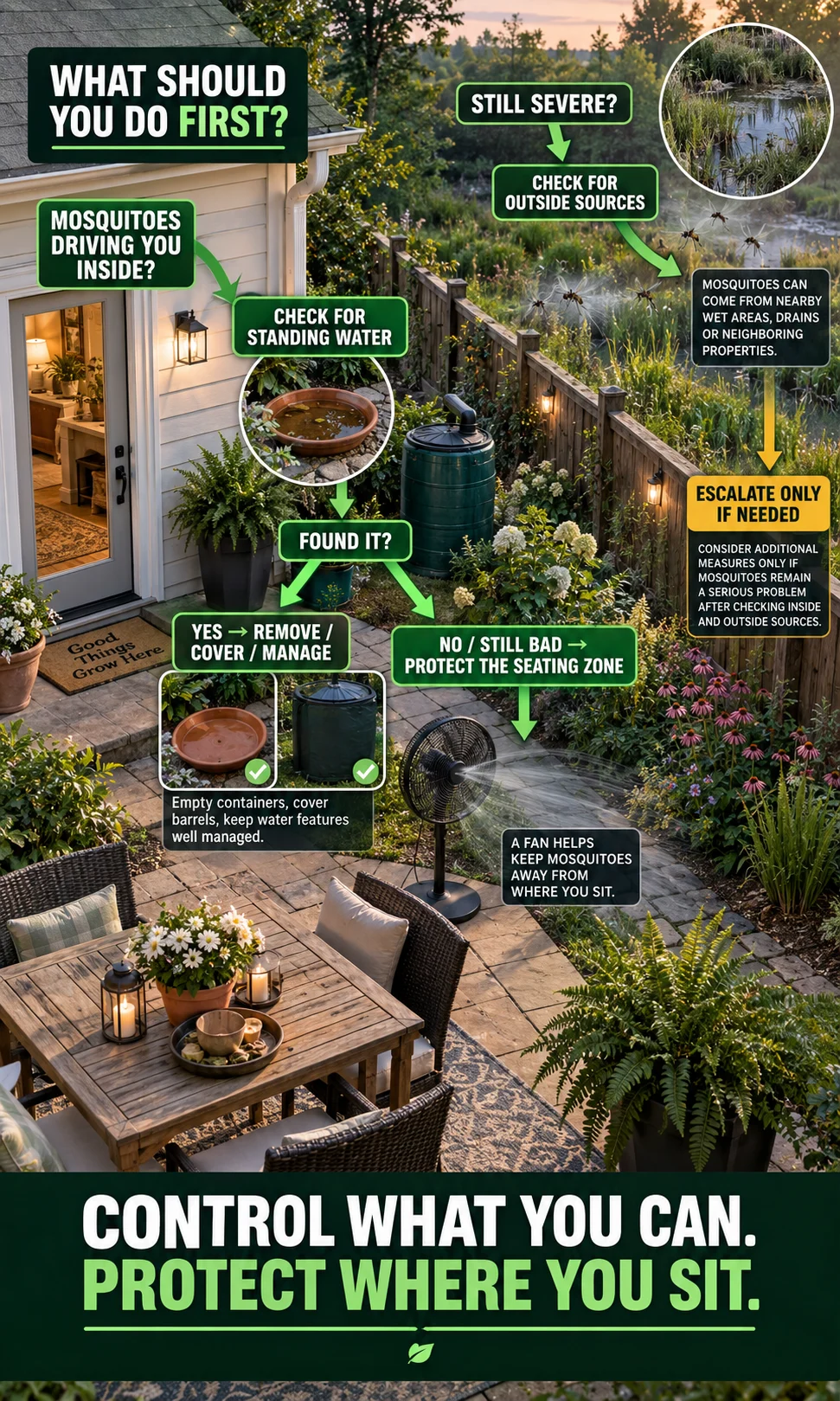
If severe mosquito pressure continues despite competent property control, outside sources, difficult habitat or species-specific behavior may be important.
That is the point where professional pest-control or local mosquito-control advice becomes more useful than buying another random backyard gadget.
When Professional Mosquito Control Makes Sense
Professional help becomes more reasonable when the problem remains severe after obvious breeding sources have been corrected, the property contains difficult drainage or extensive habitat, or the reader needs to determine whether incoming mosquitoes are overwhelming property-level control.
A competent professional should be able to explain what is being targeted and why.
Useful questions include:
- Where do you think the mosquitoes are breeding or resting?
- What evidence supports that diagnosis?
- Are you treating larvae, adults or both?
- Which areas will be treated?
- How long should the effect reasonably last?
- What happens when mosquitoes migrate back from surrounding properties?
- What precautions apply to people, pets, edible plants and pollinators?
- What should I change on the property between treatments?
- How will we determine whether the service is actually reducing bites?
Be cautious when the explanation is effectively “we spray everything on a schedule.”
A strong mosquito-control plan should have a mechanism, not merely a calendar.
If Mosquitoes Come From Outside Your Property
This is one of the most frustrating mosquito scenarios because the homeowner may be doing nearly everything correctly.
Properties near wetlands, drainage areas, unmanaged land, woodland or neighboring breeding sources can continue receiving mosquitoes after local source reduction. In that situation, the realistic objective may shift from population elimination to creating dependable protected periods and zones for outdoor use.
That may mean:
- keeping your own property from contributing additional mosquitoes;
- protecting the main seating area with airflow;
- using personal or spatial repellents appropriately;
- screening enclosed outdoor rooms where feasible;
- adjusting activity timing when mosquito pressure has a predictable pattern;
- seeking local mosquito-control guidance where community-level breeding is involved.
This is not failure.
It is matching the solution to the scale of the source.
Do Not Wait for a Mosquito-Free Backyard Before Using It
The standard for success does not need to be zero mosquitoes.
For most households, the meaningful outcome is much more practical:
Can people sit outside, eat, talk, read or garden without being driven indoors by repeated bites?
That is the same usability principle behind the wider backyard cluster. The improvement succeeds when behavior changes.
If a fan, source-control routine and appropriate bite protection turn an abandoned patio into a place the household willingly uses four evenings a week, the intervention is doing something valuable even if an occasional mosquito remains.
The next step is to make that result repeatable rather than continually searching for a mythical single product that permanently removes every mosquito from the property.
Frequently Asked Questions
Why are mosquitoes so bad in my backyard even when there is no obvious standing water?
Mosquitoes do not have to breed in the exact place where they bite you. They may be emerging from small hidden water sources on your property or arriving from neighboring yards, drainage areas, wetlands, woodland or other nearby habitat. Inspect your own property carefully first, then shift toward protecting the occupied zone if mosquito pressure stays high despite good source control.
What is the most effective way to reduce mosquitoes in a backyard?
Use several methods for different parts of the problem. Remove unnecessary standing water, manage water that must remain, then protect the places where people actually sit or move with airflow and appropriate repellents. Adult mosquito treatment may have a role when pressure remains high, but it should not replace source control or a clear diagnosis of where the mosquitoes are coming from.
Do outdoor fans really help with mosquitoes?
A fan can make a patio or seating area substantially harder for mosquitoes to use because the insects are relatively weak flyers and the moving air also disrupts conditions around the person they are trying to reach. The airflow needs to pass through the occupied zone rather than merely circulate somewhere nearby. A fan protects that local area; it does not stop mosquitoes breeding elsewhere in the yard.
Do mosquito dunks work in backyard standing water?
Mosquito dunks containing an approved larvicide can help when they are used in suitable standing water according to the product label. Their job is to control mosquito larvae before they develop into adults, so they should not be expected to remove adult mosquitoes immediately. Empty unnecessary water first and reserve larval treatment for water that cannot reasonably be removed or covered.
Why do I still have mosquitoes after removing standing water?
Removing standing water prevents future mosquitoes from developing in the sources you control, but adult mosquitoes already present can remain for a time and new mosquitoes may continue arriving from elsewhere. Recheck the property after rain or irrigation, allow time for source reduction to affect later generations, and use occupied-zone or personal protection when outside sources are likely to remain important.
Do bug zappers get rid of mosquitoes?
Traditional ultraviolet bug zappers are a poor primary strategy for mosquito control because many of the insects they kill are not the mosquitoes biting people. A device can collect large numbers of insects without meaningfully changing the number of bites around your patio. Source reduction, larval control where appropriate, airflow and proven bite protection are more useful places to begin.
Do citronella plants keep mosquitoes away from a patio?
Simply growing citronella or another aromatic plant beside a patio should not be treated as reliable mosquito protection. A living plant does not create the same concentration or controlled exposure as a properly formulated repellent. Grow mosquito-associated herbs and flowering plants for their normal garden value, but use methods with a clearer mosquito-control mechanism when bites are making the backyard unusable.
Are mosquito sprays worth using in a backyard?
Adult mosquito sprays can reduce mosquitoes that contact an appropriately applied treatment, but the effect may be temporary when new adults continue arriving from surrounding habitat. Before relying on repeated spraying, remove breeding sources you control and identify the occupied area that actually needs protection. Follow the product label and avoid indiscriminate treatment of areas where it is unnecessary.
What should I do if mosquitoes are coming from a neighbor’s property or nearby wetlands?
You may not be able to eliminate mosquitoes being continually supplied from outside your property. Keep your own yard from producing additional mosquitoes, then focus on making the main seating or activity area dependable through airflow, appropriate repellents, screening where practical and other occupied-zone measures. Severe community-level mosquito pressure may also justify advice from local mosquito-control or public-health services.
How long does it take for backyard mosquito control to start working?
The timing depends on the method. A fan or personal repellent may improve bite protection during the same outdoor session, while removing breeding water or controlling larvae is aimed at reducing future adults and therefore takes longer to judge. Adult mosquito treatments may act quickly but can lose their effect as new mosquitoes arrive. Evaluate each method according to the stage of the mosquito problem it is designed to address.
Can I make my backyard completely mosquito-free?
Complete elimination is not a realistic target for many open residential properties, especially where mosquitoes can arrive from surrounding habitat. A better goal is to reduce breeding you control and make the parts of the backyard people actually use comfortable enough that repeated bites no longer drive everyone indoors. Successful mosquito control should be judged by improved outdoor use, not by whether an occasional mosquito can still be found.