

The Silent Battlefield Inside Your Phone
Mobile AI competition is no longer limited to software.
The most decisive battles now occur at the hardware layer.
Smartphones increasingly integrate dedicated AI accelerators directly into their chip architecture.
These accelerators are often referred to as:
- Neural Processing Units
- AI Engines
- Tensor Accelerators
- Machine Learning Cores
Unlike general CPUs, these components are designed to execute matrix operations at high efficiency.
Matrix operations power:
- Image recognition
- Natural language processing
- Predictive ranking
- Recommendation systems
- Voice recognition
- On-device personalization
The location of AI execution matters.
If inference runs on the cloud, latency increases.
If inference runs locally, latency decreases.
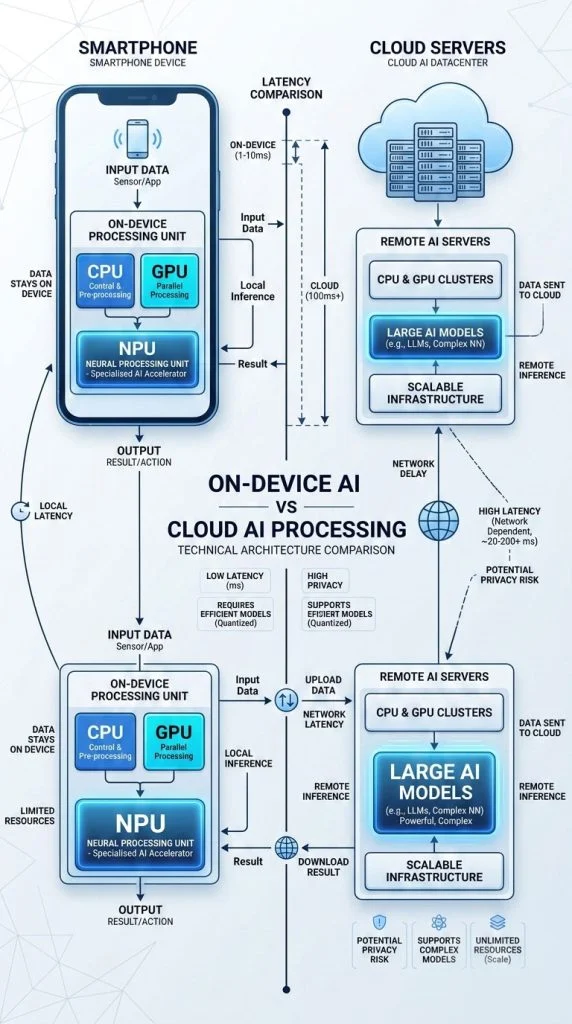
To see how mobile systems balance on-device inference with cloud-scale AI, read On-Device AI vs Cloud AI Architecture.
Reduced latency improves interaction smoothness.
Smooth interaction increases engagement stability.
Engagement stability strengthens retention probability.
Retention probability influences ecosystem durability.
Hardware therefore becomes predictive infrastructure.
This transition reshapes competitive positioning across mobile ecosystems.
For readers exploring the broader smartphone ecosystem, see all articles in Phones category to understand how mobile hardware, operating systems, and device architecture shape modern smartphones.
This shift intensifies hybrid AI architectural trade-offs inside mobile ecosystems. Chip-level acceleration alters the balance between latency and scale.
Chip-level AI reduces dependency on constant cloud communication.
Reduced dependency lowers data transmission load.
Lower transmission load improves battery efficiency.
Battery efficiency increases usage continuity.
Continuity increases daily active sessions.
Daily sessions expand behavioural datasets.
Dataset expansion improves predictive calibration.
Calibration improves personalization depth.
Personalization depth influences platform loyalty.
What Is Hardware-Level AI Acceleration?
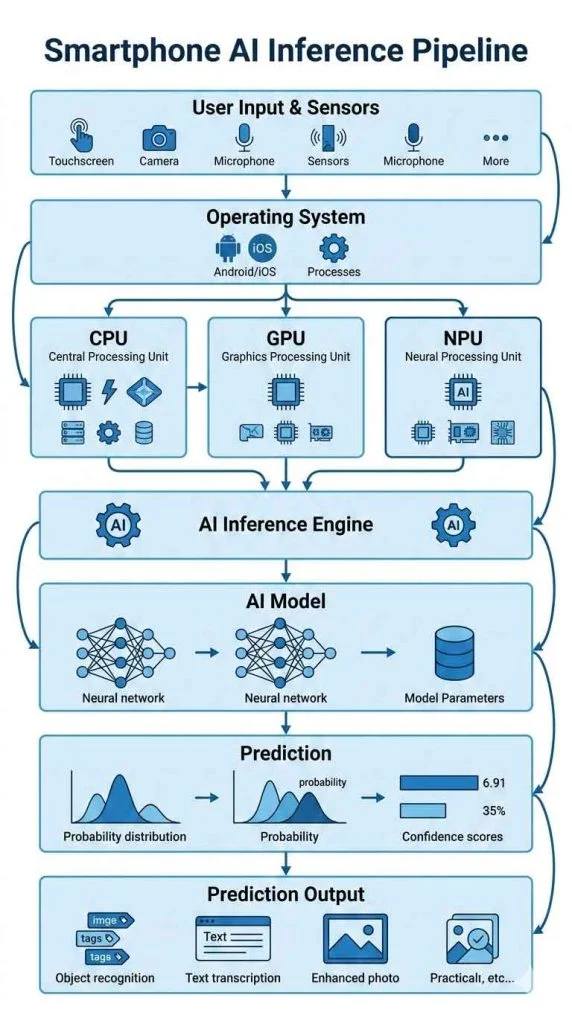
Key AI Hardware Terms in Smartphones
Understanding mobile AI competition requires recognizing several core hardware concepts used inside modern smartphone processors.
Neural Processing Unit (NPU)
A Neural Processing Unit is a specialized processor inside a smartphone chip designed specifically to execute machine learning tasks such as image recognition, voice processing, and predictive language modeling. NPUs accelerate AI workloads more efficiently than general-purpose CPUs.
Tensor Accelerators
Tensor accelerators are hardware blocks optimized for performing matrix and tensor calculations used in neural networks. These operations form the mathematical backbone of AI inference.
TOPS (Trillions of Operations Per Second)
TOPS measures how many AI-related calculations a processor can perform per second. Higher TOPS ratings indicate stronger theoretical AI processing capability, though real-world performance depends on power efficiency and thermal constraints.
Performance per Watt
Performance per watt describes how efficiently a chip performs AI tasks relative to energy consumption. In mobile devices, this metric often matters more than raw computational power because battery life and thermal stability constrain sustained workloads.
On-Device AI Inference
On-device inference refers to running machine learning models directly on the smartphone instead of sending data to cloud servers.
These hardware accelerators power many everyday smartphone features, including predictive typing systems used in modern mobile keyboards. See how these systems work in how smartphone keyboards autocorrect words you type.
This approach reduces latency, improves privacy, and allows features such as predictive typing and real-time translation to operate instantly.
Hardware-level AI acceleration refers to specialized silicon optimized for machine learning tasks.
To understand how smartphones operate at a foundational level before AI acceleration is added, see Phone Basics Explained – How Smartphones Work, Choose, and Last Longer.
These units often include:
- Dedicated matrix multiplication pipelines
- Low-precision computation support
- High-bandwidth memory channels
- Parallel inference threads
Unlike CPUs, which process general instructions sequentially, AI accelerators perform parallel tensor operations.
Understanding how these AI components interact with the rest of the smartphone processor architecture is easier when you first understand how smartphone systems are structured internally, as explained in Phone Basics Explained – How Smartphones Work, Choose, and Last Longer.
Parallelism increases throughput.
Higher throughput allows:
- Real-time image segmentation
- Instant voice processing
- Live translation
- Adaptive UI rendering
- Predictive text modelling
These processes now occur within milliseconds.
Milliseconds matter.
This enables real-time predictive calibration directly on the device. Interaction becomes fluid rather than delayed.
Fluidity influences perception of quality.
Perceived quality influences retention density.
Retention density influences monetization durability.
The Economics of Milliseconds
Latency is not merely technical.
It is economic.
If a voice assistant responds instantly, usage frequency increases.
If image processing lags, abandonment probability rises.
Every additional 100 milliseconds can reduce interaction probability.
Predictive typing systems illustrate how small latency changes affect real user interaction, such as the systems explained in smartphone keyboards that autocorrect words you type.
Reduced interaction lowers engagement frequency.
Lower frequency weakens predictive confidence.
Weak predictive confidence reduces personalization accuracy.
Accuracy influences exposure relevance.
Exposure relevance influences retention continuity.
Chip-level acceleration compresses inference time.
Compressed inference time improves engagement probability.
Improved engagement probability increases behavioural loop stability.
Latency reduction strengthens attention allocation efficiency across mobile ecosystems. Faster prediction improves timing precision.
Precision timing increases notification effectiveness.
Notification effectiveness strengthens habit reinforcement.
Habit reinforcement stabilizes daily active cycles.
Daily cycles reinforce ecosystem dominance.
Energy Efficiency and Predictive Persistence
AI acceleration is not only about speed.
It is about efficiency.
Dedicated neural units consume less power per inference compared to CPU execution.
Battery performance is tightly connected to hardware efficiency. Learn more in Phone Battery Health Explained – How Batteries Age and What Affects Them.
Accessory battery systems also interact with smartphone power management systems in different ways, as explained in How the Apple MagSafe Battery Pack Is Different From Other Chargers.
Lower energy consumption allows:
- Continuous background modeling
- Real-time camera processing
- Persistent voice wake detection
- Health monitoring analysis
Persistent inference increases data granularity.
Granular data improves model refinement.
Refinement increases predictive accuracy.
Accuracy improves personalization stability.
Stability improves long-term retention.
Retention improves lifetime value potential.
Hardware efficiency enhances predictive lifetime value systems across device ecosystems. Energy-efficient inference supports durable behavioral modeling.
Durable modeling improves monetization forecasting.
Forecasting accuracy improves investment planning.
Investment planning strengthens chip research cycles.
Chip research cycles accelerate competitive differentiation.
Strategic Chip Differentiation
Chip architecture is now a brand differentiator.
For consumers evaluating how chip performance affects real-world device experience, see Phone Buying Guide – How to Choose the Right Smartphone for Your Needs.
Manufacturers emphasize:
- Neural processing TOPS
- On-device model capacity
- Secure enclave AI
- Low-power inference
Higher TOPS ratings suggest stronger AI performance.
However, raw performance alone does not determine dominance.
Optimization between hardware and operating system determines real-world efficiency.
Integration depth matters.
Chip integration strengthens OS-level predictive coordination across the device. Hardware and software alignment enhances exposure precision.
Exposure precision improves ranking stability.
Ranking stability reduces volatility.
Reduced volatility improves retention durability.
Retention durability strengthens platform resilience.
Vertical Integration as Strategy

AI acceleration at the hardware layer is no longer treated as a component upgrade.
It has become a structural strategy.
Some manufacturers design their own AI chips.
Others rely on third-party semiconductor suppliers.
The distinction affects:
- Optimization depth
- Model compatibility
- Energy efficiency
- Update cadence
- Predictive calibration precision
When hardware and operating system are designed together, alignment increases.
Alignment improves:
- Tensor routing efficiency
- Memory access latency
- Neural core utilization
- Secure enclave integration
Integrated systems can optimize AI tasks at the compiler level.
Compiler-level optimization reduces instruction overhead.
Reduced overhead increases inference speed.
Faster inference improves interaction continuity.
Continuity increases engagement density.
Engagement density improves dataset quality.
Dataset quality enhances predictive calibration.
This approach reflects vertically integrated AI stacks inside mobile ecosystems. Hardware-software unification increases structural control.
Real-World Examples – How AI Accelerators Show Up in Phones
Chip-level AI acceleration is not a theory. It appears as dedicated neural hardware integrated into widely used smartphone chip families.
Common examples include:
- Apple A-series chips – include a dedicated neural engine used for on-device tasks such as photo processing, voice features, and personalization.
- Qualcomm Snapdragon platforms – include specialized AI compute blocks used for camera pipelines, voice processing, and on-device inference workloads.
- Google Tensor devices – emphasize on-device AI features tied to hardware-level acceleration for speech and camera-driven intelligence.
Even everyday typing systems rely on these AI accelerators. Features such as smartphone keyboards that autocorrect words you type depend on the same on-device inference hardware.
These examples matter because they show how mobile AI performance is shaped by more than CPU speed. It is shaped by how efficiently a phone can run inference under battery and thermal limits.
Structural control enhances exposure timing precision.
Timing precision strengthens retention cycles.
Retention cycles reinforce ecosystem resilience.
Independent Chip Suppliers and Ecosystem Fragmentation
Manufacturers that depend on third-party chip vendors face different constraints.
They may experience:
- Shared architectural standards
- Broader compatibility
- Reduced proprietary optimization
- Slower deep-stack integration
Third-party suppliers often prioritize scalability across brands.
Scalability promotes industry standardization.
Standardization improves interoperability.
However, standardization can limit hyper-optimization.
Limited hyper-optimization reduces micro-level predictive refinement.
Refinement affects personalization depth.
Depth influences engagement intensity.
Engagement intensity influences monetization yield.
Fragmentation between chip suppliers and OS vendors can introduce coordination friction.
Friction increases optimization delay.
Delay affects update cycles.
Slower update cycles reduce adaptive speed.
Adaptive speed influences competitive momentum.
Chip fragmentation can weaken predictive coordination layers within the device. Cross-layer latency may increase.
Increased latency reduces engagement precision.
Reduced precision weakens behavioral modeling loops.
Modeling loops stabilize monetization durability.
Durability influences long-term ecosystem competitiveness.
Supply Chain Leverage and Strategic Control
Semiconductor supply chains influence AI capability distribution.
AI chip production depends on:
- Advanced fabrication nodes
- Lithography technology
- Rare material availability
- Packaging innovation
- Foundry capacity
Access to cutting-edge fabrication nodes increases:
- Transistor density
- Power efficiency
- AI throughput capacity
Throughput capacity influences:
- Model size feasibility
- On-device transformer support
- Real-time generative capabilities
Advanced fabrication creates competitive differentiation.
Differentiation increases brand positioning strength.
Positioning strength influences developer prioritization.
Developer prioritization influences ecosystem vibrancy.
Vibrancy enhances behavioral dataset diversity.
Dataset diversity improves predictive robustness.
Supply chain dominance accelerates structural competitive concentration inside mobile ecosystems. Chip access becomes a strategic lever.
Strategic levers influence exposure architecture.
Exposure architecture influences engagement density.
Engagement density reinforces market positioning.
Positioning stabilizes dominance cycles.
National Semiconductor Strategies and AI Sovereignty
Governments increasingly treat semiconductor manufacturing as strategic infrastructure.
AI chip production influences:
- National competitiveness
- Data processing autonomy
- Technological independence
- Economic resilience
Domestic semiconductor capability reduces external dependency.
Reduced dependency increases strategic flexibility.
Flexibility allows:
- Long-term R&D investment
- Security-focused AI integration
- Sovereign cloud infrastructure
AI sovereignty influences global technology alignment.
Alignment influences standards adoption.
Standards influence ecosystem interoperability.
Interoperability shapes device compatibility networks.
Compatibility networks influence developer strategy.
Developer strategy shapes application ecosystem density.
Density improves predictive modelling diversity.
Semiconductor policy intersects with global attention infrastructure competition. Chip capability determines predictive influence scale.
Predictive influence scale affects behavioural calibration reach.
Calibration reaches shapes digital ecosystem impact.
Impact influences long-term strategic positioning.
The Arms Race for On-Device Generative AI
Recent chip advancements enable on-device generative AI models.
These models perform:
- Local text generation
- Image enhancement
- Voice cloning
- Context-aware summarization
Running generative AI locally reduces:
- Cloud dependency
- Latency spikes
- Data transmission risk
Reduced dependency improves privacy posture.
Improved privacy posture strengthens regulatory compliance.
Compliance increases user trust.
Trust improves retention stability.
Generative AI on-device requires:
- High memory bandwidth
- Efficient transformer acceleration
- Optimized low-precision arithmetic
Chip-level support for transformer architectures determines feasibility.
Feasibility influences feature rollout speed.
Rollout speed influences market perception.
Perception influences upgrade cycles.
Upgrade cycles sustain hardware revenue loops.
Generative support accelerates on-device inference evolution inside mobile ecosystems. Hardware now enables previously cloud-bound intelligence.
Local intelligence increases personalization immediacy.
Immediacy increases perceived responsiveness.
Responsiveness increases engagement probability.
Engagement probability reinforces retention cycles.
Benchmark Claims vs Sustained Reality
AI chip marketing often highlights peak theoretical performance.
Metrics commonly promoted include:
- TOPS – trillions of operations per second
- Maximum neural core throughput
- Synthetic benchmark scores
- Burst inference speeds
Peak performance numbers describe short-duration workloads under controlled conditions.
Real-world AI usage differs.
Smartphones operate within:
- Thermal envelopes
- Battery constraints
- Background process competition
- Memory bandwidth ceilings
Sustained performance matters more than burst capability.
If a chip delivers high TOPS but throttles under thermal load, real-world predictive depth declines.
Thermal throttling reduces:
- Frame consistency
- Real-time generative speed
- Continuous background modeling
- Voice assistant reliability
Reduced reliability affects engagement continuity.
Engagement continuity influences behavioral modeling stability.
Stability strengthens predictive calibration.
Thermal limits expose sustained inference trade-offs in mobile AI design. Peak performance does not equal durable predictive capacity.
Durable capacity matters more than isolated benchmarks.
Predictive ecosystems depend on sustained stability rather than momentary acceleration.
The True Competitive Metric
AI acceleration consumes energy.
Energy determines:
- Battery longevity
- Heat generation
- Device lifespan
- Usage continuity
Performance-per-watt measures how efficiently a chip performs inference relative to energy consumption.
Higher efficiency enables:
- Longer AI workloads
- Continuous personalization loops
- Always-on predictive monitoring
- Persistent contextual awareness
Persistent contextual awareness improves:
- Notification precision
- Recommendation timing
- Adaptive UI rendering
- Context-based exposure calibration
Efficient silicon enables persistent behavioral calibration across sessions. Energy efficiency directly influences predictive durability.
Predictive durability strengthens retention probability.
Retention probability improves lifetime value predictability.
Predictability improves monetization resilience.
Thermal Constraints and Long-Duration AI Workloads
Sustained AI workloads generate heat.
Heat affects:
- Processor clock speed
- Neural core frequency
- Battery discharge rate
- Device comfort
Manufacturers must balance:
- Performance ambition
- Thermal design capacity
- Device thickness
- Passive cooling constraints
Thinner devices limit heat dissipation.
Limited dissipation increases throttling risk.
Throttling reduces inference continuity.
Reduced continuity weakens predictive loops.
Weak predictive loops reduce personalization stability.
Stability influences exposure relevance.
Exposure relevance affects user perception.
Perception affects retention behavior.
Thermal stability influences system-level exposure coordination across mobile ecosystems. Sustained hardware output enables consistent predictive orchestration.
Consistency strengthens engagement rhythm.
Engagement rhythm stabilizes ecosystem interaction density.
Interaction density supports monetization continuity.
Secure Enclaves and Trusted AI Computation
Modern AI chips integrate secure enclaves.
Secure enclaves protect:
- Biometric processing
- Local language models
- Financial authentication
- Encrypted inference pipelines
Security matters for predictive trust.
If AI personalization relies on sensitive behavioural data, security guarantees influence user adoption.
Secure on-device inference reduces:
- Cloud data exposure
- External dependency
- Cross-platform tracking risk
Reduced risk strengthens regulatory compliance posture.
Compliance increases platform credibility.
Credibility influences long-term user loyalty.
Loyalty improves retention density.
Trusted silicon enables secure predictive ecosystems within mobile devices. Privacy alignment strengthens durable personalization models.
Durable personalization enhances exposure reliability.
Exposure reliability supports stable monetization loops.
Monetization loops fund future chip innovation.
Long-Term Dominance Trajectories
Chip dominance compounds through feedback loops:
Higher efficiency → Better AI features → Increased device adoption → Larger datasets → Stronger models → Enhanced personalization → Greater retention → More revenue → Increased R&D investment → Next-generation chip superiority.
This compounding effect reinforces ecosystem leadership.
Leadership influences:
- Developer prioritization
- App optimization alignment
- Platform preference
- Consumer upgrade behavior
Upgrade cycles support hardware revenue.
Hardware revenue funds next-generation AI silicon.
Silicon innovation deepens predictive capability.
Predictive capability strengthens ecosystem gravity.
Hardware dominance amplifies technological concentration dynamics across mobile markets. Chip leadership reinforces structural positioning.
Structural positioning stabilizes long-term ecosystem control.
Control shapes predictive infrastructure.
Infrastructure shapes digital behavior.
Behaviour shapes revenue durability.
Silicon as Behavioral Infrastructure

AI chips are no longer passive computational components.
They act as behavioral accelerators embedded into the device.
At the hardware layer:
- Latency is compressed
- Energy efficiency is optimized
- Secure inference is protected
- Generative AI becomes feasible
- Cross-layer predictive coordination is strengthened
These improvements alter behavioral probability curves.
If prediction executes instantly, interaction likelihood rises.
If personalization persists in the background without draining battery, engagement loops stabilize.
If generative models operate locally, immediacy increases.
Immediacy influences perception of intelligence.
Perception of intelligence influences retention density.
Retention density influences lifetime value durability.
Hardware therefore becomes foundational to predictive ecosystems.
It determines:
- How long inference can run
- How fast personalization adapts
- How secure behavioral data remains
- How scalable generative intelligence becomes
Silicon architecture influences exposure timing.
Exposure timing influences engagement probability.
Engagement probability influences monetization continuity.
Monetization continuity influences R&D reinvestment.
Reinvestment funds next-generation silicon.
The loop compounds.
Economic Durability and Platform Control
Chip leadership strengthens ecosystem resilience.
Resilience improves forecasting confidence.
Forecasting confidence improves long-term platform planning.
Platforms with superior AI hardware gain:
- Faster feature rollout
- Stronger developer alignment
- Deeper personalization layers
- Higher user upgrade cycles
Upgrade cycles generate predictable hardware revenue.
Predictable revenue supports sustained innovation budgets.
Sustained innovation budgets strengthen competitive barriers.
Barriers increase structural stability.
Structural stability improves retention durability.
Hardware superiority reinforces durable predictive revenue models across mobile ecosystems. Chip acceleration influences monetization depth indirectly through engagement stability.
Engagement stability strengthens long-term platform control.
Control reduces volatility.
Reduced volatility improves ecosystem predictability.
Predictability strengthens strategic planning cycles.
Beyond Smartphones
AI chip acceleration influences broader infrastructure.
Lessons from mobile hardware scale into:
- Wearables
- Automotive systems
- Edge computing devices
- Mixed reality platforms
As on-device AI improves:
- Cloud dependency declines for latency-sensitive tasks
- Privacy posture strengthens
- Real-time personalization expands
Even small interface features such as emoji shortcuts or text symbols depend on responsive mobile input systems, such as the guide explaining how to type your smiley face on smartphones.
Messaging security also depends heavily on device-level behavior and account protection practices. For example, situations where messaging access is compromised are discussed in Did Anyone’s WhatsApp Get Disabled After the Facebook Hacking?.
These developments reshape digital infrastructure economics.
Hardware-level intelligence becomes a prerequisite for ecosystem competitiveness.
The chip war is therefore not limited to speed.
It shapes:
- Behavioral calibration depth
- Exposure timing precision
- Generative capability expansion
- Platform resilience durability
Silicon is no longer background hardware.
It is predictive infrastructure embedded at the foundation of digital ecosystems.
Where AI Chips Actually Affect Everyday Smartphone Use
Smartphone AI chips influence everyday features more often than users realize. Many of the most frequently used functions rely on on-device machine learning inference.
Common examples include:
Predictive typing and keyboard autocorrect
Language models running inside the device analyze typing patterns and predict likely words in real time. These systems reduce typing friction and enable faster communication.
Camera scene recognition
AI accelerators analyze visual patterns instantly, allowing smartphones to detect scenes such as food, landscapes, or documents and automatically adjust camera settings.
Voice assistants
Voice processing relies on neural models for wake-word detection, speech recognition, and contextual interpretation. Running these models locally reduces response latency.
Face recognition and biometric authentication
Secure neural processing units execute facial recognition models inside protected hardware enclaves, enabling fast and secure device unlocking.
Real-time translation and transcription
On-device models process speech and text without relying entirely on cloud services, improving responsiveness and privacy.
These everyday features illustrate why mobile AI hardware matters beyond benchmarks. The effectiveness of AI accelerators directly shapes how fluid smartphone interactions feel.
Even small interface systems such as smartphone keyboards that autocorrect words you type depend on the same on-device inference hardware.
FAQs
What is hardware-level AI acceleration in smartphones?
Hardware-level AI acceleration refers to specialized neural processing units embedded in smartphone chips that execute machine learning tasks efficiently and with low latency.
Why does performance-per-watt matter for AI chips?
Performance-per-watt measures how efficiently a chip performs AI inference relative to energy consumption, directly influencing sustained personalization and battery life.
How do AI chips influence mobile ecosystem dominance?
AI chips affect latency, personalization depth, security, and generative capability, which together shape engagement stability and long-term platform resilience.
Is chip performance more important than cloud AI?
Both are important, but on-device chip acceleration reduces latency and supports privacy-sensitive tasks, complementing cloud-based scale.