

The Open Market Illusion
Digital marketplaces often appear open.
Anyone can list a product.
Anyone can publish content.
Anyone can launch a service.
Entry barriers are low.
But visibility barriers are not.
While access to participation is democratized, access to attention is constrained.
When attention is finite and ranking systems prioritize engagement probability, concentration becomes statistically likely.
Open entry does not guarantee equal exposure.
Exposure determines opportunity.
Opportunity determines revenue.
Revenue determines survival.
Entry Equality vs Exposure Inequality
At launch, most marketplaces display wide distribution.
Over time, patterns emerge.
A small number of sellers, creators, or providers begin to accumulate disproportionate engagement.
Higher engagement increases visibility probability.
Higher visibility increases conversion probability.
Higher conversion increases ranking weight.
This creates a feedback loop.
The feedback loop strengthens concentration.
This concentration mechanism mirrors engagement-weighted ranking systems where exposure probability increases with prior performance. As visibility compounds, distribution narrows.
Concentration is not imposed manually.
It is reinforced algorithmically.
The Probability Advantage
In marketplaces, engagement signals include:
- Click-through rate
- Conversion rate
- Review velocity
- Purchase frequency
- Dwell time
- Return customer ratio
If a seller slightly outperforms others in conversion rate, algorithms prioritize that listing.
Prioritization increases impressions.
Increased impressions increase purchase probability.
Higher purchase volume strengthens ranking confidence.
Confidence expands distribution further.
Small differences amplify over time.
Network Effects in Digital Commerce
Digital marketplaces benefit from network effects.
More buyers attract more sellers.
More sellers increase selection diversity.
More selection attracts more buyers.
However, network effects can also intensify concentration.
When buyers consistently purchase from high-performing sellers:
- Reviews accumulate
- Ratings strengthen
- Social proof increases
- Trust signals improve
Improved trust signals raise conversion probability.
Raised conversion probability strengthens ranking.
The cycle accelerates.
Network effects therefore reinforce exposure clustering.
The Review Amplification Layer
Review systems are often presented as fairness mechanisms.
They provide transparency.
They guide buyers.
They reward quality.
However, reviews also amplify concentration.
Early positive reviews increase conversion likelihood.
Increased conversion increases exposure.
Increased exposure produces more reviews.
More reviews strengthen perceived authority.
Authority increases conversion probability.
The review layer compounds the ranking layer.
Concentration intensifies.
Visibility as Competitive Advantage
In physical retail, shelf space is finite.
In digital marketplaces, listing space appears infinite.
Yet first-page visibility remains limited.
Limited visibility creates competitive bottlenecks.
Algorithms allocate this bottleneck space based on predicted performance.
Predicted performance favors established nodes.
Established nodes accumulate more data.
More data improves prediction accuracy.
Improved prediction increases exposure allocation confidence.
Confidence reinforces concentration.
This reflects the scarcity of digital attention that governs marketplace visibility. When attention is limited, distribution narrows toward high-confidence performers.
The Early Advantage Effect
Early entrants in digital marketplaces may benefit from timing advantages.
Lower competition allows:
- Faster review accumulation
- Higher initial visibility
- Stronger data signals
- Early algorithmic trust
Once established, these advantages persist.
Later entrants must overcome:
- Review gaps
- Visibility deficits
- Algorithmic confidence barriers
Concentration becomes path-dependent.
Path dependency means historical performance influences future probability.
This is structural, not conspiratorial.
Feedback Loops in Marketplace Algorithms
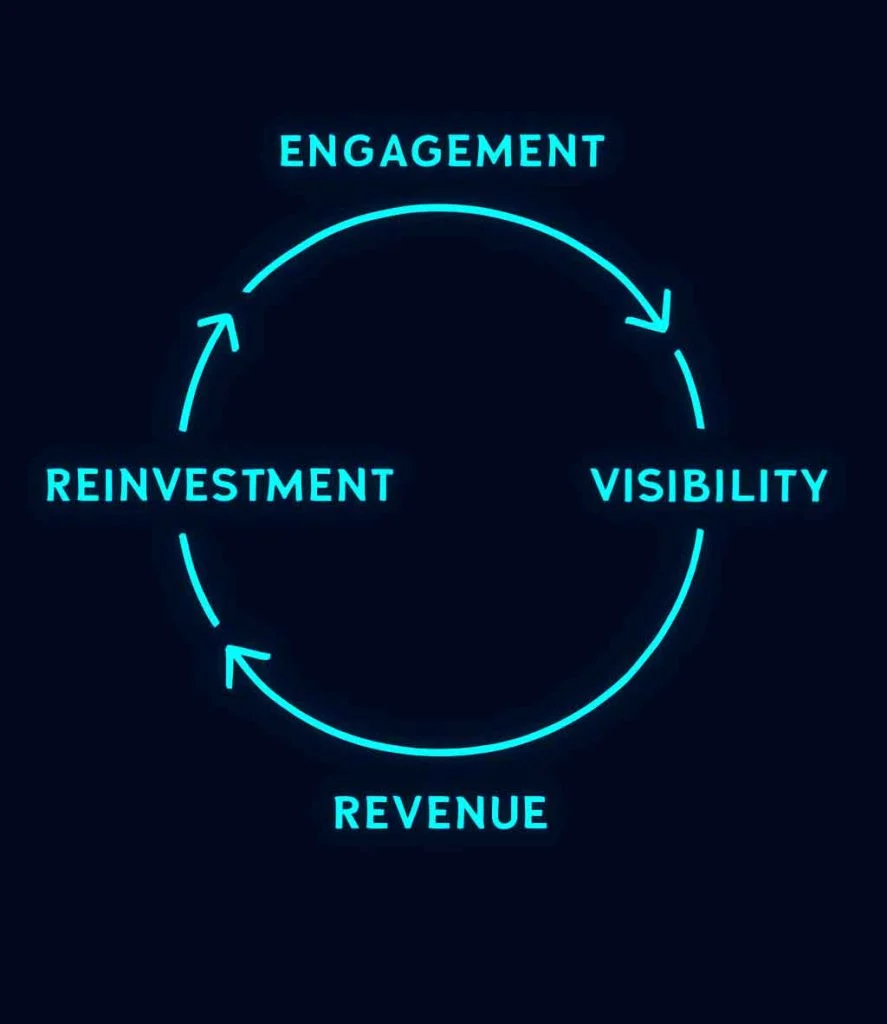
Marketplace concentration accelerates through layered feedback loops.
A simplified structure looks like this:
- Higher engagement rate
- Increased visibility allocation
- Greater impression volume
- Higher conversion count
- Stronger performance signals
- Increased ranking confidence
Each cycle increases probability weight.
Probability weight increases distribution share.
Distribution share increases revenue.
Revenue enables reinvestment.
Reinvestment improves listing quality.
Improved quality strengthens engagement signals.
The loop compounds.
Why Small Differences Matter
In probabilistic systems, small performance differences have nonlinear consequences.
If Seller A converts at 5 percent and Seller B converts at 4.5 percent, the gap appears minor.
However:
Higher conversion → more revenue
More revenue → better fulfillment
Better fulfillment → stronger reviews
Stronger reviews → higher conversion
The difference widens over time.
Nonlinear amplification turns marginal advantages into structural dominance.
This dynamic is often described as winner-take-most.
Not winner-take-all.
But winner-take-most.
Engagement Clustering
Algorithms optimize for predicted buyer satisfaction.
Predicted satisfaction is inferred from:
- Historical conversion
- Repeat purchases
- Review ratings
- Complaint frequency
- Return rates
If a listing consistently satisfies buyers, the algorithm increases exposure.
Exposure concentrates around reliability.
Reliability becomes a competitive moat.
Moats reduce new entrant probability.
Probability reduction strengthens concentration.
This reliability layer mirrors retention-based economic stability in subscription systems. Historical performance informs future allocation decisions.
Concentration becomes data-backed.
Data-backed allocation appears rational.
Rational allocation compounds dominance.
Seller Adaptation Behavior
As concentration emerges, sellers adapt strategically.
Common adaptation patterns include:
- Optimizing product titles for search algorithms
- Investing in paid placement
- Encouraging review acceleration
- Refining pricing psychology
- Increasing fulfillment speed
Optimization behavior is rational.
If algorithmic exposure determines survival, adaptation becomes mandatory.
However, adaptation does not eliminate concentration.
It often intensifies competition for visibility.
Higher competition strengthens ranking thresholds.
Higher thresholds increase entry difficulty.
Entry difficulty stabilizes incumbent advantage.
Organic vs Paid Amplification
Most digital marketplaces incorporate sponsored visibility.
Sponsored placement introduces a paid amplification layer.
Organic ranking reflects engagement-weighted probability.
Paid placement introduces bidding-based visibility allocation.
Paid visibility increases impressions regardless of organic ranking.
If sponsored listings convert well, they may improve organic ranking over time.
Thus, paid amplification can influence organic positioning.
This interaction resembles the compounding exposure effect seen in ranking systems. Paid visibility may accelerate data accumulation that strengthens future organic performance.
Visibility becomes both competitive and purchasable.
Purchasable amplification increases revenue for the platform.
Revenue incentives support the integration of paid exposure.
The Revenue Alignment Principle
Marketplace platforms generate revenue through:
- Transaction fees
- Sponsored placement
- Subscription seller tiers
- Advertising services
Concentration may indirectly increase platform revenue.
High-performing sellers generate more transactions.
More transactions increase fee revenue.
Sponsored competition increases advertising revenue.
Subscription tiers increase predictable income.
Platform incentives align with performance amplification.
However, extreme concentration may reduce seller diversity.
Reduced diversity can limit buyer choice.
Balance becomes necessary.
The Cost Structure Advantage
High-performing sellers often benefit from scale efficiencies.
Scale efficiencies may include:
- Lower production cost per unit
- Better logistics rates
- Higher advertising budgets
- Advanced analytics investment
Lower cost allows competitive pricing.
Competitive pricing increases conversion.
Conversion increases visibility.
Visibility increases volume.
Volume lowers cost further.
Cost advantage reinforces algorithmic advantage.
Data as Competitive Asset
In digital marketplaces, behavioral data accumulates unevenly.
High-volume sellers generate:
- More buyer feedback
- More conversion insights
- More A/B testing opportunities
- More demand forecasting accuracy
Data improves optimization precision.
Optimization precision improves performance signals.
Performance signals strengthen ranking confidence.
Confidence increases exposure allocation.
Data accumulation accelerates concentration.
Structural Dominance Over Time
Marketplace concentration does not necessarily create a legal monopoly.
It often creates structural dominance.
Structural dominance occurs when:
- A small group of sellers controls disproportionate transaction volume
- Visibility is predictably allocated toward established nodes
- Buyer trust clusters around familiar listings
- Entry success probability declines for new participants
Dominance emerges gradually.
It stabilizes through repeated reinforcement.
Reinforcement transforms early advantage into durable advantage.
Durability reduces volatility.
Reduced volatility increases predictability.
Predictability benefits both buyers and platforms.
Network Lock-In Dynamics
Digital marketplaces benefit from two-sided network effects.
Buyers attract sellers.
Sellers attract buyers.
As volume grows, platform utility increases.
However, lock-in intensifies as network density rises.
For buyers:
- Familiar interface reduces search friction
- Stored payment data simplifies checkout
- Review history increases confidence
- Personalized recommendations improve relevance
For sellers:
- Established review base strengthens conversion
- Historical data improves forecasting
- Existing customer base increases repeat purchases
- Advertising tools enhance performance predictability
Lock-in reduces migration probability.
Reduced migration stabilizes concentration.
Multi-Homing Behavior
Some sellers and buyers participate across multiple marketplaces.
This behavior is known as multi-homing.
Multi-homing can reduce concentration pressure by:
- Distributing listings across platforms
- Diversifying revenue sources
- Expanding buyer reach
However, multi-homing introduces complexity.
Managing multiple platforms requires:
- Inventory synchronization
- Pricing consistency
- Review management
- Advertising budget allocation
High-performing sellers often optimize selectively.
Selective optimization can reinforce dominance within one platform rather than distribute it evenly.
Thus, multi-homing does not necessarily eliminate concentration.
It may stratify it.
Switching Cost in Marketplaces
Switching cost exists on both sides of marketplace ecosystems.
Buyer switching cost may include:
- Learning new interface
- Trust uncertainty
- Loss of saved preferences
- Disruption of loyalty benefits
Seller switching cost may include:
- Rebuilding review credibility
- Reacquiring ranking position
- Reinvesting in advertising
- Migrating operational workflows
Higher switching cost reduces ecosystem fluidity.
Reduced fluidity stabilizes concentration.
Stability enhances predictability.
Predictability supports long-term revenue planning.
Platform Equilibrium vs Monopoly Myth
Concentration does not automatically equal monopoly.
A monopoly implies absence of viable alternatives.
Digital marketplaces often coexist with competitors.
However, engagement-weighted ranking and network effects can produce uneven distribution within each platform.
Concentration can exist even in competitive environments.
Each marketplace may display its own internal hierarchy.
Internal hierarchy reflects algorithmic and economic dynamics rather than absolute market control.
This internal pattern mirrors digital hierarchy formation observed across ranking-based systems. Concentration is a structural outcome of engagement optimization.
The myth of monopoly oversimplifies the phenomenon.
The mechanism is probabilistic amplification.
Competitive Pressure and Concentration Stability
Competition can influence concentration intensity.
Platforms may:
- Adjust ranking algorithms
- Introduce fairness weighting
- Promote new sellers temporarily
- Cap excessive sponsored dominance
These adjustments can moderate concentration without eliminating it.
Total equality would reduce engagement efficiency.
Total dominance would reduce competitive diversity.
Platforms therefore operate within tolerance thresholds.
Tolerance thresholds shift based on:
- User satisfaction
- Regulatory scrutiny
- Revenue performance
- Competitive pressure
Equilibrium remains dynamic.
Economic Signaling and Authority
High-performing marketplace nodes often become perceived authorities.
Authority perception increases:
- Buyer trust
- Conversion likelihood
- Brand recognition
- Repeat purchase probability
Authority strengthens exposure probability.
Exposure strengthens authority.
This circular reinforcement stabilizes market leaders.
Leadership may appear permanent, yet it remains contingent on continued performance alignment.
Sustainability Limits of Concentration
Marketplace concentration can increase efficiency.
However, extreme concentration introduces structural risks.
If too few sellers dominate:
- Buyer choice perception declines
- Price competition weakens
- Innovation incentives reduce
- Platform dependency increases
Reduced diversity can decrease long-term ecosystem resilience.
Resilient systems require moderate competition.
Competition stimulates:
- Product improvement
- Pricing efficiency
- Service quality
- Innovation cycles
Platforms therefore monitor concentration levels indirectly through engagement and satisfaction metrics.
Excessive dominance may reduce marketplace vitality.
Balance becomes necessary for sustainability.
Trust Equilibrium in Digital Markets
Trust operates as a stabilizing force.
High-performing sellers often accumulate trust through:
- Review consistency
- Fulfillment reliability
- Transparent policies
- Responsive service
Trust strengthens conversion probability.
Conversion strengthens visibility.
Visibility reinforces trust.
However, if trust becomes overly centralized, new entrants face steep credibility barriers.
Barriers reduce entry success probability.
Lower entry success reduces ecosystem renewal.
Renewal is essential for long-term vibrancy.
Marketplace sustainability depends on balancing trust accumulation with entry opportunity.
Regulatory Influence
Regulatory bodies increasingly examine digital marketplaces for:
- Fair competition practices
- Transparent ranking policies
- Advertising disclosure
- Data usage governance
- Seller treatment fairness
Regulation does not eliminate algorithmic concentration.
However, it may influence:
- Sponsored visibility labeling
- Ranking transparency requirements
- Anti-competitive conduct limits
- Data access policies
Regulatory constraints reshape how concentration manifests rather than preventing its structural emergence.
Optimization boundaries shift.
The underlying probability logic remains.
Saturation Risk and Platform Fatigue
As marketplaces mature, saturation effects may appear.
Saturation can manifest through:
- High seller density
- Advertising inflation
- Reduced organic reach
- Buyer attention fatigue
When organic reach declines sharply, sellers increase paid amplification.
Paid amplification increases cost.
Rising cost reduces profitability for mid-tier participants.
Profit compression may:
- Force seller exit
- Increase dominance of large players
- Reduce marketplace diversity
Saturation intensifies concentration unless counterbalanced by innovation or structural adjustment.
Long-Term Structural Equilibrium

Sustainable digital marketplaces often exhibit:
- Concentration at the top tier
- Competitive activity in mid-tier
- Continuous entry and exit at lower tiers
- Controlled sponsored visibility layers
- Adaptive ranking adjustments
Total equality is unlikely.
Total dominance is unstable.
The long-term equilibrium tends toward structured hierarchy with dynamic movement at the margins.
This structure resembles other ranking-driven ecosystems.
This reflects engagement-driven hierarchy formation seen across digital platforms. Concentration is an emergent pattern of optimization under scarcity.
Scarcity of attention limits distribution.
Limited distribution intensifies competition.
Competition amplifies performance gaps.
Performance gaps compound into hierarchy.
Structural Conclusion
Digital marketplaces become concentrated because:
- Engagement-weighted ranking amplifies performance
- Network effects reinforce visibility clustering
- Reviews compound trust signals
- Switching costs stabilize incumbents
- Data accumulation strengthens prediction accuracy
- Paid amplification integrates with organic distribution
- Revenue incentives align with high-performance nodes
Concentration is not necessarily imposed.
It is a statistical consequence of optimization under finite attention and probabilistic allocation.
Understanding this mechanism clarifies why:
- Open entry does not equal equal opportunity
- High-performing nodes grow disproportionately
- Visibility becomes both competitive and purchasable
- Hierarchies form without explicit favoritism
Marketplace concentration is structural.
It emerges when algorithms reward predictability, and predictability increases engagement likelihood.
FAQs
Why do digital marketplaces become concentrated?
Digital marketplaces become concentrated because engagement-weighted ranking systems amplify high-performing sellers, and network effects reinforce visibility clustering over time.
Does concentration mean monopoly?
Not necessarily. Concentration can exist within competitive markets due to probabilistic ranking systems and network effects without eliminating alternative platforms.
How do reviews influence marketplace concentration?
Reviews strengthen conversion probability and ranking confidence. Increased exposure generates more reviews, reinforcing visibility clustering through compounding feedback loops.
Can marketplaces reduce concentration?
Marketplaces may introduce fairness weighting or exposure adjustments, but complete equality may reduce engagement efficiency. Most systems operate within a dynamic balance.