



The Resource You Don’t See
In traditional economies, scarcity centered around physical goods.
Oil. Land. Labor. Capital.
In digital economies, scarcity shifted.
The rare resource is no longer material.
It is attention.
Every notification, feed refresh, autoplay video, swipe mechanic, and algorithmic recommendation is part of a coordinated competition for time. Platforms do not merely offer services. They compete for sustained engagement. Engagement translates into data. Data translates into prediction accuracy. Prediction accuracy translates into monetization.
Time is converted into revenue.
This transformation did not occur loudly. It emerged gradually as digital infrastructure expanded. Once smartphones became constant companions, platforms moved from occasional destinations to continuous environments.
When environments become continuous, competition intensifies.
Defining the Attention Economy
The attention economy describes a system where human focus becomes the primary economic asset.
In this model:
- User time is scarce.
- Platform supply is infinite.
- Monetization depends on engagement duration.
The shift from product-based economics to attention-based economics occurred when digital distribution removed production limits.
In physical markets, supply was constrained by manufacturing and logistics. In digital markets, content can be replicated instantly at negligible cost. When supply expands infinitely, demand does not.
Human attention remains finite.
A person has:
- 24 hours per day
- Limited cognitive bandwidth
- Limited emotional processing capacity
This imbalance creates a competition field.
Platforms must compete not for purchases alone, but for minutes.
Engagement as the Primary Metric
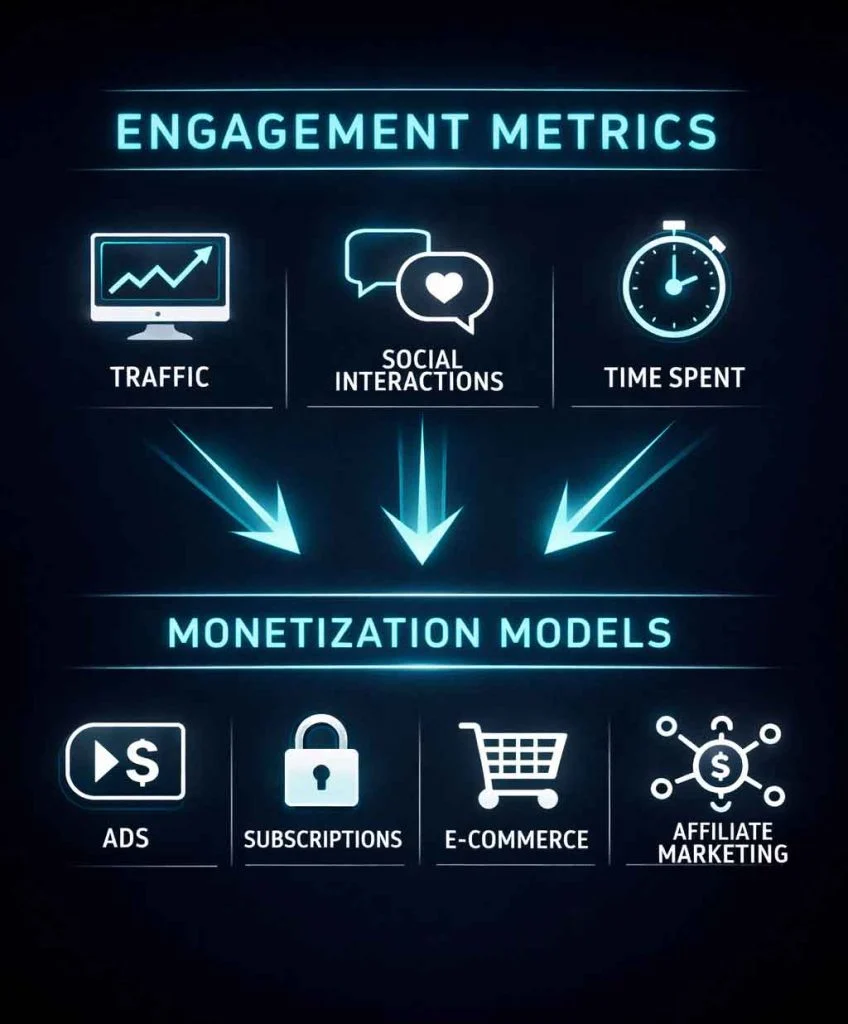
In traditional retail, success was measured by units sold.
In digital platforms, success is measured by:
- Daily active users
- Session length
- Scroll depth
- Return frequency
- Notification response rate
These metrics reflect attention capture.
Revenue models often sit downstream:
- Advertising impressions
- Subscription conversion
- In-app purchases
- Data licensing
But none of those activate without sustained engagement.
Engagement is upstream. Revenue is downstream.
From Information Economy to Engagement Economy
Early internet models focused on information access. Search engines prioritized retrieval accuracy. Forums prioritized community exchange.
As social media expanded, competition intensified.
The objective shifted from providing information to retaining presence.
Modern digital systems, including algorithmic incentive structures in dating platforms, reflect this transition from information delivery to engagement retention. Once retention becomes the objective, design decisions shift accordingly.
This shift changes interface philosophy.
Instead of asking:
How do we deliver value efficiently?
Platforms ask:
How do we extend session duration?
Interface as Strategy
Attention capture is rarely achieved through explicit demand. It is achieved through subtle interface mechanics.
Common engagement strategies include:
- Infinite scroll
- Autoplay media
- Algorithmic personalization
- Variable reward notification timing
- Gamified interaction loops
These mechanics are not random features. They are strategic responses to scarcity.
Infinite scroll removes stopping cues.
Autoplay removes decision friction.
Personalization increases relevance probability.
Variable reward timing increases return likelihood.
Gamification increases participation frequency.
Each mechanic slightly reduces the mental cost of staying.
Reduced cost increases duration.
The Illusion of Relevance
Personalization algorithms adjust content based on past behavior.
If a user lingers on certain topics, similar content appears more frequently.
This produces a feedback loop:
- User interacts with content
- Algorithm infers preference
- Similar content is prioritized
- User sees more of what aligns with prior behavior
- Engagement increases
Engagement strengthens confidence in prediction.
Confidence increases content concentration.
Concentration reduces exposure diversity.
Reduced diversity can intensify focus, even when the user did not consciously request it.
Personalization therefore increases attention density.
Density increases time-on-platform.
Notification Engineering
Notifications operate as re-entry triggers.
Well-timed notifications can:
- Interrupt competing activities
- Redirect focus
- Signal urgency
- Reinforce relevance
The effectiveness of notifications depends on behavioral prediction models.
Platforms test:
- Time of day
- Frequency
- Message framing
- Emotional language
Even small percentage improvements in notification click-through rates scale significantly across millions of users.
Notification engineering reflects a simple principle:
Interruption, when optimized, becomes invitation.
Why Time Equals Money
Advertising models rely on exposure.
More time equals more impressions.
More impressions equal higher advertising inventory.
Higher inventory equals higher revenue potential.
Subscription models rely on perceived value.
Longer time spent increases perceived utility.
In-app purchases rely on engagement triggers.
Frequent interaction increases purchase probability.
Across models, time is the foundation.
Time precedes transaction.
The Cognitive Cost of Competition
Competition for attention does not remain isolated.
When multiple platforms optimize simultaneously, the user becomes the battleground.
Each platform:
- Refines personalization
- Improves recommendation speed
- Adjusts retention tactics
- Minimizes friction
The cumulative effect increases cognitive load.
However, because each platform optimizes independently, users rarely perceive systemic pressure. They experience fragmented distraction rather than coordinated competition.
Competition occurs at the structural level.
Users feel only the surface effects.
Attention as Infrastructure
Once attention capture becomes embedded in daily routines, it transforms into infrastructure.
Morning routines include:
- Notification checks
- Feed scanning
- Quick engagement bursts
Evening routines include:
- Passive scrolling
- Short video consumption
- Swipe-based interaction
Infrastructure feels normal because it becomes habitual.
Habitual systems are difficult to question.
But infrastructure defines behavioral boundaries.
Not Manipulation, Optimization
It is important to remain precise.
Platforms do not inherently seek to manipulate. They seek to optimize engagement metrics.
Optimization is data-driven.
Data-driven iteration improves retention.
Retention increases valuation.
Valuation sustains growth.
The attention economy emerges from incentive alignment, not conspiracy.
Understanding that alignment clarifies design logic.
Repetition as Reinforcement
Repetition changes baseline expectations.
When users interact with digital platforms dozens or hundreds of times per day, the brain adapts to micro-reward cycles. Each scroll, swipe, like, or notification becomes a small feedback event. Most of these events are neutral. Some are rewarding. A few are highly stimulating.
Intermittent rewards are particularly powerful.
If every interaction produced identical feedback, engagement would plateau. Instead, digital systems distribute outcomes unpredictably. A viral post, an unexpected message, a spike in likes, a trending topic recommendation – these events occur irregularly.
Irregular reinforcement sustains anticipation.
Anticipation sustains return frequency.
Over time, repetition conditions users to check platforms reflexively, not necessarily because content is required, but because uncertainty persists.
This is not unique to social media. The same dynamic exists in swipe-based dating platforms and short-form video feeds. The underlying principle remains consistent: unpredictable reward encourages sustained engagement.
When All Platforms Optimize Simultaneously
No platform operates in isolation.
When one platform increases engagement through improved recommendation models, others respond. The competitive field intensifies.
Consider:
- If one video platform increases retention by improving autoplay accuracy, competing platforms must match or exceed that retention rate.
- If one messaging app refines notification timing for higher click-through rates, others experiment with similar optimization.
- If one dating app improves match prediction, others adjust exposure algorithms to maintain competitiveness.
This escalation dynamic produces a continuous innovation loop.
Users rarely notice escalation in real time. Instead, they experience gradual increases in content relevance, speed, and stimulation.
Escalation increases baseline expectations.
Higher expectations raise competitive thresholds.
Platforms must continuously refine engagement systems to avoid user migration.
A Zero-Sum Constraint
Time remains fixed.
An individual cannot expand daily cognitive bandwidth beyond certain biological limits. Therefore, increased time spent on one platform necessarily reduces time available elsewhere.
Attention allocation becomes zero-sum.
If short-form video consumption increases by one hour per day, that hour must come from:
- Long-form reading
- Offline social interaction
- Physical activities
- Other digital services
The competition is not just platform vs platform. It is platform vs alternative activity.
This dynamic influences design decisions.
Shorter content units reduce entry friction. Rapid consumption cycles reduce commitment barriers. Fragmented content increases perceived productivity even when depth declines.
Micro-consumption feels efficient.
Efficiency sustains retention.
Attention Flows Toward Dominance
In economic systems, network effects amplify dominance.
Platforms with larger user bases generate more data. More data improves prediction models. Better predictions increase relevance. Increased relevance attracts more users.
This positive feedback loop strengthens incumbents.
This mirrors exposure asymmetry in ranking environments observed within digital dating systems. Once attention begins clustering around dominant nodes, algorithms amplify high-engagement profiles because predictability improves.
Market concentration increases bargaining power.
When platforms dominate attention, they influence:
- Advertising pricing
- Content distribution standards
- Visibility algorithms
- Data policy norms
Dominance reshapes ecosystem rules.
The Rise of Short-Form Dominance
Short-form content has emerged as a dominant engagement model.
Why?
Because short-form reduces cognitive commitment.
A 15-second video:
- Requires minimal investment
- Offers quick feedback
- Encourages rapid consumption
Completion rates increase when duration decreases.
Higher completion rates signal strong engagement to algorithms.
Strong engagement signals increase distribution probability.
Distribution probability drives content production incentives.
Creators adapt to short formats because distribution favors them.
Platforms amplify short content because it increases session length through repetition.
Short-form dominance reflects alignment between creator incentives and platform metrics.
Speed as Competitive Advantage
Speed matters in the attention economy.
Recommendation latency reduction improves perceived responsiveness.
If content loads instantly, friction disappears.
If recommendations adapt within seconds, personalization feels intuitive.
Reduced latency increases immersion.
Immersion increases duration.
Platforms invest heavily in:
- Real-time data processing
- Edge computing
- Behavioral inference acceleration
Speed is not cosmetic. It is structural.
When speed increases, switching costs decrease.
Users move fluidly between content pieces without interruption.
Fluidity extends session duration.
Emotional Intensity as Retention Lever
High emotional content often generates higher engagement.
This does not imply deliberate amplification of extreme content. It reflects engagement probability.
Content that triggers strong reaction:
- Encourages comments
- Encourages sharing
- Encourages repeat viewing
Algorithms interpret interaction density as relevance.
Relevance increases distribution.
Distribution increases exposure.
Exposure increases reaction volume.
The cycle compounds.
This mechanism operates across:
- News
- Social commentary
- Entertainment
- Personal storytelling
Intensity often outperforms neutrality in raw engagement metrics.
Platforms must balance engagement with moderation standards.
Balancing remains complex because engagement signals are quantitative, while harm assessment is qualitative.
Cross-Platform Behavior Transfer
Behavior learned on one platform transfers to others.
If users become accustomed to:
- Fast scrolling
- Swipe-based decisions
- Short-form dominance
- Notification reflex checking
These patterns carry across digital environments.
This transfer effect explains why engagement mechanics converge across platforms.
Dating apps adopted swipe mechanics popularized in other contexts.
Social media platforms adopted short-form features pioneered elsewhere.
Feature convergence is not coincidence. It is response to user conditioning.
Conditioning creates expectation.
Expectation pressures design.
Converting Time Into Revenue
Attention alone does not generate revenue. It becomes valuable when paired with monetization architecture.
Digital platforms typically operate under one or more of the following models:
- Advertising-based
- Subscription-based
- Freemium upgrade
- Transaction-based marketplace
- Data-enhanced enterprise services
Regardless of the model, sustained engagement increases monetization probability.
Advertising models require impressions.
Subscription models require perceived value.
Freemium models require conversion triggers.
Marketplace models require transaction density.
All rely on user time.
The architecture therefore aligns incentives:
More time → more data → better targeting → higher revenue yield.
Time becomes the input variable for revenue optimization.
Inventory and Precision
Advertising remains one of the most dominant monetization pathways in the attention economy.
The value of advertising inventory depends on:
- Audience size
- Engagement depth
- Targeting precision
- Conversion likelihood
Precision increases as behavioral data accumulates.
If a platform understands:
- Content preference
- Purchase patterns
- Time-of-day activity
- Interaction frequency
It can offer more granular targeting.
Granular targeting increases advertiser willingness to pay.
Higher advertiser bids increase revenue per impression.
Revenue per impression justifies investment in further engagement optimization.
The cycle compounds.
Data as a Secondary Currency
Attention generates data.
Data improves prediction.
Improved prediction improves targeting.
Targeting increases monetization efficiency.
Data therefore functions as a secondary currency within the ecosystem.
The more users interact, the more predictive power the system gains.
Prediction reduces uncertainty.
Reduced uncertainty increases advertiser confidence.
Confidence increases platform valuation.
The accumulation of behavioral data transforms platforms into predictive engines rather than simple content hosts.
Anticipating Behavior
Modern attention-based platforms rely heavily on predictive modeling.
Models analyze:
- Scroll velocity
- Pause duration
- Interaction depth
- Content sequence patterns
- Revisit frequency
From these signals, systems estimate:
- Probability of continued engagement
- Probability of conversion
- Probability of churn
This predictive logic also appears in predictive compatibility calibration systems used in digital dating environments. The objective is not certainty, but increased probability alignment.
Prediction allows platforms to preempt user decisions.
If a user is likely to leave, a notification may trigger.
If a user is likely to convert, a premium feature prompt may surface.
Anticipation reduces friction.
Reduced friction increases engagement continuity.
Efficiency vs Depth
Optimization for attention can produce trade-offs.
When short-form content dominates, depth may decline.
When personalization intensifies, exposure diversity may shrink.
When engagement metrics determine visibility, sensational content may outperform neutral analysis.
These trade-offs are not intentional outcomes. They are emergent properties of metric-driven systems.
If a metric measures duration, systems optimize duration.
If a metric measures clicks, systems optimize clicks.
Metrics shape behavior.
Behavior shapes culture.
The challenge lies not in eliminating optimization, but in aligning metrics with long-term value rather than short-term stimulation.
Retention as Asset
Not all attention economies rely purely on advertising.
Subscription platforms monetize through:
- Monthly recurring fees
- Premium feature access
- Ad-free experiences
- Exclusive content
In these systems, attention signals perceived value.
If users disengage, cancellation risk increases.
Retention metrics become critical.
Hybrid models combine advertising and subscription.
Freemium models use engagement to upsell premium tiers.
The common denominator remains engagement duration.
Engagement duration predicts revenue stability.
Attention as Financial Multiplier
Investors evaluate platforms based on:
- Active user growth
- Retention rates
- Monetization efficiency
- Average revenue per user
- Engagement trends
High engagement increases projected lifetime value per user.
Lifetime value projections influence valuation multiples.
Valuation multiples influence capital access.
Capital access funds further engagement innovation.
The financial layer reinforces the attention layer.
This is why engagement systems continue evolving rapidly.
Balancing Optimization
As platforms grow, regulatory attention increases.
Concerns may include:
- Data privacy
- Algorithm transparency
- Manipulative design patterns
- Youth engagement exposure
- Advertising disclosures
Regulatory frameworks may impose constraints on optimization.
However, optimization itself remains central to digital economics.
The structural tension lies between:
- Revenue maximization
- User autonomy
- Societal impact
Balancing these factors requires careful metric design rather than elimination of engagement systems.
The Strategic Position of the User
Within the attention economy, users function simultaneously as:
- Consumers
- Data generators
- Product inventory for advertisers
- Engagement contributors
This dual role complicates perception.
Users seek utility and entertainment.
Platforms seek retention and monetization.
Alignment persists when perceived value exceeds perceived cost.
If cost outweighs value, churn increases.
Churn pressures redesign.
Redesign reshapes incentives.
From Platform Habit to Cultural Baseline
The attention economy does not remain confined to devices.
When interaction patterns repeat across years, they normalize.
Normalization influences:
- Communication pacing
- Content expectations
- Social validation cues
- Information processing style
- Decision speed
If rapid scrolling becomes routine, sustained reading requires deliberate effort.
If short-form dominates, long-form becomes specialized.
If notification interruption becomes constant, uninterrupted focus becomes rare.
These shifts do not eliminate alternative behaviors. They alter baseline probability.
Culture adapts gradually.
What once felt novel becomes expected.
What once required conscious action becomes reflex.
Users and Platforms Co-Evolve
The attention economy is not a one-sided force.
Users adapt.
Some develop:
- Notification boundaries
- Screen time limits
- Platform diversification habits
- Long-form consumption preferences
Platforms also adapt to user fatigue signals.
If engagement declines, redesign occurs.
If user backlash rises, moderation increases.
This creates an adaptive equilibrium.
Optimization continues, but user expectations also mature.
The system remains dynamic rather than static.
The Next Competitive Layer

Artificial intelligence intensifies the attention economy.
AI enables:
- Real-time behavioral inference
- Hyper-personalized recommendations
- Predictive notification timing
- Dynamic content re-ranking
- Automated A/B testing at scale
As models grow more sophisticated, prediction error decreases.
Lower prediction error increases engagement probability.
Higher engagement probability strengthens retention.
AI does not create the attention economy. It accelerates it.
The competition shifts from platform vs platform to model vs model.
Model precision becomes competitive advantage.
Ethical Design Considerations
Ethical discussions often focus on:
- Addictive patterns
- Data privacy
- Youth exposure
- Algorithm transparency
These concerns highlight the tension between optimization and responsibility.
Optimization aims at measurable engagement.
Responsibility considers long-term well-being and social stability.
Balancing these requires metric refinement rather than elimination of engagement systems.
If metrics incorporate quality signals, systems adjust accordingly.
The challenge lies in defining quality quantitatively.
Incentives Shape Interaction
The attention economy is not driven by intention alone.
It is driven by incentives.
When incentives reward:
- Longer sessions
- Higher click-through rates
- Frequent returns
- Rapid interaction
These behaviors increase.
When incentives reward depth and meaningful engagement, those behaviors would increase instead.
Digital systems follow measurable signals.
Measurable signals define success.
Success metrics define iteration.
Iteration defines environment.
Environment defines habit.
Habit influences culture.
A Balanced Conclusion
The attention economy represents a structural shift in digital value creation.
Scarcity moved from goods to focus.
Focus became monetizable.
Monetization required engagement.
Engagement required optimization.
Optimization required data.
Data required participation.
Participation required time.
Time remains finite.
Competition therefore intensifies.
The system is not inherently adversarial.
It is economically aligned.
Understanding the mechanism clarifies the outcome.
When we examine digital platforms through structural lens rather than emotional reaction, we see a coherent economic model responding to scarcity constraints.
The attention economy is not an anomaly.
It is the logical extension of digital distribution under finite human bandwidth.
FAQs
What is the attention economy?
The attention economy describes a system where human focus and time become scarce economic resources. Digital platforms compete to capture and retain user attention because engagement drives monetization.
Why do digital platforms optimize for engagement?
Engagement metrics such as session length and return frequency correlate with advertising revenue, subscription retention, and data collection efficiency. Optimization increases monetization stability.
How does AI influence the attention economy?
AI systems analyze behavioral signals to personalize content, predict engagement probability, and optimize notification timing, increasing retention and platform competitiveness.
Is the attention economy inherently harmful?
The attention economy is structurally driven by incentive alignment rather than intent. Its impact depends on metric design, user behavior, and regulatory frameworks.