
Modern smartphones have become so capable that many people use them for communication, photography, navigation, entertainment, banking, shopping, work and even artificial intelligence every single day. Despite this, relatively few owners understand what actually happens inside the device they carry everywhere. Terms such as processor, RAM, storage, refresh rate, AI engine, modem and battery health appear constantly in advertisements, yet they often feel disconnected from the real experience of owning and using a phone.
That disconnect creates unnecessary confusion. Buyers may spend hundreds of dollars on specifications they never fully benefit from while overlooking features that would have a much greater impact on their daily lives. Others may believe their phone has become obsolete when the real problem is simply an ageing battery, limited storage or software that needs attention.
Understanding the basics of smartphone technology does not require an engineering degree. Once you know how the major components work together, comparing devices becomes much easier, troubleshooting common problems becomes less intimidating and purchasing decisions become more logical.
This guide explains smartphones from the ground up. Rather than focusing on one manufacturer or operating system, it explores the core technologies found inside nearly every modern smartphone and shows how those technologies influence performance, battery life, cameras, connectivity, security and long-term ownership.
By the end of this guide, you should understand not only what each major smartphone component does, but also which specifications genuinely matter and which marketing numbers deserve less attention.
What Is a Smartphone?
A smartphone is much more than a mobile telephone.
It is a compact computer containing a processor, memory, storage, cameras, wireless communication systems, multiple sensors, artificial intelligence hardware and a rechargeable battery, all integrated into a device that fits comfortably inside a pocket.
Unlike traditional mobile phones that primarily handled calls and text messages, smartphones combine several technologies into one system capable of running thousands of applications. They constantly receive information from cameras, microphones, GPS satellites, Wi-Fi networks, cellular towers, motion sensors and touch input before processing that information almost instantly.
Every action you perform follows a similar sequence.
You touch the display.
The touchscreen detects your finger.
The processor interprets the command.
Memory temporarily stores the required information.
The operating system decides which resources are needed.
The graphics processor creates the visual output.
The display updates what you see.
The speaker, vibration motor or wireless connection may respond at the same time.
All of these events usually happen within milliseconds, making the interaction feel immediate even though many individual components are working together.
A smartphone should therefore be viewed as a complete ecosystem rather than a collection of independent parts. The processor affects battery life. The operating system influences memory management. Camera quality depends on both hardware and software. Artificial intelligence now assists everything from photography to voice recognition and battery optimisation.
Understanding this relationship between components is the first step toward understanding smartphones themselves.
Smartphones Continue to Evolve Beyond Communication
Early smartphones focused primarily on bringing internet access and applications to a handheld device. Today’s models perform tasks that previously required dedicated cameras, navigation systems, desktop computers and even some professional creative equipment.
Modern smartphones can:
- Capture professional-quality photographs and video.
- Translate conversations between different languages.
- Edit images using artificial intelligence.
- Recognise objects through the camera.
- Process documents.
- Authenticate secure payments.
- Monitor health and fitness.
- Connect with smart-home devices.
- Control vehicles.
- Replace physical wallets.
- Run advanced games using graphics once limited to dedicated consoles.
These capabilities continue expanding because smartphone hardware has become dramatically more powerful while software has become significantly more intelligent.
The phone you carry today is not simply faster than devices from several years ago. It is fundamentally capable of solving a much wider variety of problems.
Why Understanding Phone Basics Matters
Many technology articles immediately compare processors, benchmark scores or camera megapixels without first explaining why those specifications exist.
That often leads buyers to focus on numbers instead of outcomes.
For example, someone may believe they need the fastest processor available when their actual priority is better battery life. Another buyer may pay extra for a 200-megapixel camera without realising that autofocus performance and image processing will influence everyday photography far more than resolution alone.
Understanding smartphone fundamentals helps answer practical questions such as:
- Why does one phone feel faster than another?
- Why do two phones with identical battery capacities last different lengths of time?
- Why can a phone become hot during certain activities?
- What actually determines camera quality?
- Why do software updates sometimes improve battery life?
- How does artificial intelligence operate on a smartphone?
- Which specifications are worth paying for?
These are the questions that matter during real ownership.
Once you understand the foundations, every review, buying guide and troubleshooting article becomes much easier to interpret.
Once you understand how smartphones work, choosing the right device becomes much easier, and our comprehensive phone buying guide explains how to match specifications with your real daily needs.
A Smartphone Is a Team of Components, Not One Powerful Part
One of the biggest misconceptions is that a smartphone’s performance depends almost entirely on its processor.
In reality, every major component depends on the others.
Imagine a professional kitchen.
The chef cannot prepare meals efficiently without assistants, ingredients, equipment and organisation. Even the most talented chef becomes limited if the refrigerator is empty or the cooking equipment is inadequate.
A smartphone operates in much the same way.
The processor performs calculations.
RAM keeps active information immediately available.
Storage permanently holds applications and files.
The operating system coordinates every task.
The graphics processor renders visual information.
The battery supplies energy.
The modem communicates with cellular networks.
The cameras capture visual information.
Artificial intelligence hardware accelerates specialised calculations.
Each part contributes to the final experience.
If one component becomes a bottleneck, the entire phone may feel slower or less responsive even when every other component is excellent.
This is why experienced reviewers evaluate smartphones as complete systems rather than isolated specifications.
The next sections explain each of these major components in detail before showing how they work together to create the experience you notice every day.
The Processor – The Brain That Coordinates Everything
When people compare smartphones, the processor is often the first specification they notice. Manufacturers proudly advertise faster chips, more powerful AI engines and increasingly impressive benchmark scores, creating the impression that the processor alone determines whether a phone feels fast or slow. While the processor is undeniably one of the most important components inside a smartphone, thinking of it as the only component that matters oversimplifies how modern phones actually work.
A better way to understand the processor is to imagine it as the central decision-maker responsible for coordinating thousands of tasks every second. Every time you unlock your phone, open an application, take a photograph, stream a video, navigate with maps or send a message, the processor receives information, decides what needs to happen next and directs other hardware components to complete the task. Without this constant coordination, even the most advanced camera, display or battery would have no meaningful way to function together.
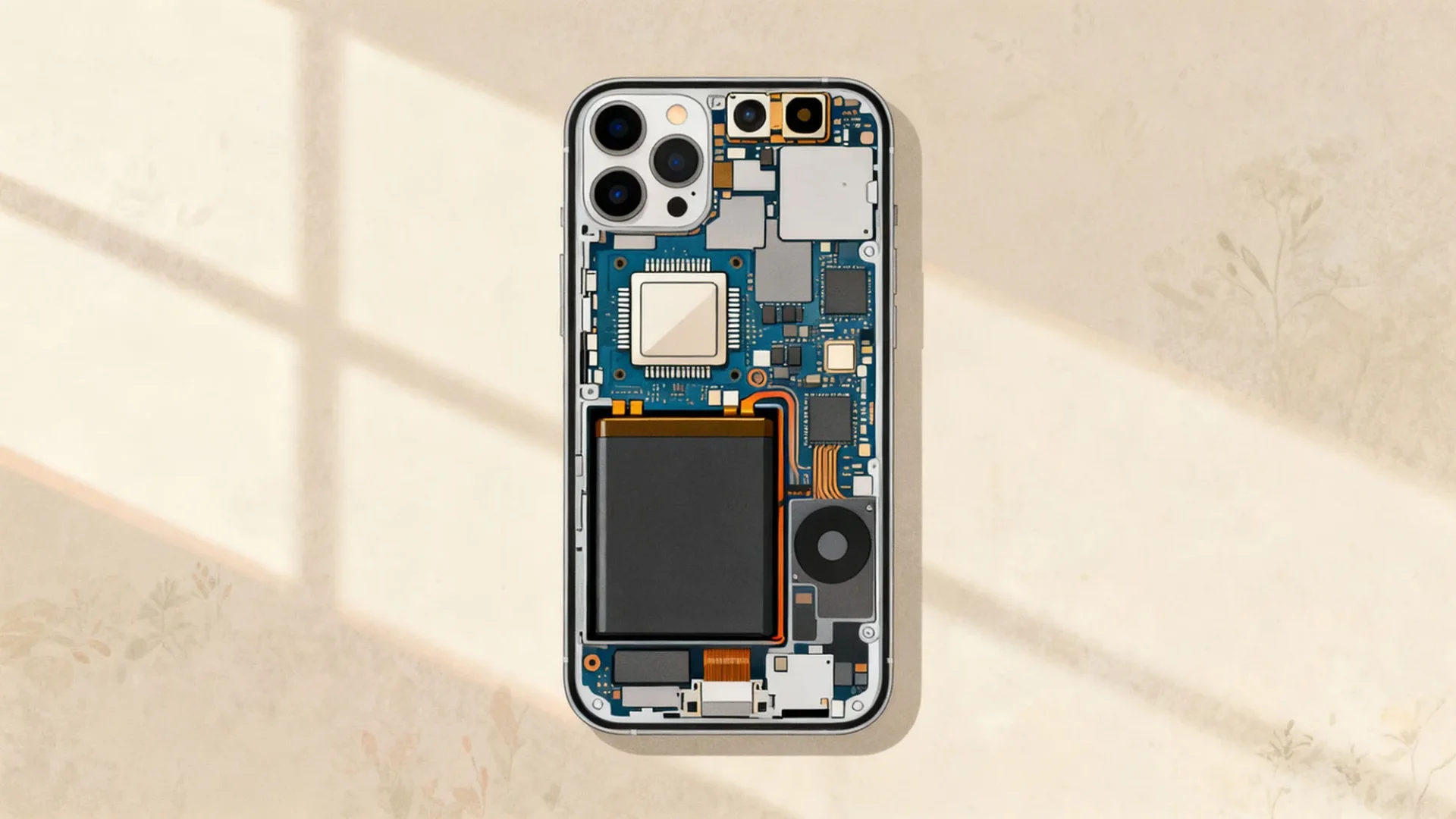
Modern smartphone processors are also known as Systems-on-a-Chip (SoCs) because they combine several important technologies into a single integrated chip rather than relying on separate components scattered throughout the device. Inside one processor package, you will typically find the central processing unit (CPU), graphics processing unit (GPU), neural processing unit (NPU), image signal processor (ISP), security processor, memory controller and communication controllers. Integrating these functions reduces power consumption, saves valuable internal space and allows information to move much faster between different parts of the phone.
One of the biggest misconceptions is that a processor with the highest benchmark score will always provide the best everyday experience. In reality, most modern smartphones already possess enough processing power for messaging, web browsing, social media, video streaming, banking and ordinary photography. Once a processor reaches a certain level of performance, improvements become increasingly difficult to notice during normal daily use. Instead, factors such as software optimization, memory management, thermal control and storage speed often have a much greater influence on how responsive the phone feels after months or years of ownership.
Processors become significantly more important when the workload becomes demanding. Recording high-resolution video, editing large files, playing graphically intensive games, running advanced AI features or keeping dozens of applications active simultaneously places far greater demands on the processor than reading emails or browsing websites. During these situations, sustained performance matters more than short bursts of speed because the processor must continue working efficiently without generating excessive heat or dramatically reducing its operating frequency.
Another important development is the increasing role of artificial intelligence inside the processor itself. Modern smartphone chips now include dedicated AI hardware designed to accelerate tasks such as speech recognition, image enhancement, live translation, voice assistants, photo editing and predictive system management. These specialised processors allow many AI features to operate directly on the device instead of sending sensitive information to cloud servers, improving both speed and privacy in many situations.
Ultimately, the processor should not be judged by a single number or benchmark result. Its true value lies in how effectively it works with every other component inside the phone, delivering smooth performance while maintaining reasonable battery life and stable temperatures throughout years of everyday use.
CPU, GPU and NPU – Understanding the Different Types of Processing
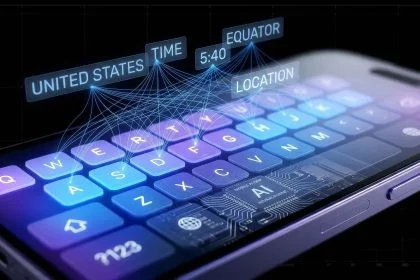
Modern smartphones continue evolving because of rapid AI hardware chip development, allowing processors to perform increasingly sophisticated artificial intelligence tasks directly on the device.
Although people often refer to “the processor” as if it were one single component, modern smartphone chips actually contain several specialised processors designed for different types of work. Understanding these different processing units helps explain why two phones with similar specifications can perform very differently depending on the task being performed.
Central Processing Unit (CPU)
The CPU acts as the general manager of the smartphone. It handles operating system instructions, application logic, calculations, multitasking and countless background operations that keep the phone functioning smoothly. Every time you launch an application, unlock your screen, send a message or browse a website, the CPU coordinates those activities while communicating continuously with memory, storage and other hardware.
Modern smartphone CPUs usually contain multiple cores rather than relying on a single processing unit. Some cores are designed for maximum performance when demanding applications require additional computing power, while others prioritize energy efficiency for lighter background tasks. This combination allows the phone to conserve battery power during everyday activities while still providing substantial performance when necessary.
Graphics Processing Unit (GPU)
The GPU specialises in rendering images, animations, videos and three-dimensional graphics. While the CPU decides what needs to happen, the GPU determines how that information should appear visually on the display.
High-performance mobile games rely heavily on the GPU because thousands of graphical calculations must be completed every second. Video playback, interface animations, augmented reality applications and advanced visual effects also depend on GPU performance. A stronger GPU generally produces smoother animations, more detailed graphics and better sustained gaming performance, especially during long sessions.
Neural Processing Unit (NPU)
The NPU is one of the newest additions to modern smartphone processors. Instead of handling general calculations or graphics, it accelerates artificial intelligence workloads that would otherwise place additional strain on the CPU.
Tasks such as recognising faces in photographs, removing unwanted background objects, translating conversations in real time, enhancing image quality, predicting user behaviour, generating text suggestions and processing voice commands can often be completed much more efficiently by the NPU.
As smartphones continue integrating more AI features, the importance of dedicated neural processing hardware will continue increasing. Rather than simply making the phone faster, the NPU enables entirely new categories of intelligent software that would previously have required powerful cloud servers.
Each processor therefore has a specialised responsibility. The CPU manages the overall operation of the device, the GPU creates visual experiences and the NPU accelerates artificial intelligence. Together they form a balanced computing system capable of handling everything from simple messaging to advanced computational photography and sophisticated on-device AI.
RAM – Your Phone’s Short-Term Working Memory

Many people understand that more RAM is generally considered beneficial, but fewer understand what RAM actually does or why it matters during everyday phone use.
RAM, or Random Access Memory, functions as the phone’s temporary workspace. Whenever you open an application, view a photograph, edit a document or switch between tasks, the information needed immediately is placed inside RAM because it can be accessed much faster than permanent storage.
Imagine working at a large office desk. The desk surface represents RAM, while the filing cabinet represents storage. Frequently used documents remain on the desk because they are needed immediately, while less important files stay safely organised inside the cabinet until required. A larger desk allows more documents to remain available without constantly putting one away before retrieving another.
Smartphones operate in much the same way. When sufficient RAM is available, applications can remain open in the background, allowing you to switch between them almost instantly. When RAM becomes limited, the operating system must remove older applications from memory to create space for new ones. The next time you return to those applications, they may need to reload completely, creating the impression that the phone has become slower even though the processor itself remains perfectly capable.
It is important to understand that RAM does not permanently store your photographs, videos or applications. Once the phone is restarted or powered off, everything stored inside RAM disappears because its purpose is temporary rather than permanent.
More RAM is particularly useful for people who regularly multitask between many applications, edit photos or videos, play demanding games or use advanced productivity software. However, simply increasing RAM without improving other components does not automatically transform the overall performance of a smartphone. The processor, storage speed and operating system must also work efficiently for the additional memory to provide meaningful real-world benefits.
For most everyday users, the ideal amount of RAM depends less on impressive numbers and more on whether the phone can comfortably maintain the applications they actually use throughout a typical day. A balanced system almost always delivers a better experience than one specification that greatly exceeds the others.
Storage – Where Everything Lives Permanently
If the processor is the brain and RAM is the short-term working memory, storage is the smartphone’s long-term memory. Every application you install, every photograph you capture, every video you record and every downloaded file eventually resides in the phone’s storage. Unlike RAM, which is cleared whenever the phone restarts, storage preserves information even when the device is completely powered off.
Many buyers only notice storage after receiving the frustrating “Storage Almost Full” notification. By then, the problem has already begun affecting the overall experience. A phone with very little free storage often takes longer to install updates, save photographs, download applications and process large files. In severe cases, the operating system may struggle to perform routine maintenance because it no longer has sufficient working space for temporary operations.
Modern smartphones generally offer capacities ranging from 128GB to 1TB, but capacity alone does not tell the complete story. Storage technology has improved significantly over the past decade, meaning today’s premium smartphones not only provide more storage but also much faster storage. Faster storage allows applications to launch more quickly, photographs to save almost instantly and large video files to transfer with far less waiting. This is one reason why two phones with identical processors may still feel different in daily use.
Storage consumption has also increased dramatically because modern digital content is much larger than it once was. A single high-resolution photograph processed with computational photography can occupy several megabytes. Short 4K videos may consume hundreds of megabytes within minutes. Large mobile games frequently require several gigabytes of storage before downloadable updates are even considered. Artificial intelligence features, offline language packs, navigation maps and productivity applications continue adding to those requirements every year.
Another important consideration is long-term ownership. Someone purchasing a phone with 128GB of storage may find it perfectly adequate today, yet after three or four years of accumulated photographs, videos, applications and software updates, the available space may become increasingly restrictive. Choosing an appropriate storage capacity should therefore consider future growth rather than simply current usage.
Cloud storage offers another way to manage growing file collections, but it should not be viewed as a complete replacement for local storage. Cloud services depend on internet connectivity, may require ongoing subscription fees and cannot always provide immediate access to every file when travelling or working offline. Many users achieve the best balance by storing frequently accessed content locally while archiving older material in cloud services.
Ultimately, storage should be viewed as an investment in long-term convenience. Having adequate space allows the phone to operate more comfortably throughout its lifespan while reducing the need to constantly delete photographs, uninstall applications or manage available capacity.
The Battery – The Heart That Powers Every Component
Every impressive feature inside a smartphone depends on one component that rarely receives the same attention as cameras or processors: the battery. Without a reliable battery, the most advanced processor cannot perform calculations, the brightest display cannot illuminate and the fastest wireless connection cannot communicate with the outside world.
Modern smartphones primarily use rechargeable lithium-ion or lithium-polymer batteries because these technologies provide an excellent balance between energy density, charging speed, size and safety. Even so, every rechargeable battery gradually ages. Unlike storage or processors, batteries are consumable components whose maximum capacity naturally decreases through normal use.
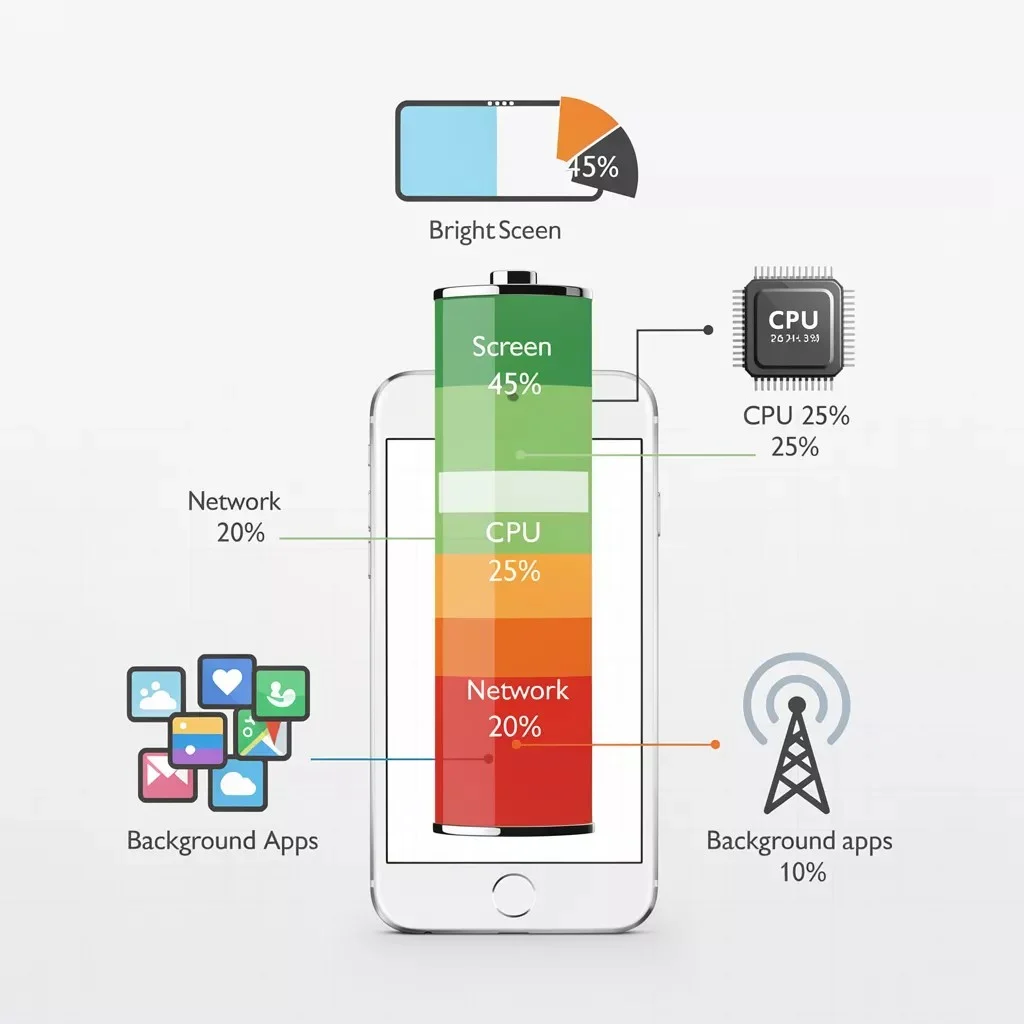
Battery capacity is usually measured in milliamp-hours (mAh), but this number often creates misunderstandings. A larger battery does not automatically guarantee longer battery life because energy consumption depends on the entire system. Display brightness, processor efficiency, software optimization, network signal strength, camera usage, artificial intelligence processing and background applications all influence how quickly energy is consumed.
Consider two smartphones with identical 5,000mAh batteries. One may comfortably last throughout an intensive workday because its processor operates efficiently and its software carefully manages background activity. The other may require charging before evening because its brighter display, less efficient processor or constantly searching cellular modem consumes significantly more energy. Looking only at battery capacity therefore provides an incomplete picture.
Charging technology has also evolved rapidly. Many smartphones now support fast charging systems capable of restoring a substantial percentage of battery capacity within a relatively short period. Wireless charging adds convenience for desk and bedside use, while reverse wireless charging allows certain phones to provide emergency power to compatible accessories. Although these technologies improve convenience, they do not eliminate the natural ageing process that affects every rechargeable battery.
Heat plays an equally important role in battery health. High temperatures accelerate chemical ageing, meaning frequent exposure to excessive heat may reduce long-term battery capacity more quickly than ordinary daily use. Activities such as prolonged gaming, recording extended high-resolution video or leaving the phone inside a hot vehicle can increase internal temperatures considerably. Modern smartphones actively monitor temperature and may reduce processor performance or charging speed temporarily to protect both the battery and other sensitive components.
Battery health therefore represents more than a single specification on a product page. It reflects the combined efficiency of the processor, operating system, display, charging system and user habits. Understanding this relationship helps explain why two seemingly similar smartphones can provide noticeably different battery experiences over several years of ownership.
Learning how phone battery health changes over time can help you decide whether your current device needs a battery replacement or whether it is genuinely time for a new phone.
The Display – The Component You Interact With More Than Any Other
The display is the only component that every smartphone owner experiences continuously throughout the life of the device. Whether reading messages, watching videos, editing photographs, browsing websites or navigating unfamiliar streets, every interaction depends on the quality of the screen. Surprisingly, many buyers still focus almost exclusively on display size while overlooking the characteristics that influence comfort and usability far more significantly.
Modern smartphone displays have become remarkably sophisticated. High-resolution OLED and AMOLED panels produce deep blacks, vivid colours and excellent contrast by allowing individual pixels to illuminate independently. LCD technology remains common in certain devices and continues offering reliable colour reproduction at lower manufacturing costs, although it generally cannot achieve the same level of contrast as self-illuminating OLED panels.
Brightness is one of the most practical display specifications because it determines how comfortably the screen remains visible under different lighting conditions. A display that appears perfectly clear indoors may become difficult to read under bright sunlight if its maximum brightness is limited. Conversely, minimum brightness becomes important when reading at night because an overly bright screen can cause unnecessary eye discomfort in dark environments.
Refresh rate is another specification that has received considerable attention in recent years. Traditional displays update the image approximately sixty times each second, while newer smartphones commonly support ninety, one hundred and twenty or even higher refresh rates. Higher refresh rates create smoother scrolling, more fluid animations and a more responsive overall feeling, particularly when navigating through applications or playing games. However, refresh rate alone should not determine display quality because brightness, colour accuracy, viewing angles and power efficiency often have a greater influence on the overall experience.
Screen protection has also become increasingly important as displays grow larger and occupy more of the phone’s front surface. Modern strengthened glass significantly improves scratch and impact resistance compared with earlier generations, but no display remains completely immune to damage. A quality protective case and screen protector often provide inexpensive insurance against accidental repairs, particularly for owners intending to keep their phones for many years.
The display should therefore be evaluated as more than a sheet of glass. It is the primary interface between the user and every other component inside the smartphone. A well-designed display enhances comfort, reduces fatigue during extended use and allows the capabilities of the processor, cameras and operating system to be appreciated every time the device is unlocked.
Cameras – Why Great Smartphone Photography Is About the Entire System
When smartphone manufacturers introduce a new device, camera specifications usually receive some of the most attention. Marketing materials often highlight higher megapixel counts, larger camera modules and additional lenses, encouraging buyers to believe that more numbers automatically produce better photographs. In reality, smartphone photography is far more sophisticated than a single specification can describe. The quality of a photograph depends on an entire imaging system working together, with hardware and software contributing equally to the final result.
Every time you press the shutter button, your smartphone completes an extraordinary amount of work within a fraction of a second. Light enters through the lens, passes onto the image sensor and is converted into electrical signals. The image signal processor immediately begins analysing exposure, colour, focus, white balance and noise, while artificial intelligence algorithms recognise objects, detect faces, improve detail and optimise dynamic range before the final image is saved. What appears to be a simple photograph is actually the result of thousands of calculations happening almost instantly.
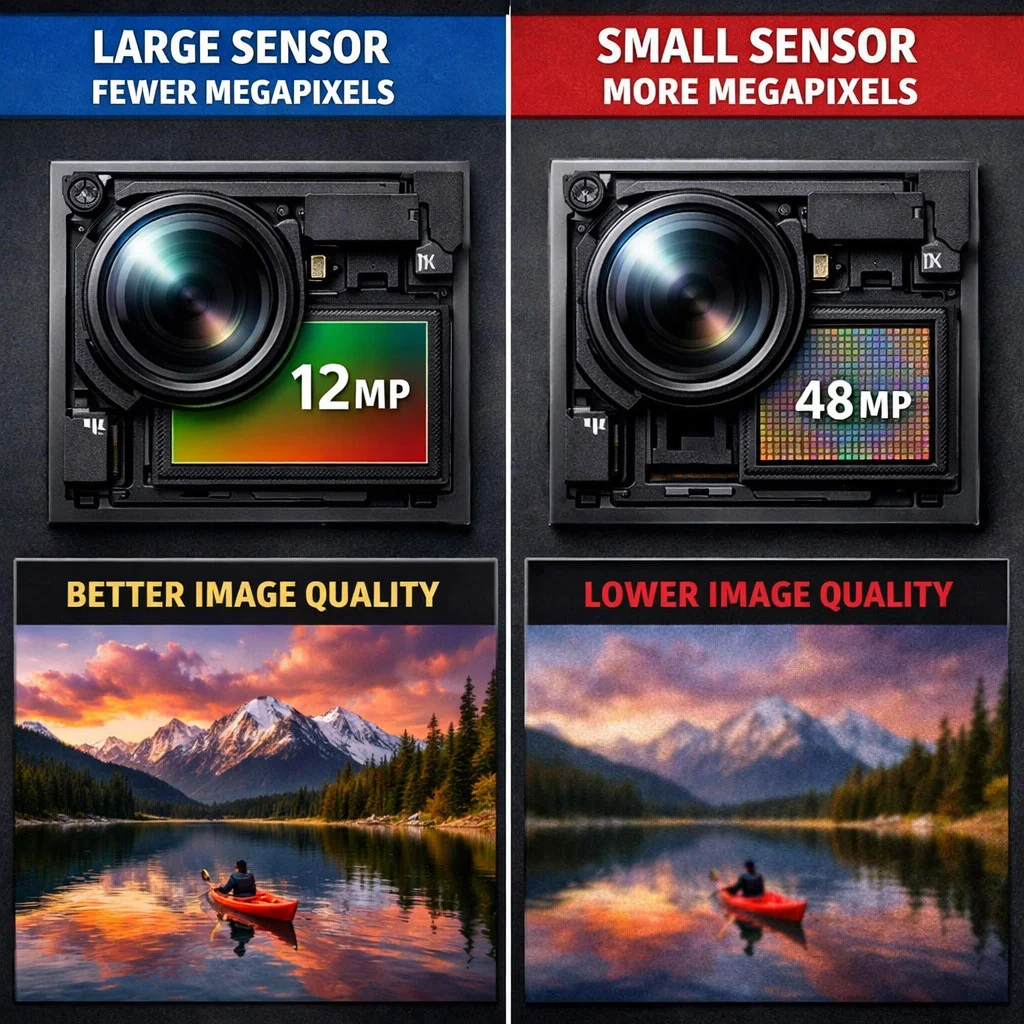
The camera lens determines how accurately light reaches the sensor. Better lenses reduce distortion, improve sharpness and allow more light to enter the camera, particularly in darker environments. The sensor itself captures the incoming light, and larger sensors generally perform better because they collect more information, especially under challenging lighting conditions. This is why two cameras with identical megapixel counts can produce dramatically different photographs when one uses a significantly larger sensor.
Megapixels describe image resolution rather than image quality. A higher megapixel count allows larger images and greater flexibility when cropping photographs, but it does not guarantee better colours, improved low-light performance or faster autofocus. A carefully designed 50-megapixel camera with an excellent sensor and advanced image processing can easily outperform a poorly optimised 200-megapixel system in everyday photography.
Image processing has become one of the defining characteristics of modern smartphone cameras. Computational photography combines multiple exposures, artificial intelligence and sophisticated processing algorithms to overcome many of the physical limitations imposed by compact smartphone hardware. Features such as Night Mode, HDR, portrait photography, motion enhancement and automatic scene recognition rely heavily on software rather than purely optical improvements. This explains why camera quality often improves after major software updates even though the physical hardware remains unchanged.
Video recording introduces additional challenges because the phone must process thousands of individual frames every minute while maintaining stable exposure, continuous autofocus, accurate colour reproduction and smooth image stabilisation. Powerful processors, efficient cooling systems and dedicated image processors become particularly important during extended video recording sessions because the workload is far greater than capturing a single photograph.
Ultimately, smartphone photography should never be judged solely by the number printed beside the camera. A successful camera system balances lenses, sensors, processing hardware, artificial intelligence and thoughtful software design to consistently produce photographs that people enjoy capturing and sharing.
Connectivity – How Your Smartphone Communicates With the World
One of the most remarkable characteristics of a smartphone is its ability to communicate with countless devices and networks almost continuously without the user noticing the complexity involved. Whether sending a message, downloading a document, streaming music, making a contactless payment or using satellite navigation, the smartphone constantly exchanges information through multiple communication technologies working simultaneously.
Cellular connectivity remains the foundation of mobile communication. Smartphones communicate with nearby cellular towers using radio frequencies, allowing voice calls, text messages and mobile internet access while travelling across cities or countries. As mobile networks have evolved from 3G to 4G and now 5G, data speeds, capacity and responsiveness have improved dramatically, enabling high-definition video streaming, cloud gaming and increasingly sophisticated artificial intelligence services.
Wi-Fi provides another important communication pathway, allowing smartphones to connect directly to local wireless networks. Compared with mobile networks, Wi-Fi often offers faster speeds, lower latency and reduced data costs when available. Most people naturally move between Wi-Fi and cellular networks throughout the day without needing to manually reconnect because the operating system intelligently manages those transitions.
Bluetooth serves a different purpose by enabling short-range communication with nearby devices. Wireless earbuds, smartwatches, keyboards, fitness trackers, vehicle infotainment systems and many other accessories rely on Bluetooth to exchange information efficiently while consuming relatively little power. Improvements in Bluetooth technology have significantly enhanced connection stability, audio quality and energy efficiency over the past several years.
Global Positioning System (GPS) technology allows smartphones to determine their approximate location by communicating with navigation satellites orbiting Earth. Modern smartphones often combine GPS with additional satellite systems and local network information to improve positioning accuracy. Navigation applications, emergency services, weather forecasting, fitness tracking and location-based reminders all depend upon this capability.
Near Field Communication (NFC) enables secure short-range communication over only a few centimetres. Contactless payments, digital transit cards, electronic identification systems and quick device pairing commonly rely on NFC because its extremely limited operating distance improves both convenience and security.
Inside every smartphone, these communication systems operate together through sophisticated antenna designs carefully positioned around the device. Engineers must balance signal strength, internal space limitations, battery consumption and physical durability while ensuring that wireless technologies do not interfere with one another. This engineering challenge has become increasingly complex as smartphones support more communication standards than ever before.
For everyday users, reliable connectivity often matters more than theoretical maximum speeds. A smartphone that maintains stable connections across different environments generally provides a better experience than one capable of extraordinary peak performance under only ideal conditions.
Sensors – The Hidden Components That Make Smartphones Intelligent
Although processors, cameras and displays receive most of the attention, modern smartphones also contain an impressive collection of miniature sensors quietly gathering information about the surrounding environment. These sensors allow the device to understand movement, orientation, light, distance and even atmospheric conditions, enabling many of the features people now consider completely normal.
The accelerometer measures movement and acceleration in multiple directions. It detects whether the phone is being lifted, shaken, tilted or rotated, allowing the operating system to automatically switch between portrait and landscape orientations, monitor physical activity and support motion-based gaming experiences.
Working closely with the accelerometer is the gyroscope, which measures rotational movement with much greater precision. This sensor plays a critical role in augmented reality applications, advanced gaming controls, image stabilisation and navigation because it continuously monitors subtle changes in the phone’s orientation.
The proximity sensor helps prevent accidental touches during phone calls by detecting when the device is close to the user’s face. When activated, the display automatically turns off, reducing both accidental input and unnecessary battery consumption.
An ambient light sensor measures surrounding light levels and allows the display to adjust brightness automatically. Rather than forcing users to constantly modify brightness manually, the phone continuously adapts to indoor lighting, bright sunlight and dark environments, improving both comfort and battery efficiency.
Many smartphones also include magnetometers, which function as digital compasses by detecting Earth’s magnetic field. Combined with GPS information, these sensors help navigation applications determine not only where the user is located but also the direction they are facing.
Higher-end smartphones may incorporate additional sensors such as barometers that estimate altitude changes, depth sensors that improve portrait photography and facial recognition, temperature sensors for monitoring device conditions or specialised biometric hardware supporting secure authentication.
Artificial intelligence increasingly combines information from multiple sensors simultaneously. For example, when taking a photograph, the phone may analyse movement, lighting conditions, camera orientation, subject recognition and distance measurements together before automatically adjusting camera settings. During navigation, GPS, accelerometers, gyroscopes and digital compasses work together to provide accurate positioning even when satellite signals become temporarily unreliable.
These sensors illustrate an important principle of modern smartphone design: intelligence rarely comes from a single component. Instead, multiple specialised systems continuously collaborate behind the scenes, providing information that allows the processor and operating system to make better decisions without requiring constant user input.
The Operating System – The Software That Brings Every Component Together
Today’s smartphones increasingly rely on mobile operating system personalization to learn user habits, prioritize important information and optimize performance throughout daily use.
A smartphone’s hardware provides the physical capability to perform different tasks, but hardware alone cannot create a useful device. Without an operating system, the processor would not know which application to run, the cameras could not capture photographs, the display would have nothing to show and the user would have no practical way to interact with the phone. The operating system serves as the central software platform that coordinates every piece of hardware, manages system resources and provides the familiar interface people use throughout the day.
The two dominant smartphone operating systems today are Android and iOS. Although they approach software design differently, both perform the same fundamental responsibilities. They manage memory allocation, schedule processor workloads, organize files, secure personal information, control wireless communication, regulate battery usage and provide the framework that allows third-party applications to function consistently across millions of devices.
Every application installed on a smartphone operates under rules established by the operating system. Rather than allowing every app unrestricted access to the processor, cameras, microphone, location or personal files, the operating system carefully controls permissions and allocates resources based on priority. This coordination allows multiple applications to remain available simultaneously without constantly interfering with one another.
Resource management has become increasingly sophisticated as smartphones have grown more powerful. When dozens of applications are installed, the operating system constantly decides which ones should remain active, which should pause in the background and which can safely release memory without affecting the user experience. Good resource management allows a phone to feel responsive while minimizing unnecessary battery consumption.
Security is another major responsibility. Modern operating systems continuously verify applications, encrypt sensitive information, isolate potentially dangerous software and provide regular security updates that protect users from newly discovered vulnerabilities. Every biometric authentication, mobile payment, banking session and password manager ultimately relies on security features built directly into the operating system rather than individual applications.
Software updates often improve much more than appearance. A well-designed update can optimize battery efficiency, improve camera processing, increase application compatibility, strengthen security and refine system stability without changing the underlying hardware. This is why a smartphone may feel noticeably smoother several months after purchase even though none of its physical components have changed.
Operating systems have also become increasingly intelligent. Rather than simply responding to commands, modern software actively predicts user behaviour, organizes notifications, learns charging routines, prioritizes frequently used applications and adjusts system performance according to daily habits. Artificial intelligence now influences many of these decisions, allowing smartphones to become more personalized over time.
The quality of an operating system therefore extends beyond visual design. It determines how efficiently hardware resources are used, how long the device remains secure and how enjoyable the phone feels during years of everyday ownership.
Artificial Intelligence – The New Brain Working Alongside the Processor
Understanding on-device AI vs cloud AI helps explain why some intelligent features work instantly without an internet connection while others depend on powerful remote servers.
Artificial intelligence has rapidly become one of the defining technologies of modern smartphones, yet it is also one of the most misunderstood. Many people assume AI is a single feature that can simply be switched on or off, when in reality it is a collection of intelligent systems quietly assisting hundreds of different tasks throughout the operating system.
Unlike traditional software, which follows fixed instructions written by programmers, artificial intelligence analyzes patterns, recognizes relationships and makes predictions based on large amounts of data. Modern smartphones use AI to improve photography, recognize speech, translate languages, organize notifications, enhance battery efficiency, filter unwanted calls, predict typing suggestions and assist countless other everyday activities.
One of the most familiar examples is computational photography. When you capture a photograph, artificial intelligence immediately begins identifying faces, skies, buildings, food, pets, documents and many other subjects before adjusting exposure, colour balance, sharpness and noise reduction accordingly. The final photograph is often assembled from multiple exposures captured within fractions of a second, producing results that would have been impossible using traditional photography alone.
Voice assistants represent another highly visible use of AI. Rather than matching simple keywords, modern assistants interpret natural language, understand conversational context and continuously improve their responses through increasingly advanced language models. Tasks that once required carefully worded commands can now be completed using ordinary conversational speech.
Artificial intelligence also contributes significantly to battery management. Instead of applying identical power-saving strategies to every user, many smartphones gradually learn daily charging schedules, frequently opened applications and regular usage patterns. Over time, the operating system can intelligently delay background activity, optimize charging behaviour and prioritize important applications without requiring constant manual adjustments.
Many newer smartphones now include dedicated Neural Processing Units (NPUs) specifically designed to accelerate AI workloads. These specialized processors allow sophisticated AI functions to operate directly on the phone instead of sending information to remote cloud servers. Local processing often improves response speed, reduces internet dependency and enhances privacy because sensitive information may never leave the device.
Cloud-based AI remains equally important for tasks requiring significantly larger computational resources, such as complex language generation, advanced image creation or extensive knowledge retrieval. In practice, many smartphones combine local AI with cloud AI, selecting the most appropriate processing location depending on the complexity of the task, network availability and privacy considerations.
As artificial intelligence continues evolving, smartphones are becoming less reactive and more proactive. Instead of simply responding after a command is issued, future devices will increasingly anticipate user needs, automate repetitive tasks and provide personalized assistance throughout the day while remaining largely invisible to the user.
Security and Privacy – Protecting the Most Personal Computer You Own
For many people, the smartphone has become the most personal computer they possess. It stores photographs, financial information, business documents, passwords, conversations, health records, travel history and countless other forms of sensitive data. Protecting that information has therefore become one of the most important responsibilities of modern smartphone design.
Security begins the moment the device is powered on. Secure hardware components verify that the operating system has not been modified before allowing it to load. Sensitive information is stored within encrypted areas that remain inaccessible even if someone physically removes the storage chip from the phone. Biometric authentication systems such as fingerprint readers and facial recognition provide convenient access while maintaining strong protection against unauthorized users.
Application permissions provide another important layer of security. Rather than automatically granting every installed application unrestricted access to the camera, microphone, contacts, location and storage, modern operating systems require applications to request permission before accessing sensitive information. Users can often approve access only while an application is actively being used or revoke permissions entirely if they become unnecessary.
Software updates play a critical role in maintaining long-term security. Cybersecurity researchers continuously discover new vulnerabilities affecting mobile operating systems, applications and communication protocols. Manufacturers regularly release security patches that correct these weaknesses before they can be exploited on a larger scale. Ignoring updates therefore leaves the device exposed to problems that may already have well-established solutions.
Privacy extends beyond preventing unauthorized access. Modern smartphones also attempt to reduce unnecessary collection of personal information by limiting background tracking, notifying users when cameras or microphones become active and providing clearer visibility into how applications access sensitive data. Although privacy policies differ between operating systems and individual applications, the overall trend has been toward giving users greater transparency and more meaningful control.
No security system can eliminate every possible risk. Strong passwords, biometric authentication, regular software updates, cautious installation of unfamiliar applications and awareness of phishing attempts remain essential habits regardless of which smartphone is being used. Technology provides powerful protection, but informed users remain one of the most effective security measures available.
Understanding smartphone security is therefore not simply about preventing hackers. It is about recognizing that the device now serves as the gateway to much of a person’s digital life, making thoughtful security practices an essential part of responsible smartphone ownership.
Why Smartphones Become Slow Over Time
Almost everyone has experienced it. A smartphone that once felt incredibly fast gradually becomes less responsive after a few years. Applications take longer to open, switching between tasks feels less fluid, photographs require more time to process and even simple activities such as typing or unlocking the phone seem slower than they once did. This gradual decline often leads people to assume that the processor has somehow become weaker, but processors do not lose computing power in the way mechanical components wear out.
Instead, the feeling of a slower phone usually results from several smaller changes occurring simultaneously throughout the system.
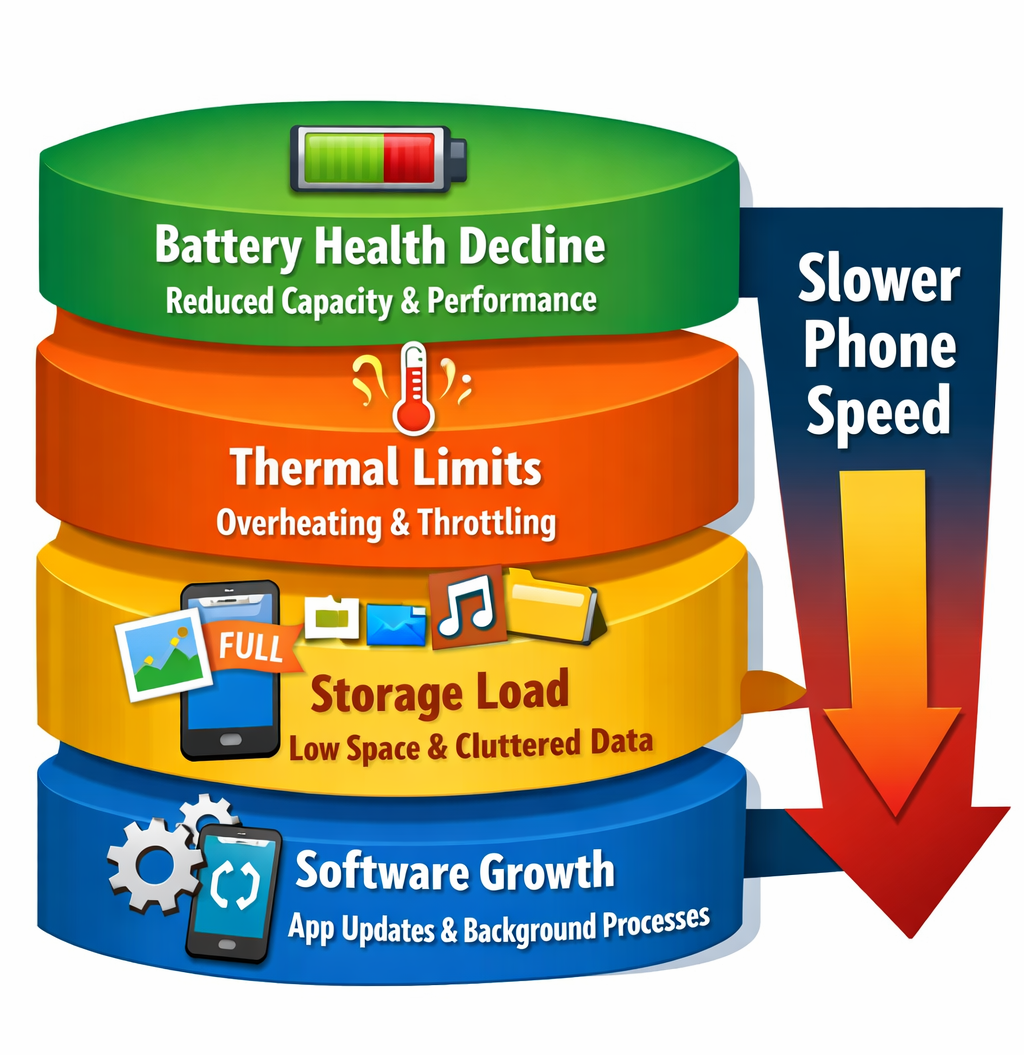
One of the most common causes is increasing software complexity. Every year, operating systems introduce additional features, stronger security protections and more sophisticated background services. Applications also evolve, often requiring more memory, storage and processing power than earlier versions. A phone that comfortably handled software released three years ago may simply be working much harder to run today’s applications.
Storage also plays an important role. As photographs, videos, downloaded files and applications accumulate, the operating system has less free space available for temporary system operations. While modern storage technologies are highly efficient, extremely limited free space can reduce overall responsiveness because the phone has fewer resources available for background maintenance and file management.
Battery ageing can contribute as well. Some smartphones intentionally reduce peak processor performance when battery health deteriorates significantly in order to prevent unexpected shutdowns under heavy workloads. This protective behaviour is designed to improve reliability rather than shorten the device’s lifespan, but it may create the impression that the processor itself has become slower.
Background applications represent another contributing factor. Many apps continue checking notifications, synchronizing cloud files, updating content or monitoring location information even when they are not actively being used. Individually these activities consume very little processing power, but collectively they can reduce available resources and increase battery consumption throughout the day.
Heat is another important influence. Smartphone processors automatically reduce operating speed whenever internal temperatures become too high. This process, known as thermal throttling, protects sensitive hardware from damage while maintaining stable operation. During extended gaming sessions, prolonged video recording or charging in hot environments, temporary performance reductions are completely normal and usually disappear once temperatures return to normal.
Software optimization also changes throughout a phone’s life. Manufacturers regularly improve performance through operating system updates, but they also introduce new capabilities that increase overall system requirements. The balance between new functionality and available hardware resources gradually shifts as devices age.
Understanding these factors helps explain why a phone that feels slower is not necessarily failing. In many situations, freeing storage space, replacing an ageing battery, removing unnecessary applications or performing routine software maintenance can restore much of the original experience without requiring an entirely new device.
How All Smartphone Components Work Together
Throughout this guide, each major smartphone component has been explained individually, but no component operates in complete isolation. The experience people describe as a “fast phone,” “great camera” or “excellent battery life” is actually the result of dozens of hardware and software systems working together continuously.
Imagine opening the camera application to photograph a moving child at sunset.
The touchscreen first detects your finger touching the display. The operating system immediately launches the camera application while the processor allocates computing resources and the RAM stores the information required for immediate operation. As the camera opens, the image sensor begins collecting light while autofocus systems continuously measure distance to the subject. Artificial intelligence simultaneously recognises faces, estimates movement, predicts exposure requirements and prepares computational photography algorithms before the photograph is even captured.
When you finally press the shutter button, the processor, image signal processor, neural processing unit and camera hardware all begin working together almost instantly. Multiple images may be captured simultaneously, combined into a single photograph, processed for colour accuracy, sharpened, stabilized, enhanced for dynamic range and finally compressed before being written to permanent storage. Within moments, the completed photograph appears on the display while the operating system quietly saves it in the background and prepares the camera for the next image.
A similarly complex sequence occurs when streaming a video, navigating unfamiliar streets, making a mobile payment or conducting a video call. The processor performs calculations, memory temporarily stores active information, storage retrieves files, wireless radios communicate with networks, sensors detect movement and orientation, artificial intelligence optimizes different tasks and the operating system coordinates every interaction.
Because these systems depend so heavily upon one another, improving a single specification rarely transforms the overall experience by itself. An exceptionally powerful processor cannot compensate for inadequate memory, slow storage or poorly optimized software. Likewise, a beautiful display cannot fully compensate for unreliable battery life or weak network connectivity.
Modern smartphone engineering is therefore an exercise in balance. Manufacturers constantly adjust performance, battery efficiency, cooling, software optimization, camera processing, wireless communication and artificial intelligence to create devices that feel fast, reliable and enjoyable across many different situations.
The best smartphones are rarely those with the highest numbers in every category. They are the ones whose hardware and software operate together so smoothly that the technology itself almost disappears, allowing users to focus entirely on what they want to accomplish.
The Future of Smartphones
Although today’s smartphones already perform tasks that once required several separate devices, their development is far from complete. The next generation of smartphones will likely evolve less through dramatic hardware changes and more through increasingly intelligent software working alongside more specialized hardware.
Artificial intelligence will continue becoming deeply integrated into everyday operation. Instead of simply responding to commands, future smartphones are expected to anticipate user needs more accurately, organize information automatically, provide increasingly natural conversational assistance and perform complex tasks directly on the device without relying heavily on cloud processing.
Camera technology will continue advancing through computational photography rather than sensor size alone. Artificial intelligence will play a larger role in improving image quality, removing unwanted objects, generating realistic edits and helping users capture better photographs regardless of lighting conditions.
Battery technology will also continue improving, although progress is expected to be gradual rather than revolutionary. More efficient processors, smarter charging systems and improved software optimization may deliver greater practical benefits than dramatic increases in battery capacity. At the same time, manufacturers continue researching new battery materials that may eventually provide faster charging, longer lifespans and higher energy density.
Connectivity will become faster and more reliable as future wireless standards mature. Greater integration between smartphones, wearable devices, vehicles, smart homes and cloud services will allow information to move more seamlessly between different parts of a person’s digital life.
Security and privacy will remain equally important. As smartphones increasingly become digital wallets, identity documents, health monitors and artificial intelligence assistants, protecting personal information will continue driving innovations in encryption, biometric authentication and on-device processing.
Perhaps the most significant change will be that smartphones become less visible as technology and more natural as personal assistants. Rather than requiring constant manual interaction, future devices may quietly handle many routine tasks automatically while presenting information only when it is genuinely useful.
Regardless of how rapidly technology evolves, the fundamental principles explained throughout this guide will remain relevant. Every smartphone will still rely on processors, memory, storage, batteries, displays, cameras, operating systems, wireless communication and intelligent software working together as a complete system.
Understanding those fundamentals allows you to evaluate new technologies with confidence instead of being influenced solely by marketing claims or specification numbers.
A smartphone is ultimately not defined by the largest battery, the fastest processor or the highest-resolution camera. It is defined by how effectively every component works together to make everyday life simpler, more productive and more enjoyable.
Frequently Asked Questions
What is the difference between a smartphone and a mobile phone?
A traditional mobile phone is primarily designed for calling and text messaging, while a smartphone functions as a portable computer with internet access, applications, cameras, artificial intelligence, GPS navigation, mobile payments and many other advanced capabilities. Modern smartphones combine communication, productivity and entertainment into a single device.
What does a smartphone processor actually do?
The processor coordinates nearly every activity inside the phone. It manages applications, calculations, multitasking, photography, gaming, artificial intelligence and communication between different hardware components. Rather than working alone, it collaborates with memory, storage, cameras and the operating system to deliver smooth performance.
How much RAM does a smartphone need?
The ideal amount depends on how the phone is used. Casual users who mainly browse the web, send messages and watch videos usually require less RAM than gamers, content creators or heavy multitaskers. More RAM helps keep applications available in memory, but overall performance also depends on the processor, storage speed and software optimization.
Why does my phone become slower after a few years?
Most smartphones slow down because software becomes more demanding, storage fills up, batteries age and background applications increase over time. The processor itself does not normally become weaker. In many cases, improving storage management, updating software or replacing an ageing battery can noticeably improve the experience.
Does a higher megapixel camera always take better photos?
No. Camera quality depends on the complete imaging system, including the lens, sensor size, image processing, autofocus, stabilization and artificial intelligence. A well-designed lower-megapixel camera can often outperform a higher-megapixel camera with weaker hardware or software.
What is the operating system on a smartphone?
The operating system is the software platform that manages the phone’s hardware, applications, security, memory, storage and user interface. Android and iOS are the two most widely used smartphone operating systems today.
What is on-device AI in a smartphone?
On-device AI performs artificial intelligence tasks directly on the smartphone without sending all information to cloud servers. This can improve speed, allow some features to work offline and enhance privacy because sensitive data often remains on the device.
How long should a smartphone last?
A quality smartphone can often remain useful for four to six years when it continues receiving security updates and major hardware components remain in good condition. Battery replacement and regular software maintenance can significantly extend its practical lifespan.