



Where Does Prediction Actually Happen?
Smartphone apps increasingly rely on predictive AI.
But prediction requires computation.
Computation must occur somewhere.
Two primary architectural models exist:
- On-device AI
- Cloud-based AI
On-device AI performs inference locally within the smartphone hardware.
Cloud AI performs inference on remote servers.
Both architectures influence:
- Latency
- Privacy
- Model scale
- Personalization depth
- Prediction accuracy
The question is not which is better.
The question is how they balance.
Modern mobile ecosystems operate through hybrid architectures.
What On-Device AI Really Means
On-device AI refers to machine learning models that execute locally on the smartphone.
These models may:
- Rank content feeds
- Predict next action
- Adjust notification timing
- Refine gesture sensitivity
- Personalize UI elements
Advantages of on-device AI include:
- Lower latency
- Offline capability
- Reduced data transmission
- Improved contextual awareness
- Privacy-sensitive inference
Local processing reduces round-trip delay.
Reduced delay improves interface responsiveness.
Responsiveness strengthens perceived intelligence.
Perceived intelligence increases engagement continuity.
On-device models often operate using compressed neural networks optimized for mobile chipsets.
These models may be:
- Quantized
- Pruned
- Lightweight
Model compression reduces resource consumption.
Efficiency enables continuous inference.
Continuous inference enables real-time recalibration.
What Cloud AI Architecture Enables
Cloud AI operates on centralized servers.
It processes:
- Aggregated behavioral datasets
- Cross-user pattern recognition
- Large-scale training loops
- Long-term prediction refinement
Cloud architecture allows:
- Massive model size
- Rapid training iteration
- Cross-device learning
- Population-level optimization
Unlike on-device models, cloud models can access broader datasets.
Broader datasets reduce variance.
Reduced variance increases prediction precision.
Precision improves outcome calibration.
These systems resemble large-scale behavioral forecasting systems used to estimate lifetime value. Cloud modeling refines probability calibration through scale.
Cloud architecture amplifies predictive depth.
Depth improves optimization scope.
Latency vs Scale Trade-Off
On-device AI offers speed.
Cloud AI offers scale.
Speed improves:
- Real-time personalization
- Gesture response
- Immediate ranking shifts
Scale improves:
- Cross-user prediction
- Pattern generalization
- Long-term optimization
Trade-offs include:
- Data transmission cost
- Privacy sensitivity
- Model update frequency
- Infrastructure complexity
Hybrid systems combine both:
- Cloud trains large models.
- On-device executes refined inference.
- Periodic synchronization updates weights.
This layered architecture balances:
- Responsiveness
- Accuracy
- Efficiency
Architectural Impact on Behavioral Calibration
Where prediction occurs influences calibration rhythm.
On-device inference allows micro-adjustments:
- Scroll depth adaptation
- Feed ranking shifts
- Notification timing fine-tuning
Cloud inference enables macro-adjustments:
- Global ranking algorithm updates
- New match scoring logic
- Engagement weighting recalibration
This layered structure strengthens probability calibration systems within mobile ecosystems. Calibration becomes continuous across device and server layers.
Architecture shapes prediction speed.
Prediction speed shapes exposure timing.
Exposure timing shapes user behavior.
Behavior feeds predictive models.
Privacy Trade-Offs in AI Architecture
Where AI computation occurs influences privacy structure.
On-device AI reduces raw data transmission.
Sensitive behavioral signals may remain local.
Local inference limits exposure of:
- Gesture patterns
- Session timing
- Location context
- Interaction frequency
Reduced transmission lowers external risk surface.
However, on-device processing does not eliminate data exchange entirely.
Cloud synchronization may still transmit:
- Model gradients
- Aggregated metrics
- Performance indicators
Cloud AI centralizes computation.
Centralization increases model capability.
But it also increases data concentration.
Data concentration creates:
- Larger security responsibility
- Infrastructure complexity
- Regulatory scrutiny
Architectural design balances:
- Predictive accuracy
- Latency
- Data exposure
- Computational cost
Privacy trade-offs therefore become structural design decisions rather than purely technical features.
Federated Learning as Hybrid Solution
Federated learning combines local training with centralized coordination.
In federated systems:
- A base model is distributed to devices.
- Devices update model parameters locally.
- Only model updates, not raw data, are transmitted back.
- The server aggregates updates.
- The global model improves.
This approach reduces centralized raw data collection.
At the same time, it preserves large-scale learning benefits.
Federated learning improves:
- Cross-device personalization
- Privacy alignment
- Model diversity
Federated systems support cross-user prediction refinement without centralized data pooling. Calibration improves while limiting raw data exposure.
Federated architecture represents a structural compromise between scale and privacy.
Model Update Pipelines
AI models require continuous updating.
Update pipelines may include:
- Scheduled weight refresh cycles
- Real-time anomaly corrections
- Behavioral pattern adjustments
- Bias detection and correction
On-device models often update through:
- Periodic firmware-level deployments
- App-level model refresh packages
Cloud models update continuously at server level.
Server updates affect:
- Global ranking logic
- Match probability scoring
- Notification prioritization
Update frequency influences calibration speed.
Faster update cycles reduce prediction drift.
Prediction drift occurs when behavioral patterns evolve faster than model adaptation.
Drift reduces accuracy.
Reduced accuracy increases exposure inefficiency.
Efficient update pipelines maintain predictive stability.
Computational Resource Allocation
Smartphones operate under hardware constraints.
On-device AI consumes:
- CPU cycles
- Neural processing unit capacity
- Battery power
- Memory bandwidth
Resource allocation must balance:
- Model complexity
- Battery efficiency
- Thermal stability
- App responsiveness
Cloud AI shifts heavy computation to data centers.
Data centers provide:
- High-performance GPUs
- Scalable infrastructure
- Parallel training loops
However, cloud processing increases:
- Network dependency
- Latency variability
- Infrastructure cost
Architectural decisions therefore reflect trade-offs between:
- Immediate personalization
- Large-scale intelligence
- Energy efficiency
- Cost control
Competitive Implications of Architectural Choice
Architecture influences competitive positioning.
Platforms investing heavily in on-device AI may emphasize:
- Privacy positioning
- Offline functionality
- Ultra-low latency experiences
Platforms prioritizing cloud AI may emphasize:
- Rapid global learning
- Population-level optimization
- Large-scale behavioral modeling
Hybrid leaders combine both.
Hybrid advantage includes:
- Micro-level adaptation
- Macro-level intelligence
- Faster calibration loops
This hybrid advantage can contribute to infrastructure scale advantages in mobile ecosystems. Architectural depth strengthens predictive efficiency.
Architecture therefore becomes strategic rather than purely technical.
Strategic architecture influences calibration accuracy.
Calibration accuracy shapes retention stability.
Retention stability strengthens monetization durability.
Why Milliseconds Matter

In mobile AI systems, latency is not just technical delay.
It is behavioral friction.
Every predictive action has a timing window.
If inference is too slow:
- Feed ranking feels delayed
- UI responsiveness drops
- Gesture prediction misaligns
- Notification timing loses precision
Milliseconds affect perception.
Perception affects engagement continuity.
Engagement continuity affects retention stability.
On-device AI reduces round-trip delay.
Cloud AI introduces network dependency.
Network variability introduces unpredictability.
Unpredictability weakens calibration confidence.
Therefore, latency becomes an economic variable.
Lower latency increases:
- Interaction frequency
- Behavioral reinforcement
- Session duration
Longer sessions strengthen predictive modeling loops.
Predictive loops improve exposure optimization.
Latency directly influences revenue durability.
Edge Inference Acceleration
Modern smartphones include dedicated neural processing units – NPUs.
These chips accelerate:
- Image recognition
- Natural language inference
- Gesture pattern detection
- Recommendation ranking
Edge acceleration reduces reliance on cloud calls.
Reduced cloud dependency improves:
- Offline functionality
- Privacy-sensitive processing
- Real-time UI recalibration
Edge inference supports micro-level adaptation.
Micro-level adaptation includes:
- Feed reorder adjustments
- Notification suppression logic
- Interaction prediction refinement
Edge acceleration strengthens real-time probability calibration in mobile apps. Micro-adjustments become seamless.
Seamlessness increases perceived intelligence.
Perceived intelligence increases habitual return.
Habitual return improves predictive dataset richness.
Chip-Level Optimization and Model Compression
On-device AI models must operate within power constraints.
Chip-level optimization includes:
- Quantization
- Model pruning
- Hardware-aware compilation
- Tensor acceleration
Model compression reduces:
- Memory footprint
- Energy consumption
- Thermal strain
Compressed models sacrifice some depth for efficiency.
Cloud models compensate with scale.
Hybrid systems distribute workload:
- Training occurs in the cloud.
- Inference occurs on-device.
- Updates synchronize periodically.
This layered model improves:
- Responsiveness
- Accuracy balance
- Battery sustainability
Battery sustainability influences session duration.
Session duration strengthens behavioral modeling.
Behavioral modeling refines prediction accuracy.
Predictive Consistency Across Devices
Users may interact with multiple devices:
- Smartphone
- Tablet
- Web browser
- Wearable
Consistency requires synchronization.
Cloud AI maintains:
- Cross-device behavioral memory
- Global preference modeling
- Long-term pattern aggregation
On-device AI personalizes locally.
Local personalization adapts:
- Gesture style
- Scroll rhythm
- Interaction timing
Synchronization aligns:
- Macro prediction
- Micro personalization
Without synchronization:
- Exposure ranking diverges
- Calibration loses coherence
- Predictive accuracy fragments
Cloud synchronization ensures exposure consistency systems remain stable across interfaces. Hierarchical ranking must remain predictable.
Predictive alignment across devices strengthens trust.
Trust improves retention stability.
Retention stability improves monetization durability.
Strategic Evolution of Mobile AI Stacks
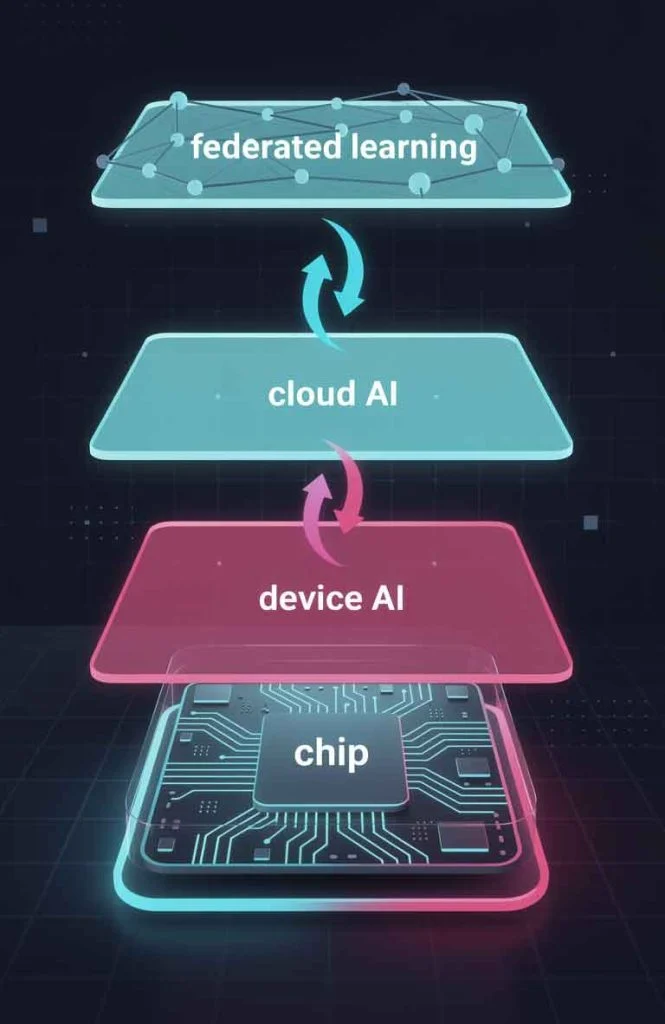
Mobile AI stacks increasingly follow layered architecture:
- Chip-level acceleration
- On-device inference
- Cloud-scale training
- Federated coordination
- Continuous synchronization
Each layer serves a function.
Chip layer optimizes speed.
Device layer optimizes personalization.
Cloud layer optimizes scale.
Federated layer optimizes privacy.
Synchronization layer optimizes coherence.
Stack evolution reflects competitive pressure.
Platforms investing in deeper stacks improve:
- Calibration precision
- Latency stability
- Predictive durability
Predictive durability influences ecosystem resilience.
Resilient ecosystems maintain engagement density.
Engagement density strengthens revenue predictability.
Long-Term Architectural Equilibrium
As mobile ecosystems mature, architectural experimentation declines.
Early-stage AI stacks are volatile.
Platforms test:
- Full cloud dependency
- Heavy on-device inference
- Aggressive data synchronization
- Conservative privacy architectures
Over time, equilibrium emerges.
Equilibrium typically includes:
- Cloud-scale training for model depth
- On-device inference for speed
- Federated refinement for privacy
- Continuous synchronization for consistency
Equilibrium reduces architectural friction.
Reduced friction improves calibration stability.
Stable calibration improves engagement predictability.
Predictable engagement improves revenue forecasting.
Architecture stabilizes when:
- Latency remains low
- Privacy risk remains manageable
- Model updates remain efficient
- Cross-device coherence remains intact
Once stabilized, architecture becomes invisible to users.
But its behavioral influence remains constant.
Why Architecture Shapes Market Power
Platforms investing deeply in hybrid AI stacks gain structural advantage.
Advantages include:
- Faster inference
- More accurate personalization
- Larger cross-user datasets
- More efficient update cycles
Accuracy improves retention.
Retention improves lifetime value.
Lifetime value strengthens reinvestment capacity.
Reinvestment strengthens AI stack depth.
Stack depth strengthens predictive precision.
Predictive precision reinforces retention.
This compounding loop influences competitive positioning.
This cycle contributes to algorithmic concentration dynamics within mobile ecosystems. Larger platforms refine architecture more rapidly.
Refinement speed influences predictive advantage.
Predictive advantage influences exposure dominance.
Exposure dominance strengthens ecosystem control.
Architecture therefore becomes strategic infrastructure.
Revenue Stability Through Hybrid AI
Revenue stability depends on:
- Retention continuity
- Engagement consistency
- Conversion predictability
- Upgrade timing
Hybrid AI architectures improve each layer.
On-device AI stabilizes immediate interaction.
Cloud AI stabilizes long-term prediction.
Federated learning stabilizes trust perception.
Trust perception influences churn probability.
Reduced churn improves revenue duration.
Hybrid stacks reinforce retention optimization systems across mobile platforms. Architectural efficiency strengthens subscription durability.
Durable subscription ecosystems increase monetization density.
Monetization density supports continuous AI investment.
Investment enhances predictive architecture.
Where AI Lives Shapes Behaviour
On-device AI optimizes immediacy.
Cloud AI optimizes intelligence scale.
Federated AI optimizes privacy alignment.
Chip-level AI optimizes energy efficiency.
Together, they form predictive infrastructure.
Predictive infrastructure determines:
- Exposure speed
- Exposure accuracy
- Exposure consistency
- Exposure frequency
Exposure shapes engagement.
Engagement shapes habit.
Habit shapes retention.
Retention shapes revenue durability.
Revenue durability funds architectural expansion.
The loop compounds.
Mobile ecosystems increasingly operate through hybrid AI stacks.
Architecture is no longer backend detail.
It is behavioral infrastructure embedded inside the device.
Where prediction runs determines how experience feels.
How experience feels determines whether engagement stabilizes.
Stability determines economic durability.
FAQs
What is the difference between on-device AI and cloud AI?
On-device AI performs machine learning inference locally on a smartphone, reducing latency and data transmission, while cloud AI processes data on remote servers to leverage larger datasets and more powerful training capabilities.
Why do mobile apps use hybrid AI architectures?
Hybrid architectures combine the speed of on-device inference with the scale of cloud training, improving personalization, predictive accuracy, and retention stability.
How does federated learning improve privacy?
Federated learning allows devices to update models locally and share only aggregated model changes, reducing centralized storage of raw behavioral data.
Does AI architecture influence revenue stability?
Yes. Efficient AI architecture improves engagement consistency and retention stability, which supports durable monetization models across mobile ecosystems.