

Readers exploring how smartphones work, from mobile hardware to AI features, can see all articles in the Phones category.

Autocorrect speed and accuracy depend heavily on dedicated AI hardware inside modern smartphones, as explained in Chip Wars - How AI Hardware Shapes Mobile Power.
Smartphone Keyboards That Autocorrect Words You Type
Smartphone keyboards that autocorrect words you type are not simple spelling helpers. They are real-time language prediction systems powered by machine learning models embedded inside your mobile device. What feels like a minor convenience – replacing “teh” with “the” – is actually the surface behavior of a predictive probability engine operating within milliseconds.
Autocorrect does not read your mind. It calculates likelihood. Messaging and typing features feel instant largely because modern smartphones run compact AI language models directly on-device. This hardware layer is part of a broader silicon competition explained in Chip Wars – How AI Hardware Shapes Mobile Power.
When you type a letter, the keyboard is already predicting the next possible character. When you complete a word, the system evaluates context from the previous words. When you finish a sentence, it recalibrates future probability patterns. This layered prediction happens continuously, and it is executed locally on the device.
Most users experience autocorrect emotionally – frustration when it changes a name incorrectly, embarrassment when it replaces an intended word with an inappropriate alternative, relief when it fixes a typo instantly. But the mechanism underneath is statistical language modeling combined with hardware acceleration.
Understanding autocorrect requires understanding three structural layers:
- The input layer – touch detection and character mapping
- The prediction layer – language model probability estimation
- The hardware layer – AI acceleration inside the smartphone chip
Autocorrect failures usually occur not because the system is unintelligent, but because its probability weighting does not match your personal linguistic pattern.
The more you type, the more the model adapts.
But adaptation depends on constraints – storage limits, privacy rules, and on-device processing power.
This is where mobile hardware becomes decisive.
Autocorrect today is no longer purely software-driven. It increasingly relies on dedicated AI cores embedded within modern smartphone processors, a hardware shift explained in detail in Chip Wars – How AI Hardware Shapes Mobile Power.
This connection matters because predictive typing is computationally intensive. Every suggested word is the result of vector calculations across language probability matrices. Without hardware acceleration, latency would increase and battery drain would spike.
Modern smartphones solve this using integrated Neural Processing Units – NPUs – or AI accelerators.
These AI accelerators are part of the larger hardware race shaping smartphone capability, detailed in Chip Wars – How AI Hardware Shapes Mobile Power.
Autocorrect is therefore a practical demonstration of on-device AI inference.
It runs locally. It adapts locally. It predicts locally.
This is fundamentally different from cloud-based correction systems used a decade ago.
Smartphones Became AI Devices
Modern smartphones are no longer simple communication tools. They increasingly function as compact AI computers that run machine learning models locally, powering features such as predictive typing, voice assistants, and camera scene recognition.
What Is a Smartphone – Structural Definition
A smartphone is a portable computing device that integrates communication, internet connectivity, application ecosystems, sensor arrays, and AI processing capabilities within a single handheld unit.
It is not merely a mobile phone with apps.
It is a compact computational platform that includes:
- System-on-Chip – CPU, GPU, NPU
- Touch interface digitizer
- High-resolution display
- Cellular modem
- Secure enclave hardware
- Operating system environment
- App execution sandbox
The presence of AI hardware inside the System-on-Chip is what transforms a standard input device into a predictive interface.
Earlier mobile phones operated using rule-based text correction. These systems relied on fixed dictionaries and basic string matching.
Modern smartphones use machine learning models trained on billions of language samples. These models assign probability weights to word sequences.
For example:
If you type “Looking forward to”, the system assigns higher probability to “seeing you” than to “banana engine.”
This probability scoring is not random – it is derived from training datasets embedded during model development.
Smartphone keyboards integrate:
- Character-level models
- Word-level frequency analysis
- Context window processing
- User adaptation memory
This layered architecture makes autocorrect feel intuitive.
But intuition is statistical compression.
The Core Mechanism – How Autocorrect Actually Works
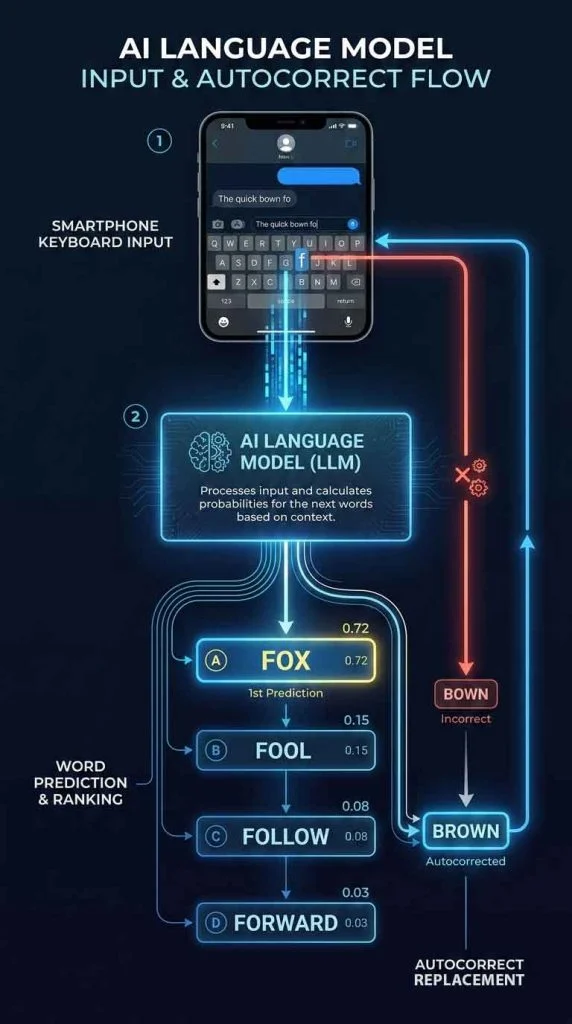
Autocorrect systems operate using language modeling techniques. At a simplified level, they predict the most likely word given previous input.
There are three primary mechanisms:
1. Dictionary Matching
The simplest layer compares typed words against a stored dictionary. If a word does not exist, it flags or replaces it.
This mechanism alone would not be sufficient for modern typing speed.
2. N-gram Probability Modeling
The keyboard evaluates word sequences using probability chains.
If you type:
“I will call you”
The probability of “later” is higher than the probability of “volcano.”
This prediction uses stored statistical patterns.
3. Neural Language Models
Modern smartphones incorporate compressed transformer-style or recurrent neural models optimized for on-device inference. These models evaluate context beyond two or three words and consider sentence-level coherence.
Because storage is limited, these models are quantized and optimized for edge processing.
This is where chip architecture matters.
Language prediction models require parallel computation and low latency memory access.
That computation is executed inside AI accelerators embedded in mobile processors.
This means autocorrect performance varies depending on hardware generation.
Older phones rely more on rule-based correction. Newer phones integrate neural inference engines.
The difference is subtle but measurable:
- Faster prediction
- More accurate contextual correction
- Lower battery consumption per inference cycle
Why Autocorrect Fails
Autocorrect fails when probability conflicts with intention.
Common causes include:
- Proper nouns not in dictionary
- Multilingual switching
- Slang and informal language
- Abbreviations
- Low-frequency phrases
The system does not understand meaning. It calculates likelihood.
If you frequently type niche terminology, the model gradually adjusts. But adaptation depends on data storage policies and privacy architecture.
Some devices allow user dictionary expansion. Others restrict learning scope for privacy reasons.
This is a trade-off between personalization and data protection.
Hardware Layer – The Silent Influence
Typing accuracy is increasingly linked to chip architecture.
When predictive models run locally, they depend on:
- Memory bandwidth
- NPU throughput
- Cache latency
- Power efficiency
Autocorrect might seem trivial, but multiply prediction calculations across millions of users, and it becomes a significant workload.
These prediction systems rely on specialized AI accelerators embedded in modern smartphone processors, explained in detail in Chip Wars – How AI Hardware Shapes Mobile Power.
AI acceleration allows:
- Real-time inference
- Reduced network dependency
- Lower latency typing
- Improved energy efficiency
This is one reason smartphone manufacturers emphasize AI performance in product launches.
Autocorrect is one of the most common daily AI interactions users experience – even if they do not realize it.
Operating System Architecture – iOS vs Android Predictive Engines
Autocorrect behavior differs across operating systems not because users type differently, but because prediction engines are built on distinct architectural philosophies. The two dominant ecosystems – Apple’s iOS and Google’s Android – approach keyboard intelligence using different integration layers, privacy rules, and hardware coordination strategies.
In iOS devices, the default keyboard engine is tightly integrated with the operating system kernel and secure enclave structure. This integration allows Apple to run predictive language models fully on-device with minimal external dependency. The prediction engine leverages Apple’s Neural Engine inside its A-series and M-series mobile chips. Because Apple controls both hardware and software stack layers, it can compress models specifically optimized for its chip architecture. The result is low-latency suggestions, consistent cross-app behavior, and relatively controlled personalization.
Android operates differently. The most widely used keyboard, Gboard, is developed by Google but must operate across thousands of device models with different chipsets and memory configurations. Android’s predictive system uses a hybrid architecture – combining on-device inference with optional cloud-enhanced suggestions depending on user settings. This flexibility allows rapid language model updates, multilingual scaling, and broader adaptation. However, performance consistency can vary depending on hardware tier.
The distinction becomes visible in three areas:
- Personalization depth
- Model update frequency
- Hardware dependency
iOS typically prioritizes local privacy and stable performance. Android prioritizes adaptive scalability and rapid language model improvement.
This difference affects autocorrect accuracy in multilingual contexts. Users who frequently switch between languages may notice Android’s dynamic language blending more aggressively than iOS’s segmented dictionary management.
But regardless of ecosystem, both systems increasingly rely on embedded AI accelerators for inference.
Without neural acceleration, modern predictive text would introduce noticeable input lag.
The hardware layer determines whether correction feels invisible or intrusive.
Privacy Architecture – Local Inference vs Cloud Enhancement
Autocorrect raises a common concern: does the keyboard read everything you type?
The answer depends on architecture configuration.
Modern smartphone keyboards are primarily designed for on-device processing. That means the majority of prediction calculations occur locally, without transmitting typed content to external servers. This approach reduces latency and increases privacy protection.
However, optional cloud-based enhancements exist.
Cloud-assisted prediction can improve:
- Rare word suggestions
- Slang adaptation
- Emerging terminology
- Contextual sentence completion
Cloud augmentation is typically anonymized and governed by privacy policies, but it introduces an additional variable: network dependency.
On-device inference provides three structural advantages:
- Immediate prediction without network delay
- Reduced exposure of personal text data
- Consistent performance offline
Cloud enhancement provides:
- Faster language model updates
- Broader vocabulary coverage
- Aggregated global learning improvements
Most modern systems default to local inference while allowing optional learning contributions.
The architectural shift toward local AI processing is directly connected to mobile hardware development. As AI accelerators become more powerful, dependency on cloud prediction decreases.
This transition reflects a broader trend in mobile computing – edge AI replacing centralized inference.
Autocorrect is a daily example of this evolution.
Battery Consumption – Hidden Computational Cost
Autocorrect feels lightweight because prediction is instantaneous. But real-time language modeling is computationally expensive.
Each typed character triggers:
- Context window update
- Probability recalculation
- Candidate ranking
- Suggestion rendering
These processes occur within milliseconds.
If executed inefficiently, they would significantly increase battery drain.
Modern smartphones mitigate this through:
- Quantized neural models
- Memory-efficient tokenization
- Hardware-accelerated matrix multiplication
- Low-power AI cores
Dedicated NPUs perform inference tasks using less energy than general-purpose CPUs.
This is critical because keyboard usage is one of the most frequent smartphone interactions.
Even small inefficiencies would compound across daily usage cycles.
The energy efficiency of AI inference engines has become a competitive hardware metric. When chip manufacturers advertise TOPS – trillions of operations per second – they are indirectly referencing workloads like predictive typing.
Autocorrect is not only a user interface feature.
It is a benchmark for mobile AI power efficiency.
Disabling Autocorrect – System-Level Explanation
Disabling autocorrect is not simply turning off a toggle. It modifies prediction layer behavior.
On most smartphones, users can navigate to:
Settings → Keyboard → Text Correction → Autocorrect
Disabling autocorrect usually leaves predictive suggestions active while preventing automatic word replacement. This distinction matters.
There are typically three related settings:
- Autocorrect – automatic word substitution
- Predictive text – suggestion bar display
- Auto-capitalization – sentence boundary detection
Turning off autocorrect stops replacement logic but does not disable underlying language modeling. The prediction engine continues operating unless predictive text is also disabled.
Some systems maintain learning memory even when replacement is off. That means the model still adapts to typing patterns.
In high-security environments, some organizations disable predictive systems entirely to reduce data retention.
For general users, disabling autocorrect may reduce frustration but slightly increase typing effort.
The trade-off is between control and automation.
Security Implications – Autocorrect as Attack Surface
Autocorrect is not typically considered a security risk, but predictive systems can theoretically be influenced by adversarial input patterns.
If a malicious application were able to manipulate dictionary learning, it could alter suggested outputs.
Operating systems mitigate this risk through sandbox isolation. Keyboard apps cannot freely read data from other applications without permission.
However, third-party keyboard installations introduce additional variables.
When users install external keyboard apps, they grant input access permissions. This can include potential data collection capabilities depending on app policy.
Therefore, the security layer involves:
- Permission management
- Data sandboxing
- Encryption during optional cloud sync
- Hardware-level secure enclaves
Built-in keyboards generally provide tighter integration with system security architecture.
Autocorrect itself is not a vulnerability, but input systems are part of the broader attack surface of any computing device.
Behavioral Impact – Cognitive Adaptation to Predictive Systems
Frequent use of autocorrect changes typing behavior.
Users begin relying on prediction rather than full spelling recall.
Studies in human-computer interaction indicate that predictive systems alter cognitive load distribution. Instead of focusing on spelling accuracy, users focus on idea flow while delegating correction responsibility to the system.
This delegation has both positive and negative implications.
Positive effects include:
- Increased typing speed
- Reduced minor spelling errors
- Lower friction in communication
Negative effects may include:
- Reduced long-term spelling retention
- Overreliance on suggestion accuracy
- Increased frustration when prediction fails
Autocorrect reshapes linguistic habits subtly over time.
It becomes part of the writing process rather than an external correction tool.
Multilingual Complexity – Entropy in Language Switching
Multilingual users experience higher autocorrect instability.
When switching between languages, the prediction engine must recalibrate probability weights rapidly.
If language detection fails, cross-language interference occurs.
For example:
Typing an English sentence while the keyboard is set to another language may trigger inappropriate substitutions.
Advanced predictive engines maintain separate language models and dynamically switch based on context detection.
However, simultaneous bilingual blending increases entropy in probability ranking.
Entropy, in this context, refers to uncertainty in word prediction.
Higher entropy increases correction error likelihood.
Improved AI accelerators allow larger language models to run locally, reducing entropy in multilingual switching.
Again, hardware performance indirectly affects typing stability.
Economic Perspective – Why Predictive Typing Matters to Manufacturers
Predictive typing is not merely a convenience feature.
It affects:
- User retention
- Platform loyalty
- Perceived intelligence of device
- Productivity satisfaction
When typing feels smooth and intuitive, the device feels intelligent.
When prediction fails repeatedly, frustration can reduce perceived device quality.
Hardware manufacturers therefore invest in AI acceleration to enhance everyday interactions.
Autocorrect is part of the invisible competitive battlefield of mobile computing.
It demonstrates how hardware evolution translates into subtle user experience improvements.
The connection between typing and silicon architecture is rarely discussed openly, but it is foundational.
Why Language Models Need Compression
Mobile devices cannot run massive AI models like cloud servers. Instead, engineers compress language models so they can operate efficiently on smartphone chips without draining battery power.
Deep AI Compression – How Large Language Models Fit Inside a Phone

Modern predictive keyboards rely on compressed neural language models that must operate within severe hardware constraints. Unlike cloud-based language systems that can access massive server clusters, smartphone keyboards must function within limited memory, limited power draw, and limited thermal tolerance.
The central challenge is compression without destroying prediction quality.
Large language models – when trained in research environments – can contain billions of parameters. These models cannot run directly on mobile hardware. Therefore, engineers apply multiple optimization strategies:
- Quantization – reducing numerical precision of model weights
- Pruning – removing low-impact neural connections
- Distillation – training smaller models to imitate larger ones
- Context window reduction – limiting how many previous words are evaluated
Quantization converts high-precision floating-point calculations into lower-bit representations, dramatically reducing memory usage and computational load. While this slightly reduces theoretical accuracy, it significantly improves energy efficiency.
Pruning eliminates redundant network pathways. Many neural networks contain over-parameterization, meaning some connections contribute minimally to output. Removing them decreases size without major performance loss.
Distillation transfers knowledge from a large teacher model to a smaller student model. The student model learns prediction patterns from the teacher and becomes compact enough for mobile deployment.
Context window reduction limits how much previous text influences prediction. Instead of analyzing entire paragraphs, mobile keyboards typically evaluate a short sequence window – often a few preceding words. This constraint balances contextual awareness and speed.
These compression strategies make on-device inference possible.
Without them, predictive typing would require constant cloud communication.
Autocorrect therefore represents a specialized subset of language AI – optimized for latency, battery efficiency, and privacy.
Latency Benchmarks – Why Milliseconds Matter

Typing is an interaction where delay is immediately perceptible.
Human perception begins noticing input lag around 100 milliseconds. For seamless typing, prediction must occur far below that threshold.
Modern AI accelerators inside smartphones reduce inference latency to under 10 milliseconds for common prediction cycles.
Latency performance depends on:
- Neural Processing Unit throughput
- Memory access speed
- Model size
- Operating system scheduling
- Thermal conditions
When devices overheat, processors may throttle performance. In rare cases, predictive responsiveness can degrade under heavy multitasking loads.
High-end devices with advanced AI cores handle prediction more smoothly under multitasking conditions. Budget devices may rely more heavily on CPU execution, increasing delay under load.
Latency consistency contributes to perceived intelligence.
If predictions appear instantly, the system feels responsive. If suggestions lag, the keyboard feels unreliable.
Autocorrect accuracy is not the only variable – timing precision influences trust.
Predictive Bias – Language Modeling Limits
Autocorrect systems are trained on large language datasets. These datasets shape prediction tendencies.
Bias can appear in several forms:
- High-frequency cultural phrasing dominance
- Slang preference skew
- Formal language prioritization
- Regional spelling conflicts
For example, American English spelling may override British spelling if training datasets are weighted heavily toward US usage.
Bias does not imply malicious intent. It reflects statistical distribution.
Because mobile models are compressed, they may lose nuance in low-frequency language patterns.
Users sometimes interpret incorrect correction as system incompetence. In reality, the model is executing probability ranking based on training exposure.
Continuous updates improve coverage, but compression constraints limit universal accuracy.
This limitation highlights an important truth: autocorrect optimizes for majority probability, not individual creativity.
Edge AI vs Centralized AI – Structural Transition

In early smartphone history, predictive typing improvements depended heavily on centralized server updates.
Today, AI inference increasingly shifts toward edge processing – meaning directly on the device.
This transition offers:
- Reduced latency
- Increased privacy
- Lower server dependency
- Better offline functionality
The shift aligns with broader industry movement toward decentralized intelligence.
Autocorrect is one of the earliest and most persistent edge AI use cases.
As mobile chips become more powerful, larger context models can run locally. This reduces reliance on external data transmission and enhances real-time personalization.
Edge AI also reduces data congestion in network infrastructure.
From an engineering perspective, predictive typing is a testbed for scalable on-device intelligence.
Future of Smartphone Keyboards – Transformer Integration
Modern language AI increasingly relies on transformer architectures. These models process context more effectively than older recurrent neural networks.
However, transformers are computationally heavy.
To integrate transformer-style models into smartphones, developers use:
- Parameter reduction
- Context truncation
- Token-level compression
- Specialized inference hardware
Future keyboards may incorporate:
- Sentence-level semantic prediction
- Intent-based completion
- Cross-app contextual awareness
- Real-time grammar restructuring
But these advances will depend on hardware evolution.
The connection between typing and chip design will strengthen further.
Mobile AI capability will define the upper boundary of keyboard intelligence.
Practical Troubleshooting – Mechanism-Based Solutions
Autocorrect frustration typically stems from three structural causes:
- Incorrect language setting
- Corrupted user dictionary memory
- Conflicting third-party keyboard permissions
Instead of viewing autocorrect as random malfunction, users can approach it structurally.
Language verification ensures the correct model is active.
Resetting keyboard dictionary clears accumulated mis-learned patterns.
Uninstalling untrusted keyboard apps reduces interference.
Turning off autocorrect but leaving predictive suggestions active offers a balanced compromise.
Understanding the mechanism reduces emotional frustration.
Autocorrect behavior is predictable once architecture is understood.
Why Autocorrect Matters More Than It Seems
Autocorrect appears to be a small convenience feature, yet it represents one of the most frequently used AI systems in everyday life. Every message typed on a smartphone activates predictive language models running inside the device.
Frequently Asked Questions About Smartphone Autocorrect
How does smartphone autocorrect work?
Smartphone autocorrect works by using on-device language models that calculate word probability based on previously typed text. It combines dictionary matching with neural prediction systems powered by mobile AI chips.
Does autocorrect use artificial intelligence?
Yes. Modern smartphone keyboards use compressed machine learning models running on Neural Processing Units to predict and correct words in real time.
Can autocorrect read my private messages?
Most modern smartphones process predictive typing locally on the device. Optional cloud features may enhance suggestions, but core autocorrect functions operate on-device.
Why does autocorrect change correct words?
Autocorrect replaces words based on statistical probability. If a word sequence appears unlikely according to its model, it may substitute a higher-probability alternative.
How can I disable autocorrect?
You can disable autocorrect in your phone’s keyboard settings under Text Correction or Keyboard Preferences. Turning off autocorrect usually stops automatic replacement but may leave predictive suggestions active.
Chip Generations – How Hardware Evolution Changes Autocorrect Accuracy
Autocorrect quality is not constant across devices. It evolves with chip generations. When users upgrade smartphones and notice that typing feels smoother, faster, or more context-aware, that improvement often reflects advances in on-device AI hardware rather than visible software changes.
Mobile processors have transitioned through three major phases:
- CPU-dominant execution
- GPU-assisted acceleration
- Dedicated Neural Processing Units – NPUs
In early smartphone generations, predictive typing relied primarily on CPU computation. The processor handled dictionary matching and probability ranking sequentially. This limited the complexity of language models that could be deployed locally.
As GPUs became programmable and more energy efficient, some predictive workloads were partially accelerated using parallel processing. However, GPUs are optimized for graphics rendering, not language inference. While faster than CPUs for certain operations, they were not ideal for continuous low-power prediction.
The introduction of dedicated AI accelerators – often branded as Neural Engines or NPUs – marked a structural shift. These hardware blocks are specifically optimized for matrix multiplication and tensor operations, the core mathematical foundation of neural language models.
With NPUs, smartphones can:
- Execute larger compressed models
- Maintain low inference latency
- Reduce battery consumption per prediction
- Improve contextual awareness
The improvement is not linear. Each chip generation increases AI throughput significantly, often doubling inference capability while improving energy efficiency.
Autocorrect accuracy therefore improves indirectly through hardware scaling.
The keyboard feels smarter because the chip is more capable.
This reinforces the earlier internal link relationship between predictive typing and silicon competition.
AI Throughput Scaling – Why TOPS Matters in Everyday Typing
Chip manufacturers frequently advertise AI performance using the metric TOPS – trillions of operations per second. While this figure may appear abstract, it directly influences daily interactions such as typing.
Each prediction cycle involves:
- Token embedding
- Context weighting
- Probability scoring
- Candidate ranking
Even compressed models require thousands of operations per word.
Higher TOPS enables:
- Larger context windows
- More refined probability ranking
- Reduced fallback to simpler rule-based correction
When TOPS increases across chip generations, predictive engines can process more linguistic signals simultaneously.
This means:
- Better handling of compound sentences
- More accurate correction of homophones
- Improved detection of contextual grammar errors
The relationship between hardware capability and typing precision becomes more visible as AI workloads expand.
Typing is one of the most frequent AI workloads executed on a smartphone.
Therefore, improvements in AI throughput influence user experience continuously.
Cross-Device Ecosystems – Synchronization and Learning Models
Modern ecosystems allow typing behavior to synchronize across devices.
When users log into the same ecosystem on phone, tablet, and laptop, predictive personalization may transfer across devices depending on privacy configuration.
This raises architectural questions:
- Is personalization stored locally or in encrypted cloud storage?
- How is model adaptation synchronized?
- Does cross-device learning improve accuracy or introduce noise?
Most ecosystems implement hybrid storage:
- Core model remains device-local
- User dictionary updates may sync securely
- Custom shortcuts may propagate
Cross-device learning increases consistency in frequently used phrases.
However, synchronization must balance personalization with security.
Encrypted storage and secure key exchange protocols protect user dictionaries during sync.
The evolution of predictive typing is therefore tied not only to chip power but to ecosystem design.
Enterprise Environments – Controlled Autocorrect Policies
In enterprise settings, predictive typing may be restricted.
Organizations handling sensitive data sometimes:
- Disable personalized learning
- Prevent cloud-based suggestion enhancement
- Enforce standard dictionaries
- Restrict third-party keyboard installations
These controls reduce data retention risks.
Enterprise mobile management systems can configure keyboard behavior centrally.
Autocorrect becomes part of a broader compliance framework.
This reinforces that predictive typing is not merely a casual feature – it interacts with security policy, privacy law, and device governance.
Mobile AI Inference Economics – Why On-Device Matters Financially
Cloud inference incurs infrastructure cost.
Each cloud-based prediction request would require:
- Server processing
- Data transmission
- Storage allocation
- Bandwidth overhead
Scaling this across billions of daily typing interactions would be economically inefficient.
On-device AI eliminates recurring cloud inference cost.
The initial expense is embedded in chip development and hardware design, but long-term operational cost per user decreases.
This economic incentive accelerates edge AI adoption.
Autocorrect is therefore a microeconomic example of distributed computation.
Manufacturers invest heavily in silicon because local inference reduces lifetime service cost.
Users experience faster typing. Companies reduce server dependency.
Predictive Typing and Cognitive Feedback Loops
Over extended usage periods, predictive typing forms a feedback loop between user behavior and machine learning adaptation.
The process follows this cycle:
- User types phrase
- System predicts likely continuation
- User accepts suggestion
- Model reinforces probability weight
- Future predictions shift
This reinforcement loop gradually customizes the keyboard to individual linguistic patterns.
However, the loop has limits:
- Memory storage capacity constraints
- Privacy-preserving deletion cycles
- Model retraining boundaries
Predictive systems adapt incrementally rather than fundamentally rewriting internal structure.
Users sometimes believe the keyboard has “learned a bad habit.” In reality, the adaptation process amplifies accepted suggestions.
Resetting the keyboard dictionary interrupts this feedback cycle.
Understanding the loop reduces confusion when unexpected corrections appear.
Transformer-Based Mobile Future – Contextual Completion Beyond Words
Current smartphone keyboards primarily predict next words or short phrases.
Future implementations may include:
- Multi-sentence completion
- Tone adjustment suggestions
- Formality adaptation
- Cross-application context linking
Such capabilities require:
- Expanded context window
- Increased model parameter count
- Advanced compression techniques
- Higher AI throughput
As chips approach higher inference capacity, transformer-based micro-models may become standard in mobile keyboards.
The boundary between keyboard and assistant will blur.
Typing may evolve from correction-based interaction to intent-based generation.
This transition must remain balanced with privacy and battery efficiency constraints.
Autocorrect will likely expand into predictive writing assistance rather than simple spelling correction.
Structural Synthesis – Autocorrect as a Lens Into Mobile AI Evolution
Autocorrect is often the first AI system users interact with daily, yet it remains one of the least understood components of modern mobile architecture.
Autocorrect illustrates a broader technological transformation.
What appears as a small interface feature represents:
- Statistical language modeling
- Neural network compression
- Hardware acceleration
- Privacy architecture
- Economic optimization
- Behavioral adaptation
It is one of the most pervasive AI interactions in modern life.
Every typed message activates machine learning inference.
Every correction reflects probability computation.
Every suggestion reflects silicon capability.
Smartphone keyboards that autocorrect words you type are therefore not trivial utilities. They are applied AI systems embedded inside consumer hardware.
Understanding autocorrect reveals how deeply artificial intelligence has integrated into everyday tools.
The keyboard is no longer a static input grid.
It is a predictive engine running continuously beneath your fingertips.
The hardware competition that enables these on-device AI systems is explored in Chip Wars – How AI Hardware Shapes Mobile Power.
Comparative Benchmarking – Generational Differences in On-Device Prediction
Autocorrect improvements are measurable across chip generations, though manufacturers rarely publish direct typing benchmarks. However, internal AI throughput metrics and third-party latency tests provide indirect insight into prediction scaling.
Across recent smartphone generations, three performance patterns consistently emerge:
- Reduced prediction latency under multitasking
- Improved contextual accuracy in longer sentences
- Lower battery drain during sustained typing sessions
In earlier devices relying primarily on CPU execution, predictive models operated with smaller vocabularies and shorter context windows. This meant autocorrect was more reactive than anticipatory. It corrected obvious typos but struggled with nuanced phrasing.
With the integration of NPUs, inference execution became parallelized. Larger compressed language models could be deployed without exceeding power thresholds. As a result, devices began predicting entire phrase structures more accurately rather than simply replacing misspellings.
Benchmark-style observations show:
- Entry-level processors prioritize lightweight dictionary matching
- Mid-tier processors run moderately compressed neural models
- Flagship processors execute more advanced contextual inference
The difference is subtle but accumulative. Over thousands of typing interactions, smoother prediction reduces micro-friction.
Micro-friction reduction increases perceived device intelligence.
This perception influences upgrade cycles and ecosystem loyalty.
Autocorrect quality therefore participates indirectly in hardware competition.
Final Structural Conclusion
Smartphone keyboards that autocorrect words you type represent the convergence of language modeling, silicon engineering, and privacy-conscious design. They demonstrate how AI moves from abstract research into invisible daily utility.
The keyboard is no longer a passive interface. It is an adaptive system operating within strict computational constraints.
Its intelligence is bounded by:
- Hardware throughput
- Model compression limits
- Context window size
- Energy efficiency targets
- Privacy frameworks
As mobile processors continue evolving, predictive typing will expand in contextual depth without sacrificing speed.
Autocorrect is not merely a convenience.
It is a real-time AI inference system integrated into consumer hardware at planetary scale.
Understanding it provides insight into how AI becomes infrastructure.