
Signs of bipolar disorder in teens involve distinct changes in mood and energy, often alongside altered sleep, faster thinking or speech, and unusually risky behavior. The useful question is whether several changes occur together and differ clearly from that teenager’s usual pattern, rather than whether they are sometimes moody. These observations can guide an assessment, but they cannot establish a diagnosis at home.
Compare the teenager with their own everyday baseline. A normally talkative student is different from a usually quiet student who suddenly talks almost continuously, starts several unrealistic projects and seems barely tired after very little sleep. The second description supplies a change, a cluster and a time context; a label such as “dramatic” supplies none of those. For teenagers, the extra challenge is responding to a concerning change without treating their independence or disagreement as evidence of illness.
Which changes are more informative than ordinary moodiness?
A teenager wanting more independence is not, by itself, showing a sign of bipolar disorder. A sustained change in activation is more informative than a disagreement about freedom or an isolated bad mood. Activation describes how energized, driven or sped up someone seems. When it rises unusually, mood, sleep, speech, activity and judgment may change together; some teenagers appear elated, while others become markedly irritable.
The comparison needs a fair starting point. Think about how this teenager usually sleeps on school nights, manages conversation, approaches activities and responds to limits. Avoid using a sibling, a social-media personality or an ideal of perfect behavior as the benchmark. Development, disability and ordinary temperament all affect what “usual” looks like.
Reduced need for sleep is a particularly useful distinction. It means sleeping substantially less than usual while seeming unusually energetic rather than simply wanting more sleep and being unable to get it. It is still one observation, not a diagnostic test. The NIMH guide to bipolar disorder in children and teens explains why clinicians consider sleep together with mood, activity and behavior.
Fast speech is also about a change in pace and manageability. A teenager may move between ideas so quickly that ordinary conversation becomes difficult, interrupt much more than usual, or describe thoughts that will not slow down. Enthusiastic talk about a favorite subject is not equivalent to an episode; the surrounding pattern matters.
Judgment can change before school results do. New, uncharacteristic spending, dangerous plans or an unusually unrealistic sense of ability can deserve attention even while assignments are being completed. A burst of productivity is not automatically a healthy improvement, but neither is ambition evidence of illness. Ask what has changed in sleep, pace and consequences. Changing clothes, exploring identity, disagreeing with parents or choosing different friends should not be turned into symptoms. For the developmental picture in younger children, see bipolar indicators in kids.
| What you notice | What makes the observation more useful | What it cannot establish |
|---|---|---|
| Less sleep | Whether the teen is tired or unusually energized the next day. | A diagnosis from a late bedtime. |
| Faster speech or activity | A clear change from usual pace alongside other changes. | That enthusiasm or being talkative is an illness. |
| Unusual confidence or risk | New behavior with consequences or implausible expectations. | That ordinary independence is mania. |
| Irritability | Its persistence, context and relationship to sleep and energy. | Bipolar disorder from anger alone. |
| Withdrawal or low mood | Loss of interest and changes in daily functioning over time. | Whether depression is bipolar or has another explanation. |
Consider two illustrative situations. One teenager stays awake gaming, struggles to get up and falls asleep after school. Another sleeps far less than usual, insists they are not tired, talks much faster and repeatedly begins ambitious plans. Both deserve understanding; the second pattern raises a different clinical question because reduced sleep comes with increased activation.
Ask about the next day, not only the night: “Did you feel tired, or did you feel as though you did not need sleep?” Allow uncertainty. Someone may feel wired and exhausted at the same time, and a family member may not know how much sleep actually occurred. Report that uncertainty instead of converting an estimate into a fact.
The reason for the late night still matters. Examinations, shift work, travel, distress, caffeine and other substances can complicate interpretation. A sleep schedule can be disrupted without bipolar disorder, and a teenager with bipolar disorder can also have ordinary sleep deprivation. Avoid forcing every observation into one explanation.
Do not keep a teenager awake or remove normal rest opportunities to “test” whether they need sleep. Do not deliberately introduce caffeine, stop a medicine or provoke an argument to see what happens. Recognition should use naturally occurring information, not experiments that might worsen the situation.
A helpful conversation separates observation from inference: “You were awake much later on several nights and seemed unusually energetic the next mornings” is an observation. “You are definitely manic” is a conclusion the observation cannot support. The first statement gives the teenager room to explain what you did not see.
If a parent and teenager remember sleep differently, retain both accounts. Someone who appears asleep may have been awake, while someone whose bedroom light was on may still have slept. The useful outcome is a more accurate description to discuss, not winning an argument about the number of hours.
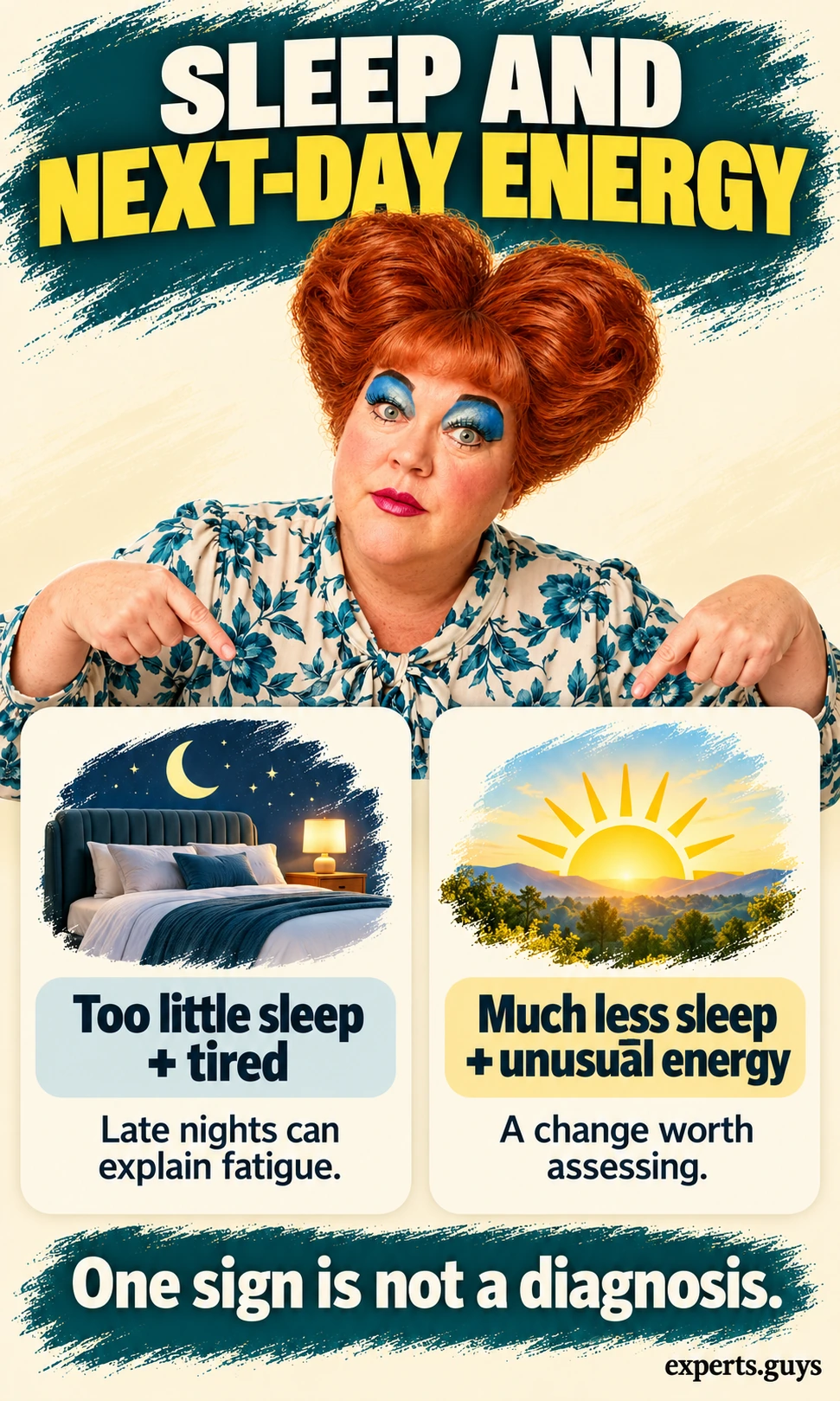
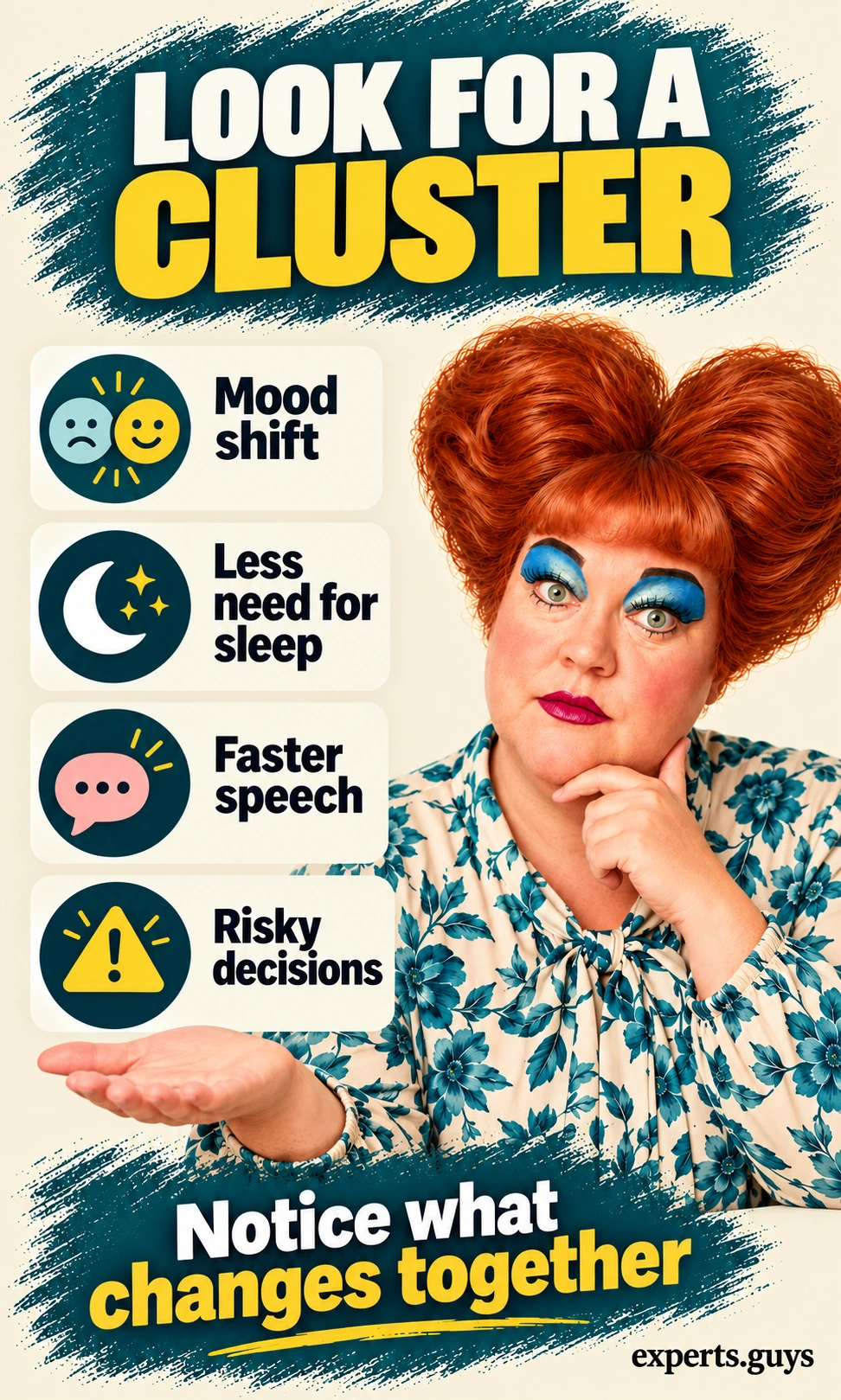
Several signs changing together deserve more attention than one sign considered in isolation. The teen and young-adult signs overview groups changes in mood, thinking and judgment rather than reducing bipolar disorder to sadness alternating with happiness. A teenager does not need every listed sign before their difficulties deserve help.
For example, a normally cautious teen becoming much more talkative would be incomplete information. Add a marked reduction in sleep, persistent increased drive and new dangerous decisions, and the assessment question becomes more specific. This is an illustrative pattern, not a scoring rule, and it does not tell a family which diagnosis will be made.
How can you distinguish a reaction from an episode?
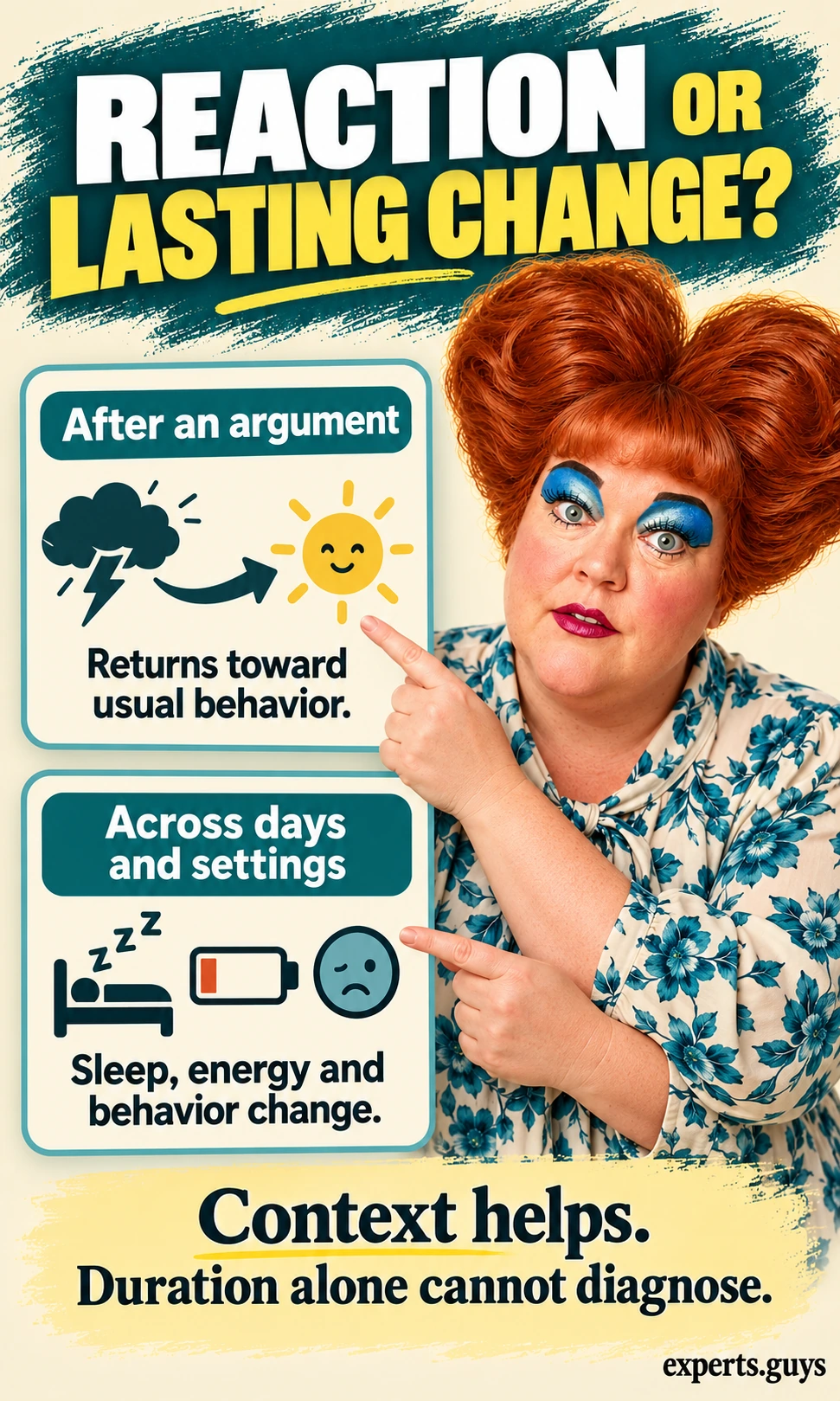
Look at whether the change continues beyond an immediate situation and affects the teenager’s broader pattern of life. A brief reaction after an argument and a sustained change across several days are different observations. Neither a trigger nor the absence of a trigger proves the cause: stressful events can precede an illness as well as ordinary distress.
Start with a bounded comparison you can describe aloud: what was usual before the change, what is different now, and whether the difference persists when the original situation has passed. “Since the weekend, sleep and conversation have both changed” is more useful than “They have always been difficult.” There is no need to turn this into a diary assignment.
Use return toward baseline carefully. Calming after a disagreement can support a situational explanation, but a pleasant afternoon does not exclude an underlying problem. Conversely, persistent irritability can arise in several conditions. The purpose of the comparison is to describe the course accurately, not to rule a diagnosis in or out.
Episode duration has a specific clinical meaning. Clinical episode definitions commonly use at least a week for mania, or any duration when hospitalization is needed, and at least four consecutive days for hypomania; major depressive episodes generally last at least two weeks. These are parts of professional criteria, not instructions to wait while a teenager deteriorates. Severity, accompanying symptoms and alternative explanations also matter.
Assessment in young people needs particular care. NICE’s youth recommendations emphasize experienced specialist assessment over time and apply a more restrictive approach to diagnosis in this age group. A home checklist cannot resolve differences between diagnostic frameworks, and depression plus family history is not enough to make the diagnosis.
- New versus longstanding: identify a change rather than relabeling a familiar temperament.
- Together versus separate: explain which changes happened during the same period.
- Persistent versus momentary: describe the course without enforcing a waiting period.
- Impact versus appearance: explain effects on safety, relationships and daily life, even when grades remain good.
Rapid cycling does not mean every swing between happy and angry within a day. In common diagnostic usage it refers to four or more mood episodes in a year. Within-day emotional changes still deserve understanding, but the phrase should not be used as a shortcut to diagnose bipolar disorder. The broader early-warning-signs discussion covers the wider topic; this page focuses on adolescent baseline and setting comparisons.
Longstanding distractibility or high activity can have a different course from an episodic change. ADHD, anxiety, trauma-related difficulties, sleep disorders and substance effects can overlap with parts of the picture, and more than one condition may coexist. Describing onset and change helps assessment; families should not be asked to eliminate these possibilities themselves.
What do depression and changes at school add to the picture?
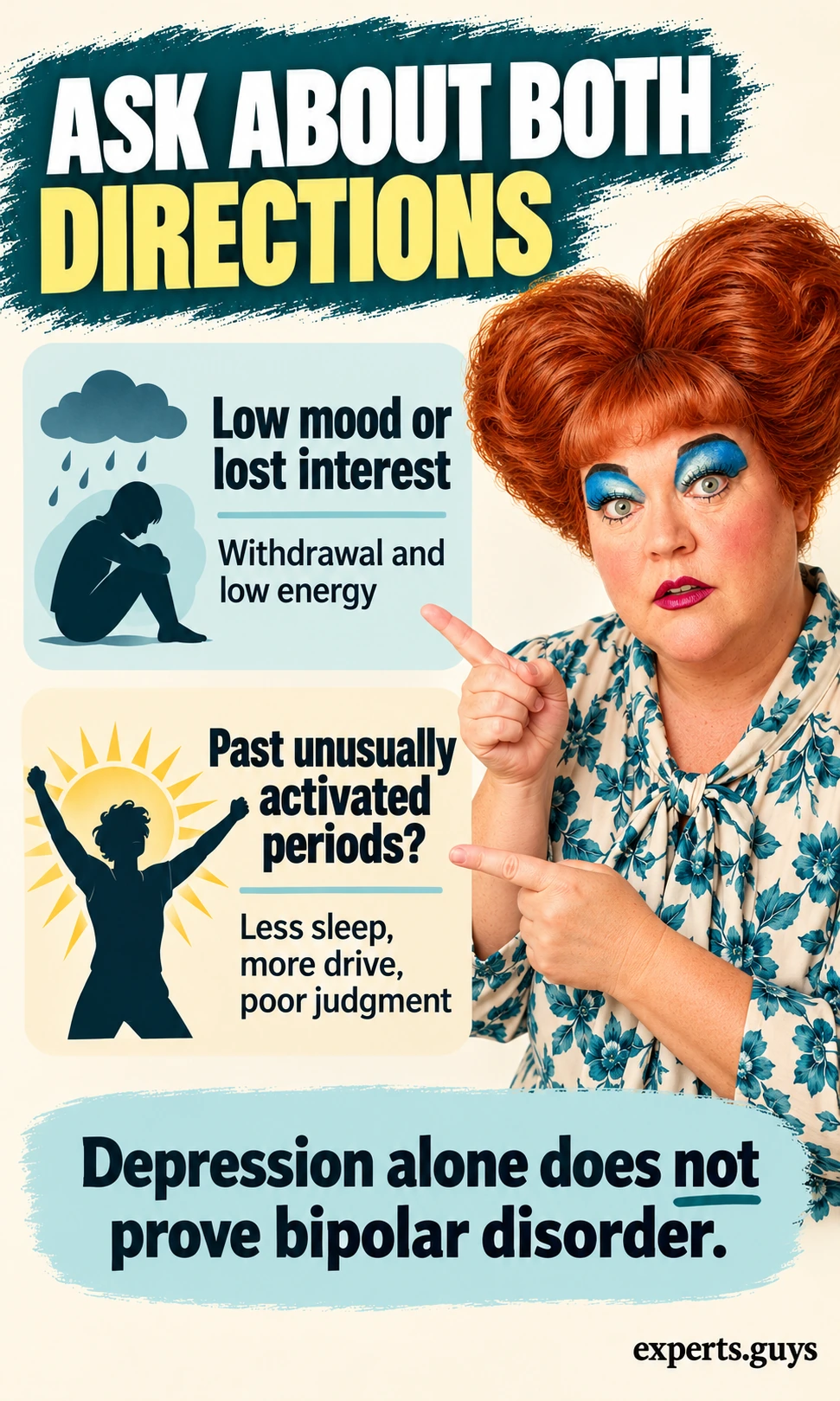
Depression and school difficulties show that support may be needed, but they do not by themselves identify bipolar disorder. A clinician needs the history in both directions: periods of low mood or lost interest, and any past periods of unusually increased activation. A teenager presenting while depressed may not think to mention a previous period they experienced as productive or exciting.
Low mood can appear as withdrawal, irritability, lost interest, fatigue or difficulty concentrating rather than visible sadness alone. Sleep and appetite may change too. The NIMH teen-depression guide explains these changes; the question here is whether the broader history adds evidence of distinct activated periods. Do not infer bipolar disorder simply because depression is severe.
Ask neutrally about earlier changes: “Was there another period when your energy or sleep felt very different from usual?” Follow the teenager’s description instead of supplying a dramatic story for them to agree with. If the answer is no or uncertain, preserve it. Looking in both directions is about avoiding missing information, not trying to obtain a particular diagnosis.
Mixed features can include depressive symptoms alongside unusually increased activation. Someone may be distressed while also sped up, agitated or sleeping very little. That combination should not be interpreted as ordinary happiness balancing sadness. Strong distress plus increased activity can require urgent assessment, especially when safety or judgment changes.
Family history is useful background, not a prediction. A close relative’s diagnosis may inform the clinician’s questions, but it neither guarantees illness nor determines what every behavior means. Equally, no known family history does not rule bipolar disorder out. Unknown or incomplete family information should remain unknown, rather than being filled with assumptions.
| Setting | Useful observation about the same period | Avoid substituting this label |
|---|---|---|
| Home | “Sleep changed, and morning energy was unusually high.” | “They are impossible.” |
| School | “They spoke far more than usual and could not stay with the task.” | “They are attention-seeking.” |
| Friends or activities | “They made out-of-character plans with serious consequences.” | “They have the wrong friends.” |
| Teenager’s account | “My thoughts feel faster, and I cannot slow them.” | “You are exaggerating.” |
To compare settings, first agree which period is being discussed. Ask an appropriate teacher or school support person for concrete changes in participation, pace or functioning during that period, not a diagnosis. Put that account alongside home observations and the teenager’s account. An adult can summarize these verbally; the teenager does not need to fill out forms to deserve support.
A useful school question is “What changed from their usual participation during those days?” rather than “Do you think they are bipolar?” Share only the information needed for support, involve the teenager where safety allows, and use appropriate school channels. Do not recruit classmates to monitor private behavior or search private messages to construct evidence.
Disagreement between settings is information too. A teacher may see an organized student while a parent sees severe nighttime difficulty; opportunities to observe are different. Ask what each person actually saw and when. Agreement is not required before arranging care, and apparent success in one setting does not cancel distress in another.
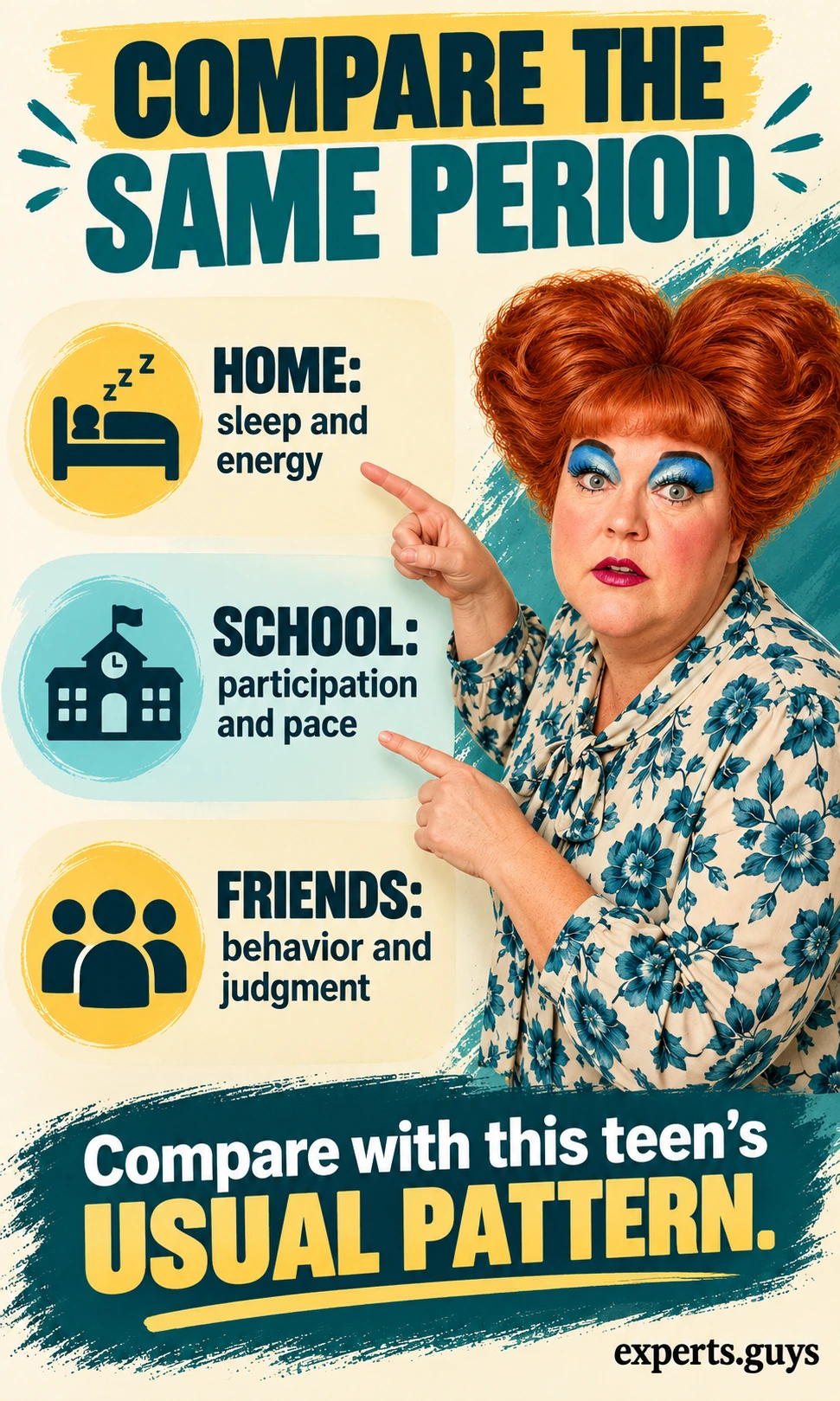
If school difficulties mainly follow bullying, loss or another pressure, address the problem itself while assessment proceeds. The related guide to causes and pressures associated with teen depression develops that separate support question. Here, the distinguishing job is comparing changes during the same period rather than repeating routines for managing general distress.
- Use one shared period so accounts can be compared fairly.
- Ask for observable changes, not diagnostic opinions.
- Include the teenager’s own experience and preserve uncertainty.
- Stop collecting examples when doing so would delay urgent help.
What can you do now without turning this into a home diagnosis?
Choose a response to the teenager’s current needs: a calm conversation when it is safe, an assessment for persistent or disruptive changes, or urgent help when deterioration or safety requires it. You do not need to prove bipolar disorder first. The conversation below applies open, nonjudgmental communication to this situation; the seating arrangement is a practical comfort choice, not a treatment for a mood episode.
Separate the teenager’s goal from the concerning change
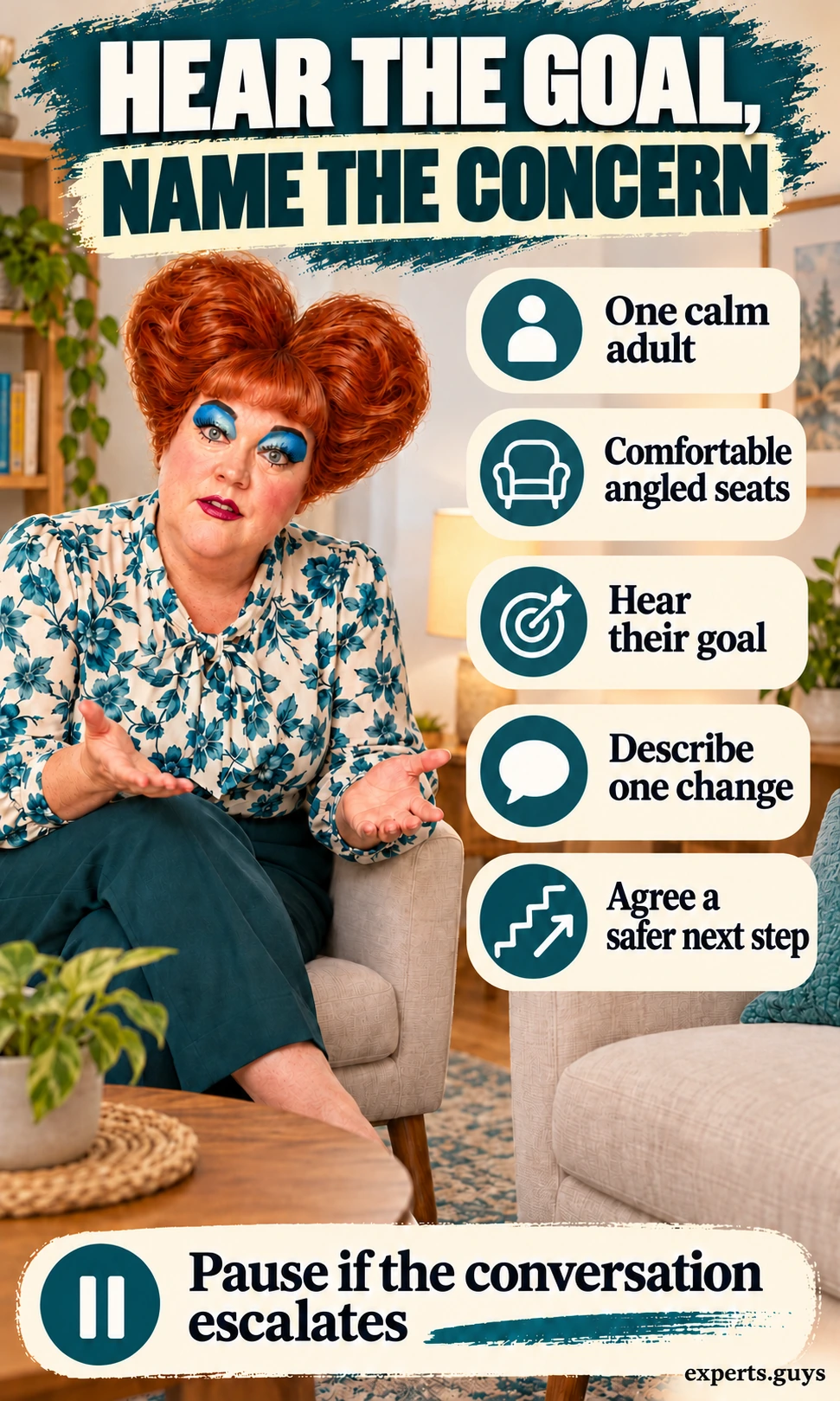
Use this when the teenager is able and willing to talk, not during an unsafe confrontation. Choose one trusted, calm adult rather than assembling an audience. The aim is to understand a specific change while preserving the teenager’s voice, not to obtain agreement with a label. Arrange comfortable seats at an angle or beside one another, leave space and an unobstructed exit, and avoid standing over the teenager. Eye contact is optional; comfort matters more than a particular posture.
- Invite a short conversation and allow a different time if there is no urgent safety concern.
- Ask about their goal: “What were you hoping to do?” Listen before adding another question.
- Describe one observation: “Your sleep and energy seem different this week.” Ask: “What has that been like for you?”
- Reflect the goal and concern separately: “You want to join your friends; I am concerned about how little you have slept and how fast everything feels.” Agree a practical support step where safe, without declaring a diagnosis.
Consider an illustrative conversation about a new plan to drive a long distance after several nights of very little sleep. Begin with the goal: “You want to see your friends.” Separate the concern: “I am worried about the sleep change and whether driving is safe right now.” Offer a safer option, such as an adult arranging transport when appropriate, while seeking assessment for the broader changes. The point is to address a concrete risk without declaring that wanting to see friends is a symptom. Do not negotiate through immediate danger; use urgent help when needed.
The common mistake is turning an invitation into an interrogation. Repeated “why” questions, demands for eye contact or multiple adults challenging each answer can shut the conversation down. In a small home, sitting comfortably at the same table is enough; if speaking is difficult, offer one question and time to respond. No written explanation is required.
Completion means the teenager had an opportunity to explain their goal, the concrete concern was named, and the next support step is understood. It does not require agreement with a diagnosis or an immediate change in mood. Pause if the exchange escalates. If the chosen adult is part of the harm or the teenager feels unsafe with them, involve another safe adult or appropriate safeguarding support. Do not make privacy promises that prevent action on immediate danger.
For persistent, recurrent or disruptive changes, arrange a health assessment that can consider both mental and physical health. A clinician may review development, prior episodes, sleep, medication, substances and family history, and may arrange targeted tests when needed to investigate other explanations. No routine blood test or brain scan by itself confirms bipolar disorder. The guide to choosing mental health support explains service selection, but suspected bipolar disorder needs appropriate diagnostic expertise.
Mention recent medication changes and any substances honestly, without using disclosure as a punishment. If a marked change began after starting or changing a medicine, contact the prescriber promptly. Do not stop or adjust prescribed treatment to test the explanation. The AACAP family guide describes why evaluation and individualized treatment matter in young people.
| Situation | Appropriate next action |
|---|---|
| Immediate danger, serious self-harm or inability to stay safe | Emergency services or the nearest emergency department now; stay nearby if safe. |
| Rapid escalation, severe loss of sleep with worsening activation, inability to meet basic needs, or loss of contact with reality | Seek urgent clinical assessment. Use emergency services if danger is immediate or safe access cannot be maintained. |
| Persistent or recurring changes affecting daily life, without immediate danger | Arrange an assessment and describe the changes, their course and their impact. |
Hearing or seeing things other people do not, or holding strongly unusual beliefs, does not automatically mean schizophrenia or bipolar disorder. These experiences need assessment, particularly when new, distressing or accompanied by unsafe behavior. Do not try to settle the diagnosis by arguing about the belief. Urgency depends on safety and deterioration, not on finding the correct label first.
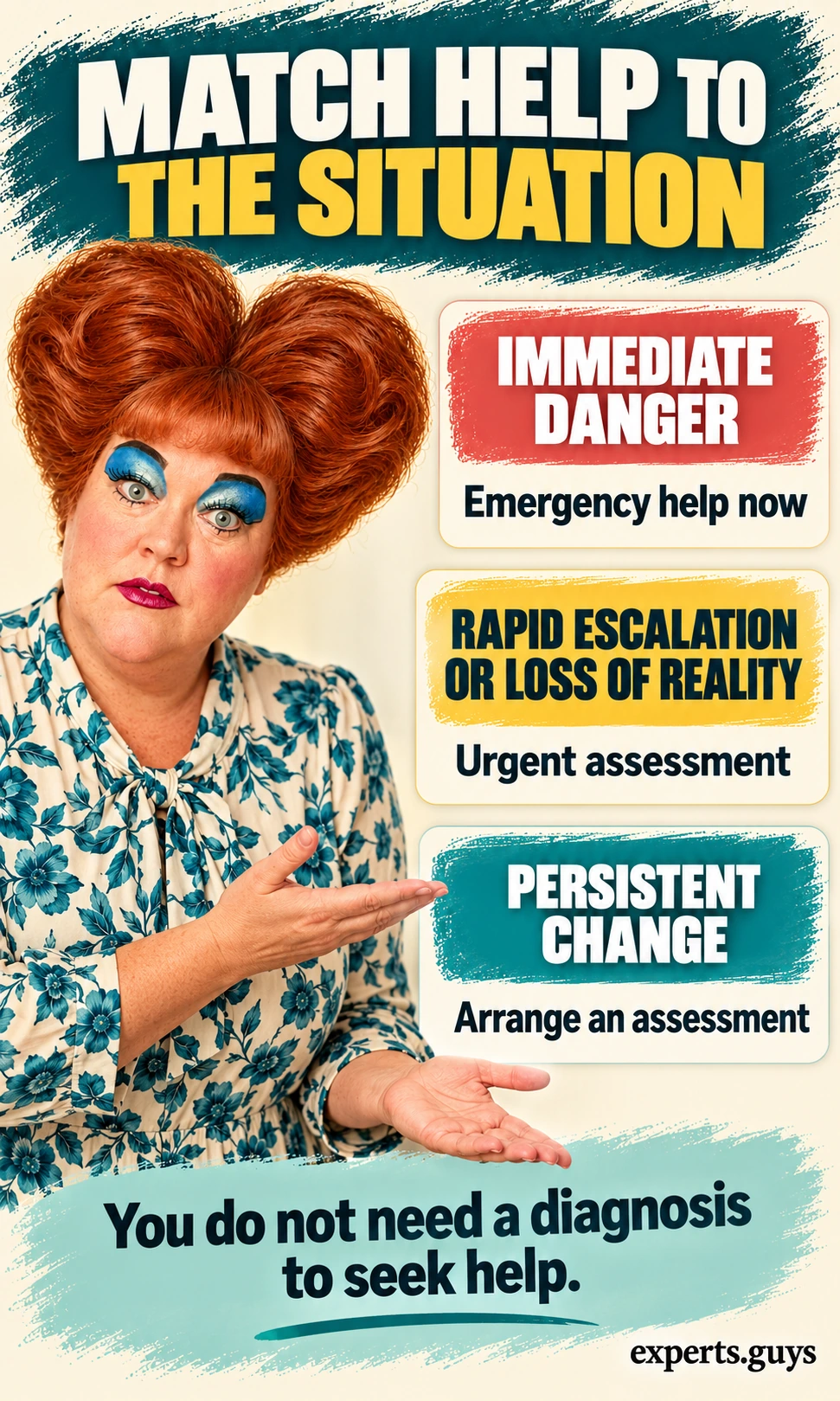
If you are the teenager reading this, you do not need a complete symptom history or a parent’s agreement that it is bipolar disorder before asking for help. Tell a trusted adult, school support person or health professional what has changed and what is hard to manage. If one person dismisses a serious concern, approach another safe person. The goal is appropriate help, not persuading someone to accept a self-diagnosis.
- Choose help based on safety and current functioning.
- Describe the change and uncertainty rather than assigning a label.
- Keep the teenager involved in the discussion wherever safety allows.
- Use a specialist assessment to resolve the diagnosis and treatment plan.
Frequently asked questions
Can a teenager have bipolar disorder without obvious depression?
A manic episode can establish bipolar I disorder when the full clinical criteria are met and other explanations are addressed; a depressive episode is not required for bipolar I. Bipolar II involves hypomania and major depression. These distinctions require professional assessment, particularly in young people.
Does doing well at school rule it out?
No. Grades are only one part of functioning and may lag behind a change in sleep, judgment or relationships. Describe the whole pattern without treating strong grades as proof of wellness or a sudden improvement as proof of mania.
Should I use an online bipolar test for my teenager?
An online score cannot diagnose a teenager. NICE advises against questionnaires to identify bipolar disorder in young people in primary care. A useful next step is describing the changes to an experienced clinician rather than seeking a score that confirms a suspicion.
What if the teenager does not want a parent in the whole appointment?
Ask the service how private conversation time, parent involvement and safeguarding work for the teenager’s age and location. Private time can help a young person speak openly. Do not promise absolute confidentiality or assume that involvement means answering every question for them.
Does a calm day mean the concern has passed?
A calmer day is useful information but does not erase a persistent or recurring change. Continue with an already-needed assessment, and seek earlier help if safety or functioning deteriorates. Improvement should be considered alongside the full course.
Can exercise or a better routine confirm or treat the diagnosis?
No. Everyday support may help general well-being, but improvement after a routine change does not identify the cause. Do not use a home activity as a test for bipolar disorder or as a replacement for assessment and an individualized treatment plan.
The useful next step
The strongest starting point is a clear change from the teenager’s usual pattern, described through sleep, energy, behavior and functioning during the same period. Use a calm conversation when safe and choose the urgency of help from the current situation. A diagnosis should explain the pattern; it should not be a label a family has to prove before the teenager receives support.