
Mental health counseling helps you work through emotional difficulties, understand patterns, and make changes with a trained professional. Start by checking a counselor’s qualifications, experience with your concern, and practical arrangements before committing. You do not need a perfect explanation of your problem to ask for an appointment.
Your first decision is the kind of support you need. Counseling can support problems involving stress, grief, relationships, or mental health symptoms, but the right treatment depends on your situation. This guide focuses on choosing and using a counseling service, from the first inquiry to reviewing the plan.
How do you choose the right mental health counselor?
Choose by verified qualifications, relevant experience, and whether you can work together. A polished profile is useful for an introduction, but it does not establish clinical competence. Ask what the counselor is trained to do, how they would approach your concern, and when they would refer you to another professional.
“Counseling,” “therapy,” and “psychotherapy” overlap in everyday usage. Their professional and legal meanings differ between countries, so the title alone does not tell you the person’s training or scope. The NHS explanation of counseling describes a collaborative talking process, rather than someone simply telling you how to run your life.
New physical symptoms, marked changes in sleep or appetite, or concerns about medication may also need a medical appointment. A counselor can be part of that care, but a counseling qualification alone does not establish prescribing authority. The NIMH guide to psychotherapy explains how treatment choices depend on individual needs and how physical health problems can sometimes contribute to mental health symptoms.

| Your main question | Who to ask | What to clarify |
|---|---|---|
| Can I understand and work on this emotional difficulty? | A suitably qualified counselor or other therapist | Relevant training, approach, and goals |
| Could illness or medication be contributing? | A primary-care clinician or relevant medical specialist | Assessment and coordination with counseling |
| Do I need a particular psychological treatment? | A clinician trained in that treatment and condition | Why that approach fits; alternatives and limits |
| Can I stay safe right now? | Local emergency or urgent mental health services | Immediate assessment rather than a routine booking |
The useful question is specific: “How do you work with someone whose main difficulty is avoiding work because of worry?” That gives the professional a problem to respond to, instead of asking whether they treat “everything.” If conflict is the main concern, depression and relationship conflict explores that separate pattern without deciding which service is right for you.
- Verify credentials: ask for the professional name and registration or license details, then check the appropriate regulator or recognized register for your location. Check the listed status and scope rather than relying only on a directory badge.
- Ask about relevant experience: describe your main concern and ask what training and approach they would use. Mention language, accessibility, cultural or faith considerations that affect your ability to participate.
- Confirm access: ask about availability, referral requirements, online eligibility, and contact between sessions. Finish when you have enough information to accept an initial appointment or look for another provider.

If comparing several providers feels overwhelming, start with one inquiry or ask a trusted person to help check the register with you. That person can help with administration without deciding what you must discuss in therapy. A completed inquiry is a useful first step even if you decide that provider is not a fit.
What happens at the first counseling appointment?
The first appointment usually establishes what brought you in and how you will work together. Expect questions about current difficulties, relevant history, safety, and what you hope will change. The BACP overview of a first session also describes introductions, assessment, and agreement about the service.
You do not have to tell your entire life story in one sitting. Explain what you can, and tell the counselor when a question is confusing or difficult. They may need to ask direct safety questions, but you can ask why information is needed and how it will be used.
Make a three-line starting note
A brief starting note is an optional communication aid, not a symptom test or a treatment exercise. It reduces the need to remember everything while meeting someone new. Use paper or your own device and keep it somewhere private.
- What changed? Write the main difficulty and approximately when you noticed it.
- What is harder now? Add one concrete effect on daily life.
- What would help? Name one change you would like to discuss, then bring the note to the appointment.
Illustrative example: “I worry at night. I have started arriving late for work. I would like mornings to feel more manageable.” The counselor can help clarify this into a useful goal; it does not identify a diagnosis or prove why the problem is happening.

A lower-effort version is one sentence: “Something has changed, and I need help explaining it.” You can read it aloud or hand it over at the start. If forgetting details is part of the difficulty, the separate guide to depression and memory problems explains why that symptom deserves attention rather than blame.
Ask to set a manageable pace
The purpose of setting a pace is to keep the conversation understandable enough for you to participate. It is not a demand that every session feel comfortable or avoid difficult topics. These sample words are an editorial conversation aid, not a formal therapeutic method.
- Name the obstacle: “I am getting overwhelmed by the number of questions.”
- Ask for a change: “Could we slow down?” or “I am not ready for details yet.”
- Agree what comes next: “Can we start with how this affects my week, then decide what else you need?”
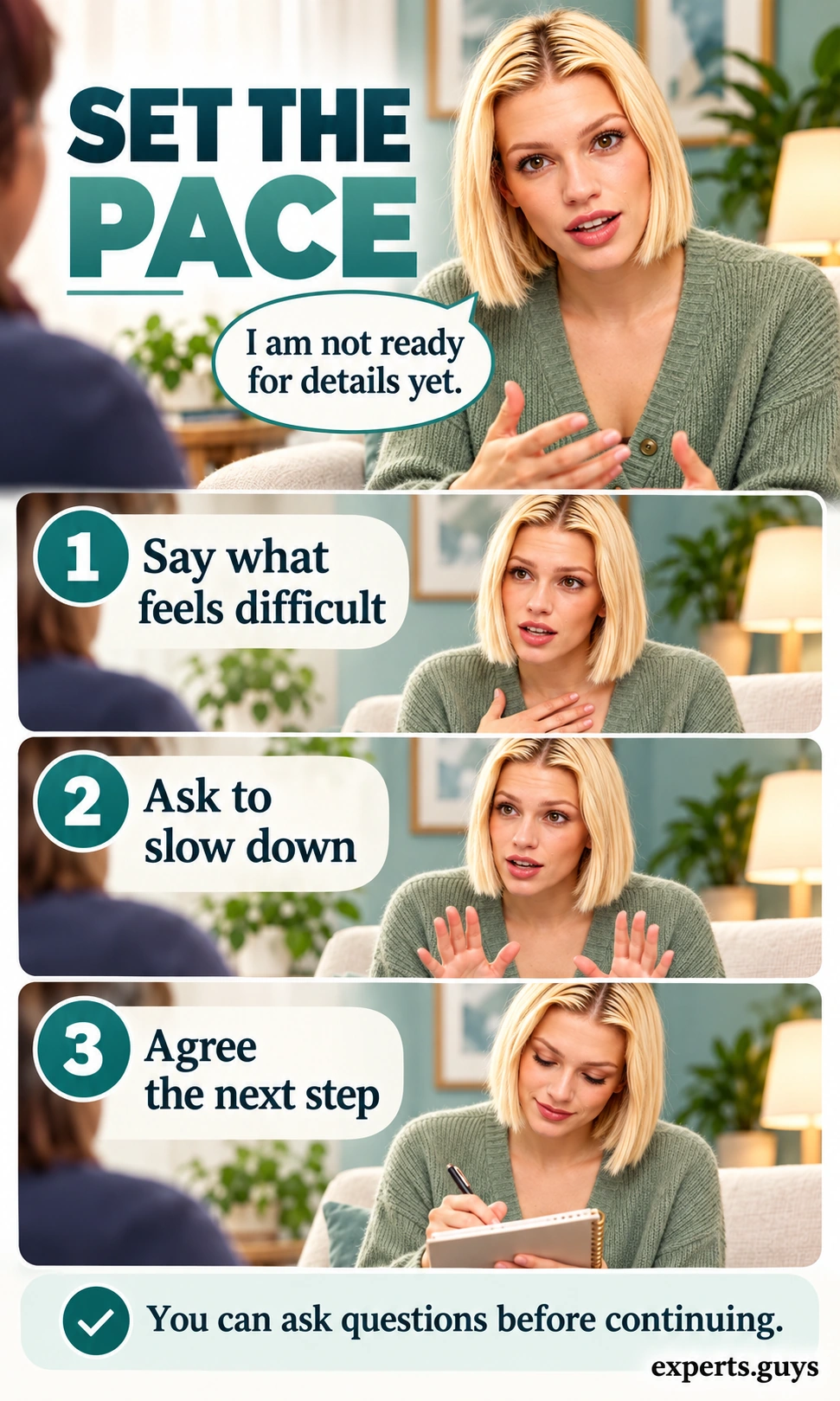
If speaking is difficult, show the counselor the sentence on your note instead. Completion means your concern has been communicated and a next step discussed, not that you feel instantly better. If you feel unsafe or repeatedly dismissed, you can seek another opinion or service.
What should you check about privacy, cost, and online sessions?
Check the service agreement before you rely on the appointment. Privacy, payment, and online arrangements can affect whether you feel able to speak and whether you can continue attending. Get unclear terms explained in ordinary language rather than assuming every practice operates alike.
Confidentiality has limits, and those limits depend on the setting and local law. The APA’s U.S. confidentiality guidance discusses situations involving serious harm, legal requirements, and information shared for payment. Ask how the rules apply to you, particularly if you are under 18 or use someone else’s insurance.
Ask three separate questions: who can see session records, when information may have to be shared, and what billing communications reveal. In the U.S., an insurance explanation of benefits can reveal that a service was used without disclosing the whole counseling conversation. Ask both the practice and insurer about their actual communication procedures; privacy is not established merely because a video platform calls itself secure.

| Topic | Ask the service | What you need to understand |
|---|---|---|
| Records | Who can access or receive information about my care? | Routine access and any proposed sharing |
| Confidentiality limits | What circumstances could require disclosure? | Rules that apply to your age and location |
| Contact | Which channel can I use between sessions? | Response time and what it cannot handle |
| Consent | Can you explain any term I do not understand? | Your options before agreeing |
Check the amount you would actually pay
Compare the cost of the arrangement you would use, rather than a headline fee alone. Ask the practice for the session price and length, what you would owe under your coverage, and the cancellation or missed-appointment policy. If using insurance or another payer, confirm eligibility and benefits with that payer as well; a practice accepting insurance is not a promise that every service is covered.
Request the terms in writing and keep the reply with your appointment details. For example, “Before I book, could you confirm the fee, my expected share, and the cancellation deadline?” This is an administrative script, not a price estimate; if the arrangement is unaffordable, ask about a lower-cost service or referral rather than assuming you have to accept it.

Set up an online appointment
Online counseling changes the setting, but it still needs privacy and a workable care arrangement. Ask whether the clinician can provide care where you will physically be, especially when traveling across borders. HHS telehealth privacy guidance highlights the importance of a private space and secure communication.
- Choose a private room: reduce interruptions and avoid a place where others can overhear. Headphones help with incoming sound but do not stop your own voice being heard.
- Test the setup: use the practice’s instructions to check sound, camera if needed, and connection. Prefer your own device and a trusted, password-protected network.
- Agree a backup: know how to reconnect if the call drops, and confirm your location and emergency arrangements with the clinician. If no private option is available, ask about another appointment format.
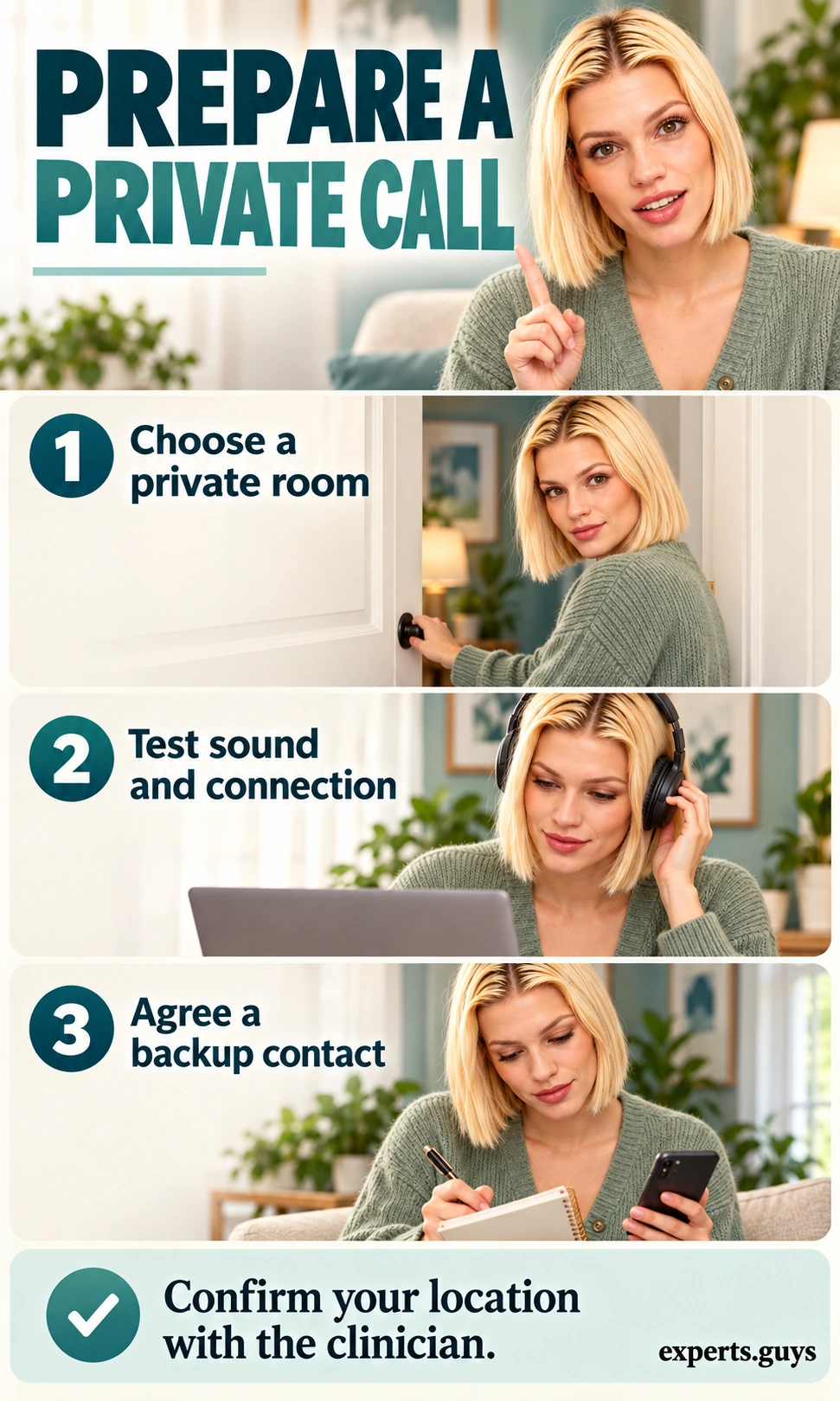
The setup is complete when you know where you will attend and what to do if the connection fails. It does not guarantee privacy or make routine online counseling an emergency service. You can ask the practice to help with the test rather than troubleshoot unfamiliar software alone.
How do you know whether counseling is helping?
Review progress against a goal you agreed together, with room to change the plan. Feeling heard matters, but it is also useful to discuss what is happening in daily life and whether the approach makes sense to you. The APA’s psychotherapy guide describes treatment as collaborative, with different approaches and lengths depending on the situation.
There is no universal session count after which counseling must have worked. Ask when you and the counselor will review progress and what would lead to changing the approach or involving another professional. Report worsening symptoms promptly rather than waiting for a scheduled review.
- Name one daily-life goal: for example, being able to arrive at work on time. Agree what progress would look like without treating a single outcome as proof of recovery.
- Bring a concrete example: describe one recent occasion when the difficulty was easier, unchanged, or harder. A short example is enough; you do not need to produce a perfect diary.
- Review and adjust together: ask what the example suggests about the plan, what to continue or change, and when to review again. If writing is tiring, discuss the example verbally.

Illustrative review: “I can leave home earlier now, but worry still keeps me awake. Can we review whether our plan addresses both?” This connects the observation to a decision instead of collecting notes indefinitely, while the separate article on depression and sleep problems explains sleep patterns in more depth.
| What you notice | What to discuss |
|---|---|
| Some progress, with an important difficulty remaining | Whether to refine the goal or address a barrier |
| No clear progress or no clear treatment rationale | Whether the approach, assessment, frequency, or referral needs review |
| Tasks feel unrealistic or the pace feels too fast | How to simplify or adapt the plan together |
| Symptoms worsen or safety changes | Prompt assessment; urgent help if you cannot stay safe |
| Pressure, exploitation, or serious boundary concerns | Another professional opinion and the relevant complaints route |
Difficult emotions during counseling do not automatically mean the treatment is wrong, but distress should not be dismissed as proof that it is working. Ask for the reasoning behind the approach and explain the effect on you. For concerns about professional conduct, use the provider’s regulator or professional body; BACP offers guidance on counseling concerns within its remit.
If you decide to change providers, ask about continuity and what information you want shared, where that is safe and appropriate. A different fit or approach may be needed, and that decision is not a personal failure. Do not change prescribed medication solely because you are starting, stopping, or switching counseling; discuss medication decisions with the prescriber.
Frequently asked questions
Do I need a diagnosis before contacting a counselor?
You can ask about counseling without knowing a diagnosis. A service may still have referral, eligibility, or payment requirements. Explain what is troubling you and ask what its first assessment involves.
Can a friend or family member attend?
Ask the counselor before the appointment. A support person may help you communicate, but their presence changes what can be discussed privately. Agree their role and whether part of the session should be one-to-one.
Will counseling mean discussing my childhood?
The topics depend on your concern and the approach. Earlier experiences may be relevant, but they are not the only possible starting point. Ask how a question relates to your agreed goals and tell the counselor when you need a slower pace.
Is an AI chatbot the same as a counselor?
An AI chatbot is not equivalent to care from an appropriately qualified professional. It may produce inaccurate responses and has different privacy and accountability arrangements. Do not rely on it for emergency assessment or assume that entering sensitive information is confidential in the same way as clinical care.
Next steps
Choose one provider to check, or prepare the question you most want answered at an existing appointment. Use the matching illustrated steps above rather than trying to complete every task at once. The useful outcome is a clearer, workable next conversation about your care.