
Living with bipolar disorder can mean adapting ordinary responsibilities to changes in energy, concentration and sleep, while also having periods of stability. For women, the practical burden may include paid work, relationships, caring responsibilities and decisions about reproductive health. Start with the part of the day that is hardest to manage, and change the task or the support around it rather than demanding more effort from yourself.
There is no single female experience of bipolar disorder, and needing help does not remove your right to make choices. The seven approaches below focus on concrete changes you or a trusted person can make together. Their purpose is to reduce a particular difficulty, not to make you prove that you are recovering by completing a routine.
Bipolar disorder is more than ordinary changes in mood; it can affect activity and functioning over an episode. For the diagnostic picture, see bipolar symptoms in women. Here, the focus is what happens around a person: whether work actually ends, help really removes a burden, and social contact leaves room for rest.
How can daily life feel different even when you look well?
1. Let the workday end at a visible stopping point
You may look capable while spending much more effort on the same task, or feel ready to continue long after your usual stopping time. A practical work boundary makes the end of a task visible instead of leaving it dependent on how much energy you happen to feel. It suits a safe desk-based activity at home; a job involving machinery, driving, medication administration or another person’s safety needs its own formal handover.

Choose an ordinary endpoint before beginning, such as finishing the current page of a work document rather than completing the entire project. Then make the transition physical:
- Finish the current safe step. Save the document or leave the material in a state that can safely wait. Do not create a new task because the first one went well.
- Put the work materials away. Close the folder, shut the laptop and place portable items in their usual storage space. A clear surface marks the transition; it is not a demand to clean the whole room.
- Leave the work position. Move to your usual nonwork seat or another room if available. If you share one room, turn away from the work surface and place the closed folder out of reach.
Easier version: close one folder and let a willing helper put it away. A common mistake is turning the shutdown into an elaborate organizing project, so stop when the work is safely paused. The useful result is that you have left the task, not that you feel relaxed; if unusually high energy keeps pushing you back into work, the answer is not a stricter productivity rule. That change belongs in your clinical care plan.
2. Return to an activity without a catch-up target
During a difficult period, an enjoyable activity can become another reminder of what you have missed. Re-entering it does not require completing the backlog or matching your previous pace. A familiar, low-pressure activity is a better fit for this example than a new challenge with equipment to buy or targets to meet; the aim is contact with something you value, not a performance test.
The illustration uses a jigsaw puzzle, but the important choice is whether the activity actually interests you. Use a comfortable seat and a surface you can reach without strain:
- Choose one familiar activity. Bring out only the materials needed for a small part. For the puzzle, a few accessible pieces are enough.
- Do one manageable part. Try placing a piece or looking for one match with a trusted person. You can participate without keeping up with the other person.
- Stop before adding more. Put loose pieces into a tray and leave the activity ready for another day. Stop sooner if discomfort or frustration is increasing.
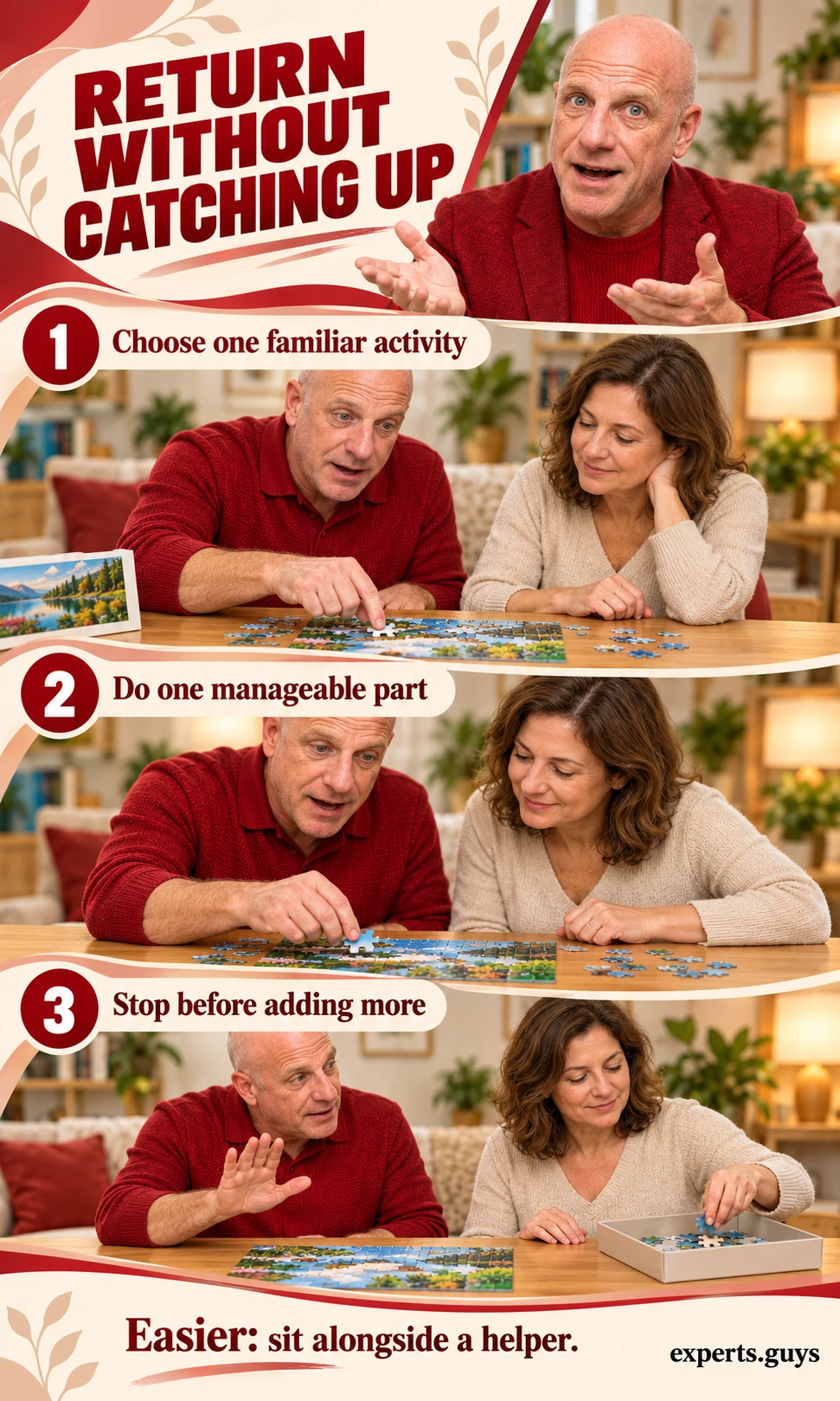
Easier version: sit alongside someone who is doing the activity and join only if you want to. Avoid making “one piece” a compulsory quota or treating a lack of enjoyment as failure. The checkpoint is that you had a manageable opportunity to participate. These task adjustments are everyday support, not a treatment protocol or evidence that an episode has ended.
How can you protect rest when other people depend on you?
Advice to rest can feel empty when the same person still answers every question and manages every interruption. Making rest possible means changing who is responsible for the next demand. A consistent routine and avoiding excessive work hours are part of general bipolar self-management guidance; the household examples here translate that principle into practical arrangements, without claiming that a rest break prevents an episode.
3. Hand over the interruptions, not only the chore
Use this when a trusted person is available and you agree that a particular responsibility can temporarily move to them. Choose a comfortable place to rest that is accessible to you, and keep exits clear:
- Agree who takes over. Name the actual responsibility aloud: “Please take the laundry out and handle the next household questions while I rest.” If care of a child or dependent is involved, responsibility must be explicitly accepted by a capable adult.
- Move the interruption away. The helper takes the basket or other safe, light materials into another space and carries out the noisy task away from the resting area where possible. Leave heavy lifting to someone able to do it safely.
- Leave the rest space available. The helper avoids returning for nonessential decisions. Agree how urgent needs will be communicated and when ordinary responsibilities return; do not lock anyone in or make them unreachable.
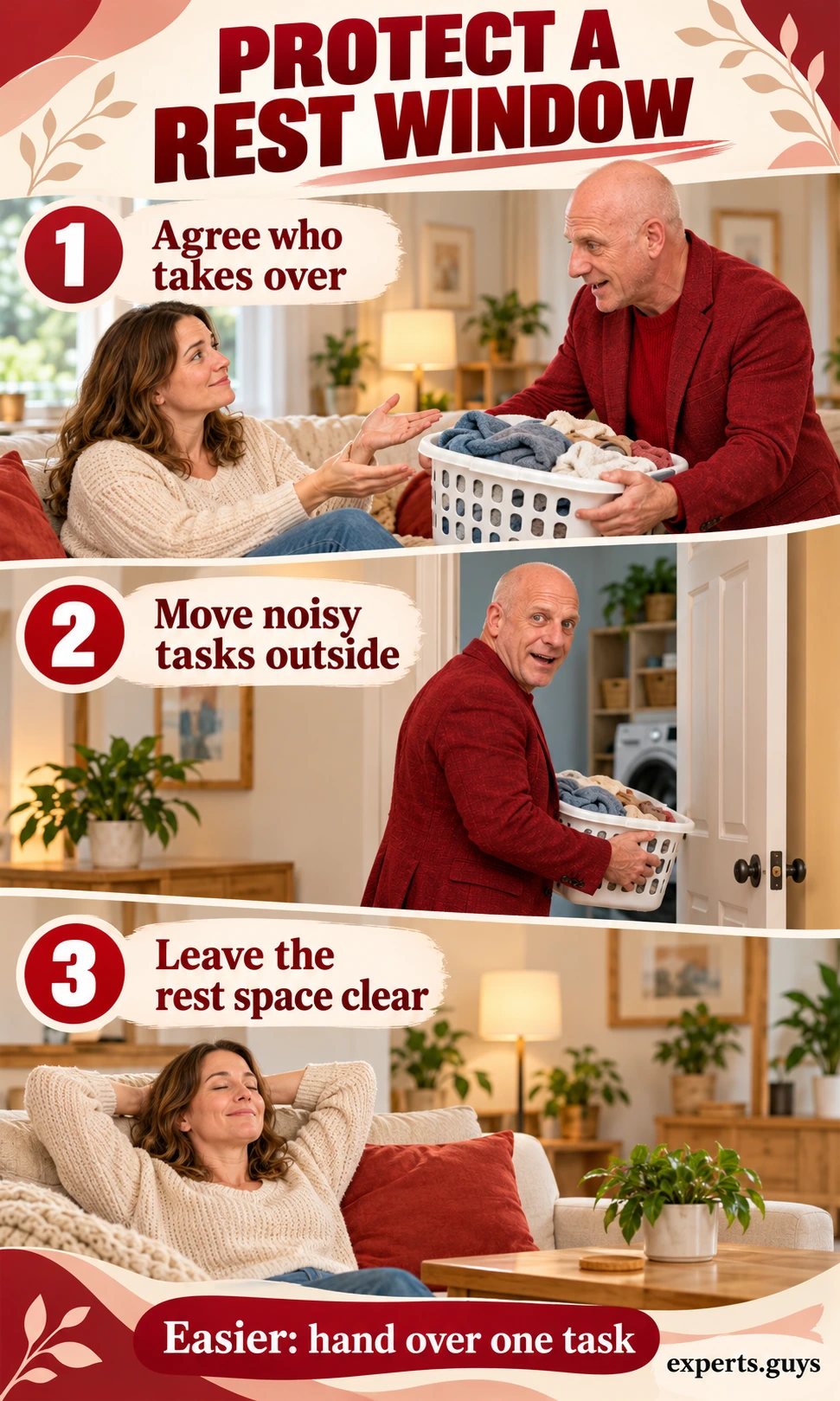
Easier version: hand over just one interrupting task. If nobody is available, postpone a nonessential chore where safe, rather than pretending all caring duties can disappear. The checkpoint is an actual reduction in demands, not a completed sleep target. This is not a prescription for prolonged daytime sleep, and feeling little need for sleep despite very short nights requires clinical attention rather than a longer household rest experiment.
4. Share a job with a clear finish
Help can leave the hardest part untouched if you still have to explain every stage, find every object and notice everything that was missed. Agreeing the finish reduces that hidden management work. The distinction below matters whether the job is setting a table, preparing for a visitor or another safe household responsibility:
| Help offered | What still falls on you | A clearer agreement |
|---|---|---|
| “Tell me what to do.” | Choosing each next step. | Name one complete job and the materials already available. |
| Doing one stage. | All remaining stages, unless agreed otherwise. | Choose a stage deliberately when a whole job is too much. |
| Taking the whole job. | Only the decisions you want to retain. | Agree the endpoint, then let the helper complete it their way. |
For the table-setting example, use lightweight items and a surface both people can reach. Decide whether you are sharing the task or handing it over completely before the first plate moves:
- Choose one household job. For example: “Set two places using the plates and glasses already out.” Agree what finished means.
- Let the helper complete the agreed part. If the whole job is handed over, they collect and place the items without requiring you to stand beside them. If you choose to share one stage, say which stage remains theirs.
- Stop at the agreed endpoint. Two usable places are enough. Do not attach clearing a cupboard, preparing dinner or reorganizing the kitchen to the original request.
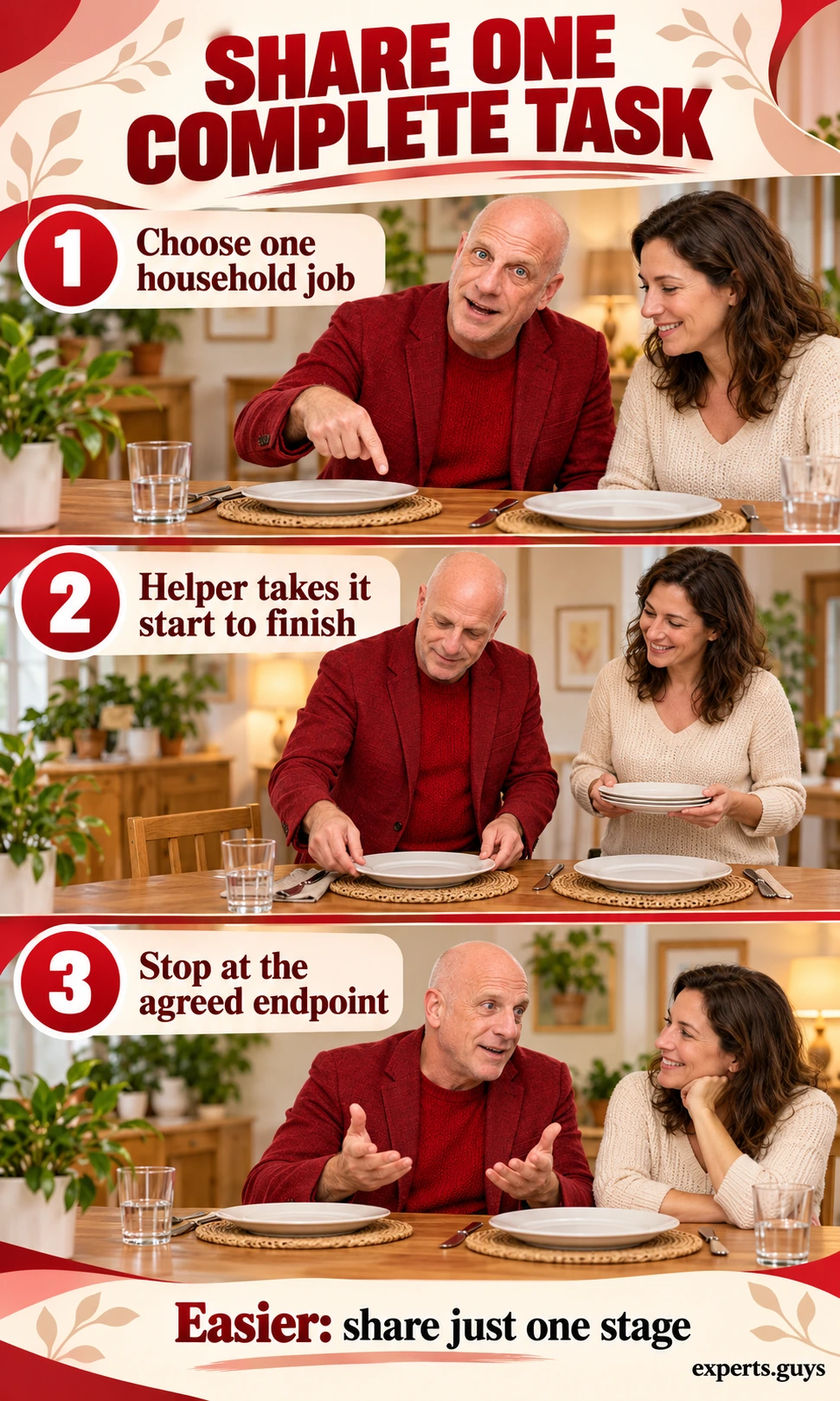
Easier version: share only one stage, such as placing the glasses, while the helper does the rest. Correct a safety problem, but avoid supervising harmless differences in arrangement. The result is one responsibility genuinely reduced. Help should be offered with consent and without turning household contribution into a measure of someone’s worth or giving another adult unlimited authority over their day.
What changes around pregnancy or after childbirth?
Pregnancy plans and the period after childbirth need individualized treatment planning because both illness and medication decisions can affect parent and baby. Do not stop or change bipolar medication on your own; perinatal mental health guidance addresses these competing risks. New confusion, unusual beliefs, hallucinations or rapidly escalating mood changes after childbirth need urgent assessment. A household handover can support care, but it is not a substitute for assessment or a baby-feeding plan tailored to the family.
How can support protect choices without taking control?
Support works best when it increases the room you have to make a decision. Optional spending is one example: some mood episodes can involve impulsive decisions, but a purchase alone does not diagnose an episode. Nor does a diagnosis give another person permission to take your money, monitor everything you buy or treat every preference as a symptom.
5. Put distance between an urge and an optional purchase
This example is for an in-person, nonessential purchase when you can still choose to pause. It is not a plan for severe mania, urgent financial problems or necessary purchases such as food and medicine:
- Put the item back. Return the optional item to the display or ask staff to do so if it is heavy or fragile. You do not need to explain your medical history.
- Step away from the display. Move to another area or leave the shop with a companion you trust, if wanted. The companion supports your choice rather than arguing, grabbing possessions or blocking you.
- Revisit when settled. Decide later whether the item still fits your ordinary needs and spending arrangements. There is no universal waiting interval that proves a decision is safe. If an episode may be developing, use the existing care plan rather than relying on the pause alone.

Easier version: ask a trusted companion to walk out of that aisle with you; no account access is required. The checkpoint is that you created a gap before an optional transaction. Avoid turning the gap into browsing the same item in another shop. Any wider financial safeguards should be agreed while you are well enough to participate and should preserve access to essentials, with appropriate independent advice if needed.
| Helpful support | A boundary it should preserve |
|---|---|
| Asking whether you want company while leaving a shop. | You can decline ordinary help. |
| Following a previously agreed care plan when symptoms escalate. | Use the agreed response, not an improvised punishment. |
| Helping with an explicitly agreed household responsibility. | Do not demand passwords or control unrelated decisions. |
| Raising a specific change with concern. | Do not use the diagnosis to dismiss every disagreement. |
How can relationships stay connected without extra pressure?
A relationship can become strained when every conversation turns into a discussion of symptoms, or when ordinary disagreement is treated as proof that someone is unwell. Practical support needs room for both people’s limits. The role of psychotherapy and family support in bipolar care is broader than any household communication technique; the examples below are small ways to reduce immediate friction, not replacements for that work.
6. Pause the argument without abandoning the person
Use this for an ordinary disagreement when both people can respect a pause. It is not suitable as a stand-alone response to violence, threats, severe confusion or an unsafe situation:
- Stop the argument. Say a short, neutral sentence such as “I want to continue this when we can hear each other.” Avoid diagnosing the other person or demanding an admission that they are wrong.
- Give each other space. Move to a separate seat or room by agreement. Keep the doorway clear; do not follow, restrain or take someone’s keys to enforce the pause.
- Return when both are ready. Agree a reasonable opportunity to come back to the issue, then discuss the original concern. A pause should not become punishment or indefinite silence.
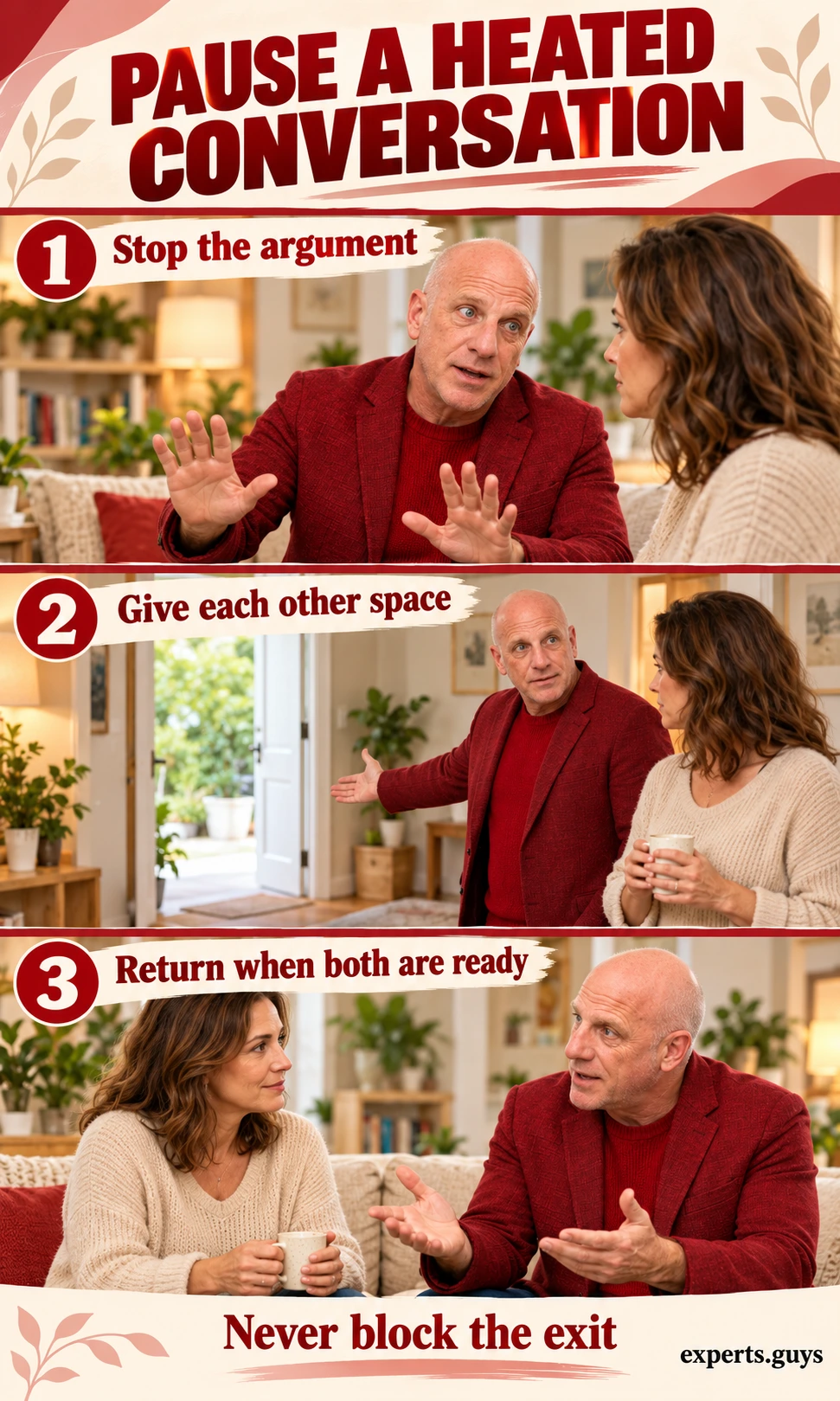
Easier version: stay seated with more space and stop speaking for a mutually comfortable pause if moving rooms is difficult. The checkpoint is that the exchange has stopped escalating, not that either person has conceded. If you are afraid of the other person or cannot leave safely, prioritize getting safe help. You do not owe a return conversation in an unsafe relationship, and bipolar disorder does not excuse abuse.
7. Give a social visit an easy exit
A gathering can be manageable at the start and exhausting later. An easy exit lowers the practical cost of attending, without assuming that every social situation should be avoided. This approach is useful for an ordinary visit when you are well enough to go; it is not a reason to push through emerging symptoms or ignore a care plan.
Choose a gathering with a realistic route home and someone who will respect your choice to leave. Keep the plan simple enough that it still works when you have less energy:
- Choose an edge seat. Sit where leaving does not require everyone else to move. Keep the route accessible; an edge seat is useful only if it is comfortable and safe for you.
- Say a brief goodbye. “Thank you for having me; I’m heading home” is enough. You can appreciate the visit without negotiating permission to end it.
- Leave with safe transport. Use the suitable ride or companion arrangement you chose. Do not drive if sleep loss, medication effects or symptoms make driving unsafe.

Easier version: choose a shorter visit or a quieter setting from the outset. Avoid adding another stop because you feel guilty about leaving. The checkpoint is that you can finish the visit without losing control of how you get home. The same principle helps a host: accepting a goodbye kindly can be more useful than repeatedly urging someone to stay.
You can ask for practical flexibility without telling every acquaintance your diagnosis. With someone close, specific requests are easier to act on than “be more supportive,” but you still decide how much personal information to share. For clinical questions, the separate guide to how bipolar disorder is treated covers treatment choices; the early-warning-signs guide addresses changes from your usual pattern. Those questions deserve their own detail rather than turning every relationship conversation into monitoring.
Frequently asked questions
Does having a good day mean bipolar disorder has gone away?
No. Feeling well can be part of living with bipolar disorder, and stability does not by itself mean that treatment is no longer needed. Keep agreed care in place and discuss changes with the prescribing clinician rather than stopping medicine because today feels easier.
Do all women need the same kind of support?
No. Household roles, health, resources and personal preferences differ. Someone who lives alone may need a different arrangement from someone sharing care of children or an older relative. Use the examples that fit the actual difficulty; a gender label is not a checklist of responsibilities.
Is rapid cycling the same as changing mood during an argument?
No. Rapid cycling describes four or more distinct mood episodes in a year. It is not a term for every quick emotional reaction. An assessment considers episode patterns over time, not a single difficult conversation.
Can someone help without being a partner or family member?
Yes. Depending on the task, a trusted friend, housemate or another willing support person may be the right fit. Agree what they are able to do, keep the request within that boundary, and avoid assuming that closeness means unlimited availability.
What if these adaptations do not make me feel better?
A useful task adjustment can remove one burden without changing mood. That does not make it pointless, but worsening symptoms or difficulty meeting basic needs needs more than a household workaround. Use your care plan and seek appropriate assessment rather than adding more routines as a test of willpower.
Choose the support that removes today’s obstacle
If work keeps extending, use a visible stopping point. If rest is repeatedly interrupted, hand over the interruptions; if help leaves you supervising, agree a complete job. If a purchase, conversation or visit feels hard to exit, create room to pause while preserving choice. Choose one change that fits today, and judge it by whether the task became safer or more manageable, not whether it produced an immediate improvement in mood.