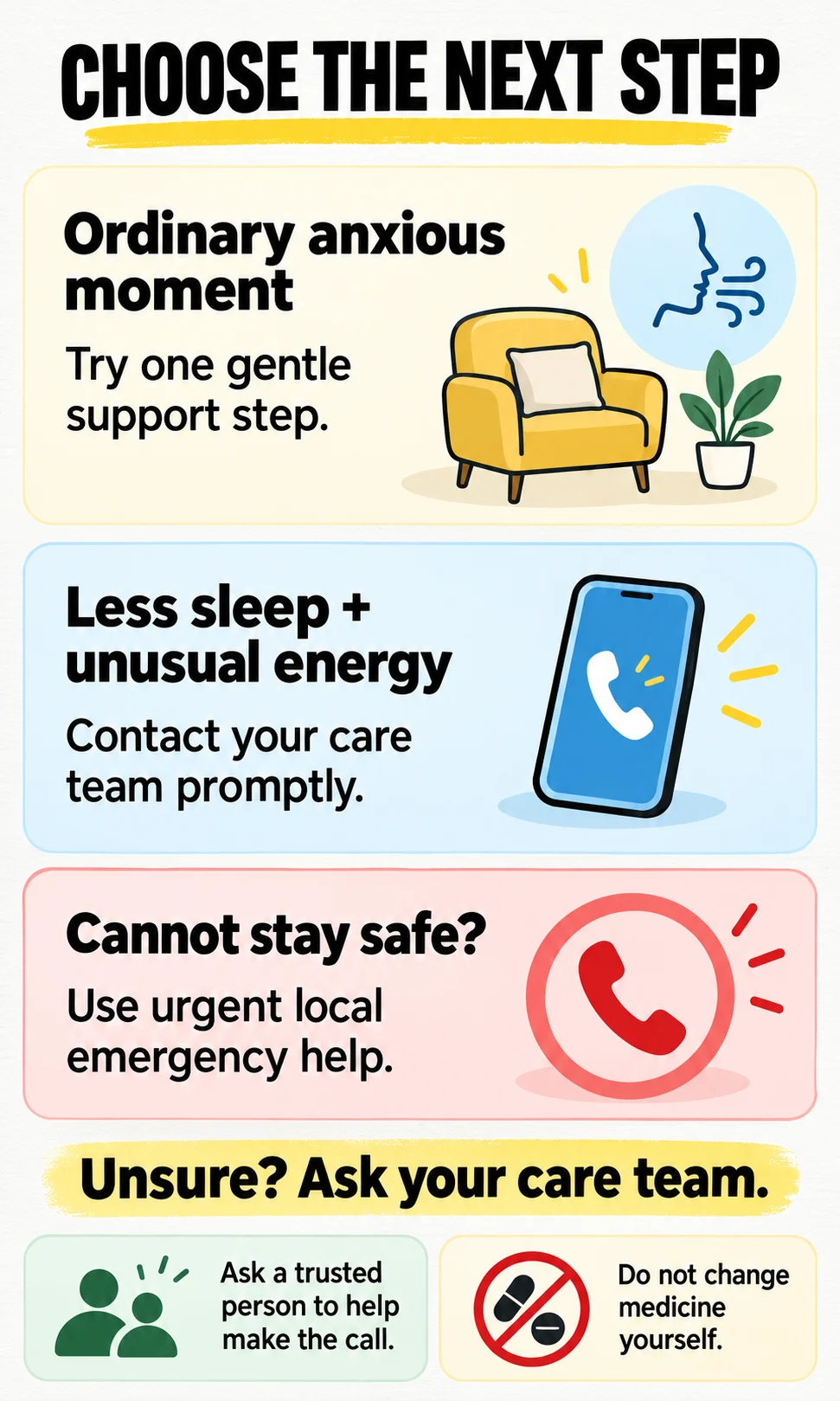
Anxiety can occur alongside bipolar disorder, and feeling anxious does not by itself tell you whether a mood episode is starting. For an ordinary anxious moment, try one gentle, manageable action; if you are sleeping much less and feeling unusually energised, impulsive or unlike yourself, contact your care team promptly. Self-help can support you, but it cannot diagnose or treat a bipolar episode.
What can you do when anxiety builds?
Start with something you can physically do: sit in a supported chair, place your feet on the floor and let your breathing settle into a comfortable rhythm. You do not need a notebook, a mood score or the perfect explanation before beginning. Choose a quieter place if noise or messages are adding to the pressure.
If you are in immediate danger, cannot stay safe, or feel at risk of harming yourself or someone else, use urgent local help rather than continuing an exercise. New severe chest pain, fainting or serious breathing difficulty also needs urgent medical assessment. Anxiety is not a safe explanation for every physical symptom.
Practise gentle breathing without forcing it
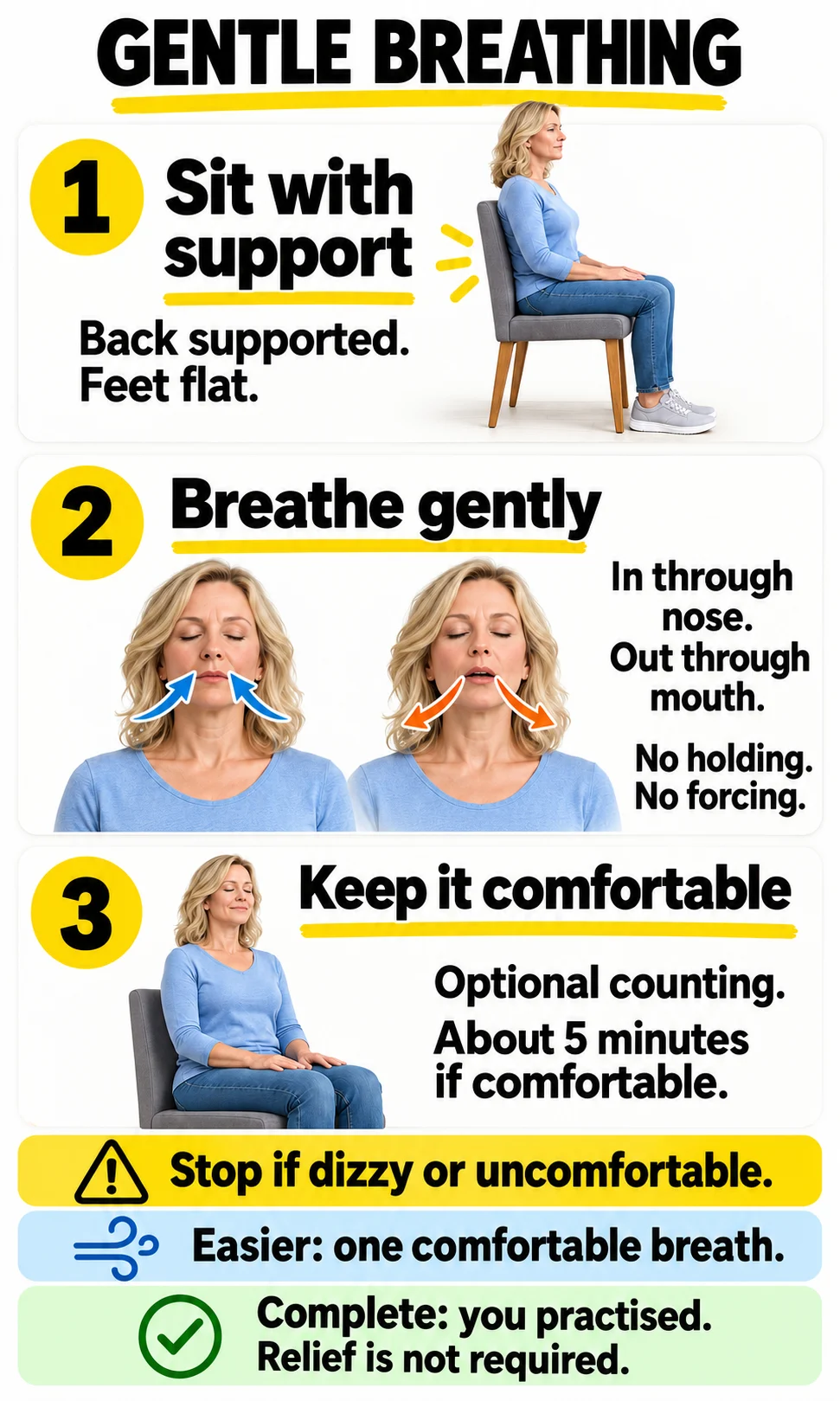
This exercise fits a tense but safe moment when you want a simple place to start. Sit with your back supported and both feet on the floor, then breathe gently in through your nose and out through your mouth if comfortable. Keep the breaths easy, with no holding, straining or effort to fill your lungs as much as possible.
- Sit with your back supported and both feet flat on the floor.
- Breathe in gently through your nose and out gently through your mouth if comfortable. Do not hold or force your breathing.
- Use a comfortable rhythm, with optional easy counting. Try about five minutes if tolerable; stop if dizzy, uncomfortable or more distressed.
The NHS breathing exercise for stress suggests a comfortable, regular rhythm, with optional counting, practised for about five minutes. You can start with one comfortable breath if a longer practice feels difficult; that shorter starting point is an editorial adaptation. Stop counting or return to normal breathing if the exercise makes you dizzy, uncomfortable or more distressed.
Illustrative example: you are about to answer a stressful message and notice that your shoulders are tight. Put the phone down, sit with support and take a few unforced breaths before deciding whether to reply now or ask for more time. Completion means you practised the step, even if the worry is still present; if breath-focused practice feels unhelpful, choose a quieter setting or ask someone to sit with you instead.
Why anxiety and bipolar symptoms can be confusing
Worry, irritability, restless feelings and disturbed sleep can appear in more than one mental-health condition. Anxiety can also persist when a person with bipolar disorder is between mood episodes. A clinician considers the pattern over time, changes from your usual behaviour and the wider context, rather than diagnosing from one symptom.
The useful question is not which condition is worse, but what has changed and what support is needed. For example, lying awake worrying and feeling exhausted is different from sleeping very little while feeling unusually driven and not tired. Neither description is enough for self-diagnosis, but the second deserves prompt attention when bipolar disorder is known or suspected.
For the broader distinction, read depression, anxiety, or bipolar disorder. Use that comparison to prepare questions for an assessment, not to choose your own label. If you have never received a diagnosis, start with a qualified health professional rather than trying to infer one from an online exercise.
There may be an obvious worry, such as an appointment or a difficult conversation, or the anxious feeling may be hard to explain. You do not have to identify its entire cause before asking for help. Tell your clinician if it is persistent, worsening or interfering with sleep, work, relationships or basic daily activities.
If your care team has already agreed an early-warning plan with you, use that plan when familiar changes return. A brief description is useful when it leads to an action: what changed, when it began and whether sleep or behaviour is different. Long, repeated diaries are optional and should not delay contacting someone when you need support.
| What you notice | What to do |
|---|---|
| Tense or worried, with usual sleep and behaviour | Try a comfortable breathing step or reduce stimulation. Arrange assessment if symptoms persist, worsen or disrupt daily life. |
| Poor sleep and tiredness | Protect your usual routine and discuss continuing sleep problems with your clinician. Do not assume tiredness excludes a mood episode. |
| Much less sleep with unusual energy, fast speech or impulsive behaviour | Contact your care team promptly and follow your agreed early-warning plan. A relaxation exercise must not delay assessment. |
| Unable to stay safe, severe confusion, or distressing loss of touch with reality | Seek urgent local mental-health or emergency help. Ask a trusted person to help you access care when possible. |
How treatment handles both problems
Care for bipolar disorder commonly includes medication and psychological support, with follow-up that reflects the current phase of illness. Anxiety needs to be discussed as part of that same picture. The overview of how bipolar disorder is treated explains why care differs during mania, depression and longer-term maintenance.
Do not start, stop or change prescribed medicine on the basis of this article. Antidepressant decisions need particular care in bipolar disorder because treatment can sometimes trigger mania or rapid cycling, especially when an antidepressant is used without appropriate mood-stabilising treatment. Tell the prescriber about previous unusually high-energy periods, current medicines and any new changes after treatment starts.
A useful appointment question is: “How will we manage my anxiety while protecting mood stability?” You can also ask whom to contact if sleep drops or symptoms change between appointments. If anxiety is still limiting your life, that is a reason to revisit the plan, not evidence that you have failed to use self-help correctly.
Choose one support step that fits the moment instead of stacking several new demands onto an already difficult day. A small action is easier to repeat when it has a clear beginning and end. The three options below are everyday supports, not a treatment protocol or a test of whether your condition is mild.
- For physical tension: sit with support and try gentle breathing without holding or forcing it.
- For evening overload: silence notifications and prepare for your usual bedtime.
- For feeling alone: ask one trusted person for one specific form of help.
Make the evening quieter, without trying to treat mania yourself
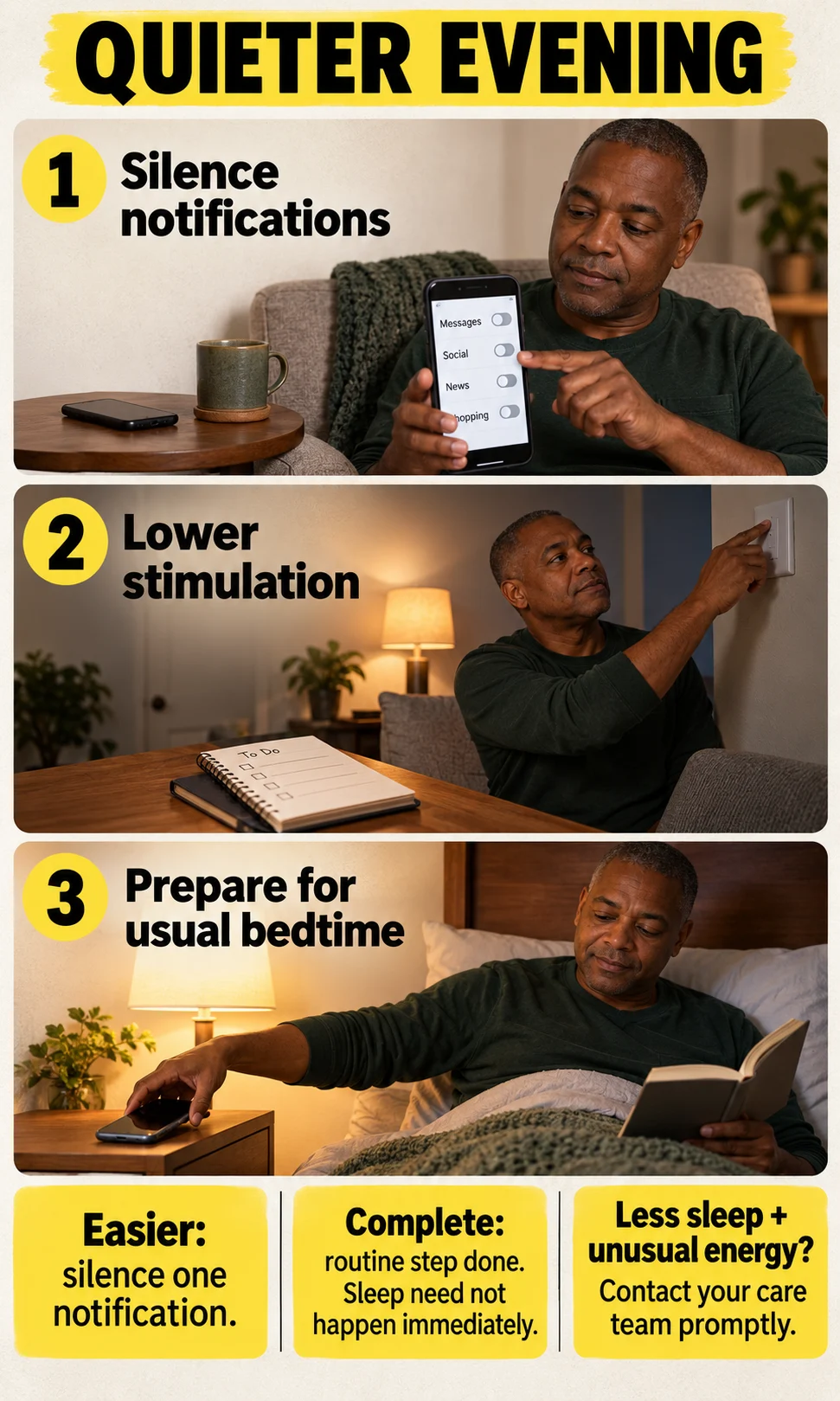
This option fits an evening when incoming messages, bright light or several unfinished tasks are keeping you engaged. Put non-essential notifications on silent, lower avoidable stimulation and keep your usual bedtime routine where possible. The NHS includes regular routine and adequate sleep among everyday supports for bipolar disorder; the phone-and-lamp sequence here is a practical editorial example.
- Silence non-essential notifications.
- Reduce avoidable stimulation, such as bright light or distracting tasks.
- Prepare for your usual bedtime with a familiar quiet activity; do not force sleep.
Illustrative example: you are checking messages repeatedly while also trying to finish tomorrow’s tasks. Silence notifications, close the task list and switch to a familiar quiet activity as you prepare for bed. You have completed the routine step when you make that change; falling asleep immediately is not required.
For a lower-effort version, silence just one distracting notification or ask someone to help you put the phone aside. If you are sleeping much less and feeling unusually energised, contact your care team rather than waiting to see whether a quiet evening fixes it. Repeated sleep loss, marked agitation or rapidly changing behaviour needs assessment, even when you can still manage some daily tasks.
Ask for one kind of help
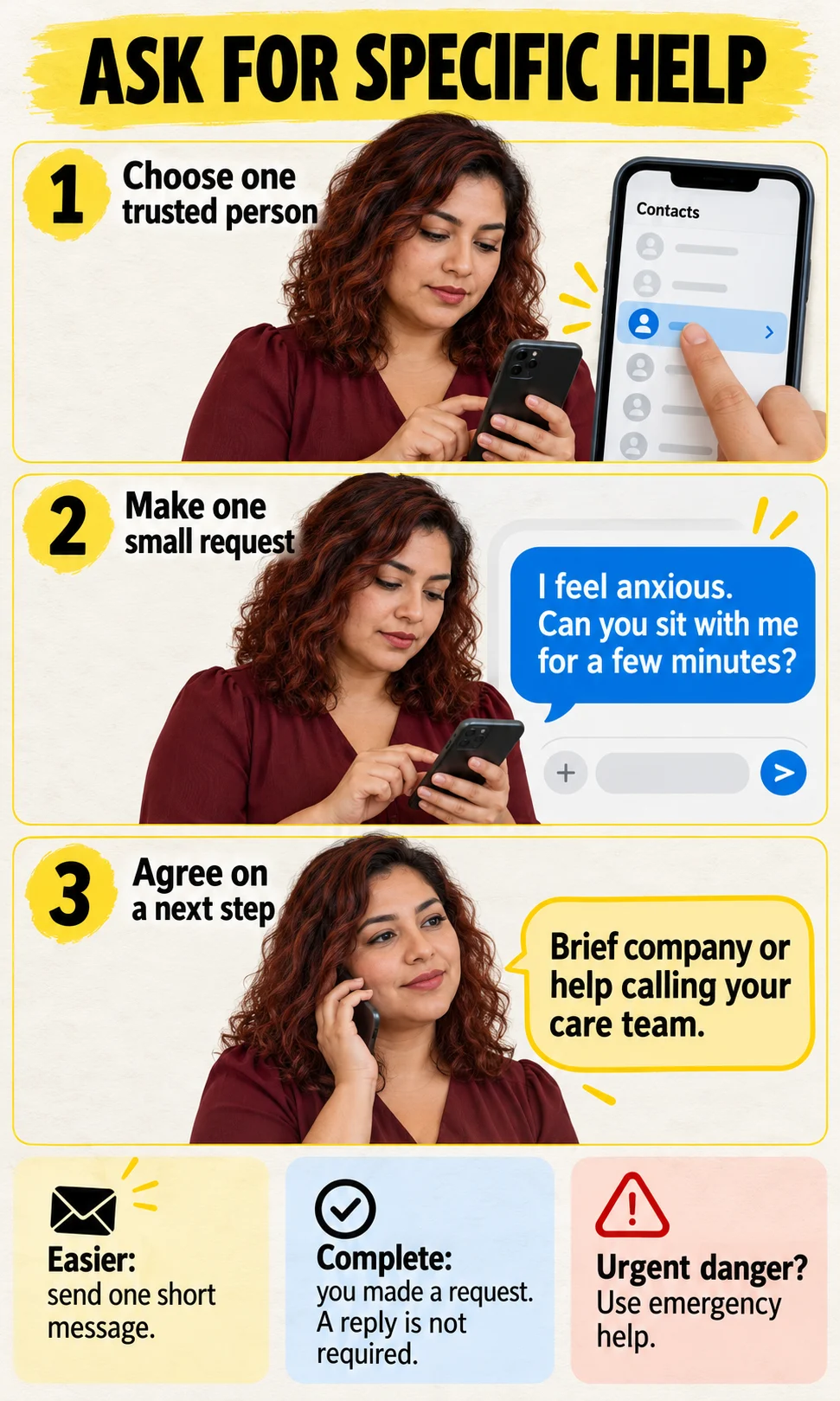
This option fits a safe moment when anxiety feels harder to manage alone. Choose a trusted person, say what is happening in a short sentence and make a specific request. You can ask for brief company, help making a care-team call or support with a manageable task; you do not have to explain your entire history.
- Choose one trusted person.
- Send a short, specific request for brief company or practical help.
- Agree on a manageable next step if they are available; try another contact or suitable support service if needed.
Illustrative example: send “I feel anxious. Can you sit with me for a few minutes?” If the person is available, agree on a small next step together, such as sitting quietly while you make an appointment. If they cannot respond, try another trusted person or a suitable support service rather than treating the unanswered message as a judgment about you.
The easier version is one short message: “Could you call me when you can?” Completion means you made a clear request, not that the other person responded perfectly or your anxiety disappeared. For persistent, worsening or disabling symptoms, professional support remains the next step; a friend can help you access it but does not have to become your clinician.
Choose the care step that fits the change
If you are unsure whether sleep, energy or behaviour has changed, ask your care team to help assess it rather than using a coping exercise to rule out a mood episode. Describe what is different and ask a trusted person to help make contact if needed. Making contact is the useful next step; you do not need to establish your own diagnosis first.
Anxiety Next Step Studio
Choose what is difficult right now and receive a short action sequence, a worked example and an easier version. The experience also routes sleep-and-energy changes or immediate safety concerns toward care instead of a coping exercise. It uses no diagnostic score, account, tracking diary or saved health answers; the manual instructions above remain available if it cannot load.
Anxiety Next Step Studio
Choose a manageable action for an anxious moment.
First step · Easier option · Next actionEveryday support, not a diagnosis or treatment for a bipolar episode. Do not change medicine based on this experience. Your selections are not stored or sent.
Warning signs: much less sleep with unusual energy, impulsivity or major behaviour changes needs prompt care-team contact. If you cannot stay safe, have severe confusion or distressing loss of touch with reality, use urgent local help.
Manual steps — always available
Gentle breathing: sit with back supported and feet flat; breathe in gently through your nose and out gently through your mouth if comfortable. No holding or forcing. Optional comfortable counting; try about five minutes if tolerable. Easier start: one comfortable breath. Stop if uncomfortable or dizzy.
Quieter evening: silence non-essential notifications, lower stimulation and prepare for your usual bedtime. Easier start: silence one notification. Less sleep with unusual energy needs prompt care-team contact.
Ask for support: choose one trusted person and make a specific request, such as “I feel anxious. Can you sit with me for a few minutes?” Easier start: send one short message.
Practising a step counts as completion; immediate relief is not required. Persistent, worsening or disabling symptoms need professional assessment. For immediate danger, use urgent local help.
Guidance basis: NHS bipolar support and NHS gentle breathing. Examples and easier starts are editorial adaptations.
Frequently asked questions
Can you have bipolar disorder and anxiety together?
Yes. Anxiety symptoms or a separate anxiety disorder can occur alongside bipolar disorder, including outside a mood episode. A qualified clinician can assess the pattern and plan care for both.
Does anxiety mean a manic episode is starting?
Not by itself. A new pattern of much less sleep together with unusual energy, impulsivity or major changes in behaviour deserves prompt clinical attention. Follow an existing early-warning plan when you have one.
Can breathing exercises treat bipolar disorder?
No. Gentle breathing may be a useful support for an anxious moment, but it cannot diagnose bipolar disorder or replace treatment for a mood episode. Stop or choose another support if the exercise feels uncomfortable.
What if concentrating on breathing makes me feel worse?
Return to normal breathing and stop the exercise. Choose a quieter setting or ask a trusted person for support instead. Persistent or severe symptoms should be discussed with a qualified health professional.
Should I take an anxiety medicine with my bipolar medication?
Ask your prescriber. The choice depends on the wider treatment plan, current symptoms, previous responses and possible interactions. Do not add, stop or change medicine using advice from an online article.
When should I get urgent help?
Use urgent local help if you cannot stay safe, are at risk of harming yourself or someone else, or have severe confusion or distressing loss of touch with reality. In a life-threatening emergency, call your local emergency number or go to an emergency department.
Your next step can be small
Choose the action that matches today’s difficulty: one comfortable breath, one quieter evening step or one request for support. You can repeat, simplify or stop a practice without calling it failure. If symptoms persist or change, bring that information to your care team; useful self-help makes the next step clearer rather than asking you to solve bipolar disorder alone.
Sources and further reading
- National Institute of Mental Health: Bipolar Disorder — symptoms, assessment and treatment.
- NHS: Bipolar disorder — treatment, routines and everyday support.
- NHS: Breathing exercises for stress — gentle breathing method.