

Mood-congruent psychotic features fit the emotional theme of a manic or depressive episode; mood-incongruent features do not. The distinction describes the content of a delusion or hallucination in relation to the current episode, and a clinician must assess the full episode and its timing before applying either label.
A person in mania might believe they have extraordinary powers; a person in severe depression might believe they have caused a catastrophe. These are illustrations of possible delusions, not ordinary confidence or guilt. Psychosis needs prompt professional assessment, and the theme alone cannot tell a person their diagnosis or predict their future.
Mood-congruent versus mood-incongruent: the quick comparison
| Context | Mood-congruent | Mood-incongruent |
|---|---|---|
| Basic meaning | The psychotic theme fits the dominant mood of the episode. | The psychotic theme does not fit the dominant mood. |
| During mania | A fixed belief in exceptional power, wealth, identity, or a special mission. | A fixed belief with no clear link to the elevated or irritable mood, such as thoughts being inserted by an outside force. |
| During severe depression | A fixed belief in deserved punishment, ruin, or catastrophic guilt. | A fixed belief in exceptional powers, or another theme unrelated to the depressive state. |
| What the label cannot tell you | Neither label diagnoses bipolar disorder, selects a medicine, or predicts an individual’s outcome. | |
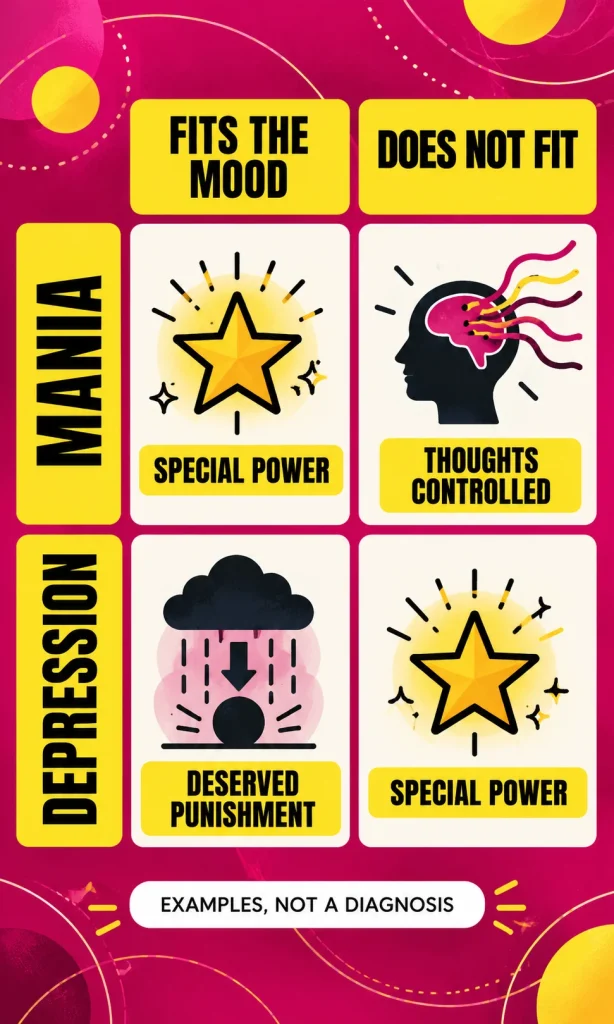
Illustrative examples only. A clinician needs the full episode and symptom timeline to apply either description.
Psychotic features can include delusions, which are firmly held false beliefs, and hallucinations, which are perceptions without an external source. An upsetting thought, an unusual opinion, or a metaphor is not automatically a delusion. A clinician considers conviction, context, insight, functioning, cultural background, and whether another cause could explain the experience.
Examples during mania and depression
In mania, a person may have sustained, marked changes in energy, activity, sleep, judgment, and mood. A belief such as “I have a unique power to govern the world” may be congruent with expansive mania. “A device is placing thoughts in my head,” without a meaningful link to the mood state, may be incongruent, but context can change the interpretation.
In severe depression, a person might be certain they have irreparably harmed their family despite clear evidence otherwise, or that they deserve punishment for an imagined offense. Those themes can be mood-congruent. A fixed grandiose belief during a clearly depressive episode may be incongruent, although clinicians must check for mixed features or an evolving manic episode before assigning a label.
Hallucinations also require the content and context to be examined. A voice saying the person deserves punishment during depression may fit the depressed mood; a voice with an unrelated theme may not. A single quoted phrase does not settle the classification, especially when the mood episode is mixed or the account is incomplete.
Hypomania is a special boundary: a hypomanic episode, by definition, has no psychotic features. If psychosis appears during an apparent elevated episode, a clinician reassesses whether the episode meets criteria for mania or whether another condition is involved. Merck Manual’s clinical overview explains this diagnostic distinction.
Mood & Meaning Studio
Organize what happened, when it happened, and what to ask your clinician.
This guide explains possible mood congruence. It cannot diagnose an episode, determine whether an experience was psychosis, or predict an outcome.
Discussion notes
Ask the care team: What was the episode type, did psychotic symptoms occur, and did they continue outside the mood episode?
Bring: the exact wording of the experience, dates, sleep changes, treatment and substance changes, and any safety concerns.
If someone is at immediate risk, has suicidal intent, or cannot stay safe, contact local emergency or crisis services now. This guide is educational and does not replace professional care.
Why clinicians ask whether the content matches the mood
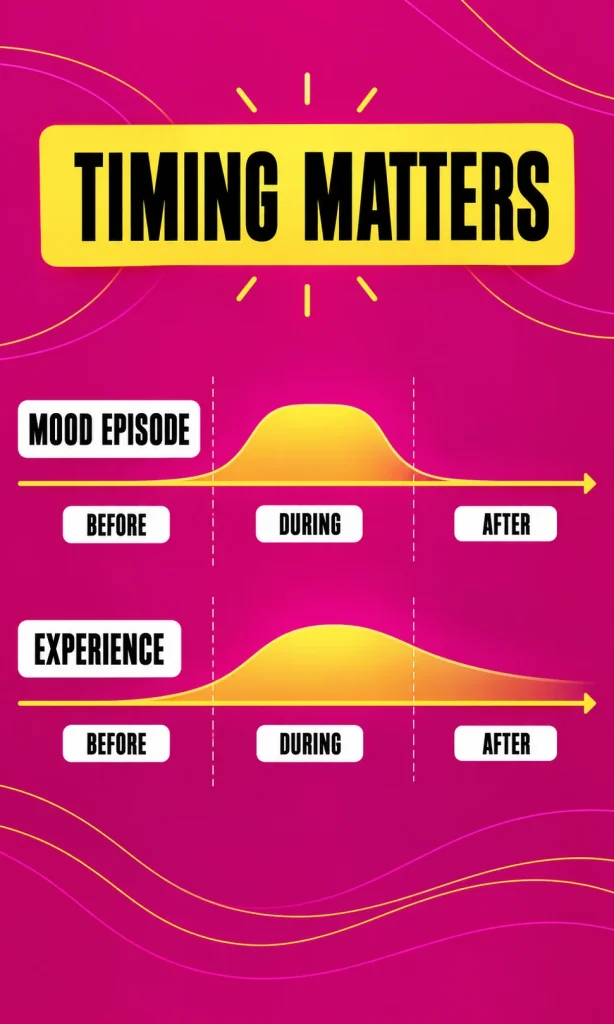
The first practical reason is to document the episode accurately. Clinicians need to know when the mood changed, when the unusual belief or perception began, and whether either continued after the other resolved. They also ask about sleep, substances, medication changes, medical conditions, previous episodes, and the effect on everyday functioning.
The second reason is follow-up. A systematic review of studies on psychosis in bipolar disorder reported associations between mood-incongruent symptoms and poorer outcomes in some research. That is a group-level finding, not a forecast for an individual; studies vary in populations and definitions, and one bipolar I outpatient cohort did not find that a history of mood-incongruent psychosis predicted outcome at entry.
The third reason is diagnostic review over time. Mood-incongruent content does not by itself turn bipolar disorder into schizophrenia or schizoaffective disorder. A key question is whether psychotic symptoms occur only during mood episodes or also persist outside them; clinicians apply the full diagnostic criteria rather than deciding from a single symptom theme. The clinical differential diagnosis includes schizoaffective disorder and other possible explanations.
Does the distinction change treatment?
It may prompt closer assessment and monitoring, but there is no dependable “mood-incongruent medication” chosen from the label alone. Treatment is based on the current episode, psychosis and safety needs, previous response, other health conditions, preferences, and the risks and benefits of medicines. NICE’s bipolar guideline gives different recommendations for acute mania, bipolar depression, and longer-term prevention.
Older studies have investigated whether mood-incongruent features relate to lithium response, with mixed and limited findings. The distinction should therefore not be used to stop lithium, start an antipsychotic, or adjust a dose independently. If symptoms are new or worsening, contact the treating team promptly for an individualized plan.
How common is psychosis in bipolar disorder?
A large systematic review reported lifetime psychotic symptoms in more than half to about two-thirds of people with bipolar disorder across the studies it assessed. Roughly a third of the patients in that review reported first-rank or mood-incongruent symptoms, particularly in manic episodes; that combined estimate is not a clean split of all psychotic experiences into congruent and incongruent groups. The proportion differs by diagnosis, episode type, clinical setting, and how researchers assess symptoms.
What to bring to an assessment

Write down the exact words or beliefs as best you can, when they started, and what mood, sleep, and activity were like at the time. Note whether the experience stopped when the mood episode eased, continued afterward, or began before the mood change. Include medication and substance changes, prior episodes, and observations from a trusted person if the person agrees.
- “Was this a delusion or hallucination, and how are you deciding?”
- “Was the mood episode manic, depressive, mixed, or still unclear?”
- “Did the experience occur outside the mood episode?”
- “What changes should make us contact you urgently, and what is the crisis plan?”
Do not argue with a person to force them to abandon a belief. Listen, describe observable changes, and help them reach professional care. If there is immediate danger, suicidal intent, inability to stay safe, or rapidly escalating psychosis, use local emergency or crisis services now.
The distinction in one sentence
Mood congruence asks whether the theme of psychosis matches the mood episode; it does not measure how real the experience feels or define the whole person. An accurate timeline and professional evaluation matter more than applying the label at home. For the broader picture, read our guides to bipolar disorder symptoms, early warning signs of a bipolar mood episode, and how bipolar disorder is treated.
Frequently asked questions
What is the difference between mood-congruent and mood-incongruent psychosis?
Mood-congruent psychotic content fits the dominant emotional theme of the current episode, such as a grandiose delusion during mania or a delusion of deserved punishment during severe depression. Mood-incongruent content does not fit that theme. The terms describe the content in context and need a clinician’s assessment.
Is mood-incongruent psychosis always more serious?
No single label predicts an individual’s severity or outcome. Some studies link mood-incongruent features with poorer group outcomes, while other findings are less consistent. Any psychosis deserves timely clinical evaluation regardless of the theme.
Can psychosis happen during hypomania?
Psychotic features are not part of a hypomanic episode by definition. If they occur during an apparent elevated episode, a clinician reassesses whether it is mania or whether another explanation fits. The person should seek prompt professional advice rather than classify the episode alone.
Does mood incongruence mean schizophrenia or schizoaffective disorder?
No. The theme of a psychotic symptom cannot establish a different diagnosis by itself. Clinicians examine the whole history, especially the timing of psychosis relative to mood episodes and whether symptoms persist outside them, before considering other diagnoses.
Does mood incongruence determine which medicine works?
No reliable treatment rule follows from this feature alone. Clinicians choose treatment using the episode type, urgency, prior response, medical history, side effects, and personal preferences. Do not change medication based on an article or interactive guide.