



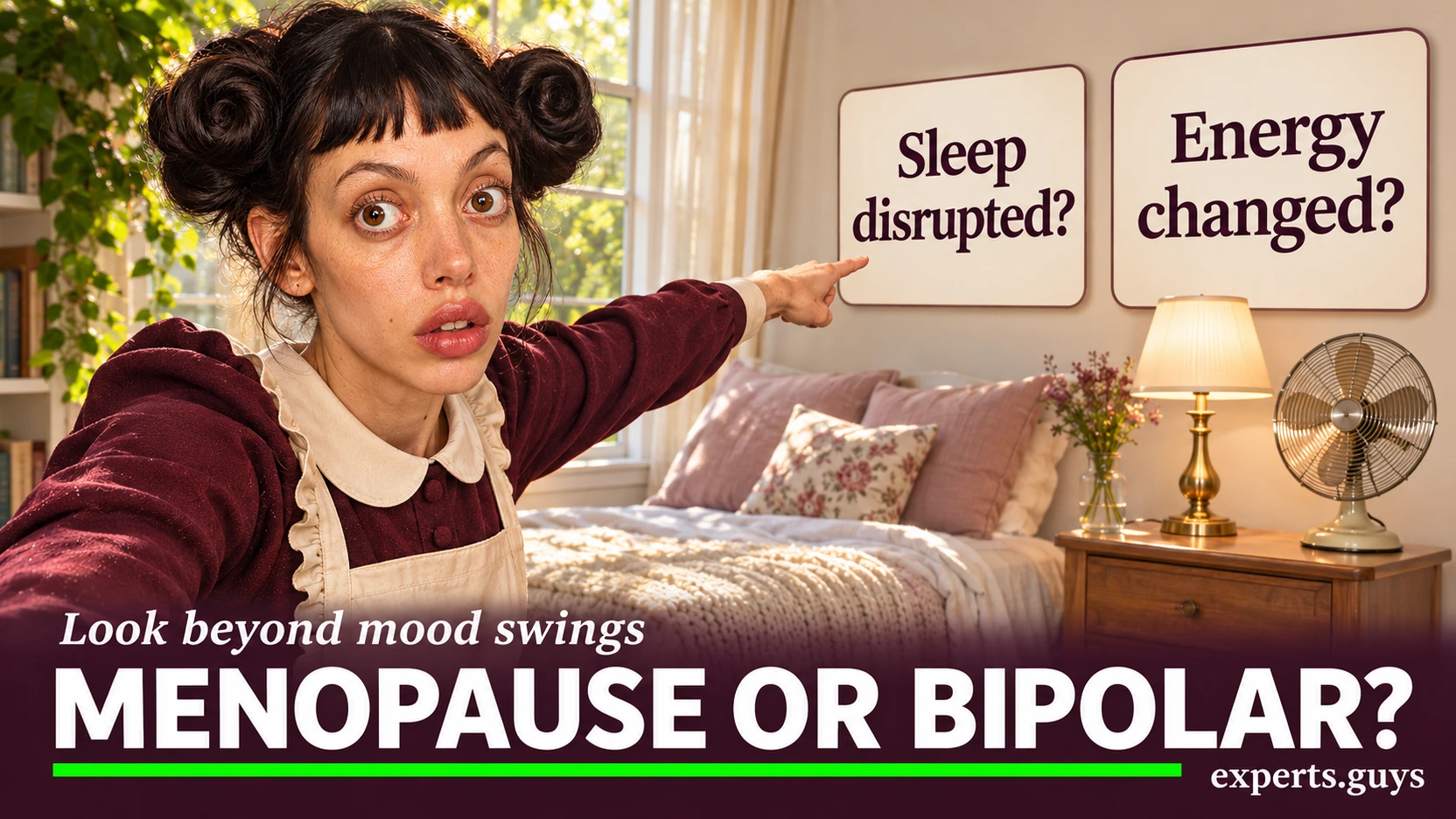
Menopause and bipolar disorder can both involve disrupted sleep, irritability and low mood, and they can occur together. A more useful distinction is whether you are exhausted after poor sleep or sleeping much less with unusual energy and a broader change in behavior; neither pattern can establish a diagnosis on its own.
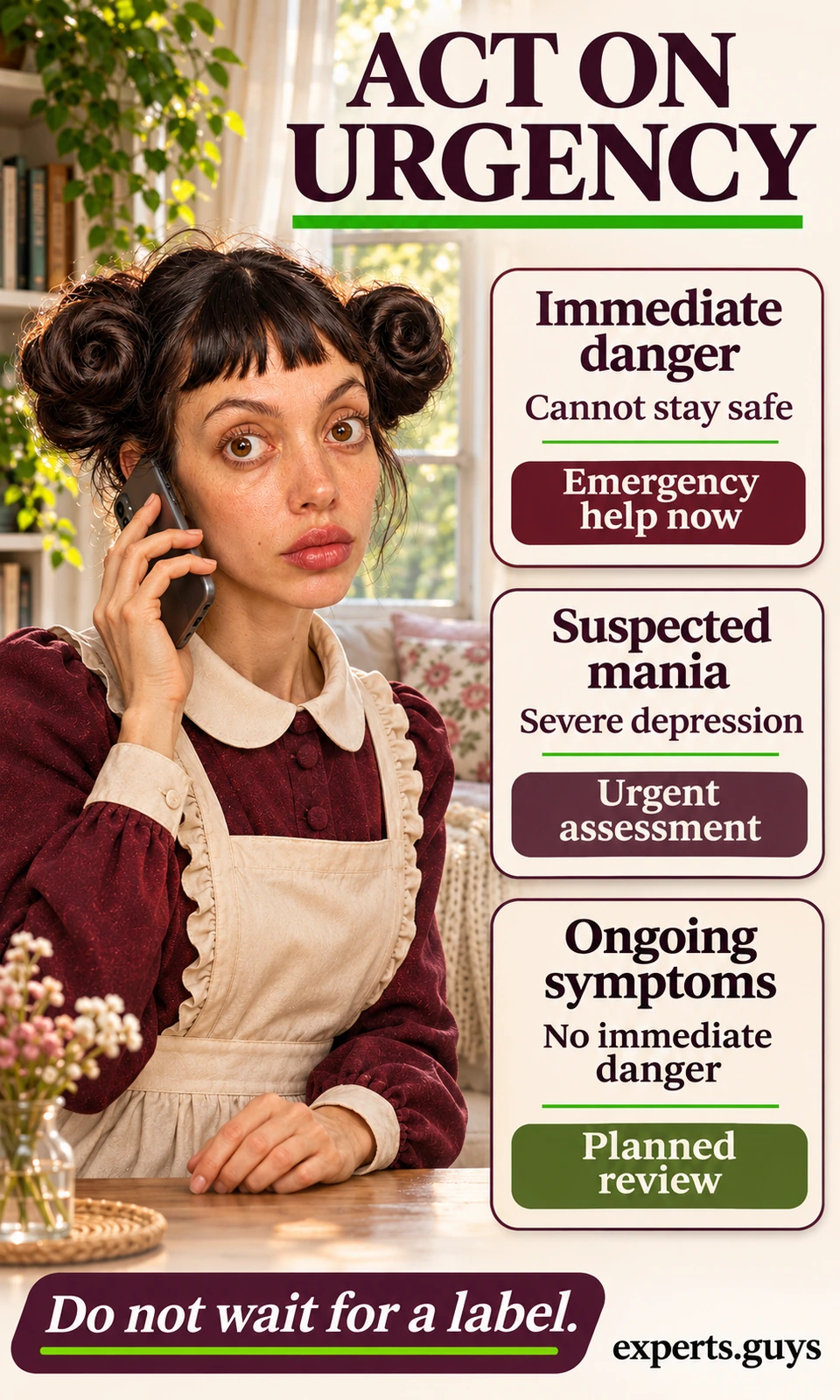
If there is immediate danger, an inability to stay safe, severe confusion, or a risk of acting on suicidal thoughts, use local emergency services or an emergency department now. Suspected mania, severe depression, new hallucinations or rapidly escalating behavior need urgent assessment. Do not wait to decide whether hormones are involved before getting the help the situation requires.
The years before the final menstrual period are often the relevant stage. Perimenopause can bring changes in bleeding, hot flushes, night sweats and sleep as well as emotional symptoms. Menopause is generally identified after 12 months without a period when another explanation, such as hormonal contraception, does not account for it. The National Institute on Aging menopause overview explains this transition; the birthday alone does not define it.
An either-or question can hide two needs. Someone with an established bipolar diagnosis can develop disruptive night sweats, while someone entering perimenopause can also need assessment for a new mood episode. Calling every change “just hormones” can miss important illness; calling every flush or difficult night “bipolar” can leave treatable menopause symptoms unaddressed. Keep both questions visible at the same time.
Which differences matter more than “mood swings”?
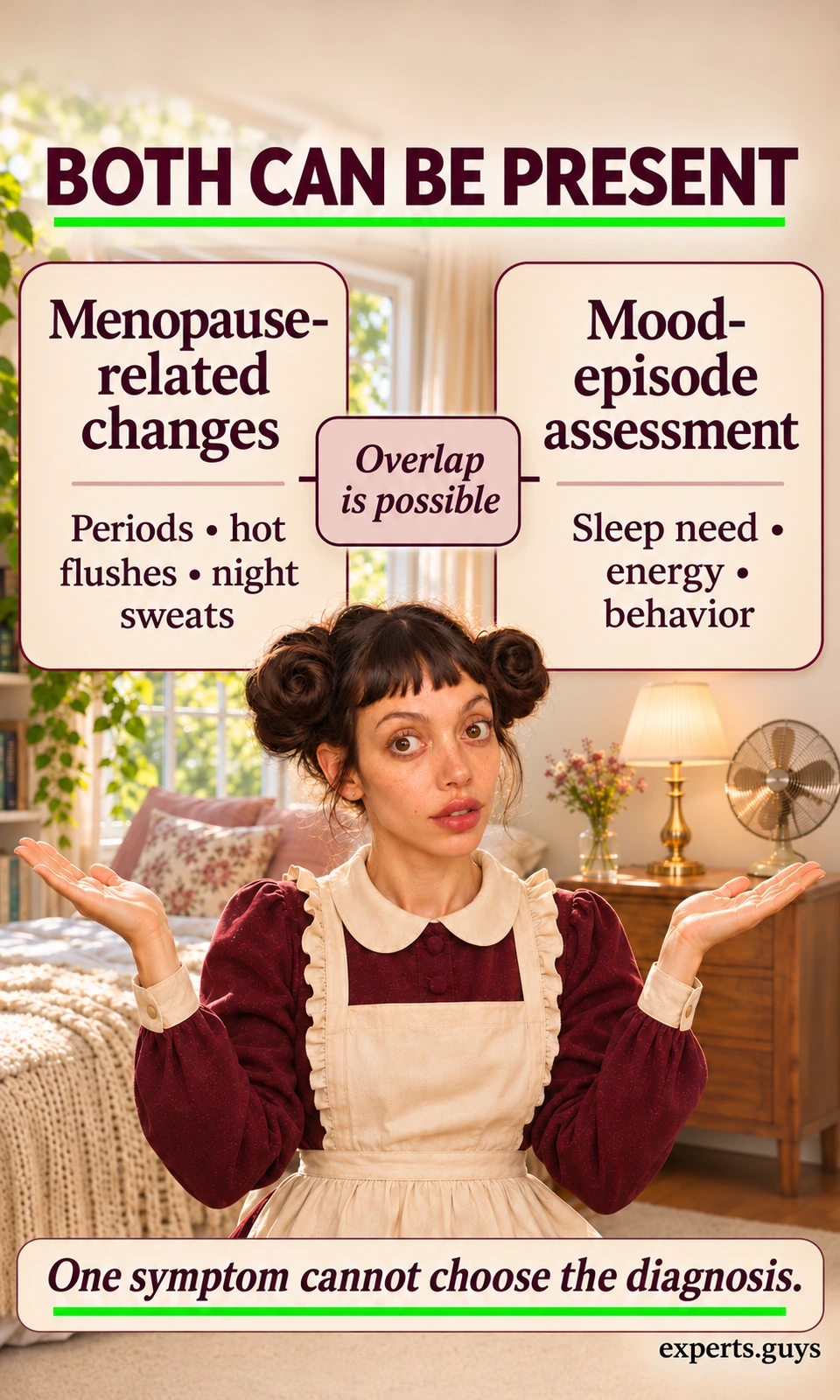
Mood swings is an everyday phrase, not a specific diagnosis. It can describe feeling tearful after a sleepless night, becoming anxious during a hot flush, or a sustained period of changed energy and judgment. Before interpreting it, separate the reproductive changes from the surrounding pattern in sleep, activity and functioning. These are clues to explain, rather than points to total up.
- Reproductive context: changing periods, new hot flushes or night sweats, and relevant hormonal treatment.
- Sleep and energy: wanting sleep but struggling to obtain it, versus feeling unusually driven despite much less sleep.
- Behavior and impact: what changed from your usual pace, decisions and ability to manage daily life.
Perimenopausal distress is real even when it does not identify a separate psychiatric condition. The American College of Obstetricians and Gynecologists discussion of midlife mood changes describes hormonal changes, disrupted sleep and life pressures as overlapping influences. It also explains that emotional symptoms do not always follow a neat monthly pattern. An irregular pattern does not automatically point to bipolar disorder.
Hot flushes can be brief and physically striking, whereas anxiety, fatigue or low mood may remain after the heat settles. The NHS menopause symptom guide includes memory and concentration difficulties as well as physical symptoms. Those experiences are not evidence that you have become less capable or unreliable. They do, however, deserve attention when they are interfering with work, relationships or ordinary activities.
Bipolar assessment asks a different set of questions about episodes over a lifetime. The NIMH bipolar disorder guide describes changes in mood alongside energy and activity, including periods of unusually elevated or irritable mood. A low mood today does not reveal the whole history. Nor must an activated episode look cheerful: distress and unusual drive can occur together.
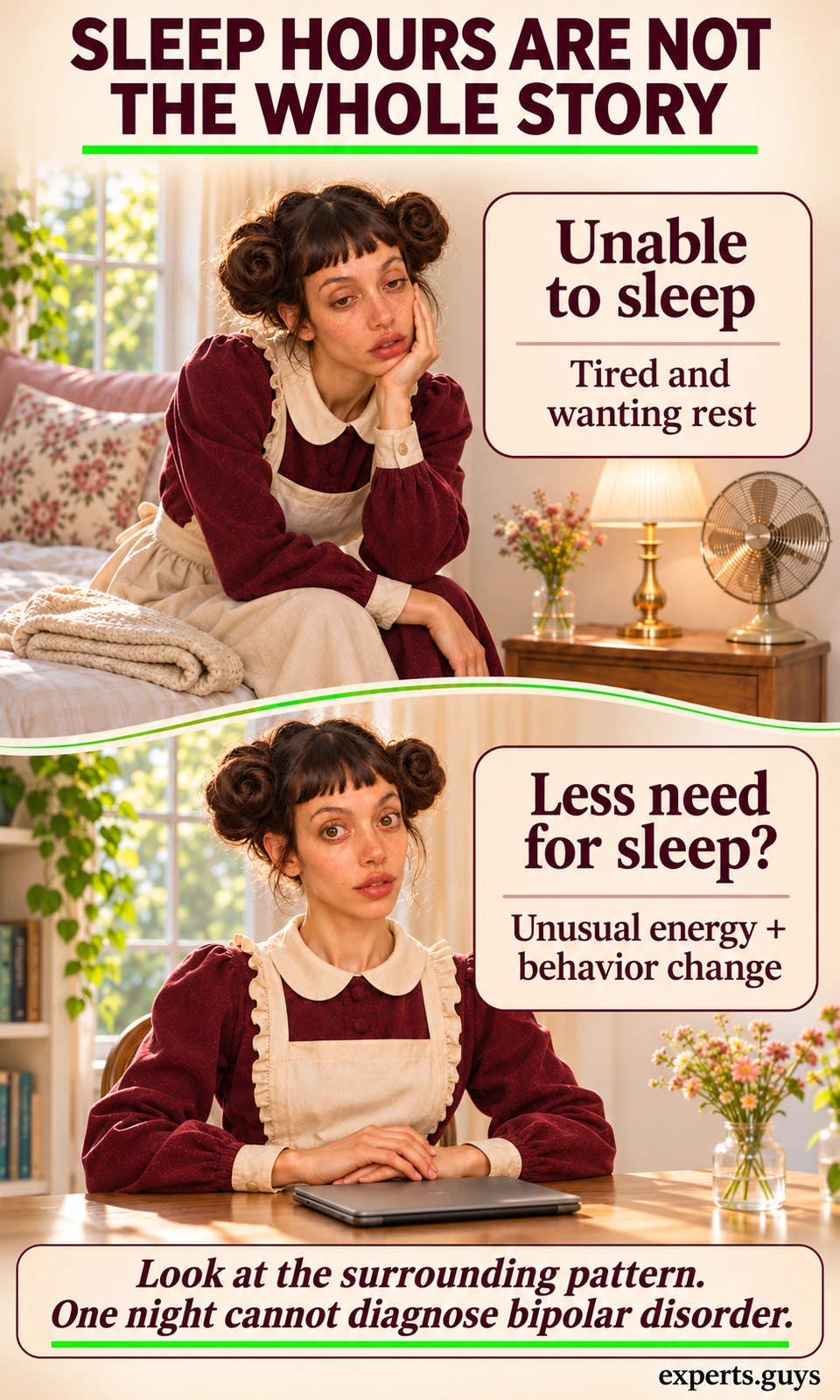
Unable to sleep is different from needing less sleep
With insomnia or repeated night-sweat awakenings, you may want sleep and feel the cost the next day. With a reduced need for sleep, the concern is sleeping markedly less while feeling unusually energized, driven or confident, especially when thinking, speech or decisions also change. The same number of hours can therefore have different meaning. One short night or one energetic morning is not enough to settle the distinction.
Do not turn this into an experiment by deliberately staying awake. Sleep loss can be relevant to mood stability in people with bipolar disorder. A study of self-reported sleep-loss triggers in 3,140 people with bipolar disorder found that some participants associated sleep loss with high-mood episodes. It was not a test proving that every poor night causes an episode, but it supports taking a sustained sleep change seriously.
The direction can also be difficult to untangle. Sweating may interrupt rest; inadequate rest may make coping harder; an emerging mood episode may itself alter sleep. Several influences can be present. Rather than deciding which came first from a single night, consider whether the sleep change is accompanied by a new pace of activity, unusually expansive plans or decisions that differ substantially from your normal judgment.
Anxiety and agitation complicate the picture further. Being restless and miserable does not automatically mean mania, and being tired does not exclude an episode. The distinction is useful because it improves the description, not because it creates a reliable yes-or-no gate. If sleep and behavior are deteriorating rapidly, urgency takes priority over fitting the pattern into the most reassuring category.
A useful comparison therefore keeps three columns separate: what you noticed, the context that changes its meaning and what cannot be concluded from it. The purpose of the table below is to prevent a shortcut, not to rank symptoms by how “bipolar” or “menopausal” they appear. Read across the row before drawing any conclusion from its first phrase.
| What you notice | Context worth distinguishing | What it cannot prove |
|---|---|---|
| Poor sleep | Wanting rest and feeling depleted, versus much less sleep with unusual energy and behavior change. | The cause from sleep hours alone. |
| Irritability | A difficult night or flush, versus a wider sustained change in mood, activity and judgment. | Bipolar disorder from anger alone. |
| Hot flushes or period changes | A reproductive transition may be relevant alongside other health questions. | That a mood episode is impossible. |
| Racing thoughts or new impulsive choices | Change from usual, occurring with other activation or safety concerns. | A diagnosis without assessment, or permission to wait if risk is rising. |
If someone asks how you are sleeping, “badly” may leave out the key difference. “I keep waking hot and want more rest” conveys something different from “I am sleeping far less but feel driven to keep going.” Neither sentence is a diagnosis. It simply gives a more useful account of both what happened at night and how much rest you seemed to need.
What does the first explanation leave unanswered?
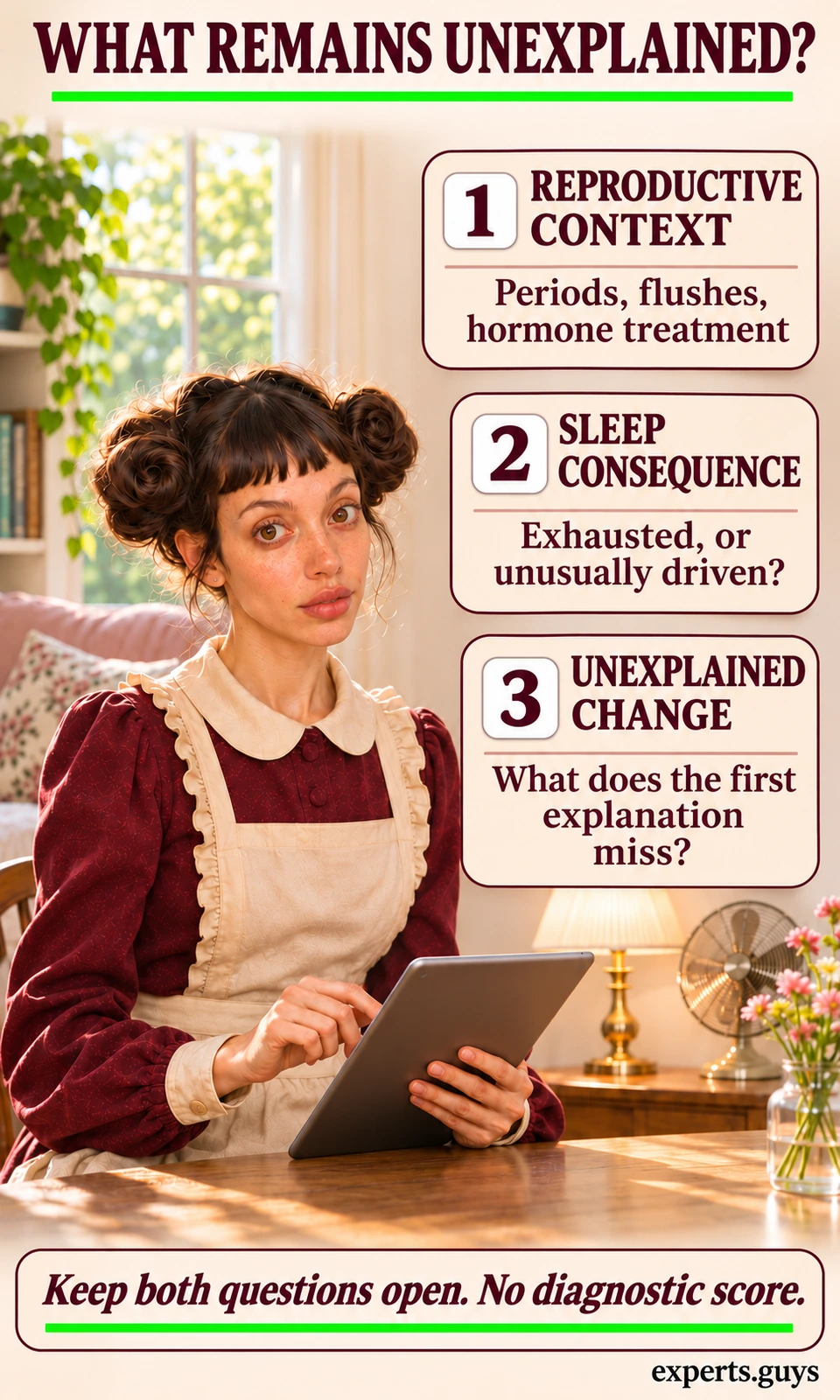
The broader guide to bipolar symptoms in women covers episode history across reproductive stages. Here the narrower task is checking whether an explanation actually accounts for the midlife changes in front of you. Keep reproductive context, the consequence of lost sleep and any unexplained change separate. You can work through the distinction aloud; a new diary, device or diagnostic score is unnecessary.
Start with reproductive context without making it a gatekeeper. Period changes, flushes, night sweats and hormone treatment belong in the explanation, but symptoms need not line up neatly with a predictable monthly cycle. If bleeding is absent because of contraception or hysterectomy, say so. The missing calendar clue should remain a limitation, rather than being replaced with an assumption that every symptom is hormonal or that hormones cannot be involved.
Next consider what followed the sleep disruption. Waking hot and struggling through the next day is a different account from sleeping far less while feeling unusually driven to make plans. Both can require help, and a person can have overlapping difficulties. The purpose is to make the consequence explicit: “I was awake” leaves out whether you wanted rest, felt depleted or seemed to need much less sleep than usual.
Then ask what remains unexplained. New sweats in someone with stable bipolar disorder should not disappear under the existing diagnosis; sustained activation should not disappear under a menopause explanation. A trusted person can help identify what changed without choosing the label for you. The bipolar types and assessment guide explains the wider clinical history. This check succeeds when it exposes an unanswered concern, rather than proving one explanation right.
Compare two illustrative situations. In the first, night sweats interrupt sleep, the next day feels exhausting and the person wants to rest. In the second, much less sleep occurs with unusual drive, faster speech and uncharacteristic spending. The second pattern raises a different concern, but neither example proves a diagnosis, and the first does not exclude another illness. The useful outcome is an account of what changed together, rather than a label chosen from a checklist.
This approach has a specific limit: it organizes a concern without determining its cause. It is not a screening questionnaire and should not be turned into “three clues means bipolar.” NICE advises against using questionnaires in primary care to identify bipolar disorder in adults. A polished online interface cannot remove that limitation. It is more honest to leave a diagnosis unresolved than to make an attractive tool report certainty that the information cannot support.
The menopause transition may also matter in someone who has never previously had mania. A 2024 UK Biobank study of first psychiatric onsets around the final menstrual period found an association between perimenopause and first-onset mania as well as depression. The study used reported histories and cannot establish that hormones caused a particular person’s symptoms. Its practical implication is to avoid dismissing a new presentation solely because it begins in midlife.
That finding is also not a forecast that most people in perimenopause will develop bipolar disorder. A change in a study’s relative incidence is not an individual probability, and mania is not synonymous with ordinary emotional fluctuation. The sensible interpretation is narrower: age and menopausal timing belong in the assessment, but they do not replace it. Neither a reassuring stereotype nor an alarming headline should decide the answer.
Can hormone tests settle whether it is menopause or bipolar?
No single hormone result can choose between the two. NICE menopause guidance identifies perimenopause clinically in otherwise healthy people aged 45 or over when recently started vasomotor symptoms occur with menstrual-cycle changes. Routine laboratory confirmation is generally unnecessary in that setting. This is different from saying that all midlife symptoms are menopausal or that no medical investigation could ever be useful.
Age, treatment and surgical history change the question. Hormonal contraception may alter or stop bleeding, and a hysterectomy removes the menstrual clue. Younger people with suspected early menopause may need a different assessment, including tests in appropriate circumstances. A “normal” number found online cannot override that context. State the relevant history rather than trying to interpret a laboratory range as a universal menopause detector.
Bipolar disorder is assessed through symptoms, episodes and their course, not diagnosed with a menopause hormone panel. Testing may help identify other explanations for symptoms; thyroid disease and medication effects are among the possibilities considered in a broader assessment. That makes testing useful for a specific question without making it a direct bipolar test. Ask what the result can clarify and what history is still needed.
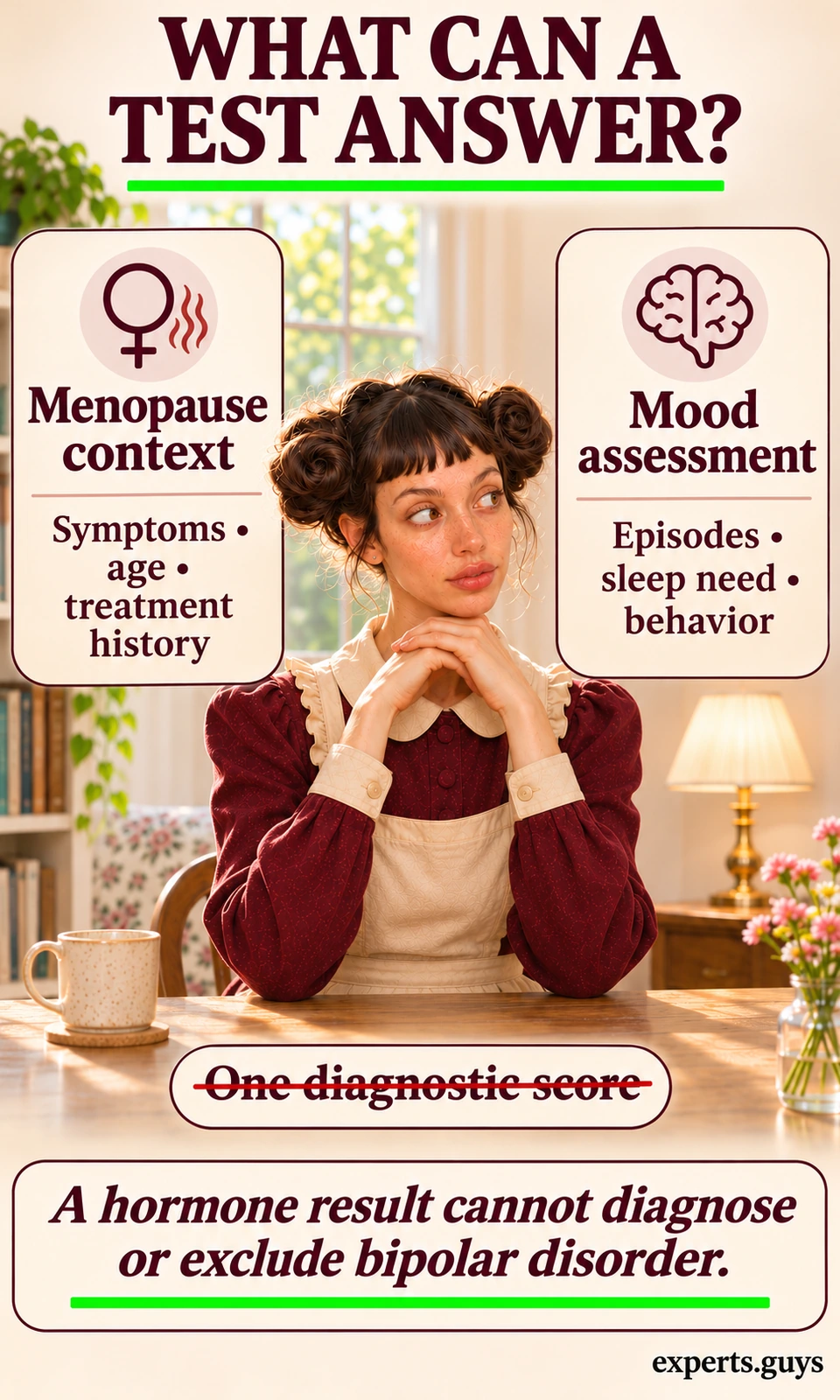
A practical way to read a proposed test is to complete the sentence, “This test is being used to investigate…” If the answer is a possible physical contributor, keep that distinct from a conclusion about a mood disorder. If the answer is unclear, ask the clinician to explain it in ordinary words. You do not need to request a long hormone panel merely to show that the symptoms are serious.
The same restraint applies to wearables and cycle apps. An existing device may show sleep estimates or a change in recorded bleeding, but it cannot establish why the change occurred or diagnose mania. An app’s label is not equivalent to an assessment. Use information you already have if it helps explain the situation, without delaying care to purchase a device, collect perfect data or complete a tracking period.
Bleeding deserves its own assessment rather than being absorbed into a discussion about mood. New vaginal bleeding after menopause should be checked, even if it happens only once or is a small amount. If you use HRT, ask the prescribing team which bleeding changes are expected and which need review in your situation. An explanation for anxiety or irritability does not explain every physical symptom, and an existing bipolar diagnosis should not prevent an unrelated concern from receiving appropriate attention.
What can you do about a hot, interrupted night?
For someone who feels hot, wakes repeatedly and wants more rest, a modest comfort change can make the immediate environment easier. The NHS menopause self-care guidance suggests lightweight clothing, a cool bedroom and measures such as a fan. This is symptom support, not a test of the diagnosis and not treatment for suspected mania. Keep a comfortable rest opportunity rather than using wakefulness to take on more tasks.
Set the cooling up while you are steady and awake. Place an existing fan or room-cooling control where it can be used safely, keeping cords out of the walking route and following the appliance instructions. Choose a comfortable setting rather than aiming for the coldest possible room. The useful result is that you can adjust comfort without searching for equipment or rearranging the bedroom in the middle of the night.
Use a light cover that can be removed separately from the rest of the bedding. Keep the arrangement simple enough to change without lifting a heavy pile or making repeated trips. If you wake sweaty, adjust the cover or clothing for comfort and return to a quiet rest opportunity. These are practical ways to apply the cooling principle; there is no required room temperature, special product or promise that the night will become uninterrupted.
If standing, reaching or handling bedding is difficult, ask someone you trust to position the control and light cover beforehand. You can make the same comfort adjustment while seated, or use the room’s existing cooling arrangement instead of buying a fan. Do not add water around powered equipment, obstruct ventilation or create a trip hazard in the effort to cool down. Safety and ease matter more than creating a perfect-looking sleep space.
Check the result in ordinary terms: is the setup easier to use, is the cover comfortable, and can you return to rest without turning the awakening into a project? If it is uncomfortable, simplify or reverse the environmental change. If sleep remains substantially disrupted or energy and behavior are changing, the next step is assessment rather than repeatedly adjusting the room. Completion means a more usable rest setup, not a result on a diagnostic scale.
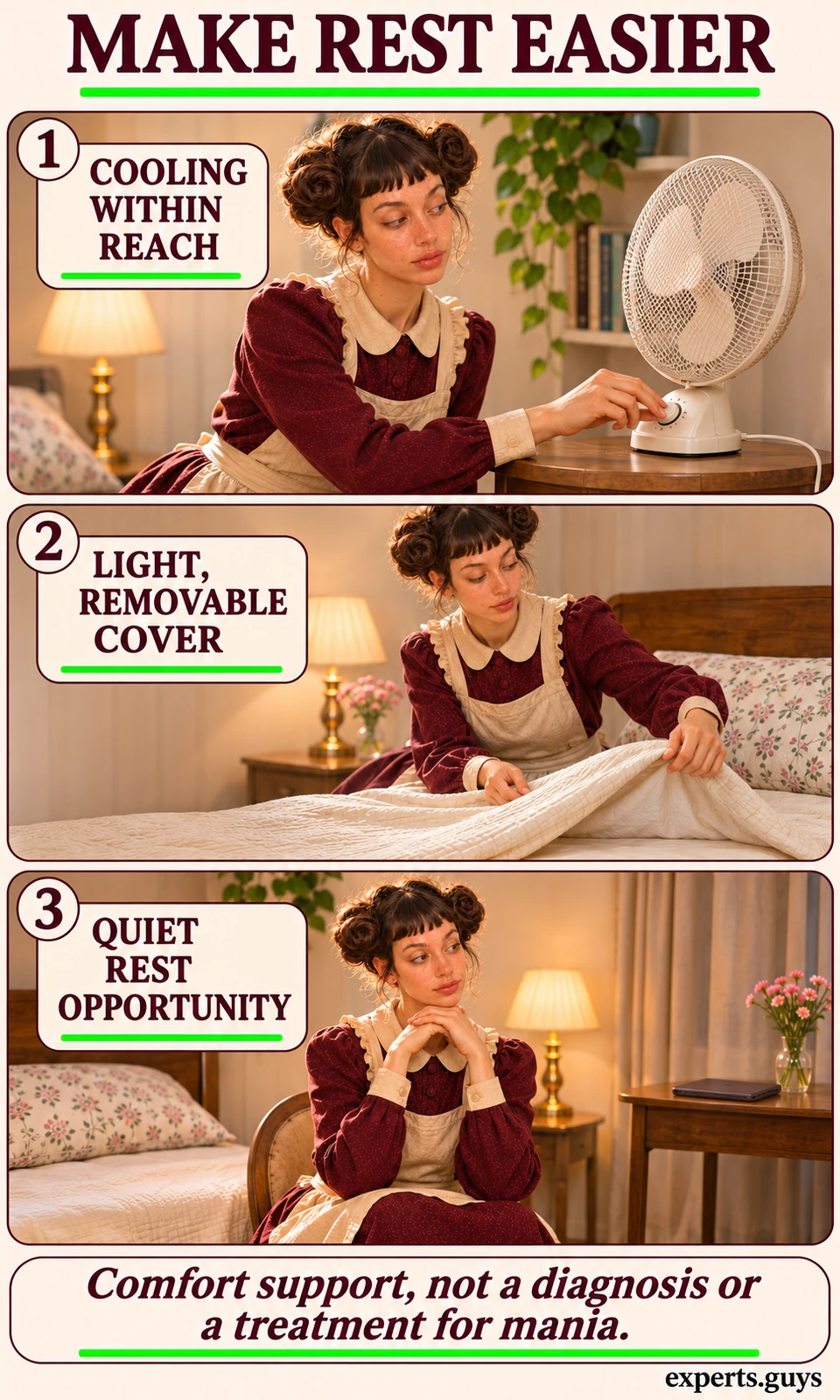
This distinction protects against two mistakes. A slightly easier night does not show that the entire problem was menopause, and a difficult night does not show that bipolar disorder is present. Comfort and diagnosis answer different questions. Similarly, do not use deliberate sleep restriction, an all-night productivity session or a borrowed sleeping medicine to test an explanation. If bipolar disorder is already diagnosed, keep to the sleep and treatment arrangements agreed with your team.
How should menopause care and bipolar treatment fit together?
Treat the needs alongside each other rather than making one service’s label cancel the other. A menopause clinician can assess vasomotor and other reproductive symptoms, while the mental health team considers an established or possible mood disorder. The important coordination question is whether each knows what the other is treating and prescribing. An apparently separate hormone change can still matter to the medicine plan.
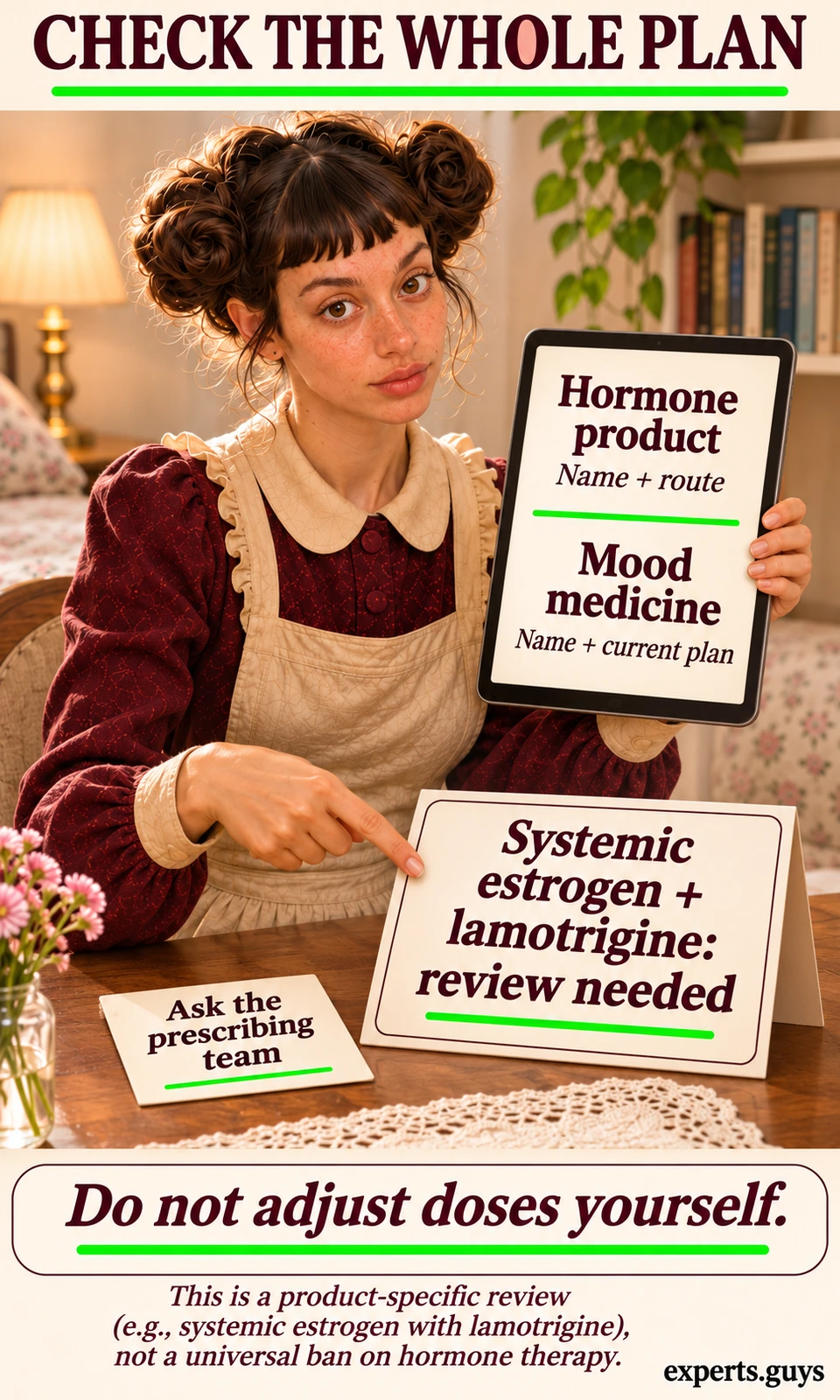
One specific example is systemic estrogen and lamotrigine. Medsafe’s medicines-safety committee reviewed evidence that estrogen-based hormone replacement therapy can reduce lamotrigine concentrations, potentially affecting mood stability or seizure control. The evidence and product details matter; this is not a claim that everyone will have the same effect. Starting, stopping or changing systemic hormone treatment therefore deserves a medicine-specific review rather than a dose calculation at home.
The route matters too. The committee distinguished systemic estrogen from vaginal-only preparations with low systemic absorption. A patch is not automatically irrelevant simply because it is not swallowed. Equally, the warning should not be expanded into a claim that all hormonal products are identical. Use the actual product and route when asking about compatibility, and leave any monitoring or dose decision to the prescribing team.
For a routine treatment discussion, ask three bounded questions aloud: what symptom is the hormone treatment intended to improve, could the exact product affect my current medicines, and who will review a new problem after a change? This is a coordination check, not another medication-packing exercise or a demand to research every interaction yourself. You can ask the same questions by phone or in a supported appointment, using the existing prescription information.
Do not abruptly stop a mood medicine because a new explanation sounds plausible. The NHS bipolar care guidance emphasizes continuing prescribed treatment unless the treating professional advises otherwise. Menopause care may need adjustment, bipolar care may need adjustment, or both may need attention. The relevant decision concerns the particular products in your plan.
Does improvement with HRT prove the cause was hormonal?
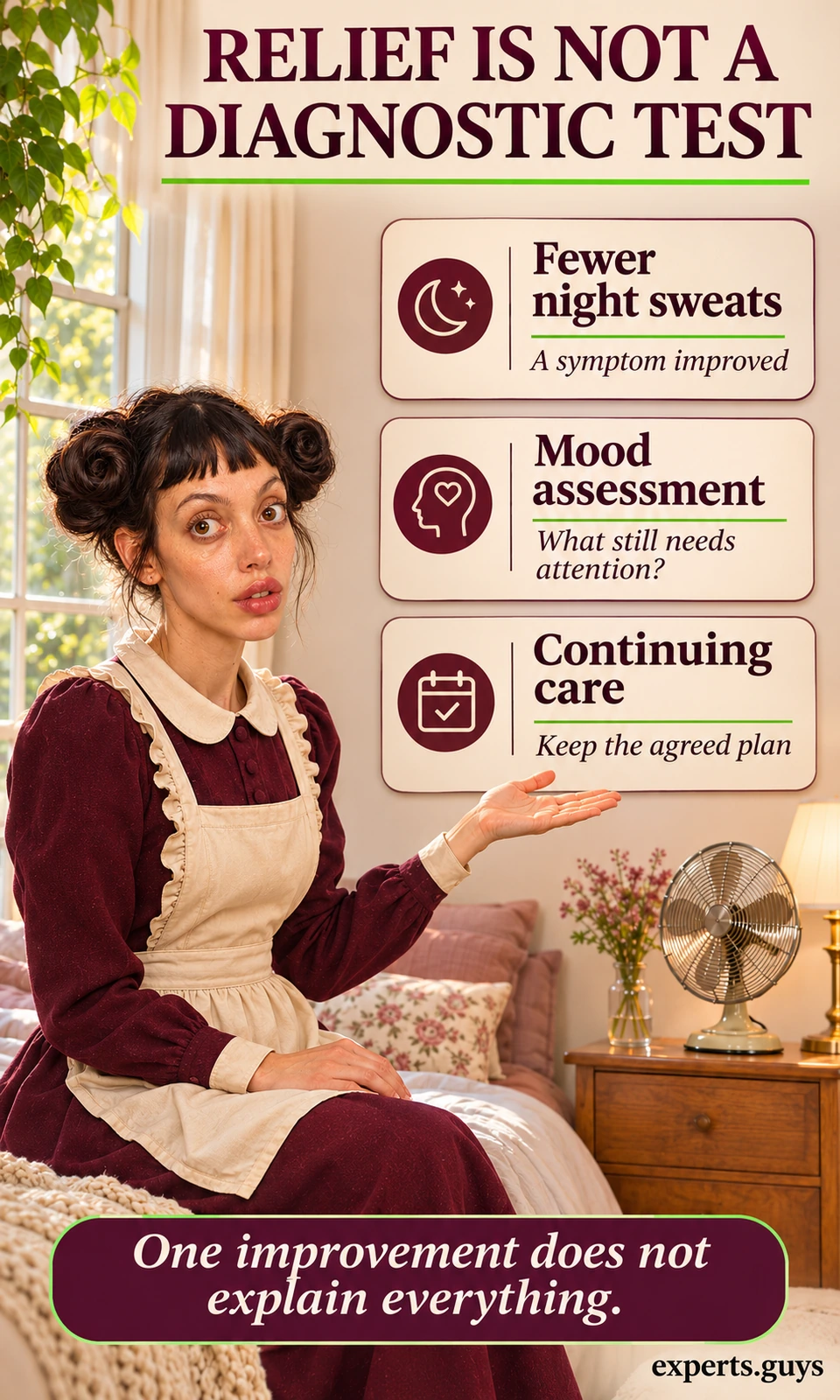
No. Relief of a symptom tells you that the symptom improved; it does not automatically identify every cause of the wider problem. For example, fewer night sweats may make sleep more comfortable while a separate change in energy or judgment still needs assessment. The useful question after treatment is which target improved and what remains, rather than whether one response has “won” the diagnosis.
Hormone replacement therapy is an established option for menopausal symptoms, but the appropriate product depends on individual circumstances. The NHS menopause treatment guide explains hormonal and nonhormonal approaches. An offer of HRT is not a prescription for treating mania, and a bipolar diagnosis does not make the menopause symptoms imaginary. The treatment target and the person’s health history should remain explicit.
Menopause-specific CBT can also be discussed for relevant symptoms such as hot flushes or associated sleep problems, depending on local availability and the individual plan. This does not mean that all distress is caused by thinking incorrectly. Nor should a generic online sleep program be assumed suitable for someone vulnerable to mood activation. Ask about an approach that fits the menopause symptoms and the existing bipolar-care context.
Antidepressants require particular care when bipolar disorder is established or suspected. They are not interchangeable with a complete bipolar treatment plan, and antidepressant treatment alone can precipitate activation in susceptible people. Do not borrow a medicine or ask for a particular drug because a general menopause page mentions mood symptoms. Explain any previous periods of unusual drive or reduced need for sleep before a new mood treatment is selected.
Imagine an illustrative follow-up in which the sweats have eased but uncharacteristic spending and a markedly faster pace continue. The sensible conclusion is not that HRT failed to do anything, nor that the mood changes must be harmless because one symptom improved. Separate the improved target from the unresolved pattern. This lets two useful clinical questions remain open without pretending that one explains everything.
When does the response need to be urgent?
Do not wait for a diagnosis when the situation is becoming unsafe. NICE bipolar assessment guidance recommends urgent specialist assessment when mania or severe depression is suspected. A duration used in diagnostic criteria is not an instruction to wait while judgment, sleep or basic functioning deteriorates. An uncertain cause can still require a clear and timely response.
For a rapid change with unusual drive, much less need for sleep or risky judgment, contact the existing mental health team, an urgent clinical service or the local crisis pathway. If there is immediate danger, inability to stay safe or a risk of acting on suicidal thoughts, use emergency help. New psychotic symptoms also need urgent assessment, with emergency help when safety is uncertain. Do not use a fan, a hormone test or a routine appointment as a substitute for that response.
For ongoing symptoms without immediate danger, arrange a review that considers both menopause and mood history. State whether the main problem is interrupted sleep with fatigue, a new activated pattern, persistent depression, or more than one concern. If you already have bipolar disorder, use the contacts and responses in your agreed care plan. The separate guide to returning bipolar depressive symptoms addresses that established-diagnosis situation in more depth.
A companion can help contact the service or communicate an agreed concern, with your permission where possible. Their task is not to diagnose you, force an argument about hormones or insist on finishing a questionnaire. If judgment or alertness is impaired, avoid driving yourself; ask for suitable transport or emergency assistance according to the situation. Keep the response practical and proportionate to the immediate need.
If the first explanation you receive leaves an important change unanswered, ask for clarification: which symptoms does this explanation cover, and what is the plan for the others? The point is not to prove that one clinician is wrong. It is to avoid allowing a plausible menopause symptom to conceal a significant mood change, or an existing diagnosis to conceal a treatable physical problem. You do not need certainty about the label before taking the safer next step.
Questions that can change the interpretation
Can perimenopause begin while I still have regular periods?
The menopausal transition can involve changing symptoms before periods stop completely. A regular-looking cycle or a lack of dramatic hot flushes does not settle the cause of mood or sleep changes. Explain the full context, including hormonal treatment and any new physical symptoms, rather than waiting for the final menstrual period before asking for help.
What if I do not have a uterus or my contraception stops bleeding?
The absence of bleeding may not identify when menopause occurred in these circumstances. Assessment uses the relevant surgical or treatment history and the symptom context. Do not stop contraception or hormones to create a home diagnostic test. A clinician can explain which evidence is useful in your situation and whether any investigation is appropriate.
Does a family history of bipolar disorder prove my midlife symptoms are bipolar?
No. Family history is relevant information, not a diagnosis. It becomes part of an assessment alongside the lifetime pattern, current symptoms, functioning, medicines and other possible explanations. Someone without a family history can still need assessment, while someone with a family history can also experience menopause-related symptoms without a bipolar episode.
Can irritability alone tell me which condition I have?
No. Irritability is shared by many situations, including sleep disruption and distress. The surrounding change in energy, activity and functioning matters more than assigning an illness to one argument. The guide to irritability in bipolar depression covers that particular symptom without treating it as a stand-alone diagnostic test.
Will menopause ending mean bipolar treatment can stop?
Reaching menopause does not establish that a bipolar diagnosis has disappeared or that maintenance treatment is no longer needed. Treatment decisions depend on the actual condition, course and individual plan. If a diagnosis or treatment needs reconsideration, arrange a review; do not use the final menstrual period as a date to stop prescribed medication.
What if the change started after surgery or a new medicine?
Make that timing explicit. Surgery affecting the ovaries, prescribed hormones, other medicines and physical illness can change the assessment. A close timing relationship is a clue, not proof of a single cause. A rapid or severe change still needs timely help; do not reverse a prescription or delay urgent care to see whether your own explanation is right.
Decision summary: keep both needs in view
Treat the immediate safety need first, the sleep and energy pattern next, and the menopause context alongside it. For a disrupted, sweaty night, practical comfort changes can support rest; for an unusual activated pattern or severe depression, assessment should not wait for hormone results. Coordinated care can address both without forcing your experience into an either-or answer.










